Cervical Incompetence
By: Dima Lotfie
13901022
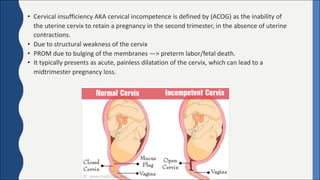
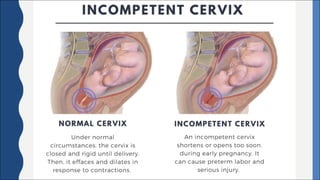
• Cervical	insufficiency	AKA	cervical	incompetence	is	defined	by	(ACOG)	as	the	inability	of	
the	uterine	cervix	to	retain	a	pregnancy	in	the	second	trimester,	in	the	absence	of	uterine	
contractions.
• Due	to	structural	weakness	of	the	cervix	
• PROM	due	to	bulging	of	the	membranes	—>	preterm	labor/fetal	death.
• It	typically	presents	as	acute,	painless	dilatation	of	the	cervix,	which	can	lead	to	a	
midtrimester	pregnancy	loss.
ETIOLOGY
• Cervical	insufficiency	may	occur	as	a	result	of	a	functional	defect	in	the	cervix,	which	
can	be	due	to	an	anatomic	abnormality	or	collagen	disorders	or	In	utero	exposure	to	
diethylstilbestrol	(DES)
• Acquired	causes	of	cervical	insufficiency	include:
• Obstetric	trauma
• Mechanical	dilation	of	the	cervix	during	gynecologic	procedures
• Cervical	conization,	which	may	be	performed	via	cold	knife,	laser,	or	loop.
SYMPTOMS
• No symptoms in the first affected pregnancy.
• The cervix dilates without any contractions
• Bulging of fetal membranes leading to PROM
• Spotting or bleeding might be there, but usually by the time the condition is detected
it is too late to stop the preterm birth.
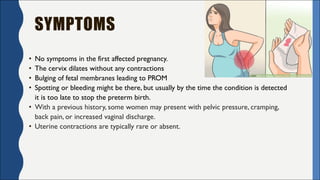
• With a previous history, some women may present with pelvic pressure, cramping,
back pain, or increased vaginal discharge.
• Uterine contractions are typically rare or absent.
DIAGNOSTIC CONSIDERATIONS
• Preterm	birth	may	result	from	numerous	causes,	including:
• Spontaneous	preterm	labor
• PROM
• Antepartum	hemorrhage
• Multiple	gestation
• Indicated	preterm	delivery	for	maternal	or	fetal	conditions	(eg,	preeclampsia,	fetal	
growth	restriction..)
• Cervical	insufficiency	is	responsible	for	only	8-9%	of	all	preterm	births,	compared	with	
40-45%	with	spontaneous	preterm	labor	and	25-30%	with	PPROM.
APPROACH CONSIDERATIONS/ WORK UP
• The	diagnosis	of	cervical	insufficiency	is	either	based	on	a	history	of	midtrimester	
pregnancy	loss	or	a	combination	of	clinical	presentation,	physical	examination,	and	
sonographic	measurement	of	cervical	length.
ULTRASONOGRAPHY
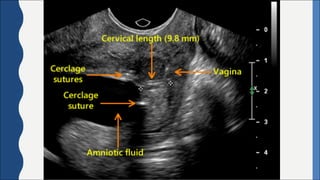
• Sonographic	measurement	of	cervical	length,	ideally	done	via	transvaginal	
ultrasonography.
• A	short	cervical	length,	which	is	typically	defined	as	less	than	25	mm,	has	been	
consistently	associated	with	an	increased	risk	for	preterm	birth.
• Cervical	effacement	appears	to	begin	at	the	internal	os	and	proceed	caudally.
• Preterm	birth	is	unlikely	to	occur	with	a	cervical	length	of	greater	than	30	mm.
• In	asymptomatic	women	with	a	prior	preterm	birth,	serial	transvaginal	cervical	length	
screening	is	typically	performed	starting	at	16	weeks’	gestation	and	is	repeated	every	
2	weeks	until	26-28	weeks’	gestation.
• For	women	without	a	history	of	preterm	delivery,	(ACOG)	recommends	
transabdominal	cervical	length	assessment	(between	18	and	22	weeks’	gestation),	
followed	by	transvaginal	measurement	if	a	short	cervical	length	is	suspected.
FETAL FIBRONECTIN TESTING
• Fetal	fibronectin	(fFN)	is	a	large	fetal	glycoprotein	that	promotes	cellular	adhesion	at	
uterine-placental	and	decidual-fetal	membrane	interfaces.
• Released	into	cervicovaginal	secretions	leading	to	its	use	as	a	predictor	of	preterm	
delivery.
• Its	use	is	limited	to	women	with	a	gestational	age	between	22	and	34	weeks,	as	long	
as	fetal	membranes	are	intact	and	cervical	dilatation	is	less	than	3	cm.	Sample	
collection	is	performed	by	placing	a	swab	in	the	posterior	vaginal	fornix.
• The	prediction	of	preterm	delivery	is	significant	in	women	with	a	positive	fFN	and	a	
cervical	length	less	than	30	mm.
TREATMENT
Cervical	Cerclage:
• Placement of a stitch in an attempt to improve the tensile strength of the cervix.
• A cerclage can be placed from a transvaginal or transabdominal approach, with the
primary objective of reinforcing the cervix at the level of the internal os and, thus,
increasing the functional length of the cervix.
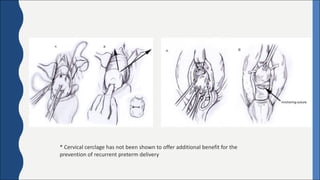
1. McDonald cerclage: Of the most commonly performed transvaginal techniques, is
a purse-string suture that passes through the cervical stroma.
2. Shirodkar cerclage: requires dissection of the bladder anteriorly and the rectum
posteriorly in order to place the stitch at the level of the internal os.
3. Transabdominal cerclage is typically reserved for patients with anatomic
limitations or those with a history of failure of a transvaginal cerclage.
*	Cervical	cerclage	has	not	been	shown	to	offer	additional	benefit	for	the	
prevention	of	recurrent	preterm	delivery
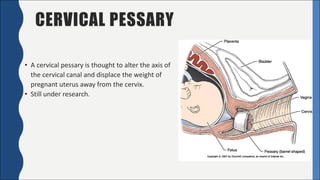
CERVICAL PESSARY
• A	cervical	pessary	is	thought	to	alter	the	axis	of	
the	cervical	canal	and	displace	the	weight	of	
pregnant	uterus	away	from	the	cervix.
• Still	under	research.
PROGESTERONE SUPPLEMENTATION
• ACOG	recommends	that	women	with	a	prior	spontaneous	preterm	birth	should	be	
offered	progesterone	supplementation	starting	at	16-24	weeks’	gestation	and	
continuing	up	to	36	weeks’	gestation,	in	order	to	reduce	the	risk	of	recurrent	preterm	
birth.
REFERENCES
• Uptodate
• ACOG

Cervical Incompetence (insufficiency)