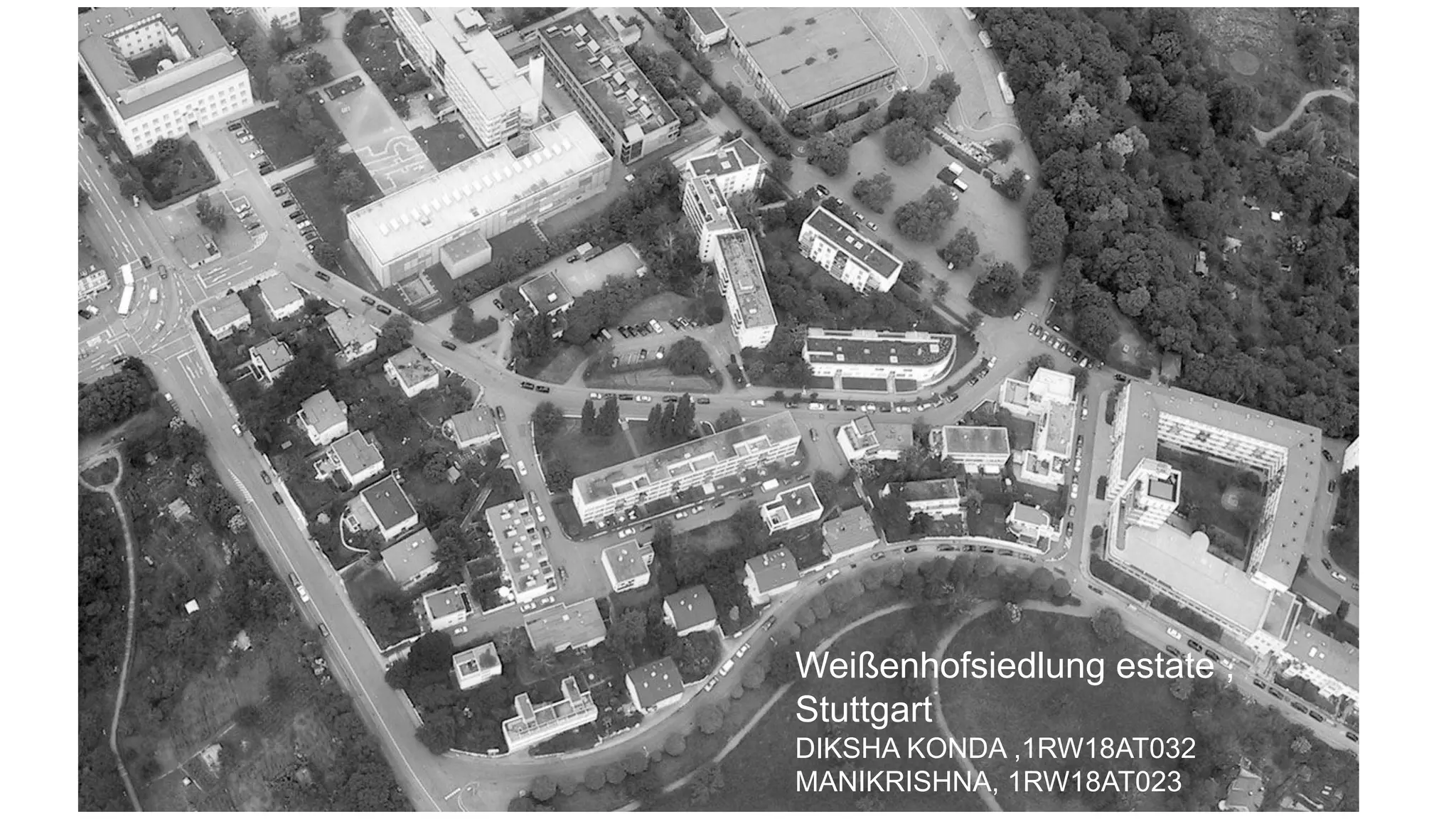

Weißenhofsiedlung estate ,
Stuttgart
DIKSHA KONDA ,1RW18AT032
MANIKRISHNA, 1RW18AT023
Exhibition staged by German Work Federation
Experimental housing
Building land and financing were made available by the City of Stuttgart
Construction - 1927
Construction duration - 21 weeks
Architectural style - Modernist
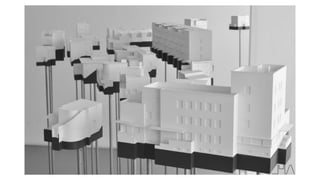
The Weissenhofsiedlung settlement is one of the most significant landmarks of
modern architecture: It was built in 1927 as a building exhibition staged by
German Work Federation. Under the artistic direction of Ludwig Mies van der
Rohe, 17 architects from Germany, Holland, Austria and Switzerland created what
was considered an exemplary model for modern urban living.
INTRODUCTION
Location - Stuttgart , Baden-Wurttemberg , Germany.
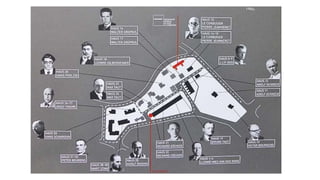
Architects - Mies van der Rohe, Le Corbusier, Gropius, Hilberseimer, Scharoun,
Max and Bruno Taut, Poelzig, Behrens, Oud, Stamm, Döcker and others.
Area - 12,540 sq ft
Buffer zone - 3,618,970 sq ft
Buildings - 21 buildings comprising a total of 63 apartments
The second international exhibition of the Deutscher Werkbund in 1927 was
designed to introduce modern housing solutions for the different social classes of
a typical city. The exhibition’s organisation, headed by architect Mies Van der
Rohe, had proposed the construction of a model housing estate in the hills of
Stuttgart.
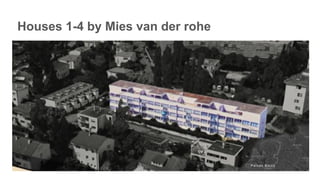
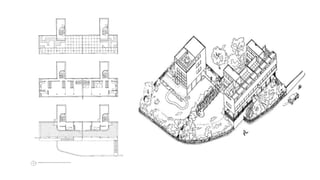
Houses 1-4 by Mies van der rohe
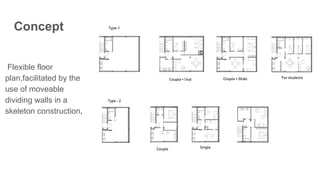
Concept
Flexible floor
plan,facilitated by the
use of moveable
dividing walls in a
skeleton construction.
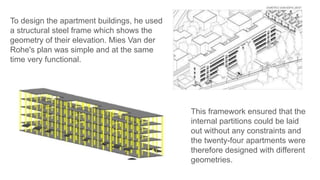
This framework ensured that the
internal partitions could be laid
out without any constraints and
the twenty-four apartments were
therefore designed with different
geometries.
To design the apartment buildings, he used
a structural steel frame which shows the
geometry of their elevation. Mies Van der
Rohe's plan was simple and at the same
time very functional.
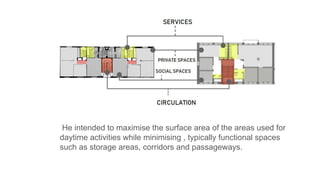
He intended to maximise the surface area of the areas used for
daytime activities while minimising , typically functional spaces
such as storage areas, corridors and passageways.
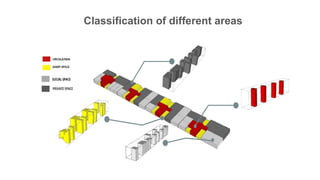
Classification of different areas
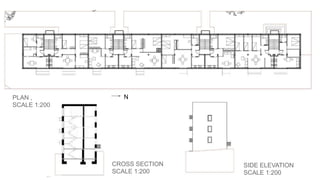
NPLAN ,
SCALE 1:200
CROSS SECTION
SCALE 1:200
SIDE ELEVATION
SCALE 1:200
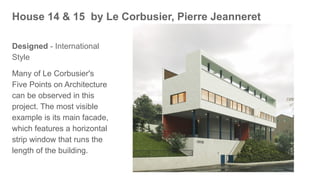
House 14 & 15 by Le Corbusier, Pierre Jeanneret
Designed - International
Style
Many of Le Corbusier's
Five Points on Architecture
can be observed in this
project. The most visible
example is its main facade,
which features a horizontal
strip window that runs the
length of the building.
Concept
T
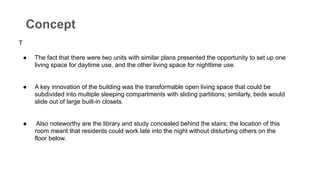
● The fact that there were two units with similar plans presented the opportunity to set up one
living space for daytime use, and the other living space for nighttime use.
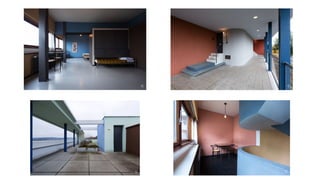
● A key innovation of the building was the transformable open living space that could be
subdivided into multiple sleeping compartments with sliding partitions; similarly, beds would
slide out of large built-in closets.
● Also noteworthy are the library and study concealed behind the stairs; the location of this
room meant that residents could work late into the night without disturbing others on the
floor below.
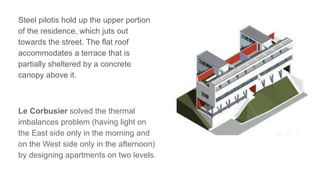
Steel pilotis hold up the upper portion
of the residence, which juts out
towards the street. The flat roof
accommodates a terrace that is
partially sheltered by a concrete
canopy above it.
Le Corbusier solved the thermal
imbalances problem (having light on
the East side only in the morning and
on the West side only in the afternoon)
by designing apartments on two levels.
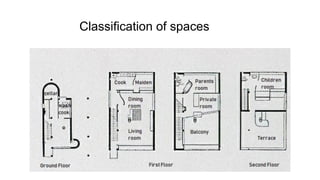
Classification of spaces
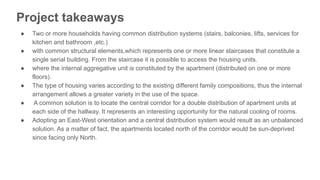
Project takeaways
● Two or more households having common distribution systems (stairs, balconies, lifts, services for
kitchen and bathroom ,etc.)
● with common structural elements,which represents one or more linear staircases that constitute a
single serial building. From the staircase it is possible to access the housing units.
● where the internal aggregative unit is constituted by the apartment (distributed on one or more
floors).
● The type of housing varies according to the existing different family compositions, thus the internal
arrangement allows a greater variety in the use of the space.
● A common solution is to locate the central corridor for a double distribution of apartment units at
each side of the hallway. It represents an interesting opportunity for the natural cooling of rooms.
● Adopting an East-West orientation and a central distribution system would result as an unbalanced
solution. As a matter of fact, the apartments located north of the corridor would be sun-deprived
since facing only North.
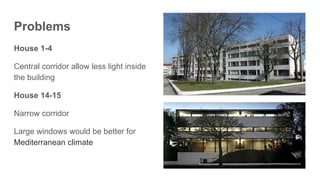
Problems
House 1-4
Central corridor allow less light inside
the building
House 14-15
Narrow corridor
Large windows would be better for
Mediterranean climate
Bibliography
https://www.bauhaus100.com/the-bauhaus/works/architecture/weissenhof-estate-stuttgart/
https://www.stuttgart.de/en/item/show/335721/1
http://biblus.accasoftware.com/en/row-houses-architectural-projects-ready-for-download/
https://www.platformarchitecture.it/le-corbusier-and-the-weissenhof-houses/
https://www.mailab.biz/weissenhof/
https://www.archdaily.com/490048/ad-classics-weissenhof-siedlung-houses-14-and-15-le-corbusier-and-pierre-jeanneret
https://www.dezeen.com/2016/07/30/le-corbusier-weissenhof-estate-stuttgart-modernist-housing-unesco-world-heritage-list/
https://www.slideshare.net/GabrielBuda11/mies-van-der-rohe-weissenhof-murrone-vidal?from_action=save
Book :- Die wohnung Juli - okt stuttgart 1927
Weissenhofsiedlung estate ,case study

Weissenhofsiedlung estate ,case study

  • 1.
    Weißenhofsiedlung estate , Stuttgart DIKSHAKONDA ,1RW18AT032 MANIKRISHNA, 1RW18AT023
  • 2.
    Exhibition staged byGerman Work Federation Experimental housing Building land and financing were made available by the City of Stuttgart Construction - 1927 Construction duration - 21 weeks Architectural style - Modernist The Weissenhofsiedlung settlement is one of the most significant landmarks of modern architecture: It was built in 1927 as a building exhibition staged by German Work Federation. Under the artistic direction of Ludwig Mies van der Rohe, 17 architects from Germany, Holland, Austria and Switzerland created what was considered an exemplary model for modern urban living.
  • 4.
    INTRODUCTION Location - Stuttgart, Baden-Wurttemberg , Germany. Architects - Mies van der Rohe, Le Corbusier, Gropius, Hilberseimer, Scharoun, Max and Bruno Taut, Poelzig, Behrens, Oud, Stamm, Döcker and others. Area - 12,540 sq ft Buffer zone - 3,618,970 sq ft Buildings - 21 buildings comprising a total of 63 apartments The second international exhibition of the Deutscher Werkbund in 1927 was designed to introduce modern housing solutions for the different social classes of a typical city. The exhibition’s organisation, headed by architect Mies Van der Rohe, had proposed the construction of a model housing estate in the hills of Stuttgart.
  • 6.
    Houses 1-4 byMies van der rohe
  • 7.
    Concept Flexible floor plan,facilitated bythe use of moveable dividing walls in a skeleton construction.
  • 8.
    This framework ensuredthat the internal partitions could be laid out without any constraints and the twenty-four apartments were therefore designed with different geometries. To design the apartment buildings, he used a structural steel frame which shows the geometry of their elevation. Mies Van der Rohe's plan was simple and at the same time very functional.
  • 9.
    He intended tomaximise the surface area of the areas used for daytime activities while minimising , typically functional spaces such as storage areas, corridors and passageways.
  • 10.
  • 11.
    NPLAN , SCALE 1:200 CROSSSECTION SCALE 1:200 SIDE ELEVATION SCALE 1:200
  • 12.
    House 14 &15 by Le Corbusier, Pierre Jeanneret Designed - International Style Many of Le Corbusier's Five Points on Architecture can be observed in this project. The most visible example is its main facade, which features a horizontal strip window that runs the length of the building.
  • 13.
    Concept T ● The factthat there were two units with similar plans presented the opportunity to set up one living space for daytime use, and the other living space for nighttime use. ● A key innovation of the building was the transformable open living space that could be subdivided into multiple sleeping compartments with sliding partitions; similarly, beds would slide out of large built-in closets. ● Also noteworthy are the library and study concealed behind the stairs; the location of this room meant that residents could work late into the night without disturbing others on the floor below.
  • 14.
    Steel pilotis holdup the upper portion of the residence, which juts out towards the street. The flat roof accommodates a terrace that is partially sheltered by a concrete canopy above it. Le Corbusier solved the thermal imbalances problem (having light on the East side only in the morning and on the West side only in the afternoon) by designing apartments on two levels.
  • 15.
  • 18.
    Project takeaways ● Twoor more households having common distribution systems (stairs, balconies, lifts, services for kitchen and bathroom ,etc.) ● with common structural elements,which represents one or more linear staircases that constitute a single serial building. From the staircase it is possible to access the housing units. ● where the internal aggregative unit is constituted by the apartment (distributed on one or more floors). ● The type of housing varies according to the existing different family compositions, thus the internal arrangement allows a greater variety in the use of the space. ● A common solution is to locate the central corridor for a double distribution of apartment units at each side of the hallway. It represents an interesting opportunity for the natural cooling of rooms. ● Adopting an East-West orientation and a central distribution system would result as an unbalanced solution. As a matter of fact, the apartments located north of the corridor would be sun-deprived since facing only North.
  • 19.
    Problems House 1-4 Central corridorallow less light inside the building House 14-15 Narrow corridor Large windows would be better for Mediterranean climate
  • 20.