














Information Design:
Semiotics and
the Use of Metaphors
by Itamar Medeiros
Use of Metaphors
    Learning Objectives
     You will learn how to use metaphors to enable
        users to better grasp the details of the conceptual
        models you create;

    Outline
     Introduction
     Metaphors and Conceptual Models
     Metaphors and Imagery
     Semiotics Theory
     Use of Metaphors: Exercise
     Relate
     Donate

  { UX Workshops: Use of Metaphors }
    You are at: Introduction » Learning Objectives and Outline
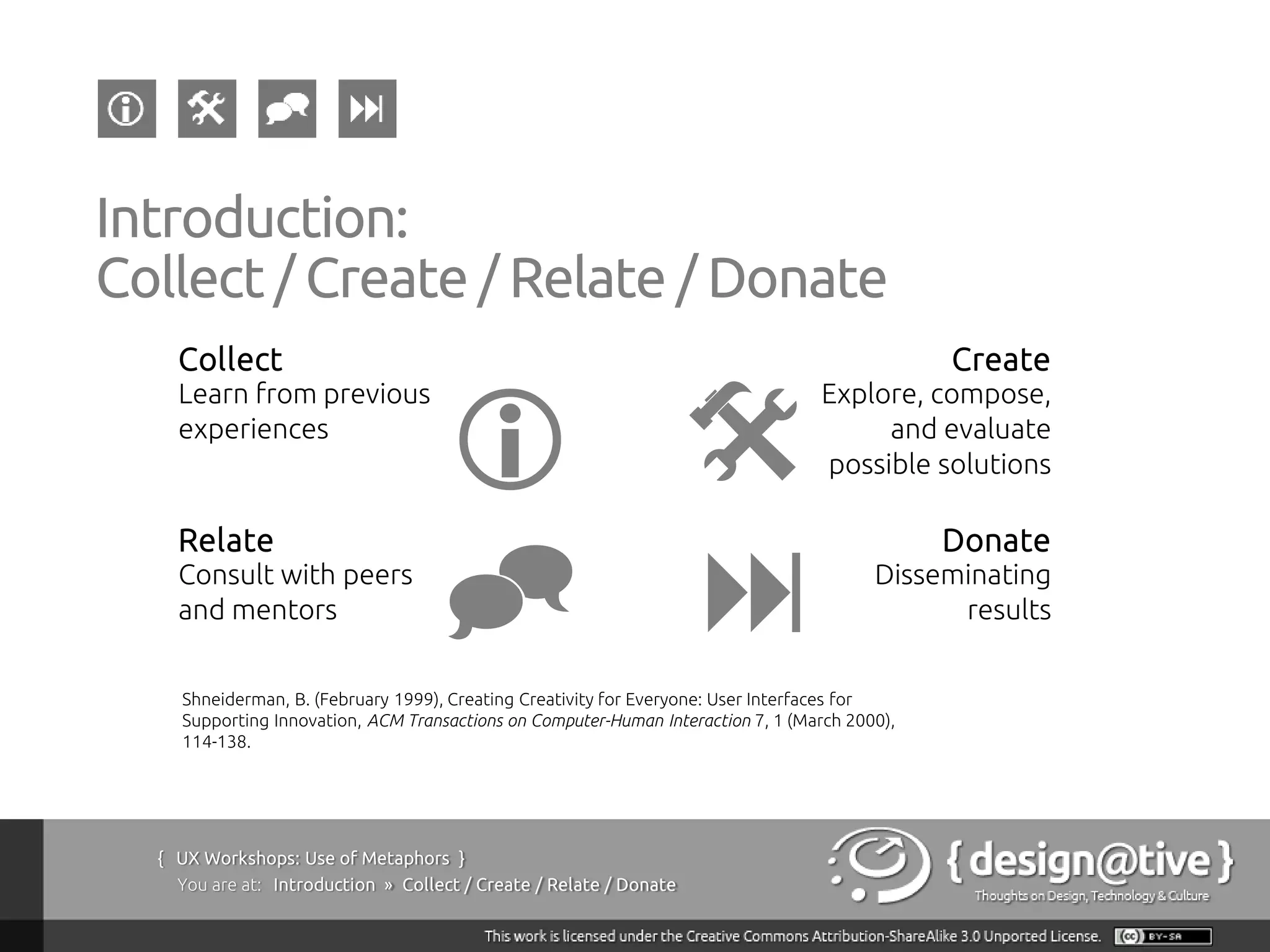
Introduction:
Collect / Create / Relate / Donate
    Collect                                                                                    Create


                                    i @
    Learn from previous                                                           Explore, compose,
    experiences                                                                        and evaluate
                                                                                  possible solutions

    Relate                                                                                     Donate
    Consult with peers
    and mentors
                                    ^ :                                                  Disseminating
                                                                                               results


    Shneiderman, B. (February 1999), Creating Creativity for Everyone: User Interfaces for
    Supporting Innovation, ACM Transactions on Computer-Human Interaction 7, 1 (March 2000),
    114-138.


  { UX Workshops: Use of Metaphors }
    You are at: Introduction » Collect / Create / Relate / Donate
Use of Metaphors:
First Principles of Interaction Design
    The following principles are fundamental to the
    design and implementation of effective interfaces,
    whether for traditional GUI environments or the web:


    Tognazzini, B. (2003), First Principles of Interaction Design, Ask Tog,
    retrieved August 31st, 2011 from http://www.asktog.com/basics/firstPrinciples.html


  { UX Workshops: Use of Metaphors }
    You are at: Collect » First Principles of Interaction Design
Use of Metaphors:
First Principles of Interaction Design
    Anticipation                                   Latency Reduction
    Autonomy                                       Learnability
    Color Blindness                                Metaphors, Use of
    Consistency                                    Protect Users' Work
    Defaults                                       Readability
    Efficiency of the User                         Track State
    Explorable Interfaces                          Visible Navigation
    Fitts' Law
    Human Interface Objects
    Tognazzini, B. (2003), First Principles of Interaction Design, Ask Tog,
    retrieved August 31st, 2011 from http://www.asktog.com/basics/firstPrinciples.html


  { UX Workshops: Use of Metaphors }
    You are at: Collect » First Principles of Interaction Design
Use of Metaphors:
First Principles of Interaction Design
    Anticipation                                   Latency Reduction
    Autonomy                                       Learnability
    Color Blindness                                Metaphors, Use of
    Consistency                                    Protect Users' Work
    Defaults                                       Readability
    Efficiency of the User                         Track State
    Explorable Interfaces                          Visible Navigation
    Fitts' Law
    Human Interface Objects
    Tognazzini, B. (2003), First Principles of Interaction Design, Ask Tog,
    retrieved August 31st, 2011 from http://www.asktog.com/basics/firstPrinciples.html


  { UX Workshops: Use of Metaphors }
    You are at: Collect » First Principles of Interaction Design
Use of Metaphors

    If chosen well, metaphors that will enable users to
    instantly grasp the finest details of the conceptual
    model of a product/system/site.


    Tognazzini, B. (2003), First Principles of Interaction Design, Ask Tog,
    retrieved August 31st, 2011 from http://www.asktog.com/basics/firstPrinciples.html


  { UX Workshops: Use of Metaphors }
    You are at: Collect » Use of Metaphors
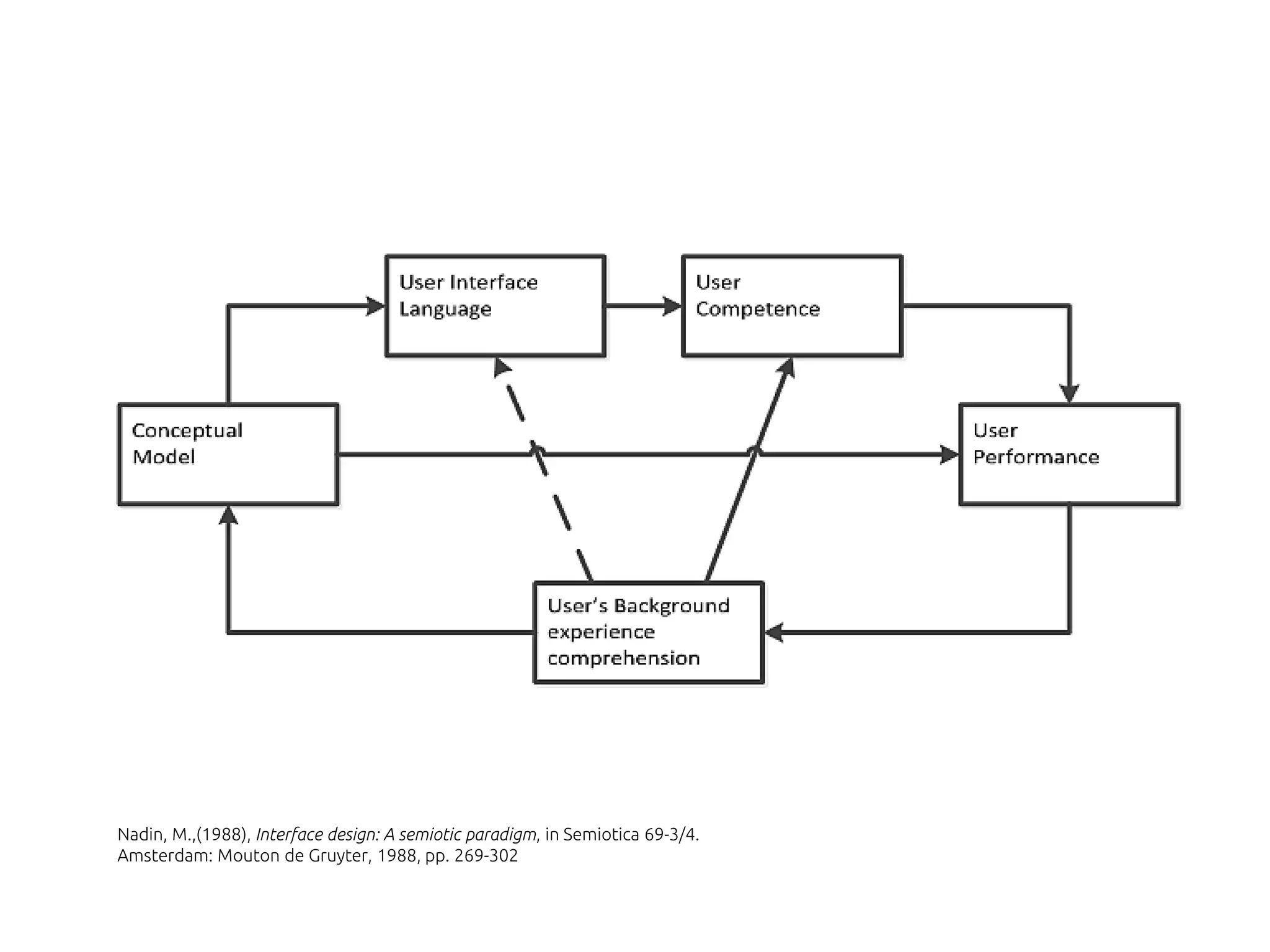
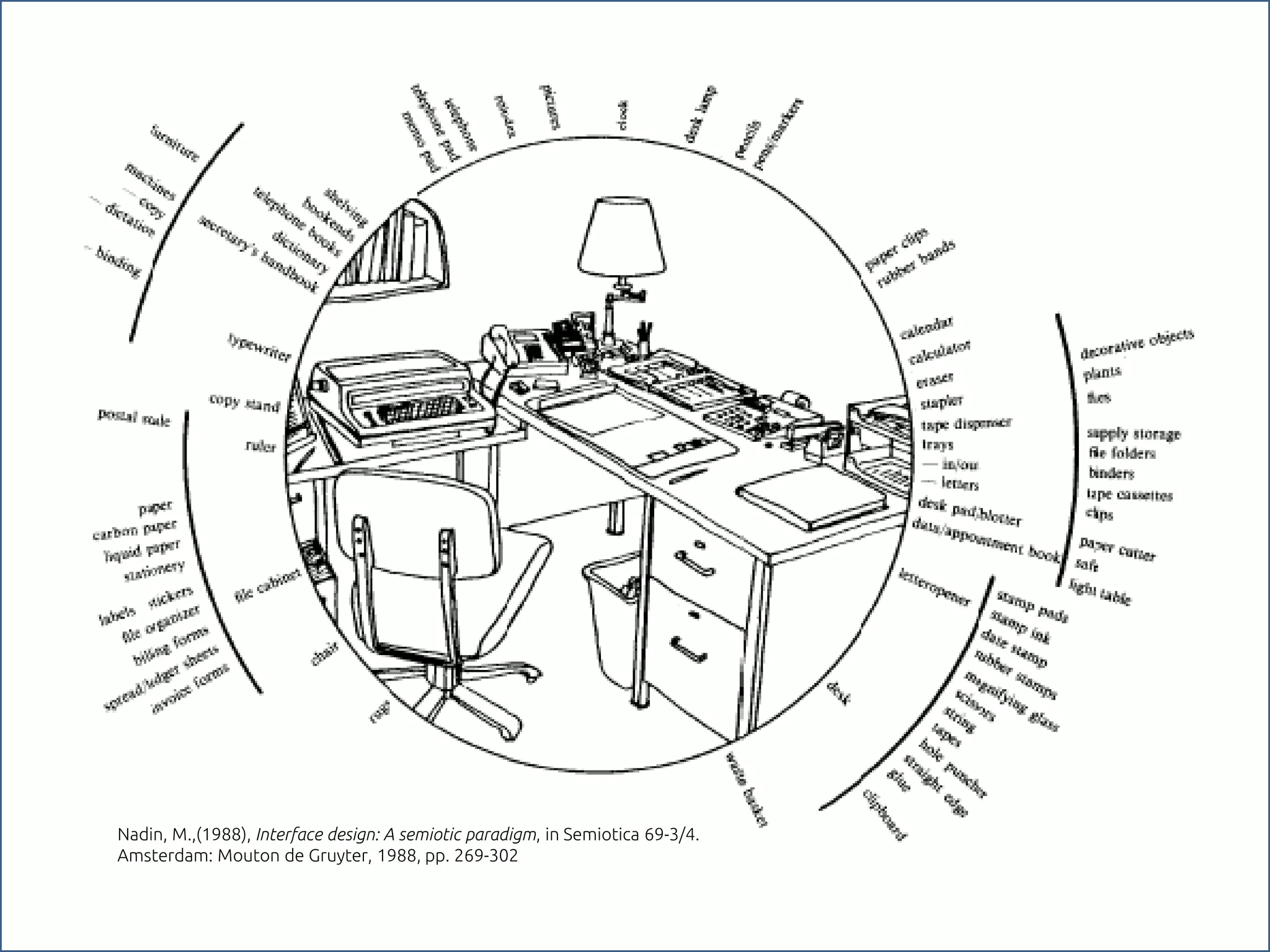
Conceptual Models

    A construct of a system created by designers to
    represent users’ mental model, based on qualitative
    assumptions about its elements, their
    interrelationships, and system boundaries .


    Wikipedia (2011), Conceptual model, retrieved August 31st, 2011 from
    http://en.wikipedia.org/wiki/Conceptual_model


  { UX Workshops: Use of Metaphors }
    You are at: Collect » Conceptual Models
Nadin, M.,(1988), Interface design: A semiotic paradigm, in Semiotica 69-3/4.
Amsterdam: Mouton de Gruyter, 1988, pp. 269-302
Use of Metaphors

    Good metaphors are stories, creating visible pictures
    in the mind.


    Tognazzini, B. (2003), First Principles of Interaction Design, Ask Tog,
    retrieved August 31st, 2011 from http://www.asktog.com/basics/firstPrinciples.html


  { UX Workshops: Use of Metaphors }
    You are at: Collect » Use of Metaphors
Use of Metaphors

    Bring metaphors alive by appealing to people’s
    perceptions–sight, sound, touch, and kinesthesia–as
    well as triggering their memories.


    Tognazzini, B. (2003), First Principles of Interaction Design, Ask Tog,
    retrieved August 31st, 2011 from http://www.asktog.com/basics/firstPrinciples.html


  { UX Workshops: Use of Metaphors }
    You are at: Collect » Use of Metaphors
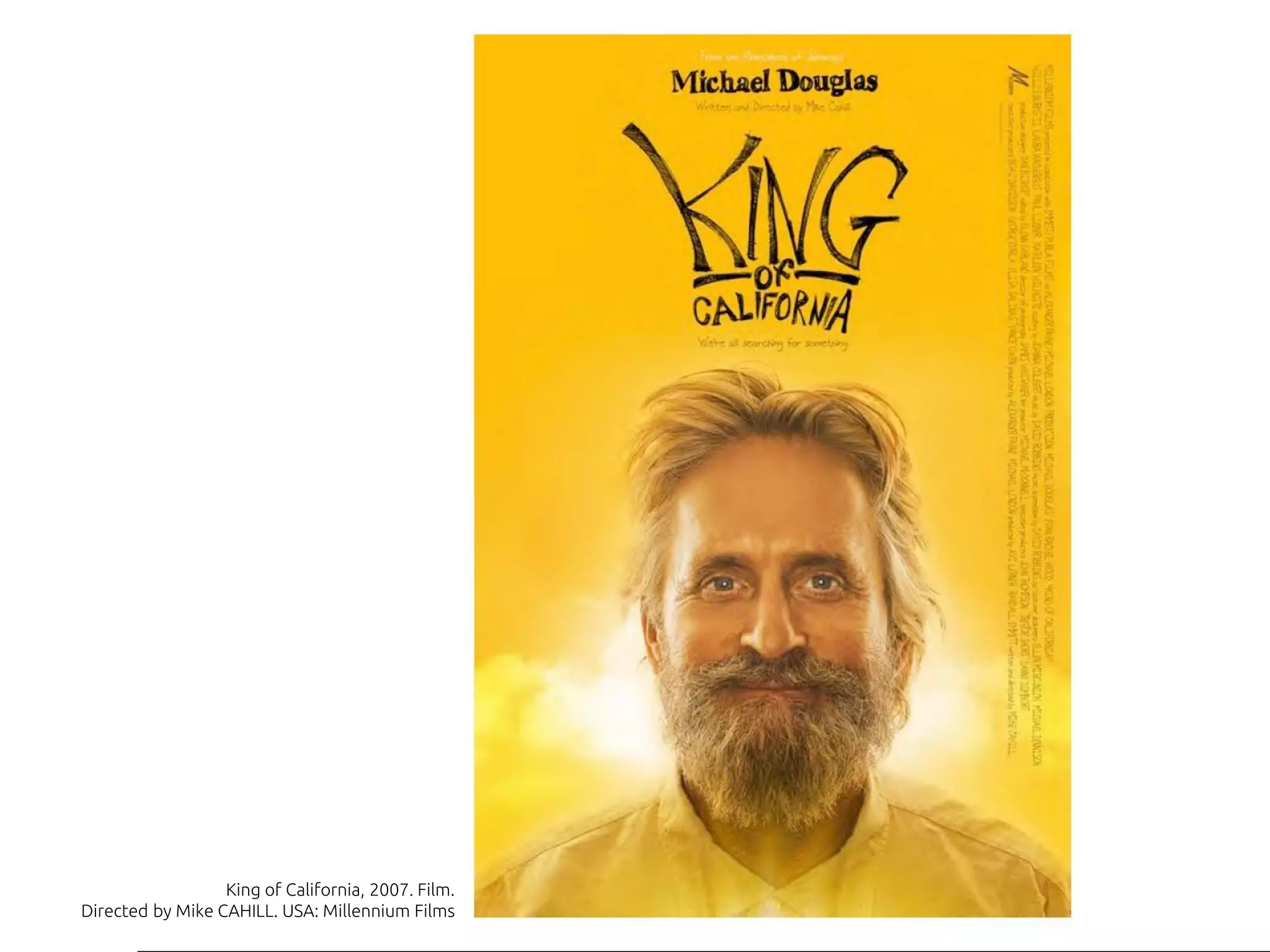
King of California, 2007. Film.
Directed by Mike CAHILL. USA: Millennium Films
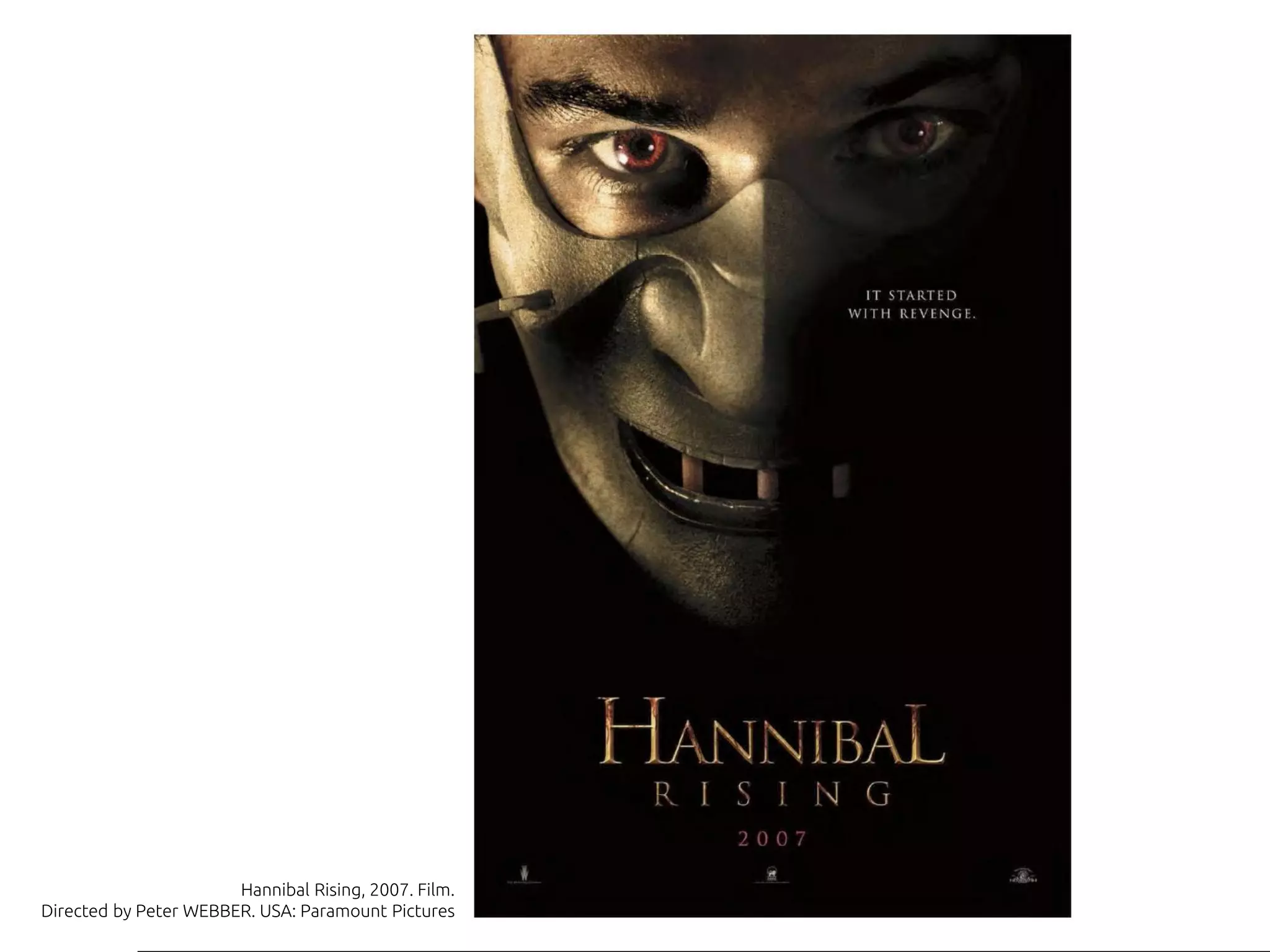
Hannibal Rising, 2007. Film.
Directed by Peter WEBBER. USA: Paramount Pictures
Use of Metaphors:
Imagery
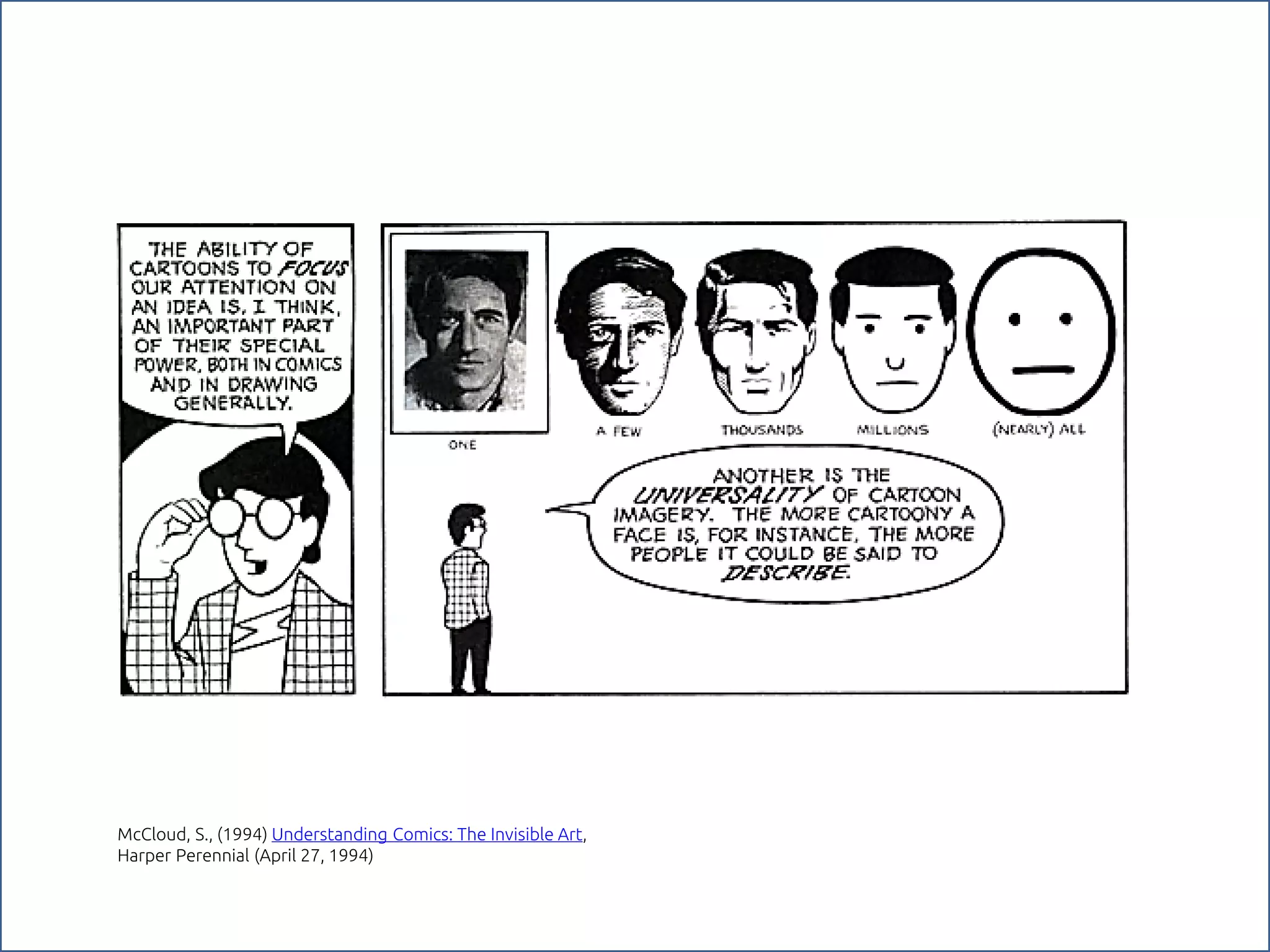
    Pictorial representation will cross social and linguistic
    boundaries with ease when the objects being
    represented are relatively across cultures


  { UX Workshops: Use of Metaphors }
    You are at: Collect » Use of Metaphors: Imagery
Use of Metaphors:
Imagery
    Understanding what an image represents (as opposed
    to what it depicts) is a prerequisite for
    reading/creating visual messages.


  { UX Workshops: Use of Metaphors }
    You are at: Collect » Use of Metaphors: Imagery
Semiotics

    The study of signs and sign processes (semiosis),
    indication, designation, likeness, analogy, metaphor,
    symbolism, signification, and communication.


    Wikipedia (2011), Semiotics, retrieved August 31st, 2011 from
    http://en.wikipedia.org/wiki/Semiotics


  { UX Workshops: Use of Metaphors }
    You are at: Collect » Semiotics
the question is:


What is a sign?
Signs

    Defined by Charles S. Peirce as something that
    stands for someone or something in some respect
    or capacity.


    Wikipedia (2011), Sign (semiotics), retrieved August 31st, 2011 from
    http://en.wikipedia.org/wiki/Sign_(semiotics)


  { UX Workshops: Use of Metaphors }
    You are at: Collect » Signs
Signs

    Understanding how signs are formed, transmitted
    and interpreted can help the designer to analyze a
    communication problem.


    Wikipedia (2011), Sign (semiotics), retrieved August 31st, 2011 from
    http://en.wikipedia.org/wiki/Sign_(semiotics)


  { UX Workshops: Use of Metaphors }
    You are at: Collect » Signs
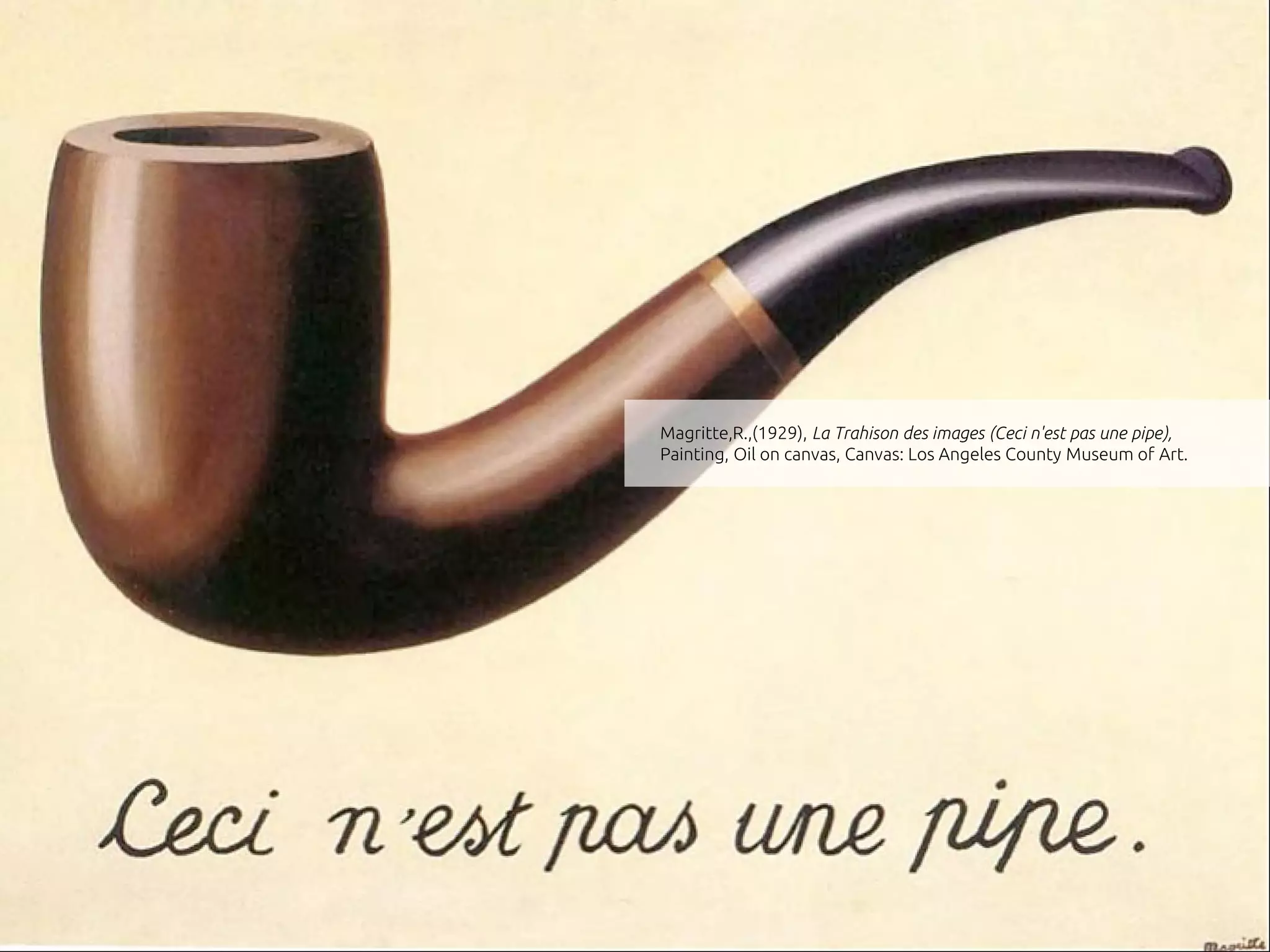
Magritte,R.,(1929), La Trahison des images (Ceci n'est pas une pipe),
Painting, Oil on canvas, Canvas: Los Angeles County Museum of Art.
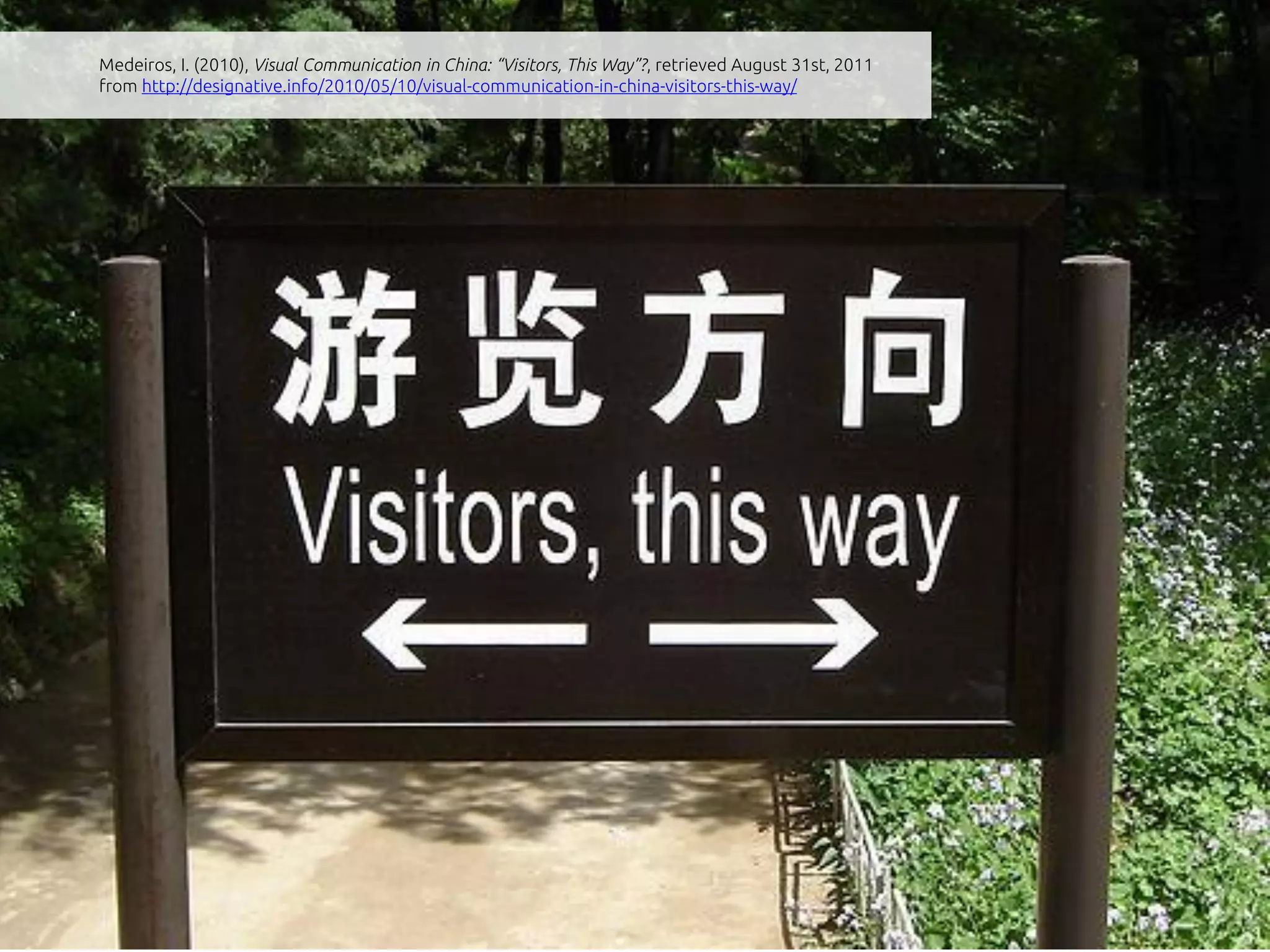
Medeiros, I. (2010), Visual Communication in China: “Visitors, This Way”?, retrieved August 31st, 2011
from http://designative.info/2010/05/10/visual-communication-in-china-visitors-this-way/
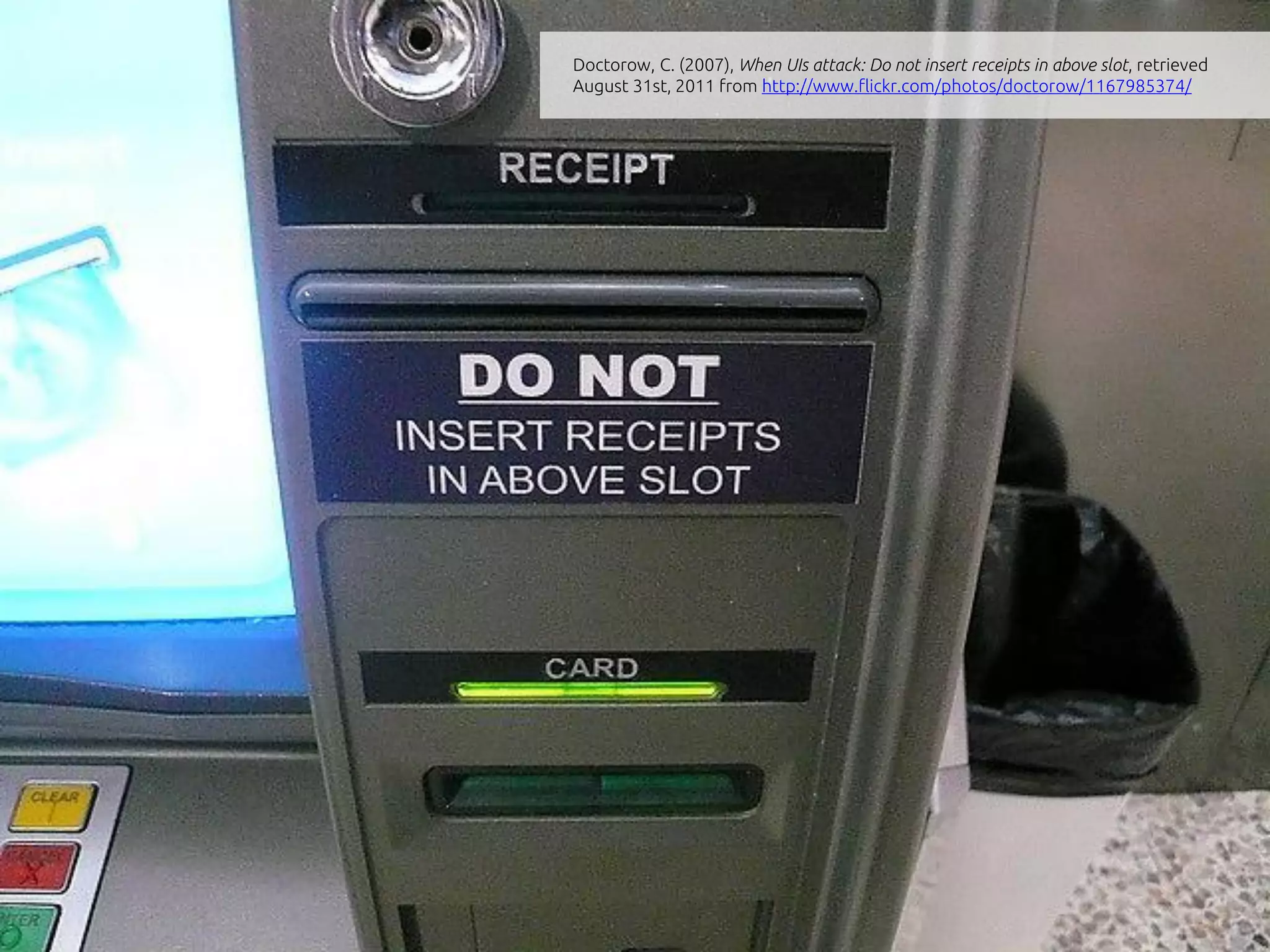
Doctorow, C. (2007), When UIs attack: Do not insert receipts in above slot, retrieved
August 31st, 2011 from http://www.flickr.com/photos/doctorow/1167985374/
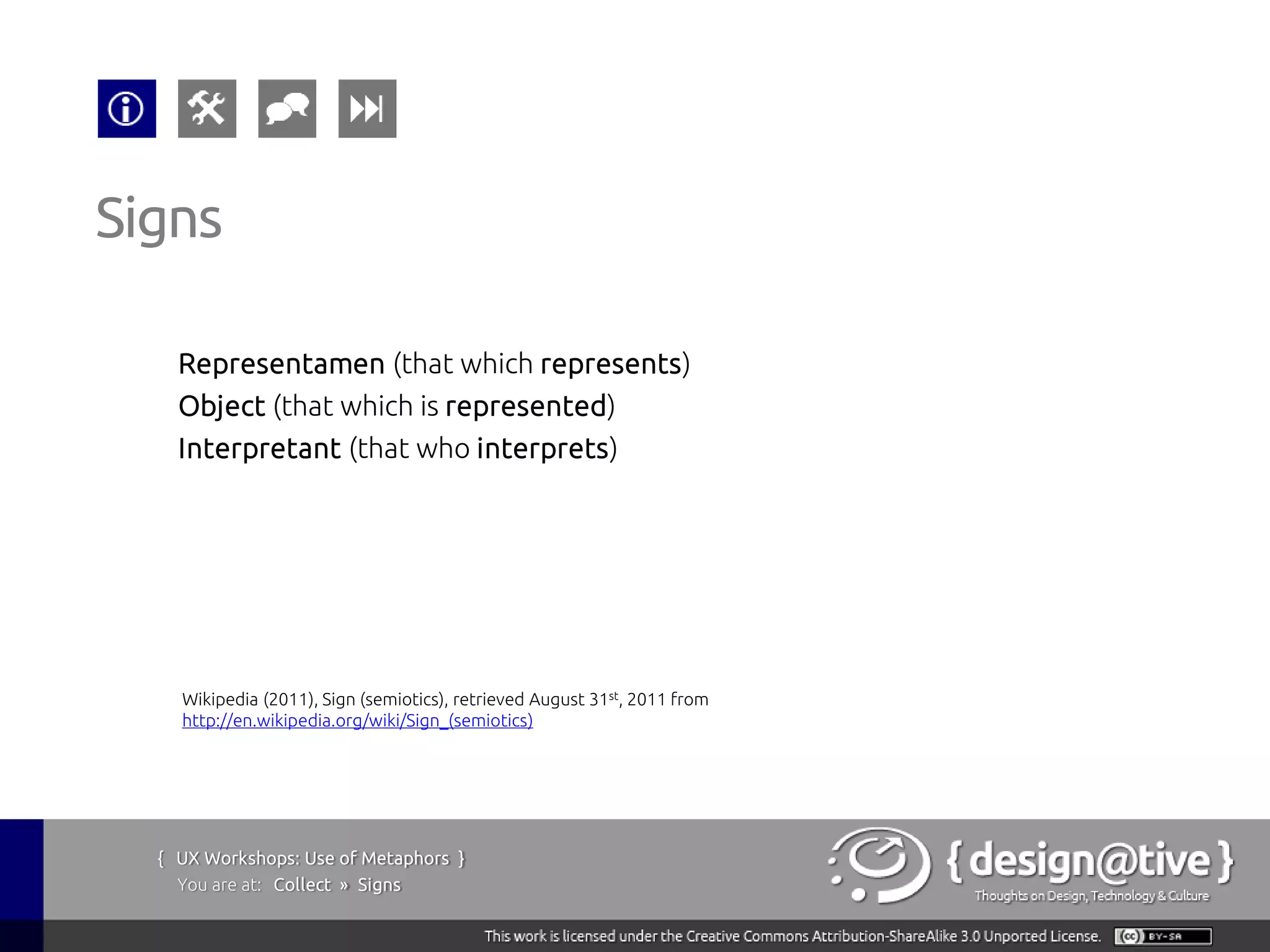
Signs

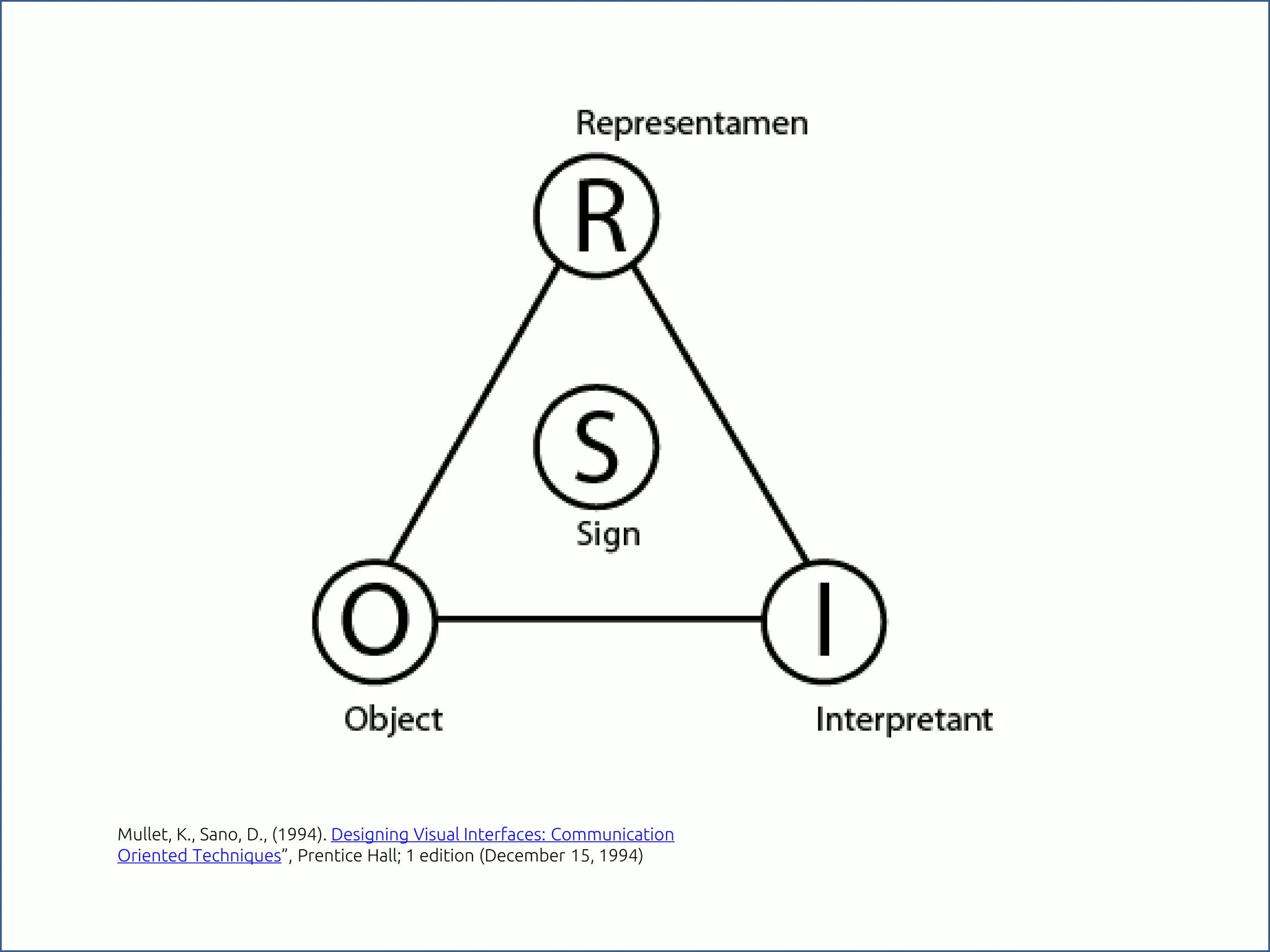
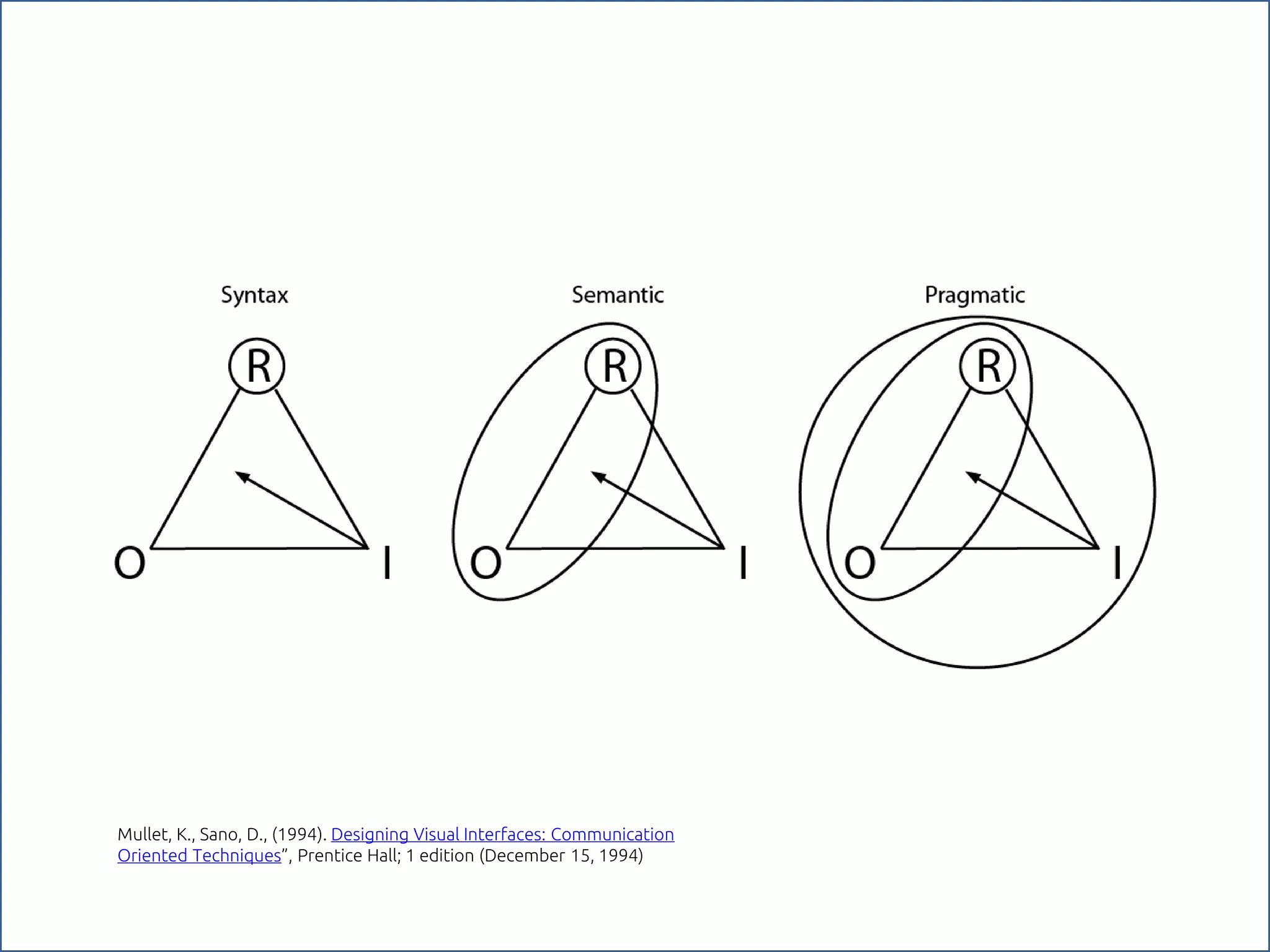
    Representamen (that which represents)
    Object (that which is represented)
    Interpretant (that who interprets)


    Wikipedia (2011), Sign (semiotics), retrieved August 31st, 2011 from
    http://en.wikipedia.org/wiki/Sign_(semiotics)


  { UX Workshops: Use of Metaphors }
    You are at: Collect » Signs
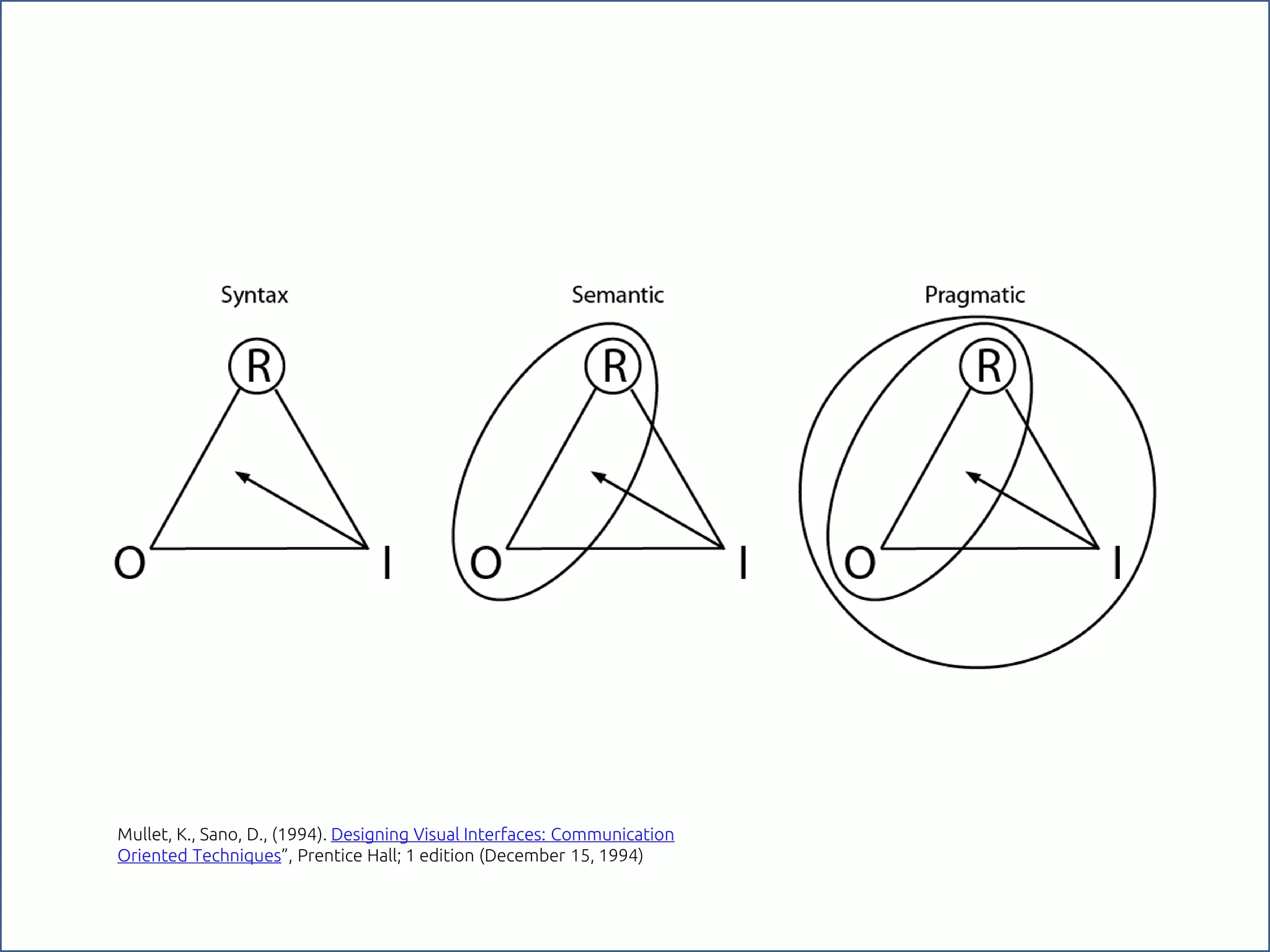
Mullet, K., Sano, D., (1994). Designing Visual Interfaces: Communication
Oriented Techniques”, Prentice Hall; 1 edition (December 15, 1994)
Signs:
Relate
    Close your eyes for a moment and think about the
    first image that comes to your mind when you hear
    the word:

    Automobile


  { UX Workshops: Use of Metaphors }
    You are at: Relate » Signs
Signs:
Relate
    What attributes would you use to describe the
    automobile you just imagined?


    Luxurious?
    Sexy?
    Comfortable?


  { UX Workshops: Use of Metaphors }
    You are at: Relate » Signs
Wikipedia (2011), Chery QQ,, retrieved August 31st, 2011 from
http://en.wikipedia.org/wiki/Chery_QQ
BMW of North America, LCC. (2008), Mini Cooper, retrieved
August 31st, 2011 from http://www.miniusa.com/#/MINIUSA.COM-m
Levels of Signs

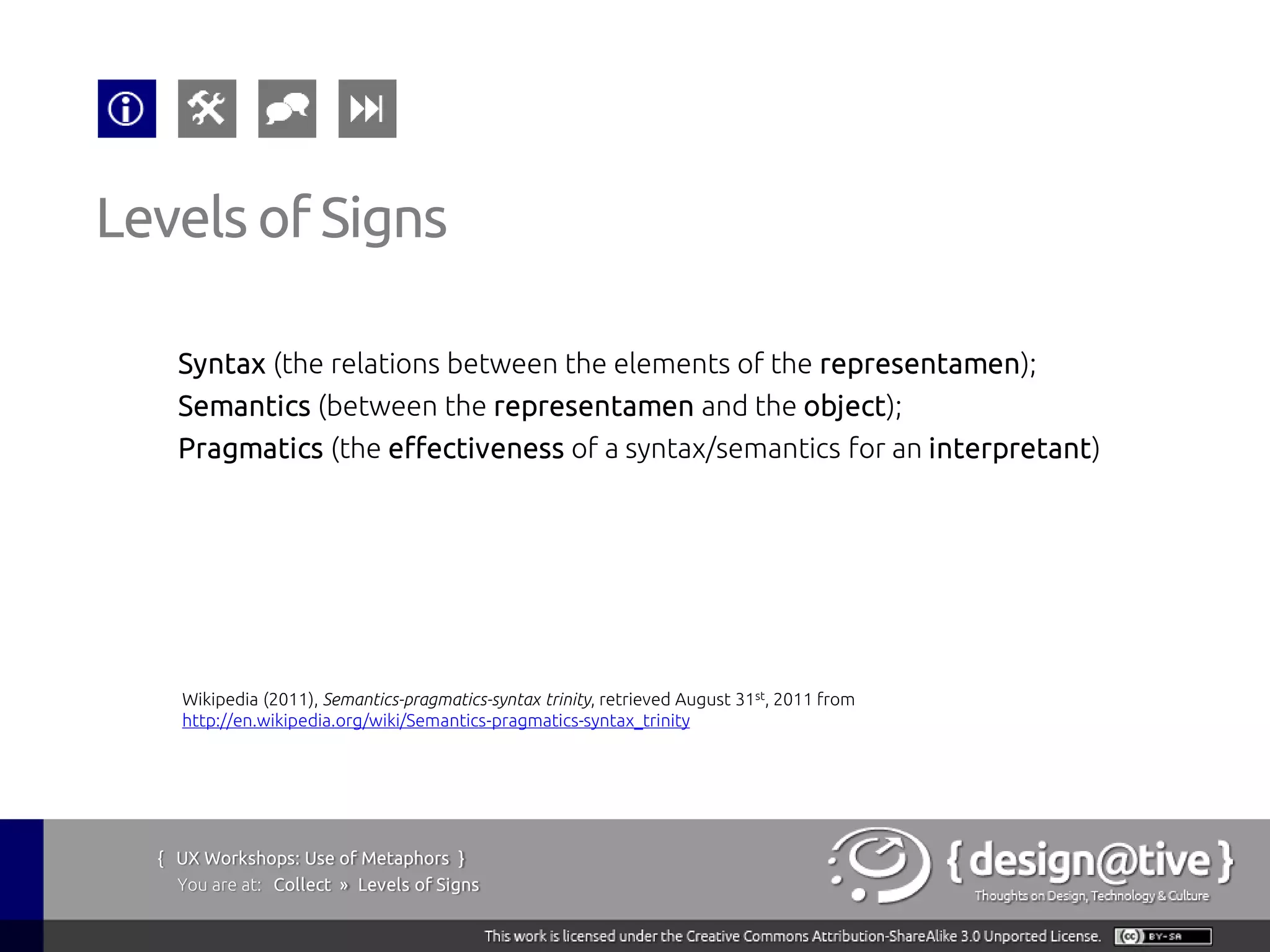
    Syntax (the relations between the elements of the representamen);
    Semantics (between the representamen and the object);
    Pragmatics (the effectiveness of a syntax/semantics for an interpretant)


    Wikipedia (2011), Semantics-pragmatics-syntax trinity, retrieved August 31st, 2011 from
    http://en.wikipedia.org/wiki/Semantics-pragmatics-syntax_trinity


  { UX Workshops: Use of Metaphors }
    You are at: Collect » Levels of Signs
Mullet, K., Sano, D., (1994). Designing Visual Interfaces: Communication
Oriented Techniques”, Prentice Hall; 1 edition (December 15, 1994)
Mullet, K., Sano, D., (1994). Designing Visual Interfaces: Communication
Oriented Techniques”, Prentice Hall; 1 edition (December 15, 1994)
Levels of Signs:
Syntax
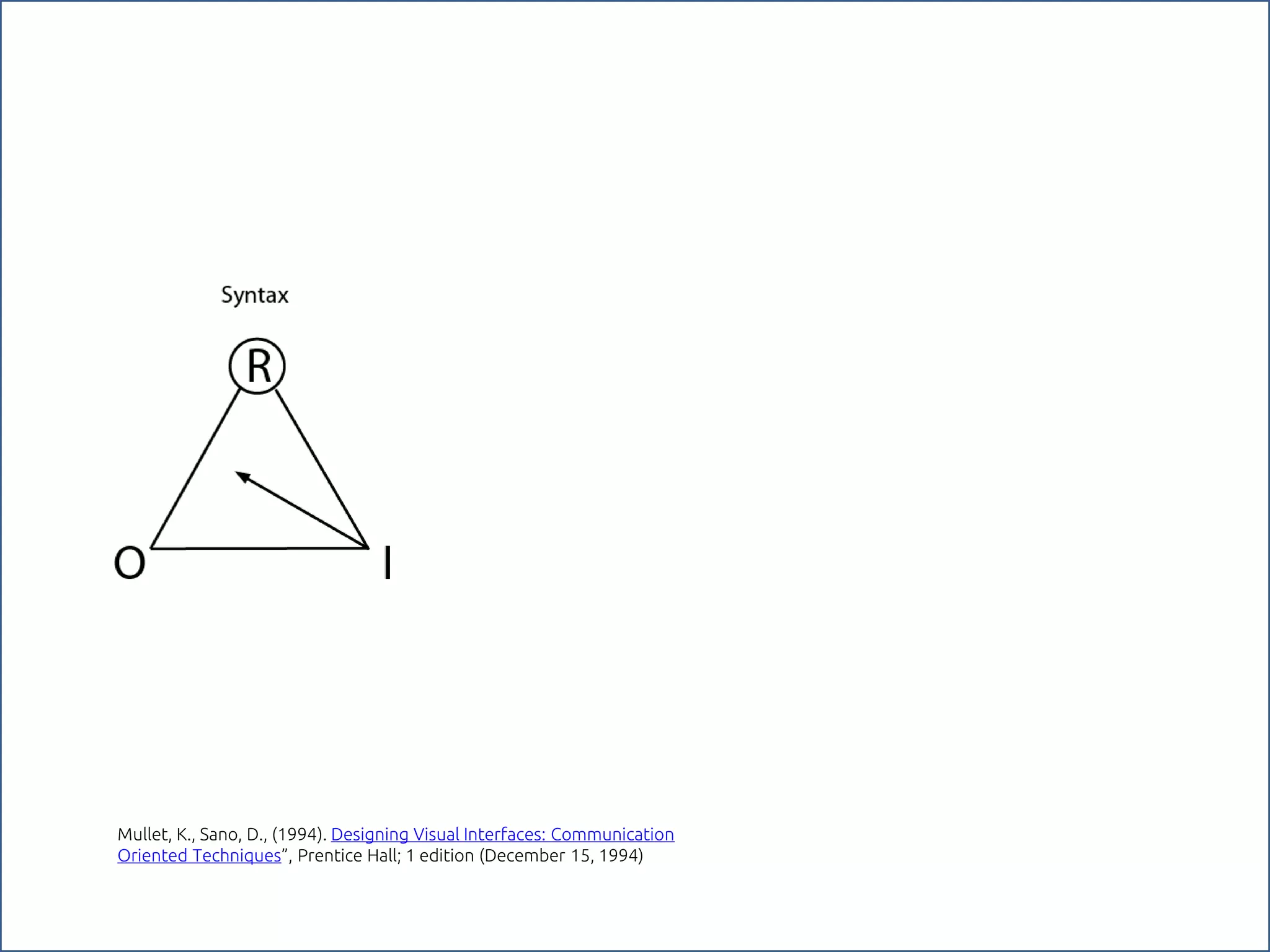
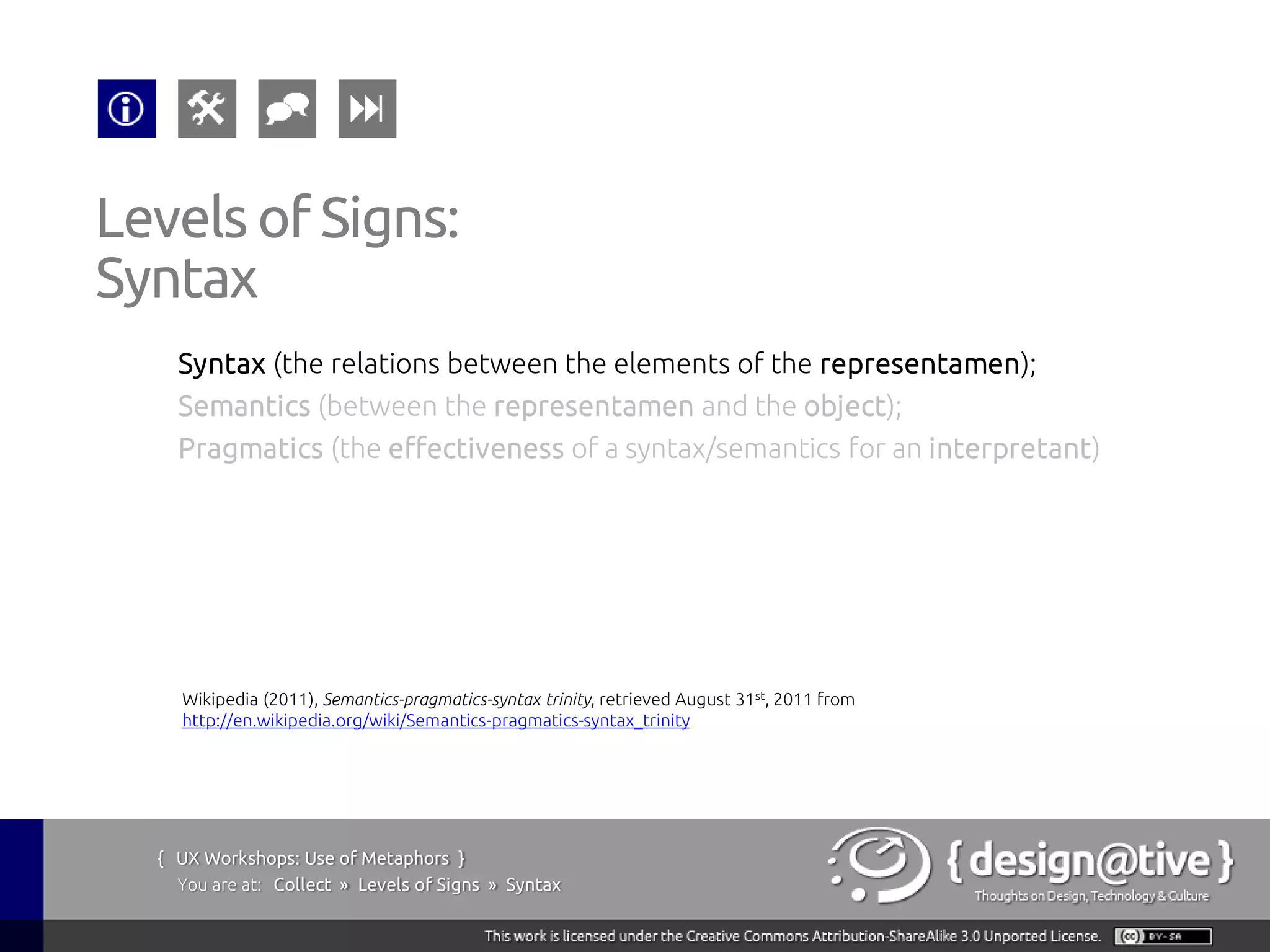
    Syntax (the relations between the elements of the representamen);
    Semantics (between the representamen and the object);
    Pragmatics (the effectiveness of a syntax/semantics for an interpretant)


    Wikipedia (2011), Semantics-pragmatics-syntax trinity, retrieved August 31st, 2011 from
    http://en.wikipedia.org/wiki/Semantics-pragmatics-syntax_trinity


  { UX Workshops: Use of Metaphors }
    You are at: Collect » Levels of Signs » Syntax
McCloud, S., (1994) Understanding Comics: The Invisible Art,
Harper Perennial (April 27, 1994)
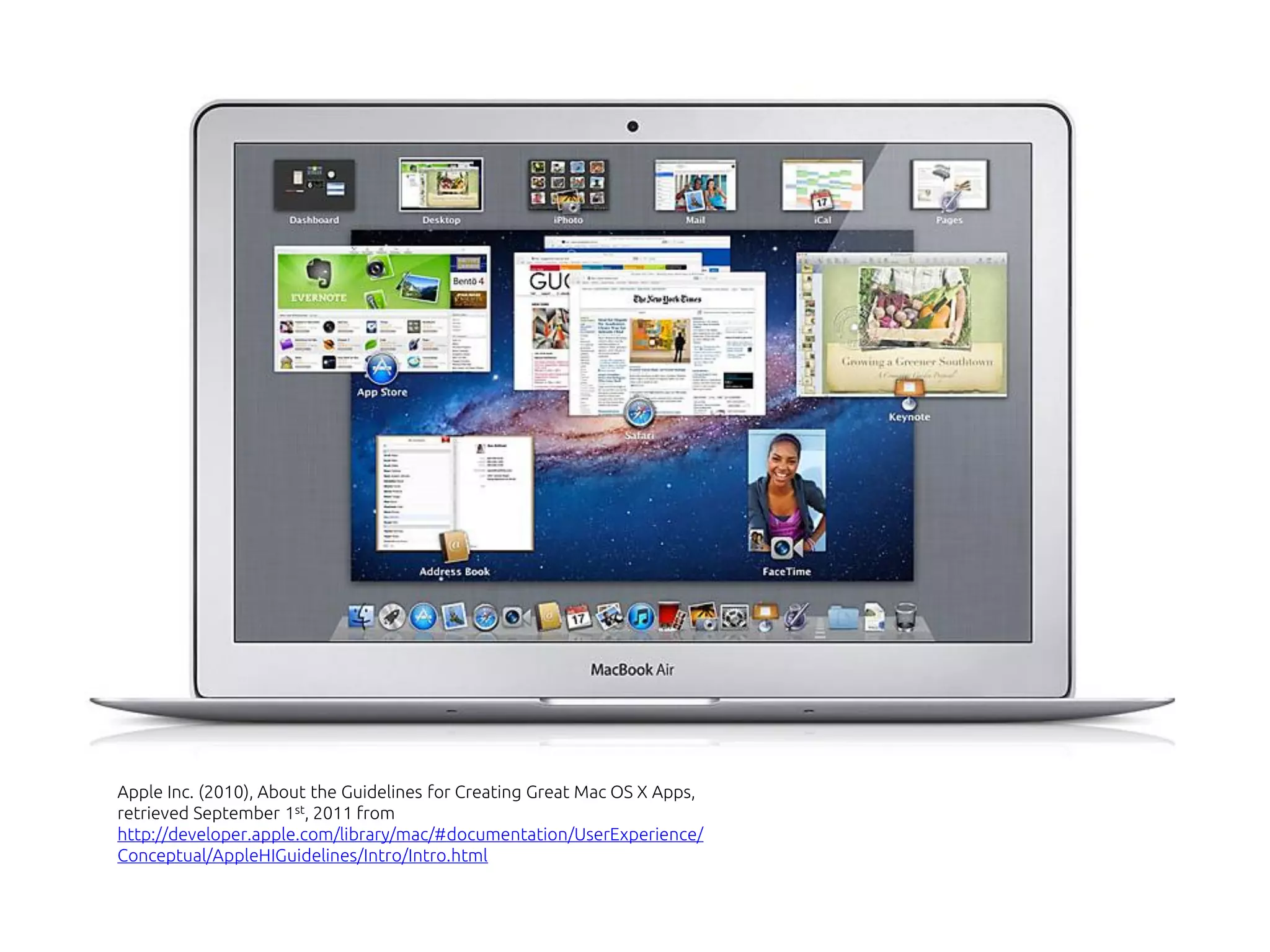
Apple Inc. (2010), About the Guidelines for Creating Great Mac OS X Apps,
retrieved September 1st, 2011 from
http://developer.apple.com/library/mac/#documentation/UserExperience/
Conceptual/AppleHIGuidelines/Intro/Intro.html
Mullet, K., Sano, D., (1994). Designing Visual Interfaces: Communication
Oriented Techniques”, Prentice Hall; 1 edition (December 15, 1994)
Mullet, K., Sano, D., (1994). Designing Visual Interfaces: Communication
Oriented Techniques”, Prentice Hall; 1 edition (December 15, 1994)
Levels of Signs:
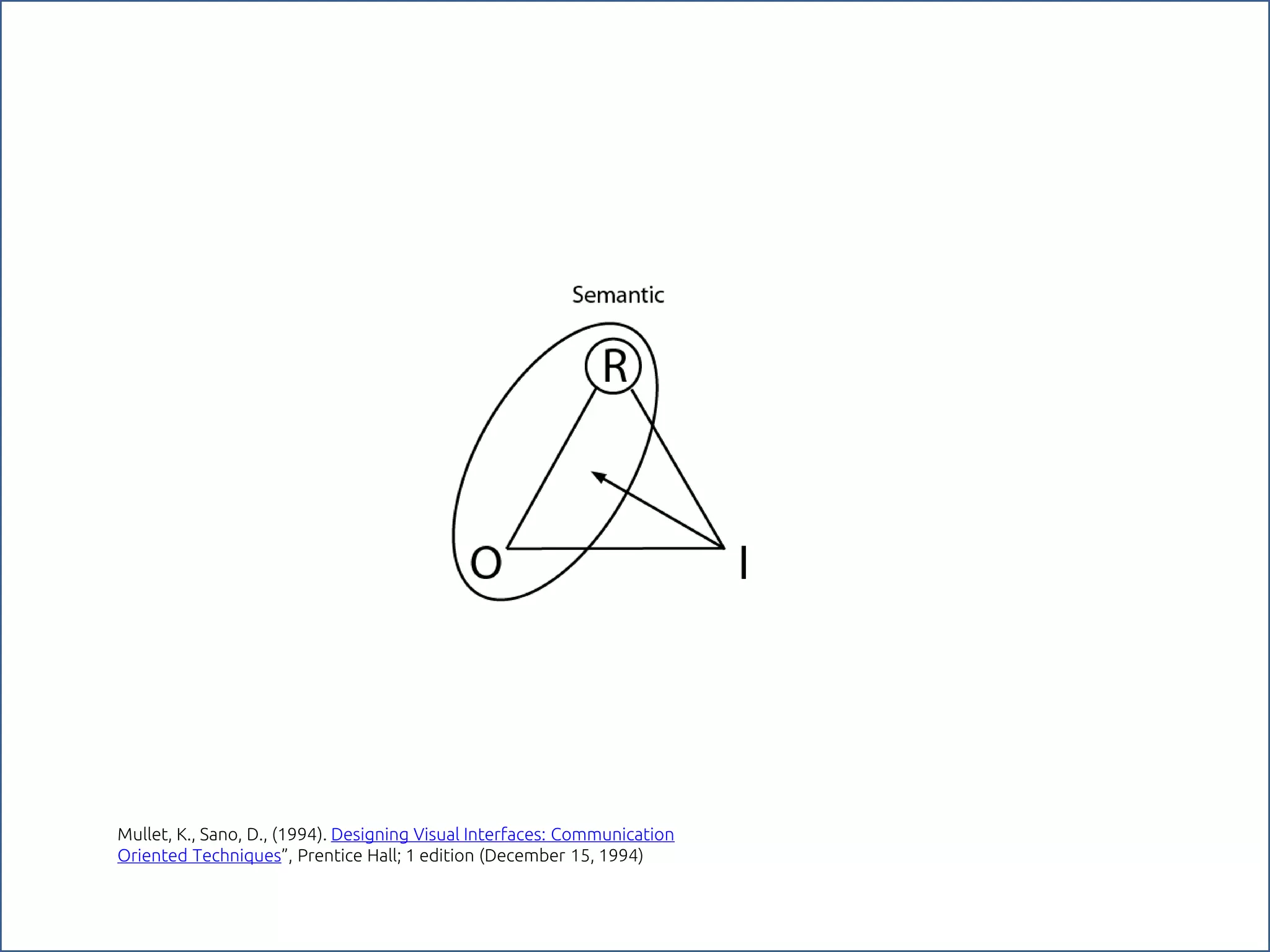
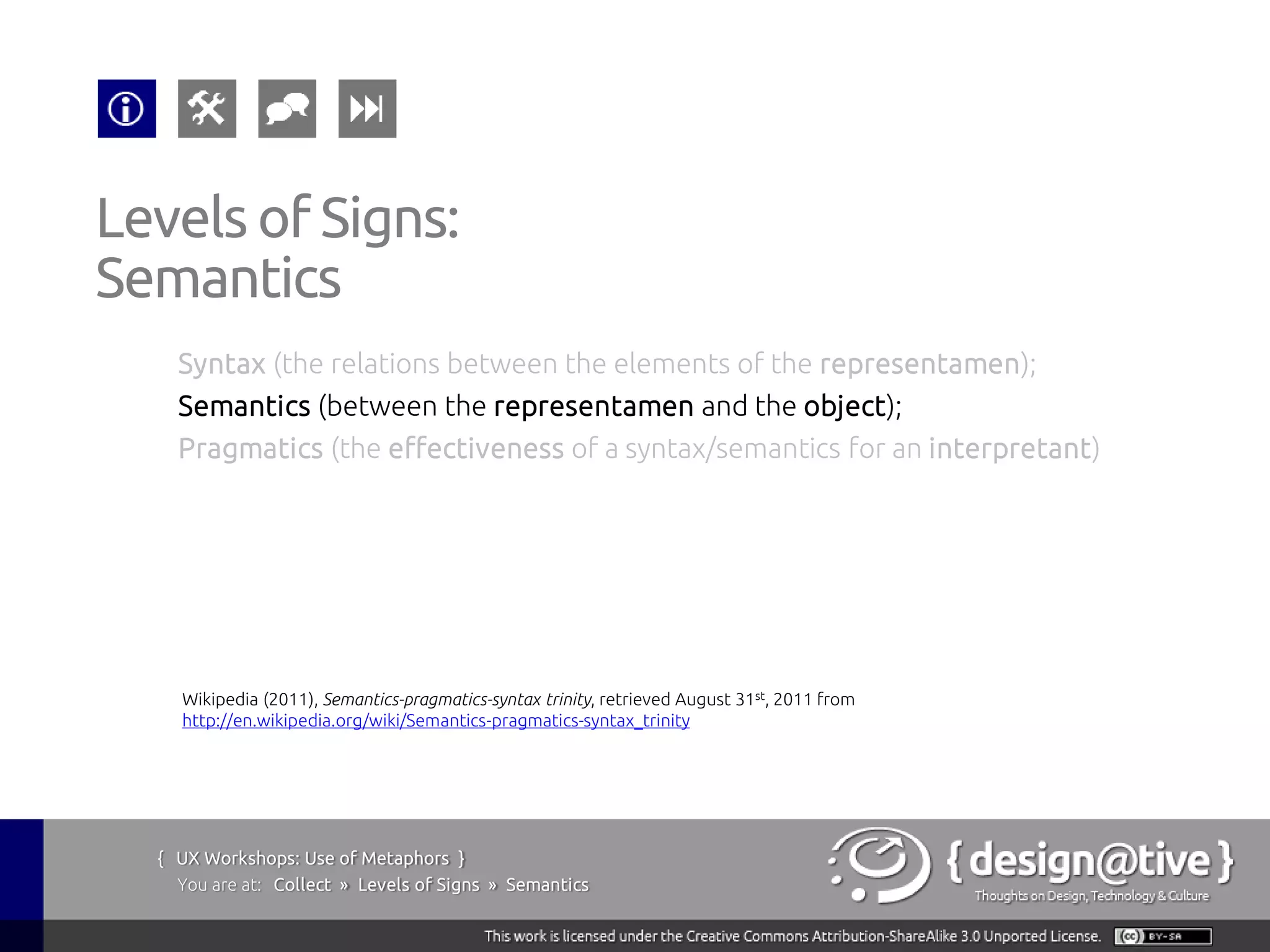
Semantics
    Syntax (the relations between the elements of the representamen);
    Semantics (between the representamen and the object);
    Pragmatics (the effectiveness of a syntax/semantics for an interpretant)


    Wikipedia (2011), Semantics-pragmatics-syntax trinity, retrieved August 31st, 2011 from
    http://en.wikipedia.org/wiki/Semantics-pragmatics-syntax_trinity


  { UX Workshops: Use of Metaphors }
    You are at: Collect » Levels of Signs » Semantics
Levels of Signs:
Semantics
    The Semantic level relates to the intended meaning
    of signs.


    Wikipedia (2011), Semantics, retrieved August 31st, 2011 from
    http://en.wikipedia.org/wiki/Semantics


  { UX Workshops: Use of Metaphors }
    You are at: Collect » Levels of Signs » Semantics
Semantics

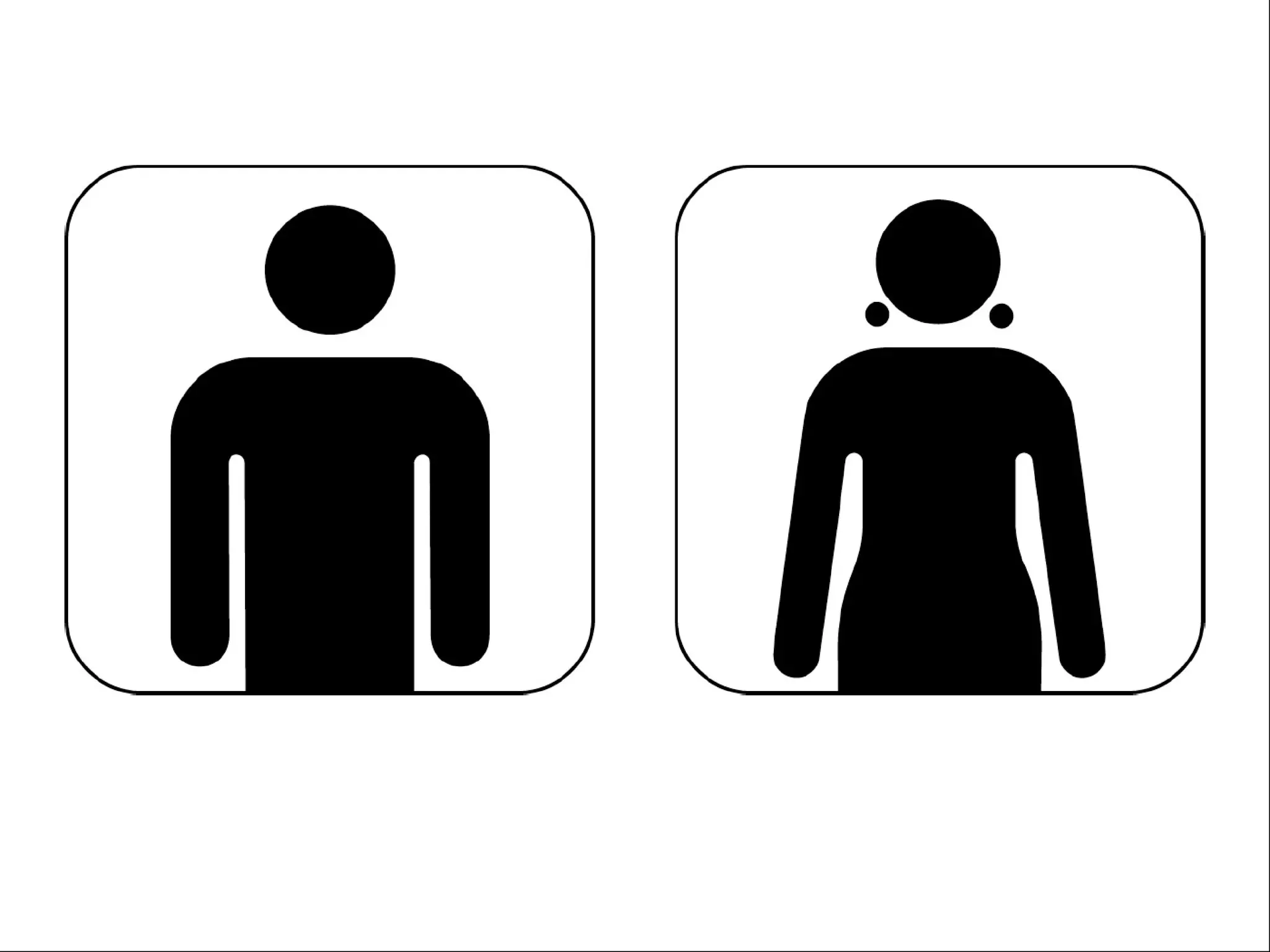
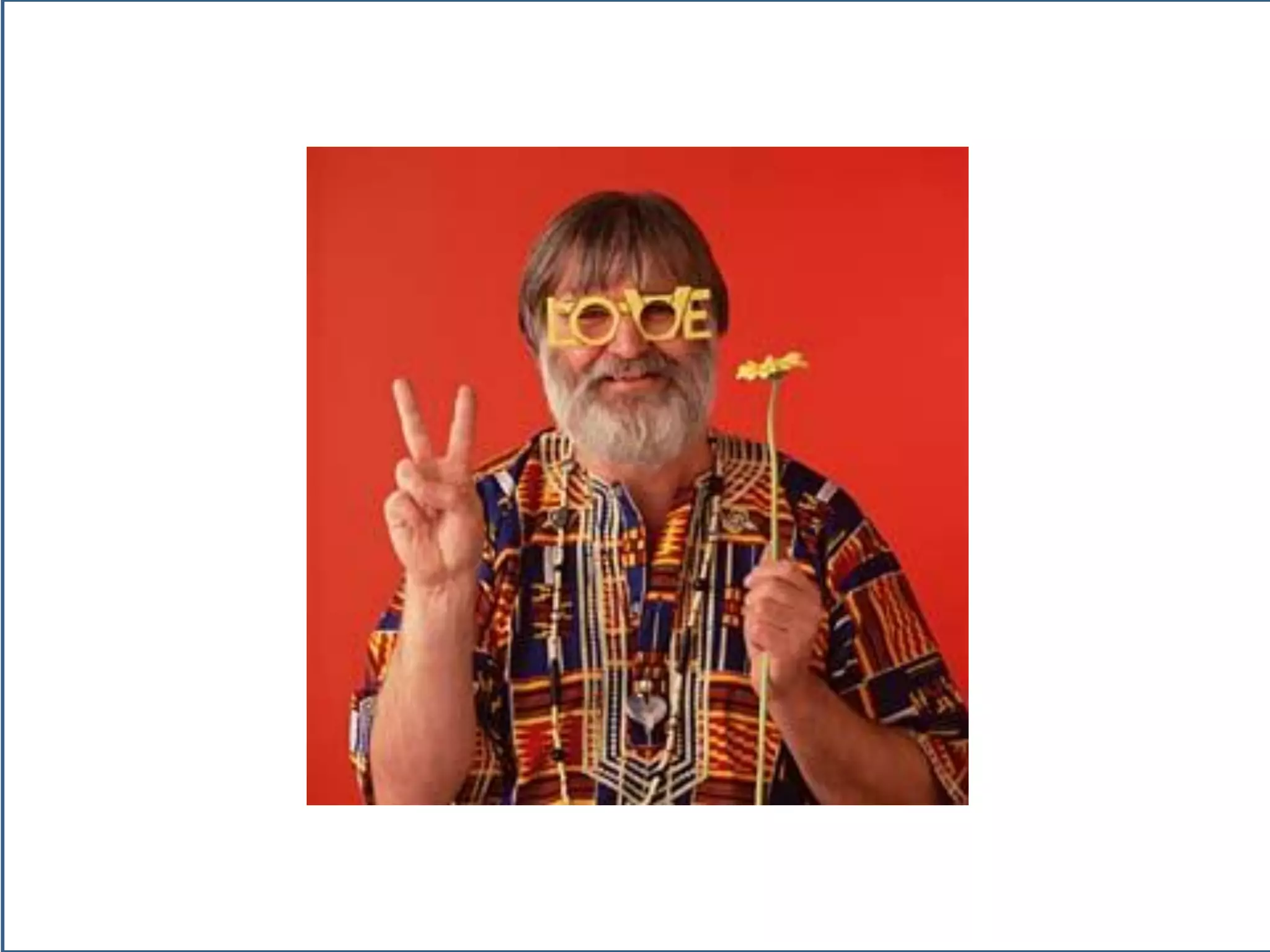
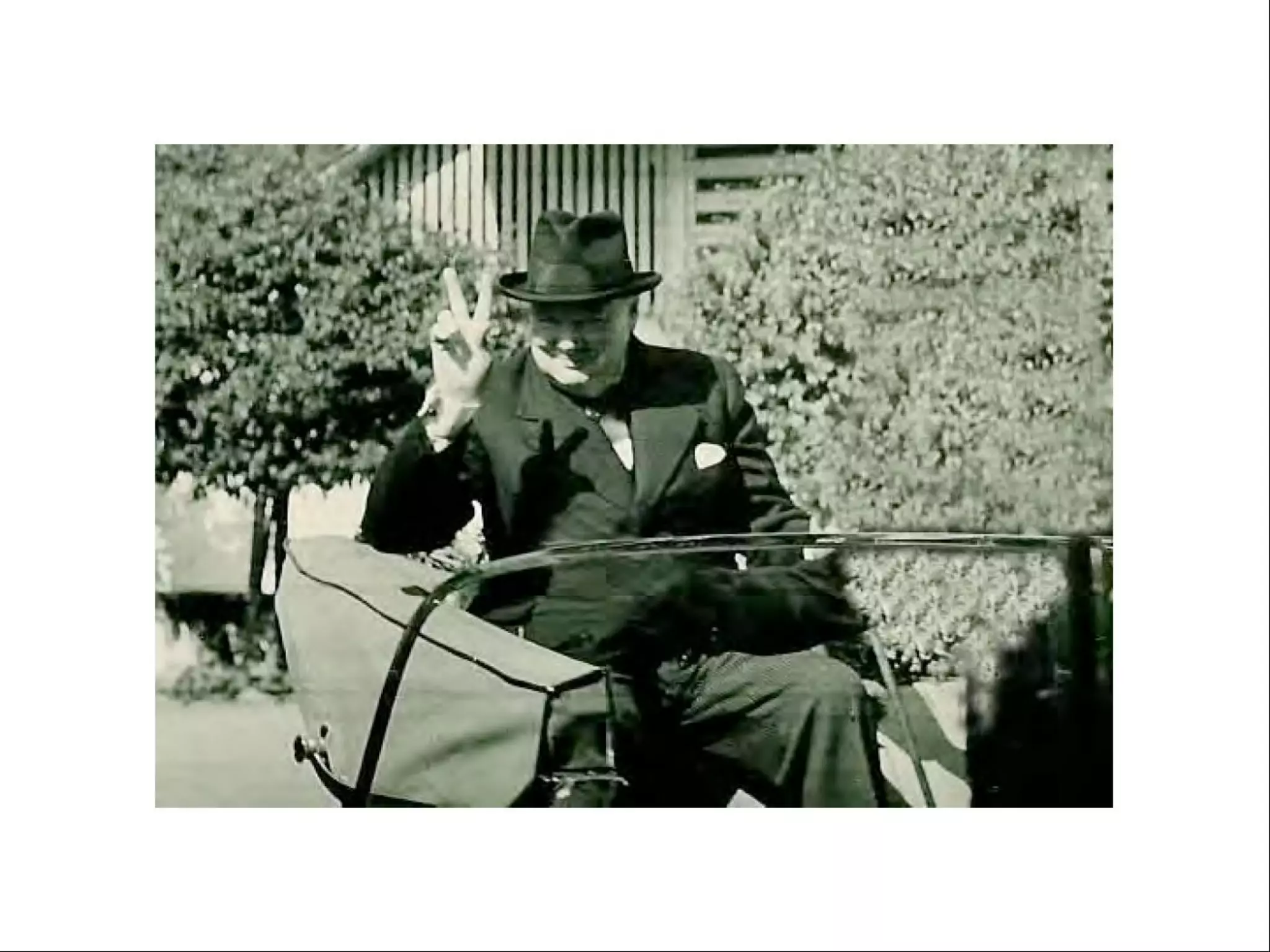
    Icon (relates to its object by resemblance);
    Index (refers to its object indirectly, by consequence);
    Symbol (refers to its object by convention alone);


    Wikipedia (2011), Semantics, retrieved August 31st, 2011 from
    http://en.wikipedia.org/wiki/Semantics


  { UX Workshops: Use of Metaphors }
    You are at: Collect » Semantics
Semantics:
Icon
    Icon (relates to its object by resemblance);
    Index (refers to its object indirectly, by consequence);
    Symbol (refers to its object by convention alone);


    Wikipedia (2011), Semantics, retrieved August 31st, 2011 from
    http://en.wikipedia.org/wiki/Semantics


  { UX Workshops: Use of Metaphors }
    You are at: Collect » Semantics » Icon
Semantics:
Index
    Icon (relates to its object by resemblance);
    Index (refers to its object indirectly, by consequence);
    Symbol (refers to its object by convention alone);


    Wikipedia (2011), Semantics, retrieved August 31st, 2011 from
    http://en.wikipedia.org/wiki/Semantics


  { UX Workshops: Use of Metaphors }
    You are at: Collect » Semantics » Index
Semantics:
Symbol
    Icon (relates to its object by resemblance);
    Index (refers to its object indirectly, by consequence);
    Symbol (refers to its object by convention alone);


    Wikipedia (2011), Semantics, retrieved August 31st, 2011 from
    http://en.wikipedia.org/wiki/Semantics


  { UX Workshops: Use of Metaphors }
    You are at: Collect » Semantics » Symbol
From the interaction design perspective:


What is a sign?
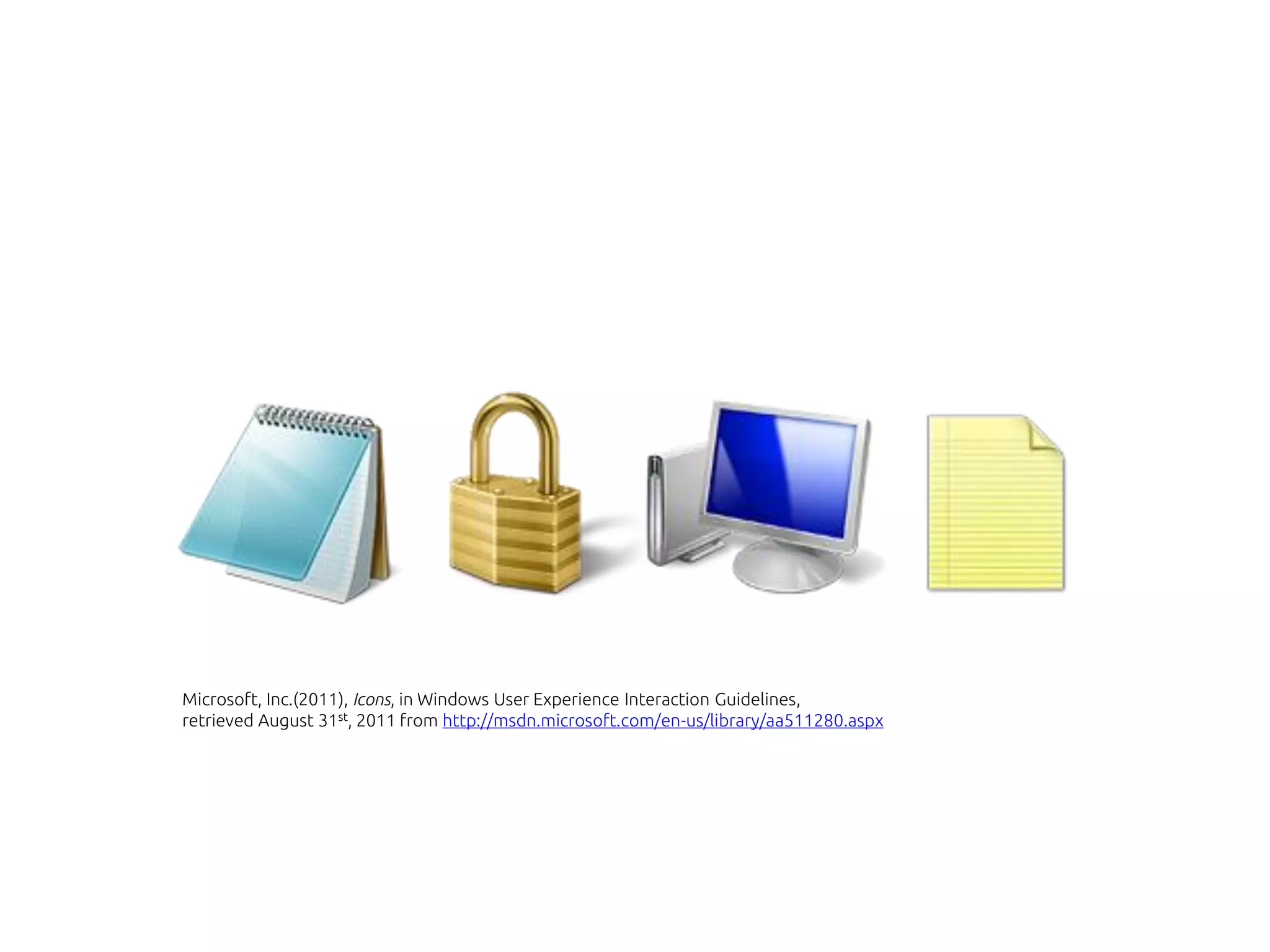
Microsoft, Inc.(2011), Icons, in Windows User Experience Interaction Guidelines,
retrieved August 31st, 2011 from http://msdn.microsoft.com/en-us/library/aa511280.aspx
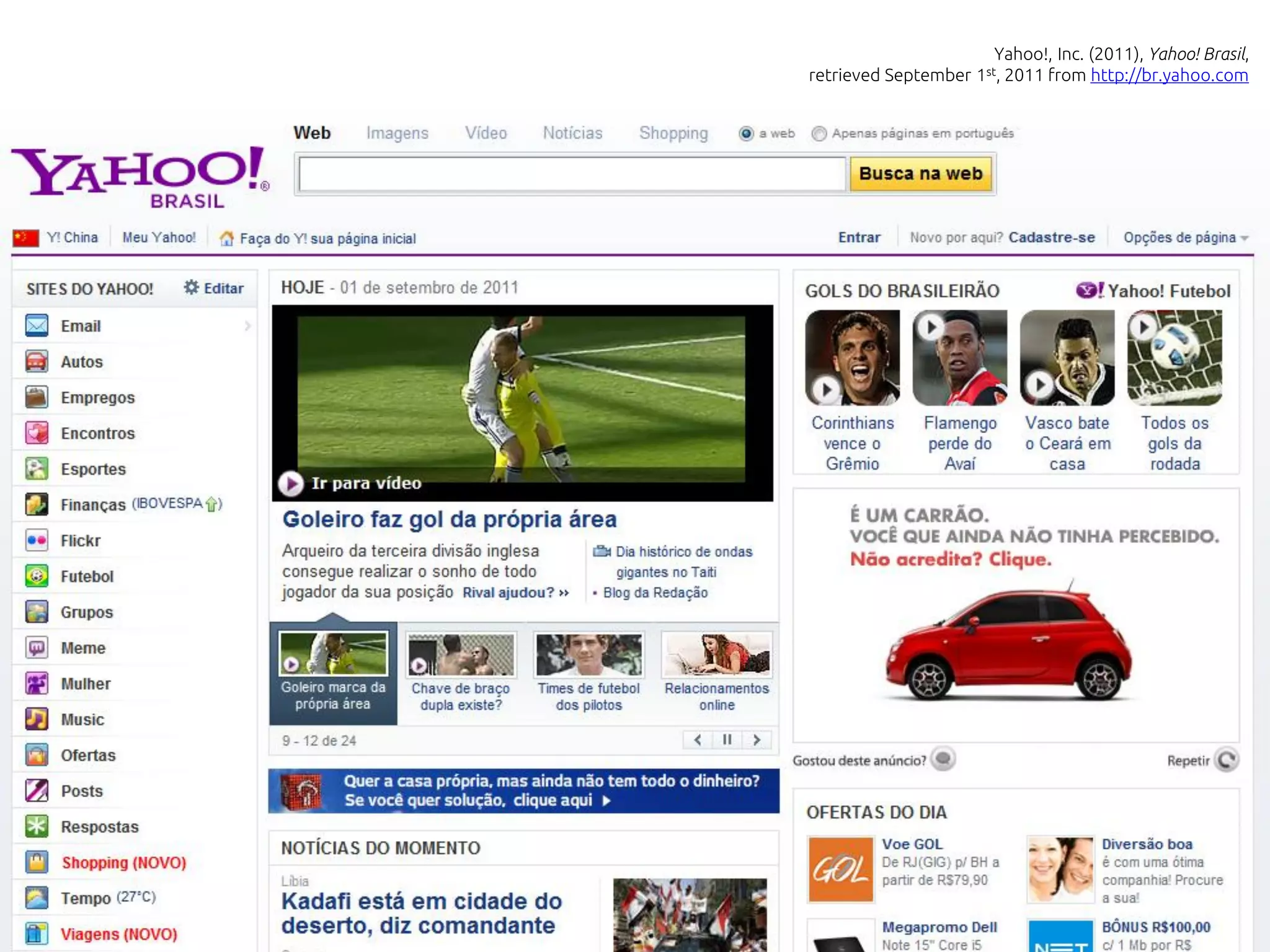
Yahoo!, Inc. (2011), Yahoo! Brasil,
retrieved September 1st, 2011 from http://br.yahoo.com
Taobao, Inc. (2011), Taobao Service Center,
retrieved September 1st, 2011 from http://service.taobao.com/support/main/service_center.htm
Levels of Signs

    Syntax (the relations between the elements of the representamen);
    Semantics (between the representamen and the object);
    Pragmatics (the effectiveness of a syntax/semantics for an interpretant)


    Wikipedia (2011), Semantics-pragmatics-syntax trinity, retrieved August 31st, 2011 from
    http://en.wikipedia.org/wiki/Semantics-pragmatics-syntax_trinity


  { UX Workshops: Use of Metaphors }
    You are at: Collect » Levels of Signs
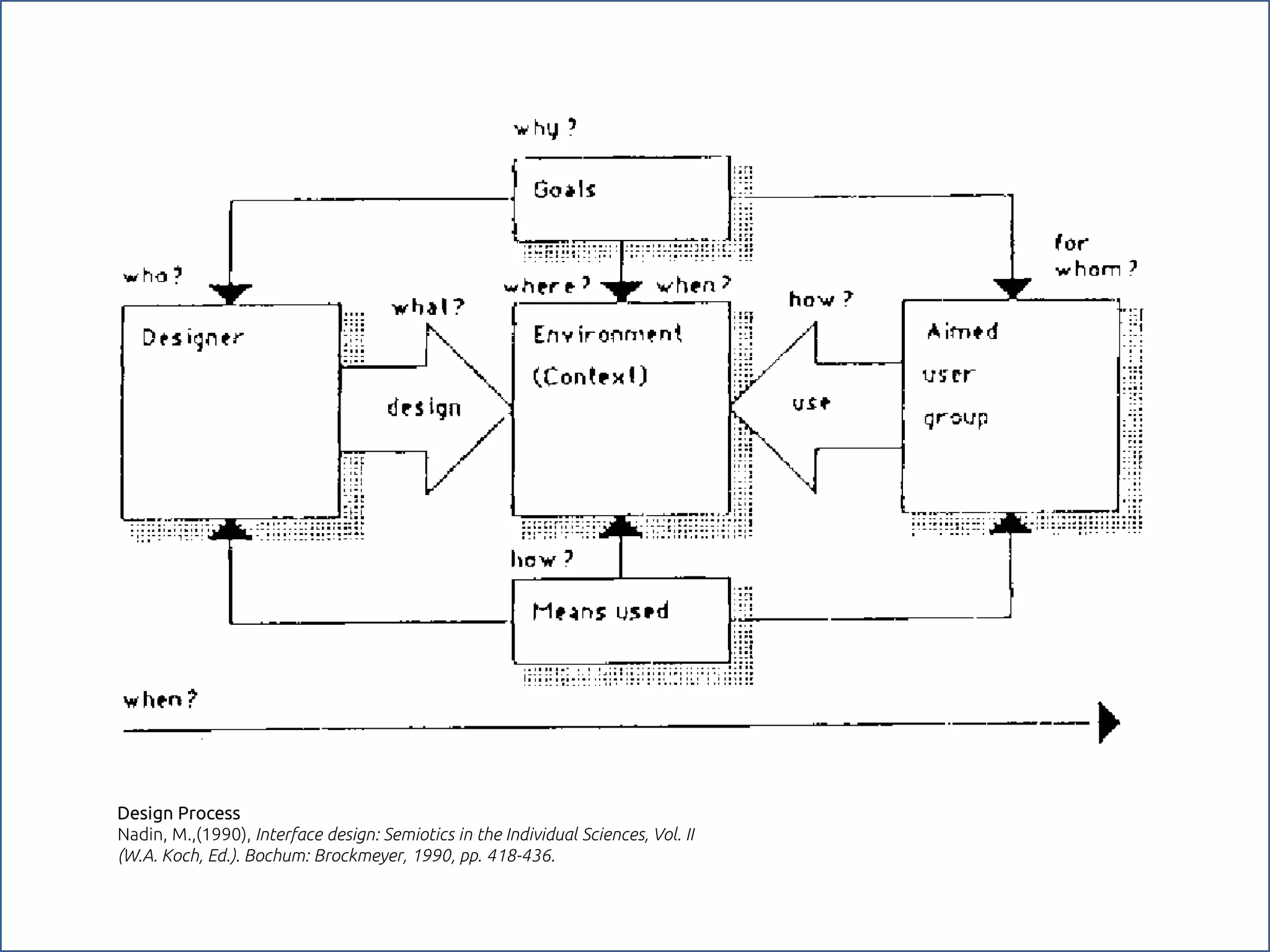
Design Process
Nadin, M.,(1990), Interface design: Semiotics in the Individual Sciences, Vol. II
(W.A. Koch, Ed.). Bochum: Brockmeyer, 1990, pp. 418-436.
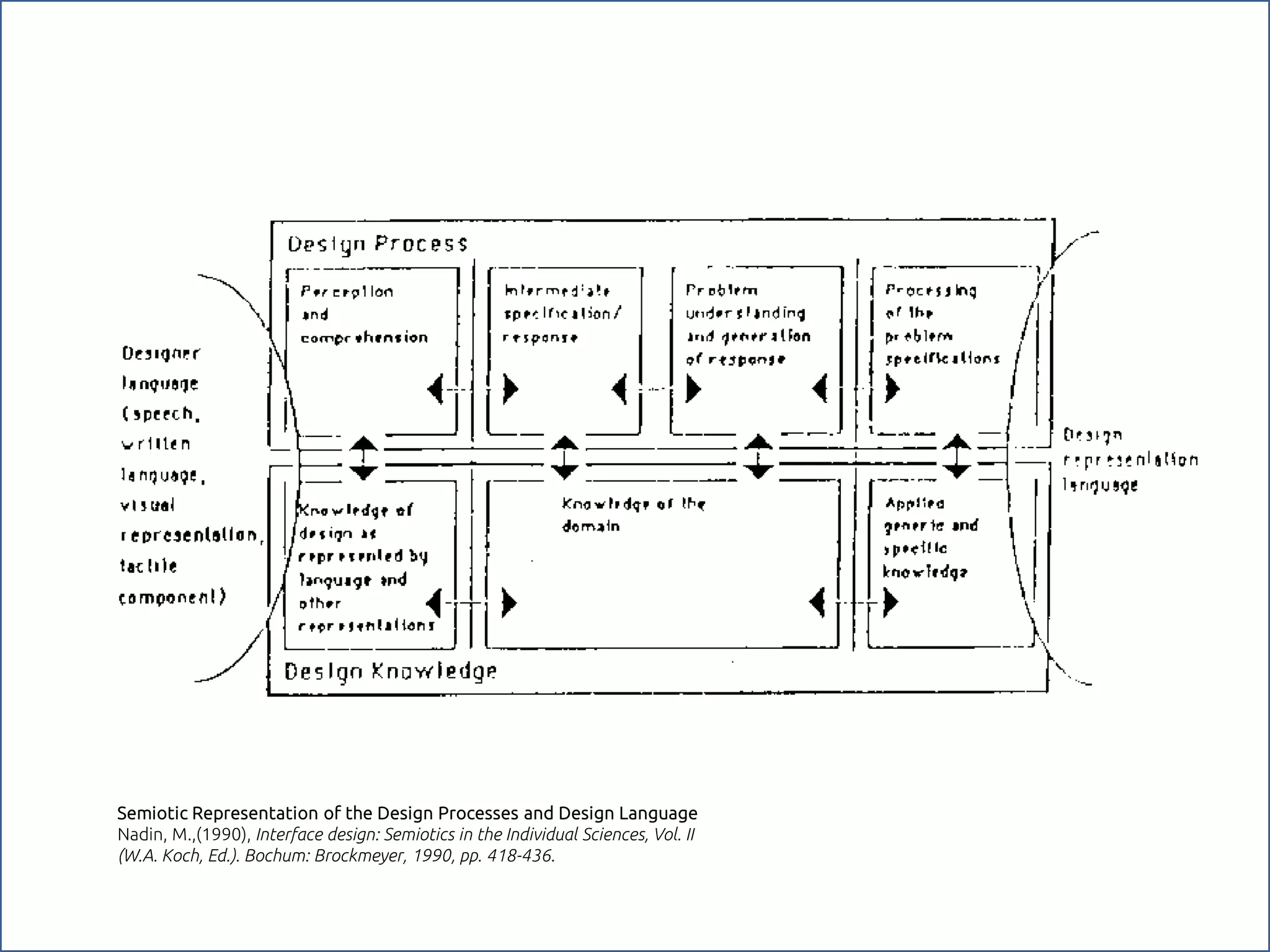
Semiotic Representation of the Design Processes and Design Language
Nadin, M.,(1990), Interface design: Semiotics in the Individual Sciences, Vol. II
(W.A. Koch, Ed.). Bochum: Brockmeyer, 1990, pp. 418-436.
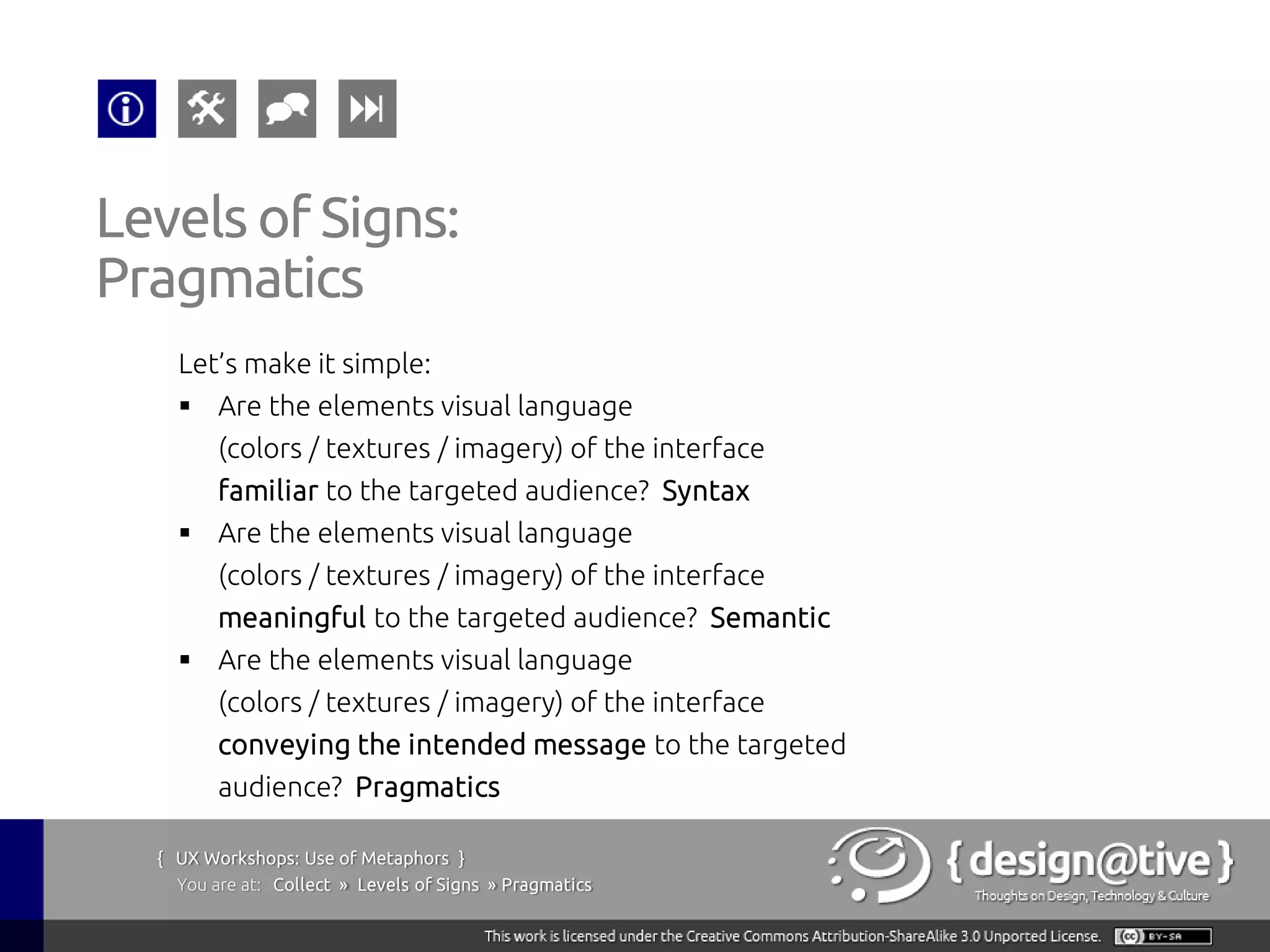
Levels of Signs:
Pragmatics
    Let’s make it simple:
     Are the elements visual language
        (colors / textures / imagery) of the interface
        familiar to the targeted audience? Syntax
     Are the elements visual language
        (colors / textures / imagery) of the interface
        meaningful to the targeted audience? Semantic
     Are the elements visual language
        (colors / textures / imagery) of the interface
        conveying the intended message to the targeted
        audience? Pragmatics

  { UX Workshops: Use of Metaphors }
    You are at: Collect » Levels of Signs » Pragmatics
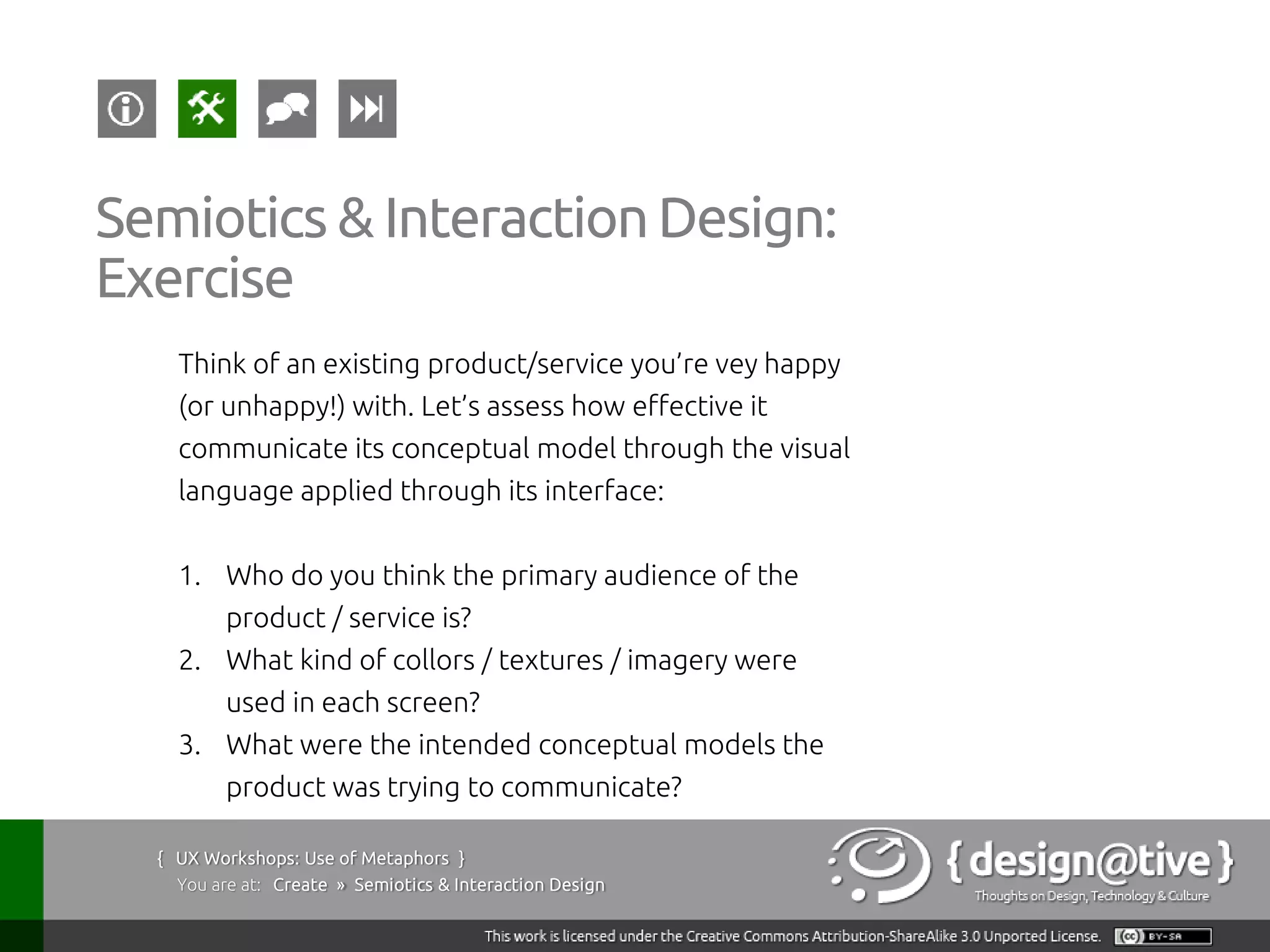
Semiotics & Interaction Design:
Exercise
    Think of an existing product/service you’re vey happy
    (or unhappy!) with. Let’s assess how effective it
    communicate its conceptual model through the visual
    language applied through its interface:


    1. Who do you think the primary audience of the
         product / service is?
    2. What kind of collors / textures / imagery were
         used in each screen?
    3. What were the intended conceptual models the
         product was trying to communicate?

  { UX Workshops: Use of Metaphors }
    You are at: Create » Semiotics & Interaction Design
Nadin, M.,(1988), Interface design: A semiotic paradigm, in Semiotica 69-3/4.
Amsterdam: Mouton de Gruyter, 1988, pp. 269-302
Semiotics & Interaction Design :
Relate
    If you could change the product/service you’ve just
    described, I’d like to hear about:


    1. What aspects would you change?
    2. How would that improve the communication of
         the product’s conceptual model?


  { UX Workshops: Basics of User Experience Design }
    You are at: Relate » Evaluating Experiences
Donate:
Disseminating Results
    Why don’t you share with me about the
    product/service you’re happy (or unhappy!) with:


    1. What aspects would you change?
    2. How would that improve the communication of
         the product’s conceptual model?


    Itamar Medeiros
    http://designative.info/
    itamar.medeiros@designative.info


  { UX Workshops: Basics of User Experience Design }
    You are at: Donate » Disseminating Results

Information Design: Semiotics and the Use of Metaphors

  • 1.
    Information Design: Semiotics and theUse of Metaphors by Itamar Medeiros
  • 2.
    Use of Metaphors Learning Objectives  You will learn how to use metaphors to enable users to better grasp the details of the conceptual models you create; Outline  Introduction  Metaphors and Conceptual Models  Metaphors and Imagery  Semiotics Theory  Use of Metaphors: Exercise  Relate  Donate { UX Workshops: Use of Metaphors } You are at: Introduction » Learning Objectives and Outline
  • 3.
    Introduction: Collect / Create/ Relate / Donate Collect Create i @ Learn from previous Explore, compose, experiences and evaluate possible solutions Relate Donate Consult with peers and mentors ^ : Disseminating results Shneiderman, B. (February 1999), Creating Creativity for Everyone: User Interfaces for Supporting Innovation, ACM Transactions on Computer-Human Interaction 7, 1 (March 2000), 114-138. { UX Workshops: Use of Metaphors } You are at: Introduction » Collect / Create / Relate / Donate
  • 4.
    Use of Metaphors: FirstPrinciples of Interaction Design The following principles are fundamental to the design and implementation of effective interfaces, whether for traditional GUI environments or the web: Tognazzini, B. (2003), First Principles of Interaction Design, Ask Tog, retrieved August 31st, 2011 from http://www.asktog.com/basics/firstPrinciples.html { UX Workshops: Use of Metaphors } You are at: Collect » First Principles of Interaction Design
  • 5.
    Use of Metaphors: FirstPrinciples of Interaction Design Anticipation Latency Reduction Autonomy Learnability Color Blindness Metaphors, Use of Consistency Protect Users' Work Defaults Readability Efficiency of the User Track State Explorable Interfaces Visible Navigation Fitts' Law Human Interface Objects Tognazzini, B. (2003), First Principles of Interaction Design, Ask Tog, retrieved August 31st, 2011 from http://www.asktog.com/basics/firstPrinciples.html { UX Workshops: Use of Metaphors } You are at: Collect » First Principles of Interaction Design
  • 6.
    Use of Metaphors: FirstPrinciples of Interaction Design Anticipation Latency Reduction Autonomy Learnability Color Blindness Metaphors, Use of Consistency Protect Users' Work Defaults Readability Efficiency of the User Track State Explorable Interfaces Visible Navigation Fitts' Law Human Interface Objects Tognazzini, B. (2003), First Principles of Interaction Design, Ask Tog, retrieved August 31st, 2011 from http://www.asktog.com/basics/firstPrinciples.html { UX Workshops: Use of Metaphors } You are at: Collect » First Principles of Interaction Design
  • 7.
    Use of Metaphors If chosen well, metaphors that will enable users to instantly grasp the finest details of the conceptual model of a product/system/site. Tognazzini, B. (2003), First Principles of Interaction Design, Ask Tog, retrieved August 31st, 2011 from http://www.asktog.com/basics/firstPrinciples.html { UX Workshops: Use of Metaphors } You are at: Collect » Use of Metaphors
  • 8.
    Conceptual Models A construct of a system created by designers to represent users’ mental model, based on qualitative assumptions about its elements, their interrelationships, and system boundaries . Wikipedia (2011), Conceptual model, retrieved August 31st, 2011 from http://en.wikipedia.org/wiki/Conceptual_model { UX Workshops: Use of Metaphors } You are at: Collect » Conceptual Models
  • 9.
    Nadin, M.,(1988), Interfacedesign: A semiotic paradigm, in Semiotica 69-3/4. Amsterdam: Mouton de Gruyter, 1988, pp. 269-302
  • 10.
    Use of Metaphors Good metaphors are stories, creating visible pictures in the mind. Tognazzini, B. (2003), First Principles of Interaction Design, Ask Tog, retrieved August 31st, 2011 from http://www.asktog.com/basics/firstPrinciples.html { UX Workshops: Use of Metaphors } You are at: Collect » Use of Metaphors
  • 11.
    Use of Metaphors Bring metaphors alive by appealing to people’s perceptions–sight, sound, touch, and kinesthesia–as well as triggering their memories. Tognazzini, B. (2003), First Principles of Interaction Design, Ask Tog, retrieved August 31st, 2011 from http://www.asktog.com/basics/firstPrinciples.html { UX Workshops: Use of Metaphors } You are at: Collect » Use of Metaphors
  • 12.
    King of California,2007. Film. Directed by Mike CAHILL. USA: Millennium Films
  • 13.
    Hannibal Rising, 2007.Film. Directed by Peter WEBBER. USA: Paramount Pictures
  • 14.
    Use of Metaphors: Imagery Pictorial representation will cross social and linguistic boundaries with ease when the objects being represented are relatively across cultures { UX Workshops: Use of Metaphors } You are at: Collect » Use of Metaphors: Imagery
  • 16.
    Use of Metaphors: Imagery Understanding what an image represents (as opposed to what it depicts) is a prerequisite for reading/creating visual messages. { UX Workshops: Use of Metaphors } You are at: Collect » Use of Metaphors: Imagery
  • 17.
    Semiotics The study of signs and sign processes (semiosis), indication, designation, likeness, analogy, metaphor, symbolism, signification, and communication. Wikipedia (2011), Semiotics, retrieved August 31st, 2011 from http://en.wikipedia.org/wiki/Semiotics { UX Workshops: Use of Metaphors } You are at: Collect » Semiotics
  • 18.
  • 20.
    Signs Defined by Charles S. Peirce as something that stands for someone or something in some respect or capacity. Wikipedia (2011), Sign (semiotics), retrieved August 31st, 2011 from http://en.wikipedia.org/wiki/Sign_(semiotics) { UX Workshops: Use of Metaphors } You are at: Collect » Signs
  • 22.
    Signs Understanding how signs are formed, transmitted and interpreted can help the designer to analyze a communication problem. Wikipedia (2011), Sign (semiotics), retrieved August 31st, 2011 from http://en.wikipedia.org/wiki/Sign_(semiotics) { UX Workshops: Use of Metaphors } You are at: Collect » Signs
  • 23.
    Magritte,R.,(1929), La Trahisondes images (Ceci n'est pas une pipe), Painting, Oil on canvas, Canvas: Los Angeles County Museum of Art.
  • 24.
    Medeiros, I. (2010),Visual Communication in China: “Visitors, This Way”?, retrieved August 31st, 2011 from http://designative.info/2010/05/10/visual-communication-in-china-visitors-this-way/
  • 25.
    Doctorow, C. (2007),When UIs attack: Do not insert receipts in above slot, retrieved August 31st, 2011 from http://www.flickr.com/photos/doctorow/1167985374/
  • 26.
    Signs Representamen (that which represents) Object (that which is represented) Interpretant (that who interprets) Wikipedia (2011), Sign (semiotics), retrieved August 31st, 2011 from http://en.wikipedia.org/wiki/Sign_(semiotics) { UX Workshops: Use of Metaphors } You are at: Collect » Signs
  • 27.
    Mullet, K., Sano,D., (1994). Designing Visual Interfaces: Communication Oriented Techniques”, Prentice Hall; 1 edition (December 15, 1994)
  • 28.
    Signs: Relate Close your eyes for a moment and think about the first image that comes to your mind when you hear the word: Automobile { UX Workshops: Use of Metaphors } You are at: Relate » Signs
  • 29.
    Signs: Relate What attributes would you use to describe the automobile you just imagined? Luxurious? Sexy? Comfortable? { UX Workshops: Use of Metaphors } You are at: Relate » Signs
  • 30.
    Wikipedia (2011), CheryQQ,, retrieved August 31st, 2011 from http://en.wikipedia.org/wiki/Chery_QQ
  • 31.
    BMW of NorthAmerica, LCC. (2008), Mini Cooper, retrieved August 31st, 2011 from http://www.miniusa.com/#/MINIUSA.COM-m
  • 32.
    Levels of Signs Syntax (the relations between the elements of the representamen); Semantics (between the representamen and the object); Pragmatics (the effectiveness of a syntax/semantics for an interpretant) Wikipedia (2011), Semantics-pragmatics-syntax trinity, retrieved August 31st, 2011 from http://en.wikipedia.org/wiki/Semantics-pragmatics-syntax_trinity { UX Workshops: Use of Metaphors } You are at: Collect » Levels of Signs
  • 33.
    Mullet, K., Sano,D., (1994). Designing Visual Interfaces: Communication Oriented Techniques”, Prentice Hall; 1 edition (December 15, 1994)
  • 34.
    Mullet, K., Sano,D., (1994). Designing Visual Interfaces: Communication Oriented Techniques”, Prentice Hall; 1 edition (December 15, 1994)
  • 35.
    Levels of Signs: Syntax Syntax (the relations between the elements of the representamen); Semantics (between the representamen and the object); Pragmatics (the effectiveness of a syntax/semantics for an interpretant) Wikipedia (2011), Semantics-pragmatics-syntax trinity, retrieved August 31st, 2011 from http://en.wikipedia.org/wiki/Semantics-pragmatics-syntax_trinity { UX Workshops: Use of Metaphors } You are at: Collect » Levels of Signs » Syntax
  • 36.
    McCloud, S., (1994)Understanding Comics: The Invisible Art, Harper Perennial (April 27, 1994)
  • 37.
    Apple Inc. (2010),About the Guidelines for Creating Great Mac OS X Apps, retrieved September 1st, 2011 from http://developer.apple.com/library/mac/#documentation/UserExperience/ Conceptual/AppleHIGuidelines/Intro/Intro.html
  • 38.
    Mullet, K., Sano,D., (1994). Designing Visual Interfaces: Communication Oriented Techniques”, Prentice Hall; 1 edition (December 15, 1994)
  • 39.
    Mullet, K., Sano,D., (1994). Designing Visual Interfaces: Communication Oriented Techniques”, Prentice Hall; 1 edition (December 15, 1994)
  • 40.
    Levels of Signs: Semantics Syntax (the relations between the elements of the representamen); Semantics (between the representamen and the object); Pragmatics (the effectiveness of a syntax/semantics for an interpretant) Wikipedia (2011), Semantics-pragmatics-syntax trinity, retrieved August 31st, 2011 from http://en.wikipedia.org/wiki/Semantics-pragmatics-syntax_trinity { UX Workshops: Use of Metaphors } You are at: Collect » Levels of Signs » Semantics
  • 41.
    Levels of Signs: Semantics The Semantic level relates to the intended meaning of signs. Wikipedia (2011), Semantics, retrieved August 31st, 2011 from http://en.wikipedia.org/wiki/Semantics { UX Workshops: Use of Metaphors } You are at: Collect » Levels of Signs » Semantics
  • 42.
    Semantics Icon (relates to its object by resemblance); Index (refers to its object indirectly, by consequence); Symbol (refers to its object by convention alone); Wikipedia (2011), Semantics, retrieved August 31st, 2011 from http://en.wikipedia.org/wiki/Semantics { UX Workshops: Use of Metaphors } You are at: Collect » Semantics
  • 43.
    Semantics: Icon Icon (relates to its object by resemblance); Index (refers to its object indirectly, by consequence); Symbol (refers to its object by convention alone); Wikipedia (2011), Semantics, retrieved August 31st, 2011 from http://en.wikipedia.org/wiki/Semantics { UX Workshops: Use of Metaphors } You are at: Collect » Semantics » Icon
  • 46.
    Semantics: Index Icon (relates to its object by resemblance); Index (refers to its object indirectly, by consequence); Symbol (refers to its object by convention alone); Wikipedia (2011), Semantics, retrieved August 31st, 2011 from http://en.wikipedia.org/wiki/Semantics { UX Workshops: Use of Metaphors } You are at: Collect » Semantics » Index
  • 50.
    Semantics: Symbol Icon (relates to its object by resemblance); Index (refers to its object indirectly, by consequence); Symbol (refers to its object by convention alone); Wikipedia (2011), Semantics, retrieved August 31st, 2011 from http://en.wikipedia.org/wiki/Semantics { UX Workshops: Use of Metaphors } You are at: Collect » Semantics » Symbol
  • 58.
    From the interactiondesign perspective: What is a sign?
  • 59.
    Microsoft, Inc.(2011), Icons,in Windows User Experience Interaction Guidelines, retrieved August 31st, 2011 from http://msdn.microsoft.com/en-us/library/aa511280.aspx
  • 60.
    Yahoo!, Inc. (2011),Yahoo! Brasil, retrieved September 1st, 2011 from http://br.yahoo.com
  • 61.
    Taobao, Inc. (2011),Taobao Service Center, retrieved September 1st, 2011 from http://service.taobao.com/support/main/service_center.htm
  • 62.
    Levels of Signs Syntax (the relations between the elements of the representamen); Semantics (between the representamen and the object); Pragmatics (the effectiveness of a syntax/semantics for an interpretant) Wikipedia (2011), Semantics-pragmatics-syntax trinity, retrieved August 31st, 2011 from http://en.wikipedia.org/wiki/Semantics-pragmatics-syntax_trinity { UX Workshops: Use of Metaphors } You are at: Collect » Levels of Signs
  • 63.
    Design Process Nadin, M.,(1990),Interface design: Semiotics in the Individual Sciences, Vol. II (W.A. Koch, Ed.). Bochum: Brockmeyer, 1990, pp. 418-436.
  • 64.
    Semiotic Representation ofthe Design Processes and Design Language Nadin, M.,(1990), Interface design: Semiotics in the Individual Sciences, Vol. II (W.A. Koch, Ed.). Bochum: Brockmeyer, 1990, pp. 418-436.
  • 66.
    Levels of Signs: Pragmatics Let’s make it simple:  Are the elements visual language (colors / textures / imagery) of the interface familiar to the targeted audience? Syntax  Are the elements visual language (colors / textures / imagery) of the interface meaningful to the targeted audience? Semantic  Are the elements visual language (colors / textures / imagery) of the interface conveying the intended message to the targeted audience? Pragmatics { UX Workshops: Use of Metaphors } You are at: Collect » Levels of Signs » Pragmatics
  • 67.
    Semiotics & InteractionDesign: Exercise Think of an existing product/service you’re vey happy (or unhappy!) with. Let’s assess how effective it communicate its conceptual model through the visual language applied through its interface: 1. Who do you think the primary audience of the product / service is? 2. What kind of collors / textures / imagery were used in each screen? 3. What were the intended conceptual models the product was trying to communicate? { UX Workshops: Use of Metaphors } You are at: Create » Semiotics & Interaction Design
  • 68.
    Nadin, M.,(1988), Interfacedesign: A semiotic paradigm, in Semiotica 69-3/4. Amsterdam: Mouton de Gruyter, 1988, pp. 269-302
  • 69.
    Semiotics & InteractionDesign : Relate If you could change the product/service you’ve just described, I’d like to hear about: 1. What aspects would you change? 2. How would that improve the communication of the product’s conceptual model? { UX Workshops: Basics of User Experience Design } You are at: Relate » Evaluating Experiences
  • 70.
    Donate: Disseminating Results Why don’t you share with me about the product/service you’re happy (or unhappy!) with: 1. What aspects would you change? 2. How would that improve the communication of the product’s conceptual model? Itamar Medeiros http://designative.info/ itamar.medeiros@designative.info { UX Workshops: Basics of User Experience Design } You are at: Donate » Disseminating Results