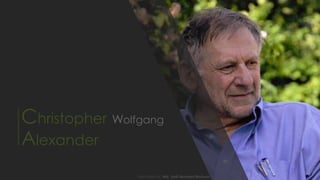
Christopher Wolfgang
Alexander
Submitted By: Md. Sadi Murshed Bhuiyan
Design Theorist
Architect
Emeritus Professor
Contractor
Author
• Personal life
• Career
• Achievement
• Philosophy
Personal Life
• Born: October 4, 1936
• Birth Place: Vienna, Austria
• Nationality: American
• Education: Oundle School
Bachelor’s Degree in Architecture
(Cambridge University)
Master’s Degree in Mathematics
(Cambridge University)
Ph.D. in Architecture (Harvard University)
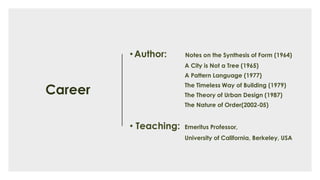
Career
•Author: Notes on the Synthesis of Form (1964)
A City is Not a Tree (1965)
A Pattern Language (1977)
The Timeless Way of Building (1979)
The Theory of Urban Design (1987)
The Nature of Order(2002-05)
• Teaching: Emeritus Professor,
University of California, Berkeley, USA
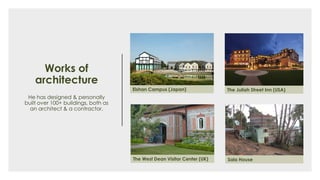
Works of
architecture
He has designed & personally
built over 100+ buildings, both as
an architect & a contractor.
Eishan Campus (Japan) The Juliah Street Inn (USA)
The West Dean Visitor Center (UK) Sala House
Achievement
Honors:
Society of Fellows in Harvard University (1961-64)
First Medal for Research by the AIA (1972)
Member of the SRA (1980)
Fellow of the AAAS (1996)
Awards:
Best Building in Japan Award (1985)
Winner of the ACSA, 1986-87)
Seaside Prize (1994)
Athena Award by CNU (2006)
Vincent Scully Prize(2009)
Lifetime Achievement Award by the UDG (2011)
Global Award for Sustainable Architecture (2014)
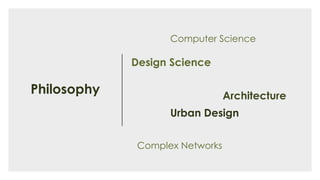
Philosophy
Design Science
Architecture
Urban Design
Complex Networks
Computer Science
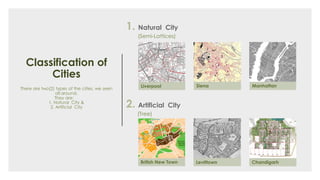
Classification of
Cities
There are two(2) types of the cities, we seen
all around.
They are:
1. Natural City &
2. Artificial City 2. Artificial City
(Tree)
1. Natural City
(Semi-Lattices)
Manhattan
Levittown
SienaLiverpool
British New Town Chandigarh
Organization of
Cities
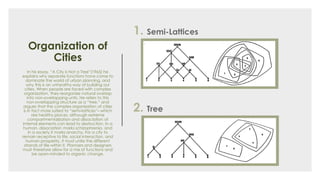
In his essay, “A City is Not a Tree”(1965) he
explains why separate functions have come to
dominate the world of urban planning, and
why this is an unhealthy way of building our
cities. When people are faced with complex
organization, they reorganize natural overlap
into non-overlapping units. He refers to this
non-overlapping structure as a “tree,” and
argues that the complex organization of cities
is in fact more suited to “semi-lattices”– which
are healthy places, although extreme
compartmentalization and dissociation of
internal elements can lead to destruction. In a
human, dissociation marks schizophrenia, and
in a society it marks anarchy. For a city to
remain receptive to life, social interaction, and
human prosperity, it must unite the different
strands of life within it. Planners and designers
must therefore allow for a mix of functions and
be open-minded to organic change.
1. Semi-Lattices
2. Tree
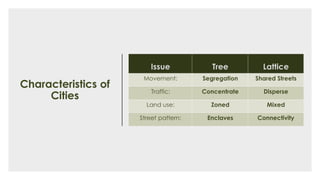
Characteristics of
Cities
Issue Tree Lattice
Movement: Segregation Shared Streets
Traffic: Concentrate Disperse
Land use: Zoned Mixed
Street pattern: Enclaves Connectivity
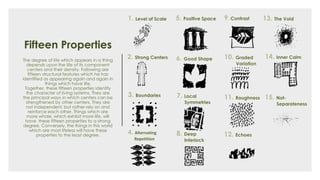
Fifteen Properties
The degree of life which appears in a thing
depends upon the life of its component
centers and their density. Following are
fifteen structural features which he has
identified as appearing again and again in
things which have life.
Together, these fifteen properties identify
the character of living systems. They are
the principal ways in which centers can be
strengthened by other centers. They are
not independent, but rather rely on and
reinforce each other. Things which are
more whole, which exhibit more life, will
have these fifteen properties to a strong
degree. Conversely, the things in this world
which are most lifeless will have these
properties to the least degree.
1. Level of Scale
2. Strong Centers
3. Boundaries
4. Alternating
Repetition
5. Positive Space
6. Good Shape
7. Local
Symmetries
8. Deep
Interlock
9. Contrast
10. Graded
Variation
11. Roughness
12. Echoes
13. The Void
14. Inner Calm
15. Not-
Separateness
"Complexity is one of the great
problems in environmental design."
Christopher Wolfgang
Alexander

A study on Christopher Alexander

  • 1.
  • 2.
  • 3.
    • Personal life •Career • Achievement • Philosophy
  • 4.
    Personal Life • Born:October 4, 1936 • Birth Place: Vienna, Austria • Nationality: American • Education: Oundle School Bachelor’s Degree in Architecture (Cambridge University) Master’s Degree in Mathematics (Cambridge University) Ph.D. in Architecture (Harvard University)
  • 5.
    Career •Author: Notes onthe Synthesis of Form (1964) A City is Not a Tree (1965) A Pattern Language (1977) The Timeless Way of Building (1979) The Theory of Urban Design (1987) The Nature of Order(2002-05) • Teaching: Emeritus Professor, University of California, Berkeley, USA
  • 6.
    Works of architecture He hasdesigned & personally built over 100+ buildings, both as an architect & a contractor. Eishan Campus (Japan) The Juliah Street Inn (USA) The West Dean Visitor Center (UK) Sala House
  • 7.
    Achievement Honors: Society of Fellowsin Harvard University (1961-64) First Medal for Research by the AIA (1972) Member of the SRA (1980) Fellow of the AAAS (1996) Awards: Best Building in Japan Award (1985) Winner of the ACSA, 1986-87) Seaside Prize (1994) Athena Award by CNU (2006) Vincent Scully Prize(2009) Lifetime Achievement Award by the UDG (2011) Global Award for Sustainable Architecture (2014)
  • 8.
  • 9.
    Classification of Cities There aretwo(2) types of the cities, we seen all around. They are: 1. Natural City & 2. Artificial City 2. Artificial City (Tree) 1. Natural City (Semi-Lattices) Manhattan Levittown SienaLiverpool British New Town Chandigarh
  • 10.
    Organization of Cities In hisessay, “A City is Not a Tree”(1965) he explains why separate functions have come to dominate the world of urban planning, and why this is an unhealthy way of building our cities. When people are faced with complex organization, they reorganize natural overlap into non-overlapping units. He refers to this non-overlapping structure as a “tree,” and argues that the complex organization of cities is in fact more suited to “semi-lattices”– which are healthy places, although extreme compartmentalization and dissociation of internal elements can lead to destruction. In a human, dissociation marks schizophrenia, and in a society it marks anarchy. For a city to remain receptive to life, social interaction, and human prosperity, it must unite the different strands of life within it. Planners and designers must therefore allow for a mix of functions and be open-minded to organic change. 1. Semi-Lattices 2. Tree
  • 11.
    Characteristics of Cities Issue TreeLattice Movement: Segregation Shared Streets Traffic: Concentrate Disperse Land use: Zoned Mixed Street pattern: Enclaves Connectivity
  • 12.
    Fifteen Properties The degreeof life which appears in a thing depends upon the life of its component centers and their density. Following are fifteen structural features which he has identified as appearing again and again in things which have life. Together, these fifteen properties identify the character of living systems. They are the principal ways in which centers can be strengthened by other centers. They are not independent, but rather rely on and reinforce each other. Things which are more whole, which exhibit more life, will have these fifteen properties to a strong degree. Conversely, the things in this world which are most lifeless will have these properties to the least degree. 1. Level of Scale 2. Strong Centers 3. Boundaries 4. Alternating Repetition 5. Positive Space 6. Good Shape 7. Local Symmetries 8. Deep Interlock 9. Contrast 10. Graded Variation 11. Roughness 12. Echoes 13. The Void 14. Inner Calm 15. Not- Separateness
  • 13.
    "Complexity is oneof the great problems in environmental design." Christopher Wolfgang Alexander