EPFL, spring 2011 - week 8!
conceptual design
objectives of this lecture 
➝  know  the different types of 
models which are
   relevant to the HCI design process.
➝  understand how
        ➝    models influence users interaction with the system
        ➝    conceptual design aims to exploit this.
➝  appreciate
            problems with applying conceptual
  design approach.


This lecture is based on a conceptual design lecture by Angela Sasse (UCL)
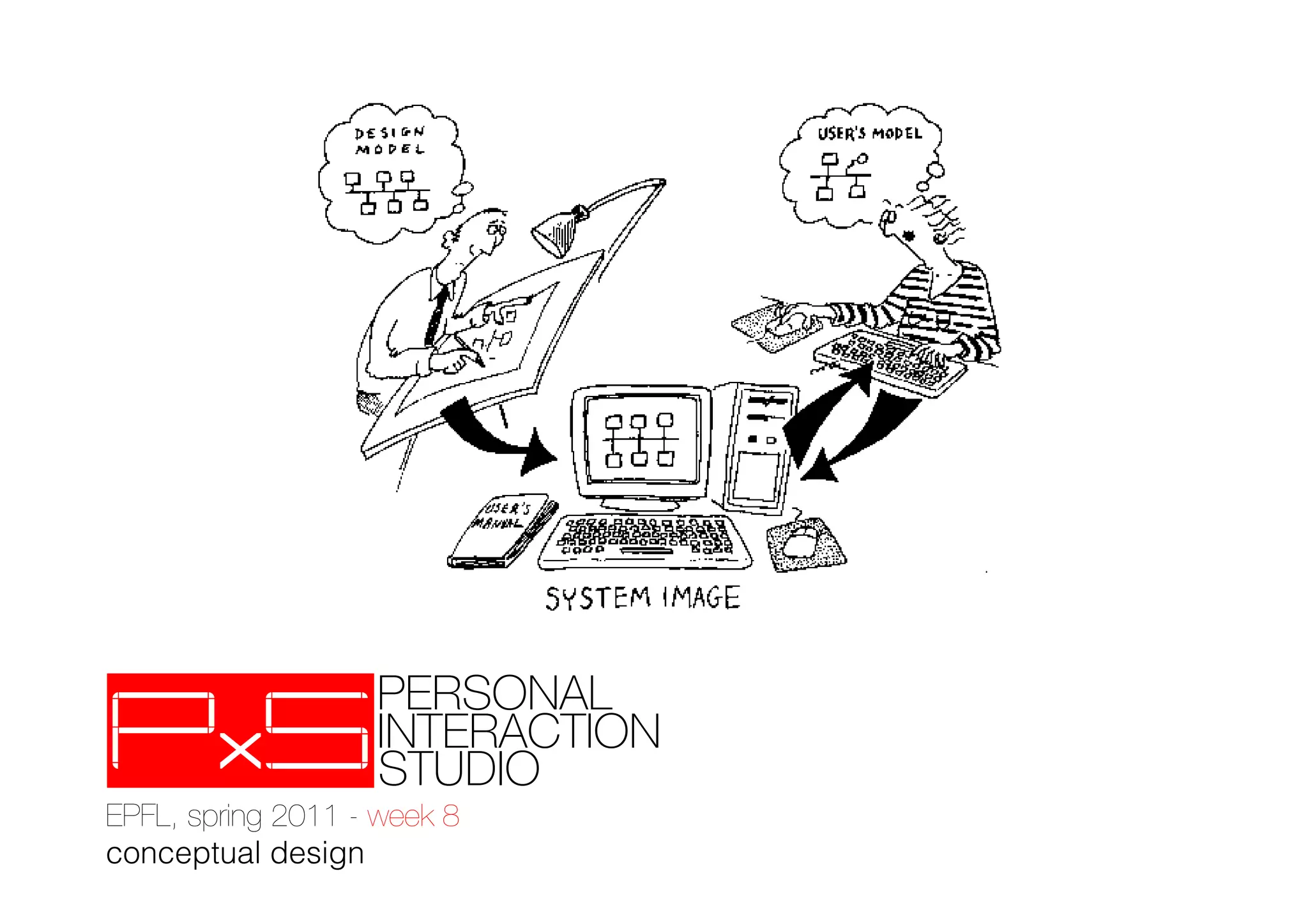
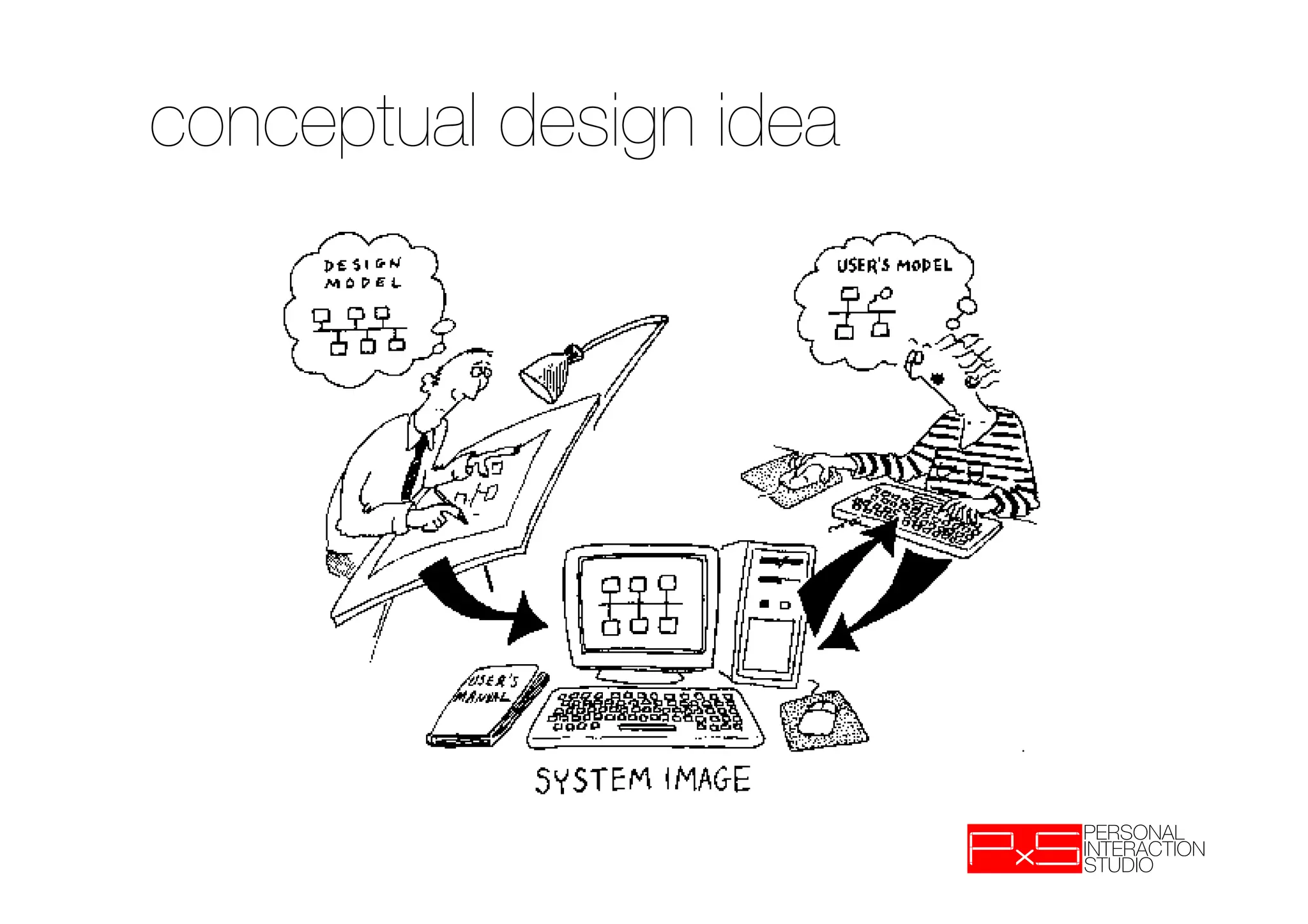
conceptual design idea
models, models & more muddles

   ➝  user s model/mental model
   ➝  design model/conceptual model
   ➝  system image
   ➝  user model
   ➝  metaphor
   ➝  analogy
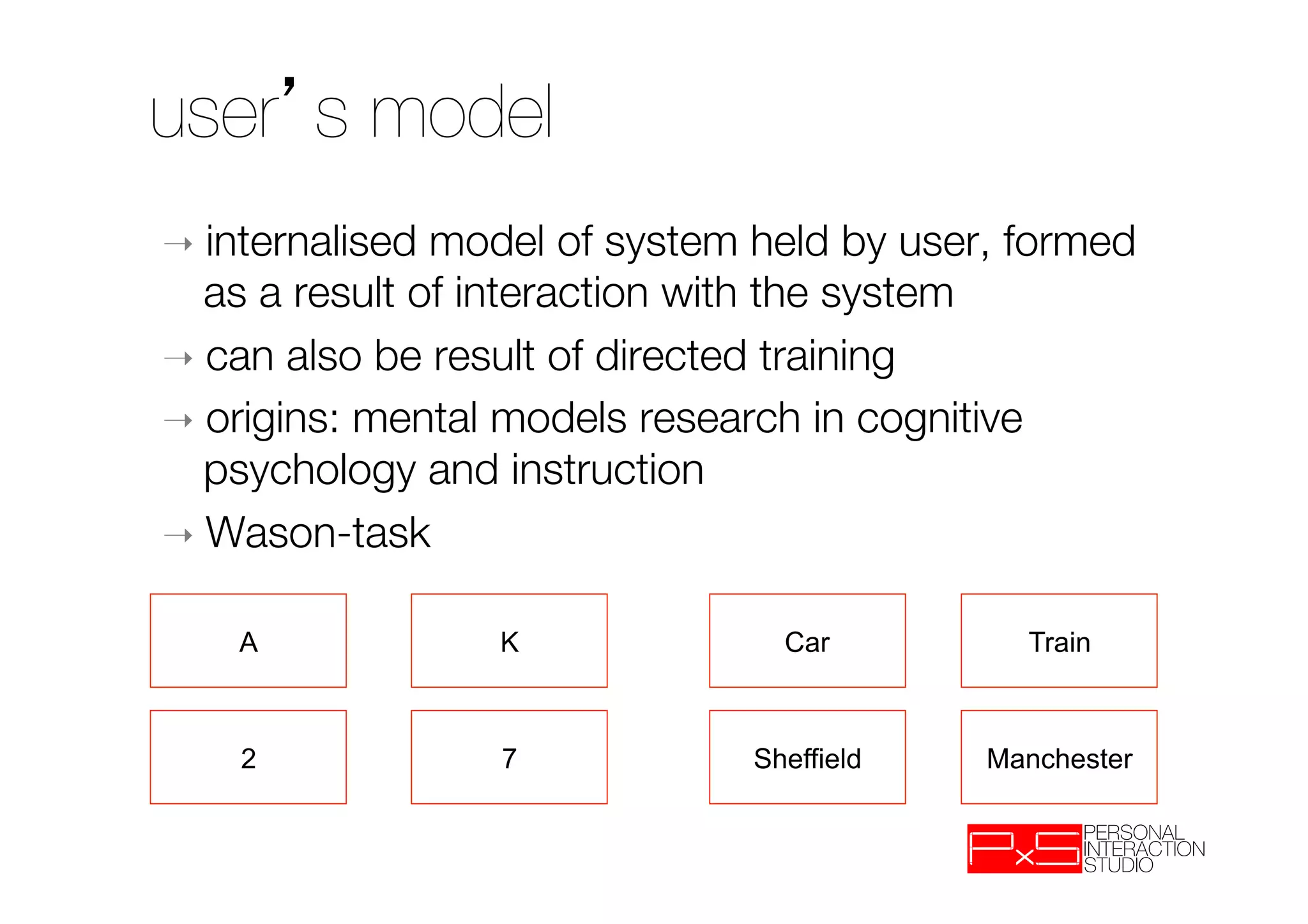
user s model
➝  internalised model of system held by user, formed
   as a result of interaction with the system 
➝  can also be result of directed training
➝  origins: mental models research in cognitive
   psychology and instruction
➝  Wason-task


    A             K              Car          Train


    2             7            Sheffield    Manchester
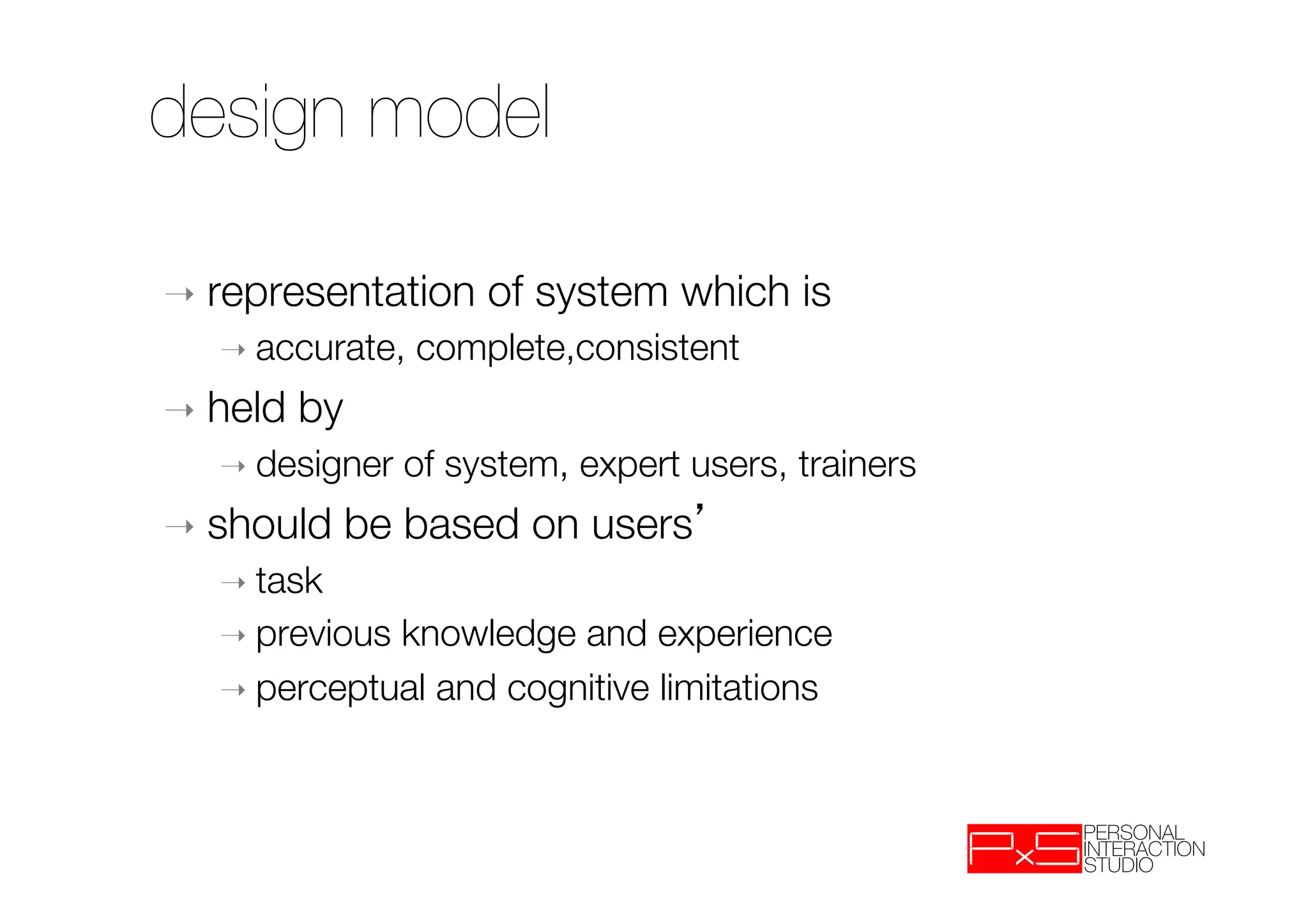
design model

➝  representation      of system which is
    ➝  accurate,   complete,consistent !
➝  held   by 
    ➝  designer   of system, expert users, trainers
➝  should      be based on users 
    ➝  task
    ➝  previousknowledge and experience
    ➝  perceptual and cognitive limitations
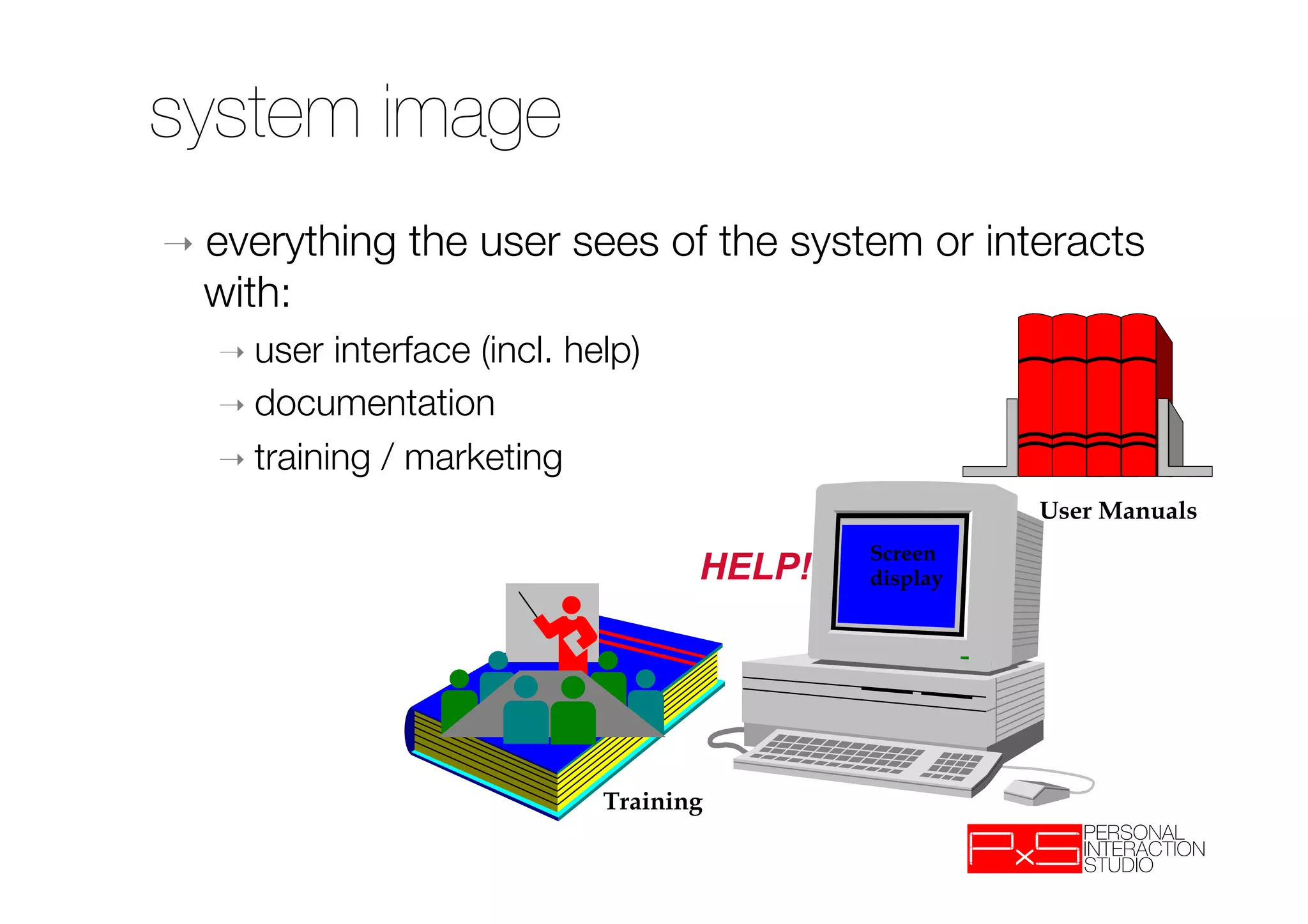
system image
➝  everything    the user sees of the system or interacts
  with:
   ➝  user  interface (incl. help)
   ➝  documentation
   ➝  training / marketing
                                                        User Manuals
                                              Screen
                                      HELP!   display


                               Training
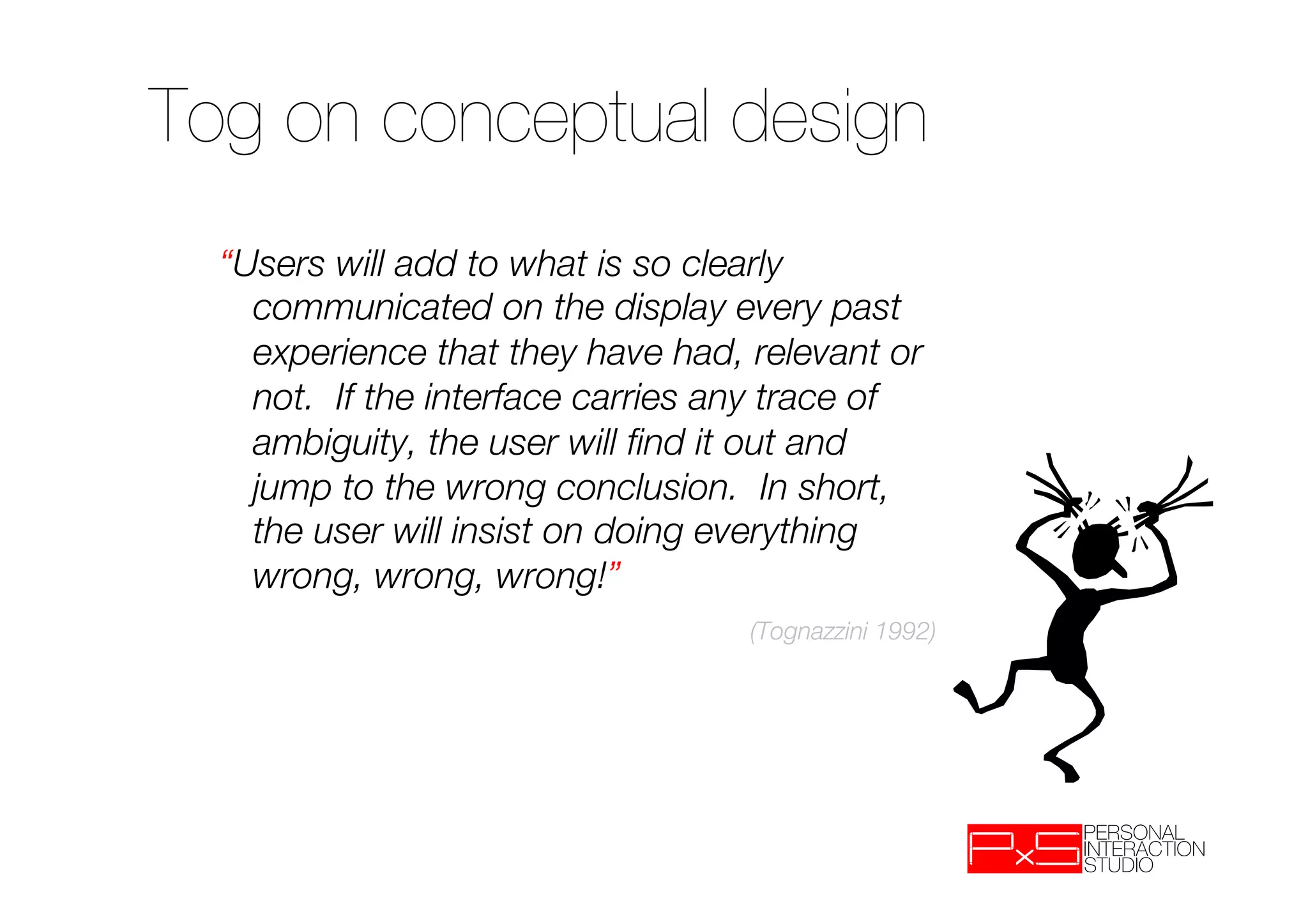
Tog on conceptual design
  “Users will add to what is so clearly
    communicated on the display every past
    experience that they have had, relevant or
    not. If the interface carries any trace of
    ambiguity, the user will find it out and
    jump to the wrong conclusion. In short,
    the user will insist on doing everything
    wrong, wrong, wrong!” 
                                   (Tognazzini 1992)
problems
➝    How to convert/integrate output of TA into a design
     model.
➝  How to identify users’ existing knowledge and
   experience which provides a basis for a design
       
model. 
➝  How to communicate a chosen design model through
   the user interface in a manner which supports the
   construction of an appropriate 
users’ model.


Sasse (1997)
how useful are user s models?
➝  users   will construct models, whether the designer
   aims for this or not
➝  trying to direct model-building process is
   worthwhile - but needs to be checked*
➝  can try to cue/exploit existing models (user tasks,
   related systems)
➝  it is often suggested that metaphors can be used
   for this purpose ...
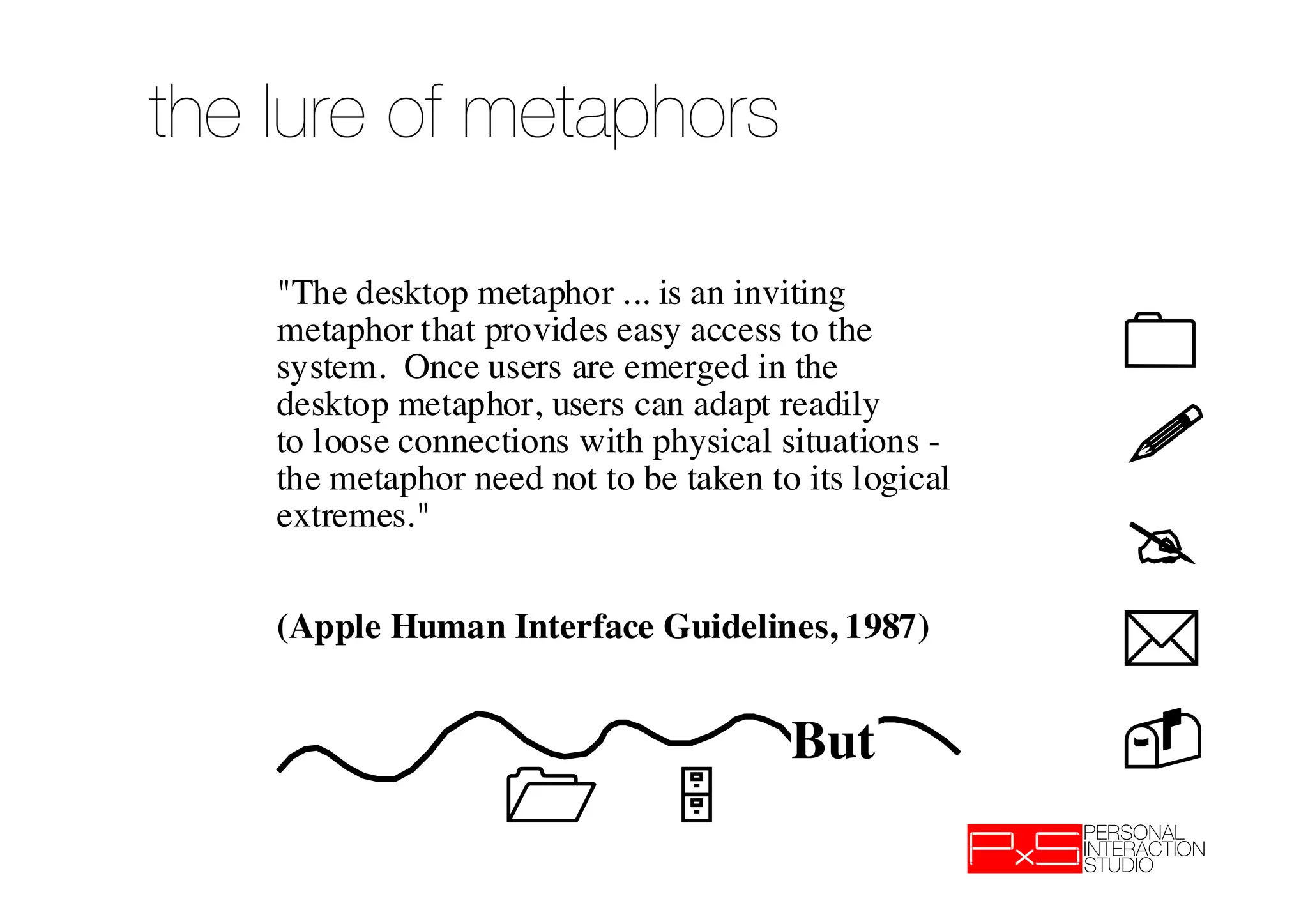
the lure of metaphors

    "The desktop metaphor ... is an inviting
    metaphor that provides easy access to the
    system. Once users are emerged in the              !
    desktop metaphor, users can adapt readily
    to loose connections with physical situations -
    the metaphor need not to be taken to its logical
                                                       !
    extremes."
                                                       !
    (Apple Human Interface Guidelines, 1987)
                                                       !
                                        But            !
                                      !
metaphor
➝  existing  model from a different domain which
   has similar structure to intended user s model 
➝  exploit user s existing knowledge and
   experience to construct appropriate user s
   model
➝  facilitate access and encourage exploration
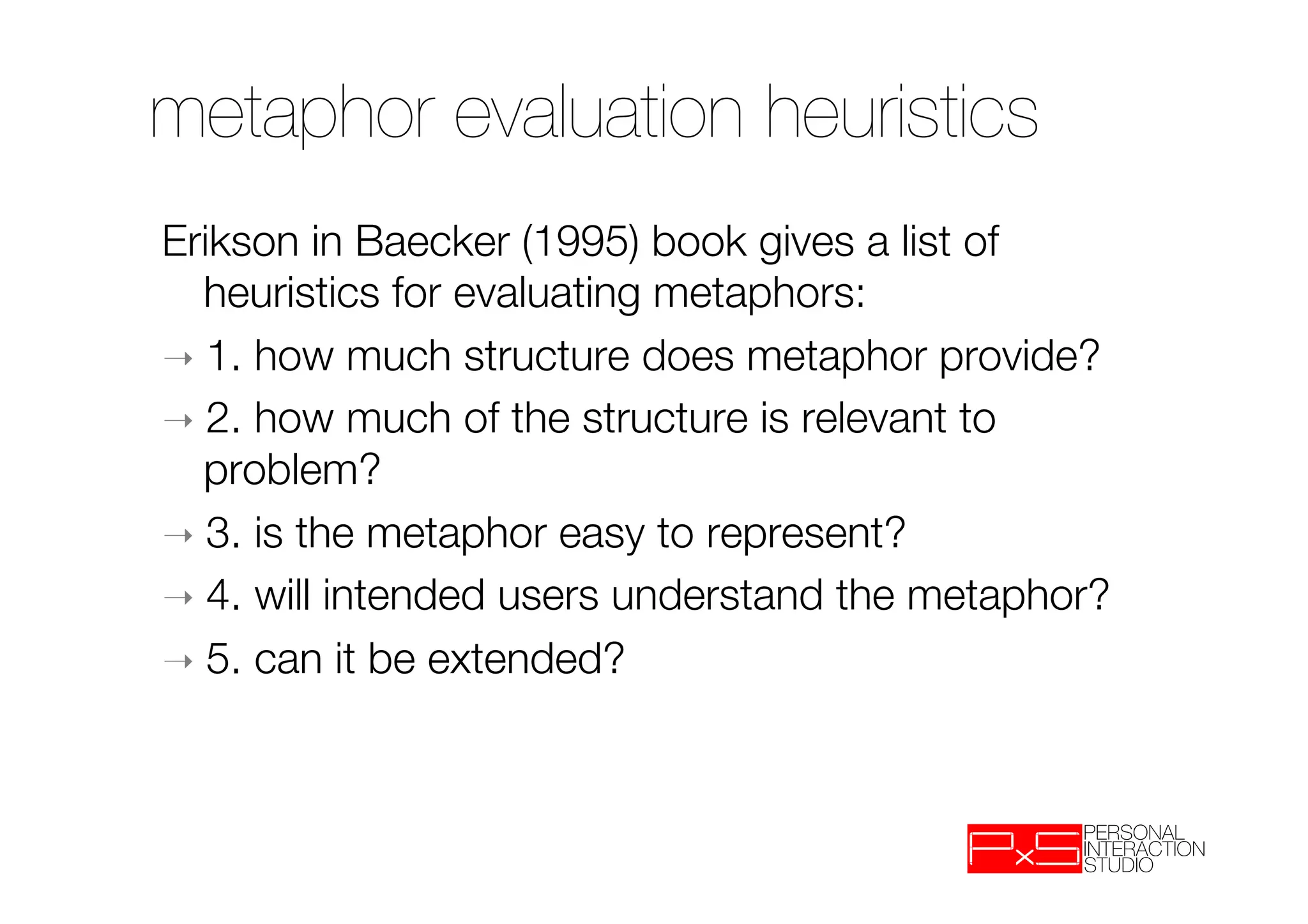
metaphor evaluation heuristics
Erikson in Baecker (1995) book gives a list of
   heuristics for evaluating metaphors:
➝  1. how much structure does metaphor provide?
➝  2. how much of the structure is relevant to
   problem?
➝  3. is the metaphor easy to represent?
➝  4. will intended users understand the metaphor?
➝  5. can it be extended?
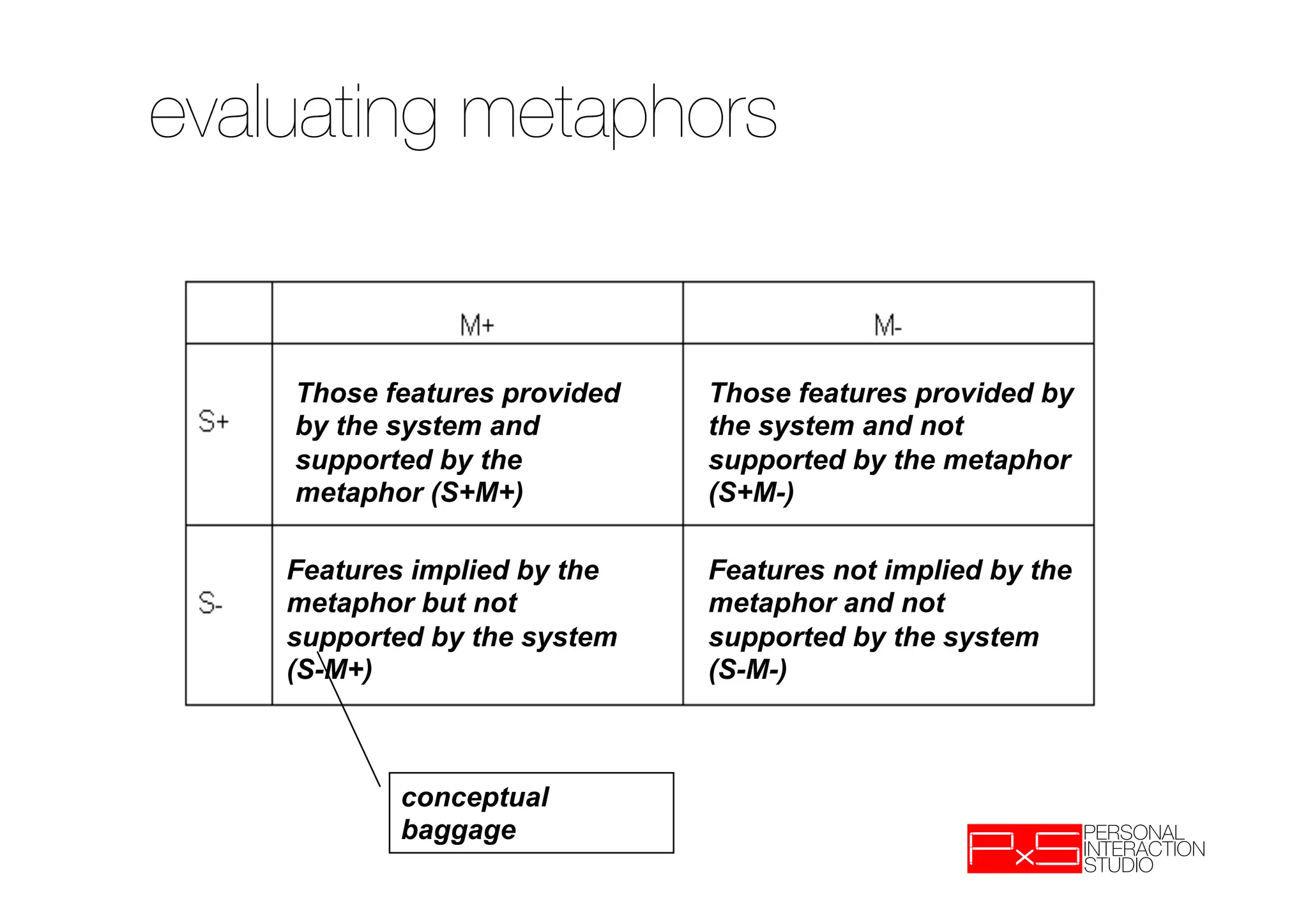
evaluating metaphors


    Those features provided   Those features provided by
    by the system and         the system and not
    supported by the          supported by the metaphor
    metaphor (S+M+)           (S+M-)

    Features implied by the   Features not implied by the
    metaphor but not          metaphor and not
    supported by the system   supported by the system
    (S-M+)                    (S-M-)


           conceptual
           baggage
evaluating metaphors


          conceptual baggage
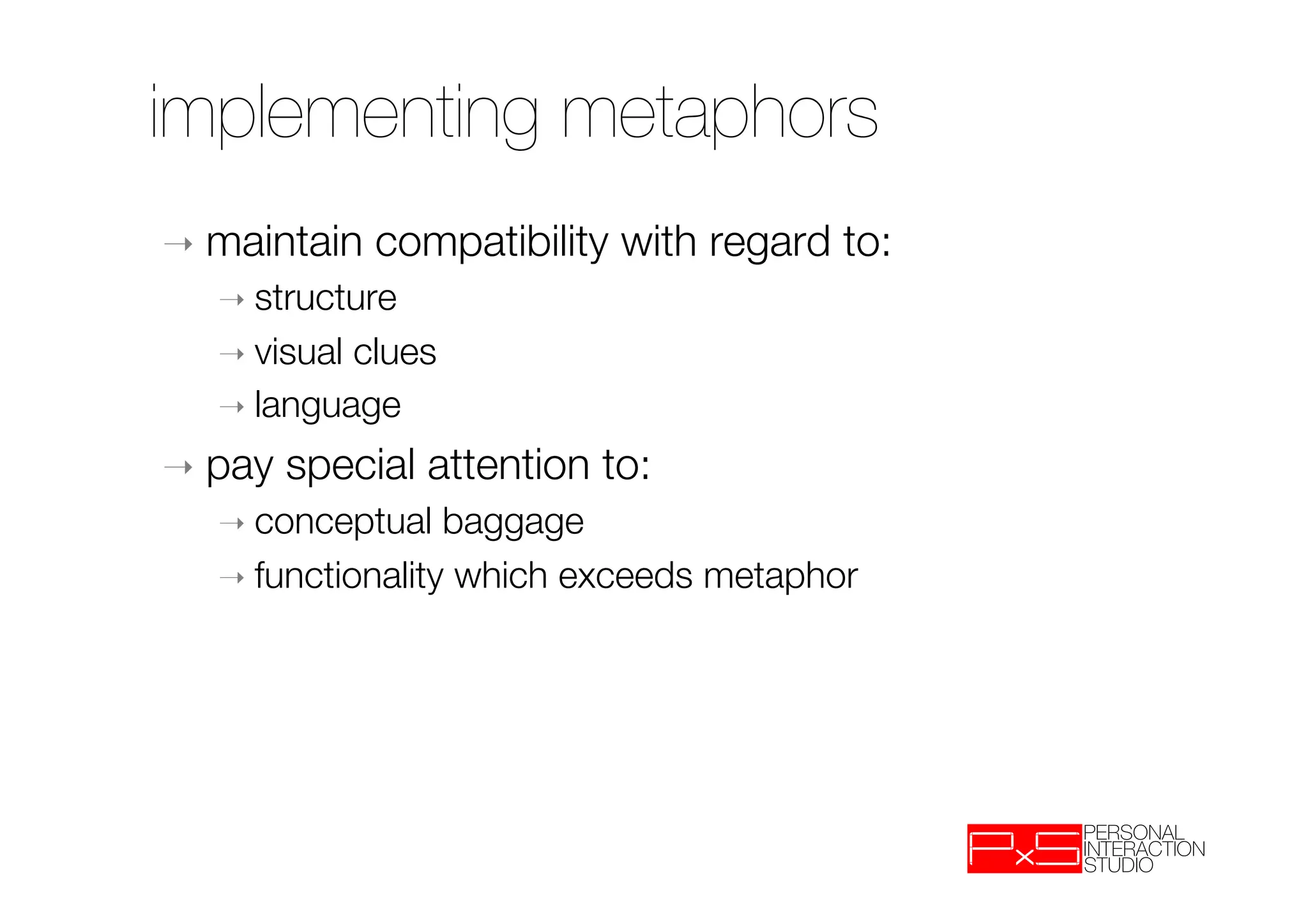
implementing metaphors
➝  maintain    compatibility with regard to:
   ➝  structure
   ➝  visualclues
   ➝  language

➝  pay   special attention to:
   ➝  conceptual   baggage
   ➝  functionality which exceeds metaphor
example: burglar alarm
  ➝  problem
    ➝  alarmstoo difficult to use; users don’t arm them
    ➝  occupied buildings are strongest deterrent

  ➝  analogy - car central locking
  ➝  design model: central locking plus home
     aware
  ➝  system image
    ➝  simple:  how to alarm
    ➝  friendly (non-technical)
evaluating users’ models (UCs)
➝  problem:   user performance cannot be taken as
   reliable indicator of user’s models
➝  important to elicit user’s models, but
   ➝  paper-and-pencil tests are not a good predictor of
     hands-on performance
   ➝  verbalising changes thought process

➝  best:   interactive methods
   ➝  constructive   interaction
   ➝  teach-back
carrying out conceptual design

➝  conceptual   design process is an idea; not much
   tool support
➝  suitable methods around, but need to be
   integrated in conceptual design process
➝  build up a repository of tools which can be used in
   each of the conceptual design stages
➝  Conceptual Designer’s Toolbox
conceptual design toolbox (1)
1. eliciting users’ model of task
   ➝  task   analysis
2. eliciting users’ relevant knowledge and experience
   ➝  scenarios
   ➝  contemporary       legends
   ➝  help
         desks
   ➝  FAQs

3. metaphor evaluation
   ➝  Anderson     et al. framework
conceptual design toolbox (2)
4. constructing design model
   ➝  extend  or merge metaphors or analogies
   ➝  structural model (as opposed to procedural model)
   ➝  creative design methods

5. implementing design model in system image
   ➝  linguistic,
                structural and visual consistency
   ➝  interviews, scenarios, conceptual maps
   ➝  grounded theory (ID concepts, relationships, structures)

6. Evaluation
   ➝  verbalprotocols 
   ➝  drawings 
   ➝  constructive interaction, teach back
summary points
➝    users form internal representations of (mental models) of
     systems they interact with.

➝    an appropriate model facilitates user system interaction, an
     inappropriate one is likely to impair it.

➝    models can be communicated through UI (appearance and
     behaviour) and training, but fit with users existing
     knowledge and experience is crucial.

➝    metaphors can be used as basis of design model.
literature
Anderson, B., Smyth, M., Knott, R., Bergan, J., Alty, J. (1994): Minimising
Conceptual Baggage: Making choices about metaphor. In G. Cockton, S. Draper
& G. Weir: People and Computers IX -Proceedings of HCI 94, Glasgow, pp
179-194.
Gentner, S. & Stevens, A. L. [Eds.] (1983): Mental Models. Hillsdale, NJ: Erlbaum.
Johnson-Laird, P. N. (1983): Mental Models. Cambridge: Cambridge University
Press.
Nielsen, J. (1990): A Meta-Model for Interacting with Computers. Interacting with
Computers,2, 147-160.
Norman, D.A. (1986). Cognitive Engineering. In Norman & Draper [Eds.] User-
Centered System Design, 1986, Hillsdale, NY: LEA.
Norman, D. A. & Draper, S. W. [Eds.] (1986): User-Centered System Design.
Hillsdale, NY: LEA.
Robert, D., Berry, D., Mullaly, J. Isensee, S. (1998): Designing for the User with
OVID: Bridging User Interface Desing and Software Engineering. Macmillan
Technical Pub.
Tognazzini, B. (1992): Tog on Interface. Reading, Mass.: Addison-Wesley.

EPFL - PxS, week 8 - conceptual design

  • 1.
    EPFL, spring 2011- week 8! conceptual design
  • 2.
    objectives of thislecture ➝  know the different types of models which are relevant to the HCI design process. ➝  understand how ➝  models influence users interaction with the system ➝  conceptual design aims to exploit this. ➝  appreciate problems with applying conceptual design approach. This lecture is based on a conceptual design lecture by Angela Sasse (UCL)
  • 3.
  • 4.
    models, models &more muddles ➝  user s model/mental model ➝  design model/conceptual model ➝  system image ➝  user model ➝  metaphor ➝  analogy
  • 5.
    user s model ➝ internalised model of system held by user, formed as a result of interaction with the system ➝  can also be result of directed training ➝  origins: mental models research in cognitive psychology and instruction ➝  Wason-task A K Car Train 2 7 Sheffield Manchester
  • 6.
    design model ➝  representation of system which is ➝  accurate, complete,consistent ! ➝  held by ➝  designer of system, expert users, trainers ➝  should be based on users ➝  task ➝  previousknowledge and experience ➝  perceptual and cognitive limitations
  • 7.
    system image ➝  everything the user sees of the system or interacts with: ➝  user interface (incl. help) ➝  documentation ➝  training / marketing User Manuals Screen HELP! display Training
  • 8.
    Tog on conceptualdesign “Users will add to what is so clearly communicated on the display every past experience that they have had, relevant or not. If the interface carries any trace of ambiguity, the user will find it out and jump to the wrong conclusion. In short, the user will insist on doing everything wrong, wrong, wrong!” (Tognazzini 1992)
  • 9.
    problems ➝  How to convert/integrate output of TA into a design model. ➝  How to identify users’ existing knowledge and experience which provides a basis for a design model. ➝  How to communicate a chosen design model through the user interface in a manner which supports the construction of an appropriate users’ model. Sasse (1997)
  • 10.
    how useful areuser s models? ➝  users will construct models, whether the designer aims for this or not ➝  trying to direct model-building process is worthwhile - but needs to be checked* ➝  can try to cue/exploit existing models (user tasks, related systems) ➝  it is often suggested that metaphors can be used for this purpose ...
  • 11.
    the lure ofmetaphors "The desktop metaphor ... is an inviting metaphor that provides easy access to the system. Once users are emerged in the ! desktop metaphor, users can adapt readily to loose connections with physical situations - the metaphor need not to be taken to its logical ! extremes." ! (Apple Human Interface Guidelines, 1987) ! But !   !
  • 12.
    metaphor ➝  existing model from a different domain which has similar structure to intended user s model ➝  exploit user s existing knowledge and experience to construct appropriate user s model ➝  facilitate access and encourage exploration
  • 13.
    metaphor evaluation heuristics Eriksonin Baecker (1995) book gives a list of heuristics for evaluating metaphors: ➝  1. how much structure does metaphor provide? ➝  2. how much of the structure is relevant to problem? ➝  3. is the metaphor easy to represent? ➝  4. will intended users understand the metaphor? ➝  5. can it be extended?
  • 14.
    evaluating metaphors Those features provided Those features provided by by the system and the system and not supported by the supported by the metaphor metaphor (S+M+) (S+M-) Features implied by the Features not implied by the metaphor but not metaphor and not supported by the system supported by the system (S-M+) (S-M-) conceptual baggage
  • 15.
    evaluating metaphors conceptual baggage
  • 16.
    implementing metaphors ➝  maintain compatibility with regard to: ➝  structure ➝  visualclues ➝  language ➝  pay special attention to: ➝  conceptual baggage ➝  functionality which exceeds metaphor
  • 17.
    example: burglar alarm ➝  problem ➝  alarmstoo difficult to use; users don’t arm them ➝  occupied buildings are strongest deterrent ➝  analogy - car central locking ➝  design model: central locking plus home aware ➝  system image ➝  simple: how to alarm ➝  friendly (non-technical)
  • 18.
    evaluating users’ models(UCs) ➝  problem: user performance cannot be taken as reliable indicator of user’s models ➝  important to elicit user’s models, but ➝  paper-and-pencil tests are not a good predictor of hands-on performance ➝  verbalising changes thought process ➝  best: interactive methods ➝  constructive interaction ➝  teach-back
  • 19.
    carrying out conceptualdesign ➝  conceptual design process is an idea; not much tool support ➝  suitable methods around, but need to be integrated in conceptual design process ➝  build up a repository of tools which can be used in each of the conceptual design stages ➝  Conceptual Designer’s Toolbox
  • 20.
    conceptual design toolbox(1) 1. eliciting users’ model of task ➝  task analysis 2. eliciting users’ relevant knowledge and experience ➝  scenarios ➝  contemporary legends ➝  help desks ➝  FAQs 3. metaphor evaluation ➝  Anderson et al. framework
  • 21.
    conceptual design toolbox(2) 4. constructing design model ➝  extend or merge metaphors or analogies ➝  structural model (as opposed to procedural model) ➝  creative design methods 5. implementing design model in system image ➝  linguistic, structural and visual consistency ➝  interviews, scenarios, conceptual maps ➝  grounded theory (ID concepts, relationships, structures) 6. Evaluation ➝  verbalprotocols ➝  drawings ➝  constructive interaction, teach back
  • 22.
    summary points ➝  users form internal representations of (mental models) of systems they interact with. ➝  an appropriate model facilitates user system interaction, an inappropriate one is likely to impair it. ➝  models can be communicated through UI (appearance and behaviour) and training, but fit with users existing knowledge and experience is crucial. ➝  metaphors can be used as basis of design model.
  • 23.
    literature Anderson, B., Smyth,M., Knott, R., Bergan, J., Alty, J. (1994): Minimising Conceptual Baggage: Making choices about metaphor. In G. Cockton, S. Draper & G. Weir: People and Computers IX -Proceedings of HCI 94, Glasgow, pp 179-194. Gentner, S. & Stevens, A. L. [Eds.] (1983): Mental Models. Hillsdale, NJ: Erlbaum. Johnson-Laird, P. N. (1983): Mental Models. Cambridge: Cambridge University Press. Nielsen, J. (1990): A Meta-Model for Interacting with Computers. Interacting with Computers,2, 147-160. Norman, D.A. (1986). Cognitive Engineering. In Norman & Draper [Eds.] User- Centered System Design, 1986, Hillsdale, NY: LEA. Norman, D. A. & Draper, S. W. [Eds.] (1986): User-Centered System Design. Hillsdale, NY: LEA. Robert, D., Berry, D., Mullaly, J. Isensee, S. (1998): Designing for the User with OVID: Bridging User Interface Desing and Software Engineering. Macmillan Technical Pub. Tognazzini, B. (1992): Tog on Interface. Reading, Mass.: Addison-Wesley.