Project Management &
Project Structure
Deepak Mehtani
Deputy Director Project Execution & Delivery
Unlimited Innovation Inc.
Topics
 Cost & Budgeting
 What You Already Have
 Introduction
 What Does Project
Structure Include?

 What Are The Key Areas?
 Utilizing WBS
 Know The Stakeholders
 Know Your Team
 Build Team For Success

 ROI With Structured
Approach
 Quality Process
 Senior Management
Review

 Organization Project
Charter
 Sample Documents
 Overall Process

 Training
2

www.UIUS.com
Introduction
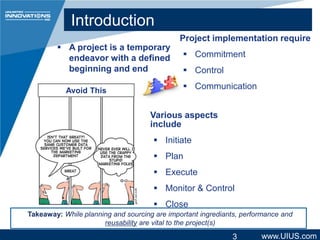
 A project is a temporary
endeavor with a defined
beginning and end
Avoid This

Project implementation require
 Commitment
 Control
 Communication

Various aspects
include

 Initiate
 Plan
 Execute
 Monitor & Control
 Close
Takeaway: While planning and sourcing are important ingrediants, performance and
reusability are vital to the project(s)

3

www.UIUS.com
What Does Project Structure Include?
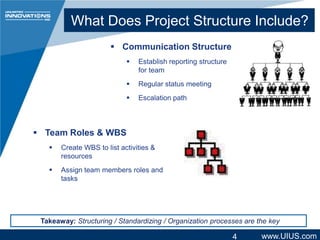
 Communication Structure


Establish reporting structure
for team



Regular status meeting



Escalation path

 Team Roles & WBS


Create WBS to list activities &
resources



Assign team members roles and
tasks

Takeaway: Structuring / Standardizing / Organization processes are the key

4

www.UIUS.com
What Does Project Structure Include?
 Project Documentation
Structure


Use standard templates



Set documentation standard



Set reporting standard and access

 Change Control Structure


 Risk Management

Define change management



Adjustment to plan and scope



Plan for risk



Use preventive techniques – part of QA and
process



Identify high-risk components

5

www.UIUS.com
What Are The Key Areas?
Project Planning


Documentation – include project brief, schedule, execution
plan, deployment plan and technical specification



Enables using standardization process



Provide traceability



May slow down process



Verification & validation process & documentation



Change log document



Plan = description of activities + budget + schedule

Quality Assurance (QA)


External process



Validates everything is happening per documents and
organization process



Can be done at any step or phase of a project

6

www.UIUS.com
Utilizing WBS
Utilizing Work Breakdown Structure
(WBS)


Essential to project lifecycle and timeline



Helps in defining tasks for a project



Makes it easier for stakeholders to understand
scope



It is much easier to manage a project when it is
split into smaller component


Easy to assign, understand, execute &
report

Takeaway: While WBS is important, we should no lose focus of the key deliverables

7

www.UIUS.com
Know The Stakeholders
Relevant stakeholders must be identified


Plan their involvement



Should have organization-wide approach



Approach should be tailored to specific project

Takeaway: Program Management Plan template, Stakeholder Management Plan
template, sample Project Stakeholder Mgmt plans

8

www.UIUS.com
Know Your Team
An effective project team has combination of
skills, experience, motivation & teamwork


Team members are vital to success of a project



Team selection for the skills required for the project



Organization level training and project specific training



Promote contribution and collaboration



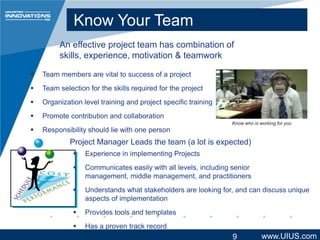
Know who is working for you

Responsibility should lie with one person

Project Manager Leads the team (a lot is expected)


Experience in implementing Projects



Communicates easily with all levels, including senior
management, middle management, and practitioners



Understands what stakeholders are looking for, and can discuss unique
aspects of implementation



Provides tools and templates



Has a proven track record

9

www.UIUS.com
Build Team For Success
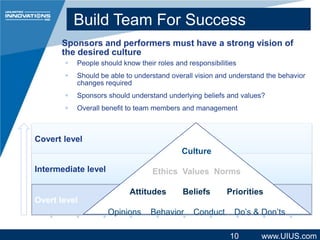
Sponsors and performers must have a strong vision of
the desired culture


People should know their roles and responsibilities



Should be able to understand overall vision and understand the behavior
changes required



Sponsors should understand underlying beliefs and values?



Overall benefit to team members and management

Covert level
Culture
Intermediate level

Ethics Values Norms
Attitudes

Beliefs

Priorities

Overt level
Opinions

Behavior

Conduct

Do’s & Don’ts
10

www.UIUS.com
Training
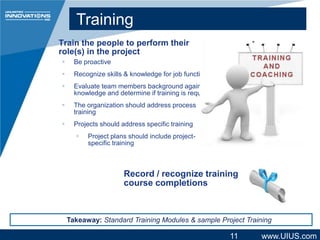
Train the people to perform their
role(s) in the project


Be proactive



Recognize skills & knowledge for job function



Evaluate team members background against
knowledge and determine if training is required



The organization should address process
training



Projects should address specific training


Project plans should include projectspecific training

Record / recognize training
course completions

Takeaway: Standard Training Modules & sample Project Training

11

www.UIUS.com
Cost & Budgeting
Cost & Budget is very important to project execution


Use organization workflow for estimation process


Estimate each task



Take technical input



Input from PM regarding value proposition



Get the project cost together



Identify risks associated with tasks and assign risk percentage



Combination of tasks estimates and risk associated with form the project
budget

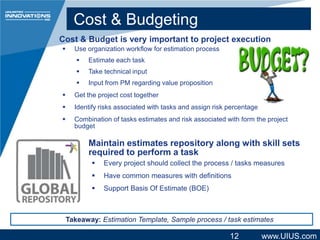
Maintain estimates repository along with skill sets
required to perform a task


Every project should collect the process / tasks measures



Have common measures with definitions



Support Basis Of Estimate (BOE)

Takeaway: Estimation Template, Sample process / task estimates

12

www.UIUS.com
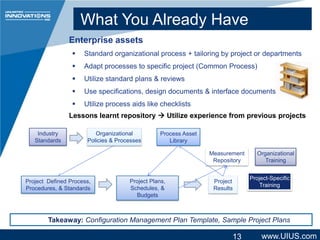
What You Already Have
Enterprise assets


Standard organizational process + tailoring by project or departments



Adapt processes to specific project (Common Process)



Utilize standard plans & reviews



Use specifications, design documents & interface documents



Utilize process aids like checklists

Lessons learnt repository  Utilize experience from previous projects
Industry
Standards

Organizational
Policies & Processes

Process Asset
Library
Measurement
Repository

Project Defined Process,
Procedures, & Standards

Project Plans,
Schedules, &
Budgets

Project
Results

Organizational
Training
Project-Specific
Training

Takeaway: Configuration Management Plan Template, Sample Project Plans

13

www.UIUS.com
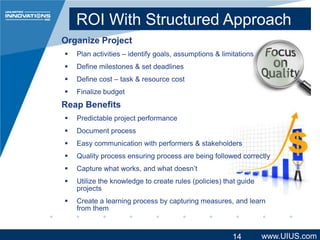
ROI With Structured Approach
Organize Project


Plan activities – identify goals, assumptions & limitations



Define milestones & set deadlines



Define cost – task & resource cost



Finalize budget

Reap Benefits


Predictable project performance



Document process



Easy communication with performers & stakeholders



Quality process ensuring process are being followed correctly



Capture what works, and what doesn’t



Utilize the knowledge to create rules (policies) that guide
projects



Create a learning process by capturing measures, and learn
from them

14

www.UIUS.com
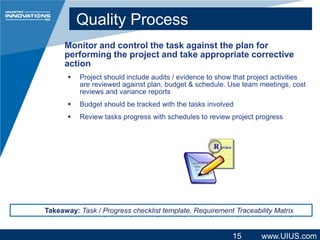
Quality Process
Monitor and control the task against the plan for
performing the project and take appropriate corrective
action


Project should include audits / evidence to show that project activities
are reviewed against plan, budget & schedule. Use team meetings, cost
reviews and variance reports



Budget should be tracked with the tasks involved



Review tasks progress with schedules to review project progress

Takeaway: Task / Progress checklist template, Requirement Traceability Matrix

15

www.UIUS.com
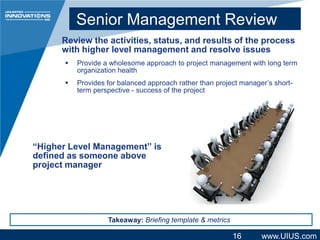
Senior Management Review
Review the activities, status, and results of the process
with higher level management and resolve issues


Provide a wholesome approach to project management with long term
organization health



Provides for balanced approach rather than project manager’s shortterm perspective - success of the project

“Higher Level Management” is
defined as someone above
project manager

Takeaway: Briefing template & metrics

16

www.UIUS.com
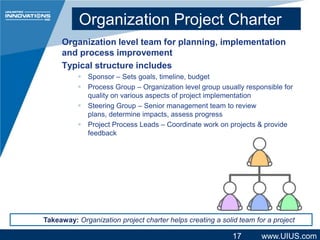
Organization Project Charter
Organization level team for planning, implementation
and process improvement
Typical structure includes
 Sponsor – Sets goals, timeline, budget
 Process Group – Organization level group usually responsible for
quality on various aspects of project implementation
 Steering Group – Senior management team to review
plans, determine impacts, assess progress
 Project Process Leads – Coordinate work on projects & provide
feedback

Takeaway: Organization project charter helps creating a solid team for a project

17

www.UIUS.com
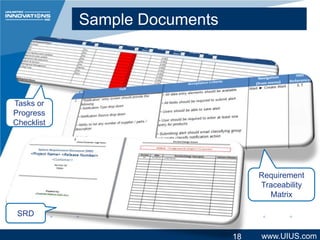
Sample Documents

Tasks or
Progress
Checklist

Requirement
Traceability
Matrix
SRD
18

www.UIUS.com
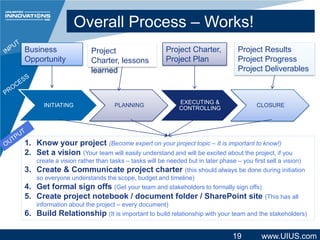
Overall Process – Works!
Business
Opportunity

INITIATING

Project
Charter, lessons
learned

PLANNING

Project Charter,
Project Plan

Project Results
Project Progress
Project Deliverables

EXECUTING &
CONTROLLING

CLOSURE

1. Know your project (Become expert on your project topic – It is important to know!)
2. Set a vision (Your team will easily understand and will be excited about the project, if you
3.

create a vision rather than tasks – tasks will be needed but in later phase – you first sell a vision)
Create & Communicate project charter (this should always be done during initiation
so everyone understands the scope, budget and timeline)
Get formal sign offs (Get your team and stakeholders to formally sign offs)

4.
5. Create project notebook / document folder / SharePoint site (This has all
6.

information about the project – every document)
Build Relationship (It is important to build relationship with your team and the stakeholders)

19

www.UIUS.com
References
 Project Management Institute (PMI) http://www.pmi.org/

 Software Engineering Institute – CMMI (Capability
Maturity Model Integration)
http://www.sei.cmu.edu/cmmi/
 ProjectManager.com (http://www.projectmanager.com/)

 Pictures or icons taken from internet

20

www.UIUS.com
Thank You!
Deepak Mehtani
dmehtani@uius.com

Pmi presentation structuring project v2

  • 1.
    Project Management & ProjectStructure Deepak Mehtani Deputy Director Project Execution & Delivery Unlimited Innovation Inc.
  • 2.
    Topics  Cost &Budgeting  What You Already Have  Introduction  What Does Project Structure Include?  What Are The Key Areas?  Utilizing WBS  Know The Stakeholders  Know Your Team  Build Team For Success  ROI With Structured Approach  Quality Process  Senior Management Review  Organization Project Charter  Sample Documents  Overall Process  Training 2 www.UIUS.com
  • 3.
    Introduction  A projectis a temporary endeavor with a defined beginning and end Avoid This Project implementation require  Commitment  Control  Communication Various aspects include  Initiate  Plan  Execute  Monitor & Control  Close Takeaway: While planning and sourcing are important ingrediants, performance and reusability are vital to the project(s) 3 www.UIUS.com
  • 4.
    What Does ProjectStructure Include?  Communication Structure  Establish reporting structure for team  Regular status meeting  Escalation path  Team Roles & WBS  Create WBS to list activities & resources  Assign team members roles and tasks Takeaway: Structuring / Standardizing / Organization processes are the key 4 www.UIUS.com
  • 5.
    What Does ProjectStructure Include?  Project Documentation Structure  Use standard templates  Set documentation standard  Set reporting standard and access  Change Control Structure   Risk Management Define change management  Adjustment to plan and scope  Plan for risk  Use preventive techniques – part of QA and process  Identify high-risk components 5 www.UIUS.com
  • 6.
    What Are TheKey Areas? Project Planning  Documentation – include project brief, schedule, execution plan, deployment plan and technical specification  Enables using standardization process  Provide traceability  May slow down process  Verification & validation process & documentation  Change log document  Plan = description of activities + budget + schedule Quality Assurance (QA)  External process  Validates everything is happening per documents and organization process  Can be done at any step or phase of a project 6 www.UIUS.com
  • 7.
    Utilizing WBS Utilizing WorkBreakdown Structure (WBS)  Essential to project lifecycle and timeline  Helps in defining tasks for a project  Makes it easier for stakeholders to understand scope  It is much easier to manage a project when it is split into smaller component  Easy to assign, understand, execute & report Takeaway: While WBS is important, we should no lose focus of the key deliverables 7 www.UIUS.com
  • 8.
    Know The Stakeholders Relevantstakeholders must be identified  Plan their involvement  Should have organization-wide approach  Approach should be tailored to specific project Takeaway: Program Management Plan template, Stakeholder Management Plan template, sample Project Stakeholder Mgmt plans 8 www.UIUS.com
  • 9.
    Know Your Team Aneffective project team has combination of skills, experience, motivation & teamwork  Team members are vital to success of a project  Team selection for the skills required for the project  Organization level training and project specific training  Promote contribution and collaboration  Know who is working for you Responsibility should lie with one person Project Manager Leads the team (a lot is expected)  Experience in implementing Projects  Communicates easily with all levels, including senior management, middle management, and practitioners  Understands what stakeholders are looking for, and can discuss unique aspects of implementation  Provides tools and templates  Has a proven track record 9 www.UIUS.com
  • 10.
    Build Team ForSuccess Sponsors and performers must have a strong vision of the desired culture  People should know their roles and responsibilities  Should be able to understand overall vision and understand the behavior changes required  Sponsors should understand underlying beliefs and values?  Overall benefit to team members and management Covert level Culture Intermediate level Ethics Values Norms Attitudes Beliefs Priorities Overt level Opinions Behavior Conduct Do’s & Don’ts 10 www.UIUS.com
  • 11.
    Training Train the peopleto perform their role(s) in the project  Be proactive  Recognize skills & knowledge for job function  Evaluate team members background against knowledge and determine if training is required  The organization should address process training  Projects should address specific training  Project plans should include projectspecific training Record / recognize training course completions Takeaway: Standard Training Modules & sample Project Training 11 www.UIUS.com
  • 12.
    Cost & Budgeting Cost& Budget is very important to project execution  Use organization workflow for estimation process  Estimate each task  Take technical input  Input from PM regarding value proposition  Get the project cost together  Identify risks associated with tasks and assign risk percentage  Combination of tasks estimates and risk associated with form the project budget Maintain estimates repository along with skill sets required to perform a task  Every project should collect the process / tasks measures  Have common measures with definitions  Support Basis Of Estimate (BOE) Takeaway: Estimation Template, Sample process / task estimates 12 www.UIUS.com
  • 13.
    What You AlreadyHave Enterprise assets  Standard organizational process + tailoring by project or departments  Adapt processes to specific project (Common Process)  Utilize standard plans & reviews  Use specifications, design documents & interface documents  Utilize process aids like checklists Lessons learnt repository  Utilize experience from previous projects Industry Standards Organizational Policies & Processes Process Asset Library Measurement Repository Project Defined Process, Procedures, & Standards Project Plans, Schedules, & Budgets Project Results Organizational Training Project-Specific Training Takeaway: Configuration Management Plan Template, Sample Project Plans 13 www.UIUS.com
  • 14.
    ROI With StructuredApproach Organize Project  Plan activities – identify goals, assumptions & limitations  Define milestones & set deadlines  Define cost – task & resource cost  Finalize budget Reap Benefits  Predictable project performance  Document process  Easy communication with performers & stakeholders  Quality process ensuring process are being followed correctly  Capture what works, and what doesn’t  Utilize the knowledge to create rules (policies) that guide projects  Create a learning process by capturing measures, and learn from them 14 www.UIUS.com
  • 15.
    Quality Process Monitor andcontrol the task against the plan for performing the project and take appropriate corrective action  Project should include audits / evidence to show that project activities are reviewed against plan, budget & schedule. Use team meetings, cost reviews and variance reports  Budget should be tracked with the tasks involved  Review tasks progress with schedules to review project progress Takeaway: Task / Progress checklist template, Requirement Traceability Matrix 15 www.UIUS.com
  • 16.
    Senior Management Review Reviewthe activities, status, and results of the process with higher level management and resolve issues  Provide a wholesome approach to project management with long term organization health  Provides for balanced approach rather than project manager’s shortterm perspective - success of the project “Higher Level Management” is defined as someone above project manager Takeaway: Briefing template & metrics 16 www.UIUS.com
  • 17.
    Organization Project Charter Organizationlevel team for planning, implementation and process improvement Typical structure includes  Sponsor – Sets goals, timeline, budget  Process Group – Organization level group usually responsible for quality on various aspects of project implementation  Steering Group – Senior management team to review plans, determine impacts, assess progress  Project Process Leads – Coordinate work on projects & provide feedback Takeaway: Organization project charter helps creating a solid team for a project 17 www.UIUS.com
  • 18.
  • 19.
    Overall Process –Works! Business Opportunity INITIATING Project Charter, lessons learned PLANNING Project Charter, Project Plan Project Results Project Progress Project Deliverables EXECUTING & CONTROLLING CLOSURE 1. Know your project (Become expert on your project topic – It is important to know!) 2. Set a vision (Your team will easily understand and will be excited about the project, if you 3. create a vision rather than tasks – tasks will be needed but in later phase – you first sell a vision) Create & Communicate project charter (this should always be done during initiation so everyone understands the scope, budget and timeline) Get formal sign offs (Get your team and stakeholders to formally sign offs) 4. 5. Create project notebook / document folder / SharePoint site (This has all 6. information about the project – every document) Build Relationship (It is important to build relationship with your team and the stakeholders) 19 www.UIUS.com
  • 20.
    References  Project ManagementInstitute (PMI) http://www.pmi.org/  Software Engineering Institute – CMMI (Capability Maturity Model Integration) http://www.sei.cmu.edu/cmmi/  ProjectManager.com (http://www.projectmanager.com/)  Pictures or icons taken from internet 20 www.UIUS.com
  • 21.

Editor's Notes

  • #4 Avoid the cartoon  How? Quality