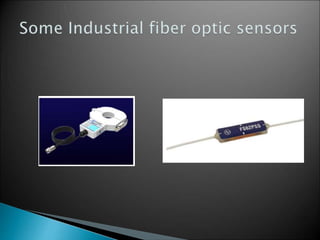
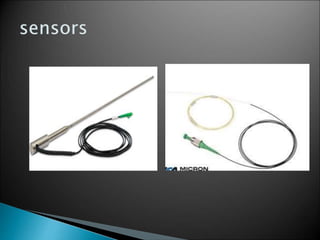
 Optical Fibers are made up of transparent dielectric whose
function to guide light over long distance
 In industries, fiber optic sensors used to monitor quantities such
as displacement, pressure, Temperature and flow rate.
 Fiber optics are essentially light pipes. The group of sensors
known as fiber optic thermometers generally refer to those
devices measuring higher temperatures wherein blackbody
radiation physics are utilized.
 Lower temperature targets say from -100°C to 400°C- can be
measured by activating various sensing materials such as
phosphors, semiconductors or liquid crystals with fiber optic
links offering the environmental and remoteness advantages.
 Output range can be - 100°C to 1600°C also.
 Completely passive: can be used in explosive environment.
 Immune to electromagnetic interference: ideal for microwave
environment.
 Resistant to high temperatures and chemically reactive
environment: ideal for harsh and hostile environment
 Small size: ideal for embedding and surface mounting.
 High degree of biocompatibility, non-intrusive nature and
electromagnetic immune:
 Can monitor a wide range of physical and chemical
parameters, Remote operation
 Point sensors: the measurement is carried out at a single
point in space, but possibly multiple channels for addressing
multiple points.
Examples are Fabry-Perot sensors and single Fibre Bragg
Grating (FBG) sensors.
Integrated sensors: the measurement averages a physical
parameter over a certain spatial section and provides a single
value.
An example is a deformation sensor measuring strain
Quasi-distributed or multiplexed sensors: the measurand is
determined at a number of fixed, discrete points along a
single fibre optical cable.
Distributed sensor: the parameter of interest is measured
with a certain spatial resolution at any point along a single
optical cable.
Examples include systems based on Rayleigh, Raman and
It can be classified as
 Intrinsic fiber optic sensors
 Extrinsic fiber optic sensors
.
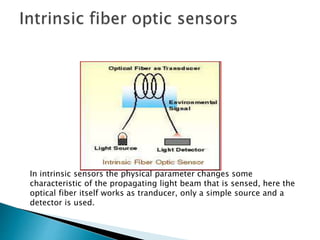
In intrinsic sensors the physical parameter changes some
characteristic of the propagating light beam that is sensed, here the
optical fiber itself works as tranducer, only a simple source and a
detector is used.
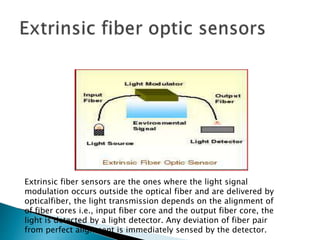
Extrinsic fiber sensors are the ones where the light signal
modulation occurs outside the optical fiber and are delivered by
opticalfiber, the light transmission depends on the alignment of
of fiber cores i.e., input fiber core and the output fiber core, the
light is detected by a light detector. Any deviation of fiber pair
from perfect alignment is immediately sensed by the detector.
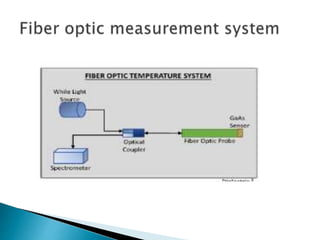
The system consist of:
 Light source
 Optical coupler
 Rugged Spectrometer
 Data processing and storage
 Thermocouple are too slow
 Fast response compared to others
 Can use long distance
 Suitable for explosive environment where
others NOT
 Not Susceptible to high voltage and magnetic
fields
 Good accuracy
 Unaffected by electromagnetic interference (EMI) from large
motors, transformers, welders and the like;
 Unaffected by radio frequency interference (RFI) from wireless
communications and lightning activity;
 Can be positioned in hard-to-reach or view places;
 Can be focused to measure small or precise locations;
 Fiber cables can be run in existing conduit, cable trays or be
strapped onto beams, pipes or conduit (easily installed for
expansions or retrofits);
 Certain cables can handle ambient temperatures to over
300°C--higher with air or water purging.
Thank You

Fibre optics sensor for Temperature measurement.ppt

  • 2.
     Optical Fibersare made up of transparent dielectric whose function to guide light over long distance  In industries, fiber optic sensors used to monitor quantities such as displacement, pressure, Temperature and flow rate.  Fiber optics are essentially light pipes. The group of sensors known as fiber optic thermometers generally refer to those devices measuring higher temperatures wherein blackbody radiation physics are utilized.  Lower temperature targets say from -100°C to 400°C- can be measured by activating various sensing materials such as phosphors, semiconductors or liquid crystals with fiber optic links offering the environmental and remoteness advantages.  Output range can be - 100°C to 1600°C also.
  • 3.
     Completely passive:can be used in explosive environment.  Immune to electromagnetic interference: ideal for microwave environment.  Resistant to high temperatures and chemically reactive environment: ideal for harsh and hostile environment  Small size: ideal for embedding and surface mounting.  High degree of biocompatibility, non-intrusive nature and electromagnetic immune:  Can monitor a wide range of physical and chemical parameters, Remote operation
  • 4.
     Point sensors:the measurement is carried out at a single point in space, but possibly multiple channels for addressing multiple points. Examples are Fabry-Perot sensors and single Fibre Bragg Grating (FBG) sensors. Integrated sensors: the measurement averages a physical parameter over a certain spatial section and provides a single value. An example is a deformation sensor measuring strain Quasi-distributed or multiplexed sensors: the measurand is determined at a number of fixed, discrete points along a single fibre optical cable. Distributed sensor: the parameter of interest is measured with a certain spatial resolution at any point along a single optical cable. Examples include systems based on Rayleigh, Raman and
  • 5.
    It can beclassified as  Intrinsic fiber optic sensors  Extrinsic fiber optic sensors .
  • 6.
    In intrinsic sensorsthe physical parameter changes some characteristic of the propagating light beam that is sensed, here the optical fiber itself works as tranducer, only a simple source and a detector is used.
  • 7.
    Extrinsic fiber sensorsare the ones where the light signal modulation occurs outside the optical fiber and are delivered by opticalfiber, the light transmission depends on the alignment of of fiber cores i.e., input fiber core and the output fiber core, the light is detected by a light detector. Any deviation of fiber pair from perfect alignment is immediately sensed by the detector.
  • 9.
    The system consistof:  Light source  Optical coupler  Rugged Spectrometer  Data processing and storage
  • 10.
     Thermocouple aretoo slow  Fast response compared to others  Can use long distance  Suitable for explosive environment where others NOT  Not Susceptible to high voltage and magnetic fields  Good accuracy
  • 11.
     Unaffected byelectromagnetic interference (EMI) from large motors, transformers, welders and the like;  Unaffected by radio frequency interference (RFI) from wireless communications and lightning activity;  Can be positioned in hard-to-reach or view places;  Can be focused to measure small or precise locations;  Fiber cables can be run in existing conduit, cable trays or be strapped onto beams, pipes or conduit (easily installed for expansions or retrofits);  Certain cables can handle ambient temperatures to over 300°C--higher with air or water purging.
  • 15.