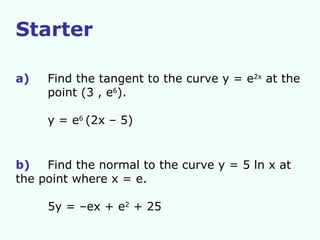
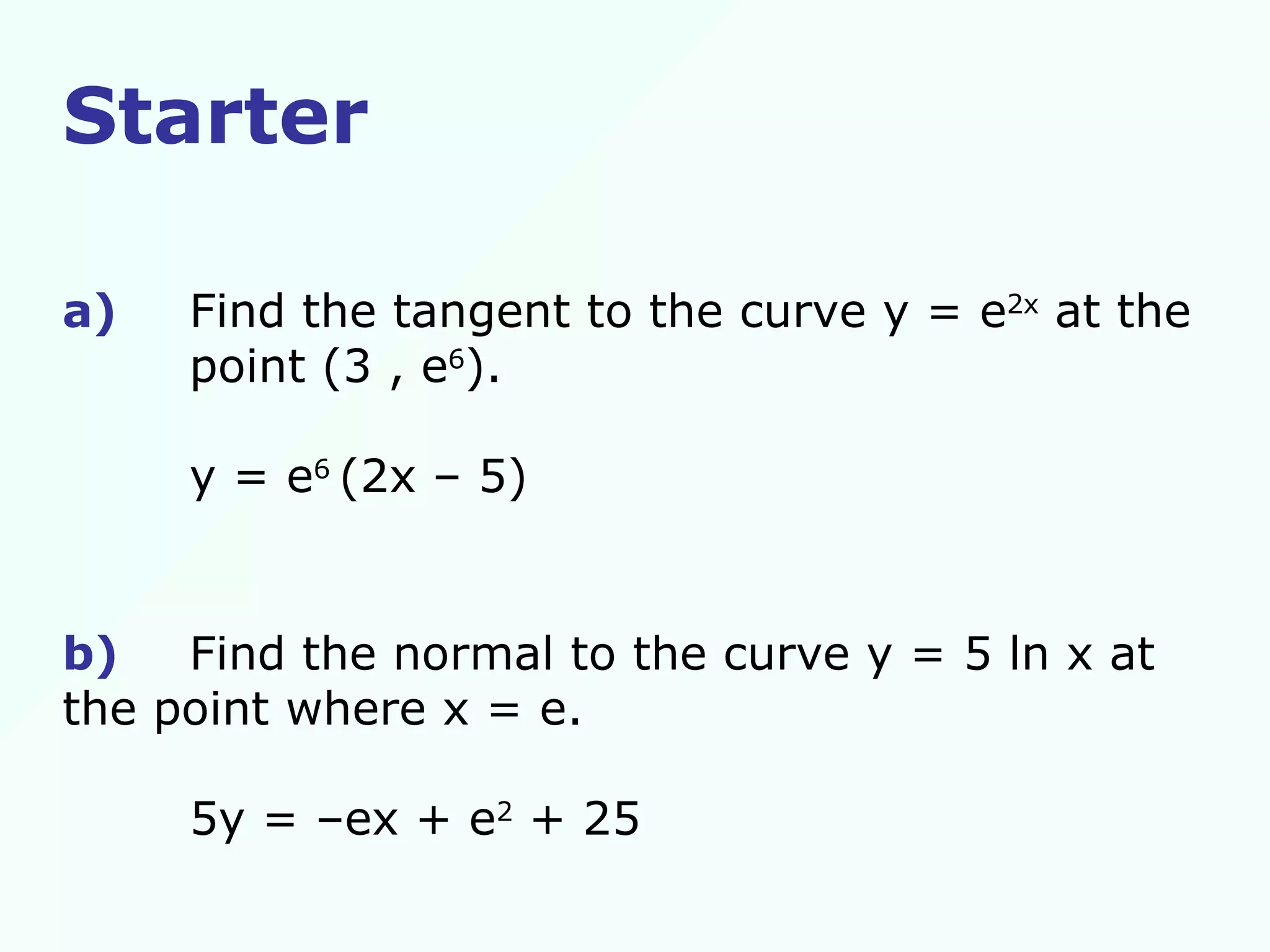
Starter a)   Find the tangent to the curve y = e 2x  at the  point (3 , e 6 ). y = e 6  (2x – 5) b) Find the normal to the curve y = 5 ln x at  the point where x = e. 5y = –ex + e 2  + 25
Objectives: to use differentiation to find the tangents and normals to curves defined parametrically
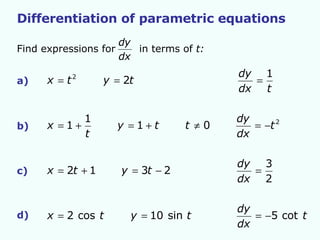
Differentiation of parametric equations Find expressions for  in terms of  t: a) b) c) d)
Tangents and normals a) A curve has parametric equations  x  =  t ²,  y  = 2 t .  Find the equation of the tangent to the curve at the  point where  y  = 4. 2 y  =  x  + 4 b) Find the tangent to the curve  x  =  t ²,  y  = 4 t  at the  point (9   ,   12).  3 y  = 2 x  + 18 c) Find the equation of the normal at (–8   ,   4) to the  curve  x  =  t ³,  y  =  t ².   y  = 3 x  + 28
Core 3 & 4 Textbook Exercise 3C Page 247
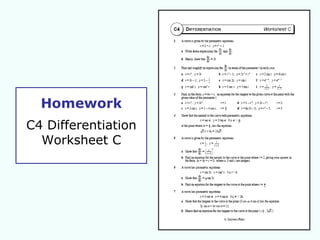
Homework C4 Differentiation Worksheet C
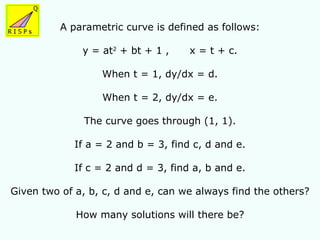
A parametric curve is defined as follows: y = at 2  + bt + 1 ,  x = t + c. When t = 1, dy/dx = d. When t = 2, dy/dx = e. The curve goes through (1, 1). If a = 2 and b = 3, find c, d and e. If c = 2 and d = 3, find a, b and e. Given two of a, b, c, d and e, can we always find the others? How many solutions will there be?
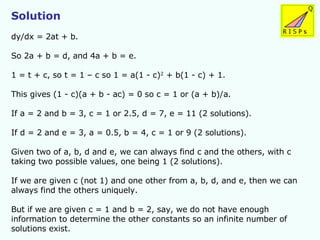
Solution dy/dx = 2at + b. So 2a + b = d, and 4a + b = e. 1 = t + c, so t = 1 – c so 1 = a(1 - c) 2  + b(1 - c) + 1. This gives (1 - c)(a + b - ac) = 0 so c = 1 or (a + b)/a. If a = 2 and b = 3, c = 1 or 2.5, d = 7, e = 11 (2 solutions). If d = 2 and e = 3, a = 0.5, b = 4, c = 1 or 9 (2 solutions). Given two of a, b, d and e, we can always find c and the others, with c taking two possible values, one being 1 (2 solutions). If we are given c (not 1) and one other from a, b, d, and e, then we can always find the others uniquely. But if we are given c = 1 and b = 2, say, we do not have enough information to determine the other constants so an infinite number of solutions exist.

Core 4 Parametric Equations 2

  • 1.
    Starter a) Find the tangent to the curve y = e 2x at the point (3 , e 6 ). y = e 6 (2x – 5) b) Find the normal to the curve y = 5 ln x at the point where x = e. 5y = –ex + e 2 + 25
  • 2.
    Objectives: to usedifferentiation to find the tangents and normals to curves defined parametrically
  • 3.
    Differentiation of parametricequations Find expressions for in terms of t: a) b) c) d)
  • 4.
    Tangents and normalsa) A curve has parametric equations x = t ², y = 2 t . Find the equation of the tangent to the curve at the point where y = 4. 2 y = x + 4 b) Find the tangent to the curve x = t ², y = 4 t at the point (9 , 12). 3 y = 2 x + 18 c) Find the equation of the normal at (–8 , 4) to the curve x = t ³, y = t ². y = 3 x + 28
  • 5.
    Core 3 &4 Textbook Exercise 3C Page 247
  • 6.
  • 7.
    A parametric curveis defined as follows: y = at 2 + bt + 1 , x = t + c. When t = 1, dy/dx = d. When t = 2, dy/dx = e. The curve goes through (1, 1). If a = 2 and b = 3, find c, d and e. If c = 2 and d = 3, find a, b and e. Given two of a, b, c, d and e, can we always find the others? How many solutions will there be?
  • 8.
    Solution dy/dx =2at + b. So 2a + b = d, and 4a + b = e. 1 = t + c, so t = 1 – c so 1 = a(1 - c) 2 + b(1 - c) + 1. This gives (1 - c)(a + b - ac) = 0 so c = 1 or (a + b)/a. If a = 2 and b = 3, c = 1 or 2.5, d = 7, e = 11 (2 solutions). If d = 2 and e = 3, a = 0.5, b = 4, c = 1 or 9 (2 solutions). Given two of a, b, d and e, we can always find c and the others, with c taking two possible values, one being 1 (2 solutions). If we are given c (not 1) and one other from a, b, d, and e, then we can always find the others uniquely. But if we are given c = 1 and b = 2, say, we do not have enough information to determine the other constants so an infinite number of solutions exist.