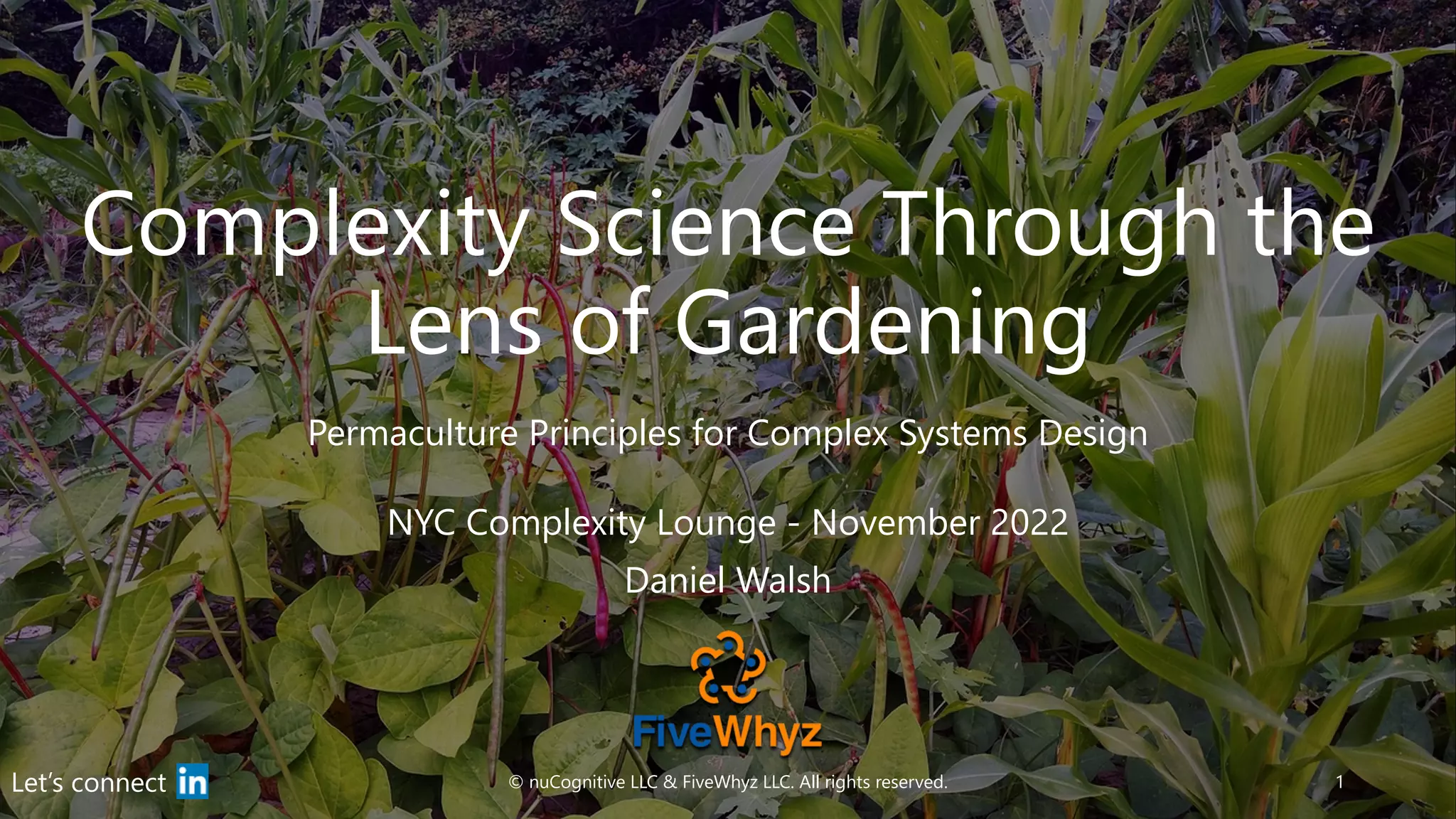
Complexity Science Through the
Lens of Gardening
Permaculture Principles for Complex Systems Design
© nuCognitive LLC & FiveWhyz LLC. All rights reserved. 1
Let’s connect
NYC Complexity Lounge - November 2022
Daniel Walsh
Our Journey
Complexity, As Transdisciplinary Science
Exaptation, Latent Superpower
Permaculture, Pragmatism X Theory
Small Group Discussion, Learning by Doing
Debrief and Next Steps
© nuCognitive LLC & FiveWhyz LLC. All rights reserved. 3
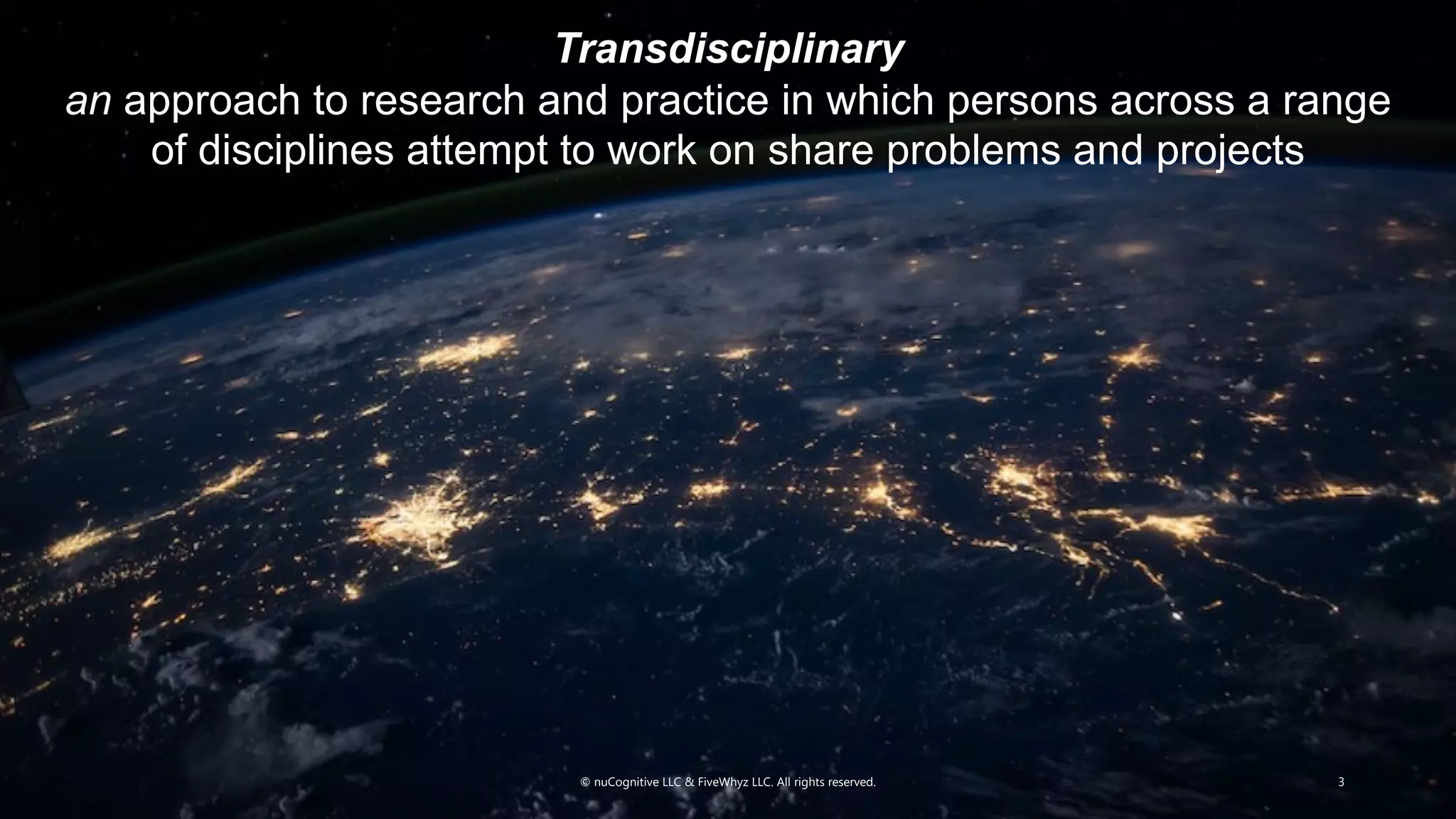
Transdisciplinary
an approach to research and practice in which persons across a range
of disciplines attempt to work on share problems and projects
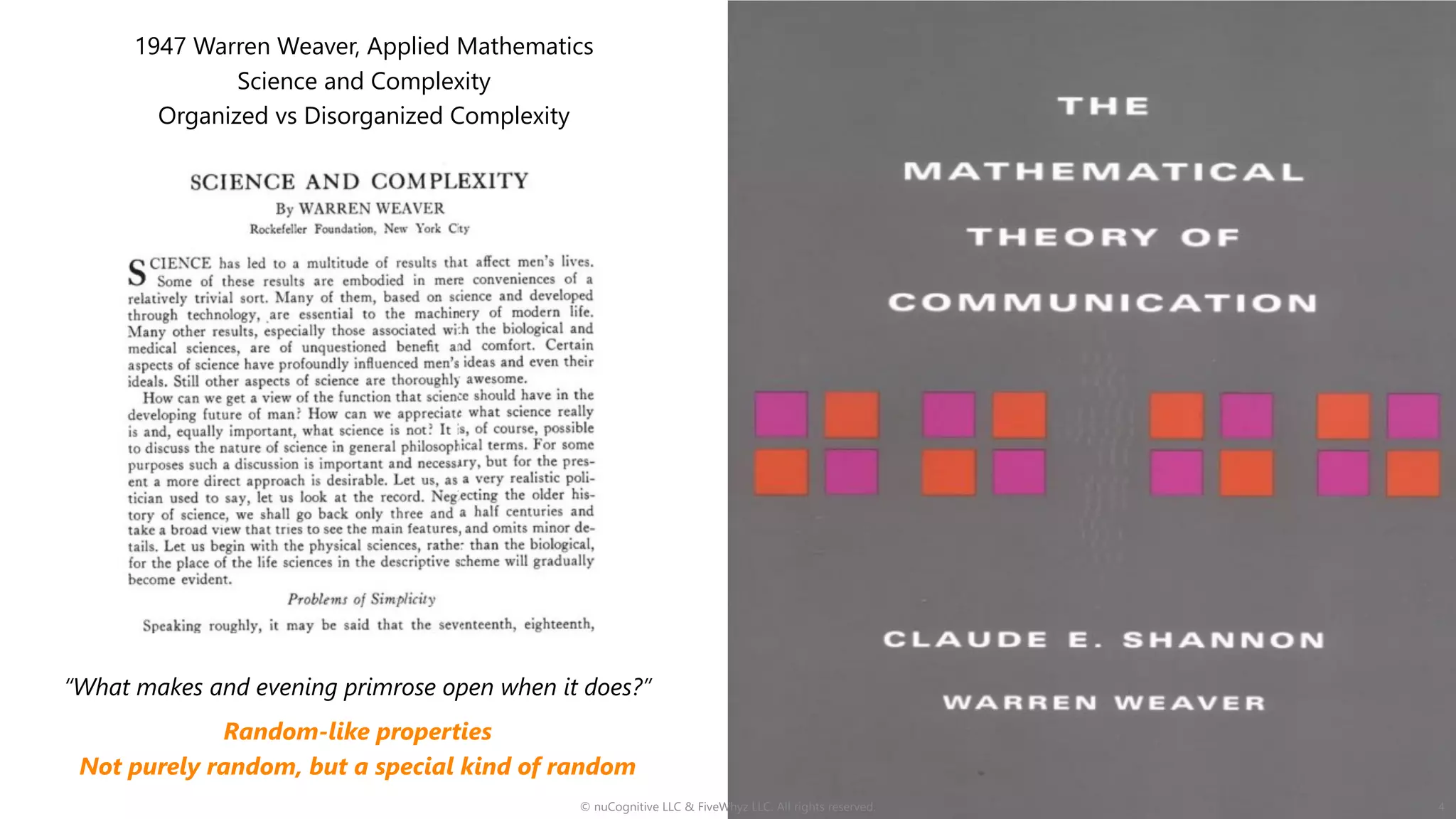
“What makes and evening primrose open when it does?”
© nuCognitive LLC & FiveWhyz LLC. All rights reserved. 4
1947 Warren Weaver, Applied Mathematics
Science and Complexity
Organized vs Disorganized Complexity
Random-like properties
Not purely random, but a special kind of random
Copyright © W.R. Owens
© nuCognitive LLC & FiveWhyz LLC. All rights reserved. 5
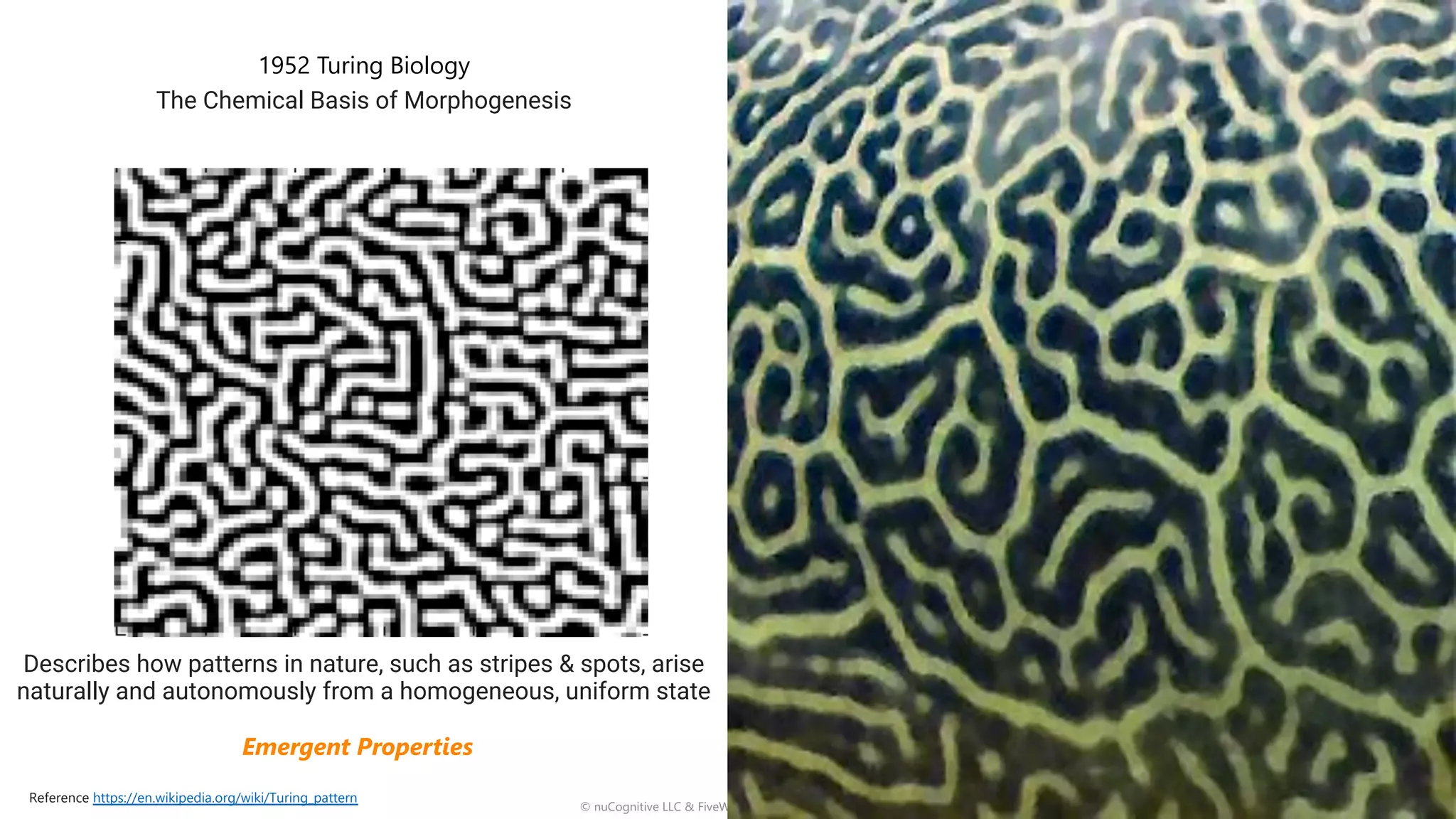
1952 Turing Biology
The Chemical Basis of Morphogenesis
Describes how patterns in nature, such as stripes & spots, arise
naturally and autonomously from a homogeneous, uniform state
Reference https://en.wikipedia.org/wiki/Turing_pattern
Emergent Properties
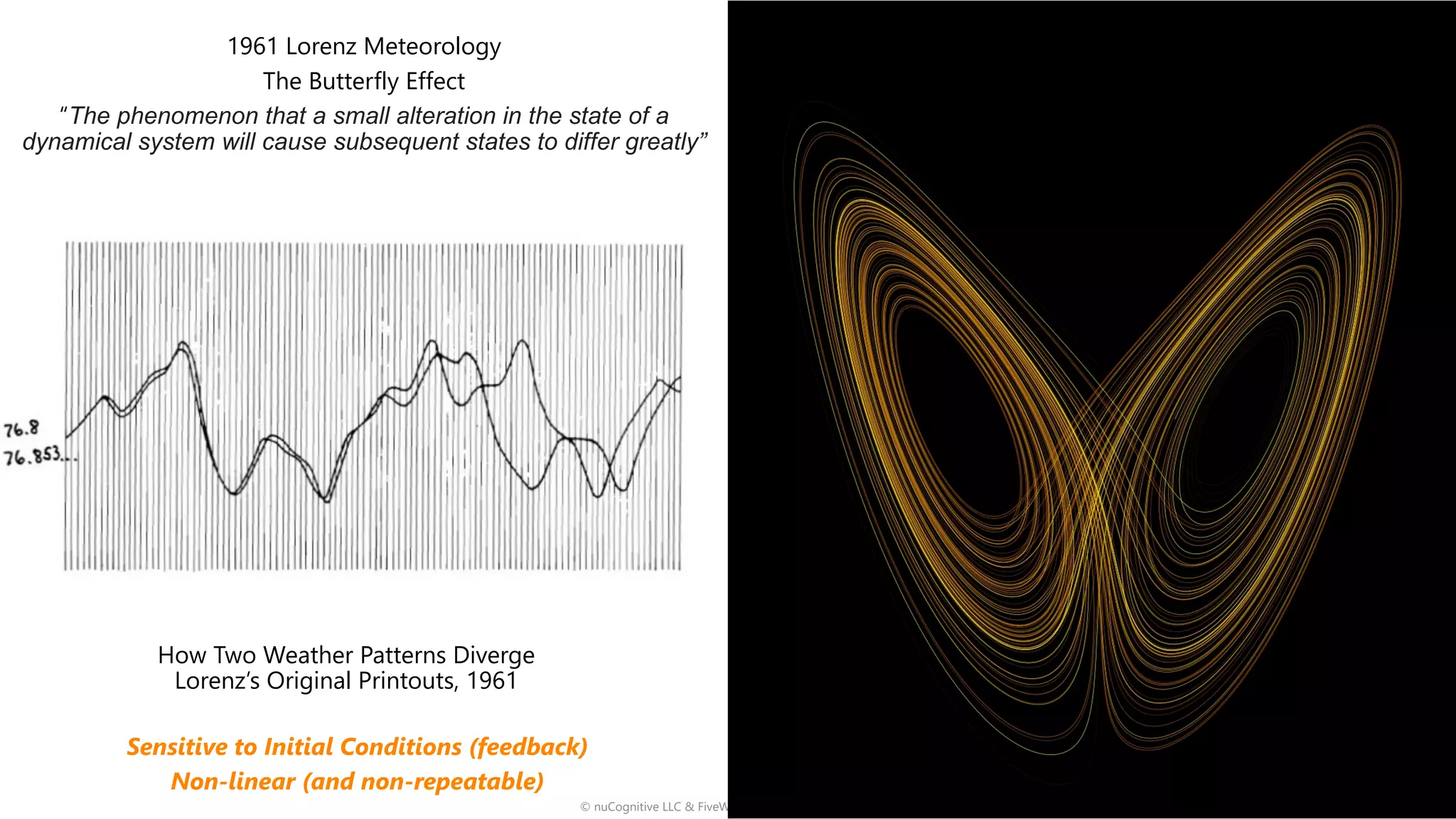
How Two Weather Patterns Diverge
Lorenz’s Original Printouts, 1961
© nuCognitive LLC & FiveWhyz LLC. All rights reserved. 6
1961 Lorenz Meteorology
The Butterfly Effect
“The phenomenon that a small alteration in the state of a
dynamical system will cause subsequent states to differ greatly”
Sensitive to Initial Conditions (feedback)
Non-linear (and non-repeatable)
© nuCognitive LLC & FiveWhyz LLC. All rights reserved. 7
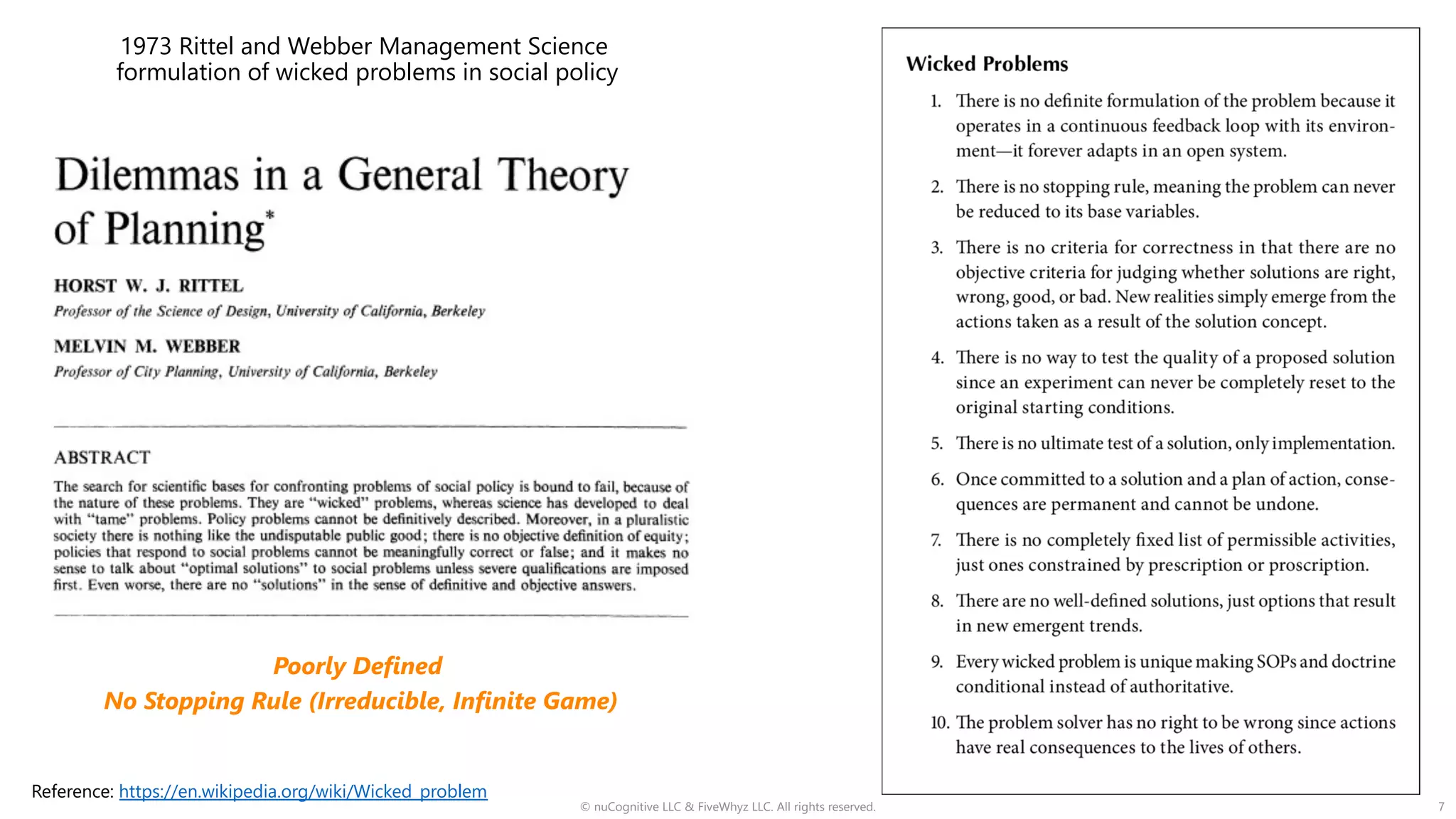
1973 Rittel and Webber Management Science
formulation of wicked problems in social policy
Reference: https://en.wikipedia.org/wiki/Wicked_problem
Poorly Defined
No Stopping Rule (Irreducible, Infinite Game)
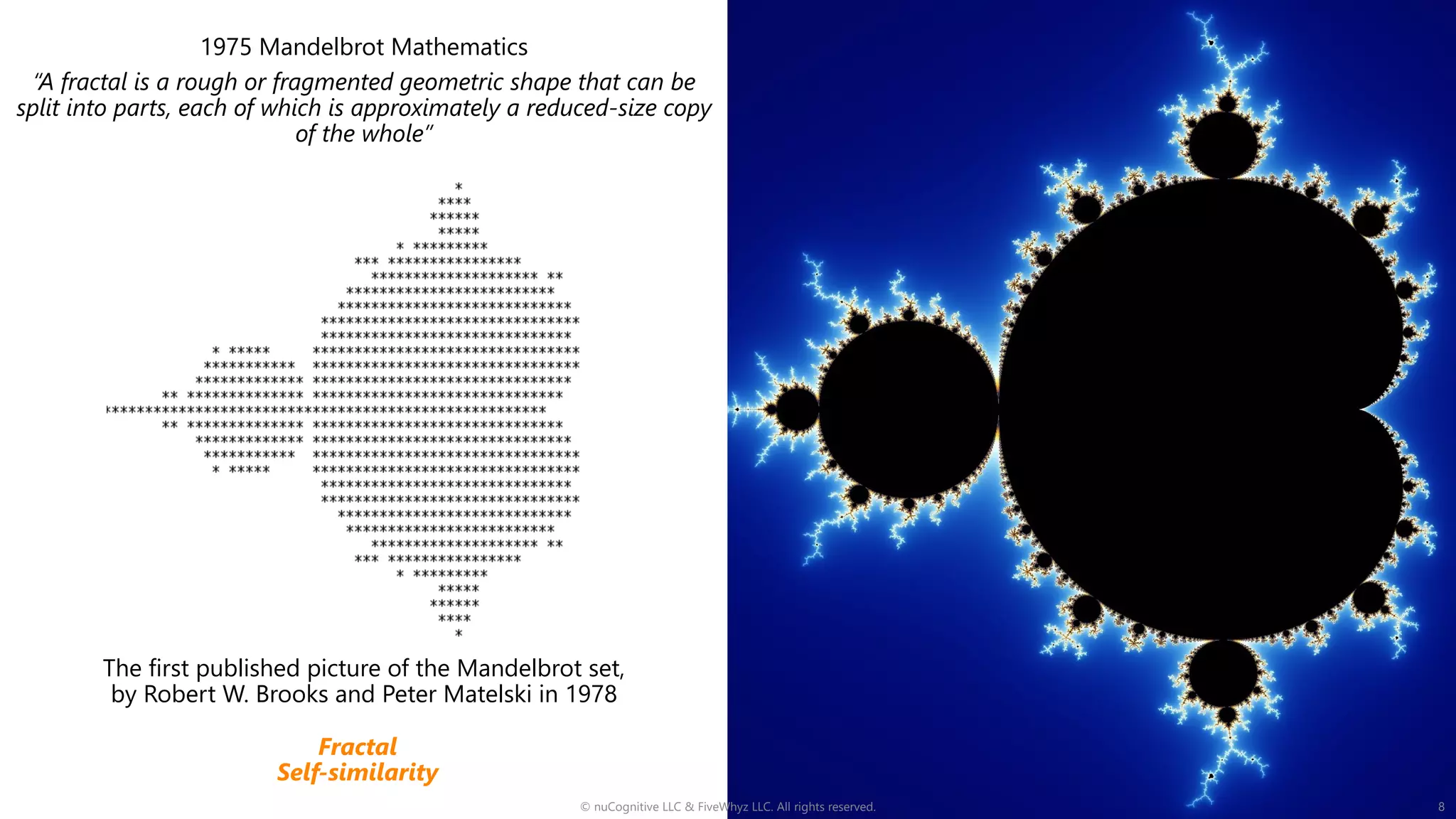
The first published picture of the Mandelbrot set,
by Robert W. Brooks and Peter Matelski in 1978
© nuCognitive LLC & FiveWhyz LLC. All rights reserved. 8
1975 Mandelbrot Mathematics
“A fractal is a rough or fragmented geometric shape that can be
split into parts, each of which is approximately a reduced-size copy
of the whole”
Fractal
Self-similarity
© nuCognitive LLC & FiveWhyz LLC. All rights reserved. 9
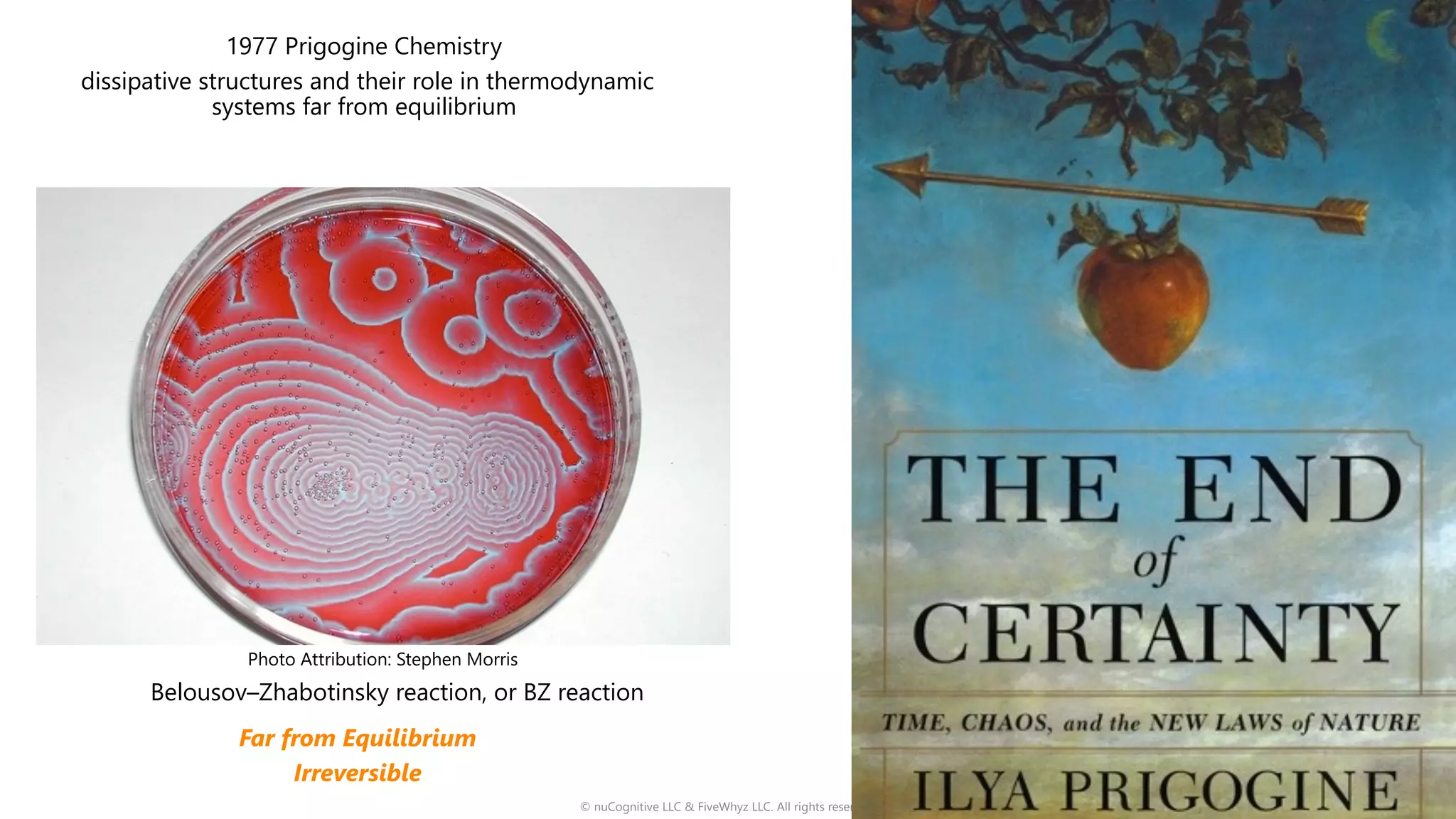
1977 Prigogine Chemistry
dissipative structures and their role in thermodynamic
systems far from equilibrium
Belousov–Zhabotinsky reaction, or BZ reaction
Photo Attribution: Stephen Morris
Far from Equilibrium
Irreversible
"From an extremely simple model, we're able to reproduce
special relativity, general relativity and the core results of
quantum mechanics”
2020 Wolfram Physics Project
10
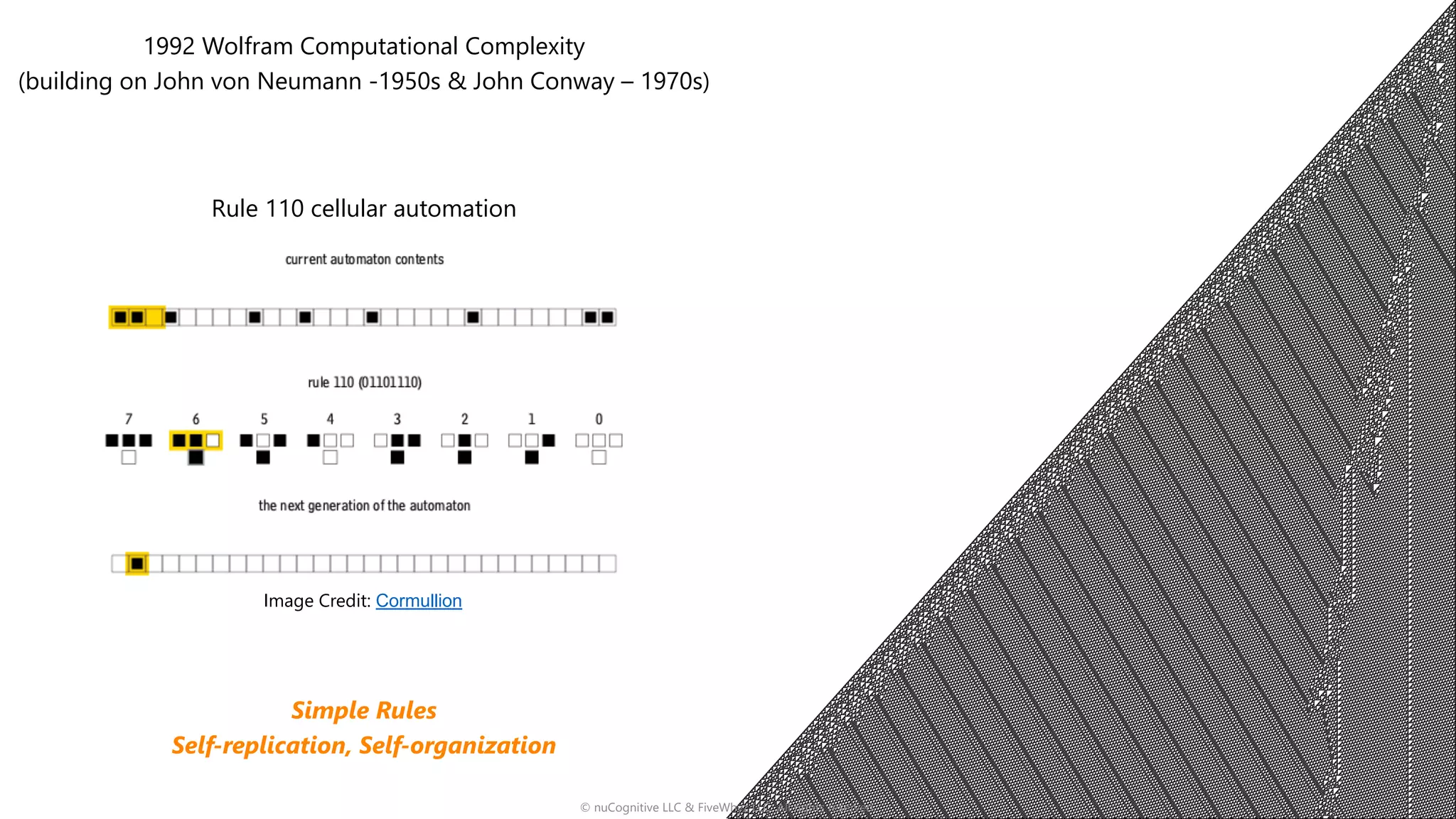
1992 Wolfram Computational Complexity
(building on John von Neumann -1950s & John Conway – 1970s)
Rule 110 cellular automation
Simple Rules
Self-replication, Self-organization
Image Credit: Cormullion
© nuCognitive LLC & FiveWhyz LLC. All rights reserved.
© nuCognitive LLC & FiveWhyz LLC. All rights reserved. 11
police
officer
labor union
leader
teacher NGO
ecologist
Anyone who
works with
people - from
the smallest
teams to the
largest
organizations -
works with(in)
complex
adaptive
systems
healthcare
conflict
mediation
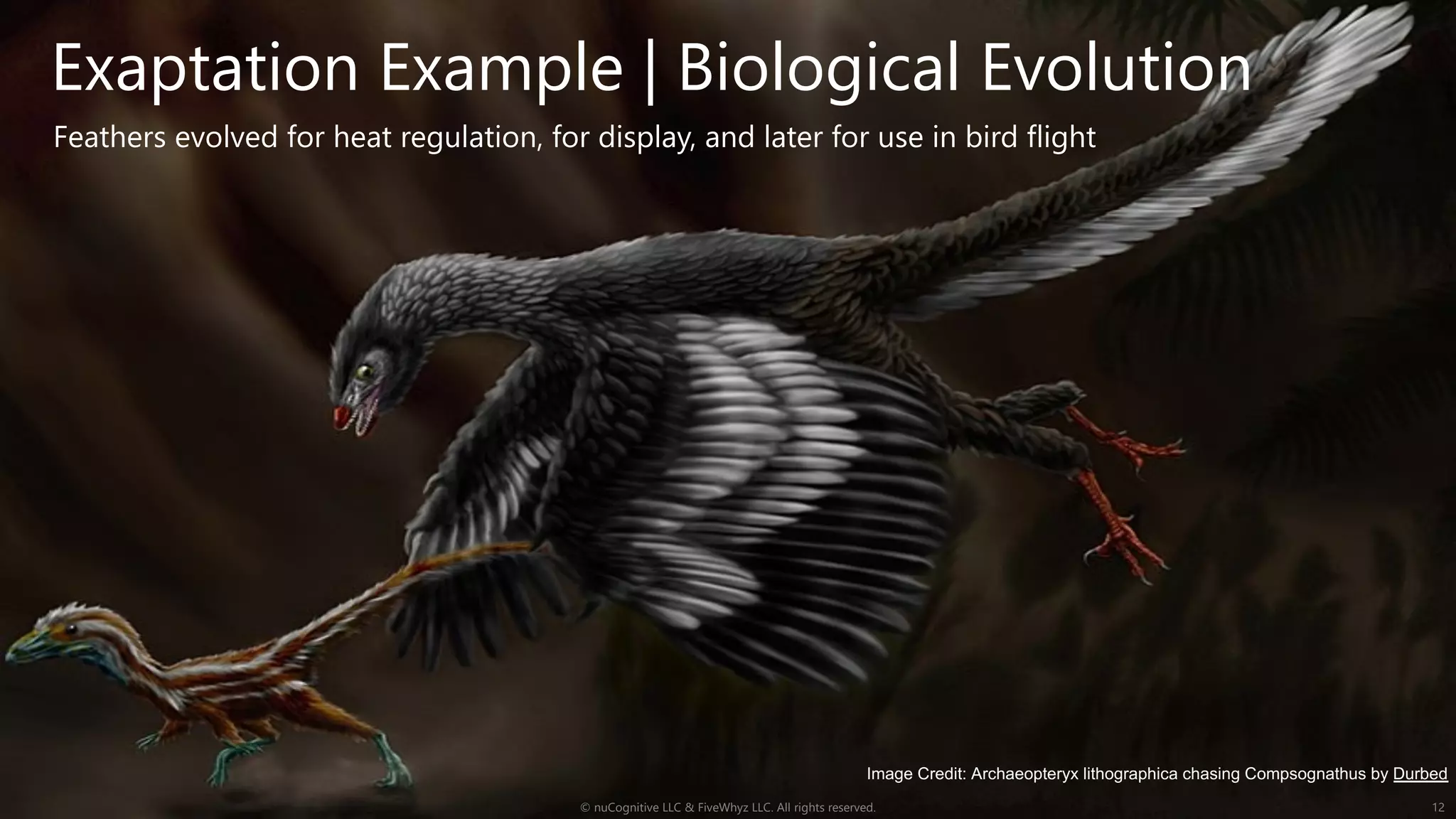
Exaptation Example | Biological Evolution
© nuCognitive LLC & FiveWhyz LLC. All rights reserved. 12
Feathers evolved for heat regulation, for display, and later for use in bird flight
Image Credit: Archaeopteryx lithographica chasing Compsognathus by Durbed
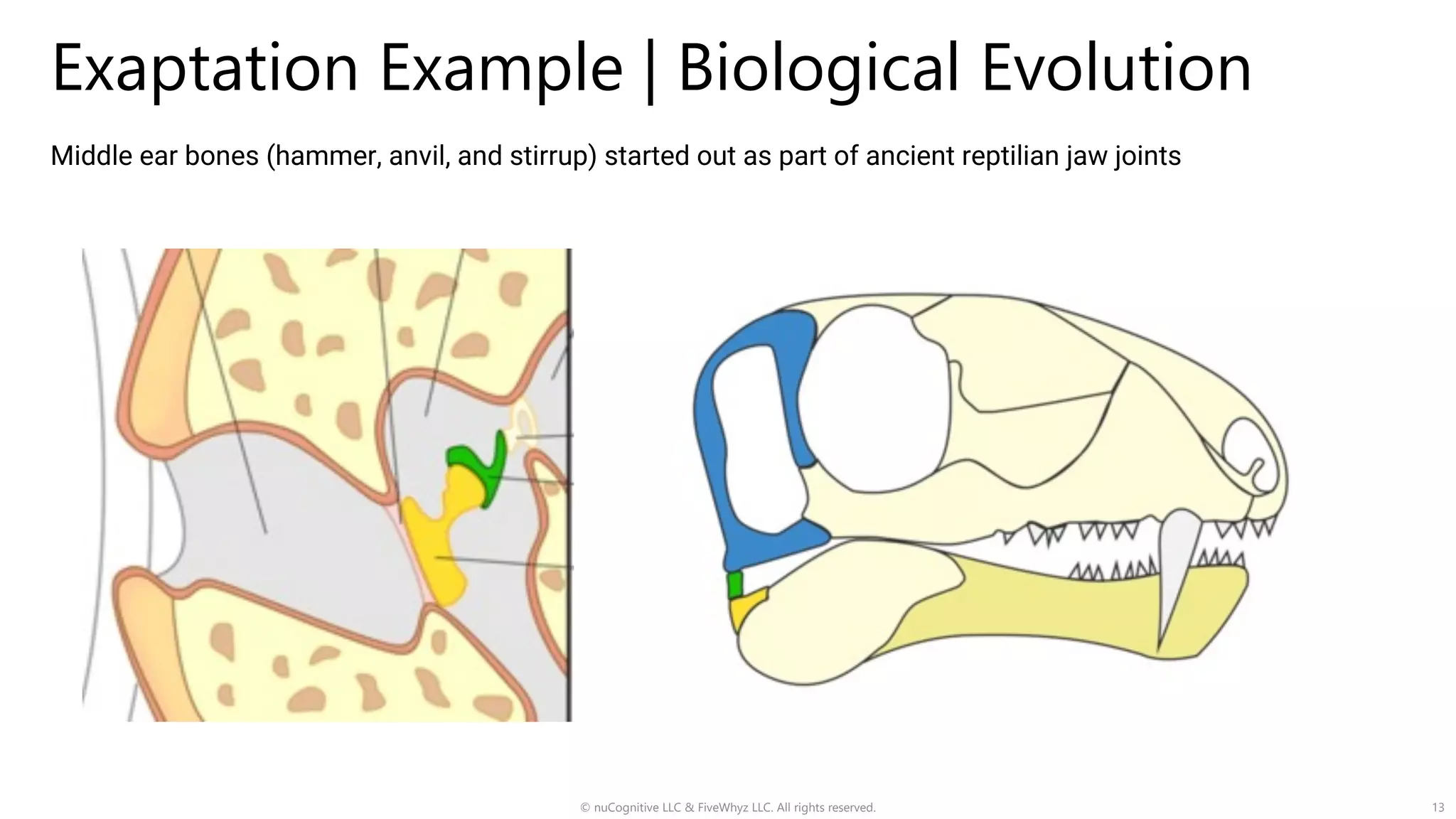
Exaptation Example | Biological Evolution
© nuCognitive LLC & FiveWhyz LLC. All rights reserved. 13
Middle ear bones (hammer, anvil, and stirrup) started out as part of ancient reptilian jaw joints
14
© nuCognitive LLC & FiveWhyz LLC. All rights reserved.
Image Credit: Holger.Ellgaard
© nuCognitive LLC & FiveWhyz LLC. All rights reserved. 15
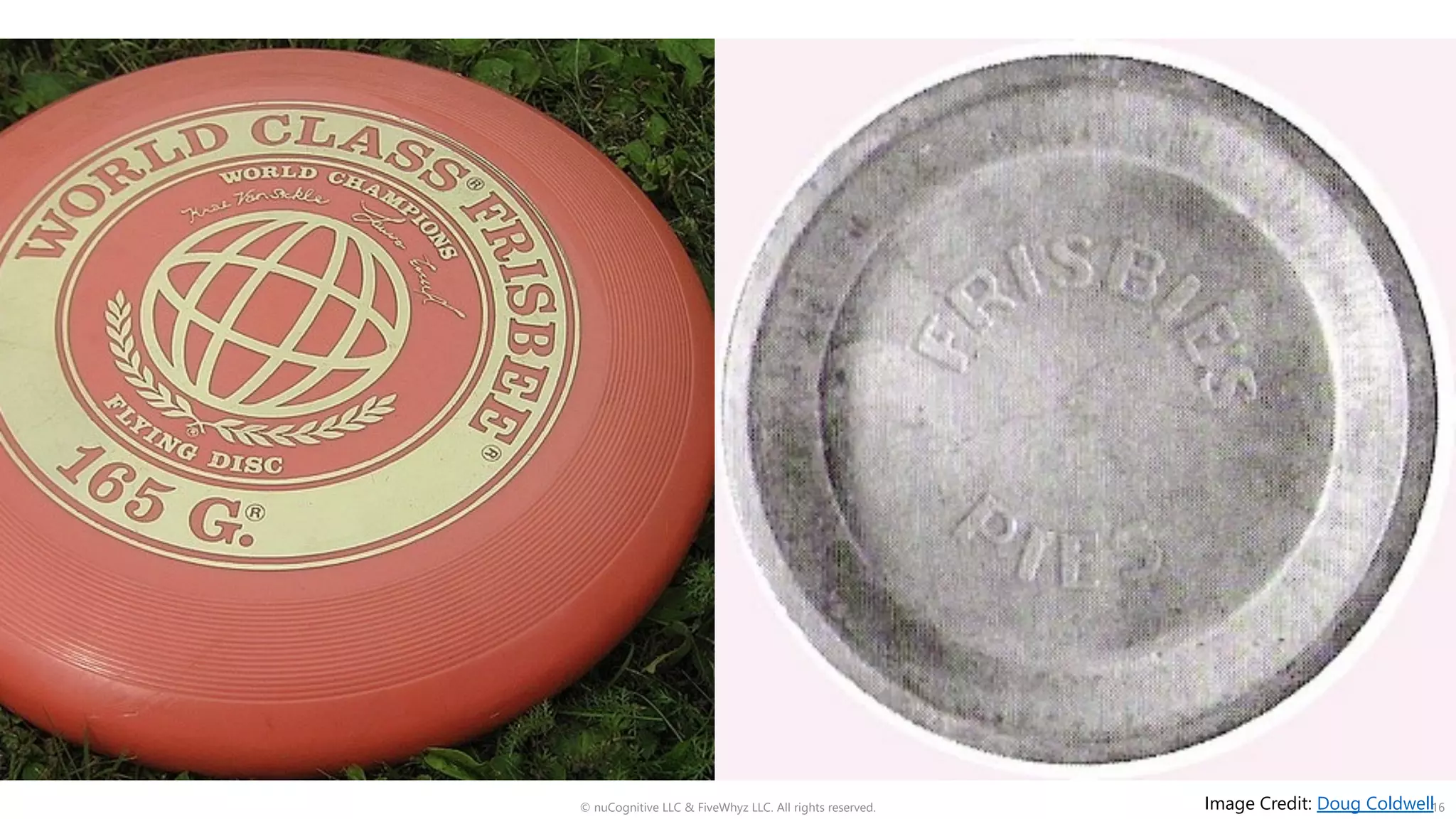
16
© nuCognitive LLC & FiveWhyz LLC. All rights reserved. Image Credit: Doug Coldwell
© nuCognitive LLC & FiveWhyz LLC. All rights reserved. 17
© nuCognitive LLC & FiveWhyz LLC. All rights reserved.
© nuCognitive LLC & FiveWhyz LLC. All rights reserved. 18
police
officer
labor union
leader
teacher NGO
ecologist
How might we
exapt or
repurpose
practices and
principles from
other
domains?
healthcare
conflict
mediation
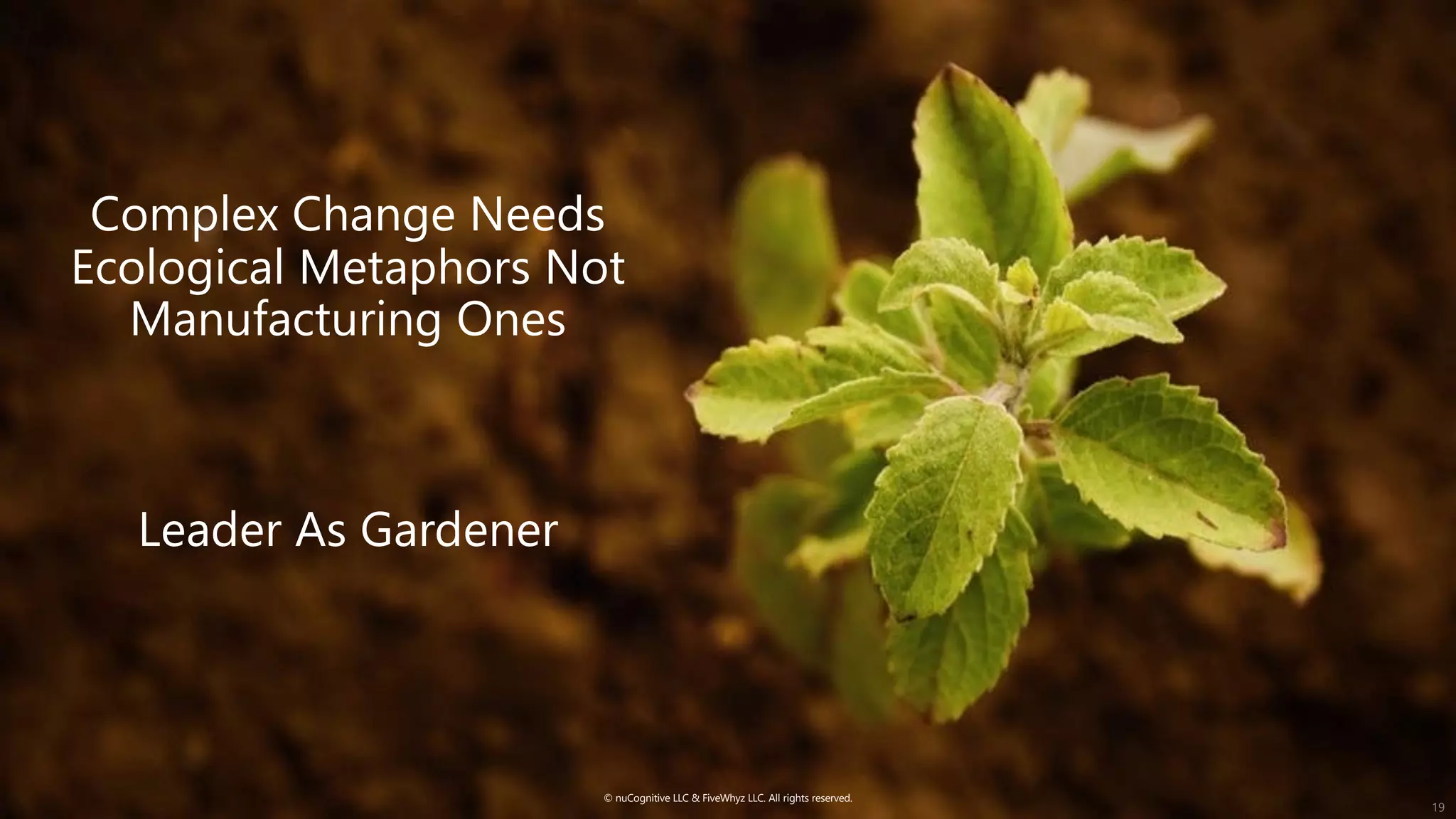
Complex Change Needs
Ecological Metaphors Not
Manufacturing Ones
Leader As Gardener
19
© nuCognitive LLC & FiveWhyz LLC. All rights reserved.
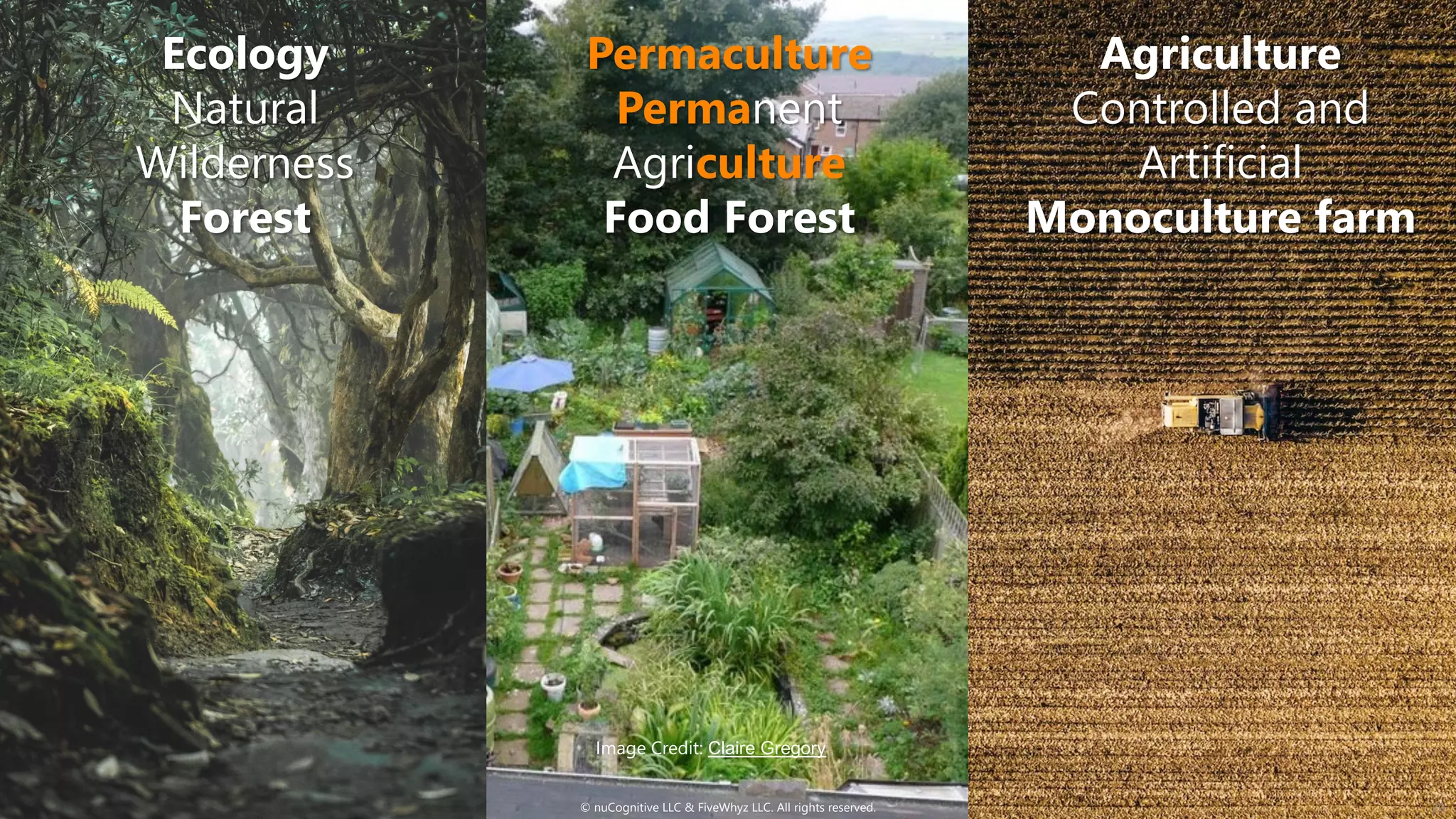
Image Credit: Claire Gregory
© nuCognitive LLC & FiveWhyz LLC. All rights reserved. 20
Permaculture
Permanent
Agriculture
Food Forest
Ecology
Natural
Wilderness
Forest
Agriculture
Controlled and
Artificial
Monoculture farm
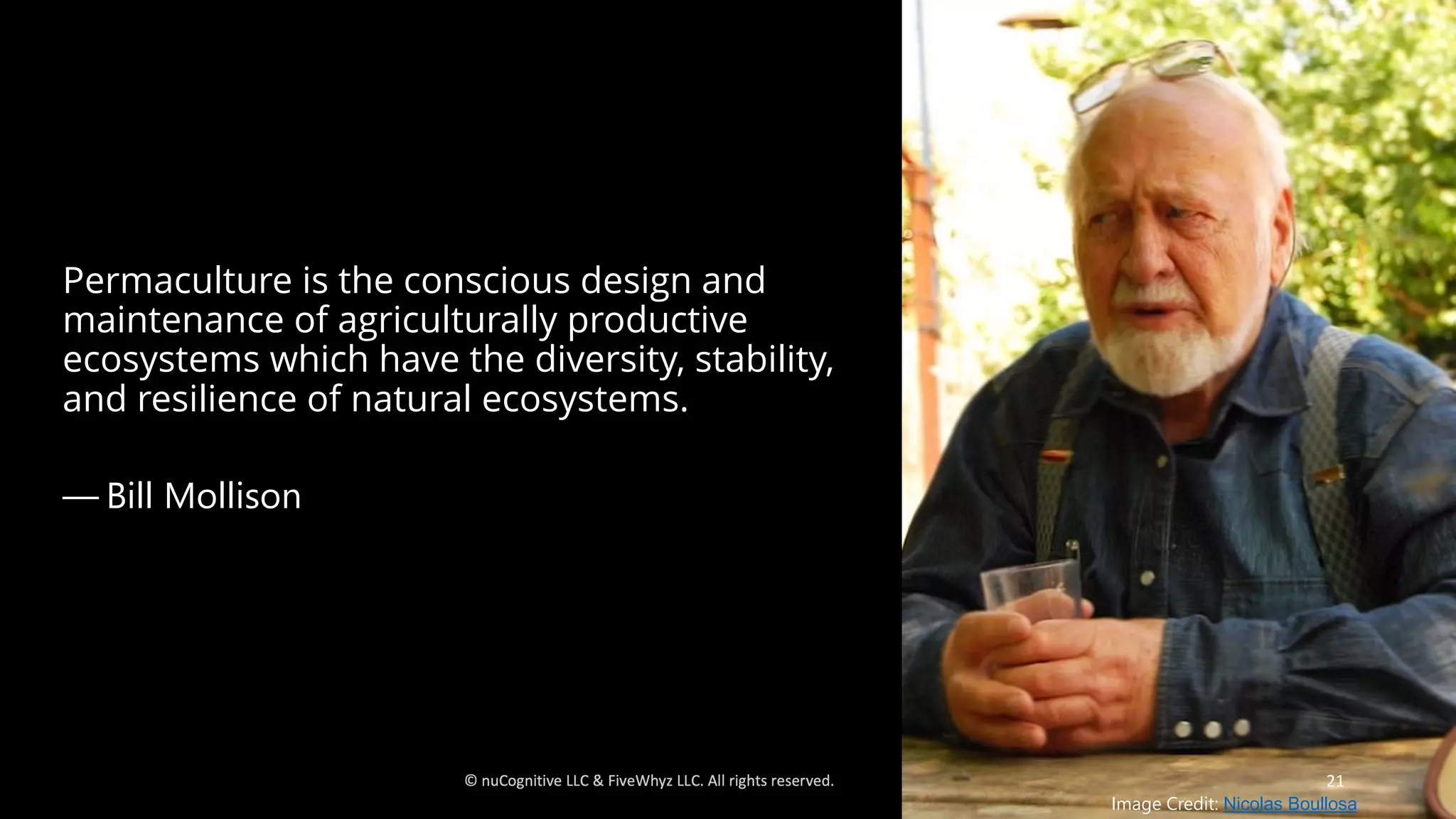
Permaculture is the conscious design and
maintenance of agriculturally productive
ecosystems which have the diversity, stability,
and resilience of natural ecosystems.
— Bill Mollison
21
Image Credit: Nicolas Boullosa
© nuCognitive LLC & FiveWhyz LLC. All rights reserved. 22
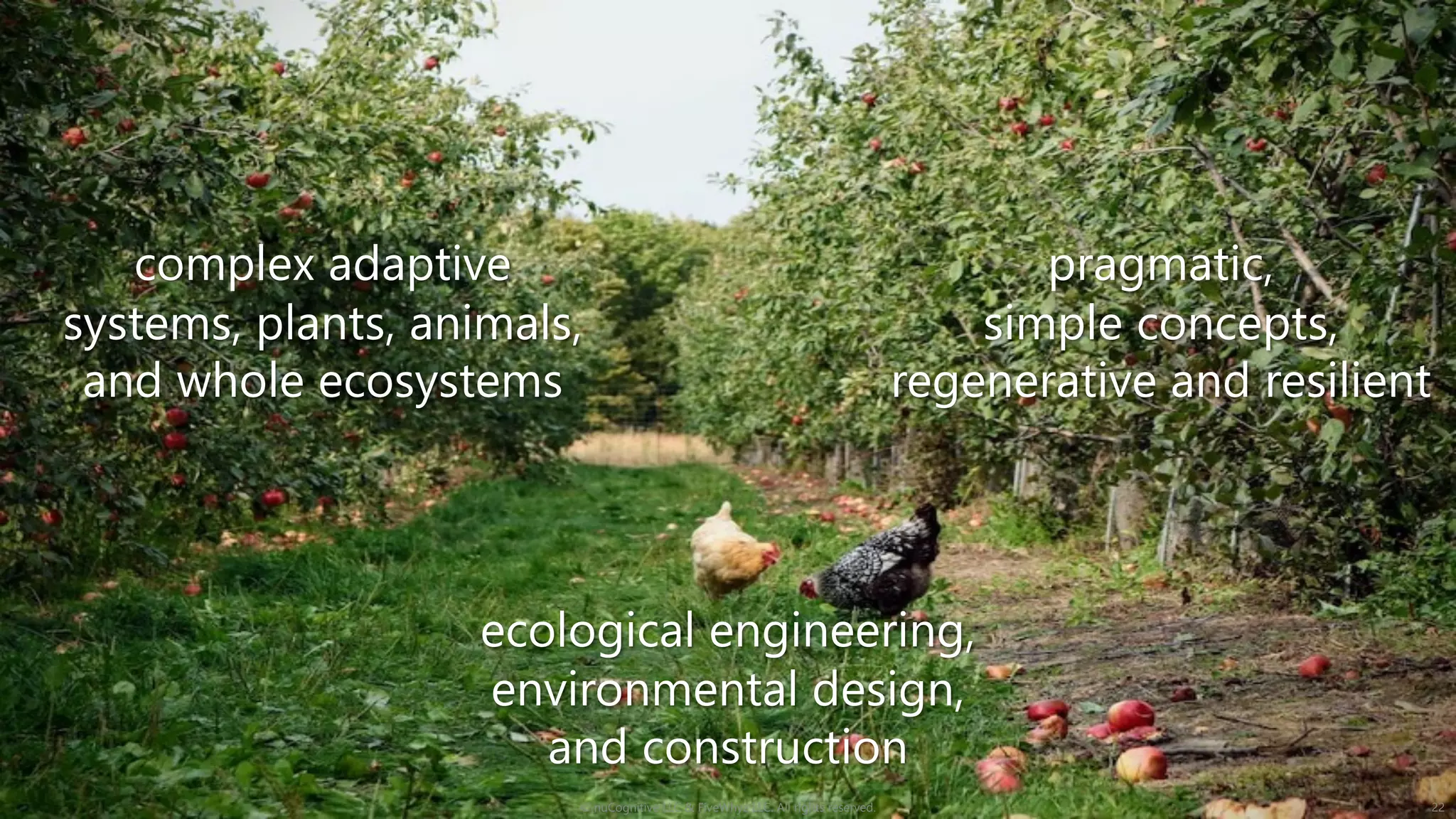
ecological engineering,
environmental design,
and construction
pragmatic,
simple concepts,
regenerative and resilient
complex adaptive
systems, plants, animals,
and whole ecosystems
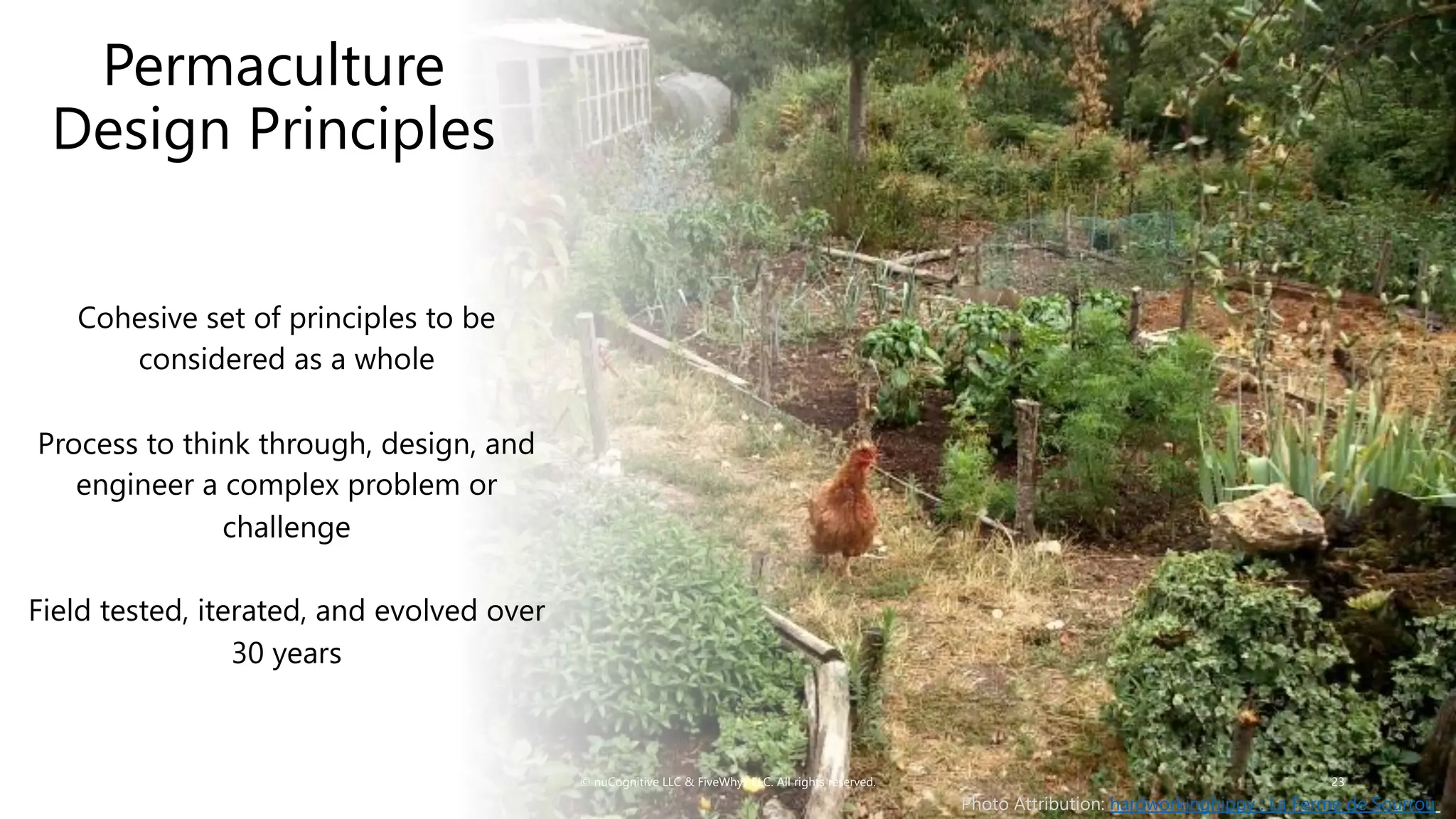
Cohesive set of principles to be
considered as a whole
Process to think through, design, and
engineer a complex problem or
challenge
Field tested, iterated, and evolved over
30 years
© nuCognitive LLC & FiveWhyz LLC. All rights reserved. 23
Permaculture
Design Principles
Photo Attribution: hardworkinghippy : La Ferme de Sourrou
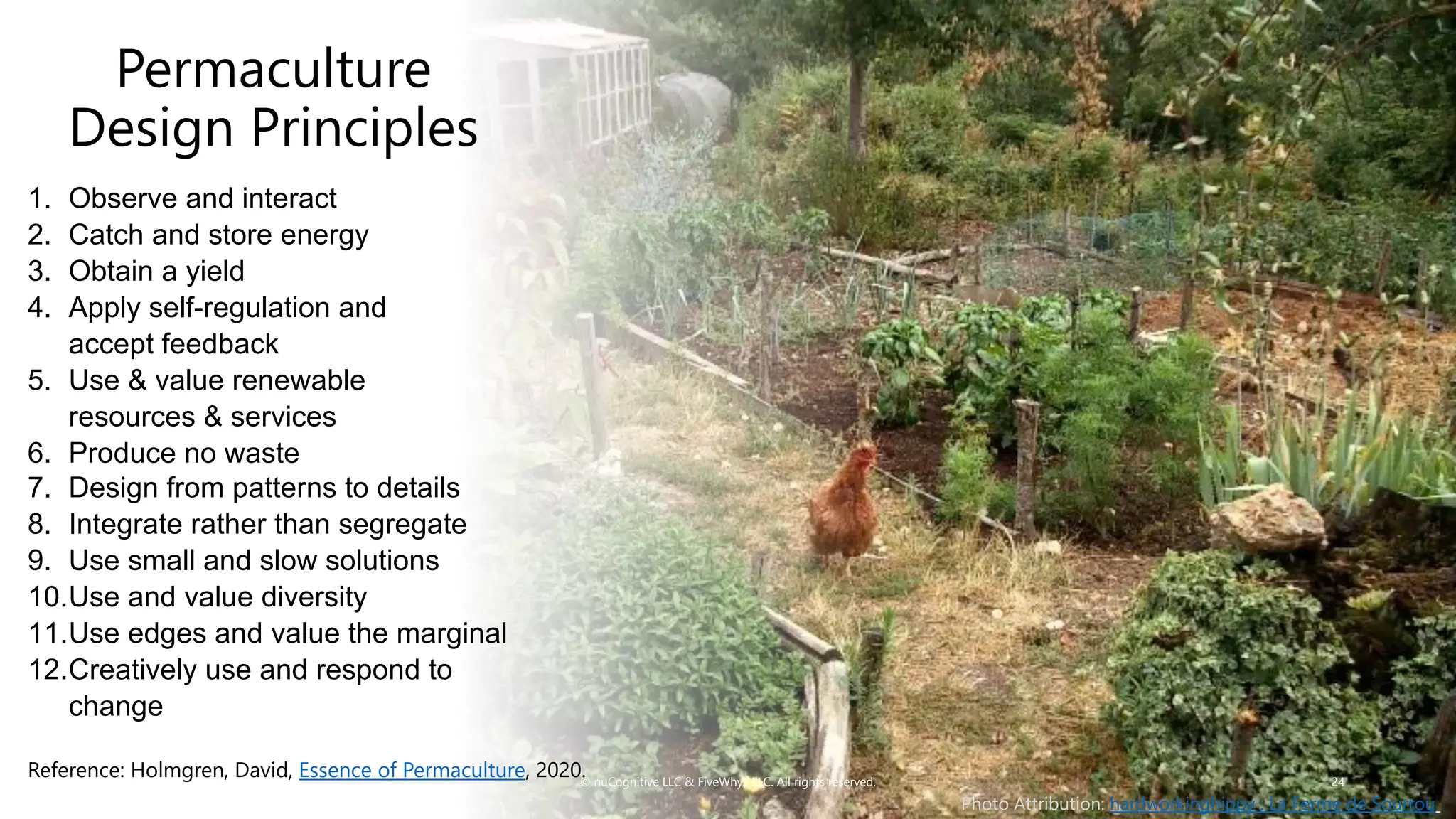
Permaculture
Design Principles
1. Observe and interact
2. Catch and store energy
3. Obtain a yield
4. Apply self-regulation and
accept feedback
5. Use & value renewable
resources & services
6. Produce no waste
7. Design from patterns to details
8. Integrate rather than segregate
9. Use small and slow solutions
10.Use and value diversity
11.Use edges and value the marginal
12.Creatively use and respond to
change
© nuCognitive LLC & FiveWhyz LLC. All rights reserved. 24
Reference: Holmgren, David, Essence of Permaculture, 2020.
Photo Attribution: hardworkinghippy : La Ferme de Sourrou
Exaptive
Exercise
Setup
• Think of a complex challenge that you’d like help with
• Imagine a expert consultant were hired to help out
• Listen to the principles proposed and make a note
anything of particular interest or exaptive connection
© nuCognitive LLC & FiveWhyz LLC. All rights reserved. 25
Permaculture Design Principles
1. Observe and interact
2. Catch and store energy
3. Obtain a yield
4. Apply self-regulation and
accept feedback
5. Use & value renewable
resources & services
6. Produce no waste
7. Design from patterns to details
8. Integrate rather than segregate
9. Use small and slow solutions
10.Use and value diversity
11.Use edges and value the marginal
12.Creatively use and respond to change
© nuCognitive LLC & FiveWhyz LLC. All rights reserved. 26
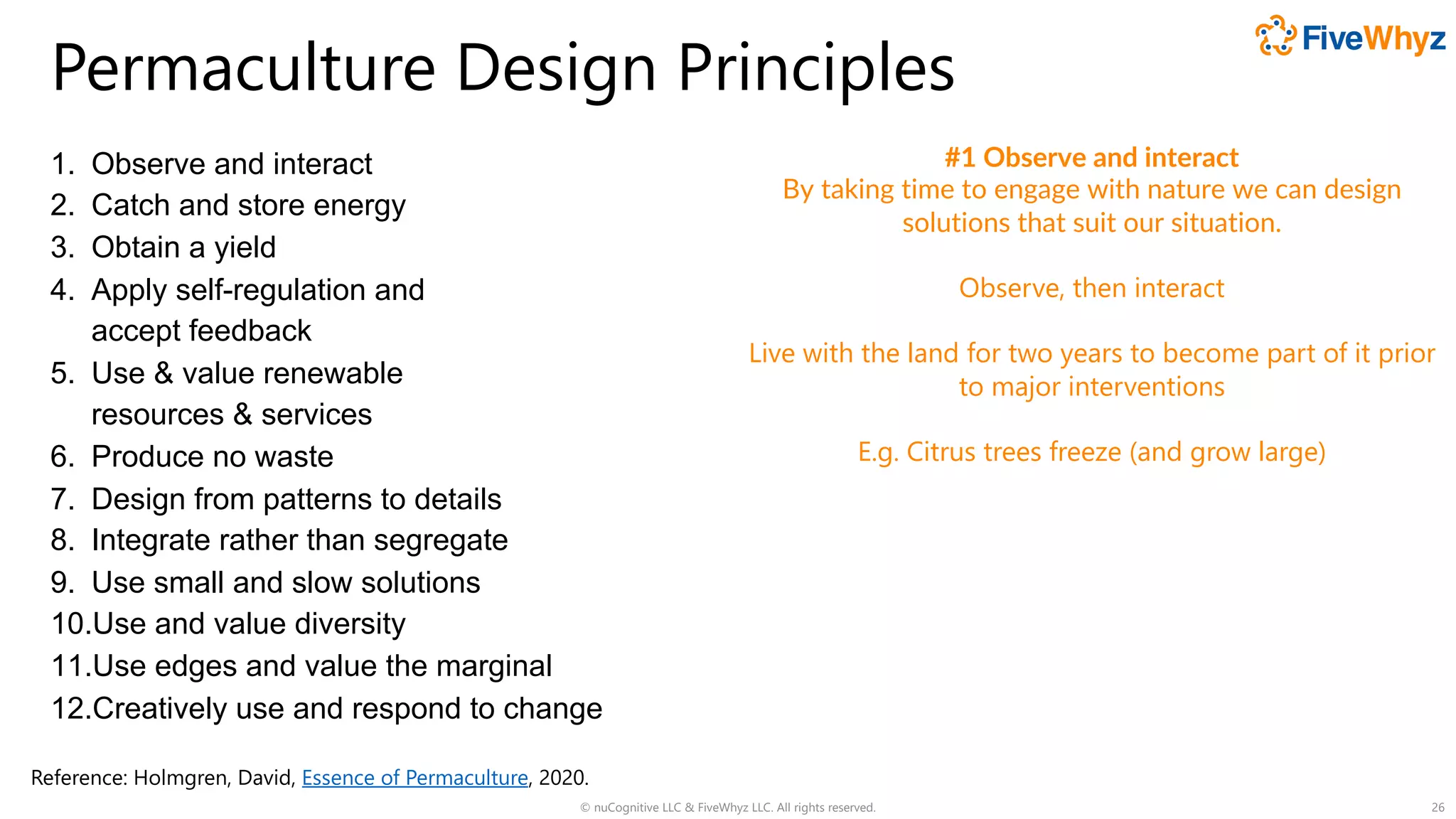
#1 Observe and interact
By taking time to engage with nature we can design
solutions that suit our situation.
Observe, then interact
Live with the land for two years to become part of it prior
to major interventions
E.g. Citrus trees freeze (and grow large)
Reference: Holmgren, David, Essence of Permaculture, 2020.
Permaculture Design Principles
1. Observe and interact
2. Catch and store energy
3. Obtain a yield
4. Apply self-regulation and
accept feedback
5. Use & value renewable
resources & services
6. Produce no waste
7. Design from patterns to details
8. Integrate rather than segregate
9. Use small and slow solutions
10.Use and value diversity
11.Use edges and value the marginal
12.Creatively use and respond to change
© nuCognitive LLC & FiveWhyz LLC. All rights reserved. 27
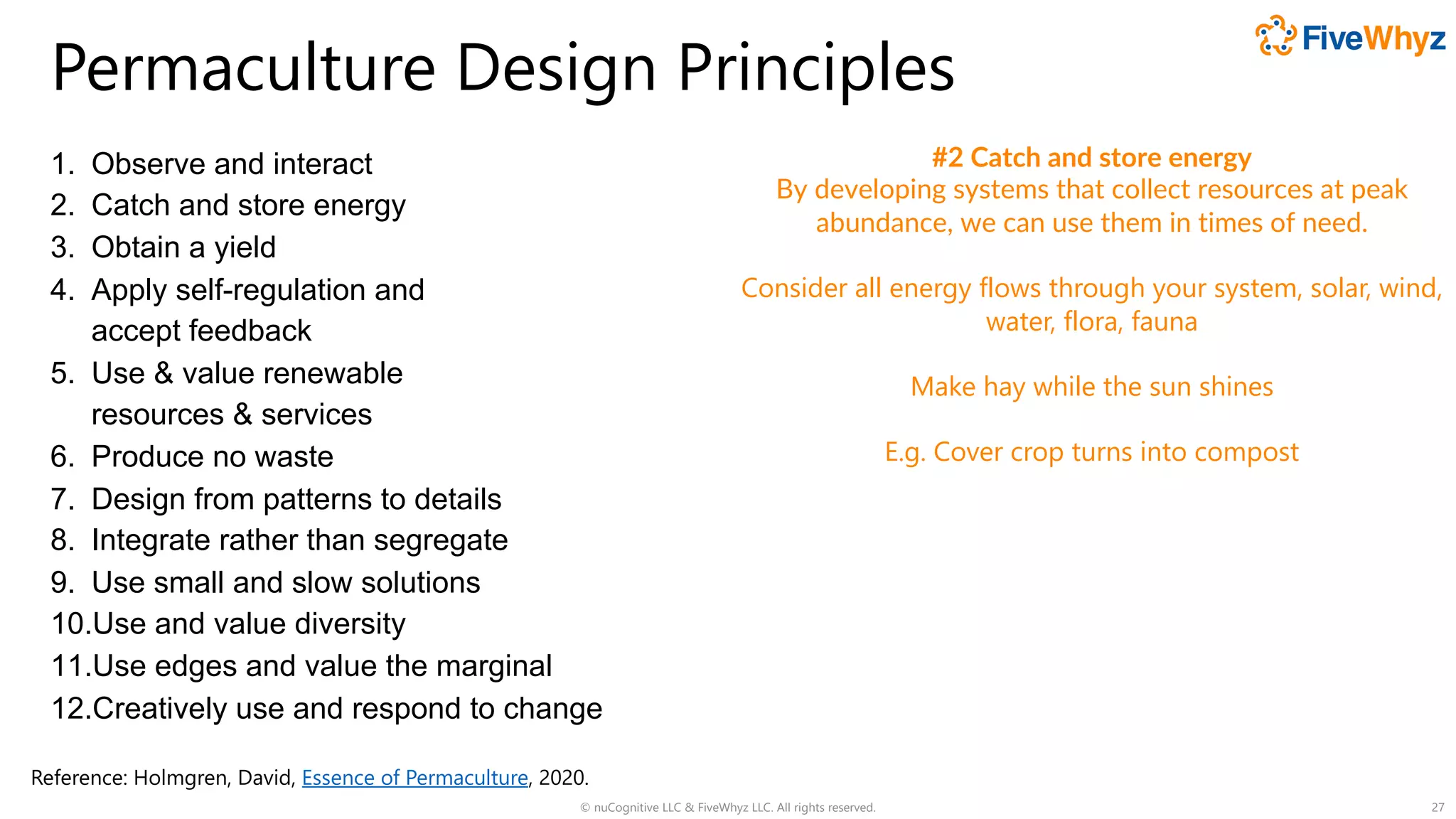
#2 Catch and store energy
By developing systems that collect resources at peak
abundance, we can use them in times of need.
Consider all energy flows through your system, solar, wind,
water, flora, fauna
Make hay while the sun shines
E.g. Cover crop turns into compost
Reference: Holmgren, David, Essence of Permaculture, 2020.
Permaculture Design Principles
1. Observe and interact
2. Catch and store energy
3. Obtain a yield
4. Apply self-regulation and
accept feedback
5. Use & value renewable
resources & services
6. Produce no waste
7. Design from patterns to details
8. Integrate rather than segregate
9. Use small and slow solutions
10.Use and value diversity
11.Use edges and value the marginal
12.Creatively use and respond to change
© nuCognitive LLC & FiveWhyz LLC. All rights reserved. 28
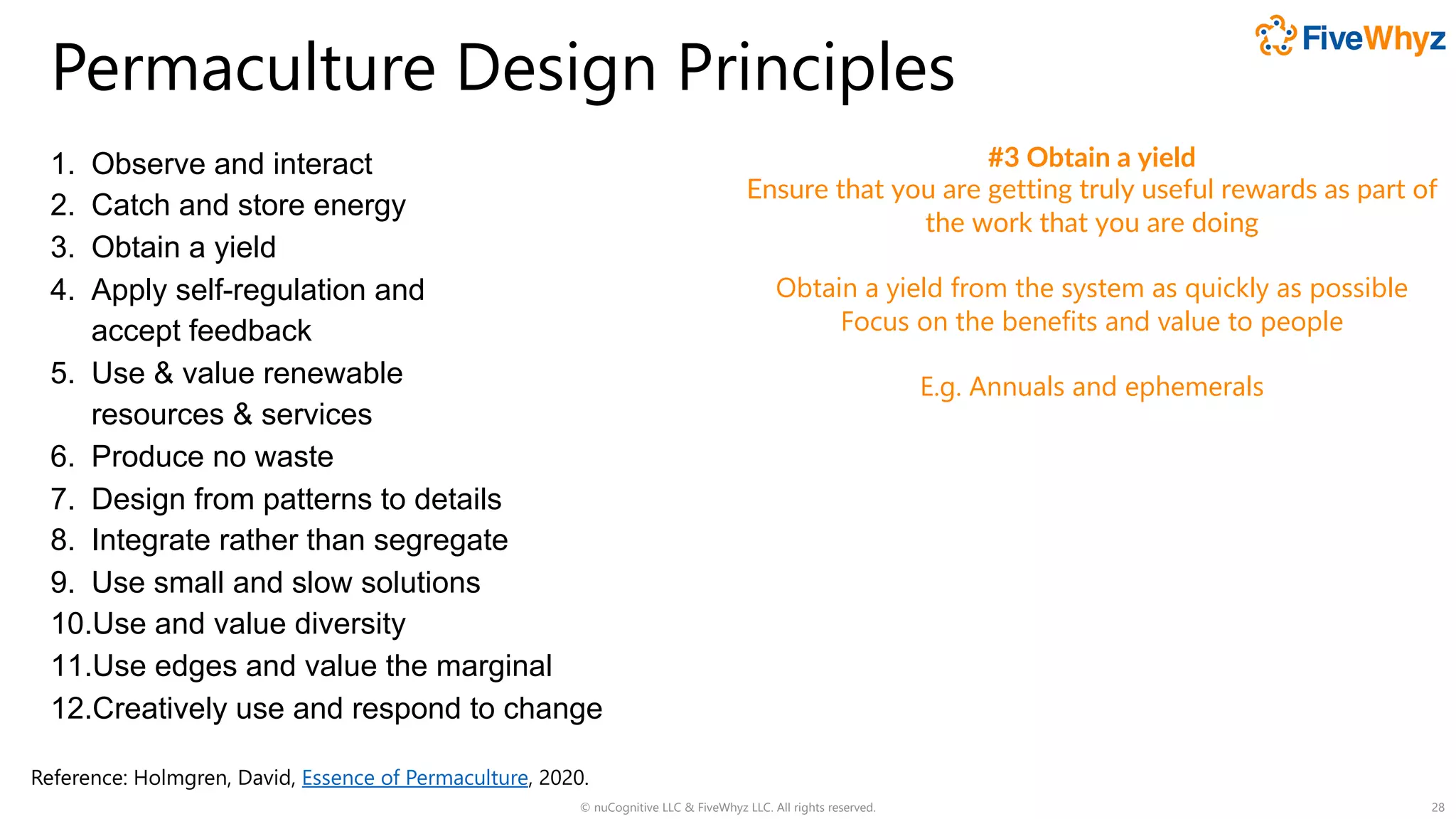
#3 Obtain a yield
Ensure that you are getting truly useful rewards as part of
the work that you are doing
Obtain a yield from the system as quickly as possible
Focus on the benefits and value to people
E.g. Annuals and ephemerals
Reference: Holmgren, David, Essence of Permaculture, 2020.
Permaculture Design Principles
1. Observe and interact
2. Catch and store energy
3. Obtain a yield
4. Apply self-regulation and
accept feedback
5. Use & value renewable
resources & services
6. Produce no waste
7. Design from patterns to details
8. Integrate rather than segregate
9. Use small and slow solutions
10.Use and value diversity
11.Use edges and value the marginal
12.Creatively use and respond to change
© nuCognitive LLC & FiveWhyz LLC. All rights reserved. 29
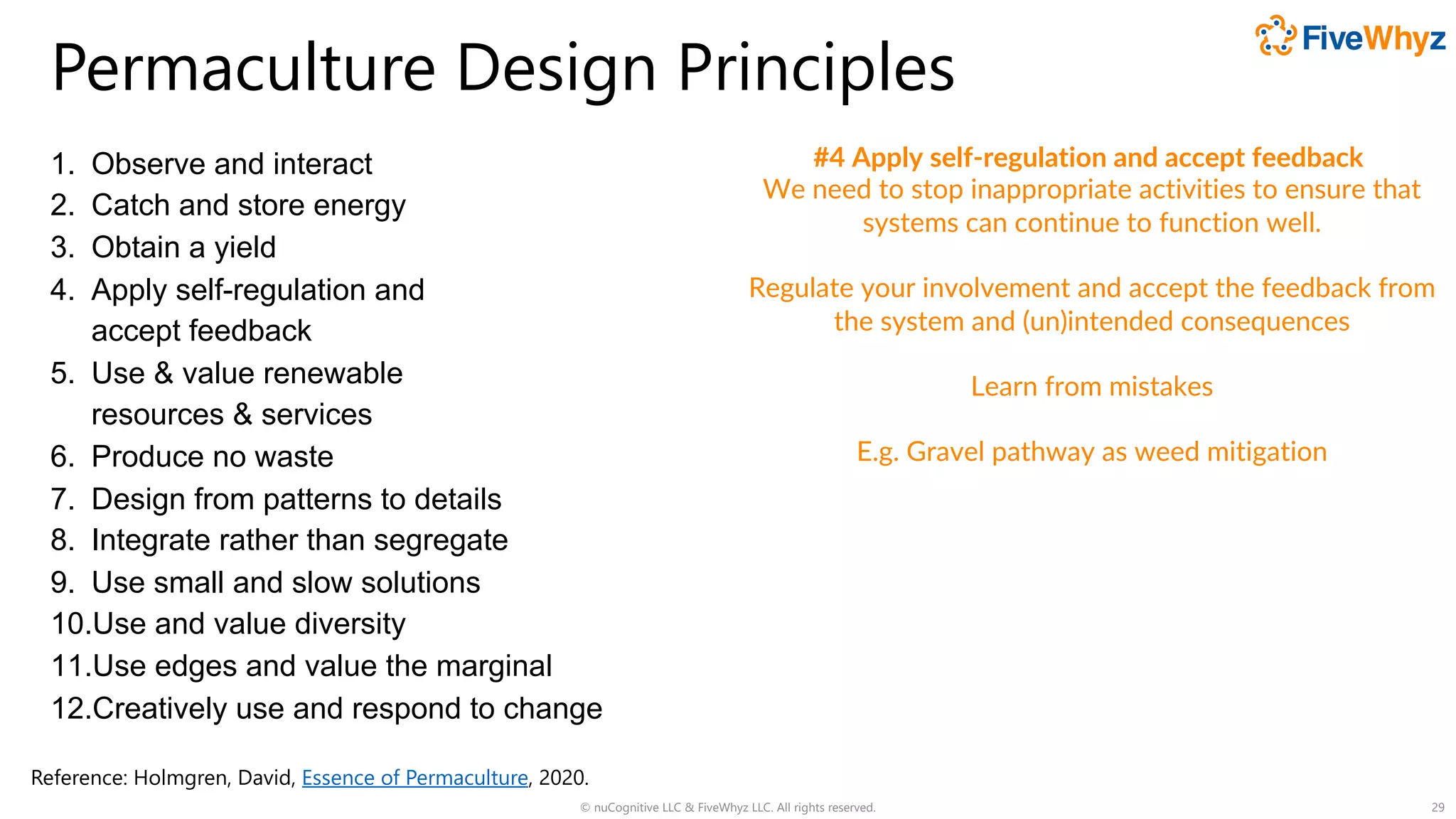
#4 Apply self-regulation and accept feedback
We need to stop inappropriate activities to ensure that
systems can continue to function well.
Regulate your involvement and accept the feedback from
the system and (un)intended consequences
Learn from mistakes
E.g. Gravel pathway as weed mitigation
Reference: Holmgren, David, Essence of Permaculture, 2020.
Permaculture Design Principles
1. Observe and interact
2. Catch and store energy
3. Obtain a yield
4. Apply self-regulation and
accept feedback
5. Use & value renewable
resources & services
6. Produce no waste
7. Design from patterns to details
8. Integrate rather than segregate
9. Use small and slow solutions
10.Use and value diversity
11.Use edges and value the marginal
12.Creatively use and respond to change
© nuCognitive LLC & FiveWhyz LLC. All rights reserved. 30
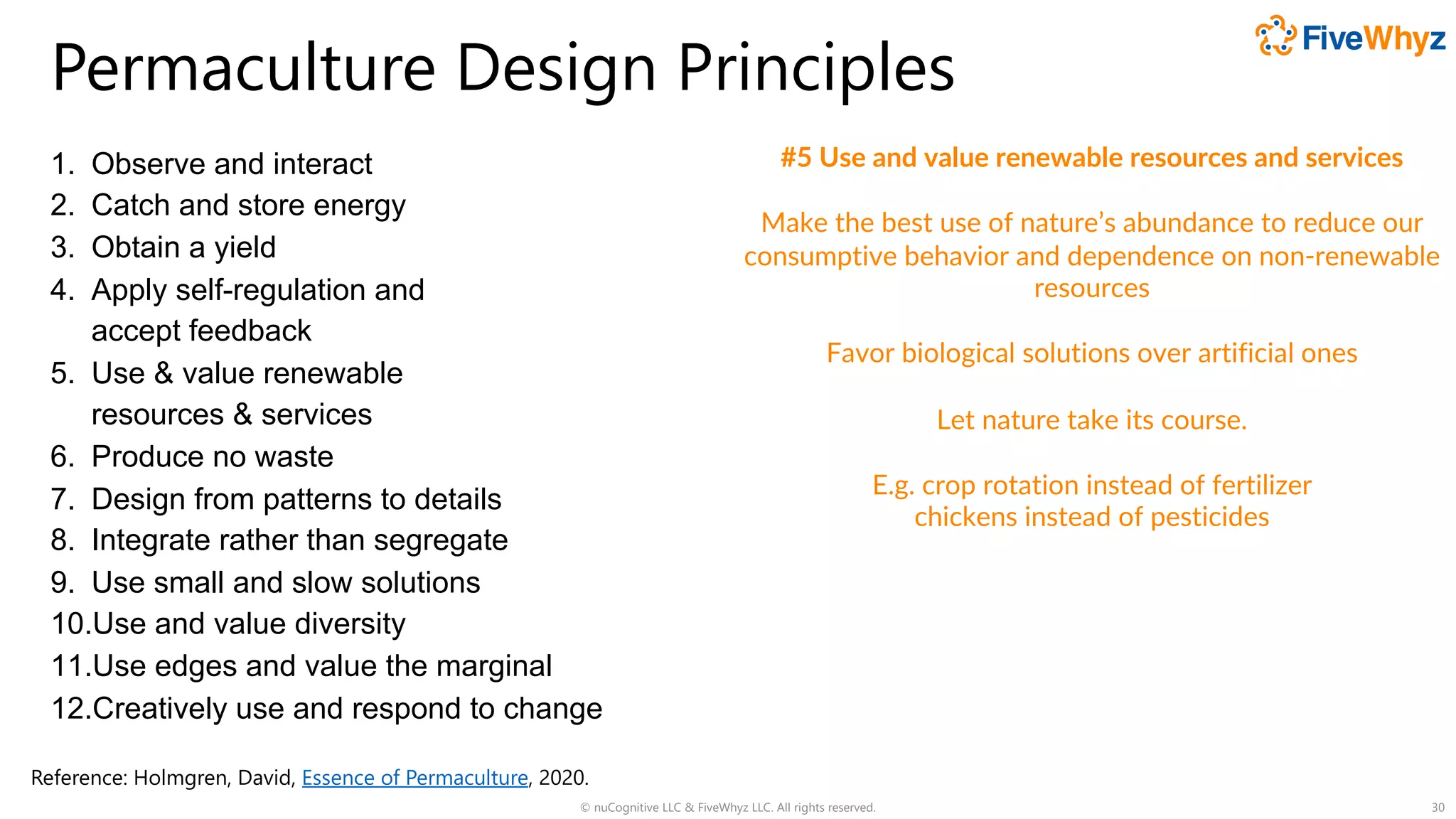
#5 Use and value renewable resources and services
Make the best use of nature’s abundance to reduce our
consumptive behavior and dependence on non-renewable
resources
Favor biological solutions over artificial ones
Let nature take its course.
E.g. crop rotation instead of fertilizer
chickens instead of pesticides
Reference: Holmgren, David, Essence of Permaculture, 2020.
Permaculture Design Principles
1. Observe and interact
2. Catch and store energy
3. Obtain a yield
4. Apply self-regulation and
accept feedback
5. Use & value renewable
resources & services
6. Produce no waste
7. Design from patterns to details
8. Integrate rather than segregate
9. Use small and slow solutions
10.Use and value diversity
11.Use edges and value the marginal
12.Creatively use and respond to change
© nuCognitive LLC & FiveWhyz LLC. All rights reserved. 31
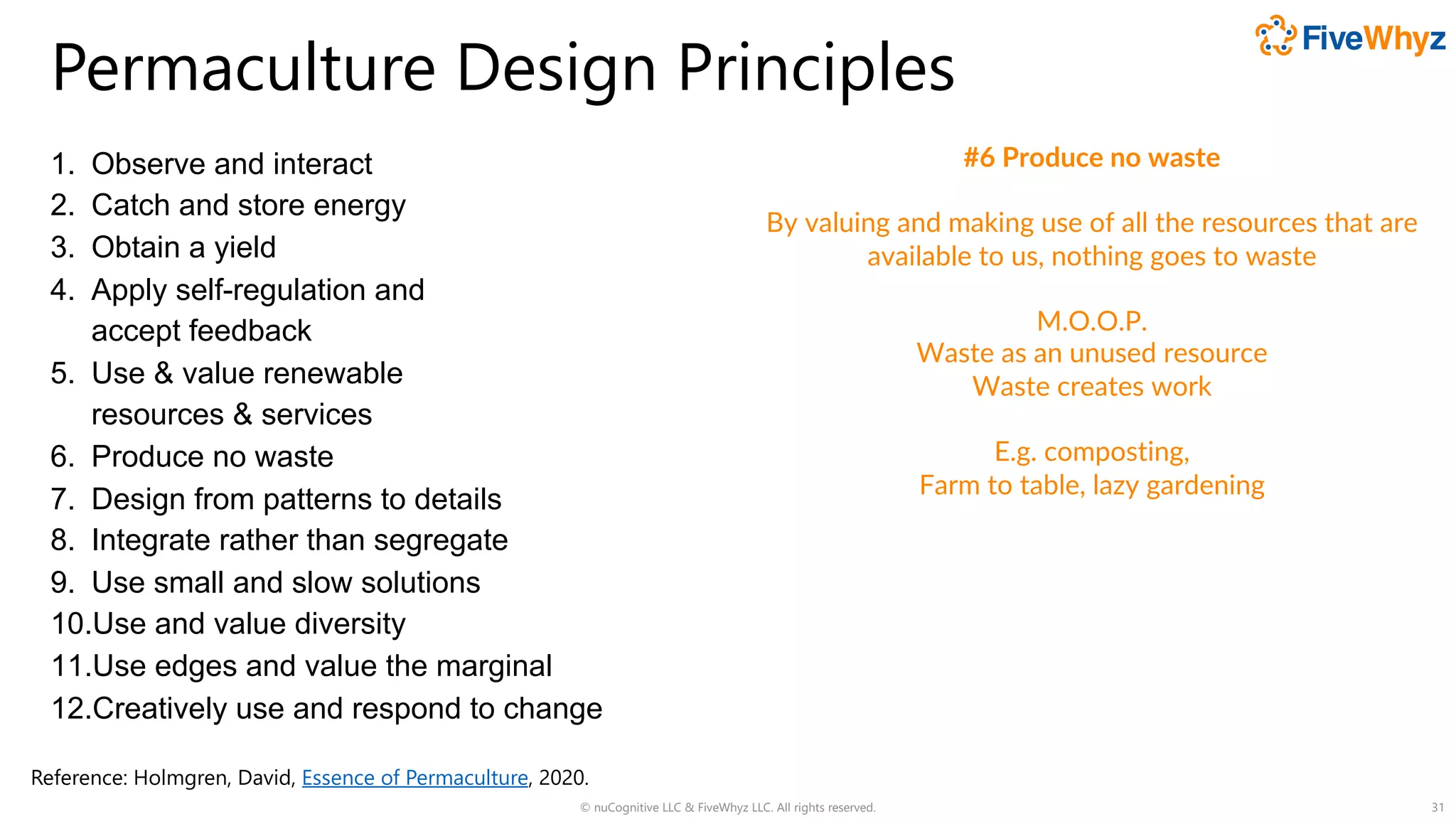
#6 Produce no waste
By valuing and making use of all the resources that are
available to us, nothing goes to waste
M.O.O.P.
Waste as an unused resource
Waste creates work
E.g. composting,
Farm to table, lazy gardening
Reference: Holmgren, David, Essence of Permaculture, 2020.
Permaculture Design Principles
1. Observe and interact
2. Catch and store energy
3. Obtain a yield
4. Apply self-regulation and
accept feedback
5. Use & value renewable
resources & services
6. Produce no waste
7. Design from patterns to details
8. Integrate rather than segregate
9. Use small and slow solutions
10.Use and value diversity
11.Use edges and value the marginal
12.Creatively use and respond to change
© nuCognitive LLC & FiveWhyz LLC. All rights reserved. 32
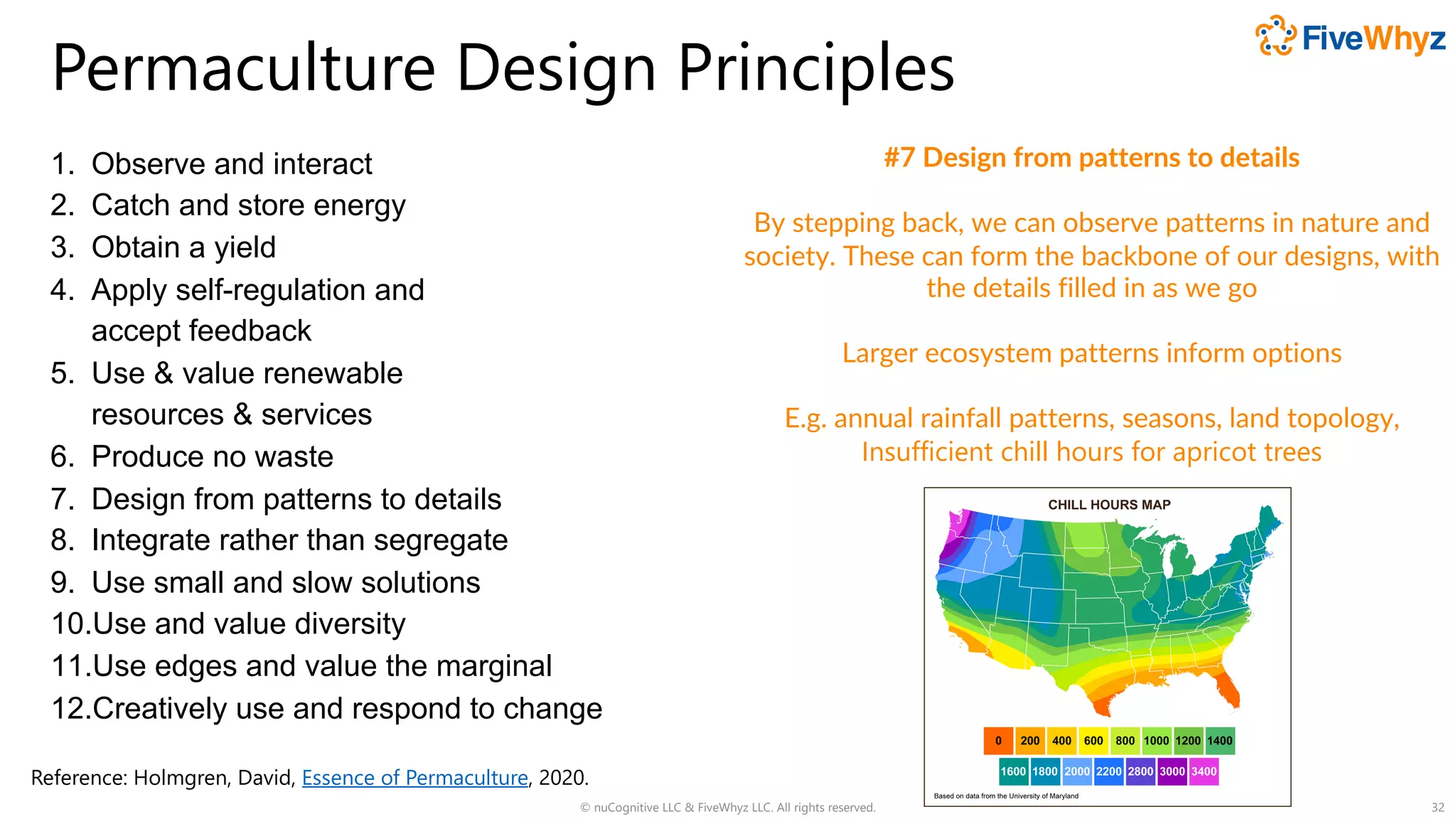
#7 Design from patterns to details
By stepping back, we can observe patterns in nature and
society. These can form the backbone of our designs, with
the details filled in as we go
Larger ecosystem patterns inform options
E.g. annual rainfall patterns, seasons, land topology,
Insufficient chill hours for apricot trees
Reference: Holmgren, David, Essence of Permaculture, 2020.
Permaculture Design Principles
1. Observe and interact
2. Catch and store energy
3. Obtain a yield
4. Apply self-regulation and
accept feedback
5. Use & value renewable
resources & services
6. Produce no waste
7. Design from patterns to details
8. Integrate rather than segregate
9. Use small and slow solutions
10.Use and value diversity
11.Use edges and value the marginal
12.Creatively use and respond to change
© nuCognitive LLC & FiveWhyz LLC. All rights reserved. 33
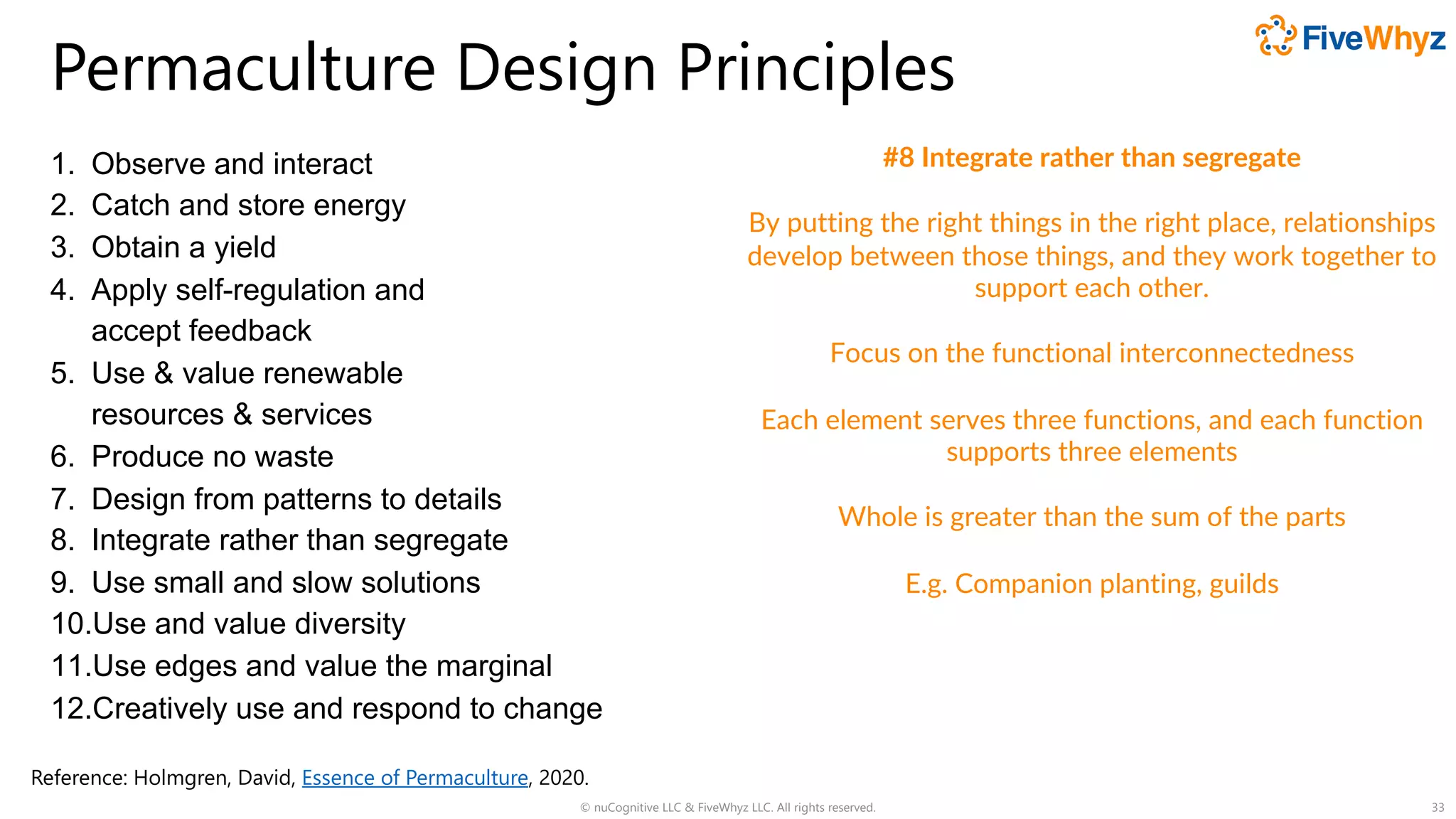
#8 Integrate rather than segregate
By putting the right things in the right place, relationships
develop between those things, and they work together to
support each other.
Focus on the functional interconnectedness
Each element serves three functions, and each function
supports three elements
Whole is greater than the sum of the parts
E.g. Companion planting, guilds
Reference: Holmgren, David, Essence of Permaculture, 2020.
Permaculture Design Principles
1. Observe and interact
2. Catch and store energy
3. Obtain a yield
4. Apply self-regulation and
accept feedback
5. Use & value renewable
resources & services
6. Produce no waste
7. Design from patterns to details
8. Integrate rather than segregate
9. Use small and slow solutions
10.Use and value diversity
11.Use edges and value the marginal
12.Creatively use and respond to change
© nuCognitive LLC & FiveWhyz LLC. All rights reserved. 34
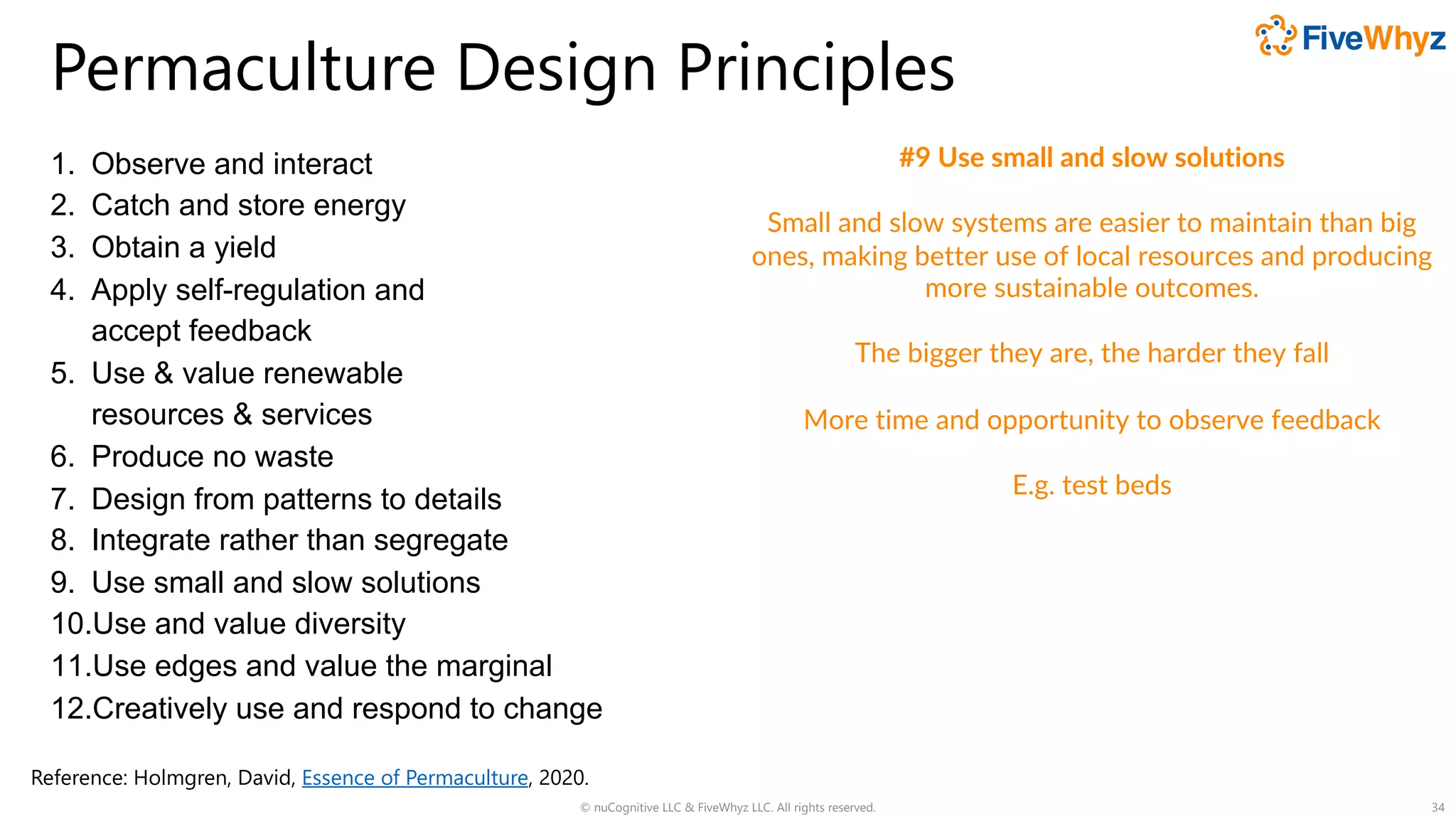
#9 Use small and slow solutions
Small and slow systems are easier to maintain than big
ones, making better use of local resources and producing
more sustainable outcomes.
The bigger they are, the harder they fall
More time and opportunity to observe feedback
E.g. test beds
Reference: Holmgren, David, Essence of Permaculture, 2020.
Permaculture Design Principles
1. Observe and interact
2. Catch and store energy
3. Obtain a yield
4. Apply self-regulation and
accept feedback
5. Use & value renewable
resources & services
6. Produce no waste
7. Design from patterns to details
8. Integrate rather than segregate
9. Use small and slow solutions
10.Use and value diversity
11.Use edges and value the marginal
12.Creatively use and respond to change
© nuCognitive LLC & FiveWhyz LLC. All rights reserved. 35
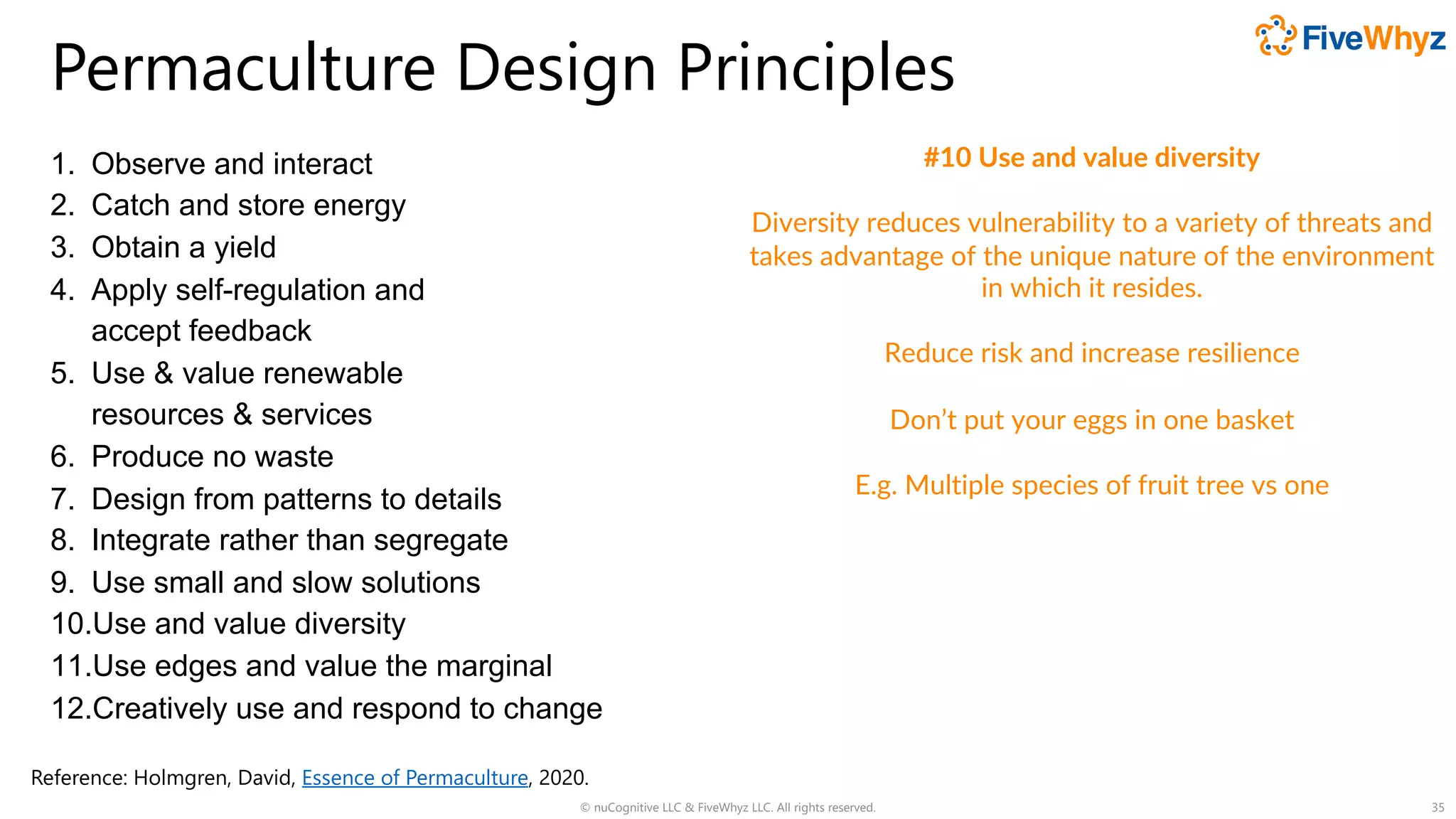
#10 Use and value diversity
Diversity reduces vulnerability to a variety of threats and
takes advantage of the unique nature of the environment
in which it resides.
Reduce risk and increase resilience
Don’t put your eggs in one basket
E.g. Multiple species of fruit tree vs one
Reference: Holmgren, David, Essence of Permaculture, 2020.
Permaculture Design Principles
1. Observe and interact
2. Catch and store energy
3. Obtain a yield
4. Apply self-regulation and
accept feedback
5. Use & value renewable
resources & services
6. Produce no waste
7. Design from patterns to details
8. Integrate rather than segregate
9. Use small and slow solutions
10.Use and value diversity
11.Use edges and value the marginal
12.Creatively use and respond to change
© nuCognitive LLC & FiveWhyz LLC. All rights reserved. 36
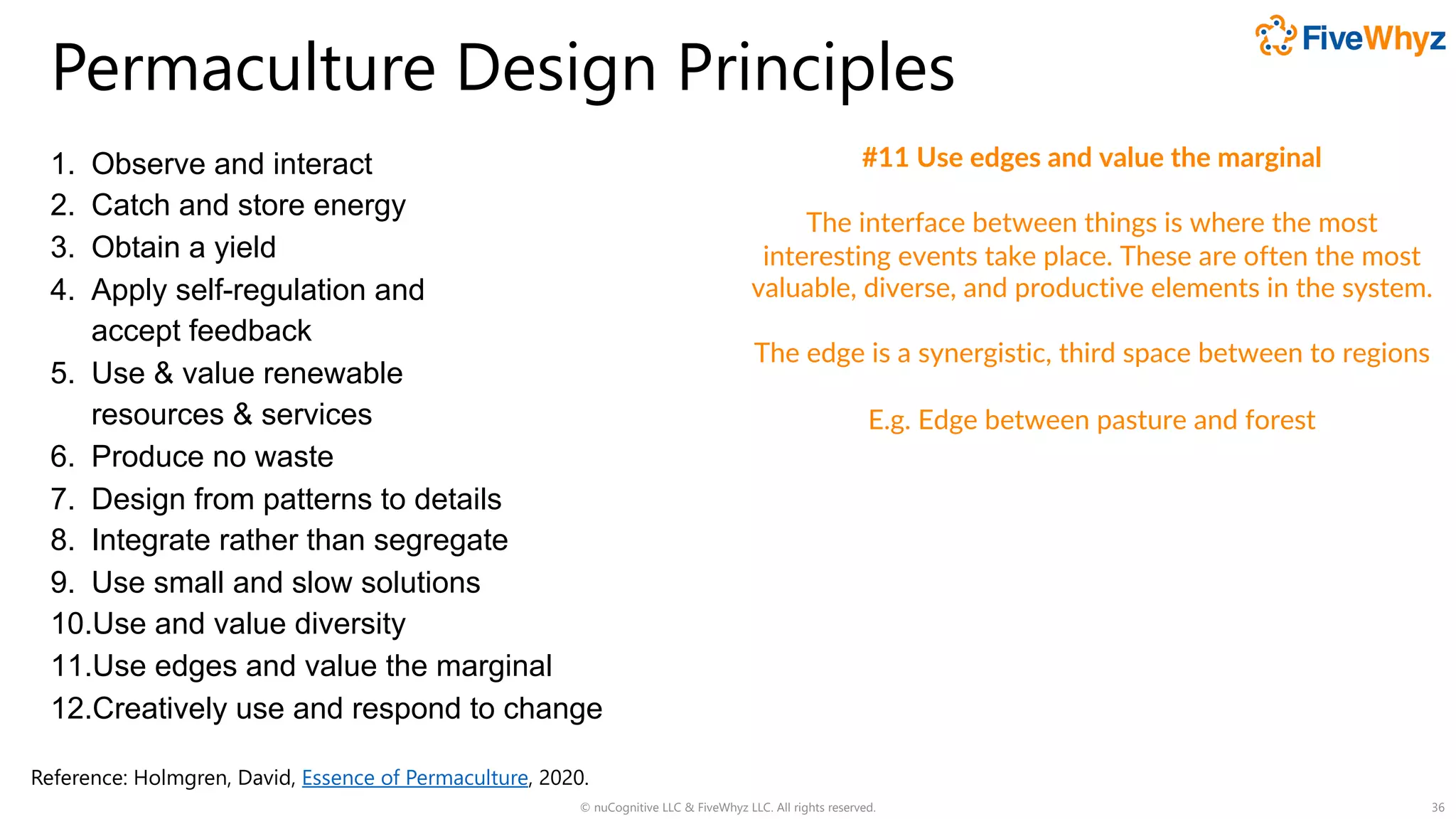
#11 Use edges and value the marginal
The interface between things is where the most
interesting events take place. These are often the most
valuable, diverse, and productive elements in the system.
The edge is a synergistic, third space between to regions
E.g. Edge between pasture and forest
Reference: Holmgren, David, Essence of Permaculture, 2020.
Permaculture Design Principles
1. Observe and interact
2. Catch and store energy
3. Obtain a yield
4. Apply self-regulation and
accept feedback
5. Use & value renewable
resources & services
6. Produce no waste
7. Design from patterns to details
8. Integrate rather than segregate
9. Use small and slow solutions
10.Use and value diversity
11.Use edges and value the marginal
12.Creatively use and respond to change
© nuCognitive LLC & FiveWhyz LLC. All rights reserved. 37
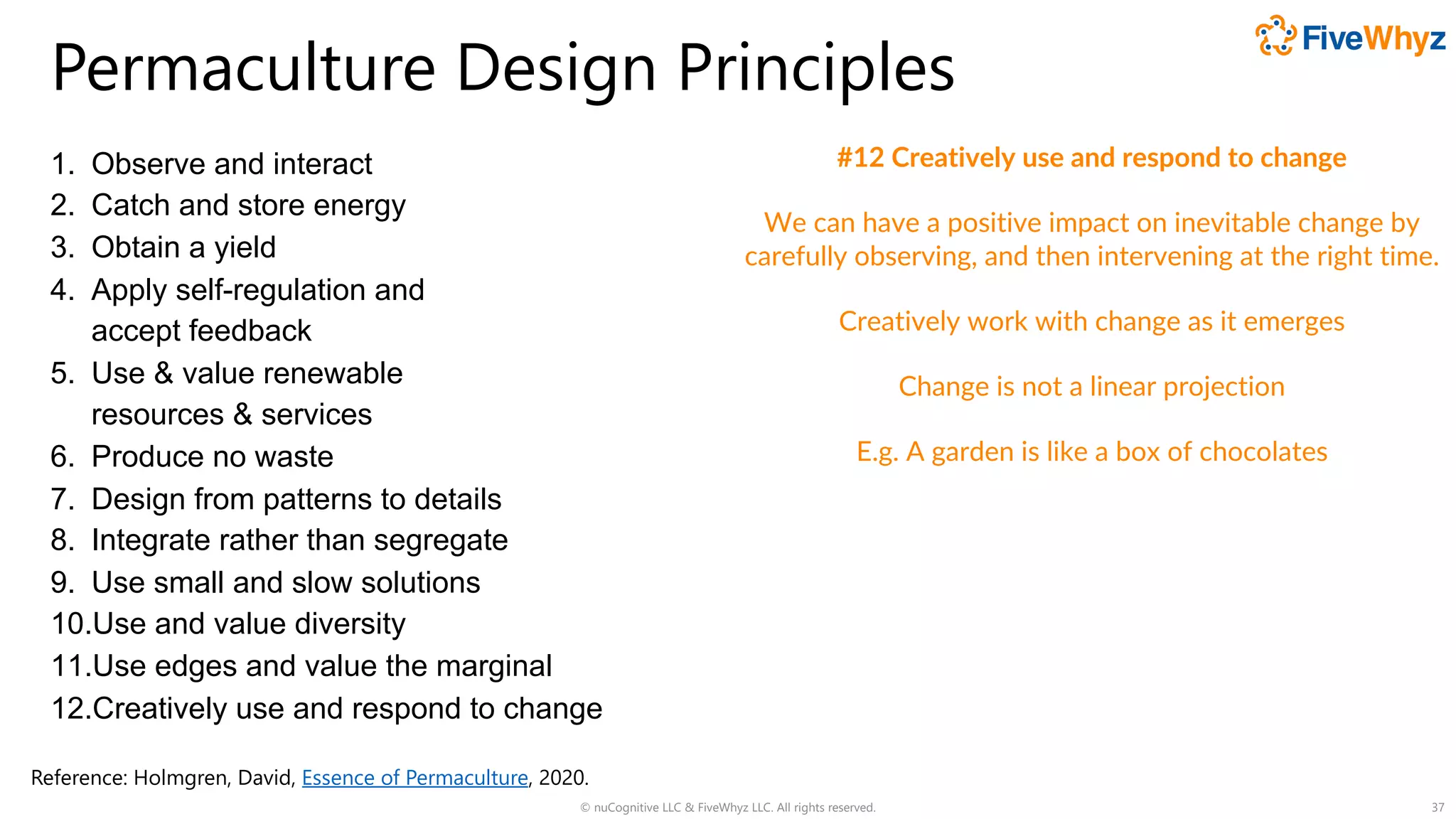
#12 Creatively use and respond to change
We can have a positive impact on inevitable change by
carefully observing, and then intervening at the right time.
Creatively work with change as it emerges
Change is not a linear projection
E.g. A garden is like a box of chocolates
Reference: Holmgren, David, Essence of Permaculture, 2020.
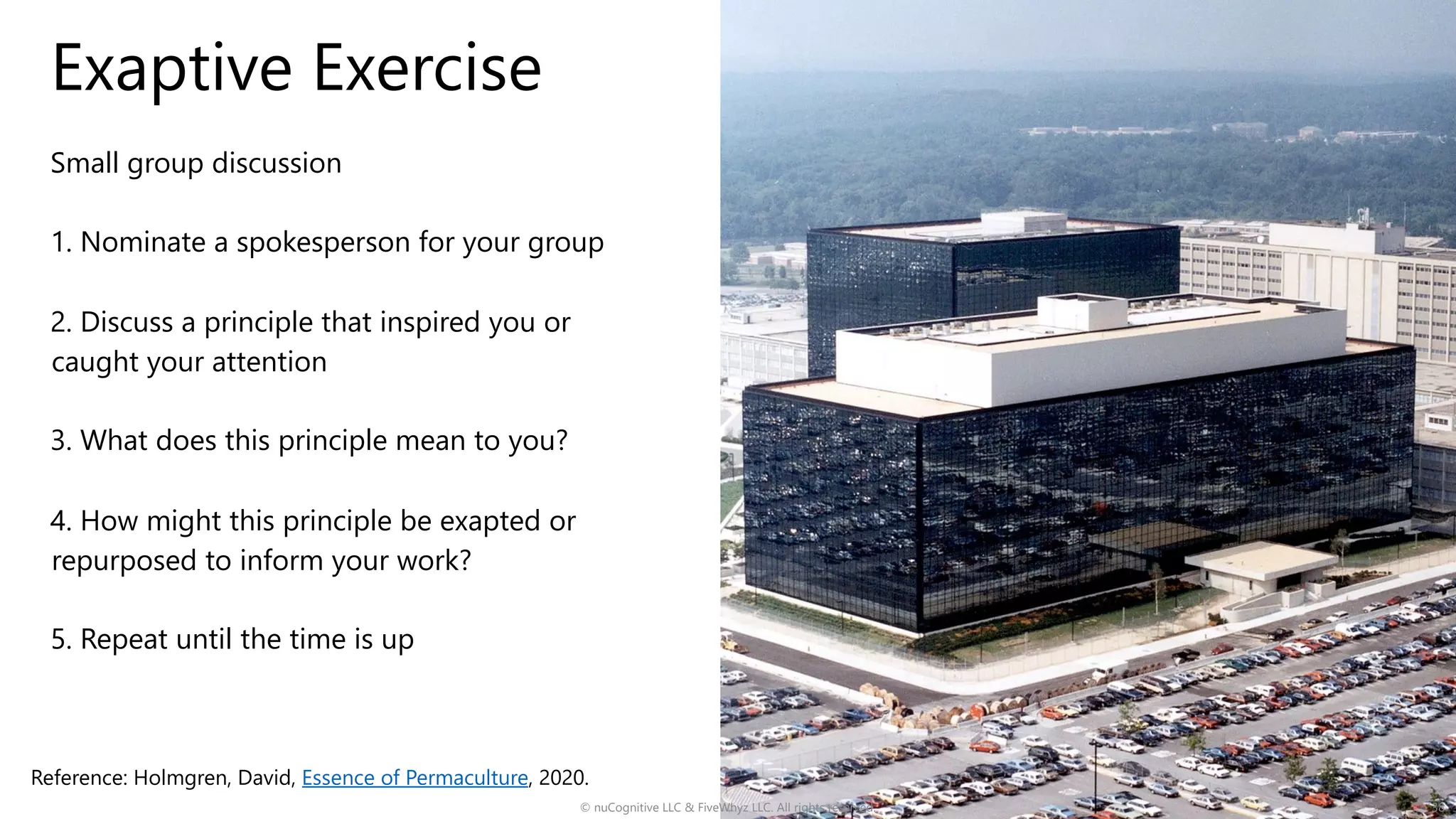
Exaptive Exercise
Small group discussion
1. Nominate a spokesperson for your group
2. Discuss a principle that inspired you or
caught your attention
3. What does this principle mean to you?
4. How might this principle be exapted or
repurposed to inform your work?
5. Repeat until the time is up
© nuCognitive LLC & FiveWhyz LLC. All rights reserved. 38
Reference: Holmgren, David, Essence of Permaculture, 2020.
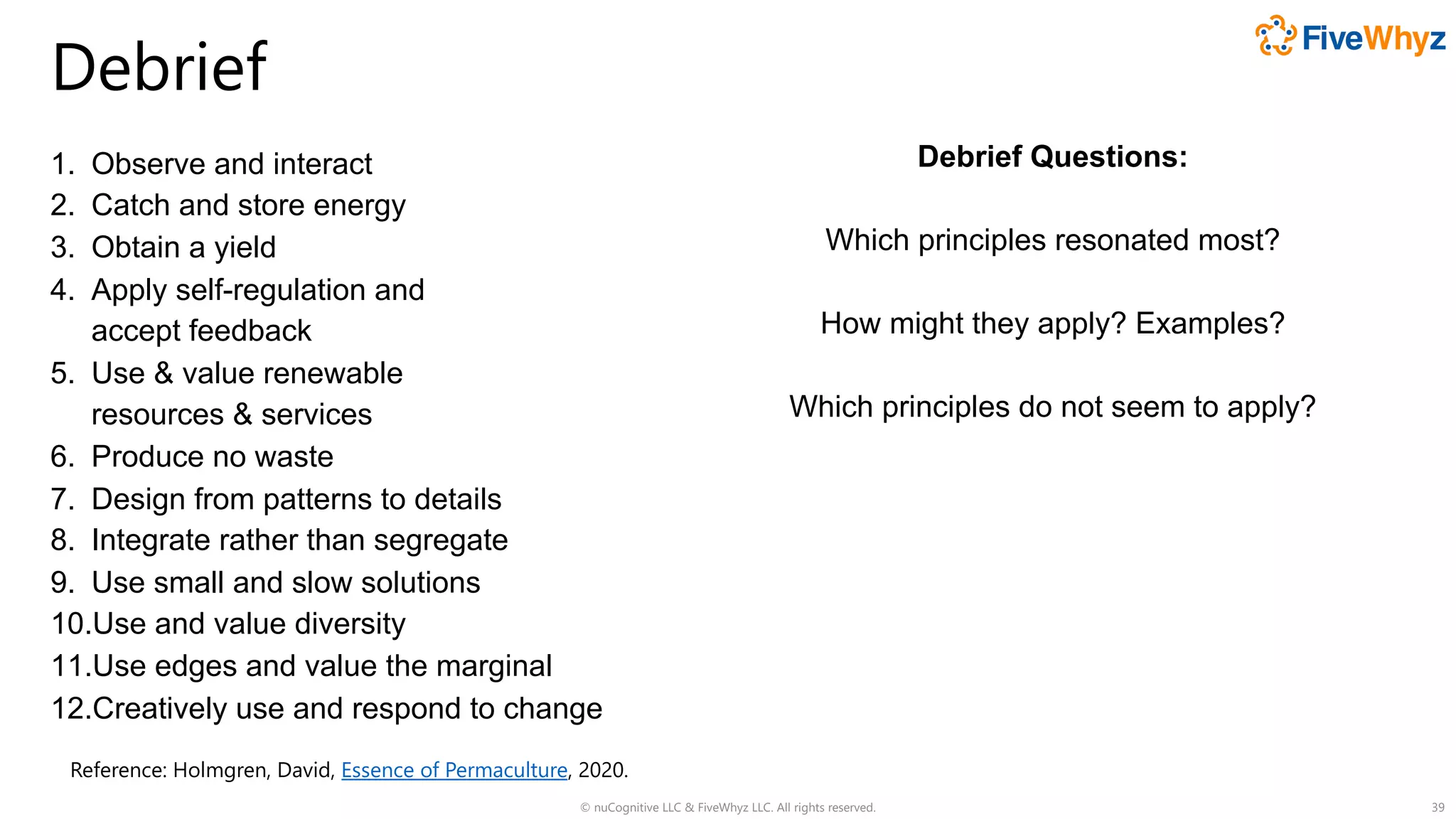
Debrief
1. Observe and interact
2. Catch and store energy
3. Obtain a yield
4. Apply self-regulation and
accept feedback
5. Use & value renewable
resources & services
6. Produce no waste
7. Design from patterns to details
8. Integrate rather than segregate
9. Use small and slow solutions
10.Use and value diversity
11.Use edges and value the marginal
12.Creatively use and respond to change
© nuCognitive LLC & FiveWhyz LLC. All rights reserved. 39
Reference: Holmgren, David, Essence of Permaculture, 2020.
Debrief Questions:
Which principles resonated most?
How might they apply? Examples?
Which principles do not seem to apply?
© nuCognitive LLC & FiveWhyz LLC. All rights reserved. 40
Though the problems of the world are increasingly complex, the
solutions remain embarrassingly simple. - Bill Mollison
References
Gleick, James, Chaos: Making a New Science, 2008.
Weaver, Warren, Science and Complexity, 1948.
Shannon and Weaver, The Mathematical Theory of Communication, 1971.
Lorenz, Edward, The Essence of Chaos, 1993.
Dizikes, Peter, When the Butterfly Effect Took Flight, 2011.
Priogogine, Ilya, The End of Certainty, 1997.
Rittlel and Webber, Dilemmas in a General Theory of Planning, 1973.
Wolfram, Stephen, A New Kind of Science, 2002.
Mollison, Bill, Permaculture: A Designers' Manual, 1997.
Holmgren, David, Essence of Permaculture, 2020.
© nuCognitive LLC & FiveWhyz LLC. All rights reserved. 41
THANK YOU!
Complexity Science Through the
Lens of Permaculture
Permaculture Principles for Complex Systems Design
© nuCognitive LLC & FiveWhyz LLC. All rights reserved. 42
Let’s connect
NYC Complexity Lounge - November 2022
Daniel Walsh - dan@fivewhyz.com

Complexity Science Through the Lens of Gardening

  • 1.
    Complexity Science Throughthe Lens of Gardening Permaculture Principles for Complex Systems Design © nuCognitive LLC & FiveWhyz LLC. All rights reserved. 1 Let’s connect NYC Complexity Lounge - November 2022 Daniel Walsh
  • 2.
    Our Journey Complexity, AsTransdisciplinary Science Exaptation, Latent Superpower Permaculture, Pragmatism X Theory Small Group Discussion, Learning by Doing Debrief and Next Steps
  • 3.
    © nuCognitive LLC& FiveWhyz LLC. All rights reserved. 3 Transdisciplinary an approach to research and practice in which persons across a range of disciplines attempt to work on share problems and projects
  • 4.
    “What makes andevening primrose open when it does?” © nuCognitive LLC & FiveWhyz LLC. All rights reserved. 4 1947 Warren Weaver, Applied Mathematics Science and Complexity Organized vs Disorganized Complexity Random-like properties Not purely random, but a special kind of random
  • 5.
    Copyright © W.R.Owens © nuCognitive LLC & FiveWhyz LLC. All rights reserved. 5 1952 Turing Biology The Chemical Basis of Morphogenesis Describes how patterns in nature, such as stripes & spots, arise naturally and autonomously from a homogeneous, uniform state Reference https://en.wikipedia.org/wiki/Turing_pattern Emergent Properties
  • 6.
    How Two WeatherPatterns Diverge Lorenz’s Original Printouts, 1961 © nuCognitive LLC & FiveWhyz LLC. All rights reserved. 6 1961 Lorenz Meteorology The Butterfly Effect “The phenomenon that a small alteration in the state of a dynamical system will cause subsequent states to differ greatly” Sensitive to Initial Conditions (feedback) Non-linear (and non-repeatable)
  • 7.
    © nuCognitive LLC& FiveWhyz LLC. All rights reserved. 7 1973 Rittel and Webber Management Science formulation of wicked problems in social policy Reference: https://en.wikipedia.org/wiki/Wicked_problem Poorly Defined No Stopping Rule (Irreducible, Infinite Game)
  • 8.
    The first publishedpicture of the Mandelbrot set, by Robert W. Brooks and Peter Matelski in 1978 © nuCognitive LLC & FiveWhyz LLC. All rights reserved. 8 1975 Mandelbrot Mathematics “A fractal is a rough or fragmented geometric shape that can be split into parts, each of which is approximately a reduced-size copy of the whole” Fractal Self-similarity
  • 9.
    © nuCognitive LLC& FiveWhyz LLC. All rights reserved. 9 1977 Prigogine Chemistry dissipative structures and their role in thermodynamic systems far from equilibrium Belousov–Zhabotinsky reaction, or BZ reaction Photo Attribution: Stephen Morris Far from Equilibrium Irreversible
  • 10.
    "From an extremelysimple model, we're able to reproduce special relativity, general relativity and the core results of quantum mechanics” 2020 Wolfram Physics Project 10 1992 Wolfram Computational Complexity (building on John von Neumann -1950s & John Conway – 1970s) Rule 110 cellular automation Simple Rules Self-replication, Self-organization Image Credit: Cormullion © nuCognitive LLC & FiveWhyz LLC. All rights reserved.
  • 11.
    © nuCognitive LLC& FiveWhyz LLC. All rights reserved. 11 police officer labor union leader teacher NGO ecologist Anyone who works with people - from the smallest teams to the largest organizations - works with(in) complex adaptive systems healthcare conflict mediation
  • 12.
    Exaptation Example |Biological Evolution © nuCognitive LLC & FiveWhyz LLC. All rights reserved. 12 Feathers evolved for heat regulation, for display, and later for use in bird flight Image Credit: Archaeopteryx lithographica chasing Compsognathus by Durbed
  • 13.
    Exaptation Example |Biological Evolution © nuCognitive LLC & FiveWhyz LLC. All rights reserved. 13 Middle ear bones (hammer, anvil, and stirrup) started out as part of ancient reptilian jaw joints
  • 14.
    14 © nuCognitive LLC& FiveWhyz LLC. All rights reserved.
  • 15.
    Image Credit: Holger.Ellgaard ©nuCognitive LLC & FiveWhyz LLC. All rights reserved. 15
  • 16.
    16 © nuCognitive LLC& FiveWhyz LLC. All rights reserved. Image Credit: Doug Coldwell
  • 17.
    © nuCognitive LLC& FiveWhyz LLC. All rights reserved. 17 © nuCognitive LLC & FiveWhyz LLC. All rights reserved.
  • 18.
    © nuCognitive LLC& FiveWhyz LLC. All rights reserved. 18 police officer labor union leader teacher NGO ecologist How might we exapt or repurpose practices and principles from other domains? healthcare conflict mediation
  • 19.
    Complex Change Needs EcologicalMetaphors Not Manufacturing Ones Leader As Gardener 19 © nuCognitive LLC & FiveWhyz LLC. All rights reserved.
  • 20.
    Image Credit: ClaireGregory © nuCognitive LLC & FiveWhyz LLC. All rights reserved. 20 Permaculture Permanent Agriculture Food Forest Ecology Natural Wilderness Forest Agriculture Controlled and Artificial Monoculture farm
  • 21.
    Permaculture is theconscious design and maintenance of agriculturally productive ecosystems which have the diversity, stability, and resilience of natural ecosystems. — Bill Mollison 21 Image Credit: Nicolas Boullosa
  • 22.
    © nuCognitive LLC& FiveWhyz LLC. All rights reserved. 22 ecological engineering, environmental design, and construction pragmatic, simple concepts, regenerative and resilient complex adaptive systems, plants, animals, and whole ecosystems
  • 23.
    Cohesive set ofprinciples to be considered as a whole Process to think through, design, and engineer a complex problem or challenge Field tested, iterated, and evolved over 30 years © nuCognitive LLC & FiveWhyz LLC. All rights reserved. 23 Permaculture Design Principles Photo Attribution: hardworkinghippy : La Ferme de Sourrou
  • 24.
    Permaculture Design Principles 1. Observeand interact 2. Catch and store energy 3. Obtain a yield 4. Apply self-regulation and accept feedback 5. Use & value renewable resources & services 6. Produce no waste 7. Design from patterns to details 8. Integrate rather than segregate 9. Use small and slow solutions 10.Use and value diversity 11.Use edges and value the marginal 12.Creatively use and respond to change © nuCognitive LLC & FiveWhyz LLC. All rights reserved. 24 Reference: Holmgren, David, Essence of Permaculture, 2020. Photo Attribution: hardworkinghippy : La Ferme de Sourrou
  • 25.
    Exaptive Exercise Setup • Think ofa complex challenge that you’d like help with • Imagine a expert consultant were hired to help out • Listen to the principles proposed and make a note anything of particular interest or exaptive connection © nuCognitive LLC & FiveWhyz LLC. All rights reserved. 25
  • 26.
    Permaculture Design Principles 1.Observe and interact 2. Catch and store energy 3. Obtain a yield 4. Apply self-regulation and accept feedback 5. Use & value renewable resources & services 6. Produce no waste 7. Design from patterns to details 8. Integrate rather than segregate 9. Use small and slow solutions 10.Use and value diversity 11.Use edges and value the marginal 12.Creatively use and respond to change © nuCognitive LLC & FiveWhyz LLC. All rights reserved. 26 #1 Observe and interact By taking time to engage with nature we can design solutions that suit our situation. Observe, then interact Live with the land for two years to become part of it prior to major interventions E.g. Citrus trees freeze (and grow large) Reference: Holmgren, David, Essence of Permaculture, 2020.
  • 27.
    Permaculture Design Principles 1.Observe and interact 2. Catch and store energy 3. Obtain a yield 4. Apply self-regulation and accept feedback 5. Use & value renewable resources & services 6. Produce no waste 7. Design from patterns to details 8. Integrate rather than segregate 9. Use small and slow solutions 10.Use and value diversity 11.Use edges and value the marginal 12.Creatively use and respond to change © nuCognitive LLC & FiveWhyz LLC. All rights reserved. 27 #2 Catch and store energy By developing systems that collect resources at peak abundance, we can use them in times of need. Consider all energy flows through your system, solar, wind, water, flora, fauna Make hay while the sun shines E.g. Cover crop turns into compost Reference: Holmgren, David, Essence of Permaculture, 2020.
  • 28.
    Permaculture Design Principles 1.Observe and interact 2. Catch and store energy 3. Obtain a yield 4. Apply self-regulation and accept feedback 5. Use & value renewable resources & services 6. Produce no waste 7. Design from patterns to details 8. Integrate rather than segregate 9. Use small and slow solutions 10.Use and value diversity 11.Use edges and value the marginal 12.Creatively use and respond to change © nuCognitive LLC & FiveWhyz LLC. All rights reserved. 28 #3 Obtain a yield Ensure that you are getting truly useful rewards as part of the work that you are doing Obtain a yield from the system as quickly as possible Focus on the benefits and value to people E.g. Annuals and ephemerals Reference: Holmgren, David, Essence of Permaculture, 2020.
  • 29.
    Permaculture Design Principles 1.Observe and interact 2. Catch and store energy 3. Obtain a yield 4. Apply self-regulation and accept feedback 5. Use & value renewable resources & services 6. Produce no waste 7. Design from patterns to details 8. Integrate rather than segregate 9. Use small and slow solutions 10.Use and value diversity 11.Use edges and value the marginal 12.Creatively use and respond to change © nuCognitive LLC & FiveWhyz LLC. All rights reserved. 29 #4 Apply self-regulation and accept feedback We need to stop inappropriate activities to ensure that systems can continue to function well. Regulate your involvement and accept the feedback from the system and (un)intended consequences Learn from mistakes E.g. Gravel pathway as weed mitigation Reference: Holmgren, David, Essence of Permaculture, 2020.
  • 30.
    Permaculture Design Principles 1.Observe and interact 2. Catch and store energy 3. Obtain a yield 4. Apply self-regulation and accept feedback 5. Use & value renewable resources & services 6. Produce no waste 7. Design from patterns to details 8. Integrate rather than segregate 9. Use small and slow solutions 10.Use and value diversity 11.Use edges and value the marginal 12.Creatively use and respond to change © nuCognitive LLC & FiveWhyz LLC. All rights reserved. 30 #5 Use and value renewable resources and services Make the best use of nature’s abundance to reduce our consumptive behavior and dependence on non-renewable resources Favor biological solutions over artificial ones Let nature take its course. E.g. crop rotation instead of fertilizer chickens instead of pesticides Reference: Holmgren, David, Essence of Permaculture, 2020.
  • 31.
    Permaculture Design Principles 1.Observe and interact 2. Catch and store energy 3. Obtain a yield 4. Apply self-regulation and accept feedback 5. Use & value renewable resources & services 6. Produce no waste 7. Design from patterns to details 8. Integrate rather than segregate 9. Use small and slow solutions 10.Use and value diversity 11.Use edges and value the marginal 12.Creatively use and respond to change © nuCognitive LLC & FiveWhyz LLC. All rights reserved. 31 #6 Produce no waste By valuing and making use of all the resources that are available to us, nothing goes to waste M.O.O.P. Waste as an unused resource Waste creates work E.g. composting, Farm to table, lazy gardening Reference: Holmgren, David, Essence of Permaculture, 2020.
  • 32.
    Permaculture Design Principles 1.Observe and interact 2. Catch and store energy 3. Obtain a yield 4. Apply self-regulation and accept feedback 5. Use & value renewable resources & services 6. Produce no waste 7. Design from patterns to details 8. Integrate rather than segregate 9. Use small and slow solutions 10.Use and value diversity 11.Use edges and value the marginal 12.Creatively use and respond to change © nuCognitive LLC & FiveWhyz LLC. All rights reserved. 32 #7 Design from patterns to details By stepping back, we can observe patterns in nature and society. These can form the backbone of our designs, with the details filled in as we go Larger ecosystem patterns inform options E.g. annual rainfall patterns, seasons, land topology, Insufficient chill hours for apricot trees Reference: Holmgren, David, Essence of Permaculture, 2020.
  • 33.
    Permaculture Design Principles 1.Observe and interact 2. Catch and store energy 3. Obtain a yield 4. Apply self-regulation and accept feedback 5. Use & value renewable resources & services 6. Produce no waste 7. Design from patterns to details 8. Integrate rather than segregate 9. Use small and slow solutions 10.Use and value diversity 11.Use edges and value the marginal 12.Creatively use and respond to change © nuCognitive LLC & FiveWhyz LLC. All rights reserved. 33 #8 Integrate rather than segregate By putting the right things in the right place, relationships develop between those things, and they work together to support each other. Focus on the functional interconnectedness Each element serves three functions, and each function supports three elements Whole is greater than the sum of the parts E.g. Companion planting, guilds Reference: Holmgren, David, Essence of Permaculture, 2020.
  • 34.
    Permaculture Design Principles 1.Observe and interact 2. Catch and store energy 3. Obtain a yield 4. Apply self-regulation and accept feedback 5. Use & value renewable resources & services 6. Produce no waste 7. Design from patterns to details 8. Integrate rather than segregate 9. Use small and slow solutions 10.Use and value diversity 11.Use edges and value the marginal 12.Creatively use and respond to change © nuCognitive LLC & FiveWhyz LLC. All rights reserved. 34 #9 Use small and slow solutions Small and slow systems are easier to maintain than big ones, making better use of local resources and producing more sustainable outcomes. The bigger they are, the harder they fall More time and opportunity to observe feedback E.g. test beds Reference: Holmgren, David, Essence of Permaculture, 2020.
  • 35.
    Permaculture Design Principles 1.Observe and interact 2. Catch and store energy 3. Obtain a yield 4. Apply self-regulation and accept feedback 5. Use & value renewable resources & services 6. Produce no waste 7. Design from patterns to details 8. Integrate rather than segregate 9. Use small and slow solutions 10.Use and value diversity 11.Use edges and value the marginal 12.Creatively use and respond to change © nuCognitive LLC & FiveWhyz LLC. All rights reserved. 35 #10 Use and value diversity Diversity reduces vulnerability to a variety of threats and takes advantage of the unique nature of the environment in which it resides. Reduce risk and increase resilience Don’t put your eggs in one basket E.g. Multiple species of fruit tree vs one Reference: Holmgren, David, Essence of Permaculture, 2020.
  • 36.
    Permaculture Design Principles 1.Observe and interact 2. Catch and store energy 3. Obtain a yield 4. Apply self-regulation and accept feedback 5. Use & value renewable resources & services 6. Produce no waste 7. Design from patterns to details 8. Integrate rather than segregate 9. Use small and slow solutions 10.Use and value diversity 11.Use edges and value the marginal 12.Creatively use and respond to change © nuCognitive LLC & FiveWhyz LLC. All rights reserved. 36 #11 Use edges and value the marginal The interface between things is where the most interesting events take place. These are often the most valuable, diverse, and productive elements in the system. The edge is a synergistic, third space between to regions E.g. Edge between pasture and forest Reference: Holmgren, David, Essence of Permaculture, 2020.
  • 37.
    Permaculture Design Principles 1.Observe and interact 2. Catch and store energy 3. Obtain a yield 4. Apply self-regulation and accept feedback 5. Use & value renewable resources & services 6. Produce no waste 7. Design from patterns to details 8. Integrate rather than segregate 9. Use small and slow solutions 10.Use and value diversity 11.Use edges and value the marginal 12.Creatively use and respond to change © nuCognitive LLC & FiveWhyz LLC. All rights reserved. 37 #12 Creatively use and respond to change We can have a positive impact on inevitable change by carefully observing, and then intervening at the right time. Creatively work with change as it emerges Change is not a linear projection E.g. A garden is like a box of chocolates Reference: Holmgren, David, Essence of Permaculture, 2020.
  • 38.
    Exaptive Exercise Small groupdiscussion 1. Nominate a spokesperson for your group 2. Discuss a principle that inspired you or caught your attention 3. What does this principle mean to you? 4. How might this principle be exapted or repurposed to inform your work? 5. Repeat until the time is up © nuCognitive LLC & FiveWhyz LLC. All rights reserved. 38 Reference: Holmgren, David, Essence of Permaculture, 2020.
  • 39.
    Debrief 1. Observe andinteract 2. Catch and store energy 3. Obtain a yield 4. Apply self-regulation and accept feedback 5. Use & value renewable resources & services 6. Produce no waste 7. Design from patterns to details 8. Integrate rather than segregate 9. Use small and slow solutions 10.Use and value diversity 11.Use edges and value the marginal 12.Creatively use and respond to change © nuCognitive LLC & FiveWhyz LLC. All rights reserved. 39 Reference: Holmgren, David, Essence of Permaculture, 2020. Debrief Questions: Which principles resonated most? How might they apply? Examples? Which principles do not seem to apply?
  • 40.
    © nuCognitive LLC& FiveWhyz LLC. All rights reserved. 40 Though the problems of the world are increasingly complex, the solutions remain embarrassingly simple. - Bill Mollison
  • 41.
    References Gleick, James, Chaos:Making a New Science, 2008. Weaver, Warren, Science and Complexity, 1948. Shannon and Weaver, The Mathematical Theory of Communication, 1971. Lorenz, Edward, The Essence of Chaos, 1993. Dizikes, Peter, When the Butterfly Effect Took Flight, 2011. Priogogine, Ilya, The End of Certainty, 1997. Rittlel and Webber, Dilemmas in a General Theory of Planning, 1973. Wolfram, Stephen, A New Kind of Science, 2002. Mollison, Bill, Permaculture: A Designers' Manual, 1997. Holmgren, David, Essence of Permaculture, 2020. © nuCognitive LLC & FiveWhyz LLC. All rights reserved. 41
  • 42.
    THANK YOU! Complexity ScienceThrough the Lens of Permaculture Permaculture Principles for Complex Systems Design © nuCognitive LLC & FiveWhyz LLC. All rights reserved. 42 Let’s connect NYC Complexity Lounge - November 2022 Daniel Walsh - dan@fivewhyz.com