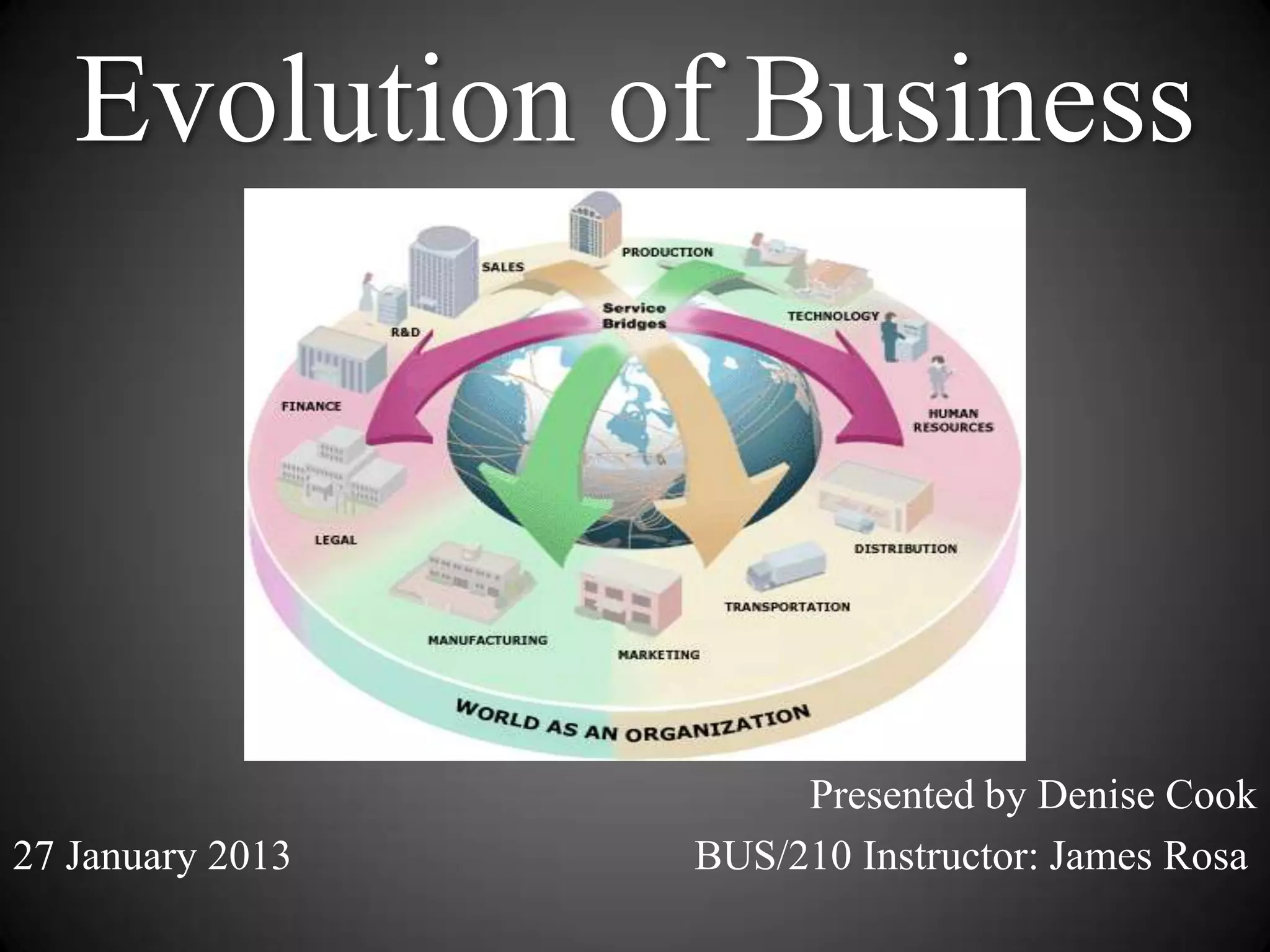
Evolution of Business


                       Presented by Denise Cook
27 January 2013   BUS/210 Instructor: James Rosa
Overview
• Feudalism

• Mercantilism

• Capitalism

• Commerce

• Property Rights

• The Industrial Revolution
Feudalism
• Aristocrats control the property rights to all valuable
  resources, including people.

• Laborers began to receive more rights and rewards.

• The system of tenant farming evolved.

• The Hundred Years War,was fought in England.
Mercantilism
• Products are traded across markets and countries

• Merchants are traders who notice a difference
  between the value and price of a product in
  onemarket and its value and price in another.

• From the time of the Phoenician traders onwards,
  there was a great deal of mercantilism between
  countries in the Middle East and Europe.
Capitalism
• Private property rights the basis for the production,
  trade, and distribution of goods and services.

• Capitalist has many negative overtones because of
  industrialists like Rockefeller and Carnegie.

• Proletariat, the vast, faceless mass of laborers who
  worked for subsistence wages.

• Trade unions and class systems developed.
Commerce
• The hierarchy of authority evolved early to reduce
  the transaction costs surrounding business activity.

• The joint-stock corporation evolved to make it easier
  for enterprising peopleto borrow capital.

• Barter system led to a problem economists call the
  double coincidence of wants arises.
Property Rights
• The claims by people to own, use, and sell the rights
  to valuable resources.

• In earliest times, the claim to property rights was a
  matter of brute force.

• Aristocrats had the incentive to enterprise ways to
  use the estates’ land and labor more profitably and
  increase their personal wealth and power.
The Industrial Revolution
• The emergence of the steam engine was a crucial
  event.

• The development of coal mining.

• Affected both farming and manufacturing and led to
  a dramatic increase in the wealth and prosperity.

• Constant wars isolated peoplemaking it difficult for
  them to learn about new innovations.
Conclusion
• Business systems evolved from earliest times to
  feudalism, mercantilism, and then to capitalism.

• People organized themselves into business systems
  to take control of productive resources and use them
  to create capital and wealth.

• The way business as commerce, occupation, and
  organization evolved to allow land, labor, capital,
  and enterprise to be used more productively and
  profitably.
References
• Jones, G. R. (2007). Introduction to business: How
     companies create value for people. New York,
NY: McGraw-Hill/Irwin

Evolution Of Business Powerpoint

  • 1.
    Evolution of Business Presented by Denise Cook 27 January 2013 BUS/210 Instructor: James Rosa
  • 2.
    Overview • Feudalism • Mercantilism •Capitalism • Commerce • Property Rights • The Industrial Revolution
  • 3.
    Feudalism • Aristocrats controlthe property rights to all valuable resources, including people. • Laborers began to receive more rights and rewards. • The system of tenant farming evolved. • The Hundred Years War,was fought in England.
  • 4.
    Mercantilism • Products aretraded across markets and countries • Merchants are traders who notice a difference between the value and price of a product in onemarket and its value and price in another. • From the time of the Phoenician traders onwards, there was a great deal of mercantilism between countries in the Middle East and Europe.
  • 5.
    Capitalism • Private propertyrights the basis for the production, trade, and distribution of goods and services. • Capitalist has many negative overtones because of industrialists like Rockefeller and Carnegie. • Proletariat, the vast, faceless mass of laborers who worked for subsistence wages. • Trade unions and class systems developed.
  • 6.
    Commerce • The hierarchyof authority evolved early to reduce the transaction costs surrounding business activity. • The joint-stock corporation evolved to make it easier for enterprising peopleto borrow capital. • Barter system led to a problem economists call the double coincidence of wants arises.
  • 7.
    Property Rights • Theclaims by people to own, use, and sell the rights to valuable resources. • In earliest times, the claim to property rights was a matter of brute force. • Aristocrats had the incentive to enterprise ways to use the estates’ land and labor more profitably and increase their personal wealth and power.
  • 8.
    The Industrial Revolution •The emergence of the steam engine was a crucial event. • The development of coal mining. • Affected both farming and manufacturing and led to a dramatic increase in the wealth and prosperity. • Constant wars isolated peoplemaking it difficult for them to learn about new innovations.
  • 9.
    Conclusion • Business systemsevolved from earliest times to feudalism, mercantilism, and then to capitalism. • People organized themselves into business systems to take control of productive resources and use them to create capital and wealth. • The way business as commerce, occupation, and organization evolved to allow land, labor, capital, and enterprise to be used more productively and profitably.
  • 10.
    References • Jones, G.R. (2007). Introduction to business: How companies create value for people. New York, NY: McGraw-Hill/Irwin