LLVM back-end for C#
@EgorBo
Senior Software Engineer at Microsoft
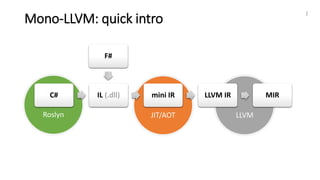
LLVMJIT/AOTRoslyn
Mono-LLVM: quick intro
2
C# IL (.dll) mini IR LLVM IR MIR
F#
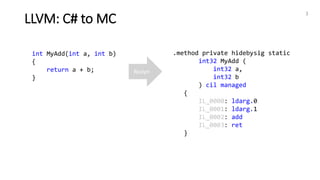
LLVM: C# to MC
3
int MyAdd(int a, int b)
{
return a + b;
}
.method private hidebysig static
int32 MyAdd (
int32 a,
int32 b
) cil managed
{
IL_0000: ldarg.0
IL_0001: ldarg.1
IL_0002: add
IL_0003: ret
}
Roslyn
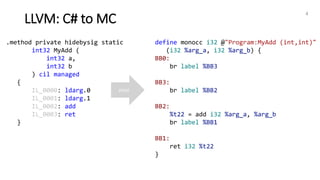
LLVM: C# to MC
4
define monocc i32 @"Program:MyAdd (int,int)"
(i32 %arg_a, i32 %arg_b) {
BB0:
br label %BB3
BB3:
br label %BB2
BB2:
%t22 = add i32 %arg_a, %arg_b
br label %BB1
BB1:
ret i32 %t22
}
.method private hidebysig static
int32 MyAdd (
int32 a,
int32 b
) cil managed
{
IL_0000: ldarg.0
IL_0001: ldarg.1
IL_0002: add
IL_0003: ret
}
mini
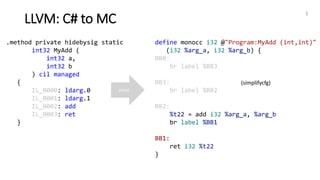
LLVM: C# to MC
5
define monocc i32 @"Program:MyAdd (int,int)"
(i32 %arg_a, i32 %arg_b) {
BB0:
br label %BB3
BB3:
br label %BB2
BB2:
%t22 = add i32 %arg_a, %arg_b
br label %BB1
BB1:
ret i32 %t22
}
.method private hidebysig static
int32 MyAdd (
int32 a,
int32 b
) cil managed
{
IL_0000: ldarg.0
IL_0001: ldarg.1
IL_0002: add
IL_0003: ret
}
mini
(simplifycfg)
LLVM: C# to MC
6
define monocc i32 @"Program:MyAdd (int,int)"(i32 %arg_a, i32 %arg_b) #0
{
BB0:
%t22 = add i32 %arg_a, %arg_b
ret i32 %t22
}
lea eax, [rdi + rsi]
ret
llc
(I am skipping the machine IR part)
LLVM: C# to MC
7
void MySet(byte* array, int len, byte val)
{
for (int i = 0; i < len; i++)
array[i] = val;
}
define monocc void @"MySet"(i8* %arg_array,
i32 %arg_len, i32 %arg_val) #0 {
BB0:
br label %BB3
BB3:
br label %BB2
BB2:
br label %BB4
BB4:
%0 = phi i32 [ 0, %BB2 ], [ %t32, %BB5 ]
%1 = icmp slt i32 %0, %arg_len
br i1 %1, label %BB5, label %BB6
BB6:
br label %BB1
BB5:
%t23 = sext i32 %0 to i64
%3 = getelementptr i8, i8* %arg_array, i64 %t23
%4 = trunc i32 %arg_val to i8
store i8 %4, i8* %3
%t32 = add i32 %0, 1
br label %BB4
BB1:
ret void
}
mini
8
define monocc void @"MySet"(i8* %arg_array,
i32 %arg_len, i32 %arg_val) #0 {
BB0:
br label %BB3
BB3:
br label %BB2
BB2:
br label %BB4
BB4:
%0 = phi i32 [ 0, %BB2 ], [ %t32, %BB5 ]
%1 = icmp slt i32 %0, %arg_len
br i1 %1, label %BB5, label %BB6
BB6:
br label %BB1
BB5:
%t23 = sext i32 %0 to i64
%3 = getelementptr i8, i8* %arg_array, i64 %t23
%4 = trunc i32 %arg_val to i8
store i8 %4, i8* %3
%t32 = add i32 %0, 1
br label %BB4
BB1:
ret void
}
opt
define monocc void @"MySet"(i8* %arg_array,
i32 %arg_len, i32 %arg_val) #0 {
BB0:
%0 = icmp sgt i32 %arg_len, 0
br i1 %0, label %BB5.lr.ph, label %BB1
BB5.lr.ph:
%1 = trunc i32 %arg_val to i8
%2 = zext i32 %arg_len to i64
call void @llvm.memset.p0i8.i64(i8* %arg_array, i8 %1, i64 %2…)
br label %BB1
BB1:
ret void
}
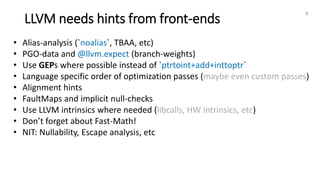
LLVM needs hints from front-ends
9
• Alias-analysis (`noalias`, TBAA, etc)
• PGO-data and @llvm.expect (branch-weights)
• Use GEPs where possible instead of `ptrtoint+add+inttoptr`
• Language specific order of optimization passes (maybe even custom passes)
• Alignment hints
• FaultMaps and implicit null-checks
• Use LLVM intrinsics where needed (libcalls, HW intrinsics, etc)
• Don’t forget about Fast-Math!
• NIT: Nullability, Escape analysis, etc
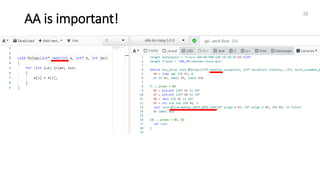
10
AA is important!
LLVM: ffast-math
11
float result = (x / 10) + 1 + 1;
CoreCLR, Mono, C++ -O2 Mono-LLVM (--llvm --ffast-math)
vfmadd132sd xmm0, xmm1, QWORD PTR .LC0[rip]vdivsd xmm0, xmm0, QWORD PTR .LC0[rip]
vaddsd xmm0, xmm0, xmm1
float result = (x / 10) + 2;
float result = (x * 0.1) + 2;
float result = fmadd(x, 0.1, 2);
1
2
3
4
LLVM: ffast-math
12
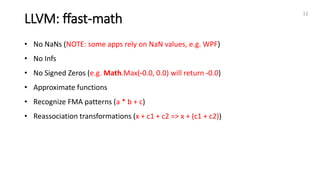
• No NaNs (NOTE: some apps rely on NaN values, e.g. WPF)
• No Infs
• No Signed Zeros (e.g. Math.Max(-0.0, 0.0) will return -0.0)
• Approximate functions
• Recognize FMA patterns (a * b + c)
• Reassociation transformations (x + c1 + c2 => x + (c1 + c2))
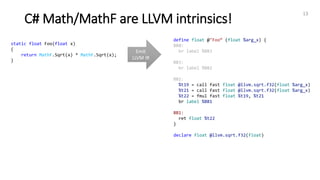
C# Math/MathF are LLVM intrinsics!
13
static float Foo(float x)
{
return MathF.Sqrt(x) * MathF.Sqrt(x);
}
define float @"Foo“ (float %arg_x) {
BB0:
br label %BB3
BB3:
br label %BB2
BB2:
%t19 = call fast float @llvm.sqrt.f32(float %arg_x)
%t21 = call fast float @llvm.sqrt.f32(float %arg_x)
%t22 = fmul fast float %t19, %t21
br label %BB1
BB1:
ret float %t22
}
declare float @llvm.sqrt.f32(float)
Emit
LLVM IR
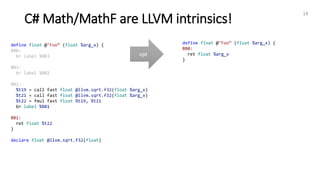
C# Math/MathF are LLVM intrinsics!
14
define float @"Foo“ (float %arg_x) {
BB0:
br label %BB3
BB3:
br label %BB2
BB2:
%t19 = call fast float @llvm.sqrt.f32(float %arg_x)
%t21 = call fast float @llvm.sqrt.f32(float %arg_x)
%t22 = fmul fast float %t19, %t21
br label %BB1
BB1:
ret float %t22
}
declare float @llvm.sqrt.f32(float)
define float @"Foo“ (float %arg_x) {
BB0:
ret float %arg_x
}
opt
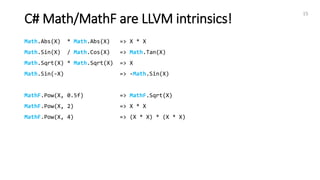
C# Math/MathF are LLVM intrinsics!
15
Math.Abs(X) * Math.Abs(X) => X * X
Math.Sin(X) / Math.Cos(X) => Math.Tan(X)
Math.Sqrt(X) * Math.Sqrt(X) => X
Math.Sin(-X) => -Math.Sin(X)
MathF.Pow(X, 0.5f) => MathF.Sqrt(X)
MathF.Pow(X, 2) => X * X
MathF.Pow(X, 4) => (X * X) * (X * X)
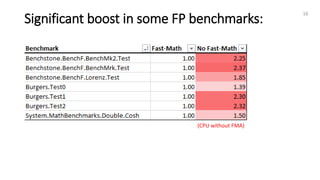
Significant boost in some FP benchmarks:
16
(CPU without FMA)
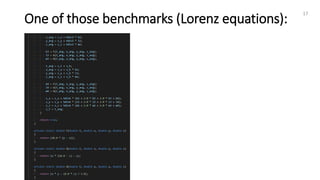
One of those benchmarks (Lorenz equations):
17
Don’t forget to feed the LLVM!
with some PGO data for better codegen
18
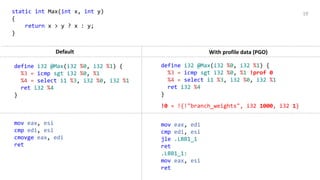
19static int Max(int x, int y)
{
return x > y ? x : y;
}
!0 = !{!"branch_weights", i32 1000, i32 1}
Default With profile data (PGO)
mov eax, esi
cmp edi, esi
cmovge eax, edi
ret
define i32 @Max(i32 %0, i32 %1) {
%3 = icmp sgt i32 %0, %1
%4 = select i1 %3, i32 %0, i32 %1
ret i32 %4
}
define i32 @Max(i32 %0, i32 %1) {
%3 = icmp sgt i32 %0, %1 !prof 0
%4 = select i1 %3, i32 %0, i32 %1
ret i32 %4
}
mov eax, edi
cmp edi, esi
jle .LBB1_1
ret
.LBB1_1:
mov eax, esi
ret
20
21
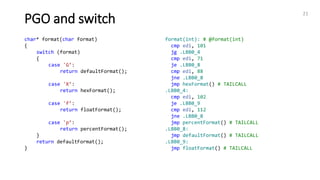
PGO and switch
char* format(char format)
{
switch (format)
{
case 'G’:
return defaultFormat();
case 'X’:
return hexFormat();
case 'f’:
return floatFormat();
case 'p’:
return percentFormat();
}
return defaultFormat();
}
format(int): # @format(int)
cmp edi, 101
jg .LBB0_4
cmp edi, 71
je .LBB0_8
cmp edi, 88
jne .LBB0_8
jmp hexFormat() # TAILCALL
.LBB0_4:
cmp edi, 102
je .LBB0_9
cmp edi, 112
jne .LBB0_8
jmp percentFormat() # TAILCALL
.LBB0_8:
jmp defaultFormat() # TAILCALL
.LBB0_9:
jmp floatFormat() # TAILCALL
22
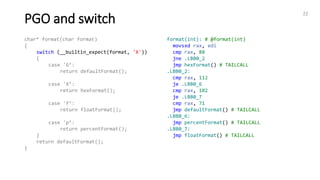
PGO and switch
char* format(char format)
{
switch (__builtin_expect(format, 'X'))
{
case 'G’:
return defaultFormat();
case 'X’:
return hexFormat();
case 'f’:
return floatFormat();
case 'p’:
return percentFormat();
}
return defaultFormat();
}
format(int): # @format(int)
movsxd rax, edi
cmp rax, 88
jne .LBB0_2
jmp hexFormat() # TAILCALL
.LBB0_2:
cmp rax, 112
je .LBB0_6
cmp rax, 102
je .LBB0_7
cmp rax, 71
jmp defaultFormat() # TAILCALL
.LBB0_6:
jmp percentFormat() # TAILCALL
.LBB0_7:
jmp floatFormat() # TAILCALL
23
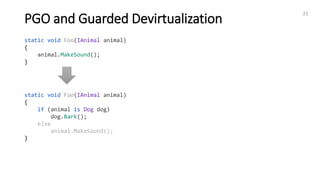
PGO and Guarded Devirtualization
static void Foo(IAnimal animal)
{
animal.MakeSound();
}
static void Foo(IAnimal animal)
{
if (animal is Dog dog)
dog.Bark();
else
animal.MakeSound();
}
Mono-LLVM
24
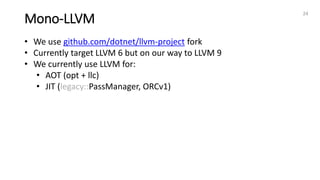
• We use github.com/dotnet/llvm-project fork
• Currently target LLVM 6 but on our way to LLVM 9
• We currently use LLVM for:
• AOT (opt + llc)
• JIT (legacy::PassManager, ORCv1)
Mono-LLVM
25
• `opt –O2` is only for C++
• We have a lot of additional checks: null-checks, bound-checks
• We have to insert safe-points (-place-safepoints) for non-preemptive mode
void MyMethod(byte* array, int len, byte val)
{
if (unlikely(gcRequested))
performGC();
for (int i = 0; i < len; i++)
{
if (unlikely(gcRequested))
performGC();
array[i] = val;
}
if (unlikely(gcRequested))
performGC();
}
How do we use optimizations?
26
• LLVM AOT:
opt -O2 –place-safepoints
• LLVM JIT:
PassManager with a small subset of the most useful passes in a specific order:
-simplifycfg
-sroa
-lower-expect
-instcombine
-licm
-simplifycfg
-lcssa
-indvars
-loop-deletion
-gvn
-memcpyopt
-sccp
-bdce
-instcombine
-dse
-simplifycfg
`opt –O2`: These pass pipelines make a good starting
point for an optimizing compiler for any language, but they
have been carefully tuned for C and C++, not your target
language.
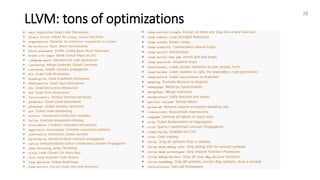
LLVM: tons of optimizations
28
Null-checks, Bound-checks 29
static int Test(int[] array)
{
return array[42];
}
Null-checks, Bound-checks 30
static int Test(int[] array)
{
if (array == null) ThrowNRE();
return array[42];
}
Null-checks, Bound-checks 31
static int Test(int[] array)
{
if (array == null) ThrowNRE();
if ((uint)array.Length <= 42) ThrowOBE();
return array[42];
}
Null-checks, Bound-checks 32
static int Test(int[] array)
{
if (array == null) ThrowNRE();
if ((uint)array.Length <= 42) ThrowOBE();
return array[42];
}
push rax
cmp DWORD PTR [rdi+0x18],0x0
je 1d <Test__int___+0x1d>
mov eax,DWORD PTR [rdi+0x20]
pop rcx
ret
movabs rax,0x1f1f030
mov edi,0xcc
call QWORD PTR [rax]
movabs rax,0x1f1f040
mov edi,0xa6
call QWORD PTR [rax]
InductiveRangeCheckElimination Pass
33
public static void Zero1000Elements(int[] array)
{
for (int i = 0; i < 1000; i++)
array[i] = 0; // bound checks will be inserted here
}
“If you language uses range checks, consider using the
IRCE pass. It is not currently part of the standard pass
order.”
InductiveRangeCheckElimination Pass
34
public static void Zero1000Elements(int[] array)
{
int limit = Math.Min(array.Length, 1000);
for (int i = 0; i < limit; i++)
array[i] = 0; // bound checks are not needed here!
for (int i = limit; i < 1000; i++)
array[i] = 0; // bound checks are needed here
// so at least we could "zero" first `limit` elements without bound checks
}
InductiveRangeCheckElimination Pass
35
public static void Zero1000Elements(int[] array)
{
int limit = Math.Min(array.Length, 1000);
for (int i = 0; i < limit - 3; i += 4)
{
array[i] = 0;
array[i+1] = 0;
array[i+2] = 0;
array[i+3] = 0;
}
for (int i = limit; i < 1000; i++)
array[i] = 0; // bound checks are needed here
// so at least we could "zero" first `limit` elements without bound checks
}
Now we can even unroll the first loop!
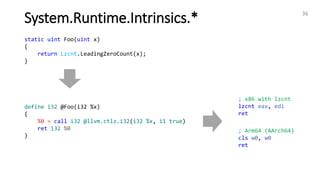
System.Runtime.Intrinsics.* 36
static uint Foo(uint x)
{
return Lzcnt.LeadingZeroCount(x);
}
define i32 @Foo(i32 %x)
{
%0 = call i32 @llvm.ctlz.i32(i32 %x, i1 true)
ret i32 %0
}
; x86 with lzcnt
lzcnt eax, edi
ret
; Arm64 (AArch64)
cls w0, w0
ret
System.Runtime.Intrinsics.* 37
int MySum(int[] array)
{
fixed (int* ptr = array)
{
var sum = Vector128<int>.Zero;
for (int i = 0; i < array.Length; i += 4)
{
sum = Sse2.Add(sum, Sse2.LoadVector128(ptr + i));
}
sum = Ssse3.HorizontalAdd(sum, sum);
return sum.ToScalar();
}
}
G_M55440_IG07: ;; bbWeight=4
movsxd r8, ecx
vpaddd xmm0, xmm0, xmmword ptr [rax+4*r8]
add ecx, 4
cmp edx, ecx
jg SHORT G_M55440_IG07
G_M55440_IG08:
vphaddd xmm0, xmm0, xmm0
vmovapd xmmword ptr [rsp+20H], xmm0
mov eax, dword ptr [rsp+20H]
38
[Benchmark]
public bool IsNaN(float value)
{
bool result = false;
for (int i = 0; i < 1000000; i++)
{
result &= float.IsNaN(value);
value += 1.0f;
}
return result;
}
[Benchmark]
public bool IsNaN(float value)
{
return false;
}
What’s wrong with this benchmark?
Pros & Cons
39
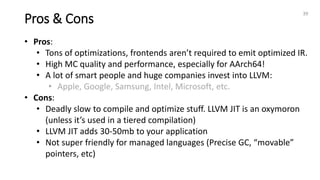
• Pros:
• Tons of optimizations, frontends aren’t required to emit optimized IR.
• High MC quality and performance, especially for AArch64!
• A lot of smart people and huge companies invest into LLVM:
• Apple, Google, Samsung, Intel, Microsoft, etc.
• Cons:
• Deadly slow to compile and optimize stuff. LLVM JIT is an oxymoron
(unless it’s used in a tiered compilation)
• LLVM JIT adds 30-50mb to your application
• Not super friendly for managed languages (Precise GC, “movable”
pointers, etc)
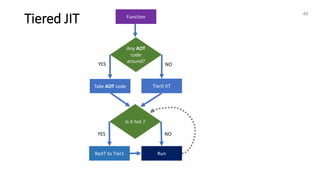
Tiered JIT
40
Any AOT
code
around?
Take AOT code
Is it hot ?
Tier0 JIT
ReJIT to Tier1
YES NO
YES
Function
Run
NO
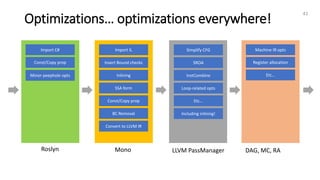
Optimizations… optimizations everywhere!
41
SSA form
Const/Copy prop
BC Removal
Import IL
Insert Bound checks
Inlining
Import C#
Const/Copy prop
Minor peephole opts
Convert to LLVM IR
Loop-related opts
Etc…
Including inlining!
Simplify CFG
SROA
InstCombine
Machine IR opts
Register allocation
Etc…
Roslyn Mono LLVM PassManager DAG, MC, RA
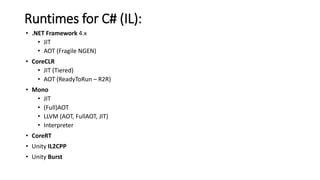
Runtimes for C# (IL):
• .NET Framework 4.x
• JIT
• AOT (Fragile NGEN)
• CoreCLR
• JIT (Tiered)
• AOT (ReadyToRun – R2R)
• Mono
• JIT
• (Full)AOT
• LLVM (AOT, FullAOT, JIT)
• Interpreter
• CoreRT
• Unity IL2CPP
• Unity Burst
Q&Atwitter: EgorBo
blog: EgorBo.com
EgorBo
Senior Software Engineer at Microsoft

Как работает LLVM бэкенд в C#. Егор Богатов ➠ CoreHard Autumn 2019

  • 1.
    LLVM back-end forC# @EgorBo Senior Software Engineer at Microsoft
  • 2.
    LLVMJIT/AOTRoslyn Mono-LLVM: quick intro 2 C#IL (.dll) mini IR LLVM IR MIR F#
  • 3.
    LLVM: C# toMC 3 int MyAdd(int a, int b) { return a + b; } .method private hidebysig static int32 MyAdd ( int32 a, int32 b ) cil managed { IL_0000: ldarg.0 IL_0001: ldarg.1 IL_0002: add IL_0003: ret } Roslyn
  • 4.
    LLVM: C# toMC 4 define monocc i32 @"Program:MyAdd (int,int)" (i32 %arg_a, i32 %arg_b) { BB0: br label %BB3 BB3: br label %BB2 BB2: %t22 = add i32 %arg_a, %arg_b br label %BB1 BB1: ret i32 %t22 } .method private hidebysig static int32 MyAdd ( int32 a, int32 b ) cil managed { IL_0000: ldarg.0 IL_0001: ldarg.1 IL_0002: add IL_0003: ret } mini
  • 5.
    LLVM: C# toMC 5 define monocc i32 @"Program:MyAdd (int,int)" (i32 %arg_a, i32 %arg_b) { BB0: br label %BB3 BB3: br label %BB2 BB2: %t22 = add i32 %arg_a, %arg_b br label %BB1 BB1: ret i32 %t22 } .method private hidebysig static int32 MyAdd ( int32 a, int32 b ) cil managed { IL_0000: ldarg.0 IL_0001: ldarg.1 IL_0002: add IL_0003: ret } mini (simplifycfg)
  • 6.
    LLVM: C# toMC 6 define monocc i32 @"Program:MyAdd (int,int)"(i32 %arg_a, i32 %arg_b) #0 { BB0: %t22 = add i32 %arg_a, %arg_b ret i32 %t22 } lea eax, [rdi + rsi] ret llc (I am skipping the machine IR part)
  • 7.
    LLVM: C# toMC 7 void MySet(byte* array, int len, byte val) { for (int i = 0; i < len; i++) array[i] = val; } define monocc void @"MySet"(i8* %arg_array, i32 %arg_len, i32 %arg_val) #0 { BB0: br label %BB3 BB3: br label %BB2 BB2: br label %BB4 BB4: %0 = phi i32 [ 0, %BB2 ], [ %t32, %BB5 ] %1 = icmp slt i32 %0, %arg_len br i1 %1, label %BB5, label %BB6 BB6: br label %BB1 BB5: %t23 = sext i32 %0 to i64 %3 = getelementptr i8, i8* %arg_array, i64 %t23 %4 = trunc i32 %arg_val to i8 store i8 %4, i8* %3 %t32 = add i32 %0, 1 br label %BB4 BB1: ret void } mini
  • 8.
    8 define monocc void@"MySet"(i8* %arg_array, i32 %arg_len, i32 %arg_val) #0 { BB0: br label %BB3 BB3: br label %BB2 BB2: br label %BB4 BB4: %0 = phi i32 [ 0, %BB2 ], [ %t32, %BB5 ] %1 = icmp slt i32 %0, %arg_len br i1 %1, label %BB5, label %BB6 BB6: br label %BB1 BB5: %t23 = sext i32 %0 to i64 %3 = getelementptr i8, i8* %arg_array, i64 %t23 %4 = trunc i32 %arg_val to i8 store i8 %4, i8* %3 %t32 = add i32 %0, 1 br label %BB4 BB1: ret void } opt define monocc void @"MySet"(i8* %arg_array, i32 %arg_len, i32 %arg_val) #0 { BB0: %0 = icmp sgt i32 %arg_len, 0 br i1 %0, label %BB5.lr.ph, label %BB1 BB5.lr.ph: %1 = trunc i32 %arg_val to i8 %2 = zext i32 %arg_len to i64 call void @llvm.memset.p0i8.i64(i8* %arg_array, i8 %1, i64 %2…) br label %BB1 BB1: ret void }
  • 9.
    LLVM needs hintsfrom front-ends 9 • Alias-analysis (`noalias`, TBAA, etc) • PGO-data and @llvm.expect (branch-weights) • Use GEPs where possible instead of `ptrtoint+add+inttoptr` • Language specific order of optimization passes (maybe even custom passes) • Alignment hints • FaultMaps and implicit null-checks • Use LLVM intrinsics where needed (libcalls, HW intrinsics, etc) • Don’t forget about Fast-Math! • NIT: Nullability, Escape analysis, etc
  • 10.
  • 11.
    LLVM: ffast-math 11 float result= (x / 10) + 1 + 1; CoreCLR, Mono, C++ -O2 Mono-LLVM (--llvm --ffast-math) vfmadd132sd xmm0, xmm1, QWORD PTR .LC0[rip]vdivsd xmm0, xmm0, QWORD PTR .LC0[rip] vaddsd xmm0, xmm0, xmm1 vaddsd xmm0, xmm0, xmm1 float result = (x / 10) + 2; float result = (x * 0.1) + 2; float result = fmadd(x, 0.1, 2); 1 2 3 4
  • 12.
    LLVM: ffast-math 12 • NoNaNs (NOTE: some apps rely on NaN values, e.g. WPF) • No Infs • No Signed Zeros (e.g. Math.Max(-0.0, 0.0) will return -0.0) • Approximate functions • Recognize FMA patterns (a * b + c) • Reassociation transformations (x + c1 + c2 => x + (c1 + c2))
  • 13.
    C# Math/MathF areLLVM intrinsics! 13 static float Foo(float x) { return MathF.Sqrt(x) * MathF.Sqrt(x); } define float @"Foo“ (float %arg_x) { BB0: br label %BB3 BB3: br label %BB2 BB2: %t19 = call fast float @llvm.sqrt.f32(float %arg_x) %t21 = call fast float @llvm.sqrt.f32(float %arg_x) %t22 = fmul fast float %t19, %t21 br label %BB1 BB1: ret float %t22 } declare float @llvm.sqrt.f32(float) Emit LLVM IR
  • 14.
    C# Math/MathF areLLVM intrinsics! 14 define float @"Foo“ (float %arg_x) { BB0: br label %BB3 BB3: br label %BB2 BB2: %t19 = call fast float @llvm.sqrt.f32(float %arg_x) %t21 = call fast float @llvm.sqrt.f32(float %arg_x) %t22 = fmul fast float %t19, %t21 br label %BB1 BB1: ret float %t22 } declare float @llvm.sqrt.f32(float) define float @"Foo“ (float %arg_x) { BB0: ret float %arg_x } opt
  • 15.
    C# Math/MathF areLLVM intrinsics! 15 Math.Abs(X) * Math.Abs(X) => X * X Math.Sin(X) / Math.Cos(X) => Math.Tan(X) Math.Sqrt(X) * Math.Sqrt(X) => X Math.Sin(-X) => -Math.Sin(X) MathF.Pow(X, 0.5f) => MathF.Sqrt(X) MathF.Pow(X, 2) => X * X MathF.Pow(X, 4) => (X * X) * (X * X)
  • 16.
    Significant boost insome FP benchmarks: 16 (CPU without FMA)
  • 17.
    One of thosebenchmarks (Lorenz equations): 17
  • 18.
    Don’t forget tofeed the LLVM! with some PGO data for better codegen 18
  • 19.
    19static int Max(intx, int y) { return x > y ? x : y; } !0 = !{!"branch_weights", i32 1000, i32 1} Default With profile data (PGO) mov eax, esi cmp edi, esi cmovge eax, edi ret define i32 @Max(i32 %0, i32 %1) { %3 = icmp sgt i32 %0, %1 %4 = select i1 %3, i32 %0, i32 %1 ret i32 %4 } define i32 @Max(i32 %0, i32 %1) { %3 = icmp sgt i32 %0, %1 !prof 0 %4 = select i1 %3, i32 %0, i32 %1 ret i32 %4 } mov eax, edi cmp edi, esi jle .LBB1_1 ret .LBB1_1: mov eax, esi ret
  • 20.
  • 21.
    21 PGO and switch char*format(char format) { switch (format) { case 'G’: return defaultFormat(); case 'X’: return hexFormat(); case 'f’: return floatFormat(); case 'p’: return percentFormat(); } return defaultFormat(); } format(int): # @format(int) cmp edi, 101 jg .LBB0_4 cmp edi, 71 je .LBB0_8 cmp edi, 88 jne .LBB0_8 jmp hexFormat() # TAILCALL .LBB0_4: cmp edi, 102 je .LBB0_9 cmp edi, 112 jne .LBB0_8 jmp percentFormat() # TAILCALL .LBB0_8: jmp defaultFormat() # TAILCALL .LBB0_9: jmp floatFormat() # TAILCALL
  • 22.
    22 PGO and switch char*format(char format) { switch (__builtin_expect(format, 'X')) { case 'G’: return defaultFormat(); case 'X’: return hexFormat(); case 'f’: return floatFormat(); case 'p’: return percentFormat(); } return defaultFormat(); } format(int): # @format(int) movsxd rax, edi cmp rax, 88 jne .LBB0_2 jmp hexFormat() # TAILCALL .LBB0_2: cmp rax, 112 je .LBB0_6 cmp rax, 102 je .LBB0_7 cmp rax, 71 jmp defaultFormat() # TAILCALL .LBB0_6: jmp percentFormat() # TAILCALL .LBB0_7: jmp floatFormat() # TAILCALL
  • 23.
    23 PGO and GuardedDevirtualization static void Foo(IAnimal animal) { animal.MakeSound(); } static void Foo(IAnimal animal) { if (animal is Dog dog) dog.Bark(); else animal.MakeSound(); }
  • 24.
    Mono-LLVM 24 • We usegithub.com/dotnet/llvm-project fork • Currently target LLVM 6 but on our way to LLVM 9 • We currently use LLVM for: • AOT (opt + llc) • JIT (legacy::PassManager, ORCv1)
  • 25.
    Mono-LLVM 25 • `opt –O2`is only for C++ • We have a lot of additional checks: null-checks, bound-checks • We have to insert safe-points (-place-safepoints) for non-preemptive mode void MyMethod(byte* array, int len, byte val) { if (unlikely(gcRequested)) performGC(); for (int i = 0; i < len; i++) { if (unlikely(gcRequested)) performGC(); array[i] = val; } if (unlikely(gcRequested)) performGC(); }
  • 26.
    How do weuse optimizations? 26 • LLVM AOT: opt -O2 –place-safepoints • LLVM JIT: PassManager with a small subset of the most useful passes in a specific order: -simplifycfg -sroa -lower-expect -instcombine -licm -simplifycfg -lcssa -indvars -loop-deletion -gvn -memcpyopt -sccp -bdce -instcombine -dse -simplifycfg `opt –O2`: These pass pipelines make a good starting point for an optimizing compiler for any language, but they have been carefully tuned for C and C++, not your target language.
  • 28.
    LLVM: tons ofoptimizations 28
  • 29.
    Null-checks, Bound-checks 29 staticint Test(int[] array) { return array[42]; }
  • 30.
    Null-checks, Bound-checks 30 staticint Test(int[] array) { if (array == null) ThrowNRE(); return array[42]; }
  • 31.
    Null-checks, Bound-checks 31 staticint Test(int[] array) { if (array == null) ThrowNRE(); if ((uint)array.Length <= 42) ThrowOBE(); return array[42]; }
  • 32.
    Null-checks, Bound-checks 32 staticint Test(int[] array) { if (array == null) ThrowNRE(); if ((uint)array.Length <= 42) ThrowOBE(); return array[42]; } push rax cmp DWORD PTR [rdi+0x18],0x0 je 1d <Test__int___+0x1d> mov eax,DWORD PTR [rdi+0x20] pop rcx ret movabs rax,0x1f1f030 mov edi,0xcc call QWORD PTR [rax] movabs rax,0x1f1f040 mov edi,0xa6 call QWORD PTR [rax]
  • 33.
    InductiveRangeCheckElimination Pass 33 public staticvoid Zero1000Elements(int[] array) { for (int i = 0; i < 1000; i++) array[i] = 0; // bound checks will be inserted here } “If you language uses range checks, consider using the IRCE pass. It is not currently part of the standard pass order.”
  • 34.
    InductiveRangeCheckElimination Pass 34 public staticvoid Zero1000Elements(int[] array) { int limit = Math.Min(array.Length, 1000); for (int i = 0; i < limit; i++) array[i] = 0; // bound checks are not needed here! for (int i = limit; i < 1000; i++) array[i] = 0; // bound checks are needed here // so at least we could "zero" first `limit` elements without bound checks }
  • 35.
    InductiveRangeCheckElimination Pass 35 public staticvoid Zero1000Elements(int[] array) { int limit = Math.Min(array.Length, 1000); for (int i = 0; i < limit - 3; i += 4) { array[i] = 0; array[i+1] = 0; array[i+2] = 0; array[i+3] = 0; } for (int i = limit; i < 1000; i++) array[i] = 0; // bound checks are needed here // so at least we could "zero" first `limit` elements without bound checks } Now we can even unroll the first loop!
  • 36.
    System.Runtime.Intrinsics.* 36 static uintFoo(uint x) { return Lzcnt.LeadingZeroCount(x); } define i32 @Foo(i32 %x) { %0 = call i32 @llvm.ctlz.i32(i32 %x, i1 true) ret i32 %0 } ; x86 with lzcnt lzcnt eax, edi ret ; Arm64 (AArch64) cls w0, w0 ret
  • 37.
    System.Runtime.Intrinsics.* 37 int MySum(int[]array) { fixed (int* ptr = array) { var sum = Vector128<int>.Zero; for (int i = 0; i < array.Length; i += 4) { sum = Sse2.Add(sum, Sse2.LoadVector128(ptr + i)); } sum = Ssse3.HorizontalAdd(sum, sum); sum = Ssse3.HorizontalAdd(sum, sum); return sum.ToScalar(); } } G_M55440_IG07: ;; bbWeight=4 movsxd r8, ecx vpaddd xmm0, xmm0, xmmword ptr [rax+4*r8] add ecx, 4 cmp edx, ecx jg SHORT G_M55440_IG07 G_M55440_IG08: vphaddd xmm0, xmm0, xmm0 vphaddd xmm0, xmm0, xmm0 vmovapd xmmword ptr [rsp+20H], xmm0 mov eax, dword ptr [rsp+20H]
  • 38.
    38 [Benchmark] public bool IsNaN(floatvalue) { bool result = false; for (int i = 0; i < 1000000; i++) { result &= float.IsNaN(value); value += 1.0f; } return result; } [Benchmark] public bool IsNaN(float value) { return false; } What’s wrong with this benchmark?
  • 39.
    Pros & Cons 39 •Pros: • Tons of optimizations, frontends aren’t required to emit optimized IR. • High MC quality and performance, especially for AArch64! • A lot of smart people and huge companies invest into LLVM: • Apple, Google, Samsung, Intel, Microsoft, etc. • Cons: • Deadly slow to compile and optimize stuff. LLVM JIT is an oxymoron (unless it’s used in a tiered compilation) • LLVM JIT adds 30-50mb to your application • Not super friendly for managed languages (Precise GC, “movable” pointers, etc)
  • 40.
    Tiered JIT 40 Any AOT code around? TakeAOT code Is it hot ? Tier0 JIT ReJIT to Tier1 YES NO YES Function Run NO
  • 41.
    Optimizations… optimizations everywhere! 41 SSAform Const/Copy prop BC Removal Import IL Insert Bound checks Inlining Import C# Const/Copy prop Minor peephole opts Convert to LLVM IR Loop-related opts Etc… Including inlining! Simplify CFG SROA InstCombine Machine IR opts Register allocation Etc… Roslyn Mono LLVM PassManager DAG, MC, RA
  • 42.
    Runtimes for C#(IL): • .NET Framework 4.x • JIT • AOT (Fragile NGEN) • CoreCLR • JIT (Tiered) • AOT (ReadyToRun – R2R) • Mono • JIT • (Full)AOT • LLVM (AOT, FullAOT, JIT) • Interpreter • CoreRT • Unity IL2CPP • Unity Burst
  • 43.