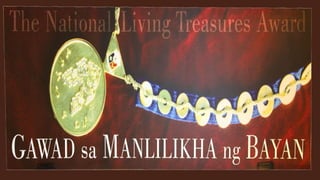
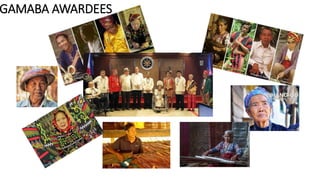
GAMABA AWARDEES
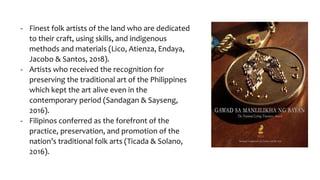
- Finest folk artists of the land who are dedicated
to their craft, using skills, and indigenous
methods and materials (Lico, Atienza, Endaya,
Jacobo & Santos, 2018).
- Artists who received the recognition for
preserving the traditional art of the Philippines
which kept the art alive even in the
contemporary period (Sandagan & Sayseng,
2016).
- Filipinos conferred as the forefront of the
practice, preservation, and promotion of the
nation’s traditional folk arts (Ticada & Solano,
2016).
Literature
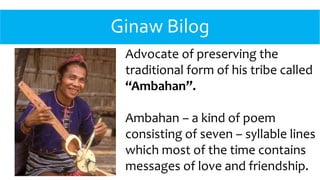
Ginaw Bilog
Advocate of preserving the
traditional form of his tribe called
“Ambahan”.
Ambahan – a kind of poem
consisting of seven – syllable lines
which most of the time contains
messages of love and friendship.
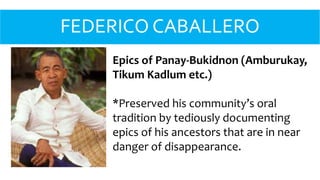
FEDERICO CABALLERO
Epics of Panay-Bukidnon (Amburukay,
Tikum Kadlum etc.)
*Preserved his community’s oral
tradition by tediously documenting
epics of his ancestors that are in near
danger of disappearance.
Music/Dance
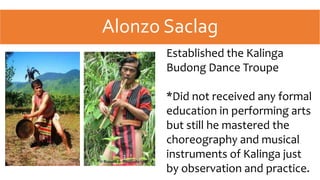
Alonzo Saclag
Established the Kalinga
Budong Dance Troupe
*Did not received any formal
education in performing arts
but still he mastered the
choreography and musical
instruments of Kalinga just
by observation and practice.
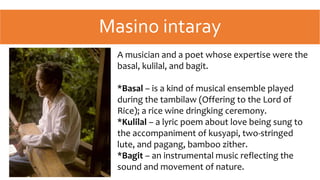
Masino intaray
A musician and a poet whose expertise were the
basal, kulilal, and bagit.
*Basal – is a kind of musical ensemble played
during the tambilaw (Offering to the Lord of
Rice); a rice wine dringking ceremony.
*Kulilal – a lyric poem about love being sung to
the accompaniment of kusyapi, two-stringed
lute, and pagang, bamboo zither.
*Bagit – an instrumental music reflecting the
sound and movement of nature.
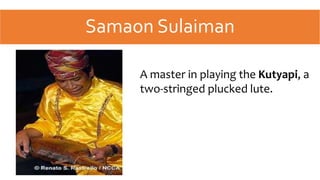
Samaon Sulaiman
A master in playing the Kutyapi, a
two-stringed plucked lute.
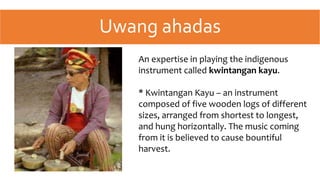
Uwang ahadas
An expertise in playing the indigenous
instrument called kwintangan kayu.
* Kwintangan Kayu – an instrument
composed of five wooden logs of different
sizes, arranged from shortest to longest,
and hung horizontally. The music coming
from it is believed to cause bountiful
harvest.
Metalwork
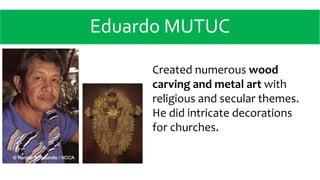
Eduardo MUTUC
Created numerous wood
carving and metal art with
religious and secular themes.
He did intricate decorations
for churches.
Casque
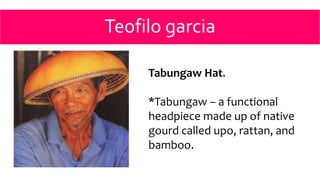
Teofilo garcia
Tabungaw Hat.
*Tabungaw – a functional
headpiece made up of native
gourd called upo, rattan, and
bamboo.
Weaving
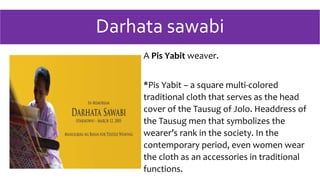
Darhata sawabi
A Pis Yabit weaver.
*Pis Yabit – a square multi-colored
traditional cloth that serves as the head
cover of the Tausug of Jolo. Headdress of
the Tausug men that symbolizes the
wearer’s rank in the society. In the
contemporary period, even women wear
the cloth as an accessories in traditional
functions.
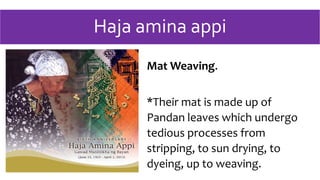
Haja amina appi
Mat Weaving.
*Their mat is made up of
Pandan leaves which undergo
tedious processes from
stripping, to sun drying, to
dyeing, up to weaving.
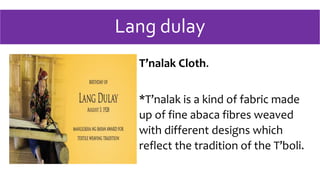
Lang dulay
T’nalak Cloth.
*T’nalak is a kind of fabric made
up of fine abaca fibres weaved
with different designs which
reflect the tradition of the T’boli.
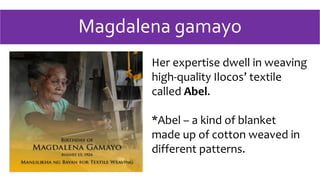
Magdalena gamayo
Her expertise dwell in weaving
high-quality Ilocos’ textile
called Abel.
*Abel – a kind of blanket
made up of cotton weaved in
different patterns.
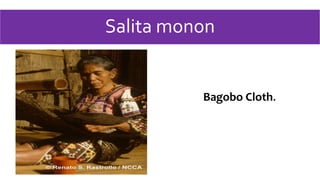
Salita monon
Bagobo Cloth.

Gamaba

  • 2.
  • 3.
    - Finest folkartists of the land who are dedicated to their craft, using skills, and indigenous methods and materials (Lico, Atienza, Endaya, Jacobo & Santos, 2018). - Artists who received the recognition for preserving the traditional art of the Philippines which kept the art alive even in the contemporary period (Sandagan & Sayseng, 2016). - Filipinos conferred as the forefront of the practice, preservation, and promotion of the nation’s traditional folk arts (Ticada & Solano, 2016).
  • 4.
  • 5.
    Ginaw Bilog Advocate ofpreserving the traditional form of his tribe called “Ambahan”. Ambahan – a kind of poem consisting of seven – syllable lines which most of the time contains messages of love and friendship.
  • 6.
    FEDERICO CABALLERO Epics ofPanay-Bukidnon (Amburukay, Tikum Kadlum etc.) *Preserved his community’s oral tradition by tediously documenting epics of his ancestors that are in near danger of disappearance.
  • 7.
  • 8.
    Alonzo Saclag Established theKalinga Budong Dance Troupe *Did not received any formal education in performing arts but still he mastered the choreography and musical instruments of Kalinga just by observation and practice.
  • 9.
    Masino intaray A musicianand a poet whose expertise were the basal, kulilal, and bagit. *Basal – is a kind of musical ensemble played during the tambilaw (Offering to the Lord of Rice); a rice wine dringking ceremony. *Kulilal – a lyric poem about love being sung to the accompaniment of kusyapi, two-stringed lute, and pagang, bamboo zither. *Bagit – an instrumental music reflecting the sound and movement of nature.
  • 10.
    Samaon Sulaiman A masterin playing the Kutyapi, a two-stringed plucked lute.
  • 11.
    Uwang ahadas An expertisein playing the indigenous instrument called kwintangan kayu. * Kwintangan Kayu – an instrument composed of five wooden logs of different sizes, arranged from shortest to longest, and hung horizontally. The music coming from it is believed to cause bountiful harvest.
  • 12.
  • 13.
    Eduardo MUTUC Created numerouswood carving and metal art with religious and secular themes. He did intricate decorations for churches.
  • 14.
  • 15.
    Teofilo garcia Tabungaw Hat. *Tabungaw– a functional headpiece made up of native gourd called upo, rattan, and bamboo.
  • 16.
  • 17.
    Darhata sawabi A PisYabit weaver. *Pis Yabit – a square multi-colored traditional cloth that serves as the head cover of the Tausug of Jolo. Headdress of the Tausug men that symbolizes the wearer’s rank in the society. In the contemporary period, even women wear the cloth as an accessories in traditional functions.
  • 18.
    Haja amina appi MatWeaving. *Their mat is made up of Pandan leaves which undergo tedious processes from stripping, to sun drying, to dyeing, up to weaving.
  • 19.
    Lang dulay T’nalak Cloth. *T’nalakis a kind of fabric made up of fine abaca fibres weaved with different designs which reflect the tradition of the T’boli.
  • 20.
    Magdalena gamayo Her expertisedwell in weaving high-quality Ilocos’ textile called Abel. *Abel – a kind of blanket made up of cotton weaved in different patterns.
  • 21.