CHAPTER4
Contemporary Philippine Arts from the
Region
GAMABA AWARDEE
GAWAD SA MANLILIKHA NG BAYAN
OR
NATIONAL LIVING TREASURES AWARD
Is Conferred on Filipinos who are at the forefront of the
practice preservation, and promotion of the nation’s
traditional folk arts.
Objectives
to honor and support traditional folk artists
and to see to it that their skills and crafts are
preserve.
• Formalized in 1992, through Republic Act No. 7355, the
Manlilikha ng Bayan Act.
• The National Commission for the Culture and the Arts oversees
its implementation.
• The award is tied with a program that ensures the transfer of
their skills to new generations and the promotion of the craft both
locally and internationally
• In 2014, the Senate of the Philippines adopted Senate Resolution
No. (SRN)765 aimed at recognizing the accomplishments of the
country’s living treasures.
EMBLEM
• The award logo is a representation
of the human form used in traditional
cloth. Below the logo is the phrase
“Manlilikha ng Bayan” written in
Baybayin,an ancient Filipino script
used in the Philippines in the
16th century.
CRITERIA
1. Should be a Filipino citizen or a group of citizens
belonging to an indigenous / traditional cultural
community anywhere in the Philippines, engaged in
Filipino traditional art in the following categories: folk
architecture, maritime transport, weaving, carving,
performing arts, literature, graphic and plastic arts,
ornament, textile or fiber art, pottery and other
artistic expressions of traditional culture;
CRITERIA
2. Should have been engaged in the tradition and craft for
a significant period of time with at least 50 years of
existence and documentation;
3. Should have produced and performed of artistic,
distinctive, and superior quality;
4. Should possess mastery of the tools and materials that
are needed for the art and must have a reputation for being
an art master and craft maker in the community where he /
she belongs;
CRITERIA
5. Should have passed on and/ or will pass on the traditional crafts
and skills to other members of the community by virtue of
teaching;
6. In case when a Manlilikha ng Bayan candidate is incapable of
teaching further his/ her craft and skill due to age or infirmity;
A. He / she should have created a significant body of work and
has contributed to the development of the tradition and craft
B. He / she should have played a role in the preservation and
revitalization of the artistic tradition in the community.
C. He/ she has been recognized as a master of his / her craft
and admired for his character and integrity in his / her
community.
GINAWBILOG
Poet, Hanunuo Mangyan
Panaytayan,Oriental Mindoro (1993)
• Ambahan – is a kind of poem
consisting of seven syllable lines
which most of the time contains
messages of love and friendship.
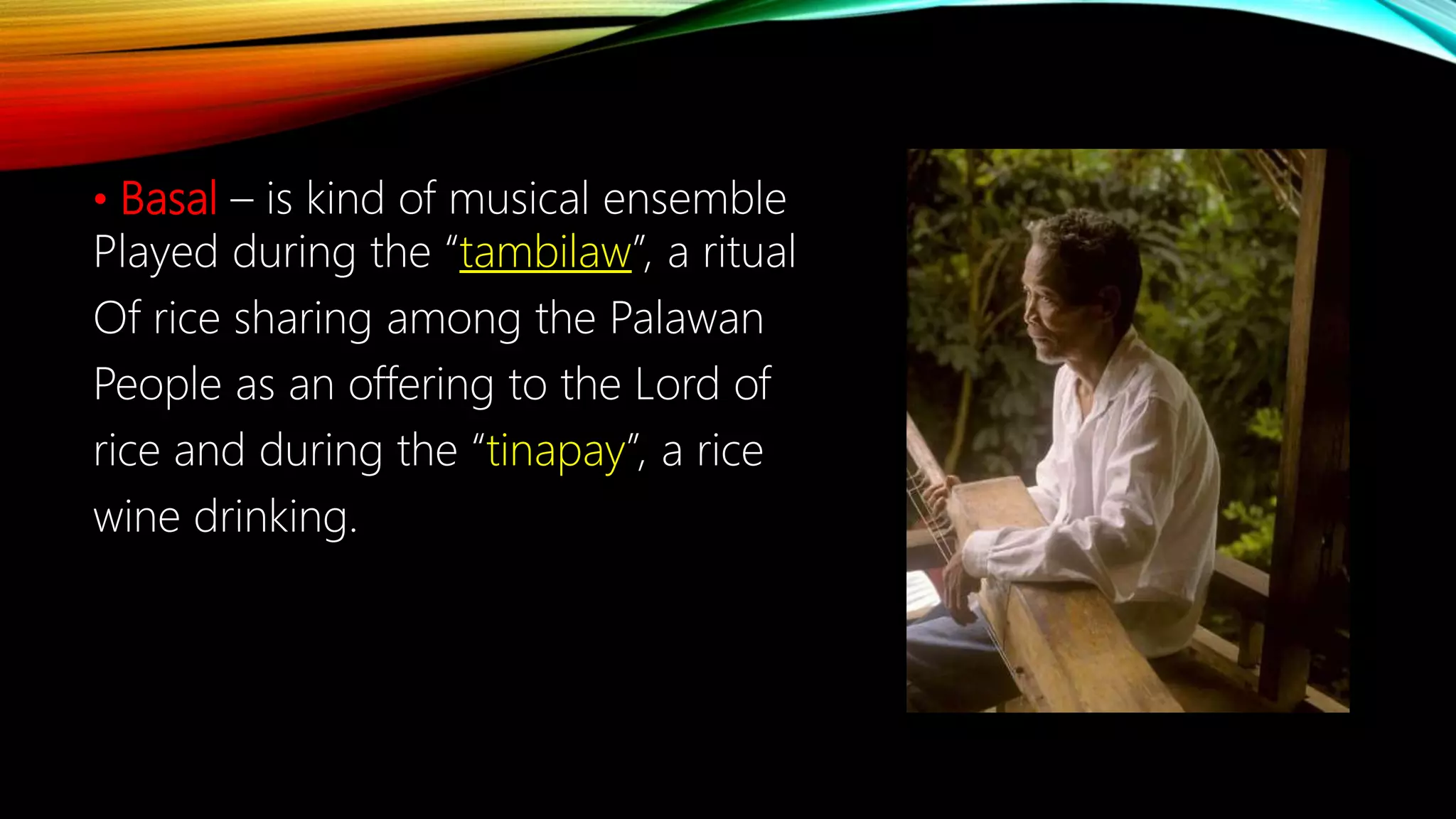
MASINOINTARAY
• Musician and Storyteller, Pala’wan
Brookes Point, Palawan (1993)
• A musician and a poet whose
Expertise were the Basal, Kulilal,
and Bagit.
• Basal – is kind of musical ensemble
Played during the “tambilaw”, a ritual
Of rice sharing among the Palawan
People as an offering to the Lord of
rice and during the “tinapay”, a rice
wine drinking.
SAMAONSULAIMAN
• Musician, Mamasa Pano, Magundanao
(1993)
• Master in playing the kutyapi,
a 2-stringed plucked lute. The Kutyapi
Is one of the most difficult to master indi-
genous Filipino instrument.
LANG DULAY
• Textile weaver, T’boli, Lake Sebu,
South Cotabato
Tnalak – a kind of fabric made up
of fine abaca fibers weaved with
different designs which reflect the
traditions of the Tboli.
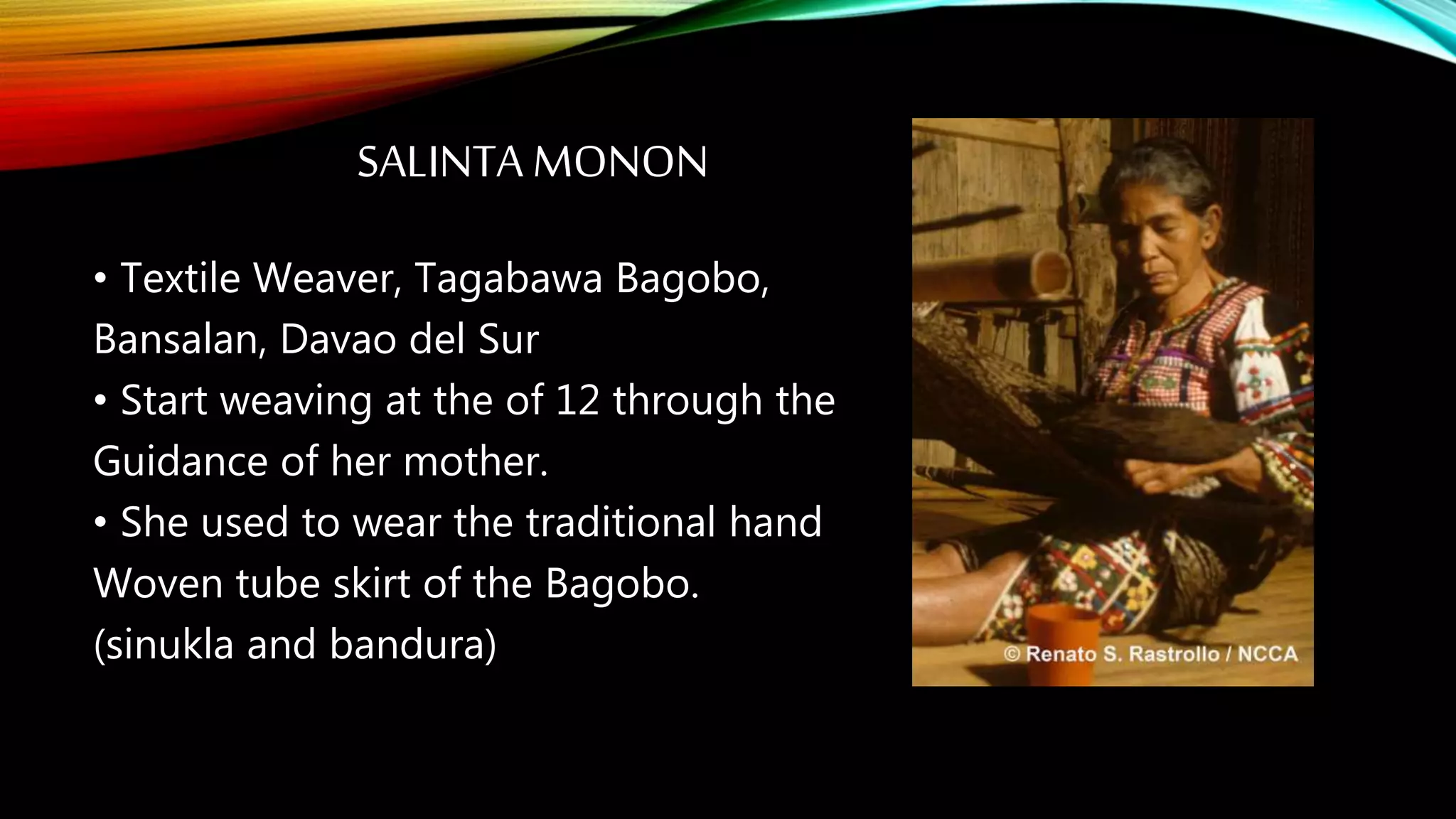
SALINTA MONON
• Textile Weaver, Tagabawa Bagobo,
Bansalan, Davao del Sur
• Start weaving at the of 12 through the
Guidance of her mother.
• She used to wear the traditional hand
Woven tube skirt of the Bagobo.
(sinukla and bandura)
ALONZOSACLAG
• Musician and Dancer, Lubugan, Kalinga
A master of dance and performing arts.
he has also mastered the dance patterns
and movements associated with his
people’s ritual. He is the founder of the
Kalinga Budong Dance Troupe to ensure
that the music and dance of his ancestor
are passed to the younger generations.
FEDERICOCABALLERO
• Epic Chanter, Sulod-Bukidnon, Calinog, Iloilo
Work for the documentation of the oral literature,
Particularly the epics of his People.
Labaw Dunggon and Humadapnon. One epic
could take as much as 162 hours to recite and
Humadapnon is the longest epic to recite. 2 months
of daily performances are required for it to be
completely chanted
UWANG AHADAS
• Musician, Yakan Lamitan, Basailan
• Is a Yakan, a people to whom instrumental music
Is closely connected to the spiritual realm.
Kwintangan kayu – consisting of five wooden logs
Hung horizontally, from the shortest to the longest.
Played to serenade the palay , as lover woos his
beloved.
DARHATA SAWABI
• Textile Weaver, Tausug, Parang, Sulu
• Weaving the Pis Syabit, the traditional cloth
tapestry worn as a head covering by the Tausug of
Jolo.
EDUARDO MUTUC
• Metal smith, Kapampangan, Apalit, Pampanga
• Creating religious and secular art in silver, bronze
and wood.
HAJA AMINAAPPI
• Mat Weaver, Sama Tandubas, Tawi-Tawi
• The mat weaving is one of the treasured traditions
of the Sama People. Their mat is made up of Pandan
Leaves w/c undergo tedious processes from
Stripping, to sun dying, to dyeing up to weaving.
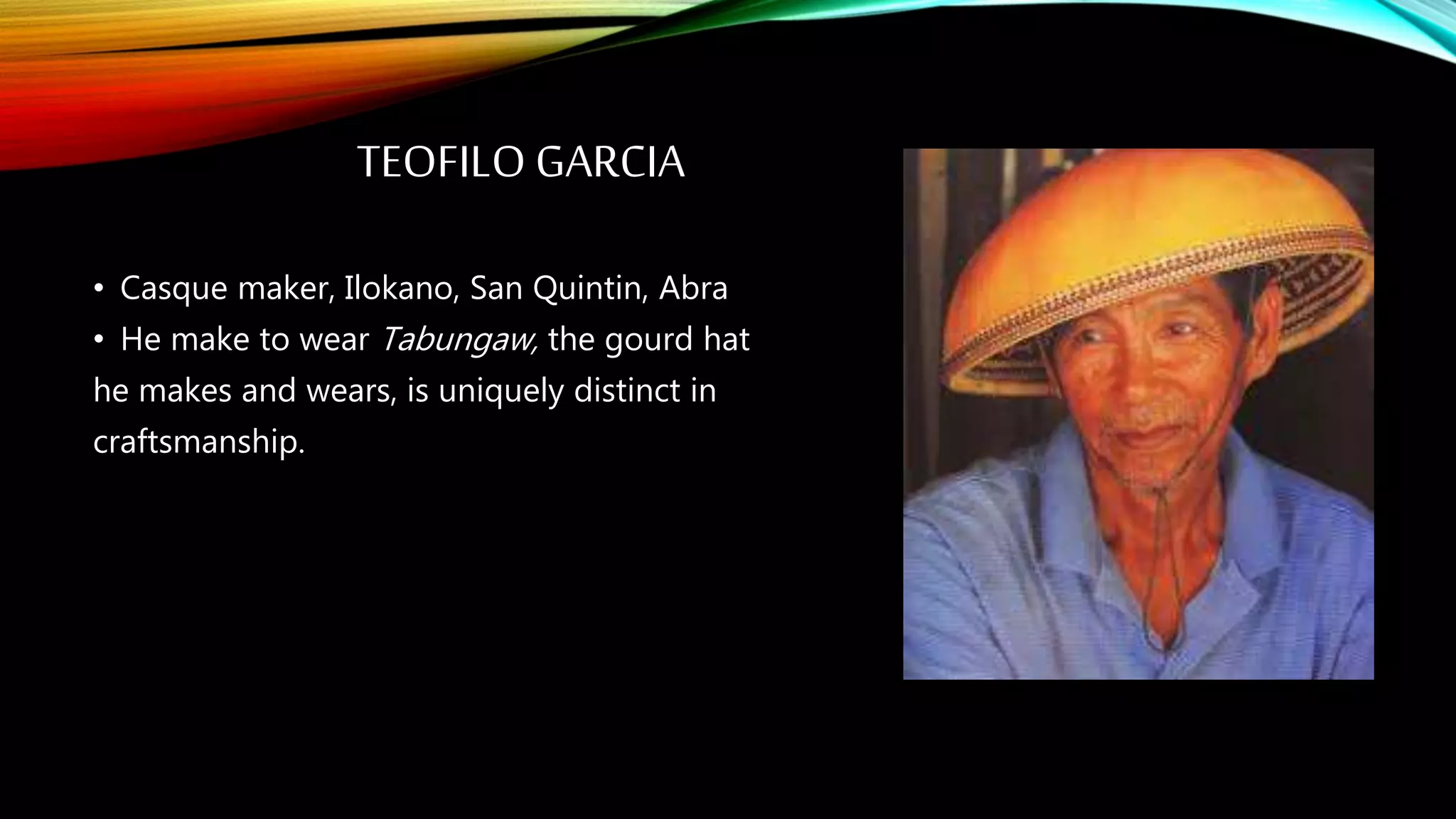
TEOFILO GARCIA
• Casque maker, Ilokano, San Quintin, Abra
• He make to wear Tabungaw, the gourd hat
he makes and wears, is uniquely distinct in
craftsmanship.
MAGDALENA GAMAYO
• Textile weaver, Ilokano, Pinili, Ilocos Norte
• Abel – the textile weaving of Ilokano from local
Cotton and other fibers.
Traditional Patterns:
Binakol and Inuritan (geometric design)
Kusikos (spiral forms similar to orange)
Sinan-sabong (Flowers)

Gamaba awardees

  • 1.
  • 2.
  • 3.
    GAWAD SA MANLILIKHANG BAYAN OR NATIONAL LIVING TREASURES AWARD Is Conferred on Filipinos who are at the forefront of the practice preservation, and promotion of the nation’s traditional folk arts. Objectives to honor and support traditional folk artists and to see to it that their skills and crafts are preserve.
  • 4.
    • Formalized in1992, through Republic Act No. 7355, the Manlilikha ng Bayan Act. • The National Commission for the Culture and the Arts oversees its implementation. • The award is tied with a program that ensures the transfer of their skills to new generations and the promotion of the craft both locally and internationally • In 2014, the Senate of the Philippines adopted Senate Resolution No. (SRN)765 aimed at recognizing the accomplishments of the country’s living treasures.
  • 5.
    EMBLEM • The awardlogo is a representation of the human form used in traditional cloth. Below the logo is the phrase “Manlilikha ng Bayan” written in Baybayin,an ancient Filipino script used in the Philippines in the 16th century.
  • 6.
    CRITERIA 1. Should bea Filipino citizen or a group of citizens belonging to an indigenous / traditional cultural community anywhere in the Philippines, engaged in Filipino traditional art in the following categories: folk architecture, maritime transport, weaving, carving, performing arts, literature, graphic and plastic arts, ornament, textile or fiber art, pottery and other artistic expressions of traditional culture;
  • 7.
    CRITERIA 2. Should havebeen engaged in the tradition and craft for a significant period of time with at least 50 years of existence and documentation; 3. Should have produced and performed of artistic, distinctive, and superior quality; 4. Should possess mastery of the tools and materials that are needed for the art and must have a reputation for being an art master and craft maker in the community where he / she belongs;
  • 8.
    CRITERIA 5. Should havepassed on and/ or will pass on the traditional crafts and skills to other members of the community by virtue of teaching; 6. In case when a Manlilikha ng Bayan candidate is incapable of teaching further his/ her craft and skill due to age or infirmity; A. He / she should have created a significant body of work and has contributed to the development of the tradition and craft B. He / she should have played a role in the preservation and revitalization of the artistic tradition in the community. C. He/ she has been recognized as a master of his / her craft and admired for his character and integrity in his / her community.
  • 9.
    GINAWBILOG Poet, Hanunuo Mangyan Panaytayan,OrientalMindoro (1993) • Ambahan – is a kind of poem consisting of seven syllable lines which most of the time contains messages of love and friendship.
  • 10.
    MASINOINTARAY • Musician andStoryteller, Pala’wan Brookes Point, Palawan (1993) • A musician and a poet whose Expertise were the Basal, Kulilal, and Bagit.
  • 11.
    • Basal –is kind of musical ensemble Played during the “tambilaw”, a ritual Of rice sharing among the Palawan People as an offering to the Lord of rice and during the “tinapay”, a rice wine drinking.
  • 12.
    SAMAONSULAIMAN • Musician, MamasaPano, Magundanao (1993) • Master in playing the kutyapi, a 2-stringed plucked lute. The Kutyapi Is one of the most difficult to master indi- genous Filipino instrument.
  • 13.
    LANG DULAY • Textileweaver, T’boli, Lake Sebu, South Cotabato Tnalak – a kind of fabric made up of fine abaca fibers weaved with different designs which reflect the traditions of the Tboli.
  • 14.
    SALINTA MONON • TextileWeaver, Tagabawa Bagobo, Bansalan, Davao del Sur • Start weaving at the of 12 through the Guidance of her mother. • She used to wear the traditional hand Woven tube skirt of the Bagobo. (sinukla and bandura)
  • 15.
    ALONZOSACLAG • Musician andDancer, Lubugan, Kalinga A master of dance and performing arts. he has also mastered the dance patterns and movements associated with his people’s ritual. He is the founder of the Kalinga Budong Dance Troupe to ensure that the music and dance of his ancestor are passed to the younger generations.
  • 16.
    FEDERICOCABALLERO • Epic Chanter,Sulod-Bukidnon, Calinog, Iloilo Work for the documentation of the oral literature, Particularly the epics of his People. Labaw Dunggon and Humadapnon. One epic could take as much as 162 hours to recite and Humadapnon is the longest epic to recite. 2 months of daily performances are required for it to be completely chanted
  • 17.
    UWANG AHADAS • Musician,Yakan Lamitan, Basailan • Is a Yakan, a people to whom instrumental music Is closely connected to the spiritual realm. Kwintangan kayu – consisting of five wooden logs Hung horizontally, from the shortest to the longest. Played to serenade the palay , as lover woos his beloved.
  • 18.
    DARHATA SAWABI • TextileWeaver, Tausug, Parang, Sulu • Weaving the Pis Syabit, the traditional cloth tapestry worn as a head covering by the Tausug of Jolo.
  • 19.
    EDUARDO MUTUC • Metalsmith, Kapampangan, Apalit, Pampanga • Creating religious and secular art in silver, bronze and wood.
  • 20.
    HAJA AMINAAPPI • MatWeaver, Sama Tandubas, Tawi-Tawi • The mat weaving is one of the treasured traditions of the Sama People. Their mat is made up of Pandan Leaves w/c undergo tedious processes from Stripping, to sun dying, to dyeing up to weaving.
  • 21.
    TEOFILO GARCIA • Casquemaker, Ilokano, San Quintin, Abra • He make to wear Tabungaw, the gourd hat he makes and wears, is uniquely distinct in craftsmanship.
  • 22.
    MAGDALENA GAMAYO • Textileweaver, Ilokano, Pinili, Ilocos Norte • Abel – the textile weaving of Ilokano from local Cotton and other fibers. Traditional Patterns: Binakol and Inuritan (geometric design) Kusikos (spiral forms similar to orange) Sinan-sabong (Flowers)