 Appropriately use information to fulfill the identified
need
USING INFORMATION
Erin L. Nagel
Clayton State University Library
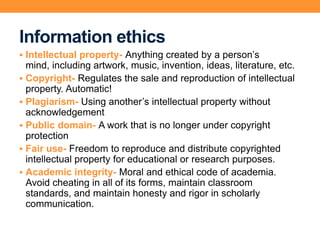
Information ethics
 Intellectual property- Anything created by a person’s
mind, including artwork, music, invention, ideas, literature, etc.
 Copyright- Regulates the sale and reproduction of intellectual
property. Automatic!
 Plagiarism- Using another’s intellectual property without
acknowledgement
 Public domain- A work that is no longer under copyright
protection
 Fair use- Freedom to reproduce and distribute copyrighted
intellectual property for educational or research purposes.
 Academic integrity- Moral and ethical code of academia.
Avoid cheating in all of its forms, maintain classroom
standards, and maintain honesty and rigor in scholarly
communication.
Is it ok to…
…use the ideas of another author
without providing a reference, even if
you write them in your own words?
Adapted from: “Is it Plagiarism?” https://ilrb.cf.ac.uk/plagiarism/quiz/index.html Created by Cardiff University Information Services.
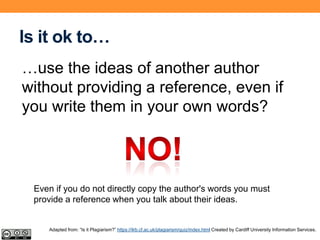
Is it ok to…
…use the ideas of another author
without providing a reference, even if
you write them in your own words?
Even if you do not directly copy the author's words you must
provide a reference when you talk about their ideas.
Adapted from: “Is it Plagiarism?” https://ilrb.cf.ac.uk/plagiarism/quiz/index.html Created by Cardiff University Information Services.
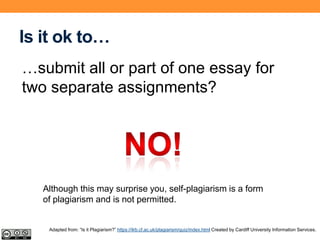
Is it ok to…
…submit all or part of one essay for
two separate assignments?
Adapted from: “Is it Plagiarism?” https://ilrb.cf.ac.uk/plagiarism/quiz/index.html Created by Cardiff University Information Services.
Is it ok to…
…submit all or part of one essay for
two separate assignments?
Although this may surprise you, self-plagiarism is a form
of plagiarism and is not permitted.
Adapted from: “Is it Plagiarism?” https://ilrb.cf.ac.uk/plagiarism/quiz/index.html Created by Cardiff University Information Services.
Is it ok to…
…include a fact or saying in your
assignment which is generally known
without providing a reference?
Adapted from: “Is it Plagiarism?” https://ilrb.cf.ac.uk/plagiarism/quiz/index.html Created by Cardiff University Information Services.
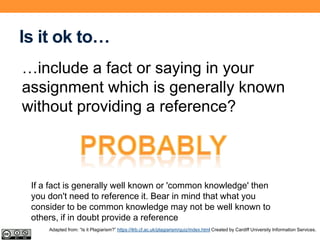
Is it ok to…
…include a fact or saying in your
assignment which is generally known
without providing a reference?
If a fact is generally well known or 'common knowledge' then
you don't need to reference it. Bear in mind that what you
consider to be common knowledge may not be well known to
others, if in doubt provide a reference
Adapted from: “Is it Plagiarism?” https://ilrb.cf.ac.uk/plagiarism/quiz/index.html Created by Cardiff University Information Services.
Is it ok to…
…incorporate text from another
source, changing one or two words and
providing a citation?
Adapted from: “Is it Plagiarism?” https://ilrb.cf.ac.uk/plagiarism/quiz/index.html Created by Cardiff University Information Services.
Is it ok to…
…incorporate text from another
source, changing one or two words and
providing a citation?
If you do not intend to quote directly from the
source, you must write about it in your own words.
Using too many words from the original source is
plagiarism, even if you provide a reference.
Adapted from: “Is it Plagiarism?” https://ilrb.cf.ac.uk/plagiarism/quiz/index.html Created by Cardiff University Information Services.
Is it ok to…
…use the ideas of another author
without providing a reference, even if
you write them in your own words?
Adapted from: “Is it Plagiarism?” https://ilrb.cf.ac.uk/plagiarism/quiz/index.html Created by Cardiff University Information Services.
Is it ok to…
…use the ideas of another author
without providing a reference, even if
you write them in your own words?
Even if you do not directly copy the author's words you
must provide a reference when you talk about their
ideas.
Adapted from: “Is it Plagiarism?” https://ilrb.cf.ac.uk/plagiarism/quiz/index.html Created by Cardiff University Information Services.
Is it ok to…
…copy a diagram or data table from a
web site, providing a reference for the
source underneath?
Adapted from: “Is it Plagiarism?” https://ilrb.cf.ac.uk/plagiarism/quiz/index.html Created by Cardiff University Information Services.
Is it ok to…
…copy a diagram or data table from a
web site, providing a reference for the
source underneath?
You can include a table, diagram or image from another
source as long as you provide a reference.
Adapted from: “Is it Plagiarism?” https://ilrb.cf.ac.uk/plagiarism/quiz/index.html Created by Cardiff University Information Services.
Why is this important?
 Plagiarism is dishonest
Honesty is the first
chapter in the Book
of wisdom. Let it be
our endeavor to
merit the character
Why is this important?
 Plagiarism is cheating
By Author's modification of original by Rob Qld on Flickr. [CC-BY-2.0 (http://creativecommons.org/licenses/by/2.0)], via Wikimedia
Commons; http://upload.wikimedia.org/wikipedia/commons/4/42/Acinonyx_jubatus_walking_edit.jpg
Why is this important?
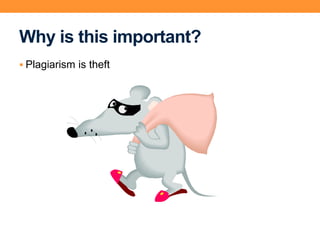
 Plagiarism is theft
CSU Student Code of Conduct
Plagiarism and Misrepresentation of Work
No student will represent the work of others as his
or her own. Themes, essays, term
papers, tests, presentations and other similar
assignments must be the work of the student
submitting them. When direct quotations are
used, they must be indicated and when the ideas
of another are incorporated, they must be
appropriately cited.
1. No student will submit the same assignment for
two courses without the prior consent of theFrom CSU Student Code of Conduct 2012-13; “Conduct Regulations
I-E” p.2
Avoid plagiarism
Take good notes
Quote, paraphrase, summari
ze
Cite!
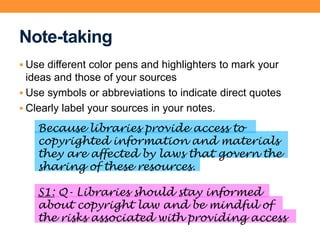
Note-taking
 Use different color pens and highlighters to mark your
ideas and those of your sources
 Use symbols or abbreviations to indicate direct quotes
 Clearly label your sources in your notes.
Because libraries provide access to
copyrighted information and materials
they are affected by laws that govern the
sharing of these resources.
S1: Q- Libraries should stay informed
about copyright law and be mindful of
the risks associated with providing access
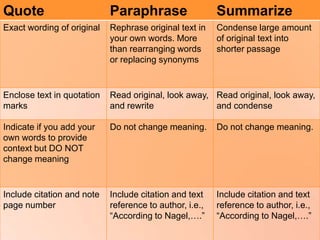
Quote Paraphrase Summarize
Exact wording of original Rephrase original text in
your own words. More
than rearranging words
or replacing synonyms
Condense large amount
of original text into
shorter passage
Enclose text in quotation
marks
Read original, look away,
and rewrite
Read original, look away,
and condense
Indicate if you add your
own words to provide
context but DO NOT
change meaning
Do not change meaning. Do not change meaning.
Include citation and note
page number
Include citation and text
reference to author, i.e.,
“According to Nagel,….”
Include citation and text
reference to author, i.e.,
“According to Nagel,….”
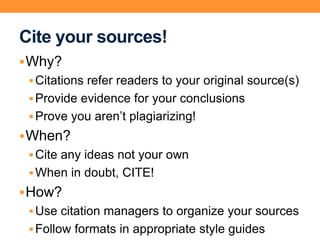
Cite your sources!
Why?
Citations refer readers to your original source(s)
Provide evidence for your conclusions
Prove you aren’t plagiarizing!
When?
Cite any ideas not your own
When in doubt, CITE!
How?
Use citation managers to organize your sources
Follow formats in appropriate style guides

Using information ethically

  • 1.
     Appropriately useinformation to fulfill the identified need USING INFORMATION Erin L. Nagel Clayton State University Library
  • 2.
    Information ethics  Intellectualproperty- Anything created by a person’s mind, including artwork, music, invention, ideas, literature, etc.  Copyright- Regulates the sale and reproduction of intellectual property. Automatic!  Plagiarism- Using another’s intellectual property without acknowledgement  Public domain- A work that is no longer under copyright protection  Fair use- Freedom to reproduce and distribute copyrighted intellectual property for educational or research purposes.  Academic integrity- Moral and ethical code of academia. Avoid cheating in all of its forms, maintain classroom standards, and maintain honesty and rigor in scholarly communication.
  • 3.
    Is it okto… …use the ideas of another author without providing a reference, even if you write them in your own words? Adapted from: “Is it Plagiarism?” https://ilrb.cf.ac.uk/plagiarism/quiz/index.html Created by Cardiff University Information Services.
  • 4.
    Is it okto… …use the ideas of another author without providing a reference, even if you write them in your own words? Even if you do not directly copy the author's words you must provide a reference when you talk about their ideas. Adapted from: “Is it Plagiarism?” https://ilrb.cf.ac.uk/plagiarism/quiz/index.html Created by Cardiff University Information Services.
  • 5.
    Is it okto… …submit all or part of one essay for two separate assignments? Adapted from: “Is it Plagiarism?” https://ilrb.cf.ac.uk/plagiarism/quiz/index.html Created by Cardiff University Information Services.
  • 6.
    Is it okto… …submit all or part of one essay for two separate assignments? Although this may surprise you, self-plagiarism is a form of plagiarism and is not permitted. Adapted from: “Is it Plagiarism?” https://ilrb.cf.ac.uk/plagiarism/quiz/index.html Created by Cardiff University Information Services.
  • 7.
    Is it okto… …include a fact or saying in your assignment which is generally known without providing a reference? Adapted from: “Is it Plagiarism?” https://ilrb.cf.ac.uk/plagiarism/quiz/index.html Created by Cardiff University Information Services.
  • 8.
    Is it okto… …include a fact or saying in your assignment which is generally known without providing a reference? If a fact is generally well known or 'common knowledge' then you don't need to reference it. Bear in mind that what you consider to be common knowledge may not be well known to others, if in doubt provide a reference Adapted from: “Is it Plagiarism?” https://ilrb.cf.ac.uk/plagiarism/quiz/index.html Created by Cardiff University Information Services.
  • 9.
    Is it okto… …incorporate text from another source, changing one or two words and providing a citation? Adapted from: “Is it Plagiarism?” https://ilrb.cf.ac.uk/plagiarism/quiz/index.html Created by Cardiff University Information Services.
  • 10.
    Is it okto… …incorporate text from another source, changing one or two words and providing a citation? If you do not intend to quote directly from the source, you must write about it in your own words. Using too many words from the original source is plagiarism, even if you provide a reference. Adapted from: “Is it Plagiarism?” https://ilrb.cf.ac.uk/plagiarism/quiz/index.html Created by Cardiff University Information Services.
  • 11.
    Is it okto… …use the ideas of another author without providing a reference, even if you write them in your own words? Adapted from: “Is it Plagiarism?” https://ilrb.cf.ac.uk/plagiarism/quiz/index.html Created by Cardiff University Information Services.
  • 12.
    Is it okto… …use the ideas of another author without providing a reference, even if you write them in your own words? Even if you do not directly copy the author's words you must provide a reference when you talk about their ideas. Adapted from: “Is it Plagiarism?” https://ilrb.cf.ac.uk/plagiarism/quiz/index.html Created by Cardiff University Information Services.
  • 13.
    Is it okto… …copy a diagram or data table from a web site, providing a reference for the source underneath? Adapted from: “Is it Plagiarism?” https://ilrb.cf.ac.uk/plagiarism/quiz/index.html Created by Cardiff University Information Services.
  • 14.
    Is it okto… …copy a diagram or data table from a web site, providing a reference for the source underneath? You can include a table, diagram or image from another source as long as you provide a reference. Adapted from: “Is it Plagiarism?” https://ilrb.cf.ac.uk/plagiarism/quiz/index.html Created by Cardiff University Information Services.
  • 15.
    Why is thisimportant?  Plagiarism is dishonest Honesty is the first chapter in the Book of wisdom. Let it be our endeavor to merit the character
  • 16.
    Why is thisimportant?  Plagiarism is cheating By Author's modification of original by Rob Qld on Flickr. [CC-BY-2.0 (http://creativecommons.org/licenses/by/2.0)], via Wikimedia Commons; http://upload.wikimedia.org/wikipedia/commons/4/42/Acinonyx_jubatus_walking_edit.jpg
  • 17.
    Why is thisimportant?  Plagiarism is theft
  • 18.
    CSU Student Codeof Conduct Plagiarism and Misrepresentation of Work No student will represent the work of others as his or her own. Themes, essays, term papers, tests, presentations and other similar assignments must be the work of the student submitting them. When direct quotations are used, they must be indicated and when the ideas of another are incorporated, they must be appropriately cited. 1. No student will submit the same assignment for two courses without the prior consent of theFrom CSU Student Code of Conduct 2012-13; “Conduct Regulations I-E” p.2
  • 19.
    Avoid plagiarism Take goodnotes Quote, paraphrase, summari ze Cite!
  • 20.
    Note-taking  Use differentcolor pens and highlighters to mark your ideas and those of your sources  Use symbols or abbreviations to indicate direct quotes  Clearly label your sources in your notes. Because libraries provide access to copyrighted information and materials they are affected by laws that govern the sharing of these resources. S1: Q- Libraries should stay informed about copyright law and be mindful of the risks associated with providing access
  • 21.
    Quote Paraphrase Summarize Exactwording of original Rephrase original text in your own words. More than rearranging words or replacing synonyms Condense large amount of original text into shorter passage Enclose text in quotation marks Read original, look away, and rewrite Read original, look away, and condense Indicate if you add your own words to provide context but DO NOT change meaning Do not change meaning. Do not change meaning. Include citation and note page number Include citation and text reference to author, i.e., “According to Nagel,….” Include citation and text reference to author, i.e., “According to Nagel,….”
  • 22.
    Cite your sources! Why? Citationsrefer readers to your original source(s) Provide evidence for your conclusions Prove you aren’t plagiarizing! When? Cite any ideas not your own When in doubt, CITE! How? Use citation managers to organize your sources Follow formats in appropriate style guides

Editor's Notes

  • #6 Created by Cardiff University Information Services.This work is licensed under a Creative Commons Attribution-NonCommercial 3.0 Unported License.
  • #7 Created by Cardiff University Information Services.This work is licensed under a Creative Commons Attribution-NonCommercial 3.0 Unported License.
  • #8 Created by Cardiff University Information Services.This work is licensed under a Creative Commons Attribution-NonCommercial 3.0 Unported License.
  • #9 Created by Cardiff University Information Services.This work is licensed under a Creative Commons Attribution-NonCommercial 3.0 Unported License.
  • #10 Created by Cardiff University Information Services.This work is licensed under a Creative Commons Attribution-NonCommercial 3.0 Unported License.
  • #11 Created by Cardiff University Information Services.This work is licensed under a Creative Commons Attribution-NonCommercial 3.0 Unported License.
  • #12 Created by Cardiff University Information Services.This work is licensed under a Creative Commons Attribution-NonCommercial 3.0 Unported License.
  • #13 Created by Cardiff University Information Services.This work is licensed under a Creative Commons Attribution-NonCommercial 3.0 Unported License.
  • #14 Created by Cardiff University Information Services.This work is licensed under a Creative Commons Attribution-NonCommercial 3.0 Unported License.
  • #15 Created by Cardiff University Information Services.This work is licensed under a Creative Commons Attribution-NonCommercial 3.0 Unported License.
  • #16 Honesty is founding principle of our nation and something we should all strive toward.
  • #17 When you use someone else’s words or ideas as your own, you are cheating. Not only are you cheating the other person out of his/her deserved recognition or even money, you are cheating yourself out of the opportunity to learn a new skill. You are cheating yourself out of the opportunity to receive feedback from your instructor on how you can improve.
  • #18 Like theft, plagiarism can have serious consequences from poor grades to incarceration.
  • #19 Sanctions may range from a zero on the assignment, F in the course, suspension for one year, or expulsion from the university.