PRESENTED BY CAROLYN KLINGER
SLIDES BY CAROLYN KLINGER, RACHEL
HOUGHTON, BETHANY AGUAD, DAN VOSS,
LISA MILEUSNICH, AND
LORI MEYER
Careers in Technical
Communication
Presentation for Allen Brizee’s
Rhetoric of Professional Writing Class
Loyola University Maryland
February 20, 2014
Agenda
 Technical communication
 What it is
 Body of Knowledge
 Disciplines
 Show me the money
 Comparative salaries
 Local industries and jobs
 Paths to careers in techcomm
 Society for Technical Communication
 Membership levels
 Washington, DC – Baltimore Chapter
Technical Communication is…
• Communicating about technical or
specialized topics by using technology,
including emerging new media
• Contributing to business goals by designing
and enhancing internal communications and
by reusing content in cost-effective ways.
Body of Knowledge
• The definitive online resource for information
about the profession of technical communication
• Experienced technical communicators, educators
and instructors, and students are invited to
contribute to the TCBOK!
• Go to the STC collaboration site at
http://stcbok.editme.com to learn, contribute,
and add to your online portfolio
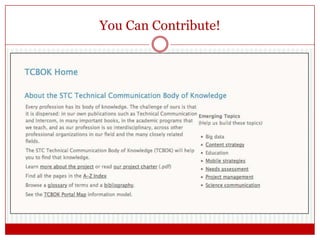
You Can Contribute!
Disciplines
• Technical writing & editing
• Content strategy
• Information architecture
• Advertising & marketing communication
• Science writing (and “ghost writing”)
• Medical writing
• Work for nonprofit organizations (grant proposals, etc.)
• Usability and accessibility
• Instructional design
• Indexing
Interdisciplinary Approach
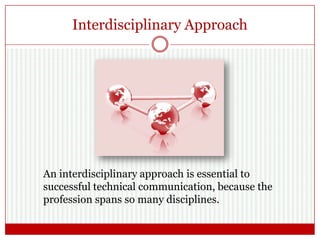
An interdisciplinary approach is essential to
successful technical communication, because the
profession spans so many disciplines.
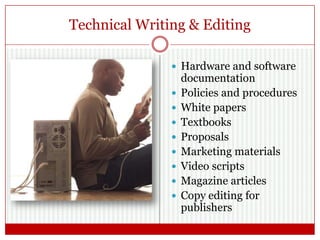
Technical Writing & Editing
 Hardware and software
documentation
 Policies and procedures
 White papers
 Textbooks
 Proposals
 Marketing materials
 Video scripts
 Magazine articles
 Copy editing for
publishers
Medical Writing
 Editing or ghost-writing
articles by physicians for
medical journals
 Patient-oriented websites
 Flyers describing illnesses and
treatments, for doctors’
offices
 Medical transcription
 Instructions for prescription
medication
 Marketing materials and web
sites
 Instructions for using medical
devices such as X-ray
machines
 Biotech
Work for Nonprofit Organizations
 Grant proposals
 Fund-raising collaterals
 Literature for clients of
the nonprofit groups
 Web site design, content,
and maintenance
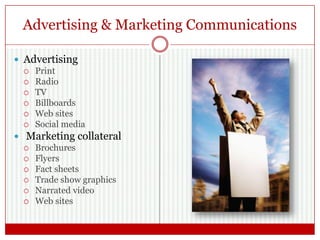
Advertising & Marketing Communications
 Advertising
 Print
 Radio
 TV
 Billboards
 Web sites
 Social media
 Marketing collateral
 Brochures
 Flyers
 Fact sheets
 Trade show graphics
 Narrated video
 Web sites
Show Me the Money
• Technical communication spans many
disciplines, so the job market is huge
• Unless technology stands still, it will always be
a growth market
• Smart companies realize that poor writing and
poor communication hurt their bottom line
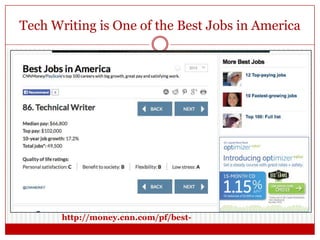
Tech Writing is One of the Best Jobs in America
.
http://money.cnn.com/pf/best-
jobs/2013/snapshots/86.html
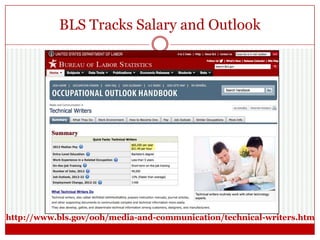
BLS Tracks Salary and Outlook
http://www.bls.gov/ooh/media-and-communication/technical-writers.htm
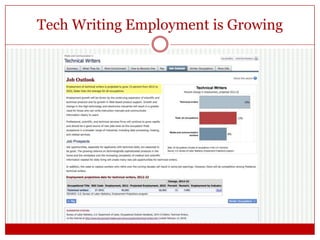
Tech Writing Employment is Growing
Growing Job Market
There are 46,100+ technical writers in the U.S.!
Geographical Distribution of Jobs in Technical Communication
Where the Jobs Are
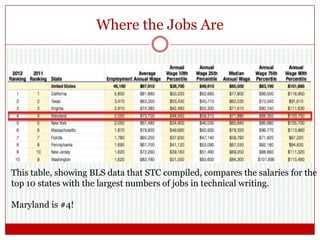
This table, showing BLS data that STC compiled, compares the salaries for the
top 10 states with the largest numbers of jobs in technical writing.
Maryland is #4!
Where the Jobs Are Going
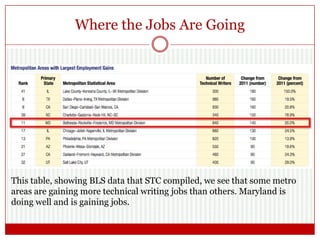
This table, showing BLS data that STC compiled, we see that some metro
areas are gaining more technical writing jobs than others. Maryland is
doing well and is gaining jobs.
Tech Writing Salaries Around the U.S.
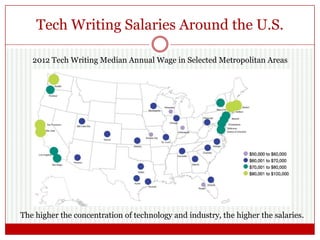
2012 Tech Writing Median Annual Wage in Selected Metropolitan Areas
The higher the concentration of technology and industry, the higher the salaries.
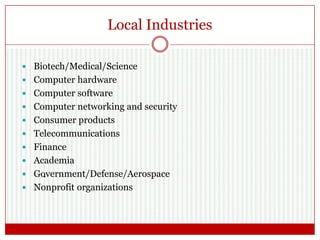
Local Industries
.
 Biotech/Medical/Science
 Computer hardware
 Computer software
 Computer networking and security
 Consumer products
 Telecommunications
 Finance
 Academia
 Government/Defense/Aerospace
 Nonprofit organizations
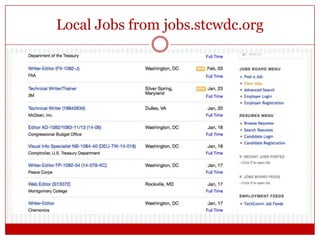
Local Jobs from jobs.stcwdc.org
.
Paths to Careers in Techcomm
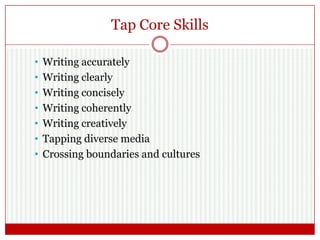
Tap Core Skills
• Writing accurately
• Writing clearly
• Writing concisely
• Writing coherently
• Writing creatively
• Tapping diverse media
• Crossing boundaries and cultures
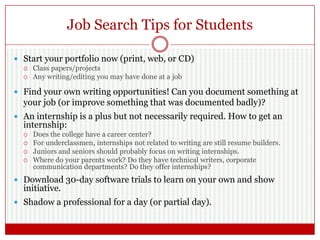
Job Search Tips for Students
 Start your portfolio now (print, web, or CD)
 Class papers/projects
 Any writing/editing you may have done at a job
 Find your own writing opportunities! Can you document something at
your job (or improve something that was documented badly)?
 An internship is a plus but not necessarily required. How to get an
internship:
 Does the college have a career center?
 For underclassmen, internships not related to writing are still resume builders.
 Juniors and seniors should probably focus on writing internships.
 Where do your parents work? Do they have technical writers, corporate
communication departments? Do they offer internships?
 Download 30-day software trials to learn on your own and show
initiative.
 Shadow a professional for a day (or partial day).
On-the-Job Training
Before tech writing programs appeared in
universities, “OJT” was the only path to a
career in technical communication
Degree Programs
 B.A. in techcomm
 M.A. in techcomm
 Ph.D. in techcomm
 Undergraduate minor in
techcomm
 A certificate based on a
given number of courses
in techcomm
Career Growth
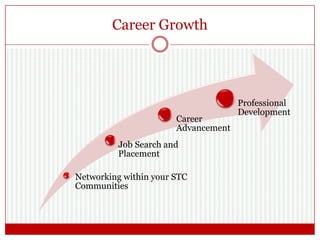
Networking within your STC
Communities
Job Search and
Placement
Career
Advancement
Professional
Development
Joining STC
Benefits of Membership
• Affiliation (geographic or virtual) with an STC
student chapter
• Affiliation (geographic or virtual) with an STC
geographic chapter
• Affiliation with one STC special interest group (SIG)
in a technical communication discipline of particular
interest to you
• Access to salary scales, job listings, and other valuable
intellectual property on the international STC web
site
• Opportunities to expand your network and build
skills through volunteering
Benefits of Membership (Cont.)
 Eligibility for STC
student mentoring
programs
 Professional networking
 Online access to
industry-leading
professional publications
 Reduced rates for STC
conferences, webinars
(plus free webinars), and
certification in technical
communication
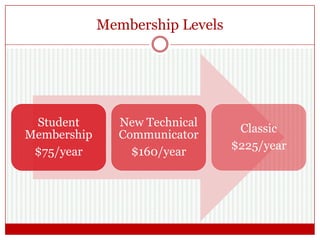
Membership Levels
Student
$75/year
New Technical
Communicator
$160/year
Classic
$225/year
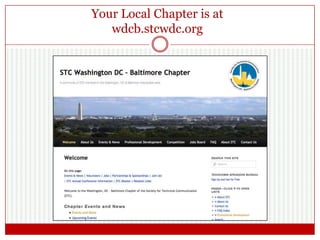
Your Local Chapter is at
wdcb.stcwdc.org
FAQs on Local Chapter Site
• "I have a degree in English—what can I do with it?"
http://wdcb.stcwdc.org/faq/faqs/what-is-a-technical-writer-communicator/#ENGLISHDEGREE
and the related links
• "What is Technical Communication?"
http://wdcb.stcwdc.org/prof-dev/competition/what-is-technical-communication/
• "What does a technical writer do?"
http://wdcb.stcwdc.org/faq/faqs/what-is-a-technical-writer-communicator/#WHAT
• How do I become a technical communicator?
http://wdcb.stcwdc.org/faq/faqs/what-is-a-technical-writer-communicator/#HOWTO
• How do I get into this field without any experience?
http://wdcb.stcwdc.org/faq/faqs/what-is-a-technical-writer-communicator/#EXPERIENCE
• How can I find a job in technical communication?
http://wdcb.stcwdc.org/faq/faqs/what-is-a-technical-writer-communicator/#JOBS
• Communication Careers Books
http://www.stcwdc.org/refbooks-2_answer.shtml
Thank you for
Coming!
Feel free to contact me!
Carolyn Kelley Klinger
carolyn.klinger@verizon.net
@cklinger

Techcomm Careers in 2014

  • 1.
    PRESENTED BY CAROLYNKLINGER SLIDES BY CAROLYN KLINGER, RACHEL HOUGHTON, BETHANY AGUAD, DAN VOSS, LISA MILEUSNICH, AND LORI MEYER Careers in Technical Communication Presentation for Allen Brizee’s Rhetoric of Professional Writing Class Loyola University Maryland February 20, 2014
  • 2.
    Agenda  Technical communication What it is  Body of Knowledge  Disciplines  Show me the money  Comparative salaries  Local industries and jobs  Paths to careers in techcomm  Society for Technical Communication  Membership levels  Washington, DC – Baltimore Chapter
  • 3.
    Technical Communication is… •Communicating about technical or specialized topics by using technology, including emerging new media • Contributing to business goals by designing and enhancing internal communications and by reusing content in cost-effective ways.
  • 4.
    Body of Knowledge •The definitive online resource for information about the profession of technical communication • Experienced technical communicators, educators and instructors, and students are invited to contribute to the TCBOK! • Go to the STC collaboration site at http://stcbok.editme.com to learn, contribute, and add to your online portfolio
  • 5.
  • 6.
    Disciplines • Technical writing& editing • Content strategy • Information architecture • Advertising & marketing communication • Science writing (and “ghost writing”) • Medical writing • Work for nonprofit organizations (grant proposals, etc.) • Usability and accessibility • Instructional design • Indexing
  • 7.
    Interdisciplinary Approach An interdisciplinaryapproach is essential to successful technical communication, because the profession spans so many disciplines.
  • 8.
    Technical Writing &Editing  Hardware and software documentation  Policies and procedures  White papers  Textbooks  Proposals  Marketing materials  Video scripts  Magazine articles  Copy editing for publishers
  • 9.
    Medical Writing  Editingor ghost-writing articles by physicians for medical journals  Patient-oriented websites  Flyers describing illnesses and treatments, for doctors’ offices  Medical transcription  Instructions for prescription medication  Marketing materials and web sites  Instructions for using medical devices such as X-ray machines  Biotech
  • 10.
    Work for NonprofitOrganizations  Grant proposals  Fund-raising collaterals  Literature for clients of the nonprofit groups  Web site design, content, and maintenance
  • 11.
    Advertising & MarketingCommunications  Advertising  Print  Radio  TV  Billboards  Web sites  Social media  Marketing collateral  Brochures  Flyers  Fact sheets  Trade show graphics  Narrated video  Web sites
  • 12.
    Show Me theMoney • Technical communication spans many disciplines, so the job market is huge • Unless technology stands still, it will always be a growth market • Smart companies realize that poor writing and poor communication hurt their bottom line
  • 13.
    Tech Writing isOne of the Best Jobs in America . http://money.cnn.com/pf/best- jobs/2013/snapshots/86.html
  • 14.
    BLS Tracks Salaryand Outlook http://www.bls.gov/ooh/media-and-communication/technical-writers.htm
  • 15.
  • 16.
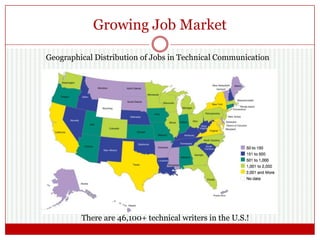
    Growing Job Market Thereare 46,100+ technical writers in the U.S.! Geographical Distribution of Jobs in Technical Communication
  • 17.
    Where the JobsAre This table, showing BLS data that STC compiled, compares the salaries for the top 10 states with the largest numbers of jobs in technical writing. Maryland is #4!
  • 18.
    Where the JobsAre Going This table, showing BLS data that STC compiled, we see that some metro areas are gaining more technical writing jobs than others. Maryland is doing well and is gaining jobs.
  • 19.
    Tech Writing SalariesAround the U.S. 2012 Tech Writing Median Annual Wage in Selected Metropolitan Areas The higher the concentration of technology and industry, the higher the salaries.
  • 20.
    Local Industries .  Biotech/Medical/Science Computer hardware  Computer software  Computer networking and security  Consumer products  Telecommunications  Finance  Academia  Government/Defense/Aerospace  Nonprofit organizations
  • 21.
    Local Jobs fromjobs.stcwdc.org .
  • 22.
    Paths to Careersin Techcomm
  • 23.
    Tap Core Skills •Writing accurately • Writing clearly • Writing concisely • Writing coherently • Writing creatively • Tapping diverse media • Crossing boundaries and cultures
  • 24.
    Job Search Tipsfor Students  Start your portfolio now (print, web, or CD)  Class papers/projects  Any writing/editing you may have done at a job  Find your own writing opportunities! Can you document something at your job (or improve something that was documented badly)?  An internship is a plus but not necessarily required. How to get an internship:  Does the college have a career center?  For underclassmen, internships not related to writing are still resume builders.  Juniors and seniors should probably focus on writing internships.  Where do your parents work? Do they have technical writers, corporate communication departments? Do they offer internships?  Download 30-day software trials to learn on your own and show initiative.  Shadow a professional for a day (or partial day).
  • 25.
    On-the-Job Training Before techwriting programs appeared in universities, “OJT” was the only path to a career in technical communication
  • 26.
    Degree Programs  B.A.in techcomm  M.A. in techcomm  Ph.D. in techcomm  Undergraduate minor in techcomm  A certificate based on a given number of courses in techcomm
  • 27.
    Career Growth Networking withinyour STC Communities Job Search and Placement Career Advancement Professional Development
  • 28.
  • 29.
    Benefits of Membership •Affiliation (geographic or virtual) with an STC student chapter • Affiliation (geographic or virtual) with an STC geographic chapter • Affiliation with one STC special interest group (SIG) in a technical communication discipline of particular interest to you • Access to salary scales, job listings, and other valuable intellectual property on the international STC web site • Opportunities to expand your network and build skills through volunteering
  • 30.
    Benefits of Membership(Cont.)  Eligibility for STC student mentoring programs  Professional networking  Online access to industry-leading professional publications  Reduced rates for STC conferences, webinars (plus free webinars), and certification in technical communication
  • 31.
  • 32.
    Your Local Chapteris at wdcb.stcwdc.org
  • 33.
    FAQs on LocalChapter Site • "I have a degree in English—what can I do with it?" http://wdcb.stcwdc.org/faq/faqs/what-is-a-technical-writer-communicator/#ENGLISHDEGREE and the related links • "What is Technical Communication?" http://wdcb.stcwdc.org/prof-dev/competition/what-is-technical-communication/ • "What does a technical writer do?" http://wdcb.stcwdc.org/faq/faqs/what-is-a-technical-writer-communicator/#WHAT • How do I become a technical communicator? http://wdcb.stcwdc.org/faq/faqs/what-is-a-technical-writer-communicator/#HOWTO • How do I get into this field without any experience? http://wdcb.stcwdc.org/faq/faqs/what-is-a-technical-writer-communicator/#EXPERIENCE • How can I find a job in technical communication? http://wdcb.stcwdc.org/faq/faqs/what-is-a-technical-writer-communicator/#JOBS • Communication Careers Books http://www.stcwdc.org/refbooks-2_answer.shtml
  • 34.
    Thank you for Coming! Feelfree to contact me! Carolyn Kelley Klinger carolyn.klinger@verizon.net @cklinger

Editor's Notes

  • #10 Helps to have a tech/science degree in related field (e.g., biology, chemistry, animal science, physiology, etc.)Practical experience is also good (lab tech, EMT, vet tech, regulatory affairs, etc.)Ability to read and interpret research dataBasic statistics
  • #11 There are many opportunities for good writers in the non-profit sector, and, in most cases, the writing isn’t that technical. In general, the salaries are lower than they are in the commercial sector, but it can be a great place to start and gain some experience. There’s also satisfaction in helping a worthy cause, as opposed to building the corporate “bottom line.”
  • #12 Technical marketing writing demands a special kind of creativity. Corporations are moving into a new paradigm on advertising. Instead of relying purely on “push” advertising where they blitz you with their brand until it finally sticks, they are exploring interactive communication with customers and potential customers in online forums such as blogs, wikis, Facebook, and Twitter.
  • #13 So, how good is the job market for technical communicators? We’ll look at some of the numbers on the next few charts, but as you can see, it’s a huge market, and it’s a growing market. Technical communicators bring business value to the companies they work for, which is directly reflected in their median salaries.
  • #17 Technical communication may not be as well-known a profession as many, but as you can see in this chart, there are a lot of technical communicators in the United States. Not surprisingly, the highest concentration of technical communicators is in the states that have the greatest concentration of high technology and industry. Like every profession, technical communication took a dive during the Recession, but as the economy starts to crank back up, so will technology and industry.
  • #24 Writing accurately— It’s important get it rightWriting clearly— It’s vital to keep it clearWriting concisely— It’s wise to keep it shortWriting coherently— It had better make sense (outline!)Writing creatively— It needs to come across to a lay audienceTapping diverse media— It’s a multi-media world. Text must be reinforced with, visuals, multi-media, web design, and social mediaCrossing boundaries and cultures— Here’s where “Global English” becomes so critical. And you can do that!
  • #26 Up until the 1980’s, before technical writing programs appeared in college curricula, on-the-job-training was the only career path into the profession, and it is still a common path.However, for entry-level positions specific to technical communication, some formal education, training, mentoring, or certification would make you more competitive with graduates of technical communication degree programs. An alternative would be to seek a different entry-level position in a company that has a requirement for technical communication, then train on the job and transfer into the technical communication (or publications) department (possibly along with pursuing certification in technical communication)
  • #27 Bethany: There are a number of formal educational paths into the profession. At this point, more than 200 colleges offer degree programs in technical communication. Here are 4 potential paths you could take as an English major to move into the field of technical communication:A graduate with a BA in English could take an MA in technical communicationA graduate with an MA in English could pursue a Ph.D. in technical communicationA current undergraduate student majoring in English could minor in technical communicationA student at any level could complete a certificate program based on a specified number of course credits in technical communication, typically 12, though the number could vary based on your school’s schedule (semesters vs. quarters).
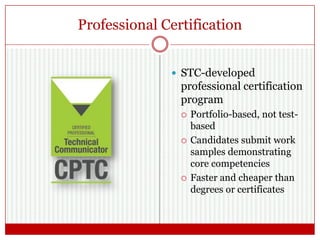
  • #28 Rachel: STC recently sponsored the establishment of a professional certification in technical communication. A professional certification is different from a university certificate in that it does not involve college classes. It took STC many years to finally establish a certification program, because, as we’ve described, the profession includes so many disciplines and spans such a broad spectrum of skill sets. We tried to develop a comprehensive test instrument, but that proved to be impossible. The key to our ultimate success was to develop a portfolio-based system in which candidates send in samples of their work to demonstrate proficiency in key skill sets.Rachel: Thus, an English major working toward a BA or MA in English could take the new STC-developed professional certification program in technical communication by adapting course assignments to demonstrate the required skill sets wherever possible. Realistically, you’d probably also have to get some work experience as an intern or perhaps a volunteer for a non-profit to complete your portfolio, but it’s definitely achievable, and it’s much faster and far less expensive than pursuing another degree or even a 12-credit certificate.
  • #29 Student STC members build a strong foundation for their careers by networking within their affiliated STC communities. Obviously, if there’s already an STC student chapter at your university, that becomes your base community. If there isn’t, you can either form one (it only takes 5 student members and a faculty advisor) or you can have a virtual membership in an existing STC student chapter at another university.Your student membership also buys you an affiliation with an STC geographic community. That affiliation can be face-to-face or virtualdepending upon whether there is an STC geographic community near your university. And your membership also gives you an affiliation with one STC special interest group (SIG) in a technical communication discipline of particular interest to you (for example, web site content and design, technical marketing communication, academics), including possible virtual mentoring from a subject matter expert within the SIG. You can join additional SIGs for just $10 apiece.Building on those three STC community affiliations, being an STC member serves you well all the way along your career path, from initial job placement, to career advancement, and to continuous professional development.
  • #32 Many benefits are free and the member discounts you get on the others will very quickly exceed your student membership fee.