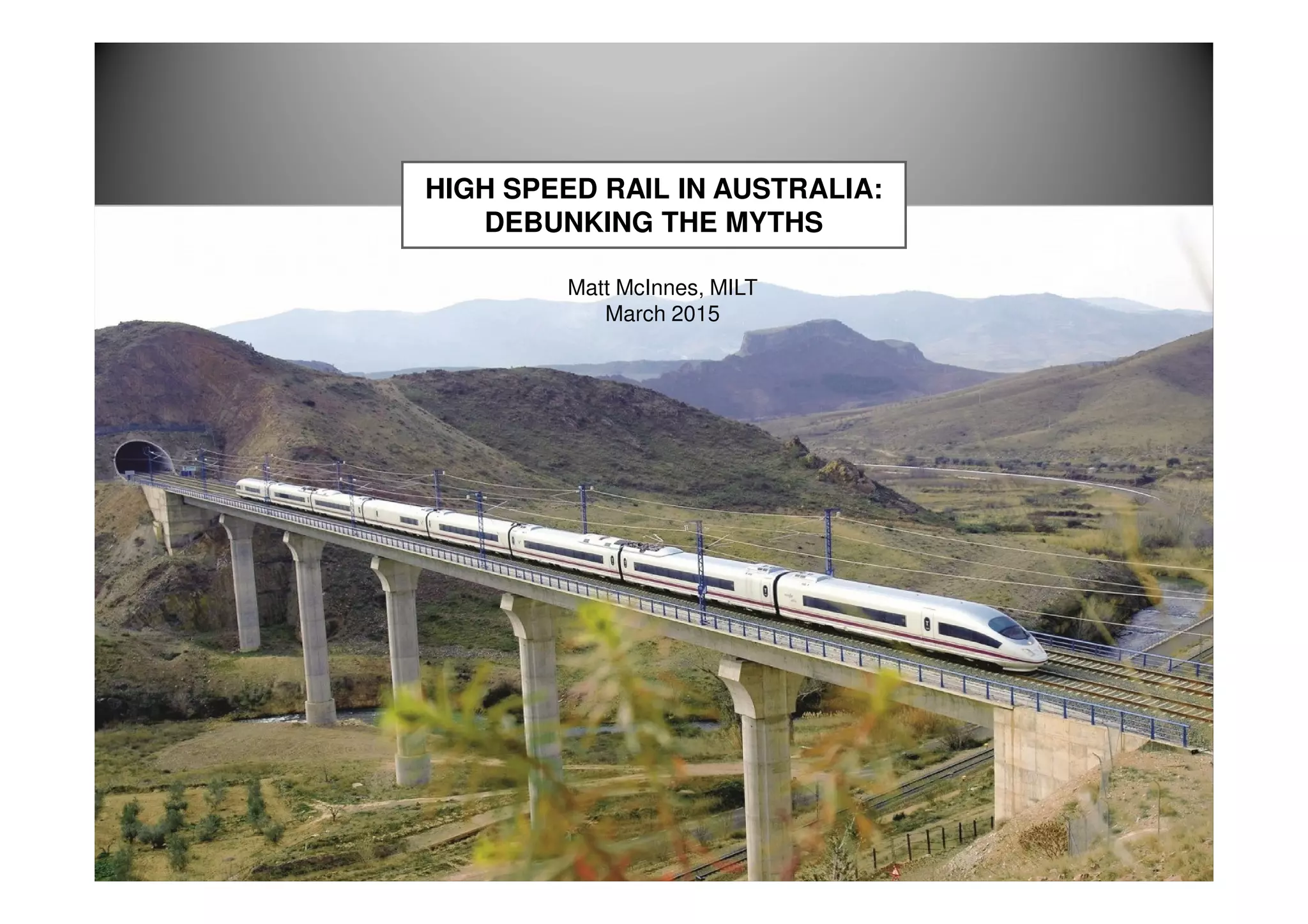
HIGH SPEED RAIL IN AUSTRALIA:
DEBUNKING THE MYTHS
Matt McInnes, MILT
March 2015
CONTENTS
• Population: density & distribution, propensity to use the train
• Costs
• Mindset
• Summary
Route Distance Time Combined
Population
Spain Barcelona – Madrid 621km 2hrs 30 5M (current)
Japan Tokyo - Osaka 515km 2hrs 25 15M (1960s)
Australia Melbourne – Sydney
Sydney - Brisbane
700- 800km
~750km
3hrs 18M (2040)
12M (2040)
POPULATION:
DISTRIBUTION AND DENSITY
• Melbourne/Sydney ~7M passenger journeys per annum (5th busiest air
travel route in world in 2012)
• London/Paris and Barcelona/Madrid held this accolade prior to high speed
rail
• Sydney/ Brisbane in top 10 global air routes
• Significant demand into other centres (Canberra, Newcastle, regional
cities)
• Journey time (city centre to city centre) is over 3 hours
These are the precise conditions that allowed other countries to set up
successful high speed rail networks.
POPULATION:
PROPENSITY TO TRAVEL
COSTS
• Not cheap, HSR is a significant financial cost
• Phase 2 report estimates $114Bn
• BZE $84Bn
• ARA/Aurecon $63Bn
But…
Costs avoided: $10Bn new Sydney airport (delay ~30 yrs)
Economic benefits: economic development, less unproductive time in planes
And…
If necessary, reduced financial burden to the state:
• Private finance options
• Hypothecated future capital gains or stamp duty tax on property windfall
The costs needn’t be the reason not to do this
MINDSET
• Population wedded to car and plane, no train mindset
• Exactly as per Japan in 1960s, French in 1980s, Germans/Spanish 1990s,
Chinese 2000s
• Cases (e.g. Paris/Brussels) where plane has been largely phased out
• Current journey time comparable between modes, future journey time will
improve with train (worsen for plane with air congestion)
• Journey much more productive
But…
• Not plane versus train
• Air France/KLM operates rail services between Paris & Brussels
• Virgin & Qantas & others should compete to offer rail services (better
opportunities for service than plane)
• CBR already seeking to become high speed rail hub (e.g. LAX – CBR
services, code share HSR and airline?)
Nothing to excite potential passengers about rail travel YET – the
mindset will change.
SUMMARY
• As an industry we need to get behind the concept (in principle)
• Let’s not in-fight on the details (alignment, traction type, etc.)
• Should not be train versus road versus plane – each mode has its place
(e.g. HSR allows existing lines to be freight-dedicated)
Next steps:
• Establish authority (lobby governments)
• The authority should reserve corridors
• Detailed planning can commence
Thank you
Any questions?

Hsr m mc_innes_110315

  • 1.
    HIGH SPEED RAILIN AUSTRALIA: DEBUNKING THE MYTHS Matt McInnes, MILT March 2015
  • 2.
    CONTENTS • Population: density& distribution, propensity to use the train • Costs • Mindset • Summary
  • 3.
    Route Distance TimeCombined Population Spain Barcelona – Madrid 621km 2hrs 30 5M (current) Japan Tokyo - Osaka 515km 2hrs 25 15M (1960s) Australia Melbourne – Sydney Sydney - Brisbane 700- 800km ~750km 3hrs 18M (2040) 12M (2040) POPULATION: DISTRIBUTION AND DENSITY
  • 4.
    • Melbourne/Sydney ~7Mpassenger journeys per annum (5th busiest air travel route in world in 2012) • London/Paris and Barcelona/Madrid held this accolade prior to high speed rail • Sydney/ Brisbane in top 10 global air routes • Significant demand into other centres (Canberra, Newcastle, regional cities) • Journey time (city centre to city centre) is over 3 hours These are the precise conditions that allowed other countries to set up successful high speed rail networks. POPULATION: PROPENSITY TO TRAVEL
  • 5.
    COSTS • Not cheap,HSR is a significant financial cost • Phase 2 report estimates $114Bn • BZE $84Bn • ARA/Aurecon $63Bn But… Costs avoided: $10Bn new Sydney airport (delay ~30 yrs) Economic benefits: economic development, less unproductive time in planes And… If necessary, reduced financial burden to the state: • Private finance options • Hypothecated future capital gains or stamp duty tax on property windfall The costs needn’t be the reason not to do this
  • 6.
    MINDSET • Population weddedto car and plane, no train mindset • Exactly as per Japan in 1960s, French in 1980s, Germans/Spanish 1990s, Chinese 2000s • Cases (e.g. Paris/Brussels) where plane has been largely phased out • Current journey time comparable between modes, future journey time will improve with train (worsen for plane with air congestion) • Journey much more productive But… • Not plane versus train • Air France/KLM operates rail services between Paris & Brussels • Virgin & Qantas & others should compete to offer rail services (better opportunities for service than plane) • CBR already seeking to become high speed rail hub (e.g. LAX – CBR services, code share HSR and airline?) Nothing to excite potential passengers about rail travel YET – the mindset will change.
  • 7.
    SUMMARY • As anindustry we need to get behind the concept (in principle) • Let’s not in-fight on the details (alignment, traction type, etc.) • Should not be train versus road versus plane – each mode has its place (e.g. HSR allows existing lines to be freight-dedicated) Next steps: • Establish authority (lobby governments) • The authority should reserve corridors • Detailed planning can commence Thank you Any questions?