- 1 -
CONCEPT OF HIGH SPEED TRAIN
What is hi speed rail?
High speed rail (HSR) services are officially defined as rail services that run at top speeds of at least 250 km/h.
They use continuous welded rail which reduces track vibrations & discrepancies between rail segments. And
almost all are also electrically driven via overhead lines.
Advantages of High Speed Rail
It is faster. The lower limit for HSR (250 km / hr) is substantially faster than the highest road speed limit in most
countries.
Avoids traffic congestion-related delays
Train tracks permit a far higher throughput of passengers per hour than a road the same width. The typical
passenger rail carries 2.8 x as many passengers per hour per meter (width) as a road. Congestion also causes the
maximum throughput of a road lane to decrease
Much lower carbon emissions. Per passenger-Km cars emit 8x more CO2 than rail.
Speed for trips of 2-10 hours (Runs @ 250-300 km / hr.). Airlines suffer from time taken to arrive at the airport
(which is generally located outside city centre rather than in the city centre like train station), check in, go through
security screening, board, taxi, disembark, and retrieve baggage.
Cost – Trains are much cheaper to operate and average train tickets are typically lower than comparable airplane
tickets.
Greater convenience - no requirement to check baggage, or repeated queuing for check in, security and boarding.
Typically higher on-time reliability. And rail travel is also typically less weather dependent than air travel. If the
rail system is well-designed and well-operated, severe weather conditions such as heavy snow, heavy fog, and
storms do not affect the journeys; whereas flights are generally cancelled or delayed under these conditions
Much lower carbon emissions. Per passenger-Km airplanes emit 11x more CO2 than rail.
Indian Railways has made significant strides in the past few years. It has turned into a profit-making enterprise
from an indebted organization but its infrastructure and services are still far behind the world standards. So, there’s
a still mile to go …………
It doesn’t require great genius or imagination to figure out where we stand on the world railway map. A clear
glimpse of the reality can be had from the simple fact that Japan’s Shinkansen (Japanese train) has been running at
over 250 km + per hour speed since its introduction in 1964, while in contrast, our fastest trains, like Shatabdis and
Rajdhanis, in 2008, run at a speed of no more than 90 km per hour. Not to say about Western Europe, Australia or
the US, even Asian countries like South Korea, Japan and China have all high speed trains running at over 325 km
per hour speed on dedicated lines and very well developed modern infrastructure and facilities.
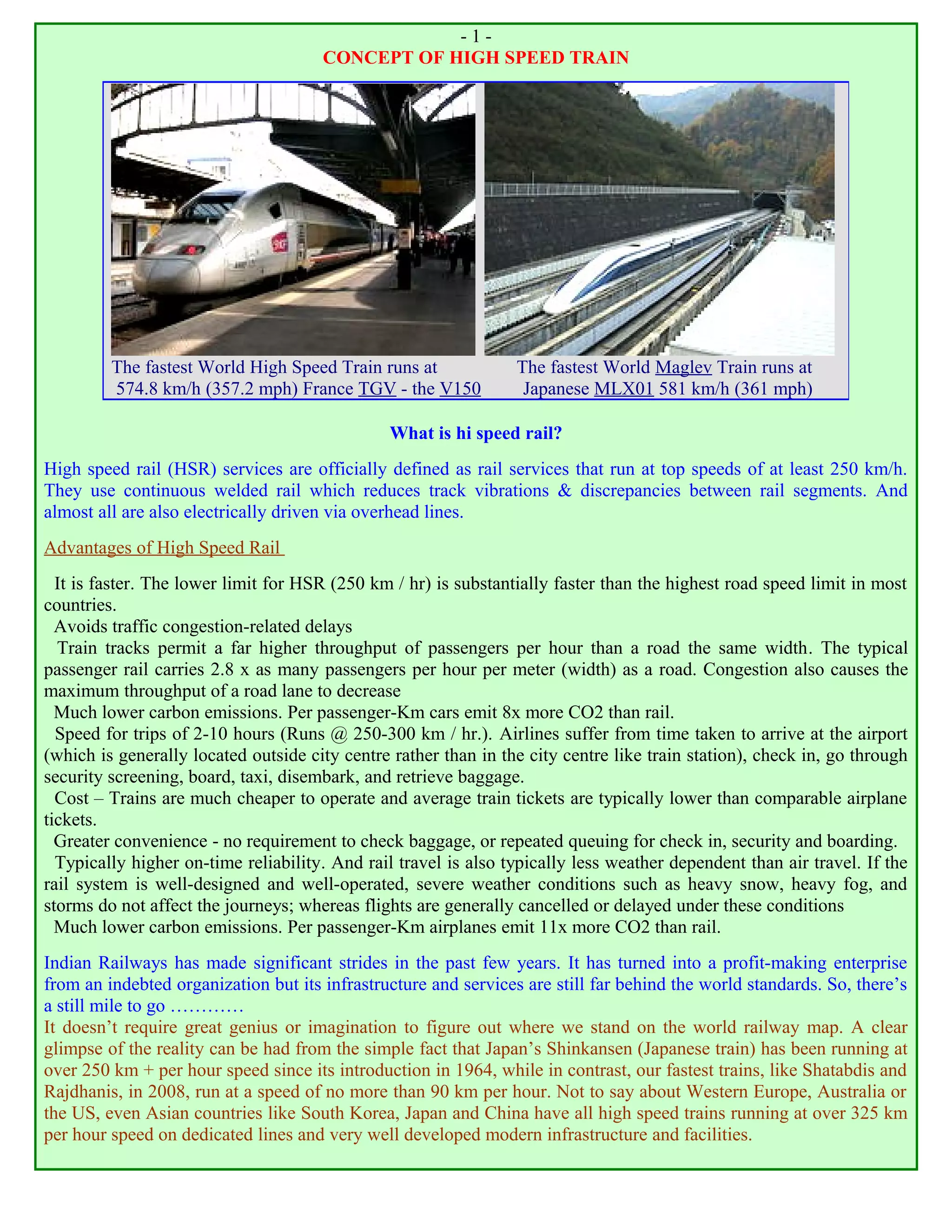
The fastest World High Speed Train runs at The fastest World Maglev Train runs at
574.8 km/h (357.2 mph) France TGV - the V150 Japanese MLX01 581 km/h (361 mph)

HST I

  • 1.
    - 1 - CONCEPTOF HIGH SPEED TRAIN What is hi speed rail? High speed rail (HSR) services are officially defined as rail services that run at top speeds of at least 250 km/h. They use continuous welded rail which reduces track vibrations & discrepancies between rail segments. And almost all are also electrically driven via overhead lines. Advantages of High Speed Rail It is faster. The lower limit for HSR (250 km / hr) is substantially faster than the highest road speed limit in most countries. Avoids traffic congestion-related delays Train tracks permit a far higher throughput of passengers per hour than a road the same width. The typical passenger rail carries 2.8 x as many passengers per hour per meter (width) as a road. Congestion also causes the maximum throughput of a road lane to decrease Much lower carbon emissions. Per passenger-Km cars emit 8x more CO2 than rail. Speed for trips of 2-10 hours (Runs @ 250-300 km / hr.). Airlines suffer from time taken to arrive at the airport (which is generally located outside city centre rather than in the city centre like train station), check in, go through security screening, board, taxi, disembark, and retrieve baggage. Cost – Trains are much cheaper to operate and average train tickets are typically lower than comparable airplane tickets. Greater convenience - no requirement to check baggage, or repeated queuing for check in, security and boarding. Typically higher on-time reliability. And rail travel is also typically less weather dependent than air travel. If the rail system is well-designed and well-operated, severe weather conditions such as heavy snow, heavy fog, and storms do not affect the journeys; whereas flights are generally cancelled or delayed under these conditions Much lower carbon emissions. Per passenger-Km airplanes emit 11x more CO2 than rail. Indian Railways has made significant strides in the past few years. It has turned into a profit-making enterprise from an indebted organization but its infrastructure and services are still far behind the world standards. So, there’s a still mile to go ………… It doesn’t require great genius or imagination to figure out where we stand on the world railway map. A clear glimpse of the reality can be had from the simple fact that Japan’s Shinkansen (Japanese train) has been running at over 250 km + per hour speed since its introduction in 1964, while in contrast, our fastest trains, like Shatabdis and Rajdhanis, in 2008, run at a speed of no more than 90 km per hour. Not to say about Western Europe, Australia or the US, even Asian countries like South Korea, Japan and China have all high speed trains running at over 325 km per hour speed on dedicated lines and very well developed modern infrastructure and facilities. The fastest World High Speed Train runs at The fastest World Maglev Train runs at 574.8 km/h (357.2 mph) France TGV - the V150 Japanese MLX01 581 km/h (361 mph)