1
Setting the Right Goals for Your Beta
2
Meet the Speaker
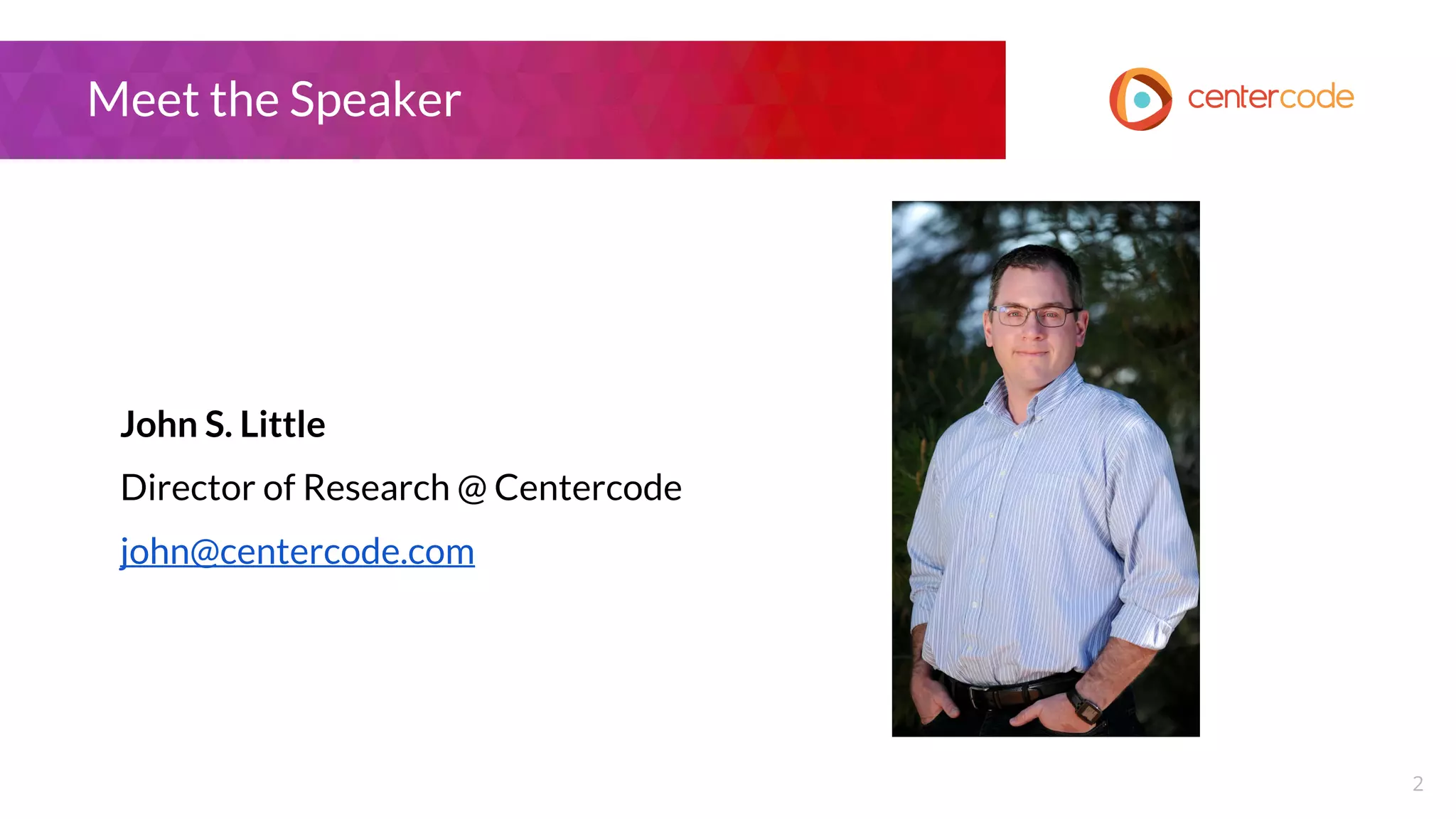
John S. Little
Director of Research @ Centercode
john@centercode.com
Agenda
1. What are goals?
2. How to set good goals for your beta test
3. How to maintain your goals throughout the beta phase
4. How to connect the insights from your test to your goals
5. Q&A
3
4
Who is Centercode?
Services Fully managed tests and programs
Software Complete beta program management platform
Testers Access to 150k+ deeply profiled global candidates
Content Free tools and best practices
Customer validation is our core competency
We've been collecting customer feedback for tech companies since 2001
Goals
Introduction
5
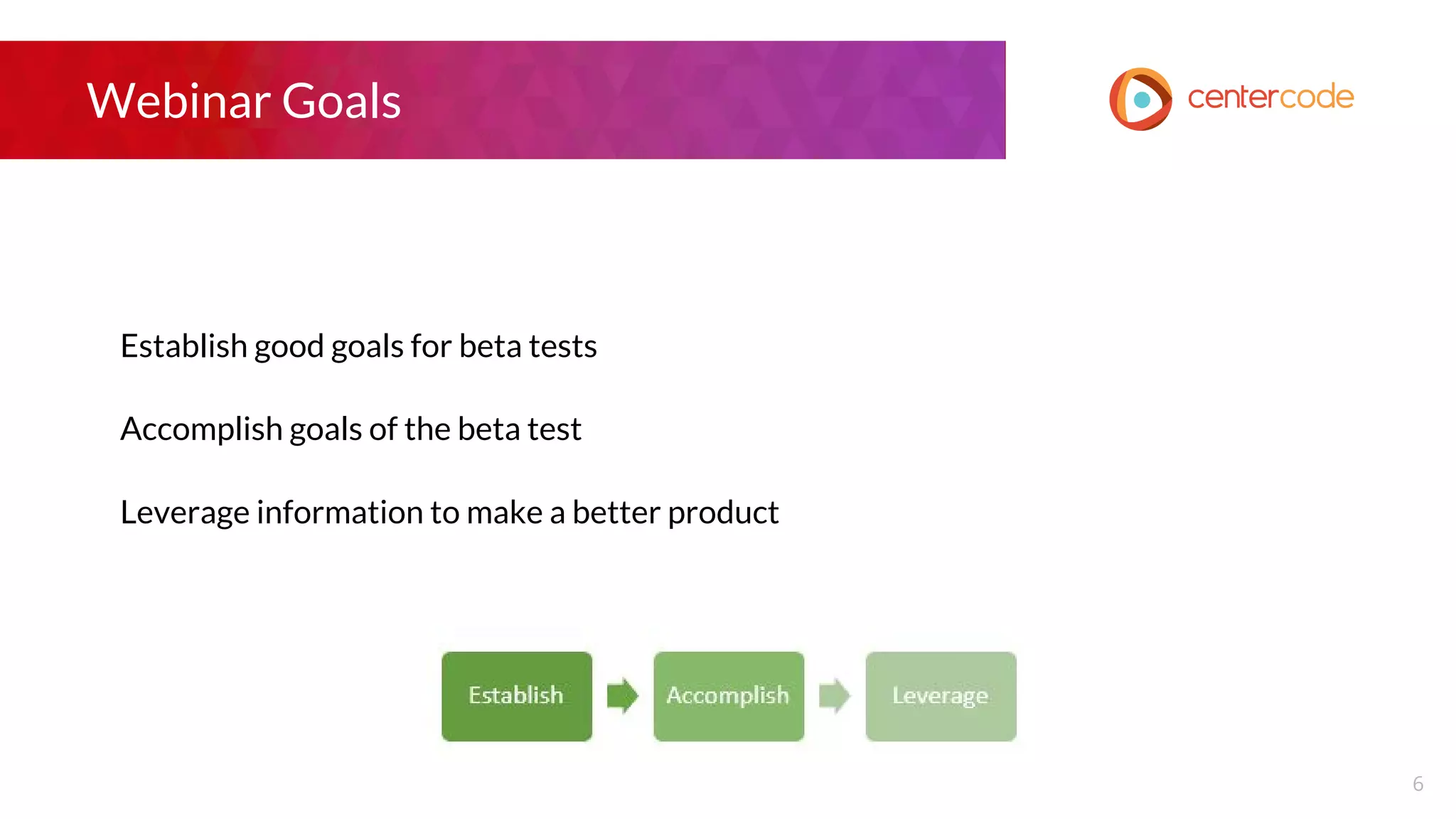
Webinar Goals
Establish good goals for beta tests
Accomplish goals of the beta test
Leverage information to make a better product
6
7
Goals Refresher
Business Definition
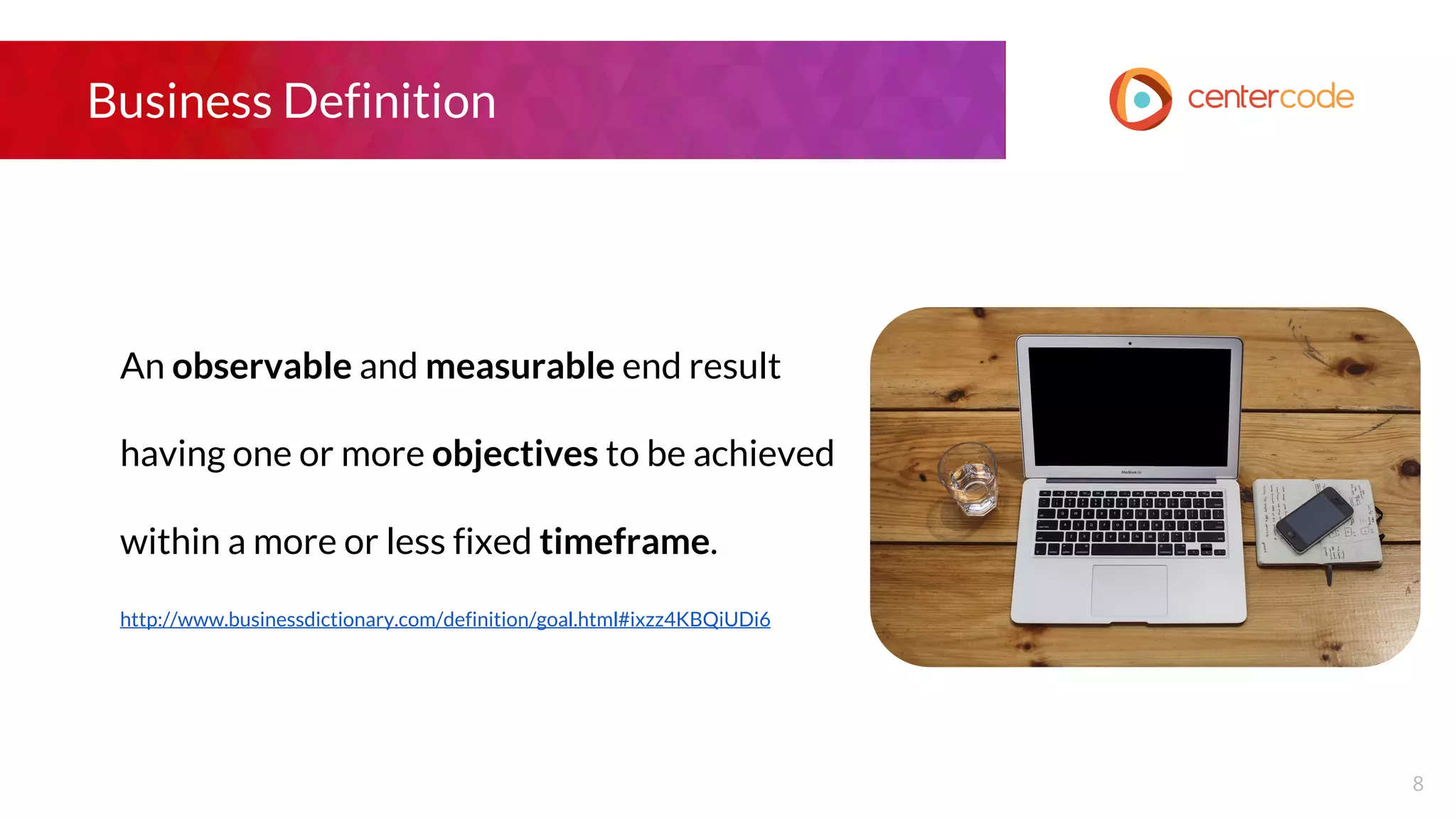
An observable and measurable end result
having one or more objectives to be achieved
within a more or less fixed timeframe.
http://www.businessdictionary.com/definition/goal.html#ixzz4KBQiUDi6
8
Goals for betas
“Goal is something that you want to achieve”
How am I going to do it? - Method
Why am I going to do it? - Return
Useful tools
● S.M.A.R.T.
● Definition of Done
● Commander’s intent
9
Quote
If one does not know to which port one is sailing, no wind is favorable.
– Seneca
10
11
Good Goals
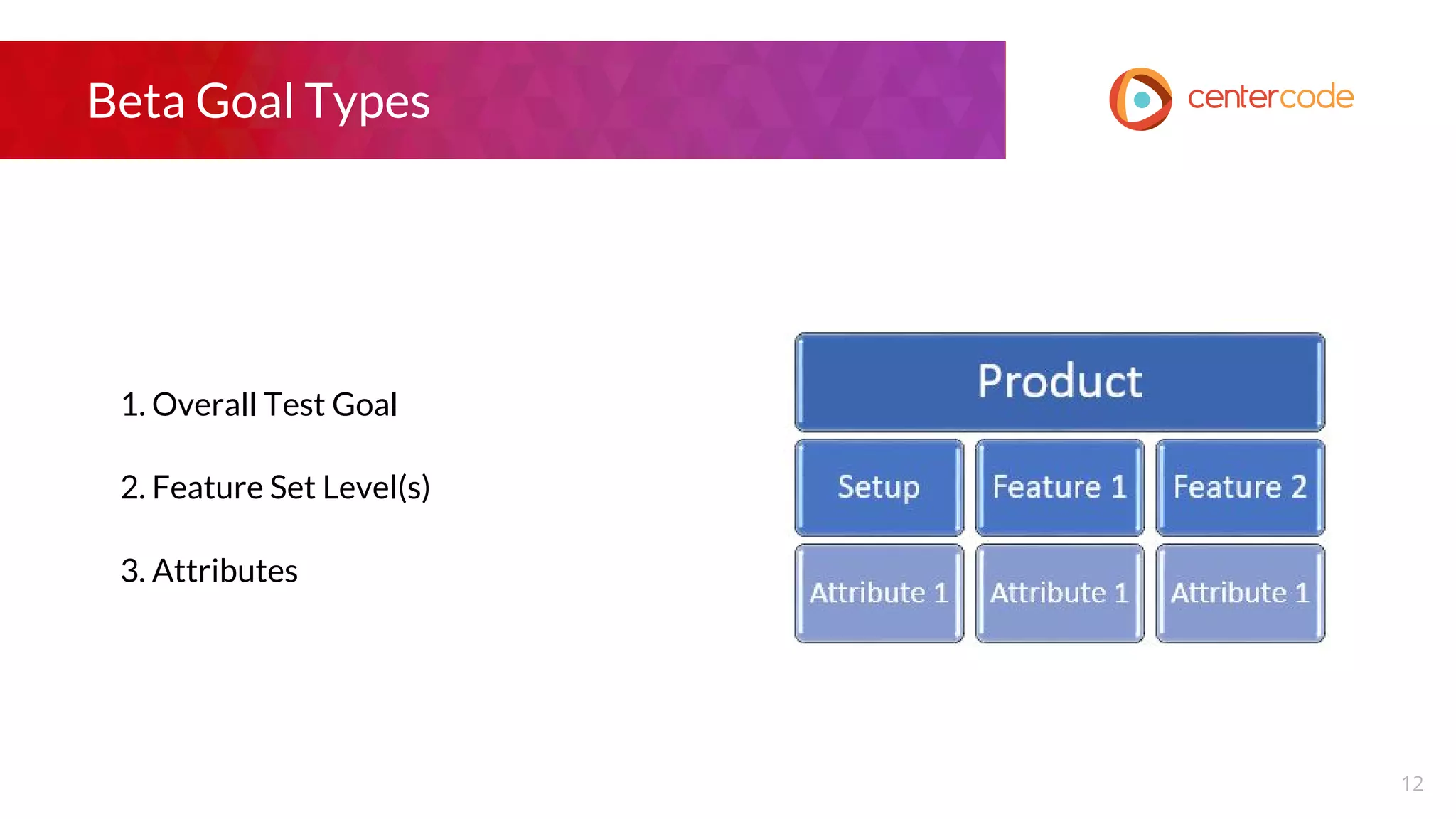
Beta Goal Types
1. Overall Test Goal
2. Feature Set Level(s)
3. Attributes
12
Overall Test Goals - Finding a Focus
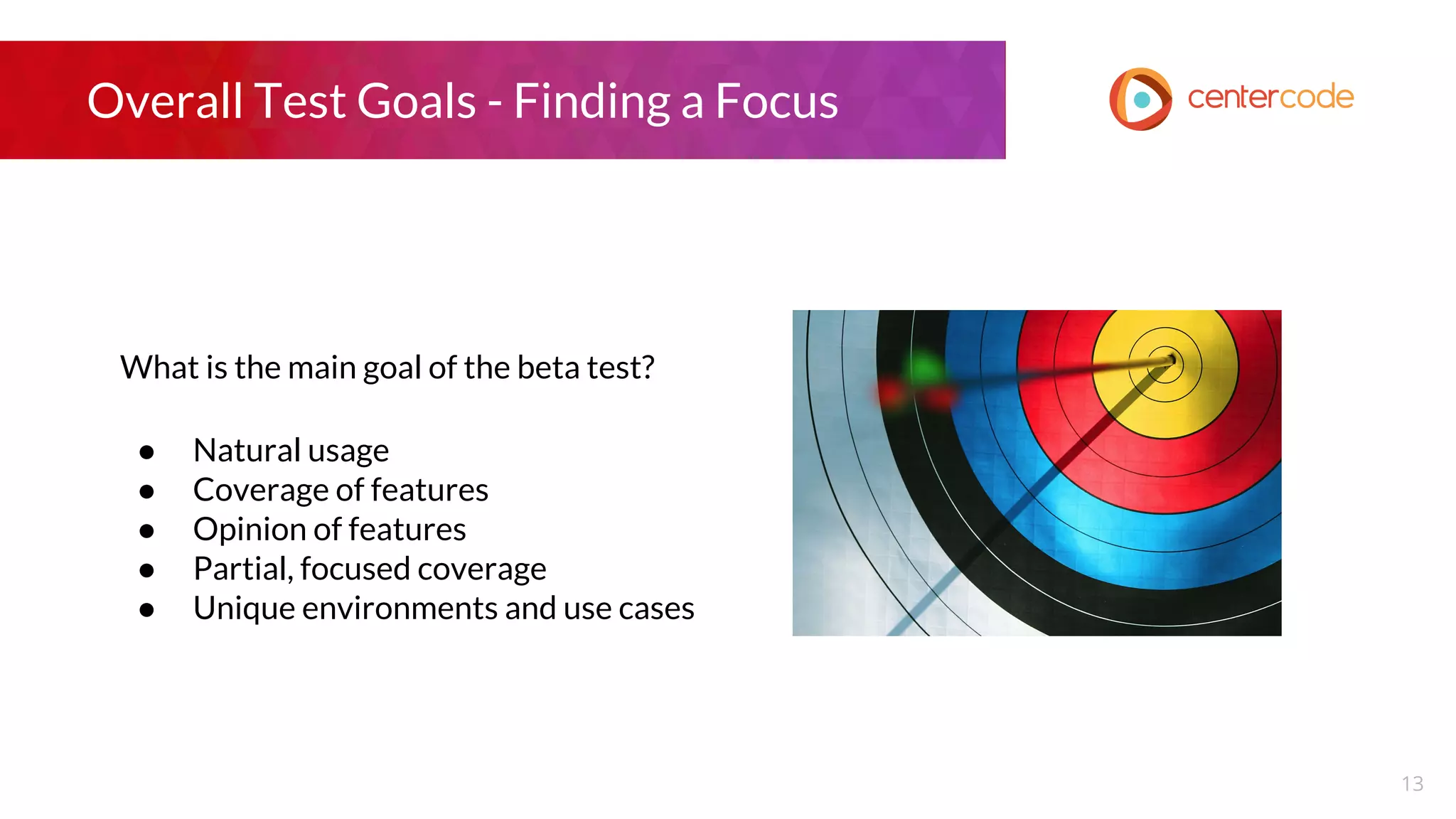
What is the main goal of the beta test?
● Natural usage
● Coverage of features
● Opinion of features
● Partial, focused coverage
● Unique environments and use cases
13
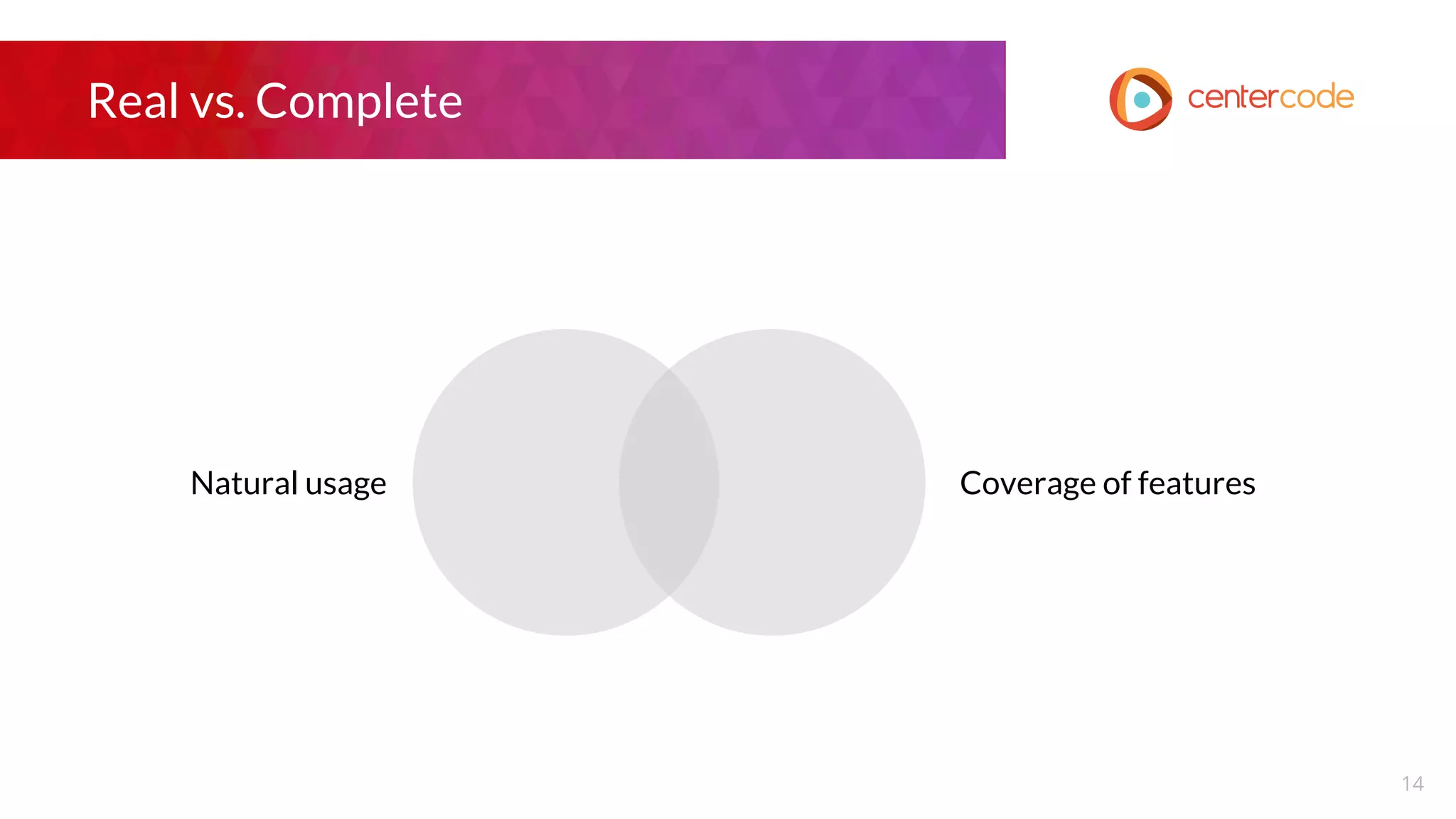
Real vs. Complete
Natural usage Coverage of features
14
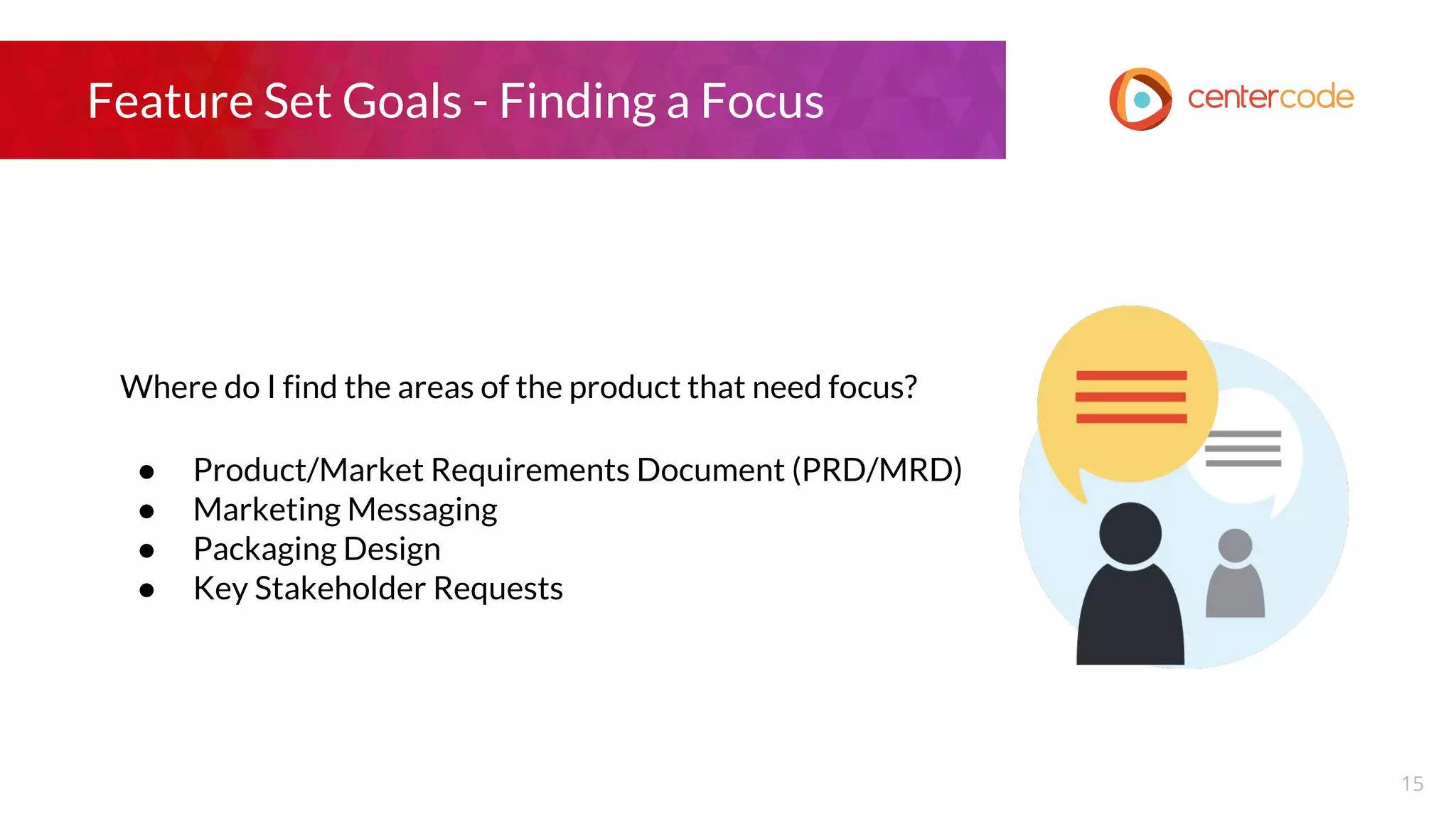
Feature Set Goals - Finding a Focus
Where do I find the areas of the product that need focus?
● Product/Market Requirements Document (PRD/MRD)
● Marketing Messaging
● Packaging Design
● Key Stakeholder Requests
15
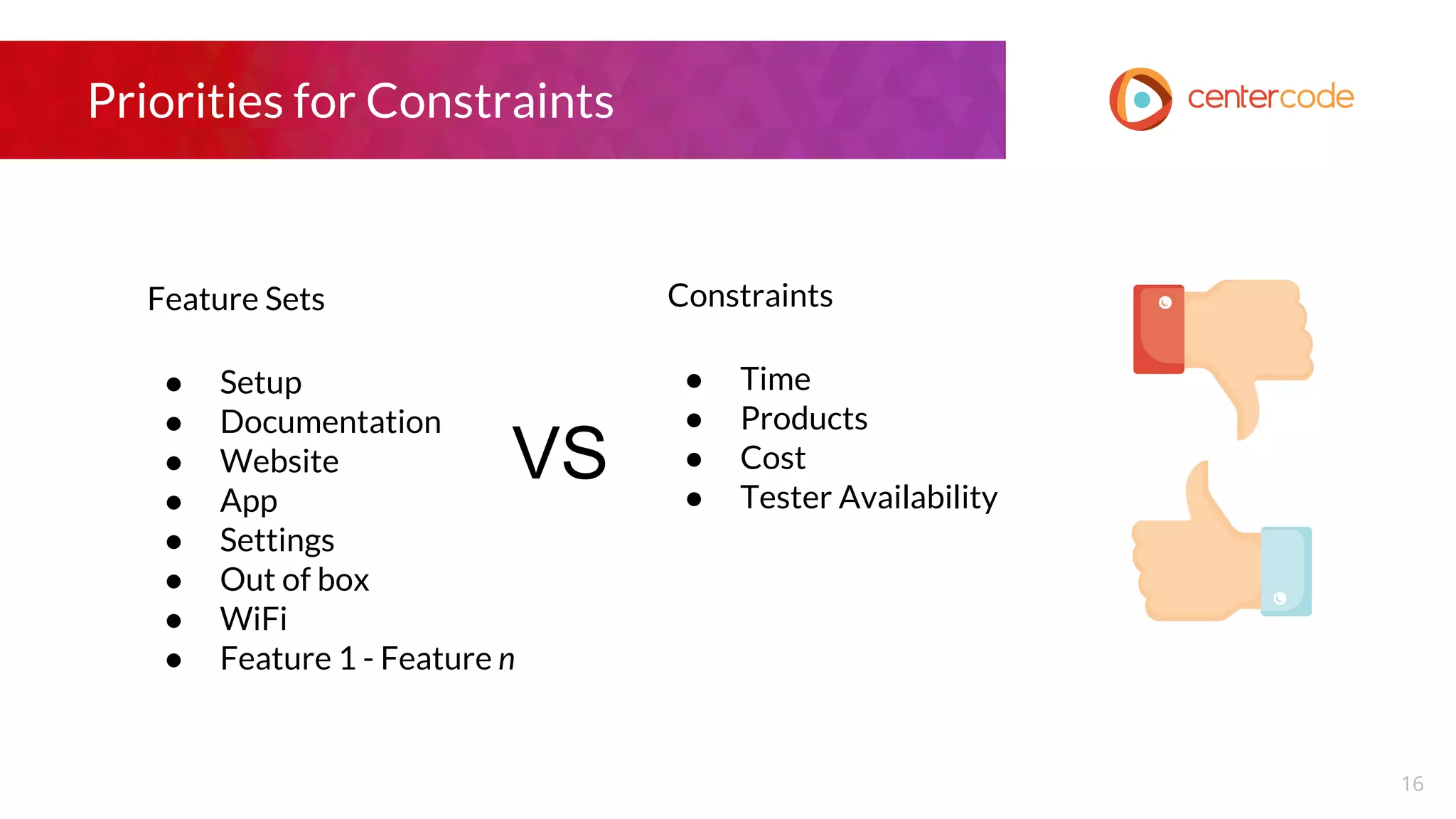
Priorities for Constraints
16
Constraints
● Time
● Products
● Cost
● Tester Availability
Feature Sets
● Setup
● Documentation
● Website
● App
● Settings
● Out of box
● WiFi
● Feature 1 - Feature n
VS
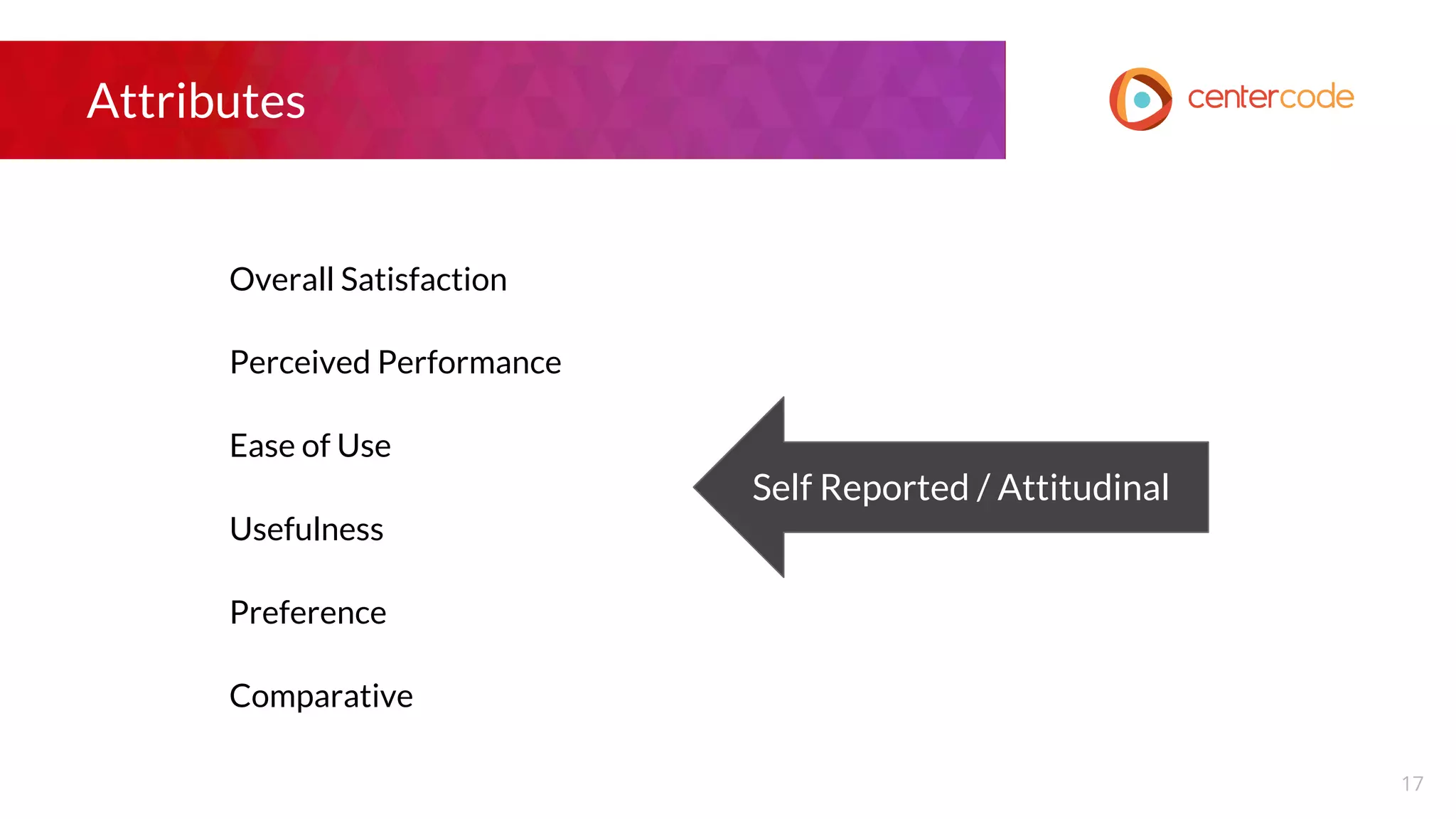
Attributes
17
Overall Satisfaction
Perceived Performance
Ease of Use
Usefulness
Preference
Comparative
Self Reported / Attitudinal
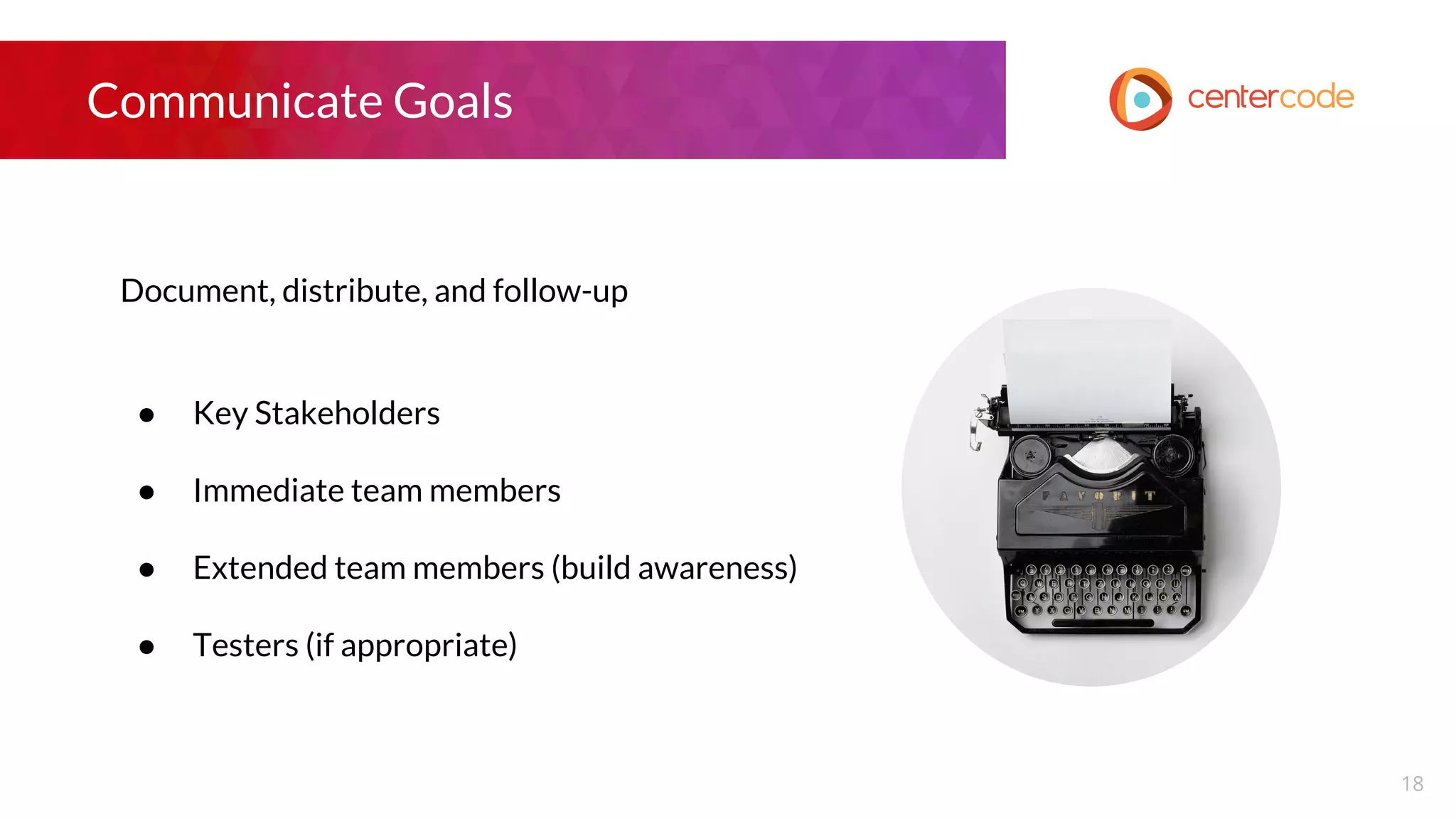
Communicate Goals
Document, distribute, and follow-up
● Key Stakeholders
● Immediate team members
● Extended team members (build awareness)
● Testers (if appropriate)
18
Goals for Feature Sets
19
Bad Good
Collect feedback on feature Measure user’s satisfaction with ease of use
of feature
Measure usability of the product Evaluate customer acceptance of product
Measure the performance of the product Measure perceived performance while
initiating application
How long did it take to setup the product? Evaluate satisfaction with time to set up
Will they pay $150 for it? Conjoint analysis
After Scenario Questionnaire (ASQ)
20
Example
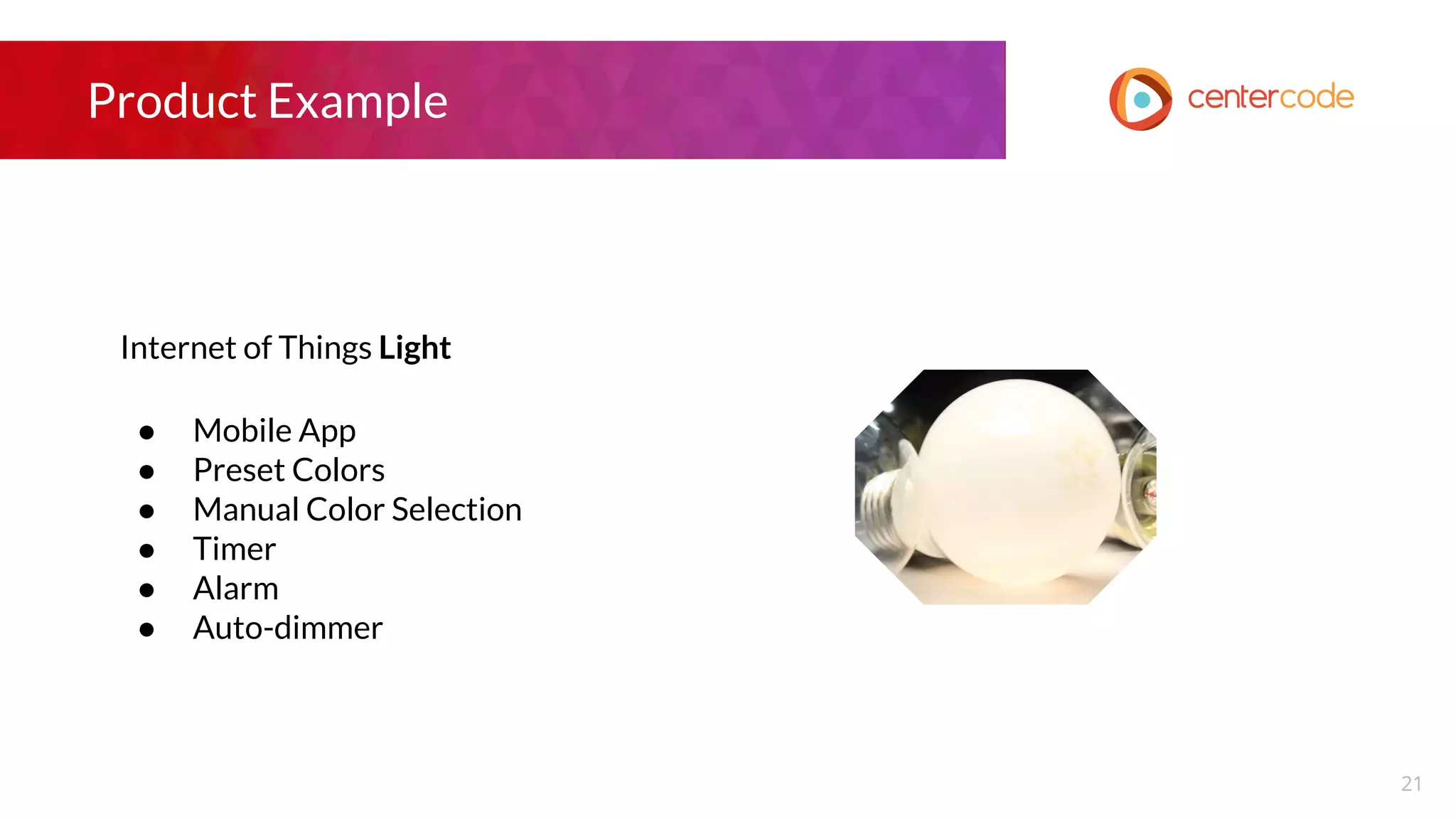
Product Example
Internet of Things Light
● Mobile App
● Preset Colors
● Manual Color Selection
● Timer
● Alarm
● Auto-dimmer
21
Beta Goals
● Evaluate total customer experience
● Assess MVP readiness
● Roadmap validation
● Competitive analysis
● Identify bugs
● Real-world impact of known issues
● Regression testing
● Analyze real-world performance
● Test compatibility
● Study user experience
● Assess new user experience
● Test documentation
● Test support processes
● Collect mock reviews
● Increase product confidence
● Collect case studies
22
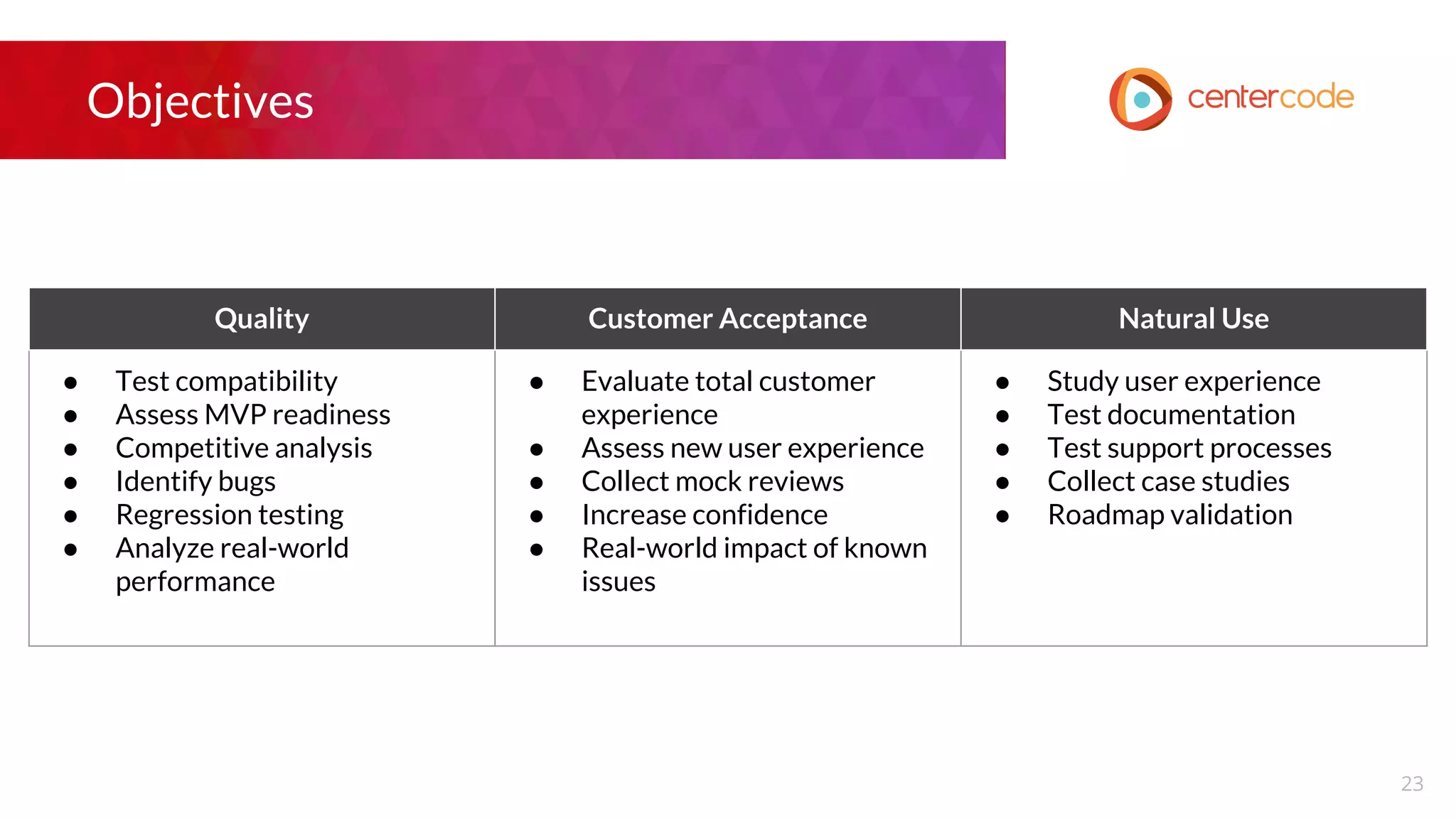
Objectives
Quality Customer Acceptance Natural Use
● Test compatibility
● Assess MVP readiness
● Competitive analysis
● Identify bugs
● Regression testing
● Analyze real-world
performance
● Evaluate total customer
experience
● Assess new user experience
● Collect mock reviews
● Increase confidence
● Real-world impact of known
issues
● Study user experience
● Test documentation
● Test support processes
● Collect case studies
● Roadmap validation
23
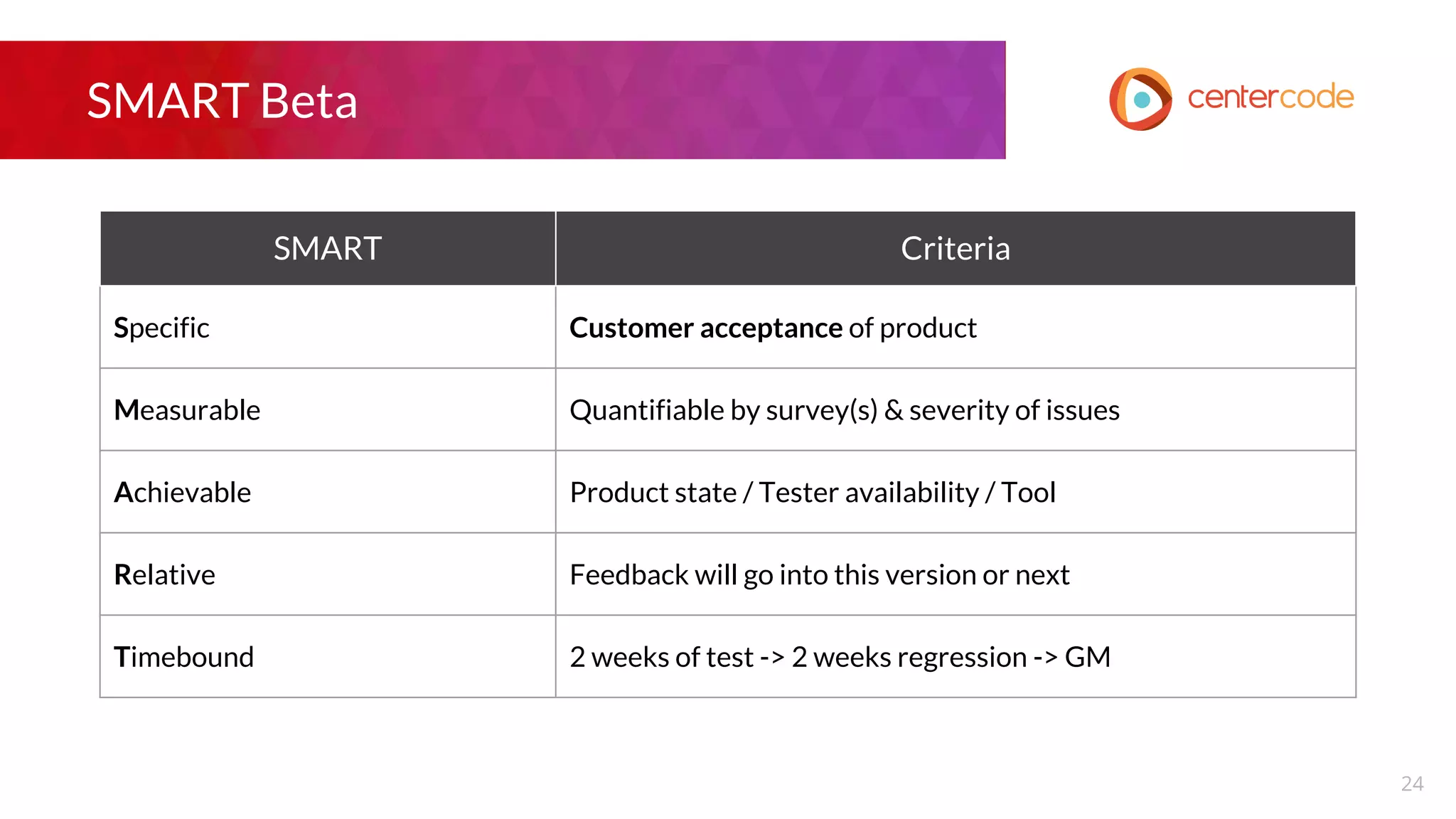
SMART Beta
SMART Criteria
Specific Customer acceptance of product
Measurable Quantifiable by survey(s) & severity of issues
Achievable Product state / Tester availability / Tool
Relative Feedback will go into this version or next
Timebound 2 weeks of test -> 2 weeks regression -> GM
24
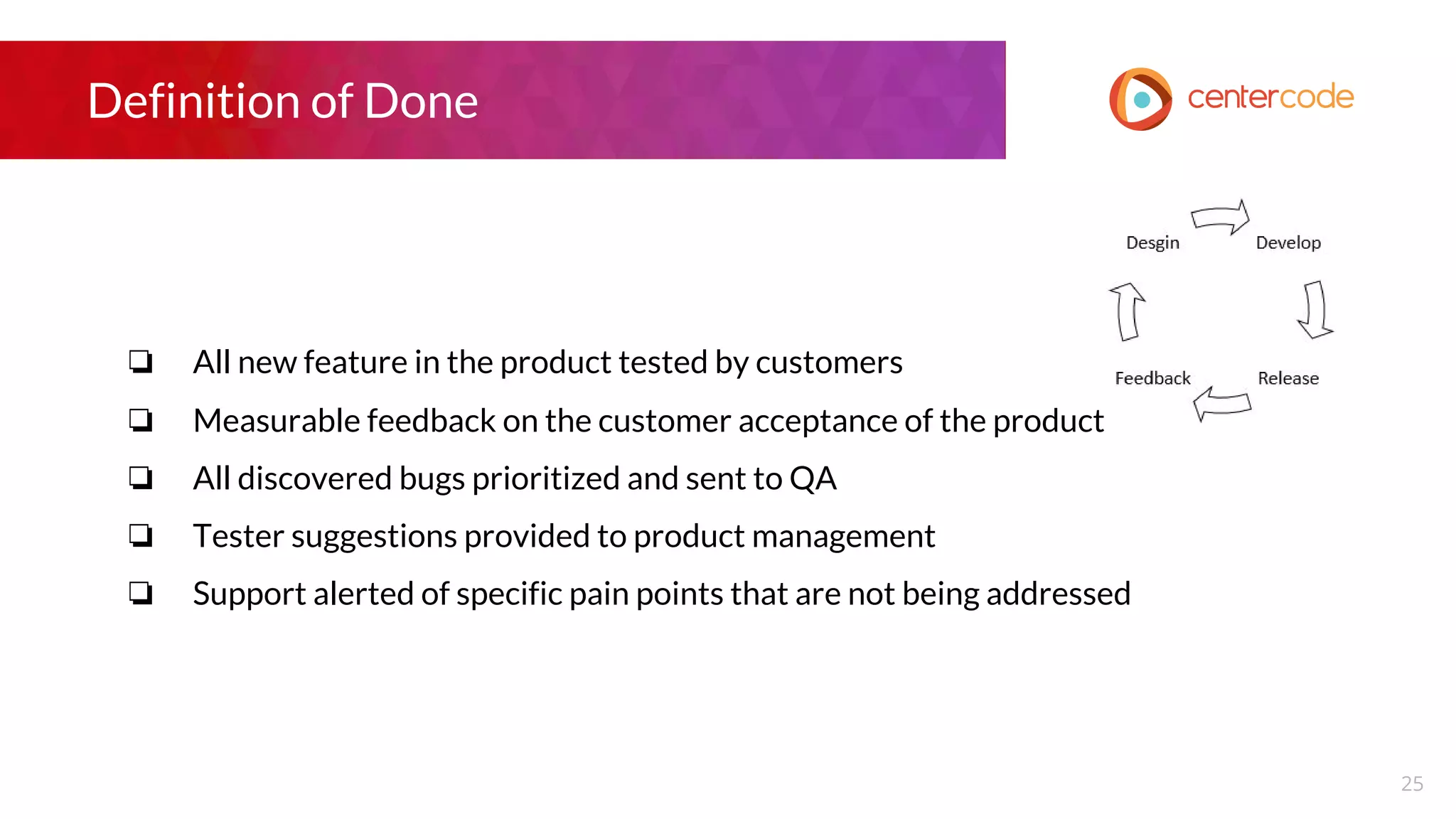
Definition of Done
❏ All new feature in the product tested by customers
❏ Measurable feedback on the customer acceptance of the product
❏ All discovered bugs prioritized and sent to QA
❏ Tester suggestions provided to product management
❏ Support alerted of specific pain points that are not being addressed
25
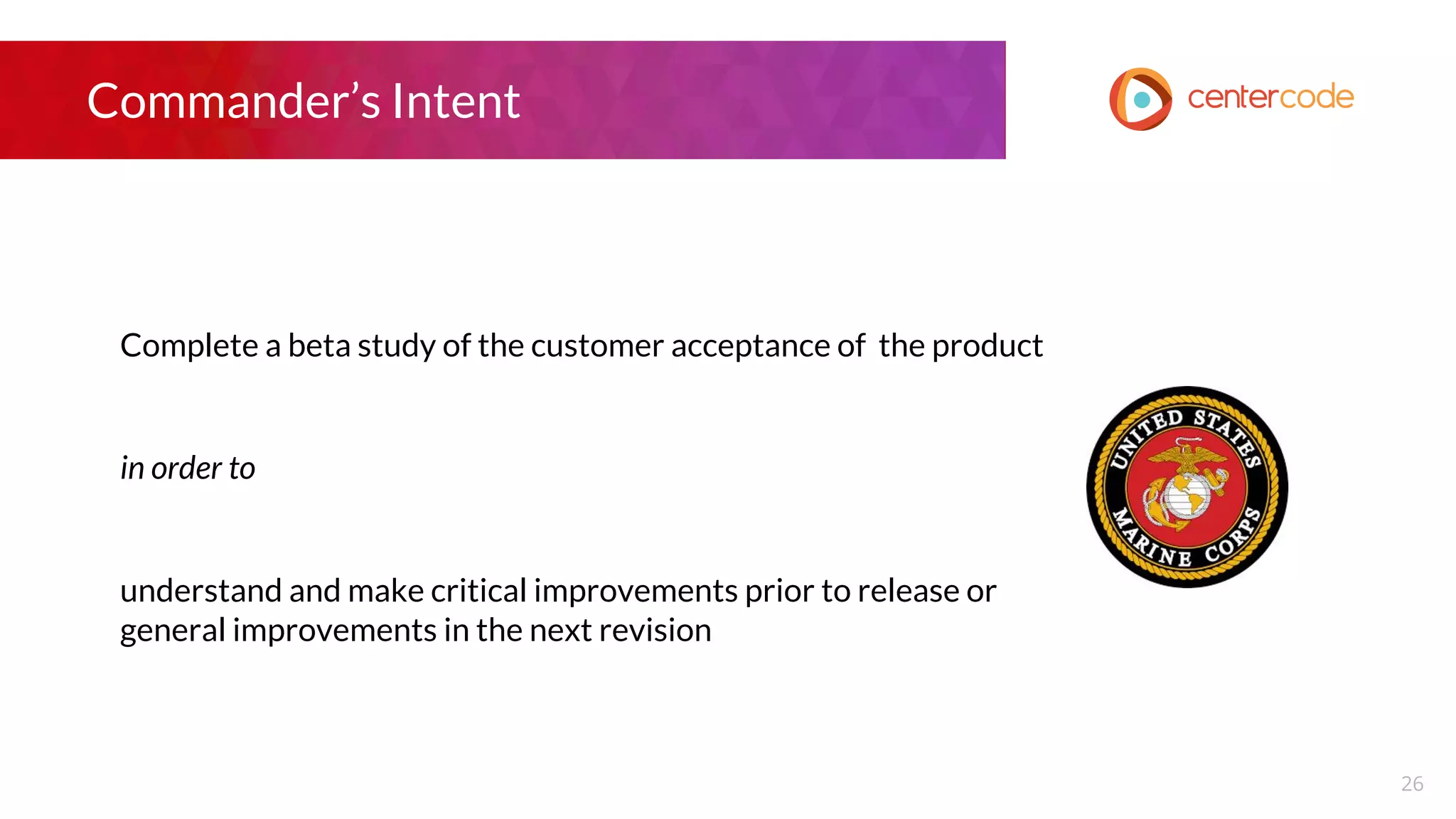
Commander’s Intent
Complete a beta study of the customer acceptance of the product
in order to
understand and make critical improvements prior to release or
general improvements in the next revision
26
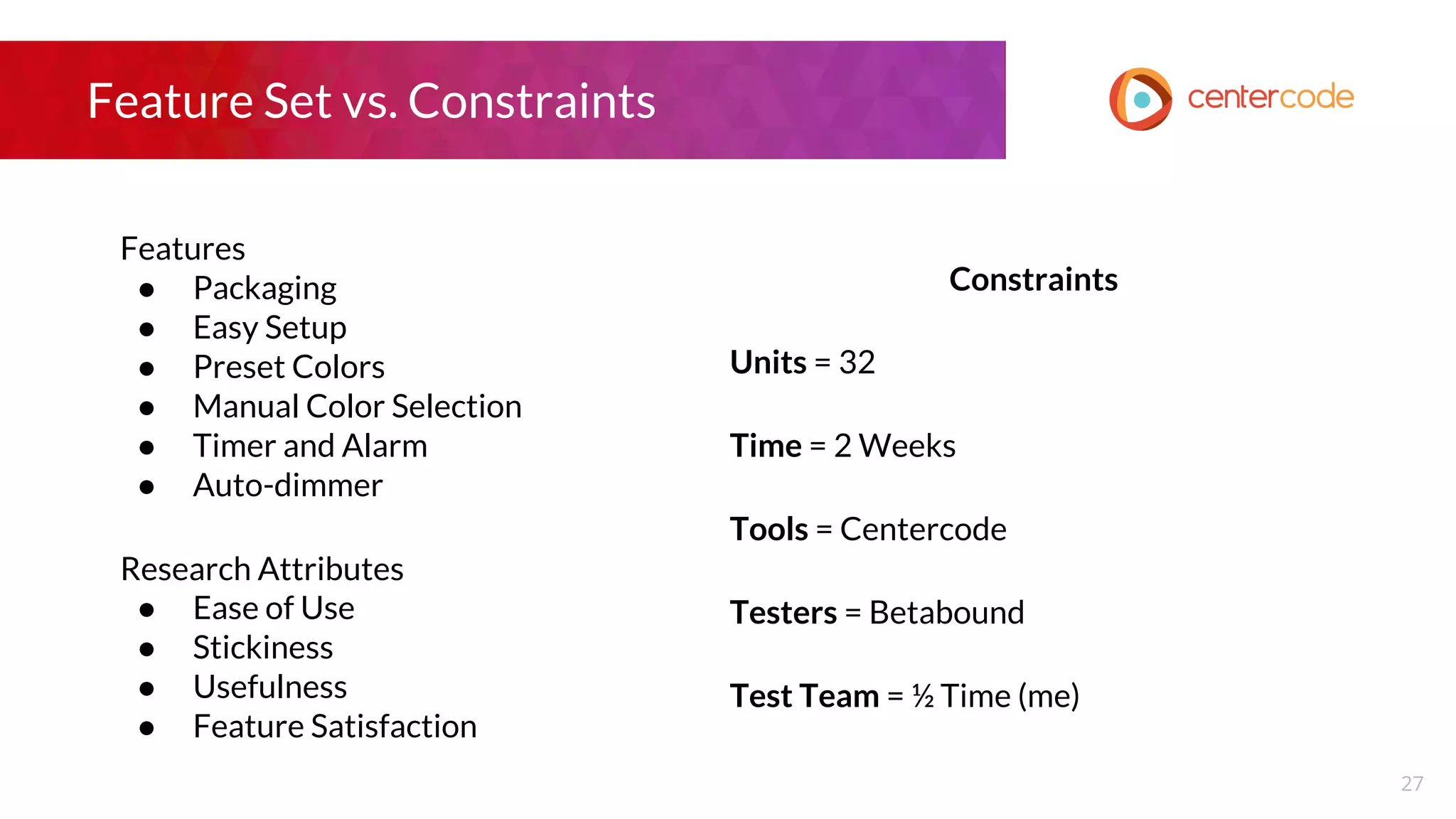
Feature Set vs. Constraints
Features
● Packaging
● Easy Setup
● Preset Colors
● Manual Color Selection
● Timer and Alarm
● Auto-dimmer
Research Attributes
● Ease of Use
● Stickiness
● Usefulness
● Feature Satisfaction
Constraints
Units = 32
Time = 2 Weeks
Tools = Centercode
Testers = Betabound
Test Team = ½ Time (me)
27
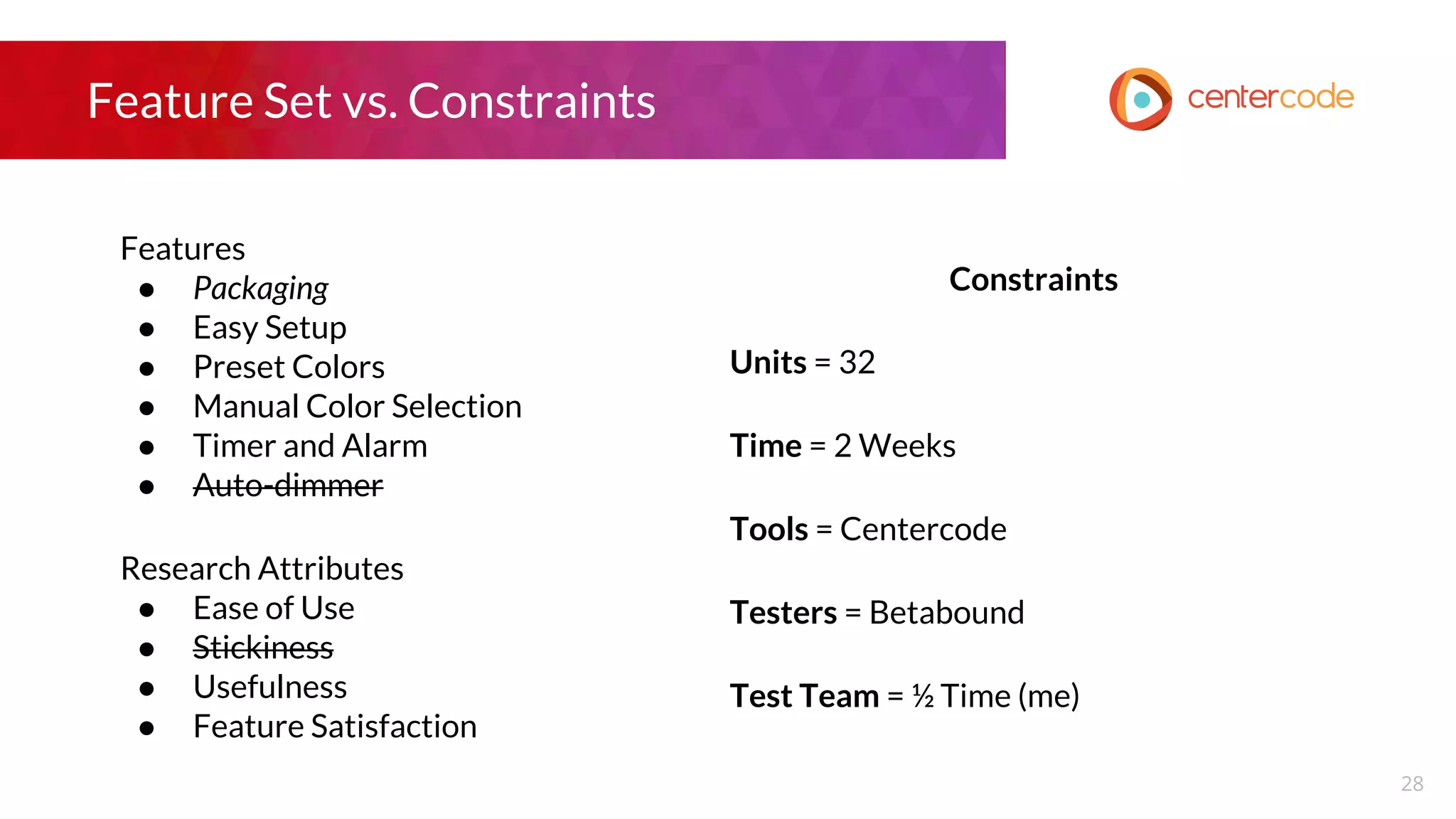
Feature Set vs. Constraints
Features
● Packaging
● Easy Setup
● Preset Colors
● Manual Color Selection
● Timer and Alarm
● Auto-dimmer
Research Attributes
● Ease of Use
● Stickiness
● Usefulness
● Feature Satisfaction
Constraints
Units = 32
Time = 2 Weeks
Tools = Centercode
Testers = Betabound
Test Team = ½ Time (me)
28
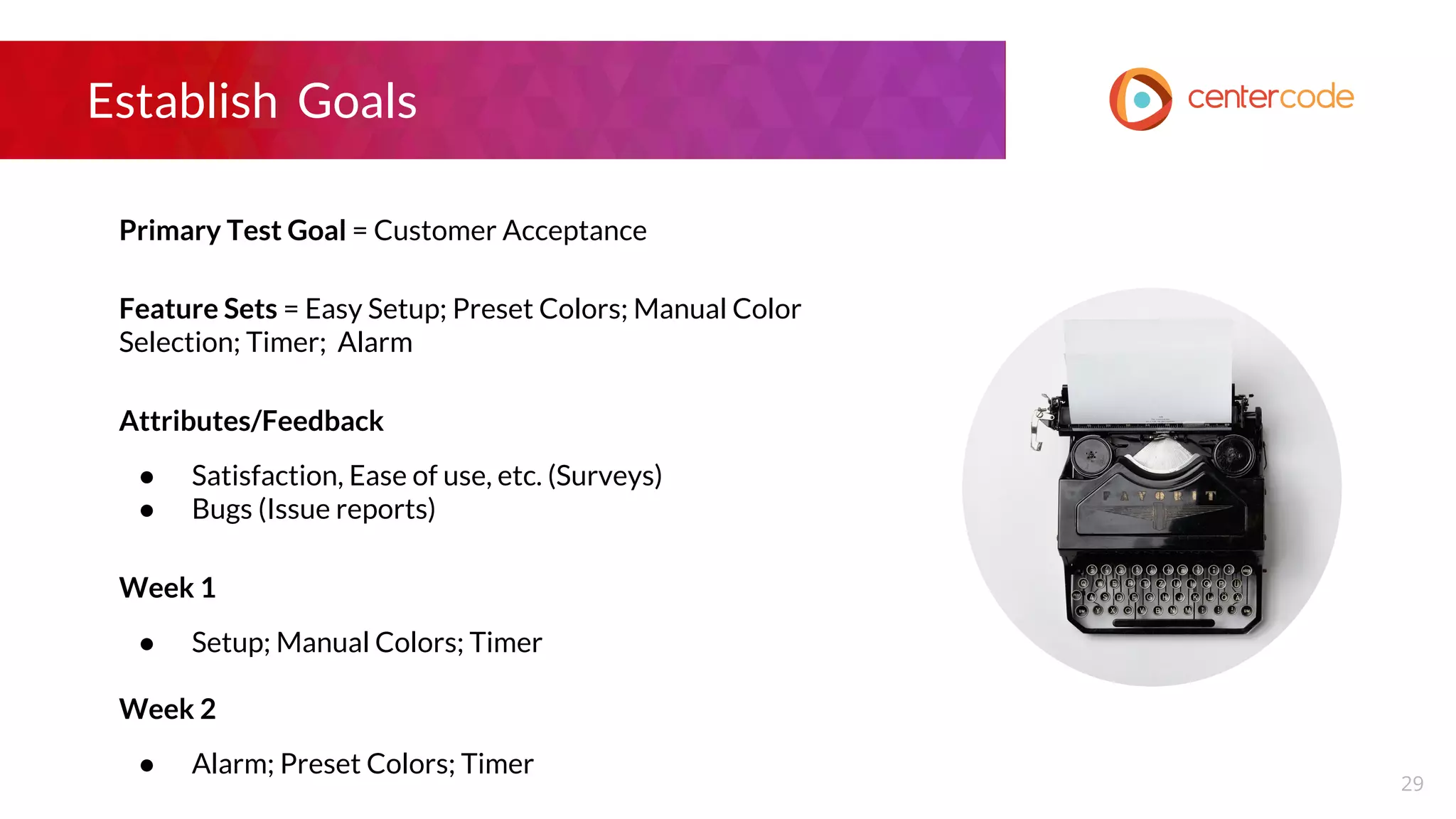
Establish Goals
Primary Test Goal = Customer Acceptance
Feature Sets = Easy Setup; Preset Colors; Manual Color
Selection; Timer; Alarm
Attributes/Feedback
● Satisfaction, Ease of use, etc. (Surveys)
● Bugs (Issue reports)
Week 1
● Setup; Manual Colors; Timer
Week 2
● Alarm; Preset Colors; Timer
29
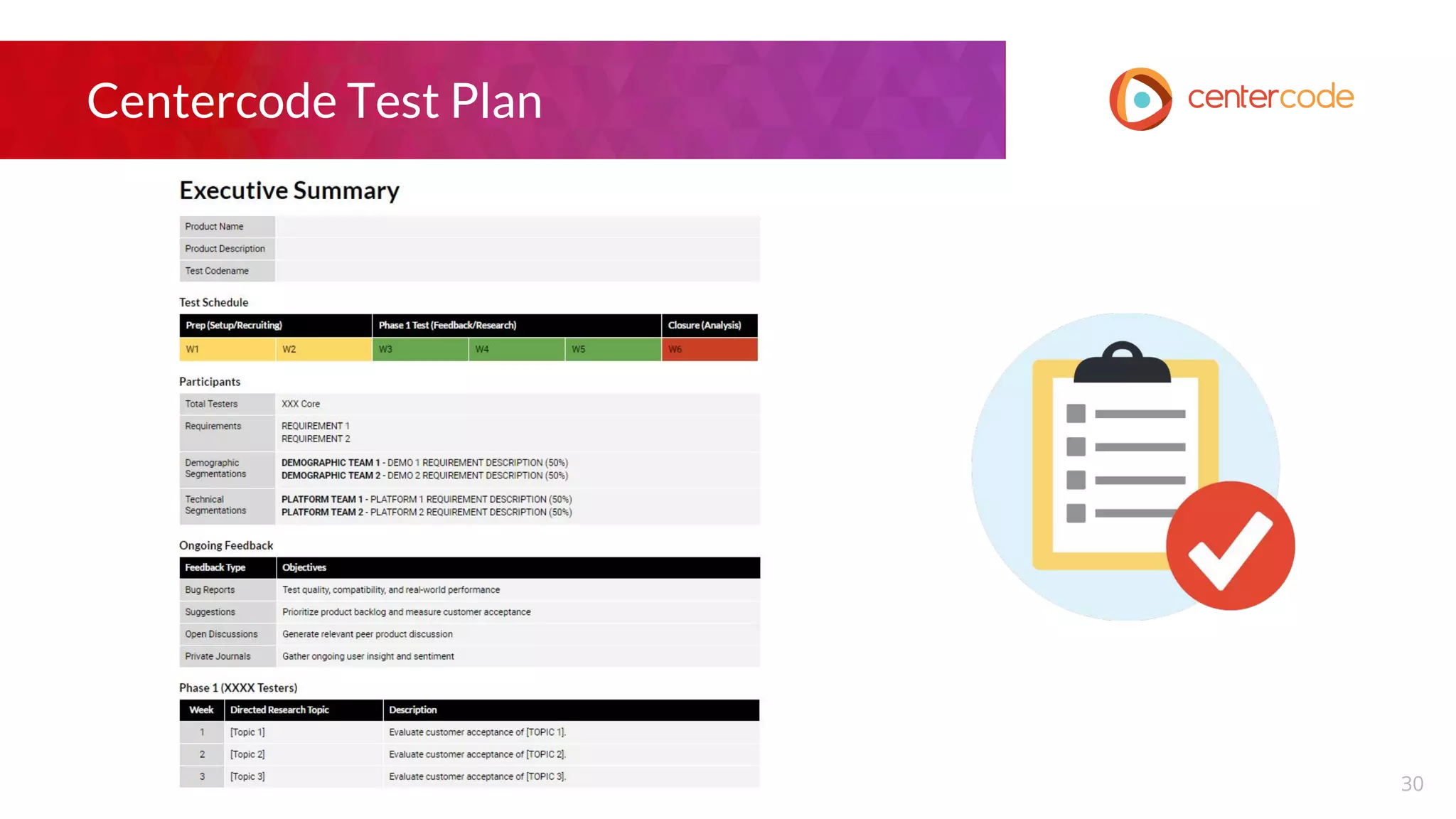
Centercode Test Plan
30
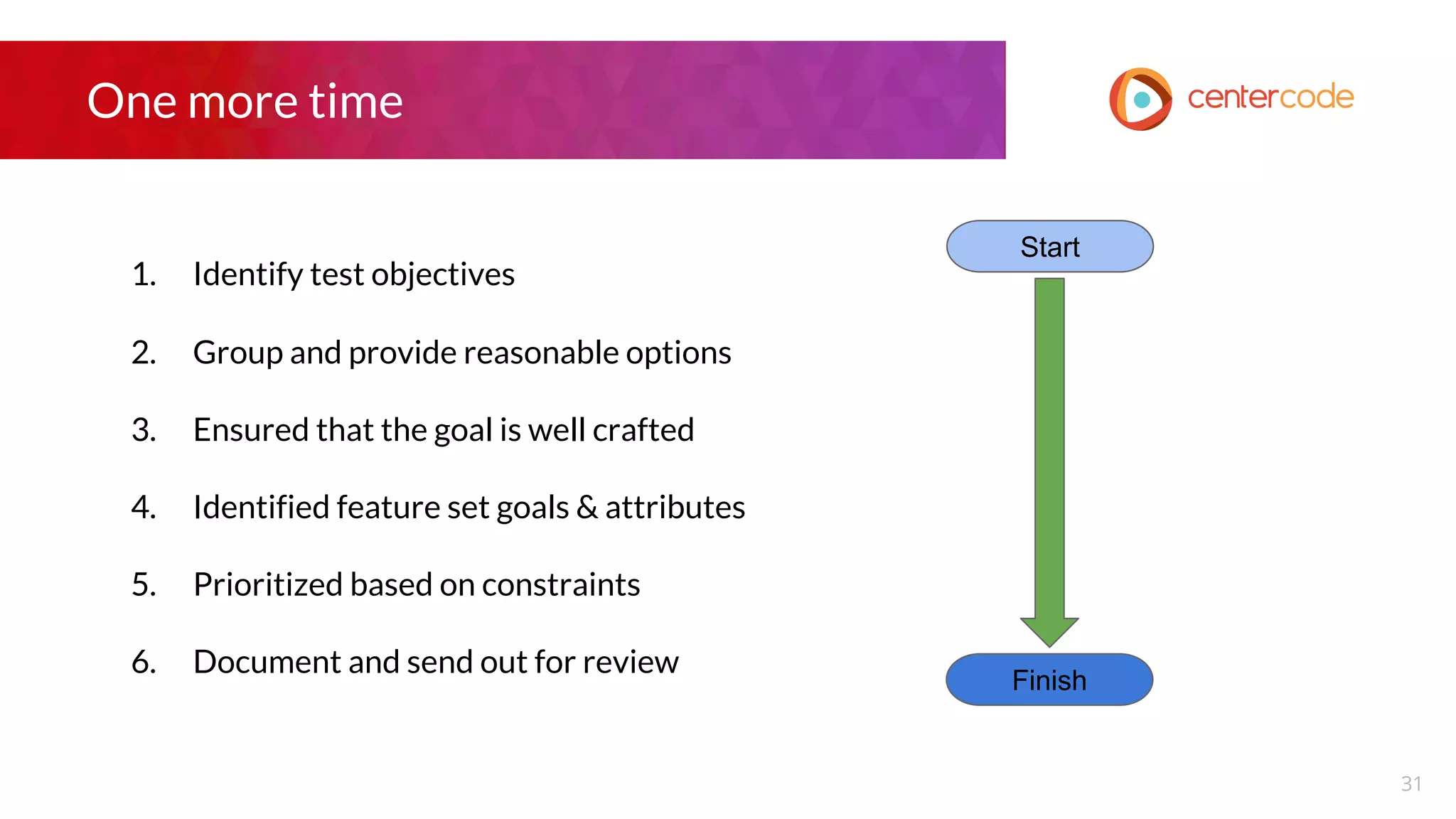
One more time
1. Identify test objectives
2. Group and provide reasonable options
3. Ensured that the goal is well crafted
4. Identified feature set goals & attributes
5. Prioritized based on constraints
6. Document and send out for review
Start
Finish
31
32
Maintaining Goals
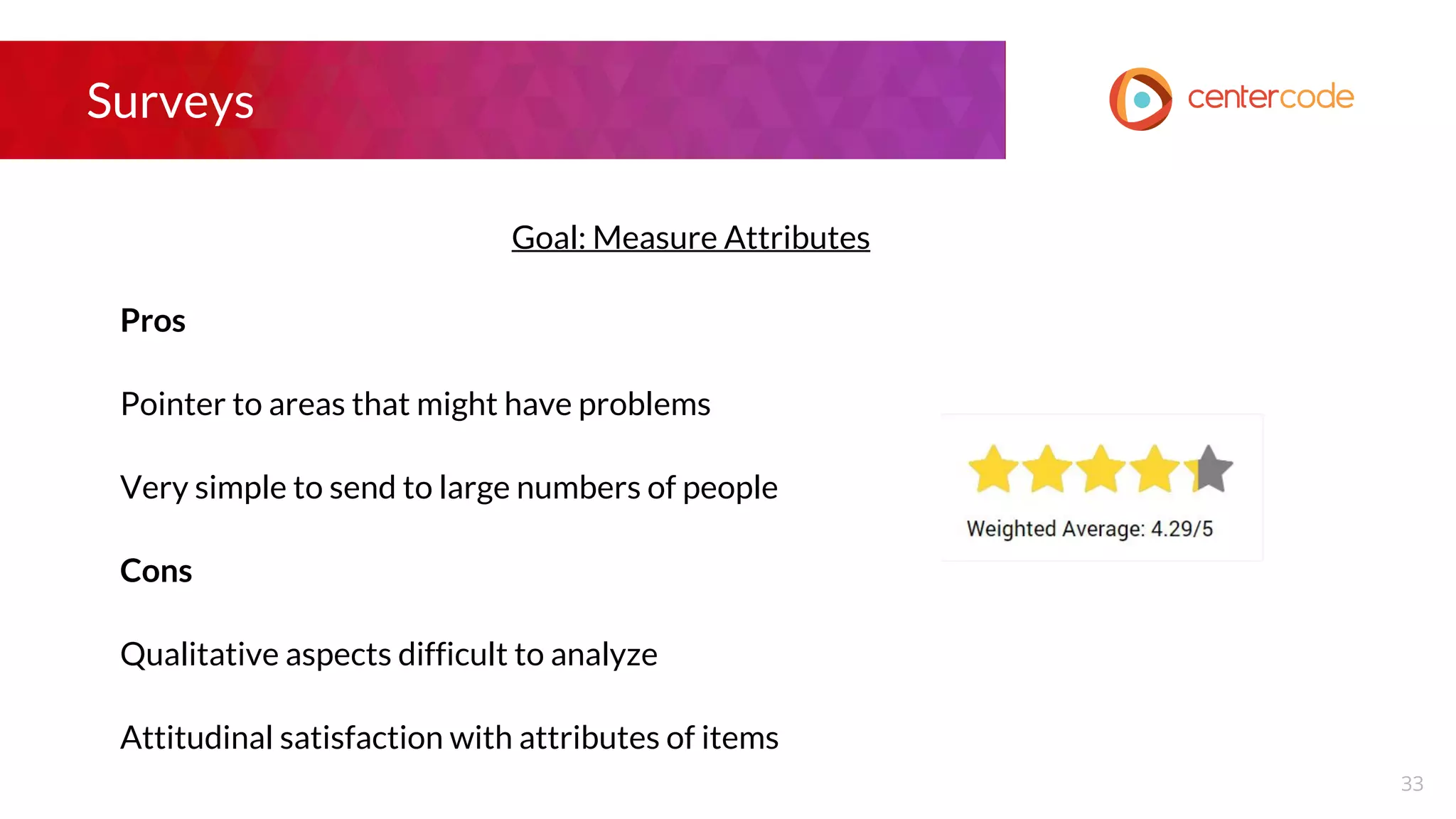
Surveys
Goal: Measure Attributes
Pros
Pointer to areas that might have problems
Very simple to send to large numbers of people
Cons
Qualitative aspects difficult to analyze
Attitudinal satisfaction with attributes of items
33
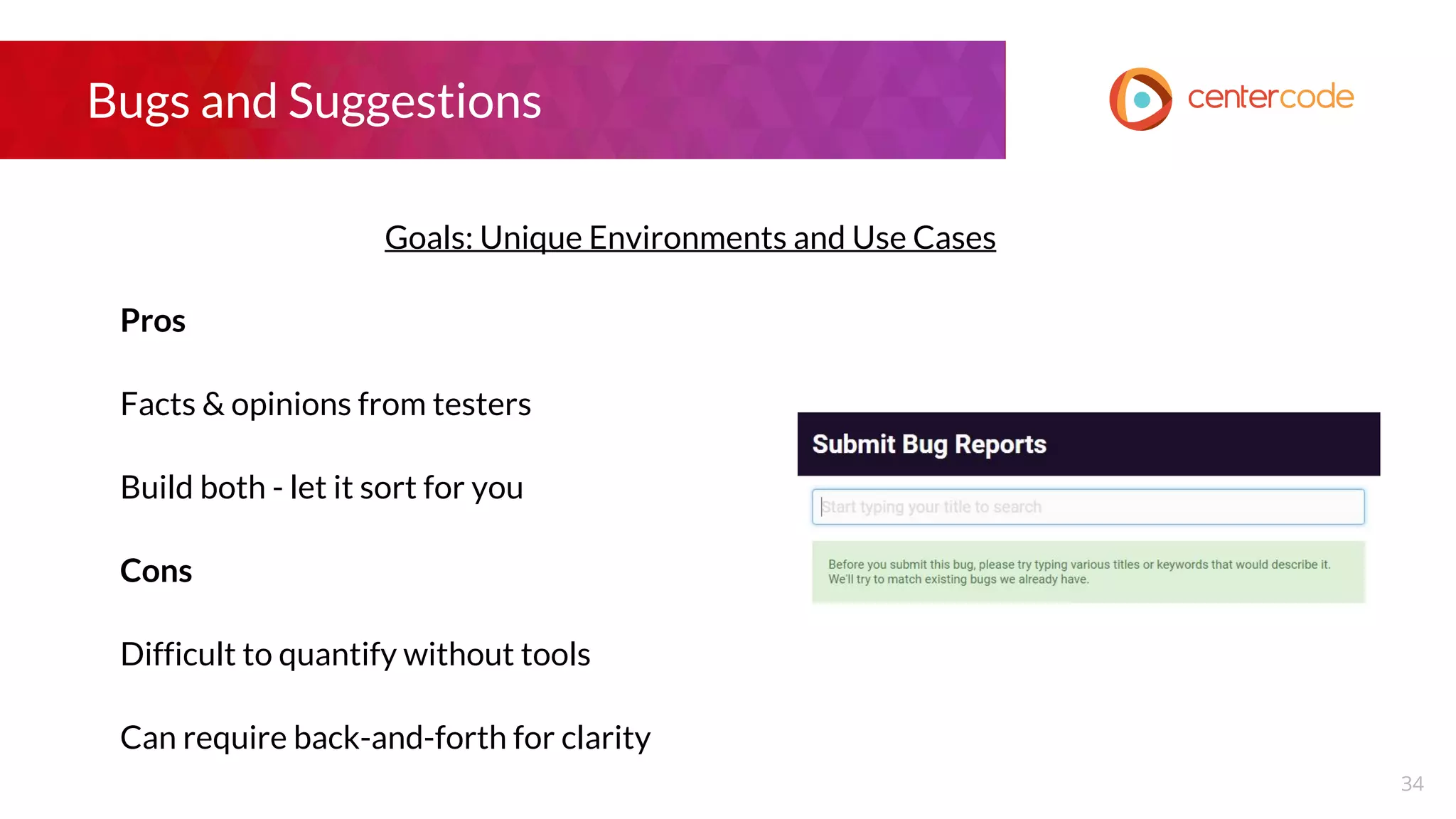
Bugs and Suggestions
Goals: Unique Environments and Use Cases
Pros
Facts & opinions from testers
Build both - let it sort for you
Cons
Difficult to quantify without tools
Can require back-and-forth for clarity
34
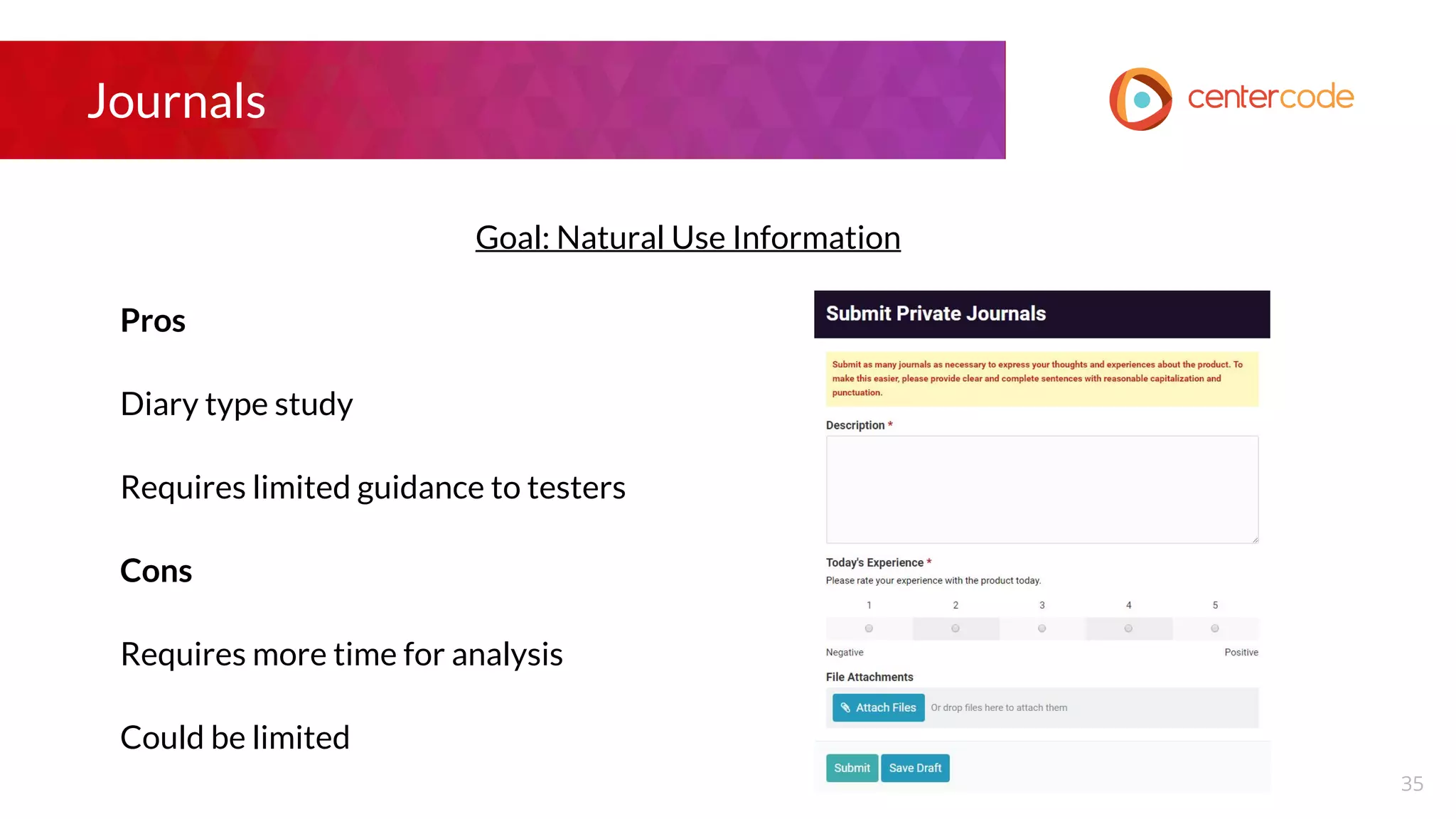
Journals
Goal: Natural Use Information
Pros
Diary type study
Requires limited guidance to testers
Cons
Requires more time for analysis
Could be limited
35
36
Goal Dangers
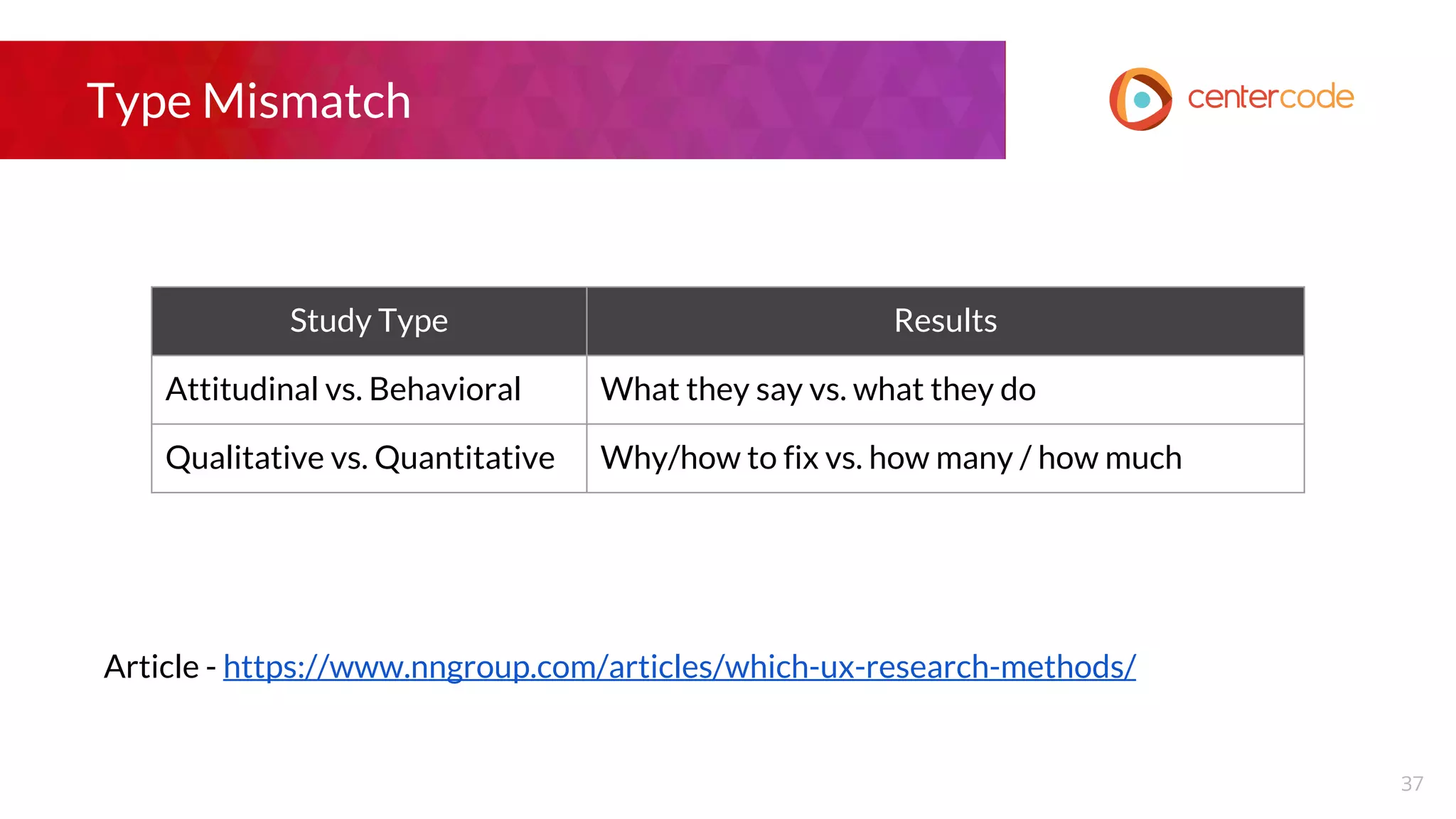
Type Mismatch
Article - https://www.nngroup.com/articles/which-ux-research-methods/
Study Type Results
Attitudinal vs. Behavioral What they say vs. what they do
Qualitative vs. Quantitative Why/how to fix vs. how many / how much
37
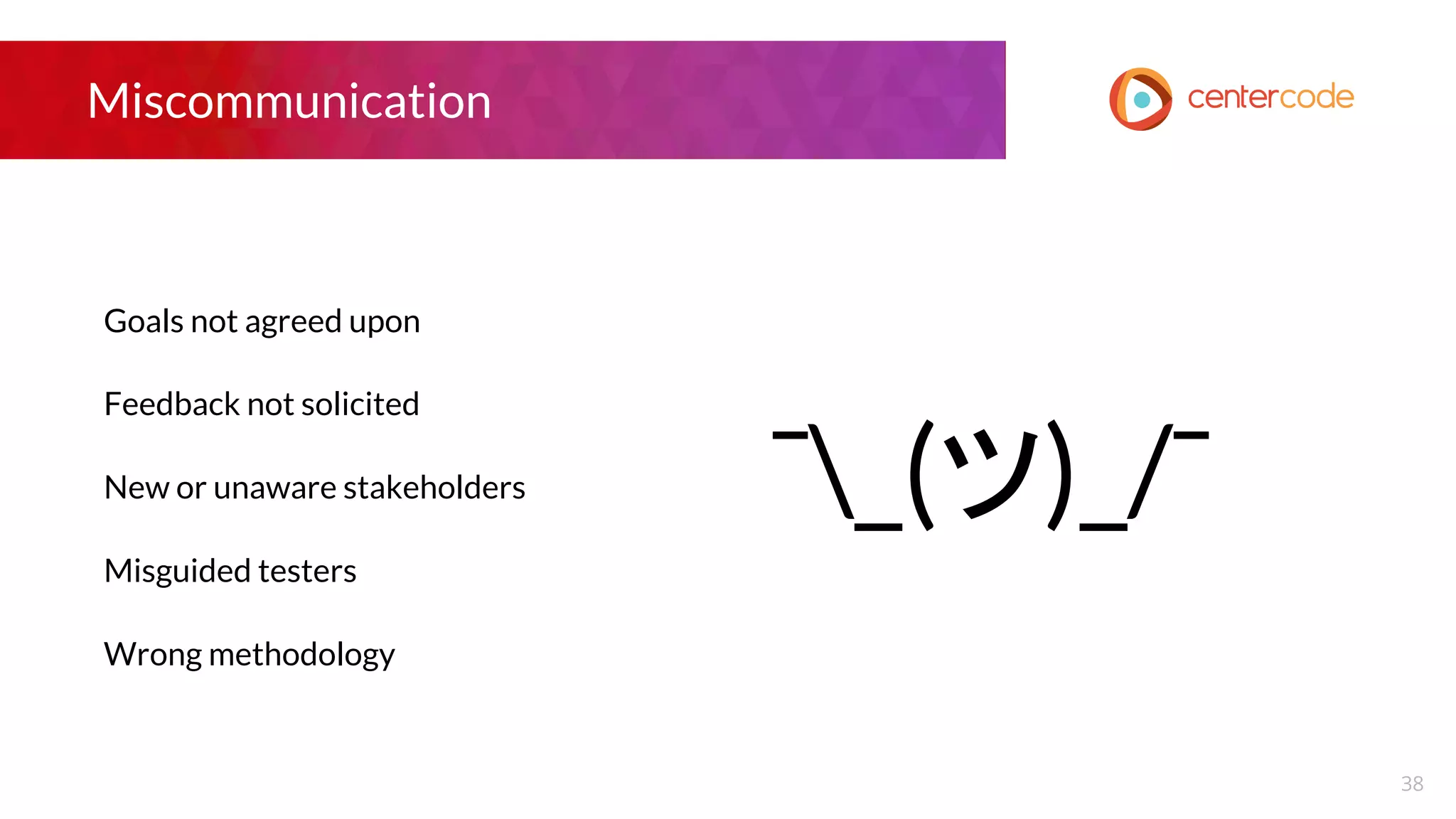
Miscommunication
Goals not agreed upon
Feedback not solicited
New or unaware stakeholders
Misguided testers
Wrong methodology
38
¯_(ツ)_/¯
39
Goals to Insight
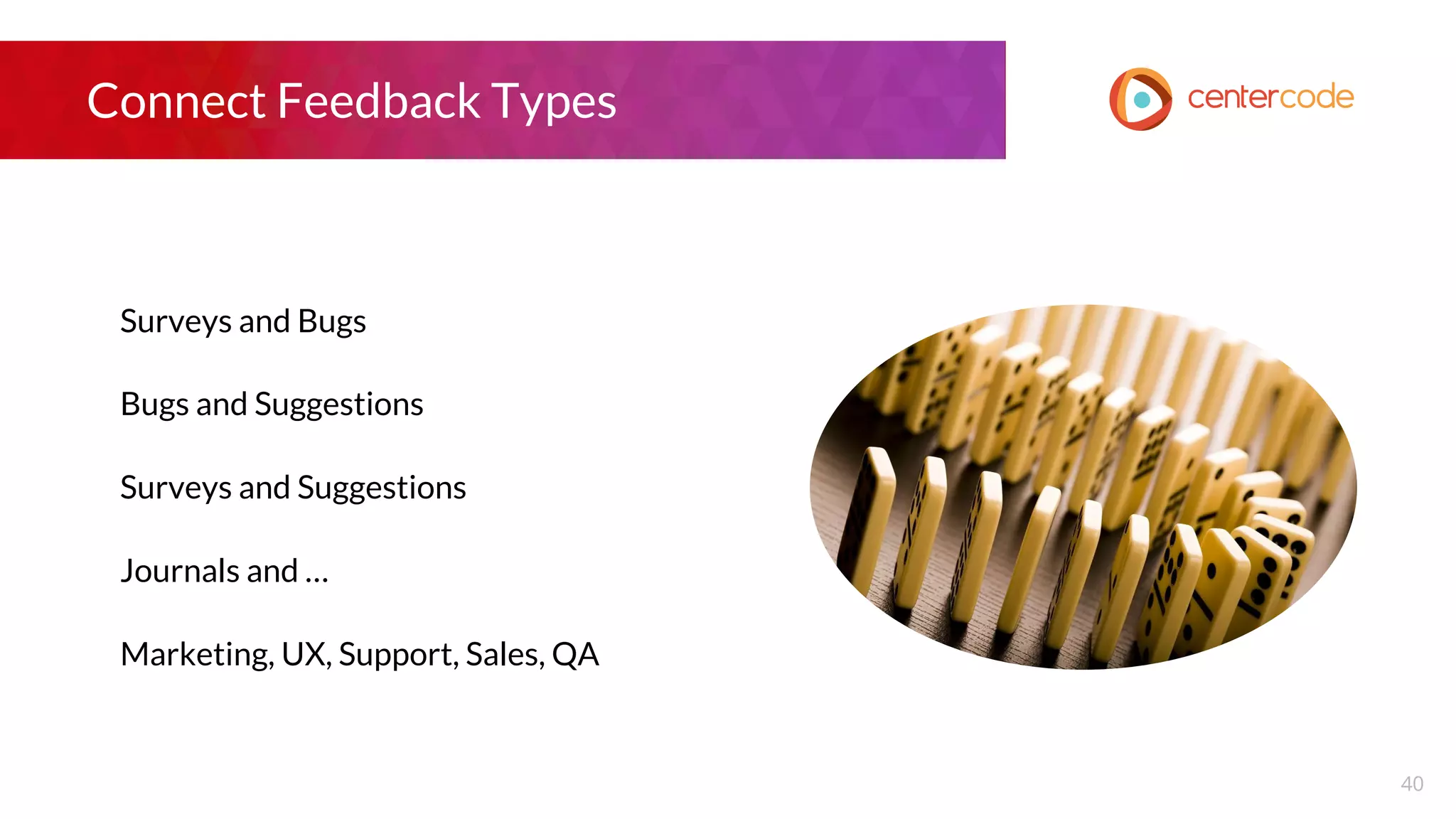
Connect Feedback Types
Surveys and Bugs
Bugs and Suggestions
Surveys and Suggestions
Journals and …
Marketing, UX, Support, Sales, QA
40
Focus on Product Goals
Focus results on original goals - they were goals
for a reason
Bring in updates to the information that helped
you define the goals
Only highlight other areas if they are significant
41
Generate Top X List

Information overload happens to everyone
Prioritize for your own sake
Short list will get more attention than long list
Bring in the “good/promotes” from the test
Everyone likes to have a couple wins, and so does the customer
42
Problem Elevator Pitch
20 - 30 second rundown
Customer’s point of view
Focused on selling the item to the team
One for each item on “Top X” list
43
44
Key Takeaways
If you remember nothing else...
1. Clearly define your goals - always; and associate
the best method to achieve them before signing off
on the project.
2. Stay focused on goals, unless significant change
3. Beware of research myopia
4. If you could use help, contact us!
45
46
Q&A
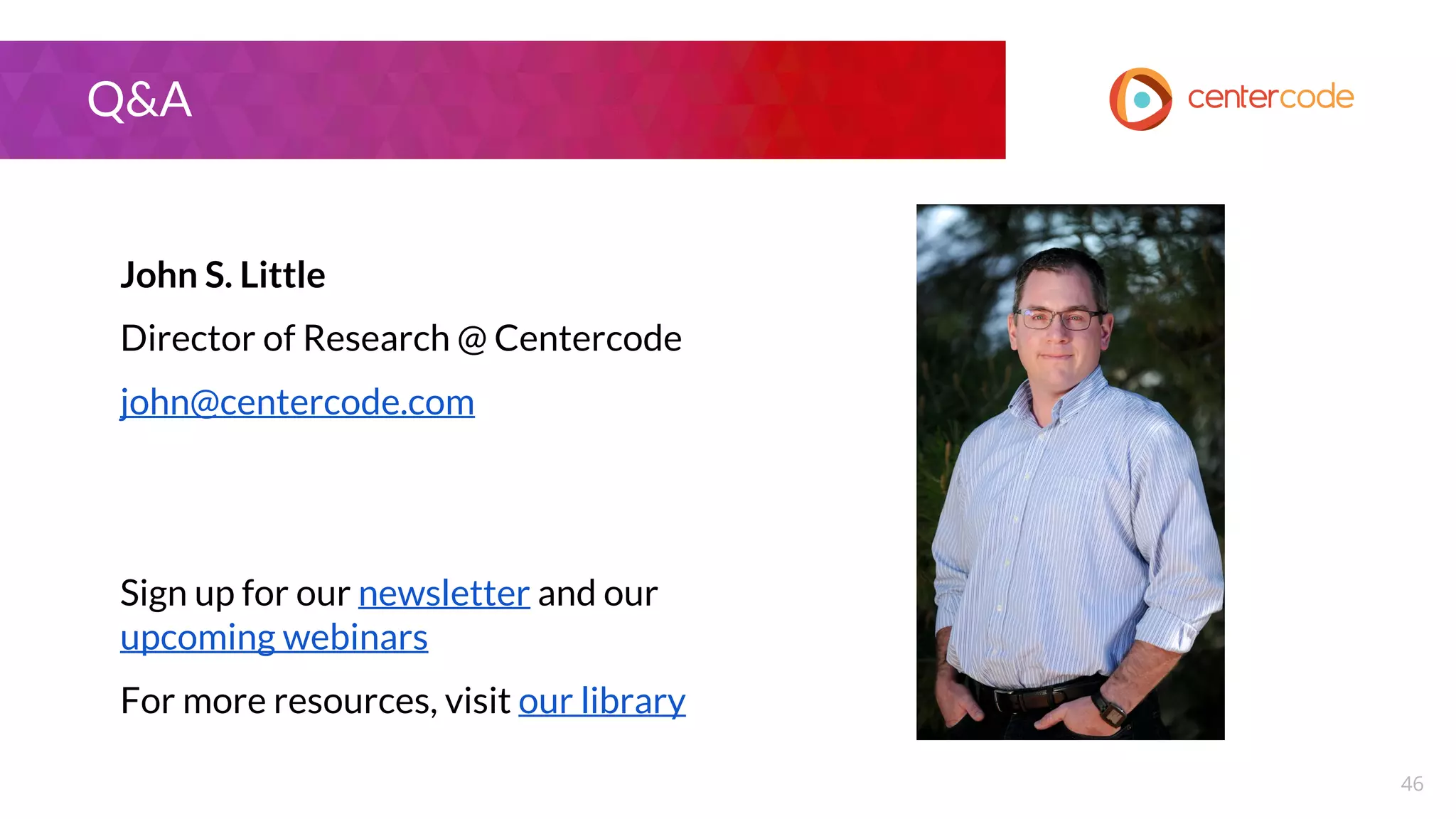
John S. Little
Director of Research @ Centercode
john@centercode.com
Sign up for our newsletter and our
upcoming webinars
For more resources, visit our library
47
Thank You!

Setting the right goals and objectives for your beta test

  • 1.
    1 Setting the RightGoals for Your Beta
  • 2.
    2 Meet the Speaker JohnS. Little Director of Research @ Centercode john@centercode.com
  • 3.
    Agenda 1. What aregoals? 2. How to set good goals for your beta test 3. How to maintain your goals throughout the beta phase 4. How to connect the insights from your test to your goals 5. Q&A 3
  • 4.
    4 Who is Centercode? ServicesFully managed tests and programs Software Complete beta program management platform Testers Access to 150k+ deeply profiled global candidates Content Free tools and best practices Customer validation is our core competency We've been collecting customer feedback for tech companies since 2001
  • 5.
  • 6.
    Webinar Goals Establish goodgoals for beta tests Accomplish goals of the beta test Leverage information to make a better product 6
  • 7.
  • 8.
    Business Definition An observableand measurable end result having one or more objectives to be achieved within a more or less fixed timeframe. http://www.businessdictionary.com/definition/goal.html#ixzz4KBQiUDi6 8
  • 9.
    Goals for betas “Goalis something that you want to achieve” How am I going to do it? - Method Why am I going to do it? - Return Useful tools ● S.M.A.R.T. ● Definition of Done ● Commander’s intent 9
  • 10.
    Quote If one doesnot know to which port one is sailing, no wind is favorable. – Seneca 10
  • 11.
  • 12.
    Beta Goal Types 1.Overall Test Goal 2. Feature Set Level(s) 3. Attributes 12
  • 13.
    Overall Test Goals- Finding a Focus What is the main goal of the beta test? ● Natural usage ● Coverage of features ● Opinion of features ● Partial, focused coverage ● Unique environments and use cases 13
  • 14.
    Real vs. Complete Naturalusage Coverage of features 14
  • 15.
    Feature Set Goals- Finding a Focus Where do I find the areas of the product that need focus? ● Product/Market Requirements Document (PRD/MRD) ● Marketing Messaging ● Packaging Design ● Key Stakeholder Requests 15
  • 16.
    Priorities for Constraints 16 Constraints ●Time ● Products ● Cost ● Tester Availability Feature Sets ● Setup ● Documentation ● Website ● App ● Settings ● Out of box ● WiFi ● Feature 1 - Feature n VS
  • 17.
    Attributes 17 Overall Satisfaction Perceived Performance Easeof Use Usefulness Preference Comparative Self Reported / Attitudinal
  • 18.
    Communicate Goals Document, distribute,and follow-up ● Key Stakeholders ● Immediate team members ● Extended team members (build awareness) ● Testers (if appropriate) 18
  • 19.
    Goals for FeatureSets 19 Bad Good Collect feedback on feature Measure user’s satisfaction with ease of use of feature Measure usability of the product Evaluate customer acceptance of product Measure the performance of the product Measure perceived performance while initiating application How long did it take to setup the product? Evaluate satisfaction with time to set up Will they pay $150 for it? Conjoint analysis After Scenario Questionnaire (ASQ)
  • 20.
  • 21.
    Product Example Internet ofThings Light ● Mobile App ● Preset Colors ● Manual Color Selection ● Timer ● Alarm ● Auto-dimmer 21
  • 22.
    Beta Goals ● Evaluatetotal customer experience ● Assess MVP readiness ● Roadmap validation ● Competitive analysis ● Identify bugs ● Real-world impact of known issues ● Regression testing ● Analyze real-world performance ● Test compatibility ● Study user experience ● Assess new user experience ● Test documentation ● Test support processes ● Collect mock reviews ● Increase product confidence ● Collect case studies 22
  • 23.
    Objectives Quality Customer AcceptanceNatural Use ● Test compatibility ● Assess MVP readiness ● Competitive analysis ● Identify bugs ● Regression testing ● Analyze real-world performance ● Evaluate total customer experience ● Assess new user experience ● Collect mock reviews ● Increase confidence ● Real-world impact of known issues ● Study user experience ● Test documentation ● Test support processes ● Collect case studies ● Roadmap validation 23
  • 24.
    SMART Beta SMART Criteria SpecificCustomer acceptance of product Measurable Quantifiable by survey(s) & severity of issues Achievable Product state / Tester availability / Tool Relative Feedback will go into this version or next Timebound 2 weeks of test -> 2 weeks regression -> GM 24
  • 25.
    Definition of Done ❏All new feature in the product tested by customers ❏ Measurable feedback on the customer acceptance of the product ❏ All discovered bugs prioritized and sent to QA ❏ Tester suggestions provided to product management ❏ Support alerted of specific pain points that are not being addressed 25
  • 26.
    Commander’s Intent Complete abeta study of the customer acceptance of the product in order to understand and make critical improvements prior to release or general improvements in the next revision 26
  • 27.
    Feature Set vs.Constraints Features ● Packaging ● Easy Setup ● Preset Colors ● Manual Color Selection ● Timer and Alarm ● Auto-dimmer Research Attributes ● Ease of Use ● Stickiness ● Usefulness ● Feature Satisfaction Constraints Units = 32 Time = 2 Weeks Tools = Centercode Testers = Betabound Test Team = ½ Time (me) 27
  • 28.
    Feature Set vs.Constraints Features ● Packaging ● Easy Setup ● Preset Colors ● Manual Color Selection ● Timer and Alarm ● Auto-dimmer Research Attributes ● Ease of Use ● Stickiness ● Usefulness ● Feature Satisfaction Constraints Units = 32 Time = 2 Weeks Tools = Centercode Testers = Betabound Test Team = ½ Time (me) 28
  • 29.
    Establish Goals Primary TestGoal = Customer Acceptance Feature Sets = Easy Setup; Preset Colors; Manual Color Selection; Timer; Alarm Attributes/Feedback ● Satisfaction, Ease of use, etc. (Surveys) ● Bugs (Issue reports) Week 1 ● Setup; Manual Colors; Timer Week 2 ● Alarm; Preset Colors; Timer 29
  • 30.
  • 31.
    One more time 1.Identify test objectives 2. Group and provide reasonable options 3. Ensured that the goal is well crafted 4. Identified feature set goals & attributes 5. Prioritized based on constraints 6. Document and send out for review Start Finish 31
  • 32.
  • 33.
    Surveys Goal: Measure Attributes Pros Pointerto areas that might have problems Very simple to send to large numbers of people Cons Qualitative aspects difficult to analyze Attitudinal satisfaction with attributes of items 33
  • 34.
    Bugs and Suggestions Goals:Unique Environments and Use Cases Pros Facts & opinions from testers Build both - let it sort for you Cons Difficult to quantify without tools Can require back-and-forth for clarity 34
  • 35.
    Journals Goal: Natural UseInformation Pros Diary type study Requires limited guidance to testers Cons Requires more time for analysis Could be limited 35
  • 36.
  • 37.
    Type Mismatch Article -https://www.nngroup.com/articles/which-ux-research-methods/ Study Type Results Attitudinal vs. Behavioral What they say vs. what they do Qualitative vs. Quantitative Why/how to fix vs. how many / how much 37
  • 38.
    Miscommunication Goals not agreedupon Feedback not solicited New or unaware stakeholders Misguided testers Wrong methodology 38 ¯_(ツ)_/¯
  • 39.
  • 40.
    Connect Feedback Types Surveysand Bugs Bugs and Suggestions Surveys and Suggestions Journals and … Marketing, UX, Support, Sales, QA 40
  • 41.
    Focus on ProductGoals Focus results on original goals - they were goals for a reason Bring in updates to the information that helped you define the goals Only highlight other areas if they are significant 41
  • 42.
    Generate Top XList Information overload happens to everyone Prioritize for your own sake Short list will get more attention than long list Bring in the “good/promotes” from the test Everyone likes to have a couple wins, and so does the customer 42
  • 43.
    Problem Elevator Pitch 20- 30 second rundown Customer’s point of view Focused on selling the item to the team One for each item on “Top X” list 43
  • 44.
  • 45.
    If you remembernothing else... 1. Clearly define your goals - always; and associate the best method to achieve them before signing off on the project. 2. Stay focused on goals, unless significant change 3. Beware of research myopia 4. If you could use help, contact us! 45
  • 46.
    46 Q&A John S. Little Directorof Research @ Centercode john@centercode.com Sign up for our newsletter and our upcoming webinars For more resources, visit our library
  • 47.