Simulated Market Testing

       Kourtney Roy
Definition
“The presentation of advertising and other
     promotional materials for several
   products, including a test product, to
 members of the product’s target market.”
Accuracy
Most simulated test marketing suppliers claim to
 have an average accuracy within +/-10% of the
      actual forecast up to 90% of the time.
Techniques
The techniques of most vendors is the same
  and are considered to be highly effective.

 The major vendors can differentiate their
 services and customize the models with the
            latest research trends.
Data Collection
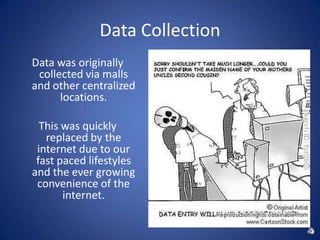
Data was originally
 collected via malls
and other centralized
      locations.

  This was quickly
   replaced by the
 internet due to our
 fast paced lifestyles
and the ever growing
 convenience of the
       internet.
Categories for simulated
    test marketing
Purchase intent   Preference share
Price
 Researching firms will offer
   simulated market tests
   for anywhere from
   $25,000 to $100,000.

 This is in comparison to the
   $1,000,000 or more that
   full scale test marketing
   would cost.
Shelf Set
Quantify the impact of product assortment, aisle
    flow, pricing and in-store signage using the
     industry’s leading online virtual shopping
   technology. Compared to traditional testing
   methods, our virtual solutions let you quickly
   gather and analyze shopping data, providing
  unprecedented insights for shopper marketing
  and category management decision making.

http://www.visioncritical.com/products/vision-
         critical-applications/shelfset
Example of virtual shopping
             capabilities
http://www.youtube.com/watch?v=CiIFL3CfEGI
All in all
Simulated test marketing is an ever growing field
  that is cost and time effective.

The high price of failure makes companies more
  prone to stick to regular test marketing
  methods.

Simulated test marketing

  • 1.
  • 2.
    Definition “The presentation ofadvertising and other promotional materials for several products, including a test product, to members of the product’s target market.”
  • 3.
    Accuracy Most simulated testmarketing suppliers claim to have an average accuracy within +/-10% of the actual forecast up to 90% of the time.
  • 4.
    Techniques The techniques ofmost vendors is the same and are considered to be highly effective. The major vendors can differentiate their services and customize the models with the latest research trends.
  • 5.
    Data Collection Data wasoriginally collected via malls and other centralized locations. This was quickly replaced by the internet due to our fast paced lifestyles and the ever growing convenience of the internet.
  • 6.
    Categories for simulated test marketing Purchase intent Preference share
  • 7.
    Price Researching firmswill offer simulated market tests for anywhere from $25,000 to $100,000. This is in comparison to the $1,000,000 or more that full scale test marketing would cost.
  • 8.
    Shelf Set Quantify theimpact of product assortment, aisle flow, pricing and in-store signage using the industry’s leading online virtual shopping technology. Compared to traditional testing methods, our virtual solutions let you quickly gather and analyze shopping data, providing unprecedented insights for shopper marketing and category management decision making. http://www.visioncritical.com/products/vision- critical-applications/shelfset
  • 9.
    Example of virtualshopping capabilities http://www.youtube.com/watch?v=CiIFL3CfEGI
  • 10.
    All in all Simulatedtest marketing is an ever growing field that is cost and time effective. The high price of failure makes companies more prone to stick to regular test marketing methods.

Editor's Notes

  • #2 Hi I am kourtney and I am going to be talking about Simulated Market Testing.
  • #3 This is meant to be the cheaper, faster, and safer alternative to the traditional test marketing. It is Marketing research techniques in which consumers are exposed to staged advertising and purchase decisions in order to observe their responses to new products.
  • #4 Simulated test markets are frequently used to aid marketing managers in making the go or no go decision for new product launches. Simulated test markets have expanded exponentially over the past 20 years to be used in financial services, pharmaceuticals, as well as new technology.
  • #5 Over the past 20 years much of simulated test marketing has evolved including the practice, major players, and the methods. Today, the simulated test market industry remains fairly consolidated, with models that are generally similar. The most notable changes are in the diversity of areas that are served by simulated test marketing, the method of data collection, and the sophistication of returned diagnostics. The vendors do more concept screening and testing than what was previously done before as well.
  • #6 One of the larger changes is in the collection of data via the internet. Originally data was generally collected in centralized locations such as a mall, but the internet has been a replacement due to its cost effectiveness and the fast paced lifestyle of consumers in our world today.
  • #7 . There are two categories for the simulated test marketing models. Purchase intent and Preference Share. Purchase intent is generally gauged on a 5 point scale system and preference share trial is measured for a new product given a competitive set.
  • #8 One of the reasons simulated test marketing has grown so much is due to the relatively cheap price in comparison to regular full scale test marketing. Simulated test marketing will range in the field of $25,000 to $100,000 unlike full scale test marketing which can be 1 million or more.
  • #9 Virtual Shelfset provides a fast and flexible virtual platform for marketers, researchers and category managers seeking proactive shopper marketing and category management solutions that drive improved sales in critical product categories.
  • #10 This is just a video outlining the capabilities of virtual shopping and internet market research.
  • #11 Though there has been much growth in the field of simulated test marketing and it is a cost effective and time effective way of data collection, many firms still believe that full scale test marketing is necessary for most new products being put into stores, since a failure with a product would be a huge cost to the company.