The OdysseyArchetypesBy HomerThe epic story of a journey —Symbolic of our journey through life.4/15/10
What areArhcetypes?4/15/10
Epic tales & ArchetypesWHY have epic tales remained so popular from ancient times till now?In a word…ARCHETYPES4/15/10
Epic tales & ArchetypesWhat are ARCHETYPES?Well…they’re easy to spot and to understand, but they’re hard to define; hard to explain.Actually, you probably already know. Or at least you recognize them when you encounter them.4/15/10
Epic tales & ArchetypesArchetypes are:CharactersSituationsThat are so common in human experience that everybody recognizes them; everybody relates to them, regardless of language or cultural background.4/15/10
Things to remember about Archetypes4/15/10
Things to remember about ArchetypesArchetypes are universal because they:Describe experiences that every human being encountersHold the same or similar meaning for all people, in every time and place4/15/10
Things to remember about ArchetypesArchetypes are recurring because they are:Timeless — not dependent upon or attached to a particular time period (they remain relevant to any time throughout history)Unchanged from ancient times until today, from The Odyssey to The Sopranos and Star Wars or Harry Potter.4/15/10
Things to remember about ArchetypesArchetypes are symbolic because theyDescribe basic human experiences in the form of symbolsAllow each one of us to make meaning from our own experiences by recognizing what the symbols mean to us, personally4/15/10
Things to remember about ArchetypesThey are inherited because theyMean the same thing to just about everybody on planet EarthCan’t be explained by anything in any one individual’s experiencesCome from experiences of humankind, not the individualIn other words, even if you’ve never had the exact experience yourself, you can still somehow relate to it.4/15/10
Things to remember about ArchetypesThey are unconscious because theyEvoke a deep response, more basic than words4/15/10
Things to remember about ArchetypesArchetypes are worldwide because they areNot shared through contacts or communication between culturesNot influenced by geographyRemain constant from the most remote village to high tech urban centers4/15/10
Things to remember about ArchetypesThey are mythic because theyAppear in myths of all culturesConnect the myths of all culturesTell the story of the individual’s and humankind’s search for meaning4/15/10
Things to remember about ArchetypesThere are 3 basic groups of Archetypes:Character ArchetypesPlot ArchetypesSymbol ArchetypesLet’s take a look at them, group by group…4/15/10
Group 1 ArchetypesofCharacter4/15/10
Character Archetype:The Hero4/15/10
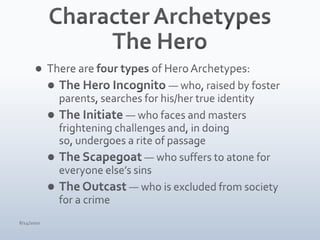
Character ArchetypesThe HeroThere are four types of Hero Archetypes:The Hero Incognito — who, raised by foster parents, searches for his/her true identityThe Initiate — who faces and masters frightening challenges and, in doing so, undergoes a rite of passageThe Scapegoat — who suffers to atone for everyone else’s sinsThe Outcast — who is excluded from society for a crime4/15/10
Character Archetype:Hero’s Allies4/15/10
Character ArchetypesThe Hero’s AlliesThe Hero’s Allies include:The Mentor — a teacher or counselorProtectors — defenders of the hero and the groupCompanions — loyal friendsAnimal friends — helpers from natureThe benevolent force of nature4/15/10
Character Archetype:Hero’s Adversaries4/15/10
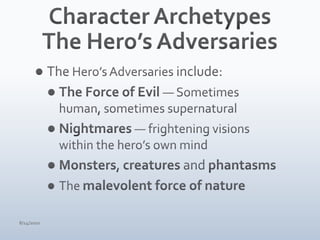
Character ArchetypesThe Hero’s AdversariesThe Hero’s Adversaries include:The Force of Evil — Sometimes human, sometimes supernaturalNightmares — frightening visions within the hero’s own mindMonsters, creatures and phantasmsThe malevolent force of nature4/15/10
Character Archetype:theFeminine4/15/10
Character ArchetypesThe FeminineThe Feminine archetypes include:Damsel in distress — woman held prisoner or in danger who must be rescuedLover — who loves intensely, but the love ends in tragedyEnchantress — who tempts the hero and brings on his destructionEarth mother — who provides life, food, warmth, and protection4/15/10
Group 2ArchetypesofPlot4/15/10
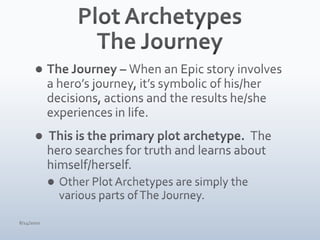
Plot ArchetypesThe JourneyThe Journey – When an Epic story involves a hero’s journey, it’s symbolic of his/her decisions, actions and the results he/she experiences in life. This is the primary plot archetype.  The hero searches for truth and learns about himself/herself.  Other Plot Archetypes are simply the various parts of The Journey.4/15/10
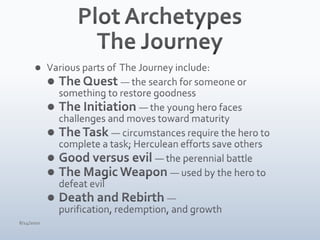
Plot ArchetypesThe JourneyVarious parts of  The Journey include:The Quest — the search for someone or something to restore goodnessThe Initiation — the young hero faces challenges and moves toward maturityThe Task — circumstances require the hero to complete a task; Herculean efforts save othersGood versus evil — the perennial battleThe Magic Weapon — used by the hero to defeat evilDeath and Rebirth — purification, redemption, and growth4/15/10
Group 3ArchetypesofSymbol4/15/10
What areSymbolArchetypes?
Symbol ArchetypesVisual symbols that convey meaning to the human psyche in a mysterious, somewhat subliminal way.
Do you know what subliminal means?
SubliminalDictionary definition:“existing or functioning below the threshold of consciousness.”
Symbol ArchetypesCommunicate messages that verbal and written information cannot.
Symbol ArchetypesHold the same or almost the same meaning for all humankindOccur in cultures so remote that there has been no chance for influence or communication
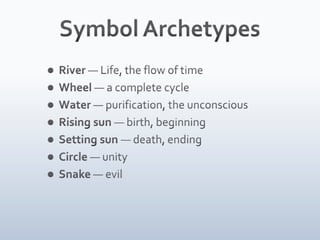
Symbol ArchetypesRiver — Life, the flow of time Wheel — a complete cycle Water — purification, the unconscious Rising sun — birth, beginning Setting sun — death, ending Circle — unity Snake — evil
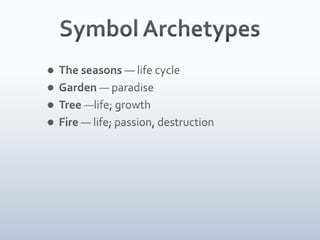
Symbol ArchetypesThe seasons — life cycle Garden — paradise Tree —life; growth Fire — life; passion, destruction
Symbol ArchetypesColorsRed — violence, passion Green — growth, hopeBlue — truth, security Black — death, evil White — purity, innocence, mystery
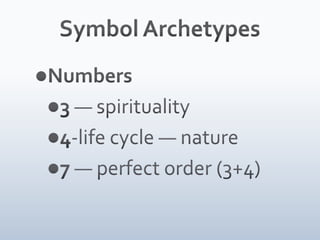
Symbol ArchetypesNumbers3 — spirituality 4-life cycle — nature7 — perfect order (3+4)
Archetypes are the keys to understandingThe OdysseyBy HomerThe epic story of a journey —Symbolic of our journey through life.4/15/10

Odyssey 02—archetypes

  • 1.
    The OdysseyArchetypesBy HomerTheepic story of a journey —Symbolic of our journey through life.4/15/10
  • 2.
  • 3.
    Epic tales &ArchetypesWHY have epic tales remained so popular from ancient times till now?In a word…ARCHETYPES4/15/10
  • 4.
    Epic tales &ArchetypesWhat are ARCHETYPES?Well…they’re easy to spot and to understand, but they’re hard to define; hard to explain.Actually, you probably already know. Or at least you recognize them when you encounter them.4/15/10
  • 5.
    Epic tales &ArchetypesArchetypes are:CharactersSituationsThat are so common in human experience that everybody recognizes them; everybody relates to them, regardless of language or cultural background.4/15/10
  • 6.
    Things to rememberabout Archetypes4/15/10
  • 7.
    Things to rememberabout ArchetypesArchetypes are universal because they:Describe experiences that every human being encountersHold the same or similar meaning for all people, in every time and place4/15/10
  • 8.
    Things to rememberabout ArchetypesArchetypes are recurring because they are:Timeless — not dependent upon or attached to a particular time period (they remain relevant to any time throughout history)Unchanged from ancient times until today, from The Odyssey to The Sopranos and Star Wars or Harry Potter.4/15/10
  • 9.
    Things to rememberabout ArchetypesArchetypes are symbolic because theyDescribe basic human experiences in the form of symbolsAllow each one of us to make meaning from our own experiences by recognizing what the symbols mean to us, personally4/15/10
  • 10.
    Things to rememberabout ArchetypesThey are inherited because theyMean the same thing to just about everybody on planet EarthCan’t be explained by anything in any one individual’s experiencesCome from experiences of humankind, not the individualIn other words, even if you’ve never had the exact experience yourself, you can still somehow relate to it.4/15/10
  • 11.
    Things to rememberabout ArchetypesThey are unconscious because theyEvoke a deep response, more basic than words4/15/10
  • 12.
    Things to rememberabout ArchetypesArchetypes are worldwide because they areNot shared through contacts or communication between culturesNot influenced by geographyRemain constant from the most remote village to high tech urban centers4/15/10
  • 13.
    Things to rememberabout ArchetypesThey are mythic because theyAppear in myths of all culturesConnect the myths of all culturesTell the story of the individual’s and humankind’s search for meaning4/15/10
  • 14.
    Things to rememberabout ArchetypesThere are 3 basic groups of Archetypes:Character ArchetypesPlot ArchetypesSymbol ArchetypesLet’s take a look at them, group by group…4/15/10
  • 15.
  • 16.
  • 17.
    Character ArchetypesThe HeroThereare four types of Hero Archetypes:The Hero Incognito — who, raised by foster parents, searches for his/her true identityThe Initiate — who faces and masters frightening challenges and, in doing so, undergoes a rite of passageThe Scapegoat — who suffers to atone for everyone else’s sinsThe Outcast — who is excluded from society for a crime4/15/10
  • 18.
  • 19.
    Character ArchetypesThe Hero’sAlliesThe Hero’s Allies include:The Mentor — a teacher or counselorProtectors — defenders of the hero and the groupCompanions — loyal friendsAnimal friends — helpers from natureThe benevolent force of nature4/15/10
  • 20.
  • 21.
    Character ArchetypesThe Hero’sAdversariesThe Hero’s Adversaries include:The Force of Evil — Sometimes human, sometimes supernaturalNightmares — frightening visions within the hero’s own mindMonsters, creatures and phantasmsThe malevolent force of nature4/15/10
  • 22.
  • 23.
    Character ArchetypesThe FeminineTheFeminine archetypes include:Damsel in distress — woman held prisoner or in danger who must be rescuedLover — who loves intensely, but the love ends in tragedyEnchantress — who tempts the hero and brings on his destructionEarth mother — who provides life, food, warmth, and protection4/15/10
  • 24.
  • 25.
    Plot ArchetypesThe JourneyTheJourney – When an Epic story involves a hero’s journey, it’s symbolic of his/her decisions, actions and the results he/she experiences in life. This is the primary plot archetype. The hero searches for truth and learns about himself/herself. Other Plot Archetypes are simply the various parts of The Journey.4/15/10
  • 26.
    Plot ArchetypesThe JourneyVariousparts of The Journey include:The Quest — the search for someone or something to restore goodnessThe Initiation — the young hero faces challenges and moves toward maturityThe Task — circumstances require the hero to complete a task; Herculean efforts save othersGood versus evil — the perennial battleThe Magic Weapon — used by the hero to defeat evilDeath and Rebirth — purification, redemption, and growth4/15/10
  • 27.
  • 28.
  • 29.
    Symbol ArchetypesVisual symbolsthat convey meaning to the human psyche in a mysterious, somewhat subliminal way.
  • 30.
    Do you knowwhat subliminal means?
  • 31.
    SubliminalDictionary definition:“existing orfunctioning below the threshold of consciousness.”
  • 32.
    Symbol ArchetypesCommunicate messagesthat verbal and written information cannot.
  • 33.
    Symbol ArchetypesHold thesame or almost the same meaning for all humankindOccur in cultures so remote that there has been no chance for influence or communication
  • 34.
    Symbol ArchetypesRiver —Life, the flow of time Wheel — a complete cycle Water — purification, the unconscious Rising sun — birth, beginning Setting sun — death, ending Circle — unity Snake — evil
  • 35.
    Symbol ArchetypesThe seasons— life cycle Garden — paradise Tree —life; growth Fire — life; passion, destruction
  • 36.
    Symbol ArchetypesColorsRed —violence, passion Green — growth, hopeBlue — truth, security Black — death, evil White — purity, innocence, mystery
  • 37.
    Symbol ArchetypesNumbers3 —spirituality 4-life cycle — nature7 — perfect order (3+4)
  • 38.
    Archetypes are thekeys to understandingThe OdysseyBy HomerThe epic story of a journey —Symbolic of our journey through life.4/15/10