Symmetry Grades 5 - 8
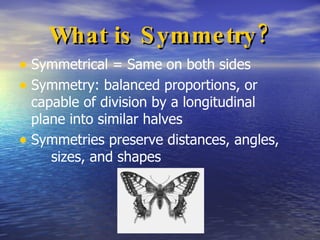
What is Symmetry? Symmetrical = Same on both sides Symmetry: balanced proportions, or  capable of division by a longitudinal  plane into similar halves Symmetries preserve distances, angles,  sizes, and shapes
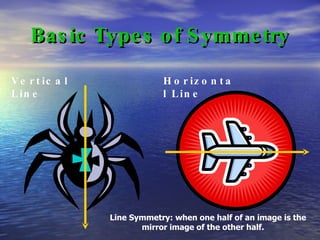
Basic Types of Symmetry Vertical Line Horizontal Line Line Symmetry: when one half of an image is the  mirror image of the other half.
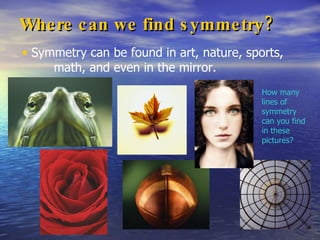
Where can we find symmetry? Symmetry can be found in art, nature, sports,  math, and even in the mirror.  How many lines of  symmetry can you find in these pictures?
Types of symmetry that transform the  plane the object is on Four main types of Euclidean Planes Translation Rotation Reflection Glide Reflection Similar concepts can be found in 3-D or  spatial symmetries also.  The Euclidean Plane
Translation: To translate an object means to move it  without rotating or reflecting it.  Every translation has a direction and a distance.
Example of Translation: If a family of ducks all lined up in a row is moved forward or back by one, two, or more ducks they have translated on the plane. This translation does not change the appearance of the procession, it just moves it on the plane.
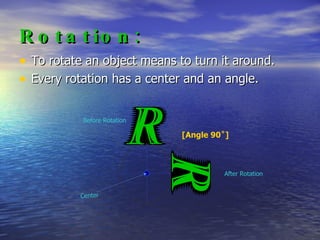
Rotation: To rotate an object means to turn it around. Every rotation has a center and an angle.  Before Rotation After Rotation Center [Angle 90˚]
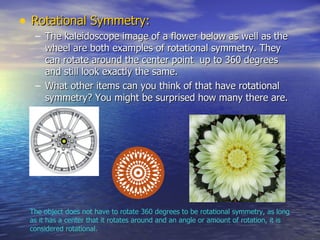
Rotational Symmetry: The kaleidoscope image of a flower below as well as the wheel are both examples of rotational symmetry. They can rotate around the center point  up to 360 degrees and still look exactly the same.  What other items can you think of that have rotational symmetry? You might be surprised how many there are.  The object does not have to rotate 360 degrees to be rotational symmetry, as long as it has a center that it rotates around and an angle or amount of rotation, it is considered rotational.
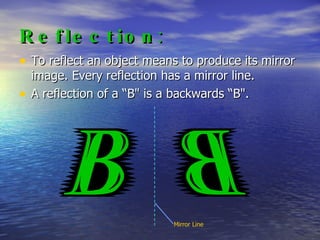
Reflection : To reflect an object means to produce its mirror image. Every reflection has a mirror line.  A reflection of a “B" is a backwards “B".  Mirror Line
Reflection: Most common form of symmetry Reflection symmetry is formed when any image is reflected or a mirror of itself on either side of the mirror line.  The Taj Mahal has both horizontal and vertical reflection symmetry.  The Vitruvian Man by Leonardo DaVinci has vertical reflection symmetry.
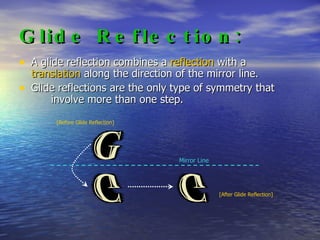
Glide Reflection: A glide reflection combines a  reflection  with a  translation  along the direction of the mirror line.  Glide reflections are the only type of symmetry that  involve more than one step.  [Before Glide Reflection] [After Glide Reflection] Mirror Line
Symmetry in 2D Shapes: In shapes such as the triangle, square, pentagon, etc. there are approximately the same number lines of symmetry as there are sides of the shape. To test this cut out shapes and fold them to find how many lines of symmetry there really are.
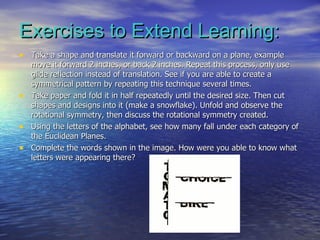
Exercises to Extend Learning: Take a shape and translate it forward or backward on a plane, example move it forward 2 inches, or back 2 inches. Repeat this process, only use glide reflection instead of translation. See if you are able to create a symmetrical pattern by repeating this technique several times.  Take paper and fold it in half repeatedly until the desired size. Then cut shapes and designs into it (make a snowflake). Unfold and observe the rotational symmetry, then discuss the rotational symmetry created. Using the letters of the alphabet, see how many fall under each category of the Euclidean Planes.  Complete the words shown in the image. How were you able to know what letters were appearing there?
References: Clip art and Animated Graphics.  http://www.adrianbruce.com/Symmetry/   Clip Art.  Microsoft Office Clip Art Gallery &quot;Euclidean plane isometry.&quot;  Wikipedia, The Free Encyclopedia . 17 Mar 2008, 16:40 UTC. Wikimedia Foundation, Inc. 12 May 2008 < http://en.wikipedia.org/w/index.php?title=Euclidean_plane_isometry&oldid=198885950 >.

Symmetry In Math

  • 1.
  • 2.
    What is Symmetry?Symmetrical = Same on both sides Symmetry: balanced proportions, or capable of division by a longitudinal plane into similar halves Symmetries preserve distances, angles, sizes, and shapes
  • 3.
    Basic Types ofSymmetry Vertical Line Horizontal Line Line Symmetry: when one half of an image is the mirror image of the other half.
  • 4.
    Where can wefind symmetry? Symmetry can be found in art, nature, sports, math, and even in the mirror. How many lines of symmetry can you find in these pictures?
  • 5.
    Types of symmetrythat transform the plane the object is on Four main types of Euclidean Planes Translation Rotation Reflection Glide Reflection Similar concepts can be found in 3-D or spatial symmetries also. The Euclidean Plane
  • 6.
    Translation: To translatean object means to move it without rotating or reflecting it. Every translation has a direction and a distance.
  • 7.
    Example of Translation:If a family of ducks all lined up in a row is moved forward or back by one, two, or more ducks they have translated on the plane. This translation does not change the appearance of the procession, it just moves it on the plane.
  • 8.
    Rotation: To rotatean object means to turn it around. Every rotation has a center and an angle. Before Rotation After Rotation Center [Angle 90˚]
  • 9.
    Rotational Symmetry: Thekaleidoscope image of a flower below as well as the wheel are both examples of rotational symmetry. They can rotate around the center point up to 360 degrees and still look exactly the same. What other items can you think of that have rotational symmetry? You might be surprised how many there are. The object does not have to rotate 360 degrees to be rotational symmetry, as long as it has a center that it rotates around and an angle or amount of rotation, it is considered rotational.
  • 10.
    Reflection : Toreflect an object means to produce its mirror image. Every reflection has a mirror line. A reflection of a “B&quot; is a backwards “B&quot;. Mirror Line
  • 11.
    Reflection: Most commonform of symmetry Reflection symmetry is formed when any image is reflected or a mirror of itself on either side of the mirror line. The Taj Mahal has both horizontal and vertical reflection symmetry. The Vitruvian Man by Leonardo DaVinci has vertical reflection symmetry.
  • 12.
    Glide Reflection: Aglide reflection combines a reflection with a translation along the direction of the mirror line. Glide reflections are the only type of symmetry that involve more than one step. [Before Glide Reflection] [After Glide Reflection] Mirror Line
  • 13.
    Symmetry in 2DShapes: In shapes such as the triangle, square, pentagon, etc. there are approximately the same number lines of symmetry as there are sides of the shape. To test this cut out shapes and fold them to find how many lines of symmetry there really are.
  • 14.
    Exercises to ExtendLearning: Take a shape and translate it forward or backward on a plane, example move it forward 2 inches, or back 2 inches. Repeat this process, only use glide reflection instead of translation. See if you are able to create a symmetrical pattern by repeating this technique several times. Take paper and fold it in half repeatedly until the desired size. Then cut shapes and designs into it (make a snowflake). Unfold and observe the rotational symmetry, then discuss the rotational symmetry created. Using the letters of the alphabet, see how many fall under each category of the Euclidean Planes. Complete the words shown in the image. How were you able to know what letters were appearing there?
  • 15.
    References: Clip artand Animated Graphics. http://www.adrianbruce.com/Symmetry/ Clip Art. Microsoft Office Clip Art Gallery &quot;Euclidean plane isometry.&quot; Wikipedia, The Free Encyclopedia . 17 Mar 2008, 16:40 UTC. Wikimedia Foundation, Inc. 12 May 2008 < http://en.wikipedia.org/w/index.php?title=Euclidean_plane_isometry&oldid=198885950 >.