honeycomb meadow
Bees & Butterflies
find it hard to survive in the concrete deserts of a city
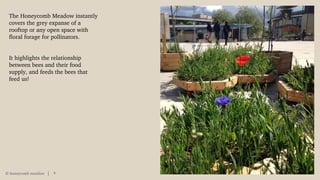
The Honeycomb Meadow instantly
covers the grey expanse of a
rooftop or any open space with
floral forage for pollinators.
It highlights the relationship
between bees and their food
supply, and feeds the bees that
feed us!
© honeycomb meadow 3
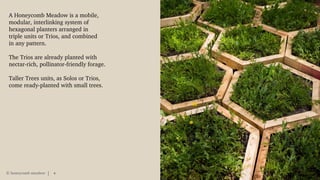
A Honeycomb Meadow is a mobile,
modular, interlinking system of
hexagonal planters arranged in
triple units or Trios, and combined
in any pattern.
The Trios are already planted with
nectar-rich, pollinator-friendly forage.
Taller Trees units, as Solos or Trios,
come ready-planted with small trees.
© honeycomb meadow 4
© honeycomb meadow 5
Suitable plants for the
Honeycomb Meadow are:
wildflowers
heathers
lavenders
campions
fleabanes
sedums
alpines
small trees
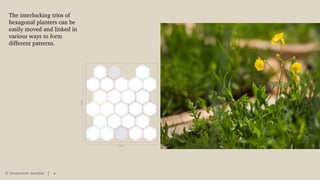
The interlocking trios of
hexagonal planters can be
easily moved and linked in
various ways to form
different patterns.
© honeycomb meadow 66
© honeycomb meadow 7
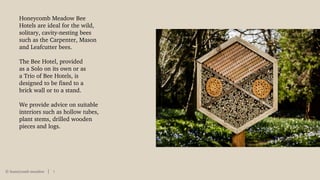
Honeycomb Meadow Bee
Hotels are ideal for the wild,
solitary, cavity-nesting bees
such as the Carpenter, Mason
and Leafcutter bees.
The Bee Hotel, provided
as a Solo on its own or as
a Trio of Bee Hotels, is
designed to be fixed to a
brick wall or to a stand.
We provide advice on suitable
interiors such as hollow tubes,
plant stems, drilled wooden
pieces and logs.
© honeycomb meadow 8
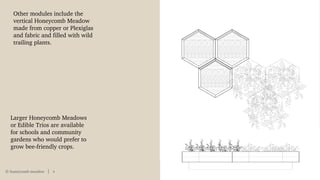
Other modules include the
vertical Honeycomb Meadow
made from copper or Plexiglas
and fabric and filled with wild
trailing plants.
Larger Honeycomb Meadows
or Edible Trios are available
for schools and community
gardens who would prefer to
grow bee-friendly crops.
© honeycomb meadow 9
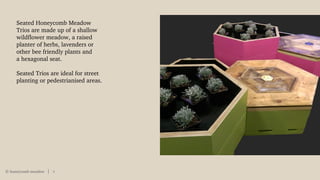
Seated Honeycomb Meadow
Trios are made up of a shallow
wildflower meadow, a raised
planter of herbs, lavenders or
other bee friendly plants and
a hexagonal seat.
Seated Trios are ideal for street
planting or pedestrianised areas.
© honeycomb meadow 10
riverofflowers.org beebristol.org
The Honeycomb Meadow supports environmental nonprofit organisations River of Flowers and Bee Bristol.

ROF_Honeycomb_v3.compressed

  • 1.
  • 2.
    Bees & Butterflies findit hard to survive in the concrete deserts of a city
  • 3.
    The Honeycomb Meadowinstantly covers the grey expanse of a rooftop or any open space with floral forage for pollinators. It highlights the relationship between bees and their food supply, and feeds the bees that feed us! © honeycomb meadow 3
  • 4.
    A Honeycomb Meadowis a mobile, modular, interlinking system of hexagonal planters arranged in triple units or Trios, and combined in any pattern. The Trios are already planted with nectar-rich, pollinator-friendly forage. Taller Trees units, as Solos or Trios, come ready-planted with small trees. © honeycomb meadow 4
  • 5.
    © honeycomb meadow5 Suitable plants for the Honeycomb Meadow are: wildflowers heathers lavenders campions fleabanes sedums alpines small trees
  • 6.
    The interlocking triosof hexagonal planters can be easily moved and linked in various ways to form different patterns. © honeycomb meadow 66
  • 7.
    © honeycomb meadow7 Honeycomb Meadow Bee Hotels are ideal for the wild, solitary, cavity-nesting bees such as the Carpenter, Mason and Leafcutter bees. The Bee Hotel, provided as a Solo on its own or as a Trio of Bee Hotels, is designed to be fixed to a brick wall or to a stand. We provide advice on suitable interiors such as hollow tubes, plant stems, drilled wooden pieces and logs.
  • 8.
    © honeycomb meadow8 Other modules include the vertical Honeycomb Meadow made from copper or Plexiglas and fabric and filled with wild trailing plants. Larger Honeycomb Meadows or Edible Trios are available for schools and community gardens who would prefer to grow bee-friendly crops.
  • 9.
    © honeycomb meadow9 Seated Honeycomb Meadow Trios are made up of a shallow wildflower meadow, a raised planter of herbs, lavenders or other bee friendly plants and a hexagonal seat. Seated Trios are ideal for street planting or pedestrianised areas.
  • 10.
    © honeycomb meadow10 riverofflowers.org beebristol.org The Honeycomb Meadow supports environmental nonprofit organisations River of Flowers and Bee Bristol.