Roland Barthes and
Levi Strauss Narrative Theories
Roland Barthes
• Roland Barthes describe that
there are five main codes which
are includes into narratives:
• The Hermeneutic Code
• The Proairetic Code
• The Semantic Code
• The Symbolic Code
• The Cultural Code
The Hermeneutic Code
• The Hermeneutic Code refers to any story that is not
explained fully which then sets mystery for the rest
of the film. The impact of this is that the reader will
keep interested throughout the story until all is
revealed in the end scene and closure is achieved.
The Proairetic Code
• The Proairetic code builds tension to upcoming
event which encourages the audience to guess
whether something will happen.
• The Hermeneutic Code and the Proairetic Code
work together as they develop the story’s enigma
and keeps the reader entertained throughout.
The Semantic Code
• The Semantic code is based on the writing side of a story. It is when
extended meanings are applied to words that enables the writer to
illustrate their creativity.
The Symbolic Code
• The Symbolic code is similar to the Semantic code. It is done in the use
of antithesis which means new meanings comes out of an opposing
and conflicting ideas.
The Cultural Code
• The Cultural code looks at the audience’s wider
cultural knowledge, morals and ideas. This cannot be
challenged as it is assumed to be a foundation on
truth.
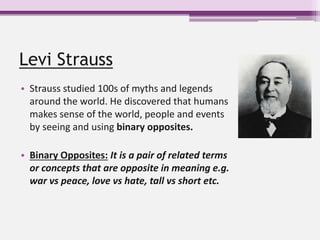
Levi Strauss
• Strauss studied 100s of myths and legends
around the world. He discovered that humans
makes sense of the world, people and events
by seeing and using binary opposites.
• Binary Opposites: It is a pair of related terms
or concepts that are opposite in meaning e.g.
war vs peace, love vs hate, tall vs short etc.
• Bathes and Strass worked together during the mid-
20th century to try and understand how certain
words affected people. They discovered that it is not
the meaning of the word, but it is our understanding
of the word and its opposite which effects how we
think. They also concluded that words are symbols
for societies, ideas and meanings.
• In conclusion, Strauss believed that the binary
opposites are the central climax of a narrative
structure.

Roland Barthes

  • 1.
    Roland Barthes and LeviStrauss Narrative Theories
  • 2.
    Roland Barthes • RolandBarthes describe that there are five main codes which are includes into narratives: • The Hermeneutic Code • The Proairetic Code • The Semantic Code • The Symbolic Code • The Cultural Code
  • 3.
    The Hermeneutic Code •The Hermeneutic Code refers to any story that is not explained fully which then sets mystery for the rest of the film. The impact of this is that the reader will keep interested throughout the story until all is revealed in the end scene and closure is achieved.
  • 4.
    The Proairetic Code •The Proairetic code builds tension to upcoming event which encourages the audience to guess whether something will happen. • The Hermeneutic Code and the Proairetic Code work together as they develop the story’s enigma and keeps the reader entertained throughout.
  • 5.
    The Semantic Code •The Semantic code is based on the writing side of a story. It is when extended meanings are applied to words that enables the writer to illustrate their creativity. The Symbolic Code • The Symbolic code is similar to the Semantic code. It is done in the use of antithesis which means new meanings comes out of an opposing and conflicting ideas.
  • 6.
    The Cultural Code •The Cultural code looks at the audience’s wider cultural knowledge, morals and ideas. This cannot be challenged as it is assumed to be a foundation on truth.
  • 7.
    Levi Strauss • Straussstudied 100s of myths and legends around the world. He discovered that humans makes sense of the world, people and events by seeing and using binary opposites. • Binary Opposites: It is a pair of related terms or concepts that are opposite in meaning e.g. war vs peace, love vs hate, tall vs short etc.
  • 8.
    • Bathes andStrass worked together during the mid- 20th century to try and understand how certain words affected people. They discovered that it is not the meaning of the word, but it is our understanding of the word and its opposite which effects how we think. They also concluded that words are symbols for societies, ideas and meanings. • In conclusion, Strauss believed that the binary opposites are the central climax of a narrative structure.