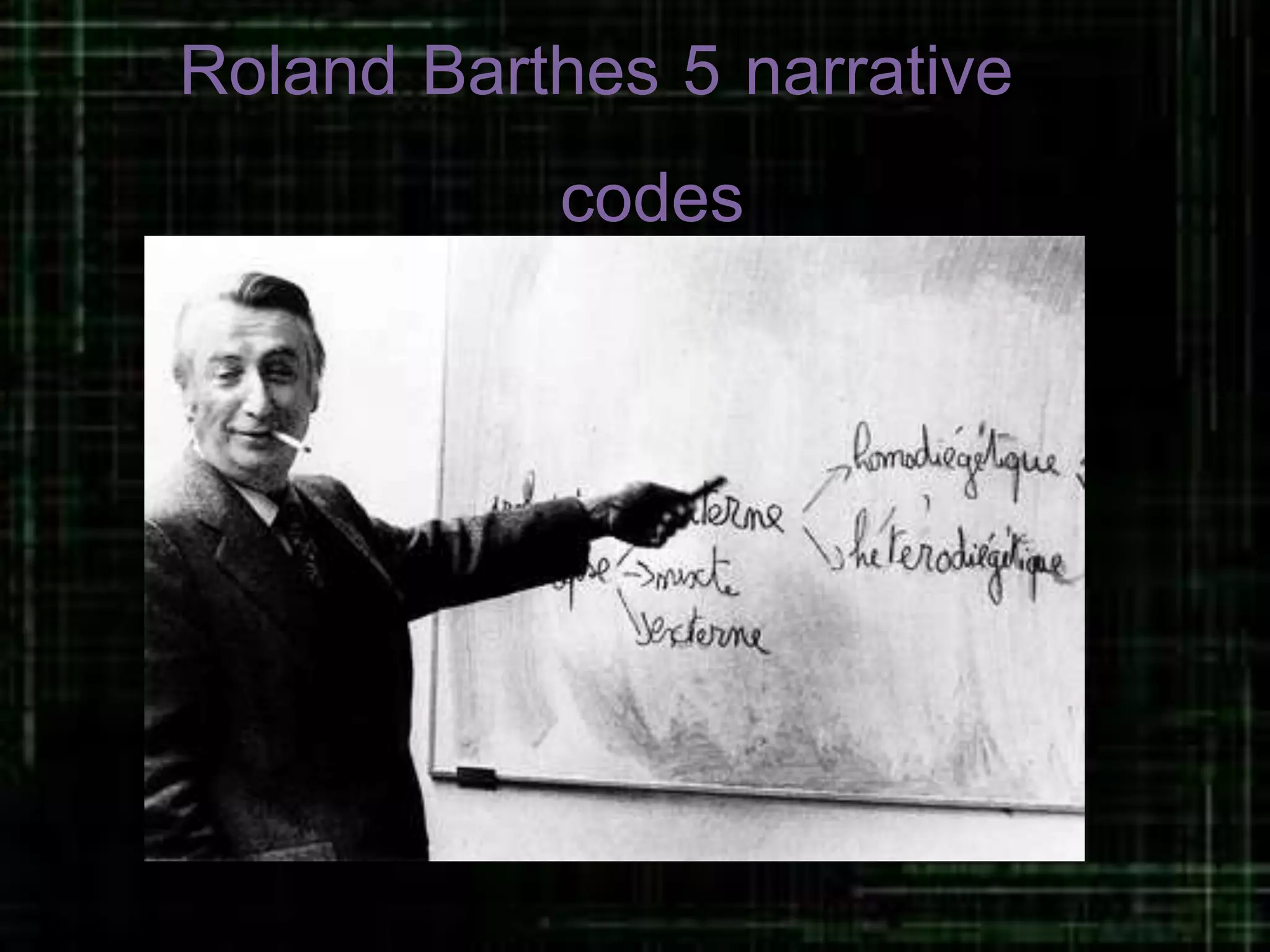
Roland Barthes 5 narrative
codes
Enigma Codes
Linguist Roland Barthes described five codes that are woven into any
narrative.
• The Hermeneutic Code
• The Proairtic Code
• The Semantic Code
• The Symbolic Code
• The Cultural Code
The Hermeneutic Code
• The Hermeneutic Code refers to any story
element of the story that is not fully explained
and hence becomes a mystery to the
audience.
• The purpose of the author in this is typically to
keep the audience guessing, which in the case
of my film I will do by keeping the McGuffin of
the object that the main character finds a
mystery within the trailer.
The Proactic Code
• The Proactic Code also builds tension, referring to any
action or event that indicates something else is going
to happen.
• The trailer for my film will use Proactic Code
throughout initially by setting up the main character as
a slightly off kilter person who seems kind of aloof and
difficult to pin exactly his feelings or thoughts at any
given moment. This ambiguity, creates in the audience
a sense of possibility as we’re not entirely certain at
any point of his motives, so at any moment he could
turn and do something completely horrendous.
The Semantic Code
• This code refers to the point within the text that suggests or
refers to additional meanings.
• Initially at the start of my trailer there is little indication of
the horror that will unfold during the course of the film.
Audiences will hopefully relate the start of the film to other
films about quarter life crisis, so when halfway through the
trailer the true nature of the film hits it will jar the
audience. In one shot in the trailer the character will be
framed against a wall with a photo of Franz Kafka on it
suggesting to the audience for the film who I expect will
probably recognise him, to wonder if the film is possibly
allegorical, and if the events in the film may take on a
Kafkaesque, surreal quality.
The Symbolic Code
• This code is about symbolism in the text. It exercises
opposites to show contrast and create greater meaning,
creating drama and character development.
• In my film the character will initially be wearing a deep
purple hoodie, a colour which has a slightly ambiguity in
the way audiences will interpret it, creating a mystery
about the main character, and his intentions. The colour is
an enigma in that in both conjures up power and royalty,
which also representing femininity and peacefulness, which
is probably the reason it is so often worn by figures of
power throughout the whole world. Because of the use of
the colour purple the audience will never quiet be sure if
the character is in control of what’s going on, or whether
he has fallen into anarchy
Referential Code
• This code refers to anything within the text which
refers to an external body of knowledge such as
scientific, historical and cultural knowledge
• My film is mostly set in a contempary modern
urban city so all scientific, historical and cultural
knowledge imparted within the film will
reference modern day England. There is a brief
flashback to Russia in the 1960’s, which in the
final film will have Stalin and Lenin posters
everywhere, and people will dressed in 1960’s
Russian clothing.

Enigma codes

  • 1.
    Roland Barthes 5narrative codes
  • 2.
    Enigma Codes Linguist RolandBarthes described five codes that are woven into any narrative. • The Hermeneutic Code • The Proairtic Code • The Semantic Code • The Symbolic Code • The Cultural Code
  • 3.
    The Hermeneutic Code •The Hermeneutic Code refers to any story element of the story that is not fully explained and hence becomes a mystery to the audience. • The purpose of the author in this is typically to keep the audience guessing, which in the case of my film I will do by keeping the McGuffin of the object that the main character finds a mystery within the trailer.
  • 4.
    The Proactic Code •The Proactic Code also builds tension, referring to any action or event that indicates something else is going to happen. • The trailer for my film will use Proactic Code throughout initially by setting up the main character as a slightly off kilter person who seems kind of aloof and difficult to pin exactly his feelings or thoughts at any given moment. This ambiguity, creates in the audience a sense of possibility as we’re not entirely certain at any point of his motives, so at any moment he could turn and do something completely horrendous.
  • 5.
    The Semantic Code •This code refers to the point within the text that suggests or refers to additional meanings. • Initially at the start of my trailer there is little indication of the horror that will unfold during the course of the film. Audiences will hopefully relate the start of the film to other films about quarter life crisis, so when halfway through the trailer the true nature of the film hits it will jar the audience. In one shot in the trailer the character will be framed against a wall with a photo of Franz Kafka on it suggesting to the audience for the film who I expect will probably recognise him, to wonder if the film is possibly allegorical, and if the events in the film may take on a Kafkaesque, surreal quality.
  • 6.
    The Symbolic Code •This code is about symbolism in the text. It exercises opposites to show contrast and create greater meaning, creating drama and character development. • In my film the character will initially be wearing a deep purple hoodie, a colour which has a slightly ambiguity in the way audiences will interpret it, creating a mystery about the main character, and his intentions. The colour is an enigma in that in both conjures up power and royalty, which also representing femininity and peacefulness, which is probably the reason it is so often worn by figures of power throughout the whole world. Because of the use of the colour purple the audience will never quiet be sure if the character is in control of what’s going on, or whether he has fallen into anarchy
  • 7.
    Referential Code • Thiscode refers to anything within the text which refers to an external body of knowledge such as scientific, historical and cultural knowledge • My film is mostly set in a contempary modern urban city so all scientific, historical and cultural knowledge imparted within the film will reference modern day England. There is a brief flashback to Russia in the 1960’s, which in the final film will have Stalin and Lenin posters everywhere, and people will dressed in 1960’s Russian clothing.