
It has been a pleasure to introduce this practical book for medical students. As we know,
Pharmacology is the science of drugs including their origin, composition, pharmacokinetics,
pharmacodynamics, therapeutic use, and toxicology which make it a vast subject to deal with.
CBME (Competency Based Medical Education) curriculum is available for medical students
who were drowning in the sea of old information. Now the students will be able to inculcate
new competencies which include different skills, knowledge and attitude which a student
should possess while dealing with the patients keeping their behaviour within ethical
boundaries. The topics explained in the manual are given with relevant examples along with
the case scenarios wherever it is required for better grasping of the topic by the students.
The main aim of writing this book is to create awareness among the medical students about
the importance and requirement of ethical principles and moral conduct of a qualified
professional doctor while approaching the patient and also educate them about various aspects
of drug use, hands on training for administration of drugs, writing a rational prescription,
identifying & reporting adverse drug reactions also to motivate chronically ill patients to
adhere to the prescribed treatment. Sincere effort has been made to provide the relevant
content based on new competencies for the better and easy understanding of the medical
students.
New relevant competencies have been added to the second edition of the book. Colored graphs
to demonstrate the effects of drugs on BP have also been included. Students of MBBS
(Medicinae Baccalaureus Baccalaureus Chirurgiae) and other courses related to healthcare will
be benefitted through this book.
We want to convey our heartfelt gratitude to Prof. Waseem Rizvi, Chairman, Department of
Pharmacology for providing valuable inputs and support in bringing out this book. We also
thank Prof. Mohammad Nasiruddin, Prof. Syed Ziaur Rehman, Prof. Farhan Ahmad Khan, Dr.
Syed Shariq Naeem and Dr. Irfan Ahmad Khan for their co-operation throughout the process
involved in writing this book. We appreciate the senior and junior resident doctors for their
inputs and assistance.
We are thankful to Writersgram Publications for their professional accuracy and remarkable
services that shaped this book as required and delivered best results. Any constructive criticism
or suggestions for the improvement of content are welcome.
Authors
S.
No.
Competency
Number
TOPICS Page No.
Logbook 9-11
Introduction 13-14
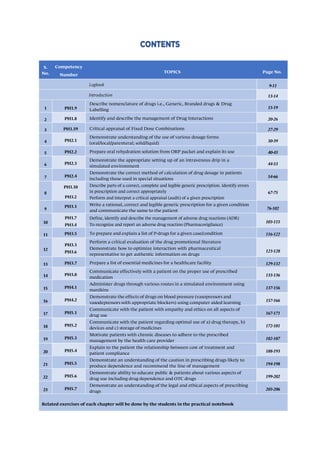
1 PH1.9
Describe nomenclature of drugs i.e., Generic, Branded drugs & Drug
Labelling
15-19
2 PH1.8 Identify and describe the management of Drug Interactions 20-26
3 PH1.59 Critical appraisal of Fixed Dose Combinations 27-29
4 PH2.1
Demonstrate understanding of the use of various dosage forms
(oral/local/parenteral; solid/liquid)
30-39
5 PH2.2 Prepare oral rehydration solution from ORP packet and explain its use 40-43
6 PH2.3
Demonstrate the appropriate setting up of an intravenous drip in a
simulated environment
44-53
7 PH2.4
Demonstrate the correct method of calculation of drug dosage in patients
including those used in special situations
54-66
8
PH1.10
PH3.2
Describe parts of a correct, complete and legible generic prescription. Identify errors
in prescription and correct appropriately
Perform and interpret a critical appraisal (audit) of a given prescription
67-75
9
PH3.1 Write a rational, correct and legible generic prescription for a given condition
and communicate the same to the patient
76-102
10
PH1.7
PH3.4
Define, identify and describe the management of adverse drug reactions (ADR)
To recognize and report an adverse drug reaction (Pharmacovigilance)
103-115
11 PH3.5 To prepare and explain a list of P-drugs for a given case/condition 116-122
12
PH3.3
PH3.6
Perform a critical evaluation of the drug promotional literature
Demonstrate how to optimize interaction with pharmaceutical
representative to get authentic information on drugs
123-128
13 PH3.7 Prepare a list of essential medicines for a healthcare facility 129-132
14 PH3.8
Communicate effectively with a patient on the proper use of prescribed
medication
133-136
15 PH4.1
Administer drugs through various routes in a simulated environment using
manikins 137-156
16 PH4.2
Demonstrate the effects of drugs on blood pressure (vasopressors and
vasodepressors with appropriate blockers) using computer aided learning
157-166
17 PH5.1
Communicate with the patient with empathy and ethics on all aspects of
drug use 167-171
18 PH5.2
Communicate with the patient regarding optimal use of a) drug therapy, b)
devices and c) storage of medicines
172-181
19 PH5.3
Motivate patients with chronic diseases to adhere to the prescribed
management by the health care provider 182-187
20 PH5.4
Explain to the patient the relationship between cost of treatment and
patient compliance
188-193
21 PH5.5
Demonstrate an understanding of the caution in prescribing drugs likely to
produce dependence and recommend the line of management 194-198
22 PH5.6
Demonstrate ability to educate public & patients about various aspects of
drug use including drug dependence and OTC drugs
199-202
23 PH5.7
Demonstrate an understanding of the legal and ethical aspects of prescribing
drugs 203-206
Related exercises of each chapter will be done by the students in the practical notebook
13
The literature in this manual has been organised according to the outlines of learning set by
the MCI/NMC under the concept of “Competency based undergraduate curriculum for the
Indian medical graduate”. The idea is to create an “Indian Medical Graduate” (IMG) possessing
requisite knowledge, skills, attitudes, values and responsiveness, so that she or he may function
appropriately and effectively as a physician of first contact of the community while being
globally relevant.
This manual has been prepared with the intention to educate an upcoming doctor about not
only the drug or medicine but to know the details of the various dosage forms and the most
appropriate route adopted for the same and to develop the rationality as to which drug is best
suited for his patient in what dose keeping in mind the essential drug list of his/her hospital.
The trainee doctors should be well aware of the adverse effects which could follow after the
drugs are prescribed to the patients and also the method required for reporting the ADR to the
Indian Pharmacopoeia Commission (IPC) through Vigiflow in events of such occurrence.
CBME curriculum aims at producing skilled and efficient physicians who could very effectively
choose a P-drug for their patients. SKILL DEVELOPMENT is a key target of this curriculum
and this manual focuses on the same. Exercises to train students using manikins, instruments
and devices to administer drugs to the patients have been included. This manual is based on
new curriculum designed by NMC/MCI keeping in mind that the student learns the theory and
practical skills as well as gains the ability to understand the problems of his/her patients and
develop empathy for the patients. Students will be trained to communicate with the patients
regarding all aspects of proper usage of drugs including storage of drugs and compliance with
the therapy especially in patients suffering from chronic diseases for improving therapeutic
outcome.
This manual aims to make the students able to prescribe drugs for the commonly occurring
communicable and non-communicable diseases in the correct format with the rational
approach at the end of their 2nd
professional. Students would be sensitized about ways to
optimize interaction with the pharmaceutical representatives and critically assess the drug
promotional literature. Thorough knowledge of the subject will help the student to practice
rational prescription of medicines by avoiding over usage of drugs which has been a serious
and common mistake by many medical professionals.
14
Goal of this practical manual is to nurture a Clinician, who understands and provides
preventive, promotive, curative, palliative and holistic care with compassion. Students must
cultivate a professional relationship with patients and communicate adequately, sensitively,
effectively and respectfully with the patient in a language that the patient understands and in
a manner that will improve patient satisfaction and health care outcomes. This manual will
instill the practice to apply newly attained knowledge and skill to patient care.
Through this manual, we intend to produce future medical professionals who are committed
to excellence, with ethical and accountable behaviour towards the society and patient.
157
________________________________________________________________________________
BLOOD PRESSURE
Definition
The force exerted by the blood against any unit area of the vessel wall.
Blood pressure is measured in millimetres of mercury (mmHg).
Systolic blood pressure
Pressure exerted by blood on aortic wall while the ventricles are contracting.
Normal value: 120 – 129 mmHg
Diastolic blood pressure
Pressure exerted by blood on aortic wall while the ventricles are relaxing.
Normal value: 80- 84 mmHg
Measurement of blood pressure
• The arterial blood pressure in humans is routinely measured by the auscultatory method
• An inflatable cuff (Riva-Rocci cuff) attached to a mercury manometer
(sphygmomanometer) is wrapped around the arm and a stethoscope is placed over the
brachial artery at the elbow
• The cuff is rapidly inflated until the pressure is well above the expected systolic pressure in
the brachial artery
• The artery is occluded by the cuff, and no sound is heard with the stethoscope
• The pressure in the cuff is then lowered slowly
• The point at which systolic pressure in the artery just exceeds the cuff pressure, a spurt of
blood passes through with each heartbeat and, synchronously with each beat; a tapping
sound is heard below the cuff
158
• The cuff pressure at which the sounds are first heard is the systolic pressure
• As the cuff pressure is lowered further, the sounds become louder, then dull and muffled
• These are the sounds of Korotkoff
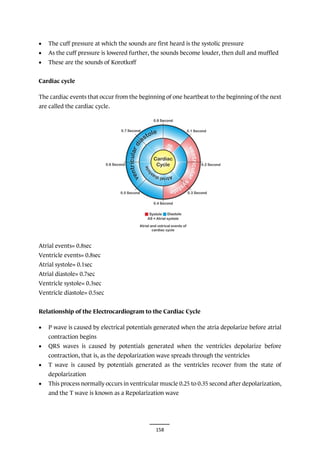
Cardiac cycle
The cardiac events that occur from the beginning of one heartbeat to the beginning of the next
are called the cardiac cycle.
Atrial events= 0.8sec
Ventricle events= 0.8sec
Atrial systole= 0.1sec
Atrial diastole= 0.7sec
Ventricle systole= 0.3sec
Ventricle diastole= 0.5sec
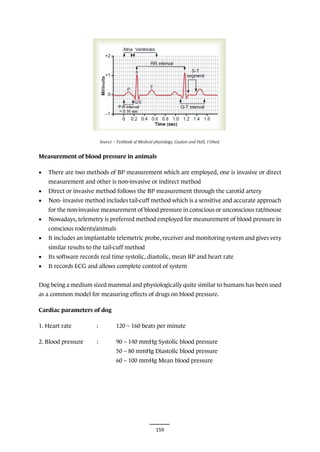
Relationship of the Electrocardiogram to the Cardiac Cycle
• P wave is caused by electrical potentials generated when the atria depolarize before atrial
contraction begins
• QRS waves is caused by potentials generated when the ventricles depolarize before
contraction, that is, as the depolarization wave spreads through the ventricles
• T wave is caused by potentials generated as the ventricles recover from the state of
depolarization
• This process normally occurs in ventricular muscle 0.25 to 0.35 second after depolarization,
and the T wave is known as a Repolarization wave
159
Source – Textbook of Medical physiology, Guyton and Hall, 11thed.
Measurement of blood pressure in animals
• There are two methods of BP measurement which are employed, one is invasive or direct
measurement and other is non-invasive or indirect method
• Direct or invasive method follows the BP measurement through the carotid artery
• Non- invasive method includes tail-cuff method which is a sensitive and accurate approach
for the non-invasive measurement of blood pressure in conscious or unconscious rat/mouse
• Nowadays, telemetry is preferred method employed for measurement of blood pressure in
conscious rodents/animals
• It includes an implantable telemetric probe, receiver and monitoring system and gives very
similar results to the tail-cuff method
• Its software records real time systolic, diastolic, mean BP and heart rate
• It records ECG and allows complete control of system
Dog being a medium sized mammal and physiologically quite similar to humans has been used
as a common model for measuring effects of drugs on blood pressure.
Cardiac parameters of dog
1. Heart rate : 120 – 160 beats per minute
2. Blood pressure : 90 – 140 mmHg Systolic blood pressure
50 – 80 mmHg Diastolic blood pressure
60 – 100 mmHg Mean blood pressure
160
Cardiac activity is measured using the given parameters
Rate: It is the number of contractions of the heart in a unit time. It can be counted as the
number of contractions in 1 cm length of a graph.
Amplitude: It represents the force of contraction of the heart. It is measured as the maximum
height from the baseline.
Tone: Tone is the state of partial contraction of the muscle. It is represented by baseline.
Increase in tone is represented by elevation of the baseline and vice-versa.
Study the effect of following drugs on blood pressure and heart rate
a. Epinephrine (EPI)
b. Nor-epinephrine (NE)
c. Isoprenaline (ISO)
d. Ephedrine (EPH)
e. Propranolol (PROP)
f. Phentolamine (PHE)
g. Acetylcholine (ACh)
h. Atropine (ATRO)
161
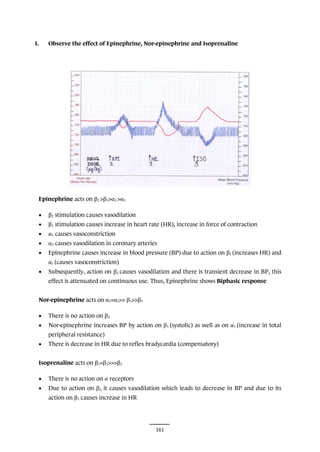
I. Observe the effect of Epinephrine, Nor-epinephrine and Isoprenaline
Epinephrine acts on β2 >β1>α2 >α1
• β2 stimulation causes vasodilation
• β1 stimulation causes increase in heart rate (HR), increase in force of contraction
• α1 causes vasoconstriction
• α2 causes vasodilation in coronary arteries
• Epinephrine causes increase in blood pressure (BP) due to action on β1 (increases HR) and
α1 (causes vasoconstriction)
• Subsequently, action on β2 causes vasodilation and there is transient decrease in BP, this
effect is attenuated on continuous use. Thus, Epinephrine shows Biphasic response
Nor-epinephrine acts on α1=α2>> β1>>β3
• There is no action on β2
• Nor-epinephrine increases BP by action on β1 (systolic) as well as on α1 (increase in total
peripheral resistance)
• There is decrease in HR due to reflex bradycardia (compensatory)
Isoprenaline acts on β1=β2>>>β3
• There is no action on α receptors
• Due to action on β2, it causes vasodilation which leads to decrease in BP and due to its
action on β1 causes increase in HR
162
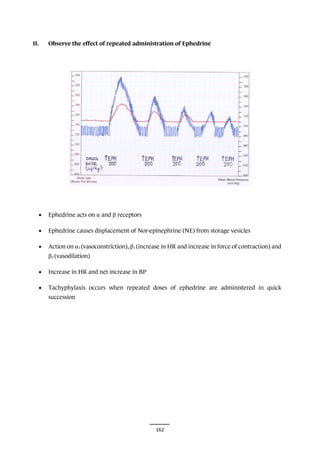
II. Observe the effect of repeated administration of Ephedrine
• Ephedrine acts on α and β receptors
• Ephedrine causes displacement of Nor-epinephrine (NE) from storage vesicles
• Action on α1 (vasoconstriction), β1 (increase in HR and increase in force of contraction) and
β2 (vasodilation)
• Increase in HR and net increase in BP
• Tachyphylaxis occurs when repeated doses of ephedrine are administered in quick
succession
163
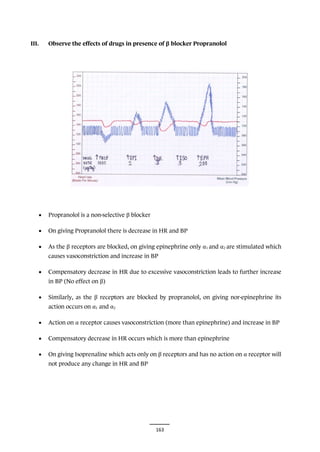
III. Observe the effects of drugs in presence of β blocker Propranolol
• Propranolol is a non-selective β blocker
• On giving Propranolol there is decrease in HR and BP
• As the β receptors are blocked, on giving epinephrine only α1 and α2 are stimulated which
causes vasoconstriction and increase in BP
• Compensatory decrease in HR due to excessive vasoconstriction leads to further increase
in BP (No effect on β)
• Similarly, as the β receptors are blocked by propranolol, on giving nor-epinephrine its
action occurs on α1 and α2
• Action on α receptor causes vasoconstriction (more than epinephrine) and increase in BP
• Compensatory decrease in HR occurs which is more than epinephrine
• On giving Isoprenaline which acts only on β receptors and has no action on α receptor will
not produce any change in HR and BP
164
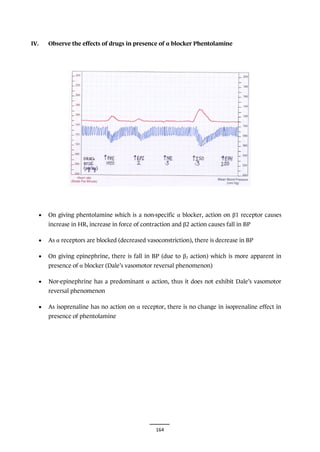
IV. Observe the effects of drugs in presence of α blocker Phentolamine
• On giving phentolamine which is a non-specific α blocker, action on β1 receptor causes
increase in HR, increase in force of contraction and β2 action causes fall in BP
• As α receptors are blocked (decreased vasoconstriction), there is decrease in BP
• On giving epinephrine, there is fall in BP (due to β2 action) which is more apparent in
presence of α blocker (Dale’s vasomotor reversal phenomenon)
• Nor-epinephrine has a predominant α action, thus it does not exhibit Dale’s vasomotor
reversal phenomenon
• As isoprenaline has no action on α receptor, there is no change in isoprenaline effect in
presence of phentolamine
165
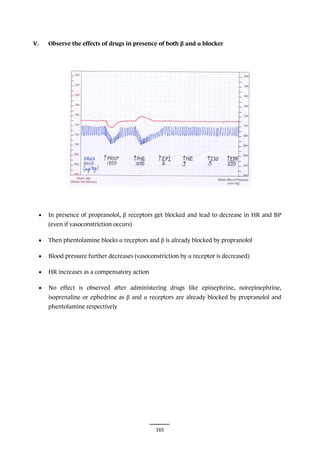
V. Observe the effects of drugs in presence of both β and α blocker
• In presence of propranolol, β receptors get blocked and lead to decrease in HR and BP
(even if vasoconstriction occurs)
• Then phentolamine blocks α receptors and β is already blocked by propranolol
• Blood pressure further decreases (vasoconstriction by α receptor is decreased)
• HR increases as a compensatory action
• No effect is observed after administering drugs like epinephrine, norepinephrine,
isoprenaline or ephedrine as β and α receptors are already blocked by propranolol and
phentolamine respectively
166
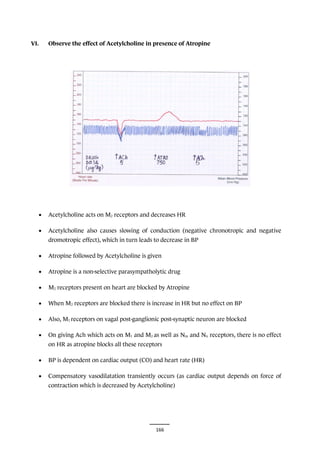
VI. Observe the effect of Acetylcholine in presence of Atropine
• Acetylcholine acts on M2 receptors and decreases HR
• Acetylcholine also causes slowing of conduction (negative chronotropic and negative
dromotropic effect), which in turn leads to decrease in BP
• Atropine followed by Acetylcholine is given
• Atropine is a non-selective parasympatholytic drug
• M2 receptors present on heart are blocked by Atropine
• When M2 receptors are blocked there is increase in HR but no effect on BP
• Also, M1 receptors on vagal post-ganglionic post-synaptic neuron are blocked
• On giving Ach which acts on M1 and M2 as well as Nm and Nn receptors, there is no effect
on HR as atropine blocks all these receptors
• BP is dependent on cardiac output (CO) and heart rate (HR)
• Compensatory vasodilatation transiently occurs (as cardiac output depends on force of
contraction which is decreased by Acetylcholine)
Sample pdf CBME Practical Pharmacology 2nd Edition.pdf

Sample pdf CBME Practical Pharmacology 2nd Edition.pdf

  • 3.
    It has beena pleasure to introduce this practical book for medical students. As we know, Pharmacology is the science of drugs including their origin, composition, pharmacokinetics, pharmacodynamics, therapeutic use, and toxicology which make it a vast subject to deal with. CBME (Competency Based Medical Education) curriculum is available for medical students who were drowning in the sea of old information. Now the students will be able to inculcate new competencies which include different skills, knowledge and attitude which a student should possess while dealing with the patients keeping their behaviour within ethical boundaries. The topics explained in the manual are given with relevant examples along with the case scenarios wherever it is required for better grasping of the topic by the students. The main aim of writing this book is to create awareness among the medical students about the importance and requirement of ethical principles and moral conduct of a qualified professional doctor while approaching the patient and also educate them about various aspects of drug use, hands on training for administration of drugs, writing a rational prescription, identifying & reporting adverse drug reactions also to motivate chronically ill patients to adhere to the prescribed treatment. Sincere effort has been made to provide the relevant content based on new competencies for the better and easy understanding of the medical students. New relevant competencies have been added to the second edition of the book. Colored graphs to demonstrate the effects of drugs on BP have also been included. Students of MBBS (Medicinae Baccalaureus Baccalaureus Chirurgiae) and other courses related to healthcare will be benefitted through this book. We want to convey our heartfelt gratitude to Prof. Waseem Rizvi, Chairman, Department of Pharmacology for providing valuable inputs and support in bringing out this book. We also thank Prof. Mohammad Nasiruddin, Prof. Syed Ziaur Rehman, Prof. Farhan Ahmad Khan, Dr. Syed Shariq Naeem and Dr. Irfan Ahmad Khan for their co-operation throughout the process involved in writing this book. We appreciate the senior and junior resident doctors for their inputs and assistance. We are thankful to Writersgram Publications for their professional accuracy and remarkable services that shaped this book as required and delivered best results. Any constructive criticism or suggestions for the improvement of content are welcome. Authors
  • 4.
    S. No. Competency Number TOPICS Page No. Logbook9-11 Introduction 13-14 1 PH1.9 Describe nomenclature of drugs i.e., Generic, Branded drugs & Drug Labelling 15-19 2 PH1.8 Identify and describe the management of Drug Interactions 20-26 3 PH1.59 Critical appraisal of Fixed Dose Combinations 27-29 4 PH2.1 Demonstrate understanding of the use of various dosage forms (oral/local/parenteral; solid/liquid) 30-39 5 PH2.2 Prepare oral rehydration solution from ORP packet and explain its use 40-43 6 PH2.3 Demonstrate the appropriate setting up of an intravenous drip in a simulated environment 44-53 7 PH2.4 Demonstrate the correct method of calculation of drug dosage in patients including those used in special situations 54-66 8 PH1.10 PH3.2 Describe parts of a correct, complete and legible generic prescription. Identify errors in prescription and correct appropriately Perform and interpret a critical appraisal (audit) of a given prescription 67-75 9 PH3.1 Write a rational, correct and legible generic prescription for a given condition and communicate the same to the patient 76-102 10 PH1.7 PH3.4 Define, identify and describe the management of adverse drug reactions (ADR) To recognize and report an adverse drug reaction (Pharmacovigilance) 103-115 11 PH3.5 To prepare and explain a list of P-drugs for a given case/condition 116-122 12 PH3.3 PH3.6 Perform a critical evaluation of the drug promotional literature Demonstrate how to optimize interaction with pharmaceutical representative to get authentic information on drugs 123-128 13 PH3.7 Prepare a list of essential medicines for a healthcare facility 129-132 14 PH3.8 Communicate effectively with a patient on the proper use of prescribed medication 133-136 15 PH4.1 Administer drugs through various routes in a simulated environment using manikins 137-156 16 PH4.2 Demonstrate the effects of drugs on blood pressure (vasopressors and vasodepressors with appropriate blockers) using computer aided learning 157-166 17 PH5.1 Communicate with the patient with empathy and ethics on all aspects of drug use 167-171 18 PH5.2 Communicate with the patient regarding optimal use of a) drug therapy, b) devices and c) storage of medicines 172-181 19 PH5.3 Motivate patients with chronic diseases to adhere to the prescribed management by the health care provider 182-187 20 PH5.4 Explain to the patient the relationship between cost of treatment and patient compliance 188-193 21 PH5.5 Demonstrate an understanding of the caution in prescribing drugs likely to produce dependence and recommend the line of management 194-198 22 PH5.6 Demonstrate ability to educate public & patients about various aspects of drug use including drug dependence and OTC drugs 199-202 23 PH5.7 Demonstrate an understanding of the legal and ethical aspects of prescribing drugs 203-206 Related exercises of each chapter will be done by the students in the practical notebook
  • 5.
    13 The literature inthis manual has been organised according to the outlines of learning set by the MCI/NMC under the concept of “Competency based undergraduate curriculum for the Indian medical graduate”. The idea is to create an “Indian Medical Graduate” (IMG) possessing requisite knowledge, skills, attitudes, values and responsiveness, so that she or he may function appropriately and effectively as a physician of first contact of the community while being globally relevant. This manual has been prepared with the intention to educate an upcoming doctor about not only the drug or medicine but to know the details of the various dosage forms and the most appropriate route adopted for the same and to develop the rationality as to which drug is best suited for his patient in what dose keeping in mind the essential drug list of his/her hospital. The trainee doctors should be well aware of the adverse effects which could follow after the drugs are prescribed to the patients and also the method required for reporting the ADR to the Indian Pharmacopoeia Commission (IPC) through Vigiflow in events of such occurrence. CBME curriculum aims at producing skilled and efficient physicians who could very effectively choose a P-drug for their patients. SKILL DEVELOPMENT is a key target of this curriculum and this manual focuses on the same. Exercises to train students using manikins, instruments and devices to administer drugs to the patients have been included. This manual is based on new curriculum designed by NMC/MCI keeping in mind that the student learns the theory and practical skills as well as gains the ability to understand the problems of his/her patients and develop empathy for the patients. Students will be trained to communicate with the patients regarding all aspects of proper usage of drugs including storage of drugs and compliance with the therapy especially in patients suffering from chronic diseases for improving therapeutic outcome. This manual aims to make the students able to prescribe drugs for the commonly occurring communicable and non-communicable diseases in the correct format with the rational approach at the end of their 2nd professional. Students would be sensitized about ways to optimize interaction with the pharmaceutical representatives and critically assess the drug promotional literature. Thorough knowledge of the subject will help the student to practice rational prescription of medicines by avoiding over usage of drugs which has been a serious and common mistake by many medical professionals.
  • 6.
    14 Goal of thispractical manual is to nurture a Clinician, who understands and provides preventive, promotive, curative, palliative and holistic care with compassion. Students must cultivate a professional relationship with patients and communicate adequately, sensitively, effectively and respectfully with the patient in a language that the patient understands and in a manner that will improve patient satisfaction and health care outcomes. This manual will instill the practice to apply newly attained knowledge and skill to patient care. Through this manual, we intend to produce future medical professionals who are committed to excellence, with ethical and accountable behaviour towards the society and patient.
  • 7.
    157 ________________________________________________________________________________ BLOOD PRESSURE Definition The forceexerted by the blood against any unit area of the vessel wall. Blood pressure is measured in millimetres of mercury (mmHg). Systolic blood pressure Pressure exerted by blood on aortic wall while the ventricles are contracting. Normal value: 120 – 129 mmHg Diastolic blood pressure Pressure exerted by blood on aortic wall while the ventricles are relaxing. Normal value: 80- 84 mmHg Measurement of blood pressure • The arterial blood pressure in humans is routinely measured by the auscultatory method • An inflatable cuff (Riva-Rocci cuff) attached to a mercury manometer (sphygmomanometer) is wrapped around the arm and a stethoscope is placed over the brachial artery at the elbow • The cuff is rapidly inflated until the pressure is well above the expected systolic pressure in the brachial artery • The artery is occluded by the cuff, and no sound is heard with the stethoscope • The pressure in the cuff is then lowered slowly • The point at which systolic pressure in the artery just exceeds the cuff pressure, a spurt of blood passes through with each heartbeat and, synchronously with each beat; a tapping sound is heard below the cuff
  • 8.
    158 • The cuffpressure at which the sounds are first heard is the systolic pressure • As the cuff pressure is lowered further, the sounds become louder, then dull and muffled • These are the sounds of Korotkoff Cardiac cycle The cardiac events that occur from the beginning of one heartbeat to the beginning of the next are called the cardiac cycle. Atrial events= 0.8sec Ventricle events= 0.8sec Atrial systole= 0.1sec Atrial diastole= 0.7sec Ventricle systole= 0.3sec Ventricle diastole= 0.5sec Relationship of the Electrocardiogram to the Cardiac Cycle • P wave is caused by electrical potentials generated when the atria depolarize before atrial contraction begins • QRS waves is caused by potentials generated when the ventricles depolarize before contraction, that is, as the depolarization wave spreads through the ventricles • T wave is caused by potentials generated as the ventricles recover from the state of depolarization • This process normally occurs in ventricular muscle 0.25 to 0.35 second after depolarization, and the T wave is known as a Repolarization wave
  • 9.
    159 Source – Textbookof Medical physiology, Guyton and Hall, 11thed. Measurement of blood pressure in animals • There are two methods of BP measurement which are employed, one is invasive or direct measurement and other is non-invasive or indirect method • Direct or invasive method follows the BP measurement through the carotid artery • Non- invasive method includes tail-cuff method which is a sensitive and accurate approach for the non-invasive measurement of blood pressure in conscious or unconscious rat/mouse • Nowadays, telemetry is preferred method employed for measurement of blood pressure in conscious rodents/animals • It includes an implantable telemetric probe, receiver and monitoring system and gives very similar results to the tail-cuff method • Its software records real time systolic, diastolic, mean BP and heart rate • It records ECG and allows complete control of system Dog being a medium sized mammal and physiologically quite similar to humans has been used as a common model for measuring effects of drugs on blood pressure. Cardiac parameters of dog 1. Heart rate : 120 – 160 beats per minute 2. Blood pressure : 90 – 140 mmHg Systolic blood pressure 50 – 80 mmHg Diastolic blood pressure 60 – 100 mmHg Mean blood pressure
  • 10.
    160 Cardiac activity ismeasured using the given parameters Rate: It is the number of contractions of the heart in a unit time. It can be counted as the number of contractions in 1 cm length of a graph. Amplitude: It represents the force of contraction of the heart. It is measured as the maximum height from the baseline. Tone: Tone is the state of partial contraction of the muscle. It is represented by baseline. Increase in tone is represented by elevation of the baseline and vice-versa. Study the effect of following drugs on blood pressure and heart rate a. Epinephrine (EPI) b. Nor-epinephrine (NE) c. Isoprenaline (ISO) d. Ephedrine (EPH) e. Propranolol (PROP) f. Phentolamine (PHE) g. Acetylcholine (ACh) h. Atropine (ATRO)
  • 11.
    161 I. Observe theeffect of Epinephrine, Nor-epinephrine and Isoprenaline Epinephrine acts on β2 >β1>α2 >α1 • β2 stimulation causes vasodilation • β1 stimulation causes increase in heart rate (HR), increase in force of contraction • α1 causes vasoconstriction • α2 causes vasodilation in coronary arteries • Epinephrine causes increase in blood pressure (BP) due to action on β1 (increases HR) and α1 (causes vasoconstriction) • Subsequently, action on β2 causes vasodilation and there is transient decrease in BP, this effect is attenuated on continuous use. Thus, Epinephrine shows Biphasic response Nor-epinephrine acts on α1=α2>> β1>>β3 • There is no action on β2 • Nor-epinephrine increases BP by action on β1 (systolic) as well as on α1 (increase in total peripheral resistance) • There is decrease in HR due to reflex bradycardia (compensatory) Isoprenaline acts on β1=β2>>>β3 • There is no action on α receptors • Due to action on β2, it causes vasodilation which leads to decrease in BP and due to its action on β1 causes increase in HR
  • 12.
    162 II. Observe theeffect of repeated administration of Ephedrine • Ephedrine acts on α and β receptors • Ephedrine causes displacement of Nor-epinephrine (NE) from storage vesicles • Action on α1 (vasoconstriction), β1 (increase in HR and increase in force of contraction) and β2 (vasodilation) • Increase in HR and net increase in BP • Tachyphylaxis occurs when repeated doses of ephedrine are administered in quick succession
  • 13.
    163 III. Observe theeffects of drugs in presence of β blocker Propranolol • Propranolol is a non-selective β blocker • On giving Propranolol there is decrease in HR and BP • As the β receptors are blocked, on giving epinephrine only α1 and α2 are stimulated which causes vasoconstriction and increase in BP • Compensatory decrease in HR due to excessive vasoconstriction leads to further increase in BP (No effect on β) • Similarly, as the β receptors are blocked by propranolol, on giving nor-epinephrine its action occurs on α1 and α2 • Action on α receptor causes vasoconstriction (more than epinephrine) and increase in BP • Compensatory decrease in HR occurs which is more than epinephrine • On giving Isoprenaline which acts only on β receptors and has no action on α receptor will not produce any change in HR and BP
  • 14.
    164 IV. Observe theeffects of drugs in presence of α blocker Phentolamine • On giving phentolamine which is a non-specific α blocker, action on β1 receptor causes increase in HR, increase in force of contraction and β2 action causes fall in BP • As α receptors are blocked (decreased vasoconstriction), there is decrease in BP • On giving epinephrine, there is fall in BP (due to β2 action) which is more apparent in presence of α blocker (Dale’s vasomotor reversal phenomenon) • Nor-epinephrine has a predominant α action, thus it does not exhibit Dale’s vasomotor reversal phenomenon • As isoprenaline has no action on α receptor, there is no change in isoprenaline effect in presence of phentolamine
  • 15.
    165 V. Observe theeffects of drugs in presence of both β and α blocker • In presence of propranolol, β receptors get blocked and lead to decrease in HR and BP (even if vasoconstriction occurs) • Then phentolamine blocks α receptors and β is already blocked by propranolol • Blood pressure further decreases (vasoconstriction by α receptor is decreased) • HR increases as a compensatory action • No effect is observed after administering drugs like epinephrine, norepinephrine, isoprenaline or ephedrine as β and α receptors are already blocked by propranolol and phentolamine respectively
  • 16.
    166 VI. Observe theeffect of Acetylcholine in presence of Atropine • Acetylcholine acts on M2 receptors and decreases HR • Acetylcholine also causes slowing of conduction (negative chronotropic and negative dromotropic effect), which in turn leads to decrease in BP • Atropine followed by Acetylcholine is given • Atropine is a non-selective parasympatholytic drug • M2 receptors present on heart are blocked by Atropine • When M2 receptors are blocked there is increase in HR but no effect on BP • Also, M1 receptors on vagal post-ganglionic post-synaptic neuron are blocked • On giving Ach which acts on M1 and M2 as well as Nm and Nn receptors, there is no effect on HR as atropine blocks all these receptors • BP is dependent on cardiac output (CO) and heart rate (HR) • Compensatory vasodilatation transiently occurs (as cardiac output depends on force of contraction which is decreased by Acetylcholine)