Executive Summary: 
Whereas data is potential information, metadata is a statement about that potential 
information. There are several distinct categories of metadata that make different 
kinds of statements -- descriptive, administrative, structural, markup languages, and 
use metadata -- with numerous subcategories. A metadata schema, also known as 
an element set or data dictionary, provides a structured framework for metadata. 
Within the field of business intelligence (BI), metadata is essential for extracting, 
transforming, and loading data into a data warehouse, and for analyzing data once 
it’s there. In BI, metadata can be leveraged to support governance, risk management 
and compliance (GRC), launch automation, enable chargeback, facilitate upgrades 
and migrations, organize content for the purpose of monitoring, and provide insight 
into the adoption of BI tools. Most organizations benefit from third-party metadata 
services solutions, like 360Suite, that centralize and process metadata inputs and 
transform them into data for business. What distinguishes 360Suite from a data 
warehouse is that it extracts only relevant data -- metadata related to BI -- into a 
data mart, which provides authorized users with easy, fast, reliable, and secure 
access to metadata that answers their business intelligence questions. As the 
volume of data grows exponentially, it becomes increasingly difficult to discover and 
understand the ​potential​ in potential information. Metadata services represent a 
new source of information to which other services are able to connect. This, in turn, 
generates new metadata and creates a greater need for metadata on metadata -- BI 
on BI -- to make information available for machine learning, artificial intelligence, 
and business analytics. 
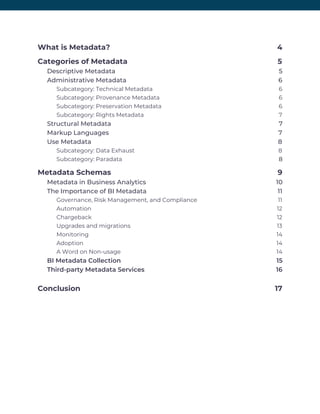
What is Metadata? 4 
Categories of Metadata 5 
Descriptive Metadata 5 
Administrative Metadata 6 
Subcategory: Technical Metadata 6 
Subcategory: Provenance Metadata 6 
Subcategory: Preservation Metadata 6 
Subcategory: Rights Metadata 7 
Structural Metadata 7 
Markup Languages 7 
Use Metadata 8 
Subcategory: Data Exhaust 8 
Subcategory: Paradata 8 
Metadata Schemas 9 
Metadata in Business Analytics 10 
The Importance of BI Metadata 11 
Governance, Risk Management, and Compliance 11 
Automation 12 
Chargeback 12 
Upgrades and migrations 13 
Monitoring 14 
Adoption 14 
A Word on Non-usage 14 
BI Metadata Collection 15 
Third-party Metadata Services 16 
Conclusion 17 
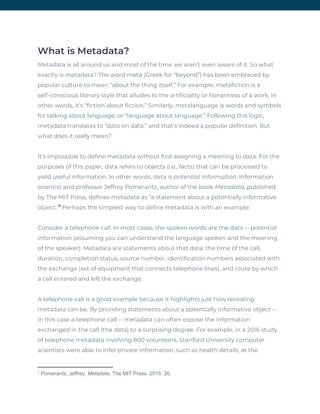
What is Metadata? 
Metadata is all around us and most of the time we aren’t even aware of it. So what 
exactly is metadata? The word meta (Greek for “beyond”) has been embraced by 
popular culture to mean “about the thing itself.” For example, metafiction is a 
self-conscious literary style that alludes to the artificiality or literariness of a work. In 
other words, it’s “fiction about fiction.” Similarly, metalanguage is words and symbols 
for talking about language, or “language about language.” Following this logic, 
metadata translates to “data on data,” and that’s indeed a popular definition. But 
what does it really mean? 
It’s impossible to define metadata without first assigning a meaning to data. For the 
purposes of this paper, data refers to objects (i.e., facts) that can be processed to 
yield useful information. In other words, data is ​potential information​. Information 
scientist and professor Jeffrey Pomerantz, author of the book ​Metadata,​ published 
by The MIT Press, defines metadata as “a statement about a potentially informative 
object.” ​Perhaps the simplest way to define metadata is with an example. 1
Consider a telephone call. In most cases, the spoken words are the data -- potential 
information (assuming you can understand the language spoken and the meaning 
of the speaker). Metadata are statements about that data: the time of the call, 
duration, completion status, source number, identification numbers associated with 
the exchange (set of equipment that connects telephone lines), and route by which 
a call entered and left the exchange.  
A telephone call is a good example because it highlights just how revealing 
metadata can be. By providing statements about a potentially informative object -- 
in this case a telephone call -- metadata can often expose the information 
exchanged in the call (the data) to a surprising degree. For example, in a 2016 study 
of telephone metadata involving 800 volunteers, Stanford University computer 
scientists were able to infer private information, such as health details, at the 
1
Pomerantz, Jeffrey. ​Metadata​. The MIT Press, 2015, 26.
individual level from metadata alone. That’s why many people were outraged when 2
classified information leaked by Edward Snowden brought to light the extent to 
which the U.S. National Security Agency (NSA) was collecting telephone metadata in 
bulk from citizens and allies. They understood that, what constituted metadata to 
most people (phone numbers, call durations, relays, etc.), was actually data for the 
NSA. This prompted Congress to pass the USA Freedom Act in 2015, which banned 
the bulk collection of telephone metadata (but allowed for a more targeted 
approach) by the U.S. intelligence community. 
Despite this simple example, metadata isn’t simple at all. For one thing, metadata is 
itself a type of data -- potential information. So what’s the difference between data 
and metadata? The line can be fuzzy, but it generally depends on the purpose of the 
information. Is it to provide content or context? Another aspect that complicates 
metadata is the number of different metadata categories and schema. Add to that 
the abstract nature of metadata and it’s no surprise that when two people are 
discussing metadata, they may or may not be talking about the same thing. 
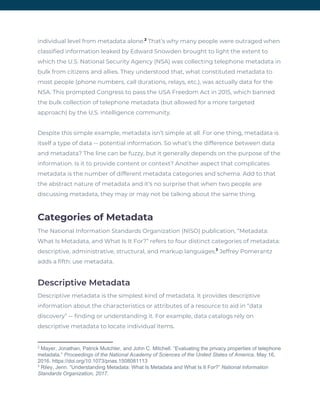
Categories of Metadata 
The National Information Standards Organization (NISO) publication, “Metadata: 
What Is Metadata, and What Is It For?” refers to four distinct categories of metadata: 
descriptive, administrative, structural, and markup languages. ​Jeffrey Pomerantz 3
adds a fifth: use metadata. 
Descriptive Metadata 
Descriptive metadata is the simplest kind of metadata. It provides descriptive 
information about the characteristics or attributes of a resource to aid in “data 
discovery” -- finding or understanding it. For example, data catalogs rely on 
descriptive metadata to locate individual items. 
2
Mayer, Jonathan, Patrick Mutchler, and John C. Mitchell. “Evaluating the privacy properties of telephone
metadata.” ​Proceedings of the National Academy of Sciences of the United States of America​. May 16,
2016. https://doi.org/10.1073/pnas.1508081113
3
Riley, Jenn. “Understanding Metadata: What Is Metadata and What Is It For?” ​National Information
Standards Organization, 2017.
Administrative Metadata 
Administrative metadata is information that relates to the creation of a resource and 
the management of that resource throughout its life cycle. Because there are so 
many different types of resources, administrative metadata is a big category with 
numerous subcategories. 
Subcategory: Technical Metadata 
Technical metadata is a type of administrative metadata that provides information 
about the characteristics of a resource. It’s often captured automatically by software 
when digital files are created or modified. For example, computer files contain 
technical metadata related to format, size, location, etc. 
Subcategory: Provenance Metadata 
Provenance metadata is a type of administrative metadata that provides lifecycle 
context that a user might need to evaluate the history of a resource, including 
authenticity and credibility. A provenance metadata record is created, often 
automatically, whenever a digital resource is created or modified to describe entities 
and processes involved in producing or delivering or otherwise influencing it.  4
Subcategory: Preservation Metadata 
Preservation metadata is a type of administrative metadata that provides 
information to support the preservation of digital resources. The goal of preservation 
metadata is to ensure that a digital object continues to exist, that it can be used, and 
that the original is distinguishable from subsequent versions. For example, lifecycle 
management (e.g., upgrades, migrations rely on preservation metadata to identify 
object formats, promote compatibility, and avoid regressions).  
4
“W3C Provenance Incubator Group Wiki,” W3C.org, last modified September 14, 2011,
https://www.w3.org/2005/Incubator/prov/wiki/W3C_Provenance_Incubator_Group_Wiki.
Subcategory: Rights Metadata 
Rights metadata is a type of administrative metadata that deals intellectual property 
rights and security. The goal of rights metadata is to record copyright-related 
information, including the right to access, digitize, collect, or provide access to digital 
works. In the context of BI, rights metadata includes information about permissions 5
and security (i.e., who has permission to access what). 
Structural Metadata 
Structural metadata provides information about the properties and organization of a 
resource, and the relationship between objects. The aim of structural metadata is to 
assist with navigating content and assembling new content from a variety of smaller 
parts. ​For example, structural metadata makes it possible to quickly sort documents 6
by type (e.g., invoice, purchase order, inventory report, etc.) based on structure. Note 
that some information scientists consider structural metadata to be a type of 
administrative data, while others treat it a separate category.  
Markup Languages 
A markup language is “a system (such as HTML or SGML) for marking or tagging a 
document that indicates its logical structure (such as paragraphs) and gives 
instructions for its layout on the page especially for electronic transmission and 
display.” By inserting tags in content to denote notable features, markup languages 7
mix metadata and content together. In the context of BI, markup languages make it 
possible to tag specific objects (e.g., SSNs as sensitive) so that data catalogs are more 
usable for humans and machines. 
5
Marcia Lei Zeng and Jian Qin, ​Metadata ​(New York: Neal-Schuman, 2008), 64.
6
Michael Andrews, “Structural Metadata: Key to Structured Content,” StoryNeedle.com, October 11,
2017, https://storyneedle.com/structural-metadata-key-to-structured-content/.
7
​Merriam-Webster​, s.v. “markup language,” accessed January 15, 2019,
https://www.merriam-webster.com/dictionary/markup%20language.
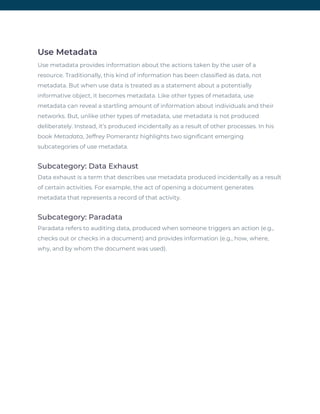
Use Metadata 
Use metadata provides information about the actions taken by the user of a 
resource. Traditionally, this kind of information has been classified as data, not 
metadata. But when use data is treated as a statement about a potentially 
informative object, it becomes metadata. Like other types of metadata, use 
metadata can reveal a startling amount of information about individuals and their 
networks. But, unlike other types of metadata, use metadata is not produced 
deliberately. Instead, it’s produced incidentally as a result of other processes. In his 
book ​Metadata​, Jeffrey Pomerantz highlights two significant emerging 
subcategories of use metadata. 
Subcategory: Data Exhaust 
Data exhaust is a term that describes use metadata produced incidentally as a result 
of certain activities. For example, the act of opening a document generates 
metadata that represents a record of that activity. 
Subcategory: Paradata 
Paradata refers to auditing data, produced when someone triggers an action (e.g., 
checks out or checks in a document) and provides information (e.g., how, where, 
why, and by whom the document was used). 
Metadata Schemas
A schema is “a structured framework or plan.” ​Therefore, a metadata schema is a 8
structured framework for metadata. In other words, it’s a simple language with basic 
rules about what kinds of statements can be made about the data. A single 
metadata schema may be designed to include multiple categories of metadata. 
A metadata schema provides a formal structure designed to identify the 
knowledge structure of a given discipline and to link that structure to the 
information of the discipline through the creation of an information 
system that will assist the identification, discovery and use of information 
within that discipline. 
Association for Library Services and Technical Collections 
Committee on Cataloging: Description & Access 
Task Force on Metadata 
Final Report 
If a schema is a language, then the words are called elements. Every metadata 
schema has its own set of elements (aka semantics) specific to the type of statement 
it was designed to make. That’s why a metadata schema is sometimes called an 
element set​ or a ​data dictionary​. 
When developing or selecting a metadata schema, interoperability is an important 
consideration. NISO defines interoperability as “the ability of multiple systems with 
different hardware and software platforms, data structures, and interfaces to 
exchange data with minimal loss of content and functionality.” The interoperability 
of metadata schemas determines how usable the metadata is by BI solutions and 
artificial intelligence. 
8
​Merriam-Webster​, s.v. “schema,” accessed January 15, 2019,
https://www.merriam-webster.com/dictionary/schema
Metadata in Business Analytics 
Business analytics depends on ETL tools to EXTRACT data from a data source, 
TRANSFORM it as necessary, and LOAD it into a data warehouse -- a centralized 
location that brings data together and optimizes it for analysis and reporting. The 
ETL process relies on existing metadata to find the desired data, organize it, and 
move it to the right location. The ETL process also generates new metadata related 
to the transformation. 
Metadata remains essential after data has been loaded into a data warehouse. Every 
table, column, and row has associated metadata (e.g., format, security, modification 
date, etc.), which makes it possible to perform business analytics activities like data 
integration, data transformation, online analytical processing (OLAP), and data 
mining.  9
9
Rahman, Nayem, Jessica Marz and Shameem Akhter. ​“An ETL Metadata Model
for Data Warehousing.” ​Journal of Computing and Information Technology​ 20, no. 2 (2012). 95-111.
https://pdfs.semanticscholar.org/5013/bc35ad83319aaac456884f3e994e77ed2ce6.pdf.
An incomplete list of metadata schemas follows (in alphabetical order): 
●
●
●
●
●
●
●
●
Categories for the Descriptions of Works of Art (CDWA)​: ​Metadata schema for the
description of art, architecture, and other cultural works
Creative Common Rights Expression Language (CC REL)​: ​Metadata schema for
machine-readable expression of copyright licensing terms and related information.
Dublin Core​:​ Metadata schemas focused on networked resources
Exchangeable image file format (Exif)​: ​Metadata schema that provides a tag structure for
embedded metadata within digital image files
Metadata Encoding and Transmission Standard (METS)​: ​Metadata schema for encoding
descriptive, administrative, and structural metadata regarding objects within a
digital library
Metadata Object Description Schema (MODS)​: ​Metadata schema for a bibliographic
element set that may be used for a variety of purposes, especially library applications
Preservation Metadata Implementation Strategies (PREMIS)​: ​Metadata schema developed
by the Library of Congress to be a core set of elements for the preservation of digital
objects
VRA Core​: ​Metadata schema used to describe works of visual culture, including
objects or events such as paintings, drawings, sculpture, architecture, photographs,
book art, decorative art, and performance art, as well as the images that document
them
Business intelligence (BI) tools query data warehouses to generate reports for 
business analysis, a process which generates its own metadata, including: 
● The connection used to query the data warehouse;
● Identification of the person who launched the query;
● Document(s) in which the data was used;
● Security associated with the data; and
● The instance/subscription/publication creation date.
Every step in the process -- from ETL to database (DB) to business analytics -- relies 
on metadata and every action creates new metadata, including paradata and 
exhaust metadata. As mentioned previously, paradata refers to audit metadata -- 
metadata focused on the use of data -- and exhaust metadata (aka data exhaust) 10
refers to the trail of data left by actions, such as search activities. Both are 
fundamental to maximizing the potential of metadata for business intelligence. 
The Importance of BI Metadata 
In the context of business intelligence, metadata can be leveraged to support 
governance, risk management and compliance (GRC), launch automation, enable 
chargeback, facilitate upgrades and migrations, organize content for the purpose of 
monitoring, and provide insight into the adoption of BI tools. 
Governance, Risk Management, and Compliance 
Metadata assists with many GRC tasks. Consider tagging, which attaches metadata 
to an object. When tagging is used indicate that objects are subject to regulations 
(e.g., ​SOX​, ​GDPR​, HIPAA, etc.), metadata facilitates regulatory compliance by making 
it possible to monitor the use of sensitive content. Metadata also facilitates​ ​account 
recertification​, segregation of duties, and security by locating permission loopholes, 
identifying who has access to what, and determining whether or not individuals are 
taking advantage of that access. Finally, metadata makes it possible to track the 
creation, modification, and deletion of objects and users, user activity, IP addresses, 
and much more. 
10
“What is Paradata,” IGI-global.com, accessed January 15, 2019,
https://www.igi-global.com/dictionary/the-importance-of-being-honest/56385.
Automation 
Metadata, in the form of tags/flags, can guide automation. For example, objects can 
be flagged in a way that corresponds with a schedule or trigger event (e.g., 
#PromoteThisWeek). Automation ensures that a job runs on a predefined schedule 
(e.g, promote every Wednesday at 11 PM) and metadata ensures that it acts on the 
appropriate objects. Depending on whether or not the metadata continues to serve 
a purpose, flags can be retained or removed automatically as part of the process. 
Metadata can also be used to launch more complex automation, like auto-cleaning 
to keep BI content from growing out of control. In this case, metadata serves two 
purposes. First, it provides insight into BI usage. Second, it guides automation in the 
form of tags/flags. When an object crosses a trigger threshold (e.g., not used in X 
days), it can be flagged automatically for archiving (e.g, #Archive). As in the previous 
example, automation ensures that the job runs according to a predefined schedule, 
and metadata ensures that it acts on the appropriate objects. 
Finally, metadata makes it possible automate reporting related to security, account 
recertification, tagged content, and more. 
Learn more about​ ​SAP BusinessObjects automation​.
Chargeback 
In this paper, chargeback refers to the process of allocating the cost of resources to 
the departments that use them. When it comes to IT, organizations may attempt to 
determine what departments used what percentage of IT resources in order to 
perform cost-benefit analyses and justify investments. BI tools -- a subset of IT 
resources -- are particularly hard to chargeback because of their complexity. That’s 
when metadata comes in handy. Metadata makes it possible to analyze BI usage, for 
example, to determine that 5% of business analytics maintenance resources were 
associated with a particular document, and that Department A represented 70% of 
the activity on that document. Similarly, metadata makes it possible to determine 
that Department A consumed 20% of the total memory associated with BI tools. 
No matter how deep an organization drills down, the purpose of analyzing metadata 
for chargeback is to understand the total cost of ownership (TCO) per group of users 
or business unit, to support technology business management (TBM), and to 
forecast future BI investments. 
Learn more about​ ​SAP BusinessObject cross charging​.
Upgrades and migrations 
Metadata makes it possible to understand BI usage, including: 
● What documents were used in a specified time period
● When a document was last used
● What documents are used most frequently
● What documents are duplicates
● What variables and objects were used in a specified time period (aka
document stripping)
● What objects are sensitive
Whereas data obtained from user surveys is subjective, metadata is objective. 
Analyzing metadata to understand usage makes it possible to archive superfluous 
content, which shortens the time frame and lowers the cost of upgrades and 
migrations. 
As mentioned previously, metadata in the form of tags/flags can drive automation. In 
preparation for an upgrade or migration, unused content can be flagged for 
automatic archiving and used content can be tagged for automatic promotion. 
Following a migration or upgrade, metadata can also support regression testing 
initiatives. Although, in most cases, regression testing focuses on data, testing for 
regressions in metadata can identify changes to structure and security. 
Monitoring 
Metadata makes it possible to filter BI content based on a metadata description (e.g., 
sensitivity, class, security, activity, etc.) in order to monitor it. This is particularly useful 
in the following scenarios: 
● When organizations outsources BI activities -- Metadata related to document
actions (e.g., creation, deletion, modification, etc.), log-on time per user,
check-in/check-out activities, etc. allows organizations to build reports
containing metrics that keep track of outsourced BI.
● When organizations must monitor service-level agreements (SLA) on multiple
BI solutions (e.g., Business Objects, Tableau, Power BI, etc.) -- Metadata related
to platform availability, server performance, successful/failed schedules, etc.
allows BI managers and business leaders to compare BI tools and determine if
they are complying with SLAs.
Adoption 
Metadata makes it possible to measure the adoption of BI tools. BI adoption is an 
important metric for BI managers, who aim to optimize resources and need to know 
the following: 
● What percentage of the documents they maintain are being used, and by
whom?
● Which of the BI tools they allocated are being used, and by whom? (This is
particularly important since most organizations invest in multiple BI tools.)
Beyond measuring adoption, metadata also helps BI managers understand 
connections, identify sources, recognize when documents are being used as data 
dumps, locate ungoverned data, and more. 
A Word on Non-usage 
The flip side of adoption is non-usage. Non-usage is not reflected in metadata, but in 
the ​absence​ of metadata. It represents what is leftover after usage is identified with 
metadata​.​ Knowing what ​isn’t​ used is just as important to IT and business as 
knowing what ​is​ used. 
For example, comparing usage and non-usage highlights trends and gives insight 
into BI reporting and the platform lifecycle. It informs decisions around training, 
investments, cleanup, etc. That’s why non-usage is a key idea throughout business 
analytics. 
● GRC: Non-usage can identify users who never connect and identify sensitive
content that has never been used.
● Automation: Non-usage can trigger automated actions or reporting.
● Upgrade Migration: Non-usage can pinpoint objects and documents that can
be archived prior to an upgrade or migration.
● Adoption: Non-usage is the flip side of adoption and identifies objects and
documents that are not being used.
Note that both usage and non-usage are trimensional; they are determined based 
on metadata (object creation date, actions on object) -- or lack thereof -- with the 
addition of a time dimension. 
Because metadata can become bulky, there are limits on the quantity of and length 
of time that metadata is retained. When metadata disappears, so does the 
opportunity to analyze usage and non-usage . That’s why it’s so important to 
continuously track usage and non-usage, and to take advantage of metadata service 
solutions, like 360Suite, that capture and retain auditing metadata. 
BI Metadata Collection 
Metadata management solutions encompass metadata registries, repositories, and 
development and production services. Metadata services typically harvest 11
metadata from the ETL, DB, and BI tools, store them in a data warehouse, and 
organize them with a semantic layer. 
Data warehouses offers several advantages. First, they facilitate information retrieval. 
Second, they minimize the impact on live production systems by loading data 
during off-peak hours, often in delta mode. Third, they make it possible for BI 
managers to perform metadata impact analysis -- to understand what documents 
11
Zeng, ​Metadata​, 212.
● Compare snapshots of metadata over time to gain insight into the BI life cycle;
● Highlight usage and non-usage to inform decision making;
● Measure and control data quality with regression testing that compares
historical metadata, including information about the source;
● Clean up metadata in order to keep the size of the data mart under control;
● Display data lineage; and
● Perform impact analysis.
are impacted by changes to an object. Fourth, they enables BI managers to trace the
lineage of objects from ETL to reporting.
Third-party Metadata Services 
Most organizations benefit from third-party metadata services solutions, like 
360Suite, that centralize and process metadata inputs and transforms them into 
data for business. Interestingly, metadata services generate their own metadata 
related to adoption. 
Data catalogs, sometimes called “searchable business glossaries,” are often the most 
visible part of metadata service solutions. By virtue of being self-service, data 
catalogs make it possible for IT and business users to perform data discovery, obtain 
data lineage, add comments to objects, and tag content. 
Metadata management solutions, like 360Suite, assist with information retrieval, 
tagging, documentation, and even triggering actions with metadata. What 
distinguishes 360Suite from a data warehouse is that it extracts only relevant data -- 
metadata related to BI -- into a data mart. 
The narrow focus makes it easier to control access and provides authorized users 
with easy, fast, reliable, and secure access to metadata that answers their business 
intelligence questions. 
360Suite also features pre-built, self-service reports, based on simple and complex 
queries, that assist with data exploration and make metadata usable to IT (data 
analysts and information scientists) and business users. Metadata searches offers 
many advantages, including the ability to: 
Finally, 360Suite creates data that can be used as a data source for further 
automation and analysis so that AI (e.g., IBM Watson) can be used on top of it. This 
provides contextual information around data and makes it possible for AI to leverage 
metadata.  
Conclusion 
Whether or not “data is the new oil”, there’s no doubt that data is extremely valuable. 
As the volume of data (whether structured, semi-structured, or unstructured) grows 
exponentially, it becomes increasingly difficult to discover and understand the 
potential​ in potential information. The only way to effectively manage big data is by 
managing metadata as a semantic layer that can be optimized for AI. Leveraging 
metadata and non-usage as a semantic layer supports “descriptive analytics,” 
“predictive analytics,” and “prescriptive analytics.” Metadata brings agility and 
insight. In fact, data without metadata is virtually unusable. 
Interoperability is key to reach the goal of machine learning. As the number of BI 
sources and connections continues to grow, metadata interoperability will pose a 
greater challenge, and metadata services will become increasingly important. 
Metadata services will represent a new source of information to which other services 
can connect. This will generate new metadata and create a greater need for 
metadata on metadata -- BI on BI -- to make the information available for machine 
learning, artificial intelligence, and business analytics. 
The importance of metadata for BI and business analytics cannot be overstated. 
Metadata allows BI managers and information scientists to make data-driven 
decisions: to understand user adoption, compare usage to non-usage, manage risk, 
optimize platforms, and better allocate resources. Ultimately, metadata supports the 
shared goal of IT and business -- an optimal end-user experience at the lowest 
possible cost. 
Auteurs: Bruno Masek
Kristen Champagne Gray
Metadata and Analytics

Metadata and Analytics

  • 2.
    Executive Summary:  Whereas datais potential information, metadata is a statement about that potential  information. There are several distinct categories of metadata that make different  kinds of statements -- descriptive, administrative, structural, markup languages, and  use metadata -- with numerous subcategories. A metadata schema, also known as  an element set or data dictionary, provides a structured framework for metadata.  Within the field of business intelligence (BI), metadata is essential for extracting,  transforming, and loading data into a data warehouse, and for analyzing data once  it’s there. In BI, metadata can be leveraged to support governance, risk management  and compliance (GRC), launch automation, enable chargeback, facilitate upgrades  and migrations, organize content for the purpose of monitoring, and provide insight  into the adoption of BI tools. Most organizations benefit from third-party metadata  services solutions, like 360Suite, that centralize and process metadata inputs and  transform them into data for business. What distinguishes 360Suite from a data  warehouse is that it extracts only relevant data -- metadata related to BI -- into a  data mart, which provides authorized users with easy, fast, reliable, and secure  access to metadata that answers their business intelligence questions. As the  volume of data grows exponentially, it becomes increasingly difficult to discover and  understand the ​potential​ in potential information. Metadata services represent a  new source of information to which other services are able to connect. This, in turn,  generates new metadata and creates a greater need for metadata on metadata -- BI  on BI -- to make information available for machine learning, artificial intelligence,  and business analytics. 
  • 3.
    What is Metadata?4  Categories of Metadata 5  Descriptive Metadata 5  Administrative Metadata 6  Subcategory: Technical Metadata 6  Subcategory: Provenance Metadata 6  Subcategory: Preservation Metadata 6  Subcategory: Rights Metadata 7  Structural Metadata 7  Markup Languages 7  Use Metadata 8  Subcategory: Data Exhaust 8  Subcategory: Paradata 8  Metadata Schemas 9  Metadata in Business Analytics 10  The Importance of BI Metadata 11  Governance, Risk Management, and Compliance 11  Automation 12  Chargeback 12  Upgrades and migrations 13  Monitoring 14  Adoption 14  A Word on Non-usage 14  BI Metadata Collection 15  Third-party Metadata Services 16  Conclusion 17 
  • 4.
    What is Metadata?  Metadatais all around us and most of the time we aren’t even aware of it. So what  exactly is metadata? The word meta (Greek for “beyond”) has been embraced by  popular culture to mean “about the thing itself.” For example, metafiction is a  self-conscious literary style that alludes to the artificiality or literariness of a work. In  other words, it’s “fiction about fiction.” Similarly, metalanguage is words and symbols  for talking about language, or “language about language.” Following this logic,  metadata translates to “data on data,” and that’s indeed a popular definition. But  what does it really mean?  It’s impossible to define metadata without first assigning a meaning to data. For the  purposes of this paper, data refers to objects (i.e., facts) that can be processed to  yield useful information. In other words, data is ​potential information​. Information  scientist and professor Jeffrey Pomerantz, author of the book ​Metadata,​ published  by The MIT Press, defines metadata as “a statement about a potentially informative  object.” ​Perhaps the simplest way to define metadata is with an example. 1 Consider a telephone call. In most cases, the spoken words are the data -- potential  information (assuming you can understand the language spoken and the meaning  of the speaker). Metadata are statements about that data: the time of the call,  duration, completion status, source number, identification numbers associated with  the exchange (set of equipment that connects telephone lines), and route by which  a call entered and left the exchange.   A telephone call is a good example because it highlights just how revealing  metadata can be. By providing statements about a potentially informative object --  in this case a telephone call -- metadata can often expose the information  exchanged in the call (the data) to a surprising degree. For example, in a 2016 study  of telephone metadata involving 800 volunteers, Stanford University computer  scientists were able to infer private information, such as health details, at the  1 Pomerantz, Jeffrey. ​Metadata​. The MIT Press, 2015, 26.
  • 5.
    individual level frommetadata alone. That’s why many people were outraged when 2 classified information leaked by Edward Snowden brought to light the extent to  which the U.S. National Security Agency (NSA) was collecting telephone metadata in  bulk from citizens and allies. They understood that, what constituted metadata to  most people (phone numbers, call durations, relays, etc.), was actually data for the  NSA. This prompted Congress to pass the USA Freedom Act in 2015, which banned  the bulk collection of telephone metadata (but allowed for a more targeted  approach) by the U.S. intelligence community.  Despite this simple example, metadata isn’t simple at all. For one thing, metadata is  itself a type of data -- potential information. So what’s the difference between data  and metadata? The line can be fuzzy, but it generally depends on the purpose of the  information. Is it to provide content or context? Another aspect that complicates  metadata is the number of different metadata categories and schema. Add to that  the abstract nature of metadata and it’s no surprise that when two people are  discussing metadata, they may or may not be talking about the same thing.  Categories of Metadata  The National Information Standards Organization (NISO) publication, “Metadata:  What Is Metadata, and What Is It For?” refers to four distinct categories of metadata:  descriptive, administrative, structural, and markup languages. ​Jeffrey Pomerantz 3 adds a fifth: use metadata.  Descriptive Metadata  Descriptive metadata is the simplest kind of metadata. It provides descriptive  information about the characteristics or attributes of a resource to aid in “data  discovery” -- finding or understanding it. For example, data catalogs rely on  descriptive metadata to locate individual items.  2 Mayer, Jonathan, Patrick Mutchler, and John C. Mitchell. “Evaluating the privacy properties of telephone metadata.” ​Proceedings of the National Academy of Sciences of the United States of America​. May 16, 2016. https://doi.org/10.1073/pnas.1508081113 3 Riley, Jenn. “Understanding Metadata: What Is Metadata and What Is It For?” ​National Information Standards Organization, 2017.
  • 6.
    Administrative Metadata  Administrative metadatais information that relates to the creation of a resource and  the management of that resource throughout its life cycle. Because there are so  many different types of resources, administrative metadata is a big category with  numerous subcategories.  Subcategory: Technical Metadata  Technical metadata is a type of administrative metadata that provides information  about the characteristics of a resource. It’s often captured automatically by software  when digital files are created or modified. For example, computer files contain  technical metadata related to format, size, location, etc.  Subcategory: Provenance Metadata  Provenance metadata is a type of administrative metadata that provides lifecycle  context that a user might need to evaluate the history of a resource, including  authenticity and credibility. A provenance metadata record is created, often  automatically, whenever a digital resource is created or modified to describe entities  and processes involved in producing or delivering or otherwise influencing it.  4 Subcategory: Preservation Metadata  Preservation metadata is a type of administrative metadata that provides  information to support the preservation of digital resources. The goal of preservation  metadata is to ensure that a digital object continues to exist, that it can be used, and  that the original is distinguishable from subsequent versions. For example, lifecycle  management (e.g., upgrades, migrations rely on preservation metadata to identify  object formats, promote compatibility, and avoid regressions).   4 “W3C Provenance Incubator Group Wiki,” W3C.org, last modified September 14, 2011, https://www.w3.org/2005/Incubator/prov/wiki/W3C_Provenance_Incubator_Group_Wiki.
  • 7.
    Subcategory: Rights Metadata  Rightsmetadata is a type of administrative metadata that deals intellectual property  rights and security. The goal of rights metadata is to record copyright-related  information, including the right to access, digitize, collect, or provide access to digital  works. In the context of BI, rights metadata includes information about permissions 5 and security (i.e., who has permission to access what).  Structural Metadata  Structural metadata provides information about the properties and organization of a  resource, and the relationship between objects. The aim of structural metadata is to  assist with navigating content and assembling new content from a variety of smaller  parts. ​For example, structural metadata makes it possible to quickly sort documents 6 by type (e.g., invoice, purchase order, inventory report, etc.) based on structure. Note  that some information scientists consider structural metadata to be a type of  administrative data, while others treat it a separate category.   Markup Languages  A markup language is “a system (such as HTML or SGML) for marking or tagging a  document that indicates its logical structure (such as paragraphs) and gives  instructions for its layout on the page especially for electronic transmission and  display.” By inserting tags in content to denote notable features, markup languages 7 mix metadata and content together. In the context of BI, markup languages make it  possible to tag specific objects (e.g., SSNs as sensitive) so that data catalogs are more  usable for humans and machines.  5 Marcia Lei Zeng and Jian Qin, ​Metadata ​(New York: Neal-Schuman, 2008), 64. 6 Michael Andrews, “Structural Metadata: Key to Structured Content,” StoryNeedle.com, October 11, 2017, https://storyneedle.com/structural-metadata-key-to-structured-content/. 7 ​Merriam-Webster​, s.v. “markup language,” accessed January 15, 2019, https://www.merriam-webster.com/dictionary/markup%20language.
  • 8.
    Use Metadata  Use metadataprovides information about the actions taken by the user of a  resource. Traditionally, this kind of information has been classified as data, not  metadata. But when use data is treated as a statement about a potentially  informative object, it becomes metadata. Like other types of metadata, use  metadata can reveal a startling amount of information about individuals and their  networks. But, unlike other types of metadata, use metadata is not produced  deliberately. Instead, it’s produced incidentally as a result of other processes. In his  book ​Metadata​, Jeffrey Pomerantz highlights two significant emerging  subcategories of use metadata.  Subcategory: Data Exhaust  Data exhaust is a term that describes use metadata produced incidentally as a result  of certain activities. For example, the act of opening a document generates  metadata that represents a record of that activity.  Subcategory: Paradata  Paradata refers to auditing data, produced when someone triggers an action (e.g.,  checks out or checks in a document) and provides information (e.g., how, where,  why, and by whom the document was used). 
  • 9.
    Metadata Schemas A schemais “a structured framework or plan.” ​Therefore, a metadata schema is a 8 structured framework for metadata. In other words, it’s a simple language with basic  rules about what kinds of statements can be made about the data. A single  metadata schema may be designed to include multiple categories of metadata.  A metadata schema provides a formal structure designed to identify the  knowledge structure of a given discipline and to link that structure to the  information of the discipline through the creation of an information  system that will assist the identification, discovery and use of information  within that discipline.  Association for Library Services and Technical Collections  Committee on Cataloging: Description & Access  Task Force on Metadata  Final Report  If a schema is a language, then the words are called elements. Every metadata  schema has its own set of elements (aka semantics) specific to the type of statement  it was designed to make. That’s why a metadata schema is sometimes called an  element set​ or a ​data dictionary​.  When developing or selecting a metadata schema, interoperability is an important  consideration. NISO defines interoperability as “the ability of multiple systems with  different hardware and software platforms, data structures, and interfaces to  exchange data with minimal loss of content and functionality.” The interoperability  of metadata schemas determines how usable the metadata is by BI solutions and  artificial intelligence.  8 ​Merriam-Webster​, s.v. “schema,” accessed January 15, 2019, https://www.merriam-webster.com/dictionary/schema
  • 10.
    Metadata in BusinessAnalytics  Business analytics depends on ETL tools to EXTRACT data from a data source,  TRANSFORM it as necessary, and LOAD it into a data warehouse -- a centralized  location that brings data together and optimizes it for analysis and reporting. The  ETL process relies on existing metadata to find the desired data, organize it, and  move it to the right location. The ETL process also generates new metadata related  to the transformation.  Metadata remains essential after data has been loaded into a data warehouse. Every  table, column, and row has associated metadata (e.g., format, security, modification  date, etc.), which makes it possible to perform business analytics activities like data  integration, data transformation, online analytical processing (OLAP), and data  mining.  9 9 Rahman, Nayem, Jessica Marz and Shameem Akhter. ​“An ETL Metadata Model for Data Warehousing.” ​Journal of Computing and Information Technology​ 20, no. 2 (2012). 95-111. https://pdfs.semanticscholar.org/5013/bc35ad83319aaac456884f3e994e77ed2ce6.pdf. An incomplete list of metadata schemas follows (in alphabetical order):  ● ● ● ● ● ● ● ● Categories for the Descriptions of Works of Art (CDWA)​: ​Metadata schema for the description of art, architecture, and other cultural works Creative Common Rights Expression Language (CC REL)​: ​Metadata schema for machine-readable expression of copyright licensing terms and related information. Dublin Core​:​ Metadata schemas focused on networked resources Exchangeable image file format (Exif)​: ​Metadata schema that provides a tag structure for embedded metadata within digital image files Metadata Encoding and Transmission Standard (METS)​: ​Metadata schema for encoding descriptive, administrative, and structural metadata regarding objects within a digital library Metadata Object Description Schema (MODS)​: ​Metadata schema for a bibliographic element set that may be used for a variety of purposes, especially library applications Preservation Metadata Implementation Strategies (PREMIS)​: ​Metadata schema developed by the Library of Congress to be a core set of elements for the preservation of digital objects VRA Core​: ​Metadata schema used to describe works of visual culture, including objects or events such as paintings, drawings, sculpture, architecture, photographs, book art, decorative art, and performance art, as well as the images that document them
  • 11.
    Business intelligence (BI)tools query data warehouses to generate reports for  business analysis, a process which generates its own metadata, including:  ● The connection used to query the data warehouse; ● Identification of the person who launched the query; ● Document(s) in which the data was used; ● Security associated with the data; and ● The instance/subscription/publication creation date. Every step in the process -- from ETL to database (DB) to business analytics -- relies  on metadata and every action creates new metadata, including paradata and  exhaust metadata. As mentioned previously, paradata refers to audit metadata --  metadata focused on the use of data -- and exhaust metadata (aka data exhaust) 10 refers to the trail of data left by actions, such as search activities. Both are  fundamental to maximizing the potential of metadata for business intelligence.  The Importance of BI Metadata  In the context of business intelligence, metadata can be leveraged to support  governance, risk management and compliance (GRC), launch automation, enable  chargeback, facilitate upgrades and migrations, organize content for the purpose of  monitoring, and provide insight into the adoption of BI tools.  Governance, Risk Management, and Compliance  Metadata assists with many GRC tasks. Consider tagging, which attaches metadata  to an object. When tagging is used indicate that objects are subject to regulations  (e.g., ​SOX​, ​GDPR​, HIPAA, etc.), metadata facilitates regulatory compliance by making  it possible to monitor the use of sensitive content. Metadata also facilitates​ ​account  recertification​, segregation of duties, and security by locating permission loopholes,  identifying who has access to what, and determining whether or not individuals are  taking advantage of that access. Finally, metadata makes it possible to track the  creation, modification, and deletion of objects and users, user activity, IP addresses,  and much more.  10 “What is Paradata,” IGI-global.com, accessed January 15, 2019, https://www.igi-global.com/dictionary/the-importance-of-being-honest/56385.
  • 12.
    Automation  Metadata, in theform of tags/flags, can guide automation. For example, objects can  be flagged in a way that corresponds with a schedule or trigger event (e.g.,  #PromoteThisWeek). Automation ensures that a job runs on a predefined schedule  (e.g, promote every Wednesday at 11 PM) and metadata ensures that it acts on the  appropriate objects. Depending on whether or not the metadata continues to serve  a purpose, flags can be retained or removed automatically as part of the process.  Metadata can also be used to launch more complex automation, like auto-cleaning  to keep BI content from growing out of control. In this case, metadata serves two  purposes. First, it provides insight into BI usage. Second, it guides automation in the  form of tags/flags. When an object crosses a trigger threshold (e.g., not used in X  days), it can be flagged automatically for archiving (e.g, #Archive). As in the previous  example, automation ensures that the job runs according to a predefined schedule,  and metadata ensures that it acts on the appropriate objects.  Finally, metadata makes it possible automate reporting related to security, account  recertification, tagged content, and more.  Learn more about​ ​SAP BusinessObjects automation​. Chargeback  In this paper, chargeback refers to the process of allocating the cost of resources to  the departments that use them. When it comes to IT, organizations may attempt to  determine what departments used what percentage of IT resources in order to  perform cost-benefit analyses and justify investments. BI tools -- a subset of IT  resources -- are particularly hard to chargeback because of their complexity. That’s  when metadata comes in handy. Metadata makes it possible to analyze BI usage, for  example, to determine that 5% of business analytics maintenance resources were  associated with a particular document, and that Department A represented 70% of  the activity on that document. Similarly, metadata makes it possible to determine  that Department A consumed 20% of the total memory associated with BI tools. 
  • 13.
    No matter howdeep an organization drills down, the purpose of analyzing metadata  for chargeback is to understand the total cost of ownership (TCO) per group of users  or business unit, to support technology business management (TBM), and to  forecast future BI investments.  Learn more about​ ​SAP BusinessObject cross charging​. Upgrades and migrations  Metadata makes it possible to understand BI usage, including:  ● What documents were used in a specified time period ● When a document was last used ● What documents are used most frequently ● What documents are duplicates ● What variables and objects were used in a specified time period (aka document stripping) ● What objects are sensitive Whereas data obtained from user surveys is subjective, metadata is objective.  Analyzing metadata to understand usage makes it possible to archive superfluous  content, which shortens the time frame and lowers the cost of upgrades and  migrations.  As mentioned previously, metadata in the form of tags/flags can drive automation. In  preparation for an upgrade or migration, unused content can be flagged for  automatic archiving and used content can be tagged for automatic promotion.  Following a migration or upgrade, metadata can also support regression testing  initiatives. Although, in most cases, regression testing focuses on data, testing for  regressions in metadata can identify changes to structure and security. 
  • 14.
    Monitoring  Metadata makes itpossible to filter BI content based on a metadata description (e.g.,  sensitivity, class, security, activity, etc.) in order to monitor it. This is particularly useful  in the following scenarios:  ● When organizations outsources BI activities -- Metadata related to document actions (e.g., creation, deletion, modification, etc.), log-on time per user, check-in/check-out activities, etc. allows organizations to build reports containing metrics that keep track of outsourced BI. ● When organizations must monitor service-level agreements (SLA) on multiple BI solutions (e.g., Business Objects, Tableau, Power BI, etc.) -- Metadata related to platform availability, server performance, successful/failed schedules, etc. allows BI managers and business leaders to compare BI tools and determine if they are complying with SLAs. Adoption  Metadata makes it possible to measure the adoption of BI tools. BI adoption is an  important metric for BI managers, who aim to optimize resources and need to know  the following:  ● What percentage of the documents they maintain are being used, and by whom? ● Which of the BI tools they allocated are being used, and by whom? (This is particularly important since most organizations invest in multiple BI tools.) Beyond measuring adoption, metadata also helps BI managers understand  connections, identify sources, recognize when documents are being used as data  dumps, locate ungoverned data, and more.  A Word on Non-usage  The flip side of adoption is non-usage. Non-usage is not reflected in metadata, but in  the ​absence​ of metadata. It represents what is leftover after usage is identified with  metadata​.​ Knowing what ​isn’t​ used is just as important to IT and business as  knowing what ​is​ used. 
  • 15.
    For example, comparingusage and non-usage highlights trends and gives insight  into BI reporting and the platform lifecycle. It informs decisions around training,  investments, cleanup, etc. That’s why non-usage is a key idea throughout business  analytics.  ● GRC: Non-usage can identify users who never connect and identify sensitive content that has never been used. ● Automation: Non-usage can trigger automated actions or reporting. ● Upgrade Migration: Non-usage can pinpoint objects and documents that can be archived prior to an upgrade or migration. ● Adoption: Non-usage is the flip side of adoption and identifies objects and documents that are not being used. Note that both usage and non-usage are trimensional; they are determined based  on metadata (object creation date, actions on object) -- or lack thereof -- with the  addition of a time dimension.  Because metadata can become bulky, there are limits on the quantity of and length  of time that metadata is retained. When metadata disappears, so does the  opportunity to analyze usage and non-usage . That’s why it’s so important to  continuously track usage and non-usage, and to take advantage of metadata service  solutions, like 360Suite, that capture and retain auditing metadata.  BI Metadata Collection  Metadata management solutions encompass metadata registries, repositories, and  development and production services. Metadata services typically harvest 11 metadata from the ETL, DB, and BI tools, store them in a data warehouse, and  organize them with a semantic layer.  Data warehouses offers several advantages. First, they facilitate information retrieval.  Second, they minimize the impact on live production systems by loading data  during off-peak hours, often in delta mode. Third, they make it possible for BI  managers to perform metadata impact analysis -- to understand what documents  11 Zeng, ​Metadata​, 212.
  • 16.
    ● Compare snapshotsof metadata over time to gain insight into the BI life cycle; ● Highlight usage and non-usage to inform decision making; ● Measure and control data quality with regression testing that compares historical metadata, including information about the source; ● Clean up metadata in order to keep the size of the data mart under control; ● Display data lineage; and ● Perform impact analysis. are impacted by changes to an object. Fourth, they enables BI managers to trace the lineage of objects from ETL to reporting. Third-party Metadata Services  Most organizations benefit from third-party metadata services solutions, like  360Suite, that centralize and process metadata inputs and transforms them into  data for business. Interestingly, metadata services generate their own metadata  related to adoption.  Data catalogs, sometimes called “searchable business glossaries,” are often the most  visible part of metadata service solutions. By virtue of being self-service, data  catalogs make it possible for IT and business users to perform data discovery, obtain  data lineage, add comments to objects, and tag content.  Metadata management solutions, like 360Suite, assist with information retrieval,  tagging, documentation, and even triggering actions with metadata. What  distinguishes 360Suite from a data warehouse is that it extracts only relevant data --  metadata related to BI -- into a data mart.  The narrow focus makes it easier to control access and provides authorized users  with easy, fast, reliable, and secure access to metadata that answers their business  intelligence questions.  360Suite also features pre-built, self-service reports, based on simple and complex  queries, that assist with data exploration and make metadata usable to IT (data  analysts and information scientists) and business users. Metadata searches offers  many advantages, including the ability to: 
  • 17.
    Finally, 360Suite createsdata that can be used as a data source for further  automation and analysis so that AI (e.g., IBM Watson) can be used on top of it. This  provides contextual information around data and makes it possible for AI to leverage  metadata.   Conclusion  Whether or not “data is the new oil”, there’s no doubt that data is extremely valuable.  As the volume of data (whether structured, semi-structured, or unstructured) grows  exponentially, it becomes increasingly difficult to discover and understand the  potential​ in potential information. The only way to effectively manage big data is by  managing metadata as a semantic layer that can be optimized for AI. Leveraging  metadata and non-usage as a semantic layer supports “descriptive analytics,”  “predictive analytics,” and “prescriptive analytics.” Metadata brings agility and  insight. In fact, data without metadata is virtually unusable.  Interoperability is key to reach the goal of machine learning. As the number of BI  sources and connections continues to grow, metadata interoperability will pose a  greater challenge, and metadata services will become increasingly important.  Metadata services will represent a new source of information to which other services  can connect. This will generate new metadata and create a greater need for  metadata on metadata -- BI on BI -- to make the information available for machine  learning, artificial intelligence, and business analytics.  The importance of metadata for BI and business analytics cannot be overstated.  Metadata allows BI managers and information scientists to make data-driven  decisions: to understand user adoption, compare usage to non-usage, manage risk,  optimize platforms, and better allocate resources. Ultimately, metadata supports the  shared goal of IT and business -- an optimal end-user experience at the lowest  possible cost.  Auteurs: Bruno Masek Kristen Champagne Gray