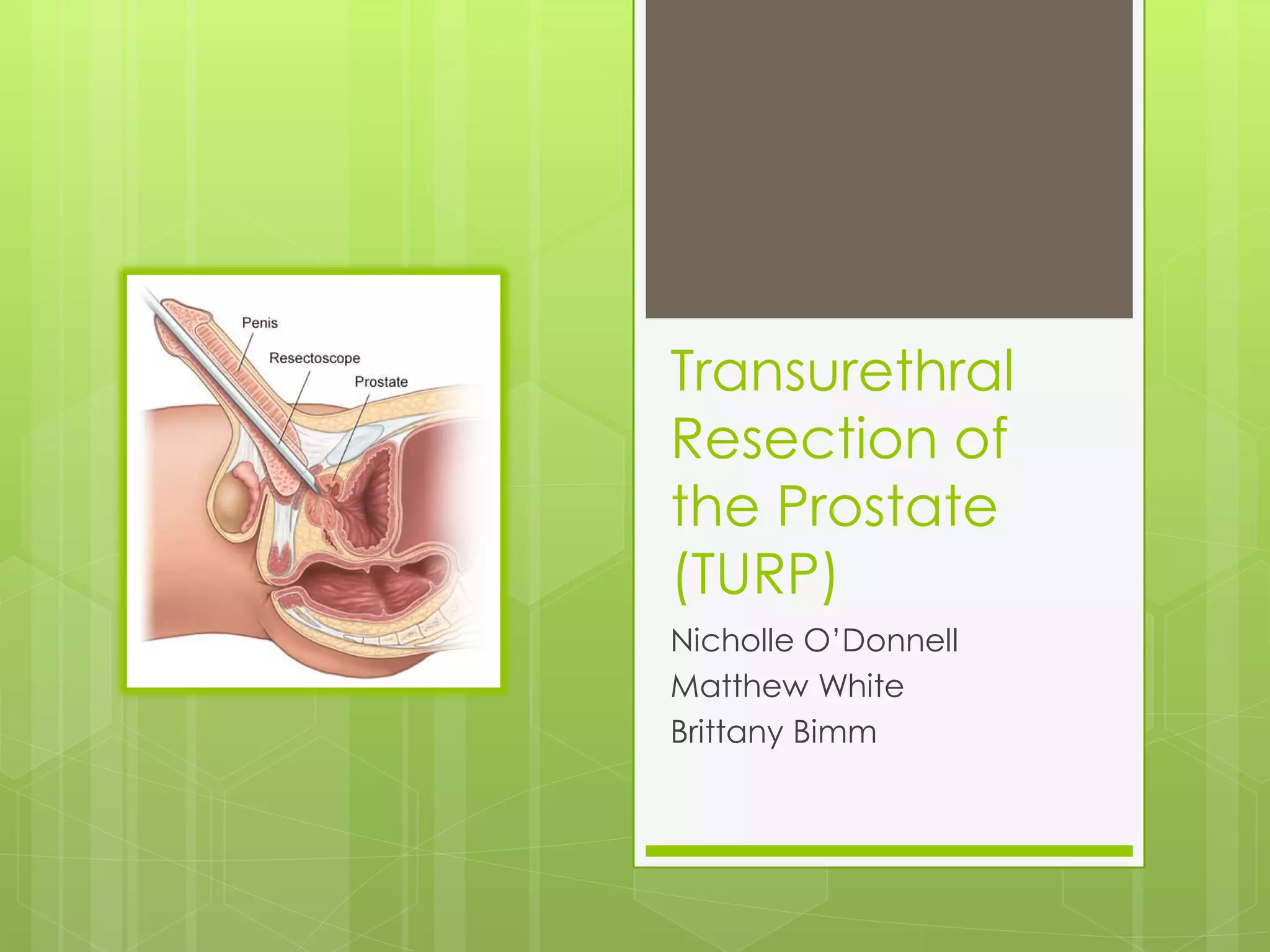
Transurethral
Resection of
the Prostate
(TURP)
Nicholle O’Donnell
Matthew White
Brittany Bimm
What is a TURP?
*Click to play video*
In Summary
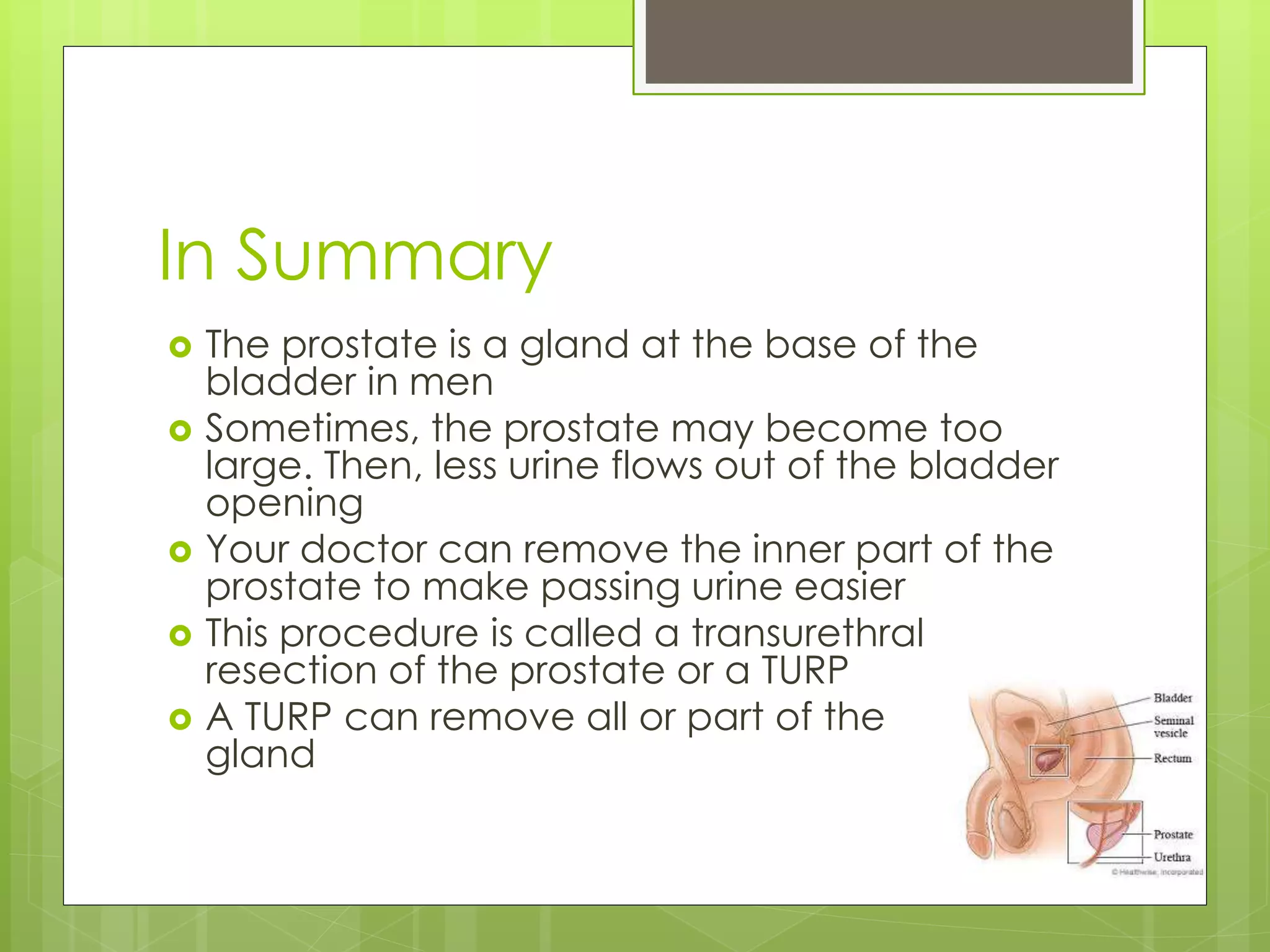
 The prostate is a gland at the base of the
bladder in men
 Sometimes, the prostate may become too
large. Then, less urine flows out of the bladder
opening
 Your doctor can remove the inner part of the
prostate to make passing urine easier
 This procedure is called a transurethral
resection of the prostate or a TURP
 A TURP can remove all or part of the prostate
gland
Resulting in
 You will be able to pass urine more easily
 Your doctor may also take small pieces of
the prostate to test and look for signs of
illness or cancer
Perianesthesia Nursing Care of
the TURP Patient
 “Pre existing medical
conditions and the effects
of anesthetic agents may
compromise respiratory
function making it
pertinent that deep
breathing and coughing,
position changes and the
use of incentive spirometry
are of utmost importance
to ensure optimal lung
function”(Odom-Forren,
2013, p. 547).
General Anesthetic
 General anesthesia is
the induction of a state
of unconsciousness with
the absence of pain
sensation over the
entire body, through the
administration of
anesthetic drugs.
General Anesthetic
Complications
 Pain - 25% of patients still experience pain despite spinal anesthesia
 Nausea and vomiting - up to 30% of patients, due to the narcotics
being used
 Damage to teeth - most frequently damaged
 teeth are the upper maxillary incisors
 Hypotension - transient hypotension as sympathetic nerves are
blocked. This usually responds to prompt fluid replacement, usually
starting with crystalloids followed by colloids
 Headache - results from CSF leak from the puncture site. This is
treated with bedrest and adequate hydration
 Awareness during anaesthesia - up to 0.2% of patients;
 Respiratory depression – due to narcotics being used, usually
treated with narcan
 Death
Spinal Anesthetic
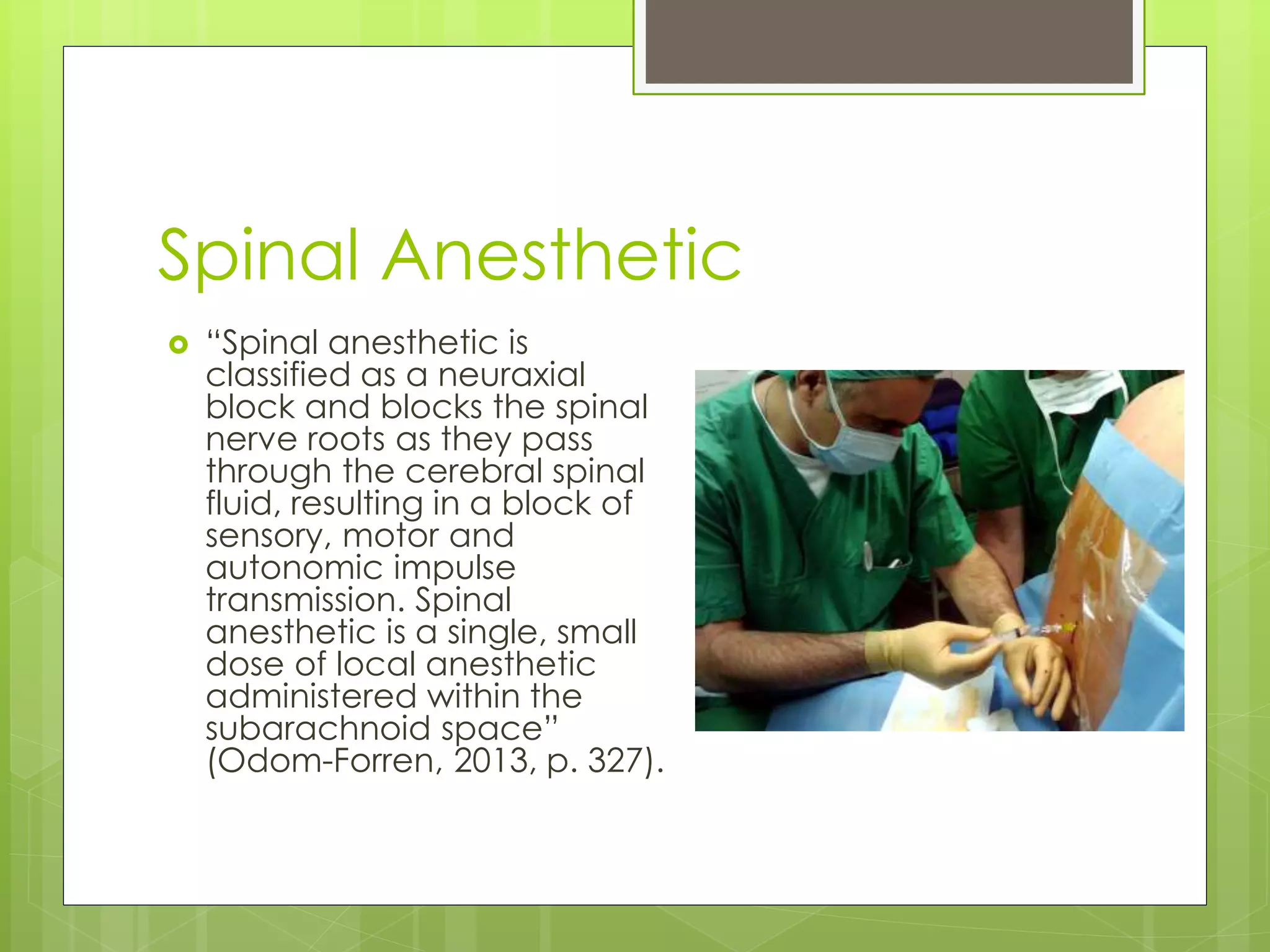
 “Spinal anesthetic is
classified as a neuraxial
block and blocks the spinal
nerve roots as they pass
through the cerebral spinal
fluid, resulting in a block of
sensory, motor and
autonomic impulse
transmission. Spinal
anesthetic is a single, small
dose of local anesthetic
administered within the
subarachnoid space”
(Odom-Forren, 2013, p. 327).
Spinal Complications
 High spinal block – excessive spread of local anesthetic that can
result in upper extremity sensory block , bradycardia/asystole, loss
of consciousness, respiratory distress or apnea.
 Hypotension – can be treated by fluid bolus, or vasopressors.
 Nausea and vomiting (sometimes due to hypotension).
 Urinary retention- often caused by autonomic blockade of the
sacral nerve and can cause patients to exhibit signs of restlessness
and incoherence. A bladder scan can be done to confirm
retention and a urinary catheter can be inserted.
 Hypothermia – inhibited peripheral vasoconstriction, transferring
body heat from the core to the periphery.
 Neurological – very rare, from traumatic needle placement,
hematoma, or bleeding. Causing pain, paralysis, sensory and motor
changes. Recovery is poor and more severe infectious
complications such as meningitis, and abcess can occur.
 Spinal Hematoma - rare but serious. Symptoms are low back pain,
motor changes, bowel & bladder dysfunction. If surgical treatment
is delayed more than 8 hours recovery is poor (Odom-Ferron, 2013,
p. 330-331).
Spinal Monitoring
 Monitoring the patient
recovering from spinal
anesthetic requires
regular checks of
dermatones ( with ice),
sensory and motor
function, respiratory,
cardiovascular and
neurological systems
frequently to assess for
complications.
Post Anesthesia Care
 Pain control
 Foley catheter with continuous bladder irrigation
(CBI)
 Monitoring CBI for color & presence of blood clots
 Intake and output
 Sequential compression devices (SCD)
 Incentive spirometer
 Vital signs
 Physical assessment
 Early ambulation
Complications of TURP
 Infection. Urinary tract infection is the most common.
 Passing the semen into the bladder instead of out through
the urethra
 Loss of sperm fertility. If you plan on having children, talk to
your doctor before your procedure.
 Problem with urine control which is rarely long-lasting.
 Need for another TURP procedure, either because the signs
never improved or simply return over time as the prostate
continues to get bigger.
 Problem with erection which is rare.
 Bleeding or small blood clots
 A hole in the bladder
 Reduced sexual activity
An Unusual Case…
 Patients who undergo a TURP are not
anticoagulated because the urine is bloody
after surgery
 A patient who develops a DVT (deep vein
thrombosis) is usually treated with an
anticoagulant such as
Coumadin or Xaralto
 In this case a patient would
not be able to be treated this
way…
What’s a DVT?
 When a blood clot forms in one of the deep
veins in your body (usually your legs)
 Leg pain or swelling can be an indication but
may occur without symptoms
 DVT can develop
when a patient doesn’t
move for a long time
 This is a serious condition
because a clot can 0
break off an cause a
pulmonary embolism
Signs & Symptoms of DVT
 Pale skin or your skin feels cold to touch
 Swelling of legs or change in size of one leg
 No feeling in your leg or foot
 Tingling sensation in your leg or foot that does not go
away
 Trouble breathing
 Chest pain
 Coughing up blood
 Pain when walking
 Blood in your stool or urine
 Bleeding from anywhere in your body that will not
stop
How its treated in TURP
patients
*Click to play video*
Preventing DVT
 Do not sit for long periods of time. Get up and
move around every 1 to 2 hours, unless you
are sleeping or on bedrest
 Stretch your legs or wiggle your toes during
long trips and change position often
 Drink 6 to 8 glasses of water each day
 Do not drink beer, wine, and mixed drinks
(alcohol)
 Do not smoke
 If you are overweight, you should lose weight
References
 Mayo Clinic Staff. (2015). Deep Vein Thrombosis (DVT).
Retrieved from http://www.mayoclinic.org/diseases-
conditions/deep-vein-thrombosis/basics/definition/con-
20031922
 Odom-Forren, J. (2013). Drain’s Perianesthesia Nursing: A
Critical Care Approach. 6th Edition. St. Louis, Missouri:
Saunders.
 Personal Communication, March 29, 2015, Dr. A. Iocca.
 Urology Care Foundation. (2013). BPH: Surgical
Management (Benign Prostatic Hyperplasia/Enlarged
Prostate). Retrieved from http://www.urologyhealth.org
/urology/index.cfm?article=31

TURP Presentation

  • 1.
    Transurethral Resection of the Prostate (TURP) NicholleO’Donnell Matthew White Brittany Bimm
  • 2.
    What is aTURP? *Click to play video*
  • 3.
    In Summary  Theprostate is a gland at the base of the bladder in men  Sometimes, the prostate may become too large. Then, less urine flows out of the bladder opening  Your doctor can remove the inner part of the prostate to make passing urine easier  This procedure is called a transurethral resection of the prostate or a TURP  A TURP can remove all or part of the prostate gland
  • 4.
    Resulting in  Youwill be able to pass urine more easily  Your doctor may also take small pieces of the prostate to test and look for signs of illness or cancer
  • 5.
    Perianesthesia Nursing Careof the TURP Patient  “Pre existing medical conditions and the effects of anesthetic agents may compromise respiratory function making it pertinent that deep breathing and coughing, position changes and the use of incentive spirometry are of utmost importance to ensure optimal lung function”(Odom-Forren, 2013, p. 547).
  • 6.
    General Anesthetic  Generalanesthesia is the induction of a state of unconsciousness with the absence of pain sensation over the entire body, through the administration of anesthetic drugs.
  • 7.
    General Anesthetic Complications  Pain- 25% of patients still experience pain despite spinal anesthesia  Nausea and vomiting - up to 30% of patients, due to the narcotics being used  Damage to teeth - most frequently damaged  teeth are the upper maxillary incisors  Hypotension - transient hypotension as sympathetic nerves are blocked. This usually responds to prompt fluid replacement, usually starting with crystalloids followed by colloids  Headache - results from CSF leak from the puncture site. This is treated with bedrest and adequate hydration  Awareness during anaesthesia - up to 0.2% of patients;  Respiratory depression – due to narcotics being used, usually treated with narcan  Death
  • 8.
    Spinal Anesthetic  “Spinalanesthetic is classified as a neuraxial block and blocks the spinal nerve roots as they pass through the cerebral spinal fluid, resulting in a block of sensory, motor and autonomic impulse transmission. Spinal anesthetic is a single, small dose of local anesthetic administered within the subarachnoid space” (Odom-Forren, 2013, p. 327).
  • 9.
    Spinal Complications  Highspinal block – excessive spread of local anesthetic that can result in upper extremity sensory block , bradycardia/asystole, loss of consciousness, respiratory distress or apnea.  Hypotension – can be treated by fluid bolus, or vasopressors.  Nausea and vomiting (sometimes due to hypotension).  Urinary retention- often caused by autonomic blockade of the sacral nerve and can cause patients to exhibit signs of restlessness and incoherence. A bladder scan can be done to confirm retention and a urinary catheter can be inserted.  Hypothermia – inhibited peripheral vasoconstriction, transferring body heat from the core to the periphery.  Neurological – very rare, from traumatic needle placement, hematoma, or bleeding. Causing pain, paralysis, sensory and motor changes. Recovery is poor and more severe infectious complications such as meningitis, and abcess can occur.  Spinal Hematoma - rare but serious. Symptoms are low back pain, motor changes, bowel & bladder dysfunction. If surgical treatment is delayed more than 8 hours recovery is poor (Odom-Ferron, 2013, p. 330-331).
  • 10.
    Spinal Monitoring  Monitoringthe patient recovering from spinal anesthetic requires regular checks of dermatones ( with ice), sensory and motor function, respiratory, cardiovascular and neurological systems frequently to assess for complications.
  • 11.
    Post Anesthesia Care Pain control  Foley catheter with continuous bladder irrigation (CBI)  Monitoring CBI for color & presence of blood clots  Intake and output  Sequential compression devices (SCD)  Incentive spirometer  Vital signs  Physical assessment  Early ambulation
  • 12.
    Complications of TURP Infection. Urinary tract infection is the most common.  Passing the semen into the bladder instead of out through the urethra  Loss of sperm fertility. If you plan on having children, talk to your doctor before your procedure.  Problem with urine control which is rarely long-lasting.  Need for another TURP procedure, either because the signs never improved or simply return over time as the prostate continues to get bigger.  Problem with erection which is rare.  Bleeding or small blood clots  A hole in the bladder  Reduced sexual activity
  • 13.
    An Unusual Case… Patients who undergo a TURP are not anticoagulated because the urine is bloody after surgery  A patient who develops a DVT (deep vein thrombosis) is usually treated with an anticoagulant such as Coumadin or Xaralto  In this case a patient would not be able to be treated this way…
  • 14.
    What’s a DVT? When a blood clot forms in one of the deep veins in your body (usually your legs)  Leg pain or swelling can be an indication but may occur without symptoms  DVT can develop when a patient doesn’t move for a long time  This is a serious condition because a clot can 0 break off an cause a pulmonary embolism
  • 15.
    Signs & Symptomsof DVT  Pale skin or your skin feels cold to touch  Swelling of legs or change in size of one leg  No feeling in your leg or foot  Tingling sensation in your leg or foot that does not go away  Trouble breathing  Chest pain  Coughing up blood  Pain when walking  Blood in your stool or urine  Bleeding from anywhere in your body that will not stop
  • 16.
    How its treatedin TURP patients *Click to play video*
  • 17.
    Preventing DVT  Donot sit for long periods of time. Get up and move around every 1 to 2 hours, unless you are sleeping or on bedrest  Stretch your legs or wiggle your toes during long trips and change position often  Drink 6 to 8 glasses of water each day  Do not drink beer, wine, and mixed drinks (alcohol)  Do not smoke  If you are overweight, you should lose weight
  • 18.
    References  Mayo ClinicStaff. (2015). Deep Vein Thrombosis (DVT). Retrieved from http://www.mayoclinic.org/diseases- conditions/deep-vein-thrombosis/basics/definition/con- 20031922  Odom-Forren, J. (2013). Drain’s Perianesthesia Nursing: A Critical Care Approach. 6th Edition. St. Louis, Missouri: Saunders.  Personal Communication, March 29, 2015, Dr. A. Iocca.  Urology Care Foundation. (2013). BPH: Surgical Management (Benign Prostatic Hyperplasia/Enlarged Prostate). Retrieved from http://www.urologyhealth.org /urology/index.cfm?article=31

Editor's Notes

  • #12 http://www.med.umich.edu/1libr/urology/postcare/turp.htm
  • #14 Dr. Angelo Iocca
  • #15 http://www.mayoclinic.org/diseases-conditions/deep-vein-thrombosis/basics/definition/con-20031922