cri-du-chat syndrome
Balbeer Singh
Biosciences (V)
Szabist
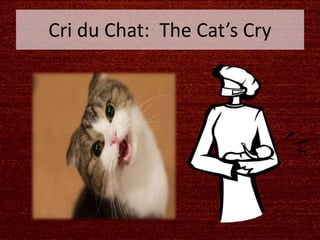
Cri du Chat: The Cat’s Cry
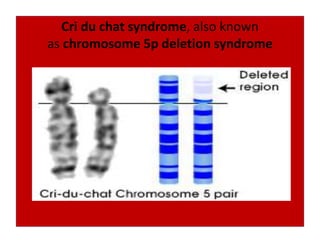
Cri du chat syndrome, also known
as chromosome 5p deletion syndrome
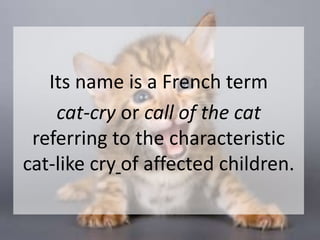
Its name is a French term
cat-cry or call of the cat
referring to the characteristic
cat-like cry of affected children.
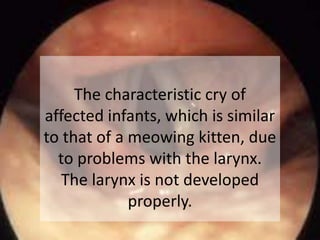
The characteristic cry of
affected infants, which is similar
to that of a meowing kitten, due
to problems with the larynx.
The larynx is not developed
properly.
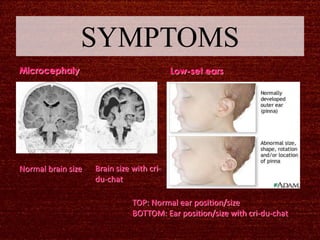
SYMPTOMS
Normal brain size
TOP: Normal ear position/size
BOTTOM: Ear position/size with cri-du-chat
Microcephaly Low-set ears
Brain size with cri-
du-chat
SYMPTOMS
 Babies with cri-du-chat are usually small at
birth, and may have respiratory problems.
 Often, the larynx doesn’t develop correctly,
which causes the signature catlike cry.
 Mental retardation
 Small head (microcephaly).
Small jaw (micrognathia).
Downward slant of the eyes.
Wide-set eyes.
Abnormally shaped/positioned ears.
Webbed fingers or toes.
Single line in the palm of the hand (simian
crease).
Hanging skin in front of the ears.
Slow or incomplete development of
basic skills.
Cause
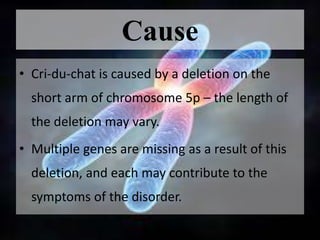
• Cri-du-chat is caused by a deletion on the
short arm of chromosome 5p – the length of
the deletion may vary.
• Multiple genes are missing as a result of this
deletion, and each may contribute to the
symptoms of the disorder.
• One of the deleted genes known to be
involved is HTERT (human telomerase reverse
transcriptase).
• HTERT helps to keep the information in DNA
functioning properly.
• If HTERT is damaged, mental illnesses such as
cri-du-chat occur.
Inheritance of Cri-du-Chat
 The deletion that causes cri-du-
chat syndrome is caused by a
dominant trait.
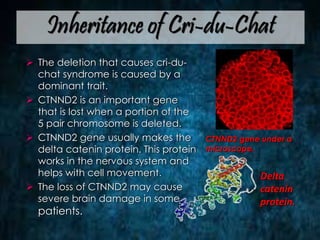
 CTNND2 is an important gene
that is lost when a portion of the
5 pair chromosome is deleted.
 CTNND2 gene usually makes the
delta catenin protein. This protein
works in the nervous system and
helps with cell movement.
 The loss of CTNND2 may cause
severe brain damage in some
patients.
CTNND2 gene under a
microscope.
Delta
catenin
protein.
Diagnosis
 Doctors most often identify cri-du-chat by looking at
the patient’s symptoms.
 Another method of diagnosing cri-du-chat
syndrome takes place while the baby is still in its
mother's womb.
 Doctors can either test a tiny sample of tissue from
outside the sac where the baby develops, or they
can test a sample of the amniotic fluid – the
protective liquid in the womb from which a baby
gets nourishment.
Treatment
• There is no specific treatment
available for this disorder so medical
care is focused on the symptoms.
Physical therapy is recommended to
strengthen the muscles. To increase
communication skills, a speech
therapist can help the child learn to
use sign language.
Statistics
 Approximately 90% of cases of cri-du-chat
syndrome result from a randomly-occurring
deletion.
 The remaining 10% occurs purely by inheritance.
 Cri-du-chat syndrome occurs in an estimated 1 in
20,000 to 50,000 newborns.
 Cri-du-chat can occur in all races and in both
genders, although there is a slight female
predominance. The male to female ratio is 3:4.
 Approximately 30% of infants with cri-du-chat have
heart defects.
 About 1/3 of infants lose the catlike cry at age 2.
Interesting Facts
 The geneticist Jerome Lejeune identified cri-du-chat
syndrome in 1963. He also discovered the genetic
abnormality that causes Down syndrome.
 In 80% of cri-du-chat cases, the chromosome
carrying the deletion comes from the father’s sperm
rather than the mother’s eggs.
 If pairs of chromosomes don’t line up correctly
during metaphase in meiosis, the structure of a
chromosome can be changed. When this happens
with chromosome 5, it causes cri-du-chat.
 Cri-du-chat is the most common syndrome caused
by deletion.
ThAnk yOu…

Cri du-chat syndrome

  • 1.
  • 2.
    Cri du Chat:The Cat’s Cry
  • 3.
    Cri du chatsyndrome, also known as chromosome 5p deletion syndrome
  • 4.
    Its name isa French term cat-cry or call of the cat referring to the characteristic cat-like cry of affected children.
  • 5.
    The characteristic cryof affected infants, which is similar to that of a meowing kitten, due to problems with the larynx. The larynx is not developed properly.
  • 6.
    SYMPTOMS Normal brain size TOP:Normal ear position/size BOTTOM: Ear position/size with cri-du-chat Microcephaly Low-set ears Brain size with cri- du-chat
  • 7.
    SYMPTOMS  Babies withcri-du-chat are usually small at birth, and may have respiratory problems.  Often, the larynx doesn’t develop correctly, which causes the signature catlike cry.  Mental retardation  Small head (microcephaly). Small jaw (micrognathia).
  • 8.
    Downward slant ofthe eyes. Wide-set eyes. Abnormally shaped/positioned ears. Webbed fingers or toes. Single line in the palm of the hand (simian crease). Hanging skin in front of the ears. Slow or incomplete development of basic skills.
  • 9.
    Cause • Cri-du-chat iscaused by a deletion on the short arm of chromosome 5p – the length of the deletion may vary. • Multiple genes are missing as a result of this deletion, and each may contribute to the symptoms of the disorder.
  • 10.
    • One ofthe deleted genes known to be involved is HTERT (human telomerase reverse transcriptase). • HTERT helps to keep the information in DNA functioning properly. • If HTERT is damaged, mental illnesses such as cri-du-chat occur.
  • 11.
    Inheritance of Cri-du-Chat The deletion that causes cri-du- chat syndrome is caused by a dominant trait.  CTNND2 is an important gene that is lost when a portion of the 5 pair chromosome is deleted.  CTNND2 gene usually makes the delta catenin protein. This protein works in the nervous system and helps with cell movement.  The loss of CTNND2 may cause severe brain damage in some patients. CTNND2 gene under a microscope. Delta catenin protein.
  • 12.
    Diagnosis  Doctors mostoften identify cri-du-chat by looking at the patient’s symptoms.  Another method of diagnosing cri-du-chat syndrome takes place while the baby is still in its mother's womb.  Doctors can either test a tiny sample of tissue from outside the sac where the baby develops, or they can test a sample of the amniotic fluid – the protective liquid in the womb from which a baby gets nourishment.
  • 13.
    Treatment • There isno specific treatment available for this disorder so medical care is focused on the symptoms. Physical therapy is recommended to strengthen the muscles. To increase communication skills, a speech therapist can help the child learn to use sign language.
  • 14.
    Statistics  Approximately 90%of cases of cri-du-chat syndrome result from a randomly-occurring deletion.  The remaining 10% occurs purely by inheritance.  Cri-du-chat syndrome occurs in an estimated 1 in 20,000 to 50,000 newborns.  Cri-du-chat can occur in all races and in both genders, although there is a slight female predominance. The male to female ratio is 3:4.  Approximately 30% of infants with cri-du-chat have heart defects.  About 1/3 of infants lose the catlike cry at age 2.
  • 15.
    Interesting Facts  Thegeneticist Jerome Lejeune identified cri-du-chat syndrome in 1963. He also discovered the genetic abnormality that causes Down syndrome.  In 80% of cri-du-chat cases, the chromosome carrying the deletion comes from the father’s sperm rather than the mother’s eggs.  If pairs of chromosomes don’t line up correctly during metaphase in meiosis, the structure of a chromosome can be changed. When this happens with chromosome 5, it causes cri-du-chat.  Cri-du-chat is the most common syndrome caused by deletion.
  • 16.