Breaking Bad Equilibrium
John Willis
Twitter: botchagalupe
GitHub: botchagalupe
It’s a strategy that all the
players in the game can adopt
and converge on, but it won’t
produce a desirable outcome
for anyone.
Bad Equilibrium
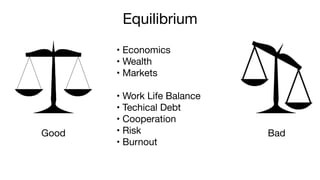
• Economics

• Wealth

• Markets

• Work Life Balance

• Techical Debt

• Cooperation

• Risk 

• Burnout
Equilibrium
Good Bad
Movie Fun
Game Theory Fun
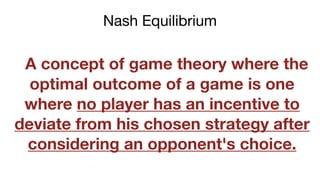
A concept of game theory where the
optimal outcome of a game is one
where no player has an incentive to
deviate from his chosen strategy after
considering an opponent's choice.
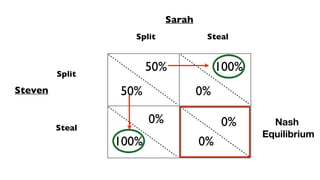
Nash Equilibrium
Sarah
Steven
Split Steal
Split
Steal
100%50%
50%
100% 0%
0% 0%
0%
Nash

Equilibrium
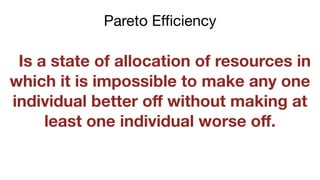
Is a state of allocation of resources in
which it is impossible to make any one
individual better off without making at
least one individual worse off.
Pareto Efficiency
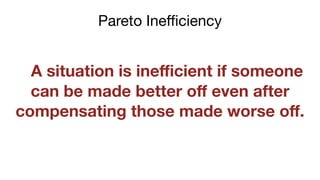
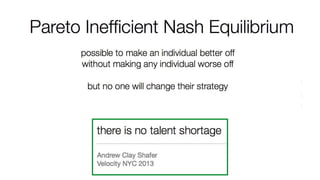
A situation is inefficient if someone
can be made better off even after
compensating those made worse off.
Pareto Inefficiency
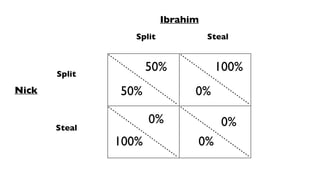
Ibrahim
Nick
Split Steal
Split
Steal
100%50%
50%
100% 0%
0% 0%
0%
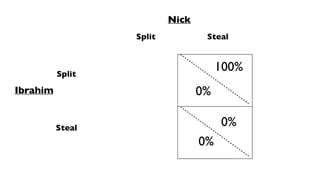
Nick
Ibrahim
Split Steal
Split
Steal
100%
0%
0%
0%
Why Michael Lewis?
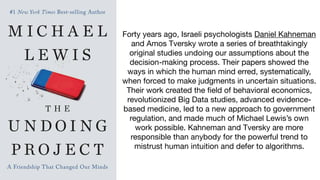
Forty years ago, Israeli psychologists Daniel Kahneman
and Amos Tversky wrote a series of breathtakingly
original studies undoing our assumptions about the
decision-making process. Their papers showed the
ways in which the human mind erred, systematically,
when forced to make judgments in uncertain situations.
Their work created the field of behavioral economics,
revolutionized Big Data studies, advanced evidence-
based medicine, led to a new approach to government
regulation, and made much of Michael Lewis’s own
work possible. Kahneman and Tversky are more
responsible than anybody for the powerful trend to
mistrust human intuition and defer to algorithms.
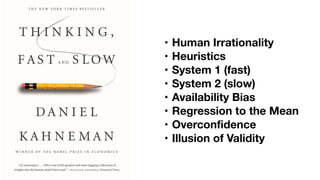
• Human Irrationality
• Heuristics
• System 1 (fast)
• System 2 (slow)
• Availability Bias
• Regression to the Mean
• Overconfidence
• Illusion of Validity
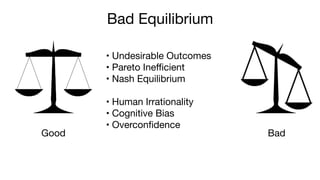
• Undesirable Outcomes

• Pareto Inefficient 

• Nash Equilibrium

• Human Irrationality

• Cognitive Bias

• Overconfidence
Bad Equilibrium
Good Bad
How to Change the
Game?
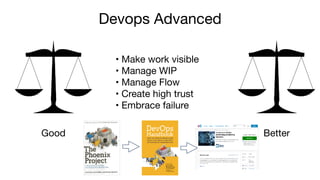
• Make work visible 

• Manage WIP

• Manage Flow

• Create high trust

• Embrace failure
Devops Advanced
Good Better
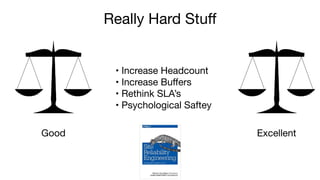
Really Hard Stuff
Good Excellent
• Increase Headcount

• Increase Buffers

• Rethink SLA’s

• Psychological Saftey
You are either building a
learning organization…
or you will be losing to
someone who is…
Andrew Clay Shafer

Breaking Bad Equilibrium - Devops Connect 2016 LA

  • 1.
    Breaking Bad Equilibrium JohnWillis Twitter: botchagalupe GitHub: botchagalupe
  • 2.
    It’s a strategythat all the players in the game can adopt and converge on, but it won’t produce a desirable outcome for anyone. Bad Equilibrium
  • 3.
    • Economics • Wealth •Markets
 • Work Life Balance • Techical Debt • Cooperation • Risk • Burnout Equilibrium Good Bad
  • 4.
  • 8.
  • 10.
    A concept ofgame theory where the optimal outcome of a game is one where no player has an incentive to deviate from his chosen strategy after considering an opponent's choice. Nash Equilibrium
  • 13.
  • 14.
    Is a stateof allocation of resources in which it is impossible to make any one individual better off without making at least one individual worse off. Pareto Efficiency
  • 15.
    A situation isinefficient if someone can be made better off even after compensating those made worse off. Pareto Inefficiency
  • 20.
  • 21.
  • 22.
  • 23.
    Forty years ago,Israeli psychologists Daniel Kahneman and Amos Tversky wrote a series of breathtakingly original studies undoing our assumptions about the decision-making process. Their papers showed the ways in which the human mind erred, systematically, when forced to make judgments in uncertain situations. Their work created the field of behavioral economics, revolutionized Big Data studies, advanced evidence- based medicine, led to a new approach to government regulation, and made much of Michael Lewis’s own work possible. Kahneman and Tversky are more responsible than anybody for the powerful trend to mistrust human intuition and defer to algorithms.
  • 24.
    • Human Irrationality •Heuristics • System 1 (fast) • System 2 (slow) • Availability Bias • Regression to the Mean • Overconfidence • Illusion of Validity
  • 27.
    • Undesirable Outcomes •Pareto Inefficient • Nash Equilibrium
 • Human Irrationality • Cognitive Bias • Overconfidence Bad Equilibrium Good Bad
  • 28.
    How to Changethe Game?
  • 29.
    • Make workvisible • Manage WIP • Manage Flow • Create high trust • Embrace failure Devops Advanced Good Better
  • 30.
    Really Hard Stuff GoodExcellent • Increase Headcount • Increase Buffers • Rethink SLA’s • Psychological Saftey
  • 31.
    You are eitherbuilding a learning organization… or you will be losing to someone who is… Andrew Clay Shafer