By Bita Jedo and Sophia Asilah Kelly
QUESTION 7: LOOKING BACK AT YOUR
PRELIMINARY TASK, WHAT DO YOU FEEL
YOU HAVE LEARNT IN THE PROGRESSION
FROM IT TO THE FULL PROJECT?
TYPES OF SHOT 1
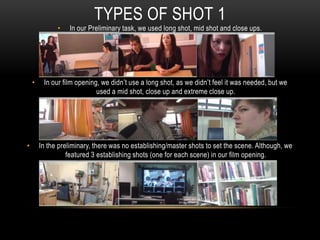
• In our Preliminary task, we used long shot, mid shot and close ups.
• In our film opening, we didn’t use a long shot, as we didn’t feel it was needed, but we
used a mid shot, close up and extreme close up.
• In the preliminary, there was no establishing/master shots to set the scene. Although, we
featured 3 establishing shots (one for each scene) in our film opening.
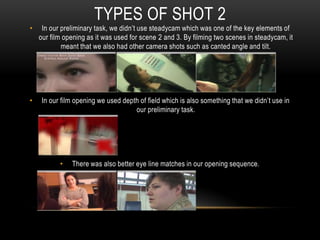
• In our preliminary task, we didn’t use steadycam which was one of the key elements of
our film opening as it was used for scene 2 and 3. By filming two scenes in steadycam, it
meant that we also had other camera shots such as canted angle and tilt.
• In our film opening we used depth of field which is also something that we didn’t use in
our preliminary task.
• There was also better eye line matches in our opening sequence.
TYPES OF SHOT 2
COMPOSITION OF SHOTS
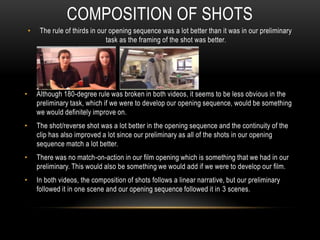
• The rule of thirds in our opening sequence was a lot better than it was in our preliminary
task as the framing of the shot was better.
• Although 180-degree rule was broken in both videos, it seems to be less obvious in the
preliminary task, which if we were to develop our opening sequence, would be something
we would definitely improve on.
• The shot/reverse shot was a lot better in the opening sequence and the continuity of the
clip has also improved a lot since our preliminary as all of the shots in our opening
sequence match a lot better.
• There was no match-on-action in our film opening which is something that we had in our
preliminary. This would also be something we would add if we were to develop our film.
• In both videos, the composition of shots follows a linear narrative, but our preliminary
followed it in one scene and our opening sequence followed it in 3 scenes.
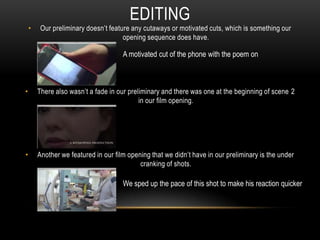
• Our preliminary doesn’t feature any cutaways or motivated cuts, which is something our
opening sequence does have.
• There also wasn’t a fade in our preliminary and there was one at the beginning of scene 2
in our film opening.
• Another we featured in our film opening that we didn’t have in our preliminary is the under
cranking of shots.
EDITING
A motivated cut of the phone with the poem on
We sped up the pace of this shot to make his reaction quicker
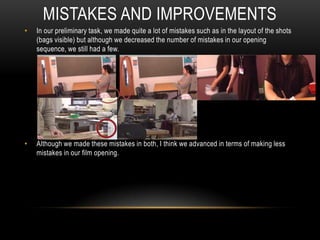
• In our preliminary task, we made quite a lot of mistakes such as in the layout of the shots
(bags visible) but although we decreased the number of mistakes in our opening
sequence, we still had a few.
• Although we made these mistakes in both, I think we advanced in terms of making less
mistakes in our film opening.
MISTAKES AND IMPROVEMENTS
• Overall I think we have learnt a lot in terms of camera shots, editing and composition of
shots.
• We used a wider range of shots and angles and included more editing techniques to make
our opening look more professional. Our placement of the camera also eliminated any
massive views of the background which lowered the amount of mistakes made.
• The organisation was also a lot better in our film opening as we did scripts, storyboards,
shooting schedules and location booking which made the production of our film opening a
lot faster than our preliminary.
• The feedback we received after our first draft has also helped as it told us what we need
to improve to make it look better.
CONCLUSION

Question 7

  • 1.
    By Bita Jedoand Sophia Asilah Kelly QUESTION 7: LOOKING BACK AT YOUR PRELIMINARY TASK, WHAT DO YOU FEEL YOU HAVE LEARNT IN THE PROGRESSION FROM IT TO THE FULL PROJECT?
  • 2.
    TYPES OF SHOT1 • In our Preliminary task, we used long shot, mid shot and close ups. • In our film opening, we didn’t use a long shot, as we didn’t feel it was needed, but we used a mid shot, close up and extreme close up. • In the preliminary, there was no establishing/master shots to set the scene. Although, we featured 3 establishing shots (one for each scene) in our film opening.
  • 3.
    • In ourpreliminary task, we didn’t use steadycam which was one of the key elements of our film opening as it was used for scene 2 and 3. By filming two scenes in steadycam, it meant that we also had other camera shots such as canted angle and tilt. • In our film opening we used depth of field which is also something that we didn’t use in our preliminary task. • There was also better eye line matches in our opening sequence. TYPES OF SHOT 2
  • 4.
    COMPOSITION OF SHOTS •The rule of thirds in our opening sequence was a lot better than it was in our preliminary task as the framing of the shot was better. • Although 180-degree rule was broken in both videos, it seems to be less obvious in the preliminary task, which if we were to develop our opening sequence, would be something we would definitely improve on. • The shot/reverse shot was a lot better in the opening sequence and the continuity of the clip has also improved a lot since our preliminary as all of the shots in our opening sequence match a lot better. • There was no match-on-action in our film opening which is something that we had in our preliminary. This would also be something we would add if we were to develop our film. • In both videos, the composition of shots follows a linear narrative, but our preliminary followed it in one scene and our opening sequence followed it in 3 scenes.
  • 5.
    • Our preliminarydoesn’t feature any cutaways or motivated cuts, which is something our opening sequence does have. • There also wasn’t a fade in our preliminary and there was one at the beginning of scene 2 in our film opening. • Another we featured in our film opening that we didn’t have in our preliminary is the under cranking of shots. EDITING A motivated cut of the phone with the poem on We sped up the pace of this shot to make his reaction quicker
  • 6.
    • In ourpreliminary task, we made quite a lot of mistakes such as in the layout of the shots (bags visible) but although we decreased the number of mistakes in our opening sequence, we still had a few. • Although we made these mistakes in both, I think we advanced in terms of making less mistakes in our film opening. MISTAKES AND IMPROVEMENTS
  • 7.
    • Overall Ithink we have learnt a lot in terms of camera shots, editing and composition of shots. • We used a wider range of shots and angles and included more editing techniques to make our opening look more professional. Our placement of the camera also eliminated any massive views of the background which lowered the amount of mistakes made. • The organisation was also a lot better in our film opening as we did scripts, storyboards, shooting schedules and location booking which made the production of our film opening a lot faster than our preliminary. • The feedback we received after our first draft has also helped as it told us what we need to improve to make it look better. CONCLUSION