THE UPANISHADS
“SITTING DOWN NEAR”
108 IN MUKTIKĀ
“they express the
restlessness and striving
of human mind to grasp
the true nature of reality.
They set forth fundamental
conceptions that are
sound. Their lofty ideals
and poetry have the power
to move the greatest
minds”
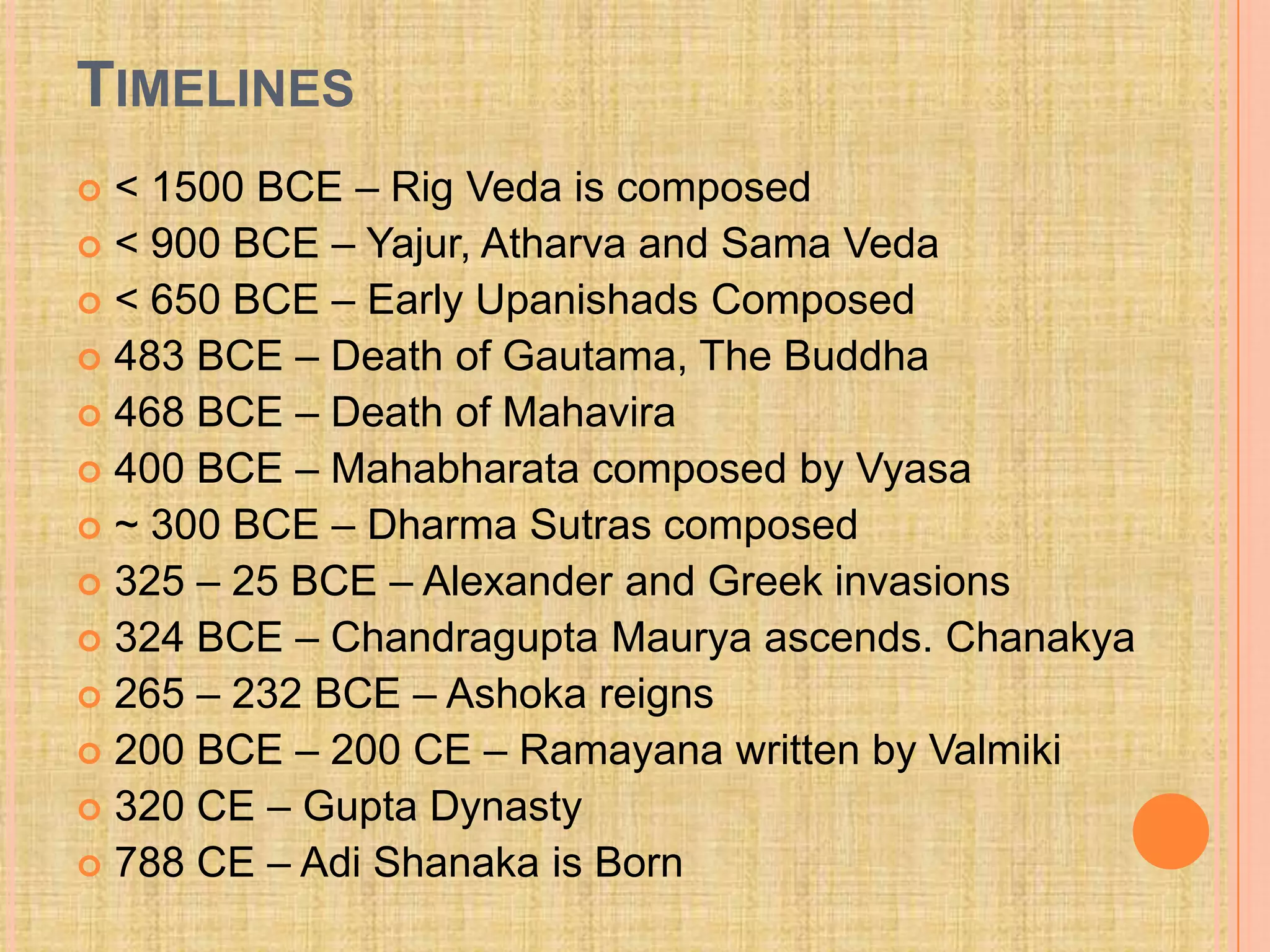
TIMELINES
 < 1500 BCE – Rig Veda is composed
 < 900 BCE – Yajur, Atharva and Sama Veda
 < 650 BCE – Early Upanishads Composed
 483 BCE – Death of Gautama, The Buddha
 468 BCE – Death of Mahavira
 400 BCE – Mahabharata composed by Vyasa
 ~ 300 BCE – Dharma Sutras composed
 325 – 25 BCE – Alexander and Greek invasions
 324 BCE – Chandragupta Maurya ascends. Chanakya
 265 – 232 BCE – Ashoka reigns
 200 BCE – 200 CE – Ramayana written by Valmiki
 320 CE – Gupta Dynasty
 788 CE – Adi Shanaka is Born
HINDU PHILOSOPHICAL ROOTS
 Vedas  Brāhmaṇas  Āraṇyaka  Upanishad
 Uttarā Mīmāṃsā
 Higher Enquiry – Philosophical texts related to self
realization
 Pūrva Mimamsa
 Explanations of the fire-sacrifices, Brahmanas and
Āraṇyakas (forest scriptures!)
 Vedānta
 The appendix of Vedic Hymns ~ Veda + Anta
 Upanishads, Bhagawad Gita and Brahmasutras
AUTHORSHIP
 Yajnavalkya
 Uddalaka Aruni
 Shvetaketu
 Shandilya
 Aitreya
 Pippalada
 Sanatkumara
 Maitreyi
 Gargi
 Jabala
 Bharadwaja
 Pratardana
 Ajatasatru
 Varuna
 Gargyayana
 Adi Shankara
 Madhvācārya
 Bal Gangadhar Tilak
 Maharshi Aurobindo
 Swami Rama
 Eknath Easwaran
 Sarvepalli Radhakrishnan
 Professor Hirannayya
 Max Muller
 Schopenhauer
Originals Commentaries
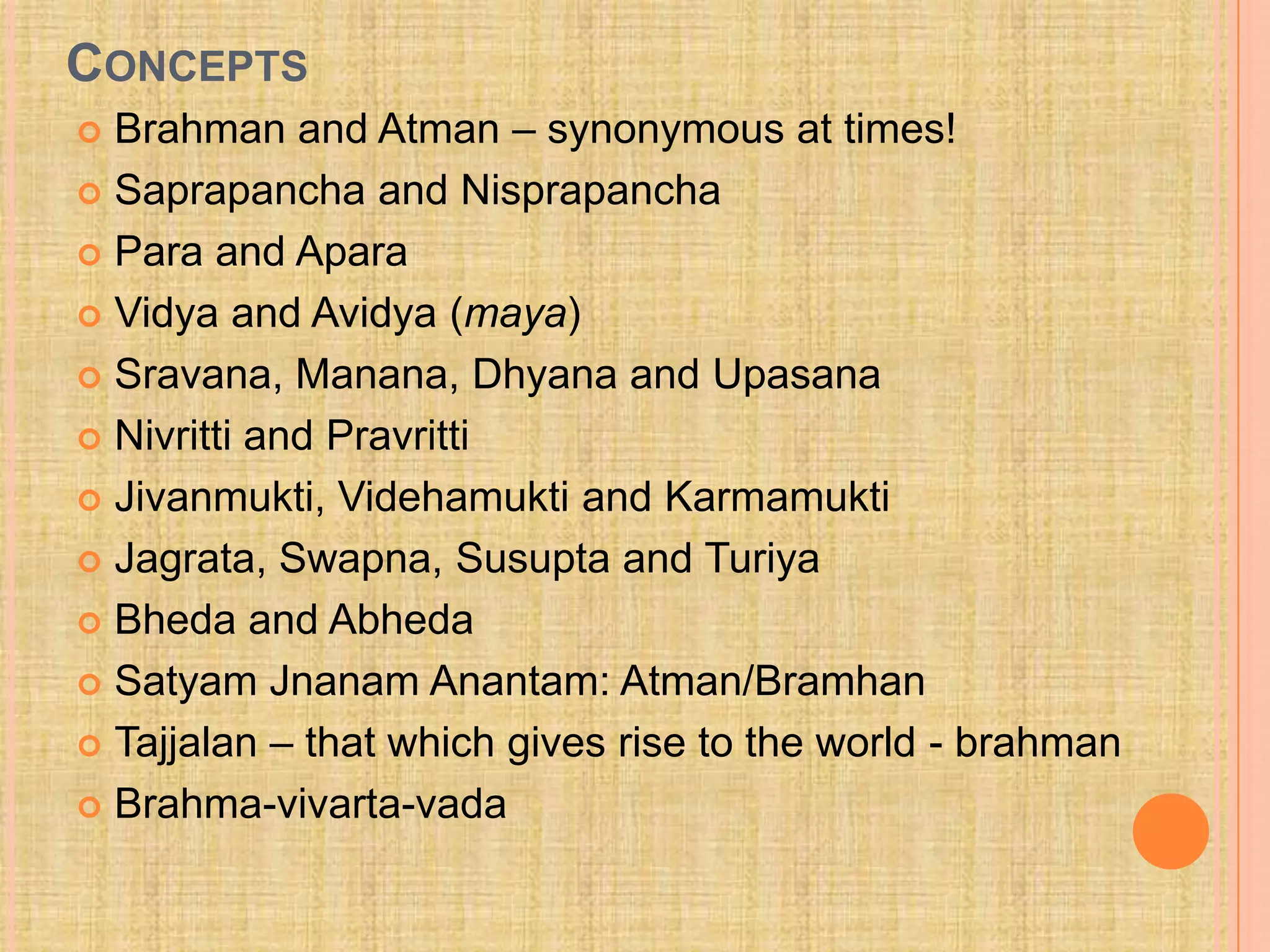
CONCEPTS
 Brahman and Atman – synonymous at times!
 Saprapancha and Nisprapancha
 Para and Apara
 Vidya and Avidya (maya)
 Sravana, Manana, Dhyana and Upasana
 Nivritti and Pravritti
 Jivanmukti, Videhamukti and Karmamukti
 Jagrata, Swapna, Susupta and Turiya
 Bheda and Abheda
 Satyam Jnanam Anantam: Atman/Bramhan
 Tajjalan – that which gives rise to the world - brahman
 Brahma-vivarta-vada
 Fundamentally Monistic
 Śruti and not Smṛti
 Philosophy
 The Upanishadic philosophers regarded the Self as the
ultimate existence and subordinated the world and God to the
Self. The Self to them, is more real than either the world or
God
 Presentation
 Upanishads are primarily presented as conversations
between two persons or animals rather than expository
statements of philosophy or ideology
 Fountain of Philosophical Thought
 West: Curiosity
 Hindu: Solve problems of life
DASHOPANISHAD
 Īṣa - The Inner Ruler – Shukla Yajur
 Kena - Who moves the world? - Sama
 Kaṭha - Death as Teacher – Krishna Yajur
 Praṣna - The Breath of Life - Atharva
 Muṇḍaka - Two modes of Knowing -
Atharva
 Māṇḍūkya - Consciousness and its
phases - Atharva
 Taittirīya - From Food to Joy – Krishna
Yajur
 Aitareya - The Microcosm of Man - Rg
 Chāndogya - Song and Sacrifice - Sama
 Bṛhadāraṇyaka - Shukla Yajur Veda
 Doctrine: Scholars have long held the view that all
Upanishads propound the same doctrine. As to what the
exact nature of that doctrine is, they differ widely!! – Prof
Hiriyanna
 Phase change: Ashwamedha as meditative act –
Brihadaranyaka
 Philosophical: Onslaughts against sacrifices, rituals and
ceremonies – Mundaka Upanishad
 Prime Object: removal of aham-kara; the basis of all evil;
cultivation of detachment or vairagya
 Darshana – A mere reasoned conviction is NOT enough
 Upanishadic God: explicit repudiation of objective
conception of god. (Agni, Vayu subordinate to Brahman –
Kena)
 Upanishads have consistency of intuition rather than logic –
Dr. Radhakrishnan
ĪṢA UPANISHAD
DESCRIPTION OF THE NATURE OF SUPREME BEING
18 Verses
IT MOVES; IT MOVES NOT
IT IS FAR; IT IS NEAR
IT IS WITHIN; IT IS WITHOUT
KENA UPANISHAD
 Story of Brahman, Indra, Agni and Vayu
Not that which the eye can see, but that whereby the eye can see:
know that to be Brahman the eternal, and not what people here
adore;
Not that which the ear can hear, but that whereby the ear can hear:
know that to be Brahman the eternal, and not what people here
adore;
Not that which speech can illuminate, but that by which speech
can be illuminated: know that to be Brahman the eternal, and not
what people here adore;
Not that which the mind can think, but that whereby the mind can
think: know that to be Brahman the eternal, and not what people
here adore.
4 Sections, 35 Verses
KAṬHOPANISHAD
ATMA – CHARIOTS PASSENGER
BODY – CHARIOT ITSELF
CONSCIOUSNESS – DRIVER
MIND – REINS
OBJECTS PERCEIVED BY THE
SENSES ARE THE CHARIOT'S PATH
3 Sections, 109 Verses
PRAṢNA UPANISHAD
QUESTIONS TO SAGE PIPPALADA
 The son of Katya, Kabandhi: “Root
cause of the universe”
 Bhargava of Vidarbha: “Relation
between senses and prana”
 The son of Ashwala, Kausalya: “From
whom prana orignates”
 Souryayanee Gargya: “Which
elements in a human actually sleep”
 Shaibya Satyakama: What fruit does
one get who regularly meditates on
holy syllable OM till his/her death?
 Son of Bharadwaja the Sukesha:
Description of the vedic divine being
6 Sections, 67 Verses
MUṆḌAKA
64 Mantras
 Question for Angiras -
 I want to know from you if there is
something I can learn which will
explain everything to me – Para
and Aprara
 There is a sacred word -- OM --
which is the bow; your own self is
the arrow and Brahman is the
target. Without trembling, hit the
mark, and like the arrow, lose
yourself in It!
 Shivo Bhutva Shivam Yajet
 My son, when you know that
Brahman, you become that
Brahman
MĀṆḌŪKYA
Ayam Atma Brahma
Fundamental approach to
Reality
– Shri Radhakrishnan
Sri Gaudapada
Adi Shankara
12 Verses
TAITTIRĪYA
ANNAMAYA – MADE OF FOOD
PRANAMAYA – MADE OF BREATH
MANOMAYA – MADE OF MIND
VIJNANAMAYA – MADE OF KNOWLEDGE
ANANDAMAYA – MADE OF JOY
Matru devo bhavaḥ,
Pitru devo bhavaḥ,
Acharya devo bhavaḥ,
Atithi devo bhavaḥ
3 Sections, Quite long
AITAREYA
 Aitareya Aranyaka of Rig Veda
 Chapter 1: Creation of Purusha, other divine
beings, creation of food
 Chapter 2: Three births of the self
 Chapter 3:
 Pragyanam brahma: Consciousness is Brahman
33 Verses
CHĀNDOGYA
 Tat tvam asi
 Dialogues between father
Uddalaka and son
Svetaketu
8 Chapters, Quite long
BṚHADĀRAṆYAKA
Aham brahmāsmi
neti neti
Asatoma Sadgamaya
Close your
Eyes
The Upanishads
The Upanishads
The Upanishads

The Upanishads

  • 1.
    THE UPANISHADS “SITTING DOWNNEAR” 108 IN MUKTIKĀ “they express the restlessness and striving of human mind to grasp the true nature of reality. They set forth fundamental conceptions that are sound. Their lofty ideals and poetry have the power to move the greatest minds”
  • 2.
    TIMELINES  < 1500BCE – Rig Veda is composed  < 900 BCE – Yajur, Atharva and Sama Veda  < 650 BCE – Early Upanishads Composed  483 BCE – Death of Gautama, The Buddha  468 BCE – Death of Mahavira  400 BCE – Mahabharata composed by Vyasa  ~ 300 BCE – Dharma Sutras composed  325 – 25 BCE – Alexander and Greek invasions  324 BCE – Chandragupta Maurya ascends. Chanakya  265 – 232 BCE – Ashoka reigns  200 BCE – 200 CE – Ramayana written by Valmiki  320 CE – Gupta Dynasty  788 CE – Adi Shanaka is Born
  • 3.
    HINDU PHILOSOPHICAL ROOTS Vedas  Brāhmaṇas  Āraṇyaka  Upanishad  Uttarā Mīmāṃsā  Higher Enquiry – Philosophical texts related to self realization  Pūrva Mimamsa  Explanations of the fire-sacrifices, Brahmanas and Āraṇyakas (forest scriptures!)  Vedānta  The appendix of Vedic Hymns ~ Veda + Anta  Upanishads, Bhagawad Gita and Brahmasutras
  • 4.
    AUTHORSHIP  Yajnavalkya  UddalakaAruni  Shvetaketu  Shandilya  Aitreya  Pippalada  Sanatkumara  Maitreyi  Gargi  Jabala  Bharadwaja  Pratardana  Ajatasatru  Varuna  Gargyayana  Adi Shankara  Madhvācārya  Bal Gangadhar Tilak  Maharshi Aurobindo  Swami Rama  Eknath Easwaran  Sarvepalli Radhakrishnan  Professor Hirannayya  Max Muller  Schopenhauer Originals Commentaries
  • 5.
    CONCEPTS  Brahman andAtman – synonymous at times!  Saprapancha and Nisprapancha  Para and Apara  Vidya and Avidya (maya)  Sravana, Manana, Dhyana and Upasana  Nivritti and Pravritti  Jivanmukti, Videhamukti and Karmamukti  Jagrata, Swapna, Susupta and Turiya  Bheda and Abheda  Satyam Jnanam Anantam: Atman/Bramhan  Tajjalan – that which gives rise to the world - brahman  Brahma-vivarta-vada
  • 6.
     Fundamentally Monistic Śruti and not Smṛti  Philosophy  The Upanishadic philosophers regarded the Self as the ultimate existence and subordinated the world and God to the Self. The Self to them, is more real than either the world or God  Presentation  Upanishads are primarily presented as conversations between two persons or animals rather than expository statements of philosophy or ideology  Fountain of Philosophical Thought  West: Curiosity  Hindu: Solve problems of life
  • 7.
    DASHOPANISHAD  Īṣa -The Inner Ruler – Shukla Yajur  Kena - Who moves the world? - Sama  Kaṭha - Death as Teacher – Krishna Yajur  Praṣna - The Breath of Life - Atharva  Muṇḍaka - Two modes of Knowing - Atharva  Māṇḍūkya - Consciousness and its phases - Atharva  Taittirīya - From Food to Joy – Krishna Yajur  Aitareya - The Microcosm of Man - Rg  Chāndogya - Song and Sacrifice - Sama  Bṛhadāraṇyaka - Shukla Yajur Veda
  • 8.
     Doctrine: Scholarshave long held the view that all Upanishads propound the same doctrine. As to what the exact nature of that doctrine is, they differ widely!! – Prof Hiriyanna  Phase change: Ashwamedha as meditative act – Brihadaranyaka  Philosophical: Onslaughts against sacrifices, rituals and ceremonies – Mundaka Upanishad  Prime Object: removal of aham-kara; the basis of all evil; cultivation of detachment or vairagya  Darshana – A mere reasoned conviction is NOT enough  Upanishadic God: explicit repudiation of objective conception of god. (Agni, Vayu subordinate to Brahman – Kena)  Upanishads have consistency of intuition rather than logic – Dr. Radhakrishnan
  • 9.
    ĪṢA UPANISHAD DESCRIPTION OFTHE NATURE OF SUPREME BEING 18 Verses IT MOVES; IT MOVES NOT IT IS FAR; IT IS NEAR IT IS WITHIN; IT IS WITHOUT
  • 10.
    KENA UPANISHAD  Storyof Brahman, Indra, Agni and Vayu Not that which the eye can see, but that whereby the eye can see: know that to be Brahman the eternal, and not what people here adore; Not that which the ear can hear, but that whereby the ear can hear: know that to be Brahman the eternal, and not what people here adore; Not that which speech can illuminate, but that by which speech can be illuminated: know that to be Brahman the eternal, and not what people here adore; Not that which the mind can think, but that whereby the mind can think: know that to be Brahman the eternal, and not what people here adore. 4 Sections, 35 Verses
  • 11.
    KAṬHOPANISHAD ATMA – CHARIOTSPASSENGER BODY – CHARIOT ITSELF CONSCIOUSNESS – DRIVER MIND – REINS OBJECTS PERCEIVED BY THE SENSES ARE THE CHARIOT'S PATH 3 Sections, 109 Verses
  • 12.
    PRAṢNA UPANISHAD QUESTIONS TOSAGE PIPPALADA  The son of Katya, Kabandhi: “Root cause of the universe”  Bhargava of Vidarbha: “Relation between senses and prana”  The son of Ashwala, Kausalya: “From whom prana orignates”  Souryayanee Gargya: “Which elements in a human actually sleep”  Shaibya Satyakama: What fruit does one get who regularly meditates on holy syllable OM till his/her death?  Son of Bharadwaja the Sukesha: Description of the vedic divine being 6 Sections, 67 Verses
  • 13.
    MUṆḌAKA 64 Mantras  Questionfor Angiras -  I want to know from you if there is something I can learn which will explain everything to me – Para and Aprara  There is a sacred word -- OM -- which is the bow; your own self is the arrow and Brahman is the target. Without trembling, hit the mark, and like the arrow, lose yourself in It!  Shivo Bhutva Shivam Yajet  My son, when you know that Brahman, you become that Brahman
  • 14.
    MĀṆḌŪKYA Ayam Atma Brahma Fundamentalapproach to Reality – Shri Radhakrishnan Sri Gaudapada Adi Shankara 12 Verses
  • 15.
    TAITTIRĪYA ANNAMAYA – MADEOF FOOD PRANAMAYA – MADE OF BREATH MANOMAYA – MADE OF MIND VIJNANAMAYA – MADE OF KNOWLEDGE ANANDAMAYA – MADE OF JOY Matru devo bhavaḥ, Pitru devo bhavaḥ, Acharya devo bhavaḥ, Atithi devo bhavaḥ 3 Sections, Quite long
  • 16.
    AITAREYA  Aitareya Aranyakaof Rig Veda  Chapter 1: Creation of Purusha, other divine beings, creation of food  Chapter 2: Three births of the self  Chapter 3:  Pragyanam brahma: Consciousness is Brahman 33 Verses
  • 17.
    CHĀNDOGYA  Tat tvamasi  Dialogues between father Uddalaka and son Svetaketu 8 Chapters, Quite long
  • 18.

Editor's Notes

  • #2  upa- (nearby), ni- (at the proper place, down) and ṣad(to sit) thus: &quot;sitting down near&quot;
  • #3 Vedas and Upanishads were Sidelined after the coming of Ashoka and Adi Shankara re-established the Vedic Dharma
  • #6 Cosmic and acosmicBrahman does not change but merely appears as the world
  • #10 &quot;unembodied, omniscient, beyond reproach, without veins, pure and uncontaminated“&quot;moves and does not move&apos;, who is &apos;far away, but very near as well&apos;&quot; and who &quot;although fixed in His abode is swifter than the mind“&quot;For the enlightened one all that exists is nothing but the Self“Tatvampushanapavrinu - A golden vessel covers the fact of truth, O thou nourisher, remove the cover so that votary and seeker of truth may see him.THAT (BRAHMAN) IS WHOLETHIS (CREATION) IS ALSO WHOLE FROM THAT WHOLE (I.E. BRAHMAN ONLY)THIS WHOLE HAS COME OUT (CREATION)BUT EVEN THOUGH THIS WHOLE HAS COME OUT OF THAT WHOLEYET THAT WHOLE REMAINS WHOLE ONLYGod pervades all all this that we see in the Universe. Therefore we must give up the idea of &apos;I&apos; and &apos;Mine&apos;, accept gratefully whatever is given to us by God and use it sharing it with our fellow beings. Eschew all feelings of greed and selfishness. Remember that everything really belongs to God alone.
  • #11 http://www.vedanta-atlanta.org/stories/God.behind.gods.html
  • #12 Vajashravasa -  &apos;one who is famous (-shravA) for his charity of giving grains (vAja-) and he performs a sacrifice in which he was required to give away all his worldly possessions1) to be allowed to return to his father alive, and that his father not be angry with him (1.1.10);2) to be instructed as to the proper performance of Vedic fire-sacrifice in order to gain immortality (1.1.12–13);3) to be given knowledge about life after death (1.1.20).
  • #14 ShivoBhutvaShivamYajet
  • #16 ShikshaValliBrahmanandaValliBhr.gu Valli
  • #18 I live; yet not I but God liveth in meJanshruti.  “The King’s merit is no more than that of Raikva”Food is my deity.If Prana pervades the universe, it must pervade me too. Who am I but a part of the universe... am I not?