COMPARATIVE ECONOMICS Modern Economic Systems – The State and The Market
The classification of economic systems Technological level and institutions The role of property The allocation of  the  production factors Work Capital Land
The institutional shell The forms of public service The scheme of economic regulation by the state The redistribution methods of income sources and income The specific forms of property The peculiarity of money
Typifying the economic systems  (I.) Early theories of the stages of growth: the stressing of singular factors (for instance: production or allocation): the differences between systems disappear Marx and Engles: the relation between the historical development of the social economic system and the forces of production  Late theories of the stages of growth: Rostow and the distinct role of economic growth
Typifying the economic systems  (II.) Walter Eucken and the thinking in terms of a system: the morphological apparatus of the description of the ideal economic systems Centrally planned economy and the barter economy The distinct factor: the extent of the customer’s freedom National Economies and the Global Economy
Cooperation and conflict Selfishness and malevolence Cooperation and selfishness Envy and competition Price, quantity, competition, cooperation: the contradictions of the enforcement of self-interest The role of the time factor in the resolution of the prisoner's dilemma
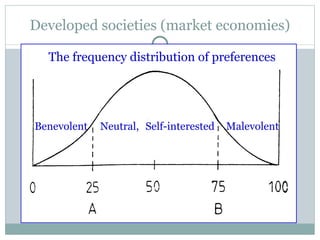
Developed societies (market economies) The frequency distribution of preferences Benevolent Neutral , Self-interested Malevolent
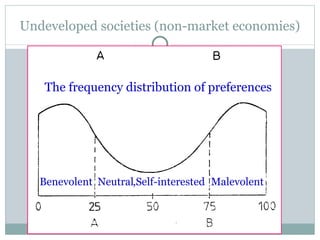
Undeveloped societies (non-market economies) The frequency distribution of preferences Benevolent Neutral , Self-interested Malevolent
State and market in modern capitalism The development of private property The family enterprise The measurement of performance The institution of unlimited liability Governance/management and property Owner and manager
Owner and manager The softening of property rights Limiting the special interest of the manager Competition on the capital markets – the signaling role of stock prices Competition on the product markets – (also) the evaluation of the managers’ performance Competition on the market of managers – higher profitability  higher managerial value
State sector in the modern market economy Expansion and contraction Market failures and nationalization State failures and (re)privatization Public goods – mixed goods – private goods The  S tate and the manager:  The danger of the softening up of the budgetary constraint Contradicting owner
Which is the more efficient economic solution? The general rule Specific situation, specific actors, specific institutions, specific „playing-field” The economic context of the political system  The role of the voters and the interest groups The effects of the world market
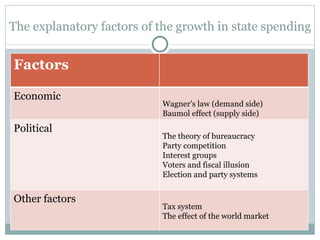
The explanatory factors of the growth in state spending Factors Economic Wagner’s law (demand side) Baumol effect (supply side) Political The theory of bureaucracy Party competition Interest groups Voters and fiscal illusion Election and party systems Other factors Tax system The effect of the world market
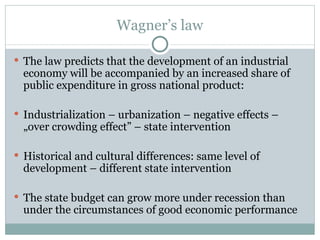
Wagner’s law The law predicts that the development of an industrial economy will be accompanied by an increased share of public expenditure in gross national product: Industrialization – urbanization – negative effects – „over crowding effect” – state intervention Historical and cultural differences: same level of development – different state intervention The state budget can grow more under recession than under the circumstances of good economic performance
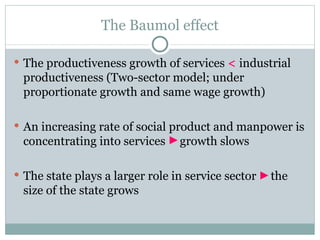
The  Baumol effect The productiveness growth of services  <  industrial productiveness (Two-sector model; under proportionate growth and same wage growth) An increasing rate of social product and manpower is concentrating into services  growth slows The state plays a larger role in service   sector  the size of the state grows
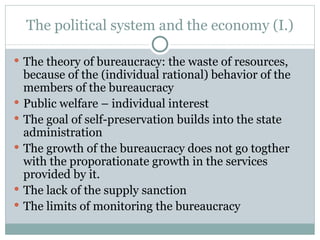
The political system and the economy (I.) The theory of bureaucracy: the waste of resources, because of the (individual rational) behavior of the members of the bureaucracy  Public welfare – individual interest The goal of self-preservation builds into the state administration The growth of the bureaucracy does not go togther with the proporationate growth in the services provided by it. The lack of the supply sanction The limits of monitoring the bureaucracy
The political system and the economy ( I I.) Parties and public welfare vs. Power Vote maximizing public expenditures Public expenditures and taxes: the inclination of the political parties for income redistribution Rational ignorance  smaller state than necessary (Downs, 1974) Present and future in the behavior of the voter Group-specific public goods (Buchanan and Tullock [1962])  excessive state spending
The political system and the economy ( II I.) Interest groups (Olson [1997] the free riding phenomenon and the (negative and positive) selective incentives) The competition of interest groups can either increase or decrease state spending Partisan-politics hypothesis (Kohl, 1987) Ideological distance Fragmentedness  or concentration The dynamics of coalition building: product bundling State spending and the political left Social expenditures and the moderate right
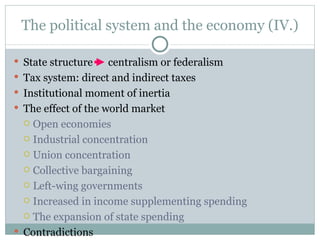
The political system and the economy ( IV .) State structure  centralism or federalism Tax system: direct and indirect taxes Institutional moment of inertia The effect of the world market Open economies Industrial concentration Union concentration Collective bargaining Left-wing governments Increased in income supplementing spending The expansion of state spending Contradictions
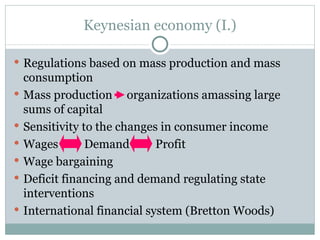
Keynesian economy  (I.) Regulations based on mass production and mass consumption Mass production  organizations amassing large sums of capital Sensitivity to the changes in consumer income Wages  Demand  Profit Wage bargaining Deficit financing and demand regulating state interventions International financial system (Bretton Woods)
Keynesian economy  (II.) The theory of social coalitions The culture, elasticity or rigidity of state bureaucracy The crisis of the Keynesian economic policy A move towards a liberalism The disintegration of the social coalition The crisis of mass production (?)
The historical types of the capitalist economy Competition and regulation Nationalization – privatization Regulation – deregulation Losses created by the State  >  Losses created by the market The mixed economic systems Market driven economy Negotiated economy State driven economy

Modern Econ. Systems State&amp;Market

  • 1.
    COMPARATIVE ECONOMICS ModernEconomic Systems – The State and The Market
  • 2.
    The classification ofeconomic systems Technological level and institutions The role of property The allocation of the production factors Work Capital Land
  • 3.
    The institutional shellThe forms of public service The scheme of economic regulation by the state The redistribution methods of income sources and income The specific forms of property The peculiarity of money
  • 4.
    Typifying the economicsystems (I.) Early theories of the stages of growth: the stressing of singular factors (for instance: production or allocation): the differences between systems disappear Marx and Engles: the relation between the historical development of the social economic system and the forces of production Late theories of the stages of growth: Rostow and the distinct role of economic growth
  • 5.
    Typifying the economicsystems (II.) Walter Eucken and the thinking in terms of a system: the morphological apparatus of the description of the ideal economic systems Centrally planned economy and the barter economy The distinct factor: the extent of the customer’s freedom National Economies and the Global Economy
  • 6.
    Cooperation and conflictSelfishness and malevolence Cooperation and selfishness Envy and competition Price, quantity, competition, cooperation: the contradictions of the enforcement of self-interest The role of the time factor in the resolution of the prisoner's dilemma
  • 7.
    Developed societies (marketeconomies) The frequency distribution of preferences Benevolent Neutral , Self-interested Malevolent
  • 8.
    Undeveloped societies (non-marketeconomies) The frequency distribution of preferences Benevolent Neutral , Self-interested Malevolent
  • 9.
    State and marketin modern capitalism The development of private property The family enterprise The measurement of performance The institution of unlimited liability Governance/management and property Owner and manager
  • 10.
    Owner and managerThe softening of property rights Limiting the special interest of the manager Competition on the capital markets – the signaling role of stock prices Competition on the product markets – (also) the evaluation of the managers’ performance Competition on the market of managers – higher profitability higher managerial value
  • 11.
    State sector inthe modern market economy Expansion and contraction Market failures and nationalization State failures and (re)privatization Public goods – mixed goods – private goods The S tate and the manager: The danger of the softening up of the budgetary constraint Contradicting owner
  • 12.
    Which is themore efficient economic solution? The general rule Specific situation, specific actors, specific institutions, specific „playing-field” The economic context of the political system The role of the voters and the interest groups The effects of the world market
  • 13.
    The explanatory factorsof the growth in state spending Factors Economic Wagner’s law (demand side) Baumol effect (supply side) Political The theory of bureaucracy Party competition Interest groups Voters and fiscal illusion Election and party systems Other factors Tax system The effect of the world market
  • 14.
    Wagner’s law Thelaw predicts that the development of an industrial economy will be accompanied by an increased share of public expenditure in gross national product: Industrialization – urbanization – negative effects – „over crowding effect” – state intervention Historical and cultural differences: same level of development – different state intervention The state budget can grow more under recession than under the circumstances of good economic performance
  • 15.
    The Baumoleffect The productiveness growth of services < industrial productiveness (Two-sector model; under proportionate growth and same wage growth) An increasing rate of social product and manpower is concentrating into services growth slows The state plays a larger role in service sector the size of the state grows
  • 16.
    The political systemand the economy (I.) The theory of bureaucracy: the waste of resources, because of the (individual rational) behavior of the members of the bureaucracy Public welfare – individual interest The goal of self-preservation builds into the state administration The growth of the bureaucracy does not go togther with the proporationate growth in the services provided by it. The lack of the supply sanction The limits of monitoring the bureaucracy
  • 17.
    The political systemand the economy ( I I.) Parties and public welfare vs. Power Vote maximizing public expenditures Public expenditures and taxes: the inclination of the political parties for income redistribution Rational ignorance smaller state than necessary (Downs, 1974) Present and future in the behavior of the voter Group-specific public goods (Buchanan and Tullock [1962]) excessive state spending
  • 18.
    The political systemand the economy ( II I.) Interest groups (Olson [1997] the free riding phenomenon and the (negative and positive) selective incentives) The competition of interest groups can either increase or decrease state spending Partisan-politics hypothesis (Kohl, 1987) Ideological distance Fragmentedness or concentration The dynamics of coalition building: product bundling State spending and the political left Social expenditures and the moderate right
  • 19.
    The political systemand the economy ( IV .) State structure centralism or federalism Tax system: direct and indirect taxes Institutional moment of inertia The effect of the world market Open economies Industrial concentration Union concentration Collective bargaining Left-wing governments Increased in income supplementing spending The expansion of state spending Contradictions
  • 20.
    Keynesian economy (I.) Regulations based on mass production and mass consumption Mass production organizations amassing large sums of capital Sensitivity to the changes in consumer income Wages Demand Profit Wage bargaining Deficit financing and demand regulating state interventions International financial system (Bretton Woods)
  • 21.
    Keynesian economy (II.) The theory of social coalitions The culture, elasticity or rigidity of state bureaucracy The crisis of the Keynesian economic policy A move towards a liberalism The disintegration of the social coalition The crisis of mass production (?)
  • 22.
    The historical typesof the capitalist economy Competition and regulation Nationalization – privatization Regulation – deregulation Losses created by the State > Losses created by the market The mixed economic systems Market driven economy Negotiated economy State driven economy