ECONOMIC DEVELOPMENT
OF THE PHILIPPINES
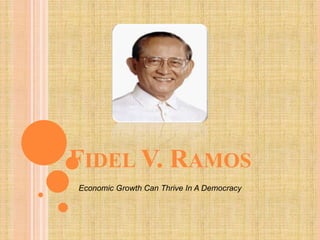
FIDEL V. RAMOS
Economic Growth Can Thrive In A Democracy
FIDEL V. RAMOS
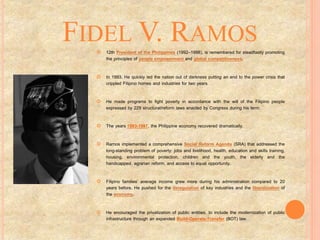
 12th President of the Philippines (1992–1998), is remembered for steadfastly promoting
the principles of people empowerment and global competitiveness.
 In 1993, He quickly led the nation out of darkness putting an end to the power crisis that
crippled Filipino homes and industries for two years.
 He made programs to fight poverty in accordance with the will of the Filipino people
expressed by 229 structural/reform laws enacted by Congress during his term.
 The years 1993-1997, the Philippine economy recovered dramatically.
 Ramos implemented a comprehensive Social Reform Agenda (SRA) that addressed the
long-standing problem of poverty: jobs and livelihood, health, education and skills training,
housing, environmental protection, children and the youth, the elderly and the
handicapped, agrarian reform, and access to equal opportunity.
 Filipino families’ average income grew more during his administration compared to 20
years before. He pushed for the deregulation of key industries and the liberalization of
the economy.
 He encouraged the privatization of public entities, to include the modernization of public
infrastructure through an expanded Build-Operate-Transfer (BOT) law.
FIDEL V. RAMOS
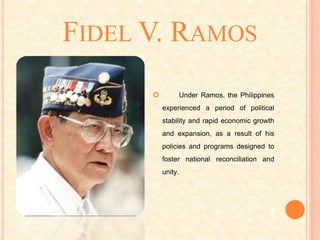
 Under Ramos, the Philippines
experienced a period of political
stability and rapid economic growth
and expansion, as a result of his
policies and programs designed to
foster national reconciliation and
unity.
FIDEL V. RAMOS
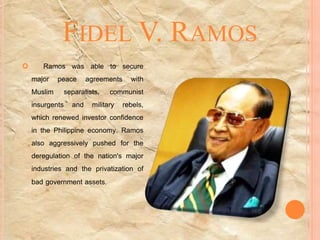
 Ramos was able to secure
major peace agreements with
Muslim separatists, communist
insurgents and military rebels,
which renewed investor confidence
in the Philippine economy. Ramos
also aggressively pushed for the
deregulation of the nation's major
industries and the privatization of
bad government assets.
FIDEL V. RAMOS
Economy during his term in Administration . . .
ECONOMY
 President Fidel Ramos
embarked on an ambitious
development plan dubbed
"Philippines 2000." Under the plan,
several industries critical to
economic development were
privatized, such as
 electricity,
 telecommunications,
 banking,
 domestic shipping, and
 oil.
ECONOMY
 The taxation system was reformed,
and external debt was brought to more
manageable levels by debt
restructuring and sensible fiscal
management. By 1996, GNP was
growing at a rate of 7.2 percent and
GDP at 5.2 percent. The annual
inflation rate had dropped to 5.9
percent from its high of 9.1 percent in
1995. By the late 1990s, the
Philippines' economic growth gained
favorable comparisons with other
Asian countries such as Taiwan,
Thailand, South Korea, and Malaysia.
PHILIPPINE ECONOMY
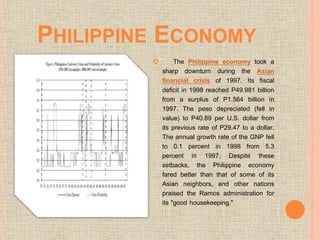
 The Philippine economy took a
sharp downturn during the Asian
financial crisis of 1997. Its fiscal
deficit in 1998 reached P49.981 billion
from a surplus of P1.564 billion in
1997. The peso depreciated (fell in
value) to P40.89 per U.S. dollar from
its previous rate of P29.47 to a dollar.
The annual growth rate of the GNP fell
to 0.1 percent in 1998 from 5.3
percent in 1997. Despite these
setbacks, the Philippine economy
fared better than that of some of its
Asian neighbors, and other nations
praised the Ramos administration for
its "good housekeeping."
ECONOMIC REFORMS
 During his administration, Ramos began implementing economic reforms intended to open
up the once-closed national economy, encourage private enterprise, invite more foreign and
domestic investment, and reduce corruption.
 Ramos was also known as the most-traveled Philippine President compared to his
predecessors with numerous foreign trips abroad, generating about US$ 20 billion worth of
foreign investments to the Philippines.
 To ensure a positive financial outlook on the Philippines, Ramos led the 4th Asia Pacific
Economic Cooperation (APEC) Leaders' Summit in the Philippines on November 1996.
 He also instituted reforms in the tax system which includes a forced increase on VAT (E-
VAT law) from 4% to 10% mandated by World Bank and the International Monetary
Fund.
ECONOMIC REFORMS
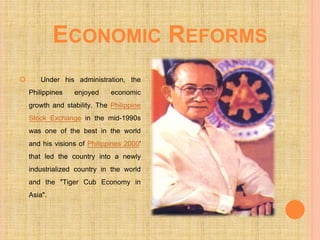
 Under his administration, the
Philippines enjoyed economic
growth and stability. The Philippine
Stock Exchange in the mid-1990s
was one of the best in the world
and his visions of Philippines 2000'
that led the country into a newly
industrialized country in the world
and the "Tiger Cub Economy in
Asia".
ECONOMIC REFORMS
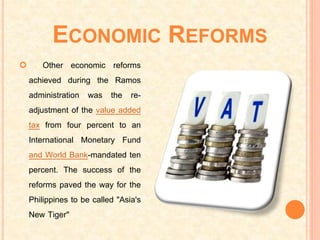
 Other economic reforms
achieved during the Ramos
administration was the re-
adjustment of the value added
tax from four percent to an
International Monetary Fund
and World Bank-mandated ten
percent. The success of the
reforms paved the way for the
Philippines to be called "Asia's
New Tiger"
ECONOMIC REFORMS
 Economic reforms instituted
during the Ramos era enabled the
Philippines to experience growth
rates of up to nine percent
annually, and enjoy annual budget
surpluses well into his tenure. The
economic reforms instituted in
the Philippines 2000 platform would
have an effect on how the
Philippines would be affected in
the 1997 East Asian financial
crisis.
PHILIPPINES 2000 FIVE-
POINT PROGRAM
Philippines 2000 was the socio-economic program of
former Philippine President Fidel V. Ramos. The plan
envisioned the Philippines achieving newly industrialized
country status by the year 2000.
PHILIPPINES 2000 FIVE-POINT PROGRAM
 The Philippines 2000 platform largely hinged on five major areas:
 Peace and Stability
 Economic Growth and Sustainable Development
 Energy and Power Generation
 Environmental Protection
 Streamlined Bureaucracy
 He implemented economic reforms intended to open up the once-
closed national economy, encourage private enterprise, invite more
foreign and domestic investment, and reduce corruption.
EFFECTS AND LEGACY
 The Philippines 2000 platform was
widely successful, making it one of the
greatest legacies of the Ramos
administration to the Philippines. Ramos
was successfully able to open the then-
closed Philippine economy and break
Marcos-era formed monopolies,
especially with regard to Philippine
Airlines and the Philippine Long
Distance Telephone Company, which
were privatized and de-monopolized
during his tenure.
 The Philippines 2000 program
formed the core of the Ramos campaign
platform in the 1992 elections which
largely centered on economic reforms
and improved national security and
unity.
PREPARED BY:
John Henry Madriaga
Joshua Gabriel Buan
-END-

Fidel v ramos 2

  • 1.
  • 2.
    FIDEL V. RAMOS EconomicGrowth Can Thrive In A Democracy
  • 3.
    FIDEL V. RAMOS 12th President of the Philippines (1992–1998), is remembered for steadfastly promoting the principles of people empowerment and global competitiveness.  In 1993, He quickly led the nation out of darkness putting an end to the power crisis that crippled Filipino homes and industries for two years.  He made programs to fight poverty in accordance with the will of the Filipino people expressed by 229 structural/reform laws enacted by Congress during his term.  The years 1993-1997, the Philippine economy recovered dramatically.  Ramos implemented a comprehensive Social Reform Agenda (SRA) that addressed the long-standing problem of poverty: jobs and livelihood, health, education and skills training, housing, environmental protection, children and the youth, the elderly and the handicapped, agrarian reform, and access to equal opportunity.  Filipino families’ average income grew more during his administration compared to 20 years before. He pushed for the deregulation of key industries and the liberalization of the economy.  He encouraged the privatization of public entities, to include the modernization of public infrastructure through an expanded Build-Operate-Transfer (BOT) law.
  • 4.
    FIDEL V. RAMOS Under Ramos, the Philippines experienced a period of political stability and rapid economic growth and expansion, as a result of his policies and programs designed to foster national reconciliation and unity.
  • 5.
    FIDEL V. RAMOS Ramos was able to secure major peace agreements with Muslim separatists, communist insurgents and military rebels, which renewed investor confidence in the Philippine economy. Ramos also aggressively pushed for the deregulation of the nation's major industries and the privatization of bad government assets.
  • 6.
    FIDEL V. RAMOS Economyduring his term in Administration . . .
  • 7.
    ECONOMY  President FidelRamos embarked on an ambitious development plan dubbed "Philippines 2000." Under the plan, several industries critical to economic development were privatized, such as  electricity,  telecommunications,  banking,  domestic shipping, and  oil.
  • 8.
    ECONOMY  The taxationsystem was reformed, and external debt was brought to more manageable levels by debt restructuring and sensible fiscal management. By 1996, GNP was growing at a rate of 7.2 percent and GDP at 5.2 percent. The annual inflation rate had dropped to 5.9 percent from its high of 9.1 percent in 1995. By the late 1990s, the Philippines' economic growth gained favorable comparisons with other Asian countries such as Taiwan, Thailand, South Korea, and Malaysia.
  • 9.
    PHILIPPINE ECONOMY  ThePhilippine economy took a sharp downturn during the Asian financial crisis of 1997. Its fiscal deficit in 1998 reached P49.981 billion from a surplus of P1.564 billion in 1997. The peso depreciated (fell in value) to P40.89 per U.S. dollar from its previous rate of P29.47 to a dollar. The annual growth rate of the GNP fell to 0.1 percent in 1998 from 5.3 percent in 1997. Despite these setbacks, the Philippine economy fared better than that of some of its Asian neighbors, and other nations praised the Ramos administration for its "good housekeeping."
  • 10.
    ECONOMIC REFORMS  Duringhis administration, Ramos began implementing economic reforms intended to open up the once-closed national economy, encourage private enterprise, invite more foreign and domestic investment, and reduce corruption.  Ramos was also known as the most-traveled Philippine President compared to his predecessors with numerous foreign trips abroad, generating about US$ 20 billion worth of foreign investments to the Philippines.  To ensure a positive financial outlook on the Philippines, Ramos led the 4th Asia Pacific Economic Cooperation (APEC) Leaders' Summit in the Philippines on November 1996.  He also instituted reforms in the tax system which includes a forced increase on VAT (E- VAT law) from 4% to 10% mandated by World Bank and the International Monetary Fund.
  • 11.
    ECONOMIC REFORMS  Underhis administration, the Philippines enjoyed economic growth and stability. The Philippine Stock Exchange in the mid-1990s was one of the best in the world and his visions of Philippines 2000' that led the country into a newly industrialized country in the world and the "Tiger Cub Economy in Asia".
  • 12.
    ECONOMIC REFORMS  Othereconomic reforms achieved during the Ramos administration was the re- adjustment of the value added tax from four percent to an International Monetary Fund and World Bank-mandated ten percent. The success of the reforms paved the way for the Philippines to be called "Asia's New Tiger"
  • 13.
    ECONOMIC REFORMS  Economicreforms instituted during the Ramos era enabled the Philippines to experience growth rates of up to nine percent annually, and enjoy annual budget surpluses well into his tenure. The economic reforms instituted in the Philippines 2000 platform would have an effect on how the Philippines would be affected in the 1997 East Asian financial crisis.
  • 14.
    PHILIPPINES 2000 FIVE- POINTPROGRAM Philippines 2000 was the socio-economic program of former Philippine President Fidel V. Ramos. The plan envisioned the Philippines achieving newly industrialized country status by the year 2000.
  • 15.
    PHILIPPINES 2000 FIVE-POINTPROGRAM  The Philippines 2000 platform largely hinged on five major areas:  Peace and Stability  Economic Growth and Sustainable Development  Energy and Power Generation  Environmental Protection  Streamlined Bureaucracy  He implemented economic reforms intended to open up the once- closed national economy, encourage private enterprise, invite more foreign and domestic investment, and reduce corruption.
  • 16.
    EFFECTS AND LEGACY The Philippines 2000 platform was widely successful, making it one of the greatest legacies of the Ramos administration to the Philippines. Ramos was successfully able to open the then- closed Philippine economy and break Marcos-era formed monopolies, especially with regard to Philippine Airlines and the Philippine Long Distance Telephone Company, which were privatized and de-monopolized during his tenure.  The Philippines 2000 program formed the core of the Ramos campaign platform in the 1992 elections which largely centered on economic reforms and improved national security and unity.
  • 17.
    PREPARED BY: John HenryMadriaga Joshua Gabriel Buan -END-