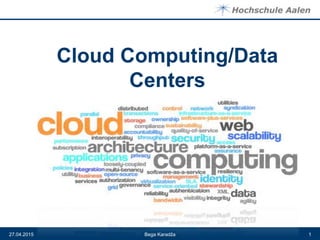
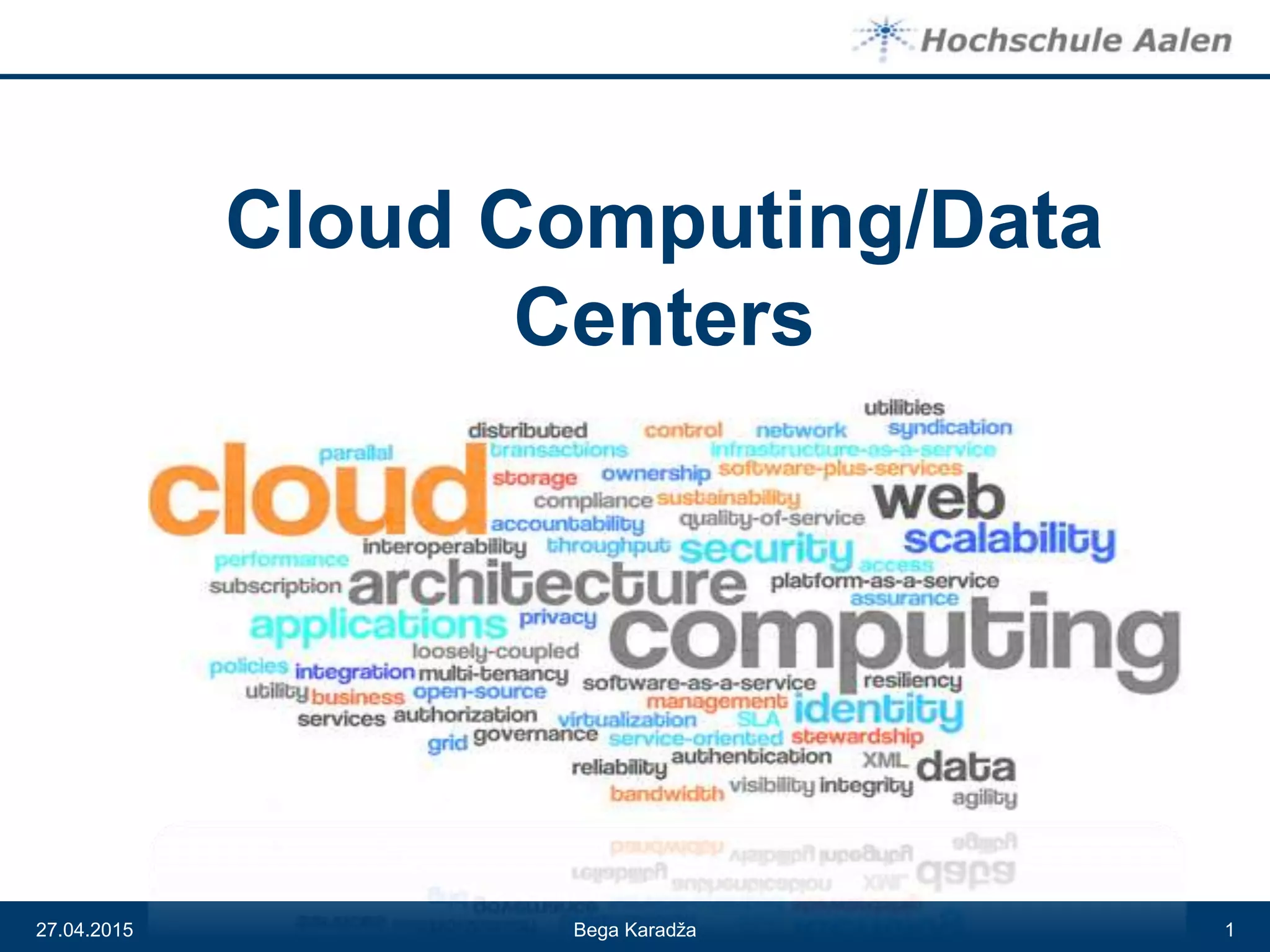
Cloud Computing/Data
Centers
27.04.2015 1Bega Karadža
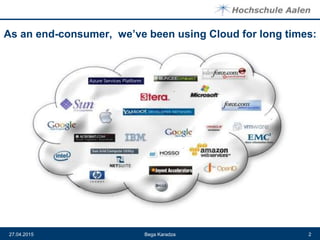
As an end-consumer, we’ve been using Cloud for long times:
Bega Karadza27.04.2015 2
John McCarthy, scientist:
“…Computing may someday be organized as a public
utility just as the telephone system is a public utility...”
Bega Karadza27.04.2015 3
What is Cloud Computing?
Bega Karadza27.04.2015 4
“Cloud computing is a style of computing where
massively scalable IT-related capabilities are provided
as a service across the Internet to multiple external
customers”
“Cloud computing: A pool of abstracted, highly scalable,
and managed infrastructure capable of hosting end-
customer applications and billed by consumption”
“Cloud Computing is a computing model for enabling
convenient and on demand network access to a shared pool
of configurable computing resources (e.g.,
networks, servers, storage, applications, and services) that
can be rapidly released with minimal management effort or
service provider interaction.”
Cloud Comuting
● Cloud Computing is a general term used to describe a new class of
computing that takes place over the Internet.
● A collection/group of integrated and networked hardware, software and
Internet infrastructure.
● Using the Internet for communication and transport CC provides
hardware, software and networking services to clients.
● Complexity and details of the underlying infrastructure are hidden from
users.
Bega Karadza27.04.2015 5
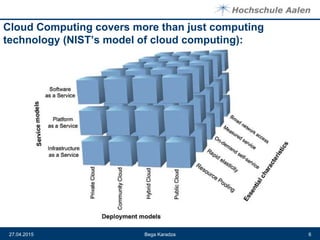
Cloud Computing covers more than just computing
technology (NIST’s model of cloud computing):
Bega Karadza27.04.2015 6
Essential characteristics:
● On-demand self service that enables consumers to unilaterally provision computing
capabilities, such network storage and server time as needed, automatically, without
requiring human involvement.
● Broad network access which ensures that all Cloud functionalities and the resources
are available over the network and can be accessed through standard mechanisms via
thick or thin clients (e.g., laptops, desktops, tablets and mobile phones).
● Resource pooling which allows the computing resources provisioned by the provider to
be pooled, in order to serve numerous consumers using a multi-tenant model, where
different physical and virtual resources are dynamically assigned and reassigned
according to the demands of the consumer.
● Rapid elasticity and scaling that not only allows the functionalities and resources to
scale rapidly outward and inward in accordance to the demands of the consumer, but
also allows those capabilities to be elastically provisioned and released. Pay for use and
as needed
● Measured service that facilitates automatic control and optimization of resource
allocations in addition to providing the capability to monitor, control and report resource
usage, for both the providers as well as the consumers.
Name27.04.2015 7
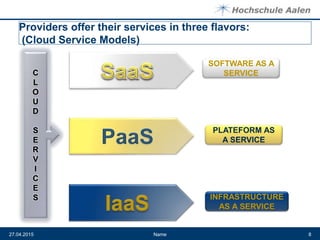
Providers offer their services in three flavors:
(Cloud Service Models)
Name27.04.2015 8
C
L
O
U
D
S
E
R
V
I
C
E
S
SOFTWARE AS A
SERVICE
PLATEFORM AS
A SERVICE
INFRASTRUCTURE
AS A SERVICE
Cloud Software as a Service (SaaS)
● Essentially based on the concept of renting application functionality
from a service provider rather than buying, installing and running
software yourself.
● Consumers typically access these applications from client devices that
support thin client interfaces like a web browser or use Application
Programming Interfaces (API) defined by the hosted software.
● Consumers do not control or manage the underlying infrastructure or
platform
● e.g. Gmail, Google Docs, Salesforce.com and Microsoft Office 365.
Name27.04.2015 9
Cloud Platform as a Service (PaaS):
● The providers deliver a computing platform using which consumers can
build and deploy their own applications on the Cloud.
● The computing platform typically includes operating systems,
programming libraries and tools that are supported by the service
provider.
● Subscribers do not have access to the underlying Cloud infrastructure,
but they are typically able control the deployed applications and
configuration settings for the application hosting environment.
● Examples of PaaS include: Google App Engine, Microsoft Azure and
Amazon Elastic Beanstalk.
Name27.04.2015 10
Cloud Infrastructure as a Service (IaaS):
● Delivers compute services, typically in the form of a set of virtual
machines with associated storage, processing capability, and other
relevant resources like network connectivity.
● Some examples of IaaS include: Amazon Cloud Formation, Rackspace
Cloud and Google Compute Engine.
Name27.04.2015 11
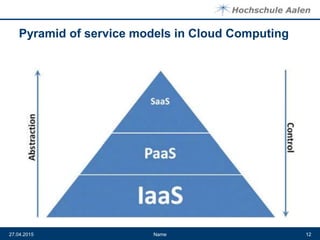
Pyramid of service models in Cloud Computing
Name27.04.2015 12
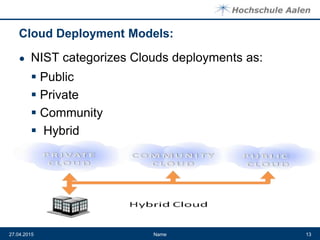
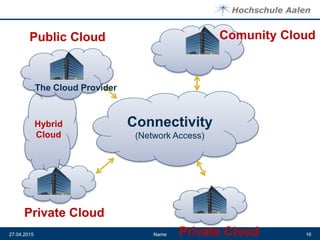
Cloud Deployment Models:
● NIST categorizes Clouds deployments as:
 Public
 Private
 Community
 Hybrid
Name27.04.2015 13
Private Cloud:
● The Cloud infrastructure is exclusively used by a single organization.
● Companies only want to use hosted services and do not want to share
their infrastructure.
● Under Public deployment model, the Cloud functionalities and
resources are made available for open use to the general public.
● Customers access and use hosted Cloud services that are either free
or offered on pay-per-use basis. Generally, public Cloud service
providers like Microsoft, Amazon and Google own and operate their
Cloud infrastructure and offer access to end users via the Internet.
Name27.04.2015 14
Public Cloud:
Community Cloud:
● The Cloud infrastructure is shared exclusively between organizations
from a specific group or community and have common computing
concerns. The Cloud framework may be owned, managed and
operated by one or more organizations.
● The Cloud infrastructure consists of two or more distinct Clouds
(Public, Private or Community). These composite Clouds remain
unique entities, but they are bound together by standardized
technologies that enable data and application portability.
Name27.04.2015 15
Hybrid Cloud:
Name27.04.2015 16
Hybrid
Cloud
Connectivity
(Network Access)
Public Cloud
Private Cloud
Private Cloud
The Cloud Provider
Comunity Cloud
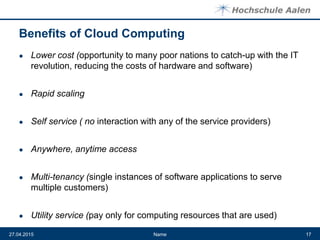
Benefits of Cloud Computing
● Lower cost (opportunity to many poor nations to catch-up with the IT
revolution, reducing the costs of hardware and software)
● Rapid scaling
● Self service ( no interaction with any of the service providers)
● Anywhere, anytime access
● Multi-tenancy (single instances of software applications to serve
multiple customers)
● Utility service (pay only for computing resources that are used)
Name27.04.2015 17
Name27.04.2015 18
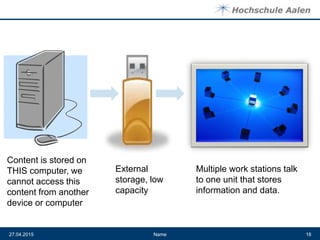
Content is stored on
THIS computer, we
cannot access this
content from another
device or computer
External
storage, low
capacity
Multiple work stations talk
to one unit that stores
information and data.
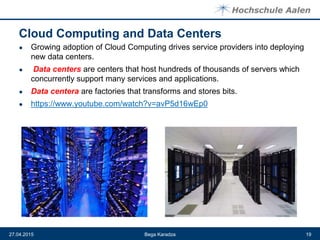
Cloud Computing and Data Centers
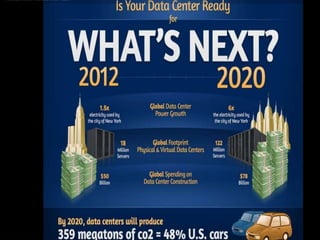
● Growing adoption of Cloud Computing drives service providers into deploying
new data centers.
● Data centers are centers that host hundreds of thousands of servers which
concurrently support many services and applications.
● Data centera are factories that transforms and stores bits.
● https://www.youtube.com/watch?v=avP5d16wEp0
Bega Karadza27.04.2015 19
● Requirements for building data center:
 Power supply (high power supply, generator facility to overcome the
power failure situation)
 Continuous cooling system
 Security system ( fire alarms, proper ventilation in order to remove
smoke, authorised access, video cameras, security-code
access,biometric access,card reader access,locked cabinets…)
Bega Karadza27.04.2015 20
Ethernet
● Ethernet has become the most widely used data transport protocol for
networking technology in local area networks (LANs) and data centers
around the world. The main reason is that Ethernet provides a very
cost effective high bandwidth link between servers and switches.
● Ethernet specifications moved from 100Mbps to 1Gbps in about 4
years and then to 10GbE in about another 4 years.
● It has taken about 10 more years to come up with a 100GbE
specification that is useful for data center applications. The reason for
this increase in time has a lot to do with semiconductor technology.
Bega Karadza
27.04.2015 21
Cloud Computing and Data Centers
Bega Karadza27.04.2015 22
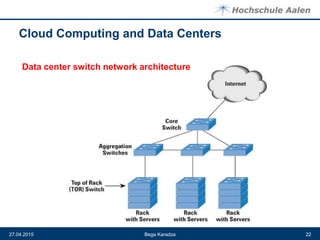
Data center switch network architecture
Cloud Computing and Data Centers
● A typical rack may contain on the order of 40 or more servers, so many ToR
switches contain up to 48 10GbE ports and four 40GbE uplink ports which are
connected to aggregation switches.
● Cloud data center ToR switches are evolved from LAN workgroup switches.
Bega Karadza27.04.2015 23
● In the case of the 10GbE ports, lower cost, direct attach copper cabling
can be used for the short distance between the servers and the ToR
switches, which is less than a few meters.
● Optic fibers are used for the ToR switch uplink ports, because they
need to drive longer distances and higher bandwidth.
● Aggregation switches are typically used to connect a number of ToR
switches to a core switch/router.
● The core switch is at the top of the cloud data center network pyramid
and may include a wide area network (WAN) connection to the outside
carrier network.
Bega Karadza27.04.2015 24
● Data centers are not only serving data, but also pulling information
from a variety of servers and running specialized programs based on
user input. For example, a Google map request could spawn some of
the following transactions:
● Determine the device type the client is using (laptop, handheld, etc.).
● Send information to a local search engine to match the map address.
● Based on the match, pull up the appropriate map data and send it to
the client based on device type.
● Based on the match and the user settings, pull up relative nearby
attractions to display on the map and send it to the client.
● Retrieve relative information about the client based on recent web
transaction.
● Use this information to identify shopping history and send targeted
advertising to be displayed on the client’s web page.
Bega Karadza
27.04.2015 25
Bega Karadza27.04.2015 26
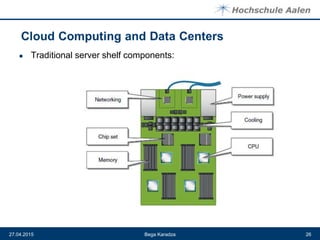
● Traditional server shelf components:
Name27.04.2015 27
Resources
● S.Kulkarni, P.Agrawal, Analysis of TCP Performance in Data Center
Networks, Springer New York
● Gary Lee, Cloud Networking
● http://www.slideshare.net/ctrlsweb/the-abc-of-data-center
Bega Karadza
27.04.2015 28

Cloud Computing and Data Centers

  • 1.
  • 2.
    As an end-consumer,we’ve been using Cloud for long times: Bega Karadza27.04.2015 2
  • 3.
    John McCarthy, scientist: “…Computingmay someday be organized as a public utility just as the telephone system is a public utility...” Bega Karadza27.04.2015 3
  • 4.
    What is CloudComputing? Bega Karadza27.04.2015 4 “Cloud computing is a style of computing where massively scalable IT-related capabilities are provided as a service across the Internet to multiple external customers” “Cloud computing: A pool of abstracted, highly scalable, and managed infrastructure capable of hosting end- customer applications and billed by consumption” “Cloud Computing is a computing model for enabling convenient and on demand network access to a shared pool of configurable computing resources (e.g., networks, servers, storage, applications, and services) that can be rapidly released with minimal management effort or service provider interaction.”
  • 5.
    Cloud Comuting ● CloudComputing is a general term used to describe a new class of computing that takes place over the Internet. ● A collection/group of integrated and networked hardware, software and Internet infrastructure. ● Using the Internet for communication and transport CC provides hardware, software and networking services to clients. ● Complexity and details of the underlying infrastructure are hidden from users. Bega Karadza27.04.2015 5
  • 6.
    Cloud Computing coversmore than just computing technology (NIST’s model of cloud computing): Bega Karadza27.04.2015 6
  • 7.
    Essential characteristics: ● On-demandself service that enables consumers to unilaterally provision computing capabilities, such network storage and server time as needed, automatically, without requiring human involvement. ● Broad network access which ensures that all Cloud functionalities and the resources are available over the network and can be accessed through standard mechanisms via thick or thin clients (e.g., laptops, desktops, tablets and mobile phones). ● Resource pooling which allows the computing resources provisioned by the provider to be pooled, in order to serve numerous consumers using a multi-tenant model, where different physical and virtual resources are dynamically assigned and reassigned according to the demands of the consumer. ● Rapid elasticity and scaling that not only allows the functionalities and resources to scale rapidly outward and inward in accordance to the demands of the consumer, but also allows those capabilities to be elastically provisioned and released. Pay for use and as needed ● Measured service that facilitates automatic control and optimization of resource allocations in addition to providing the capability to monitor, control and report resource usage, for both the providers as well as the consumers. Name27.04.2015 7
  • 8.
    Providers offer theirservices in three flavors: (Cloud Service Models) Name27.04.2015 8 C L O U D S E R V I C E S SOFTWARE AS A SERVICE PLATEFORM AS A SERVICE INFRASTRUCTURE AS A SERVICE
  • 9.
    Cloud Software asa Service (SaaS) ● Essentially based on the concept of renting application functionality from a service provider rather than buying, installing and running software yourself. ● Consumers typically access these applications from client devices that support thin client interfaces like a web browser or use Application Programming Interfaces (API) defined by the hosted software. ● Consumers do not control or manage the underlying infrastructure or platform ● e.g. Gmail, Google Docs, Salesforce.com and Microsoft Office 365. Name27.04.2015 9
  • 10.
    Cloud Platform asa Service (PaaS): ● The providers deliver a computing platform using which consumers can build and deploy their own applications on the Cloud. ● The computing platform typically includes operating systems, programming libraries and tools that are supported by the service provider. ● Subscribers do not have access to the underlying Cloud infrastructure, but they are typically able control the deployed applications and configuration settings for the application hosting environment. ● Examples of PaaS include: Google App Engine, Microsoft Azure and Amazon Elastic Beanstalk. Name27.04.2015 10
  • 11.
    Cloud Infrastructure asa Service (IaaS): ● Delivers compute services, typically in the form of a set of virtual machines with associated storage, processing capability, and other relevant resources like network connectivity. ● Some examples of IaaS include: Amazon Cloud Formation, Rackspace Cloud and Google Compute Engine. Name27.04.2015 11
  • 12.
    Pyramid of servicemodels in Cloud Computing Name27.04.2015 12
  • 13.
    Cloud Deployment Models: ●NIST categorizes Clouds deployments as:  Public  Private  Community  Hybrid Name27.04.2015 13
  • 14.
    Private Cloud: ● TheCloud infrastructure is exclusively used by a single organization. ● Companies only want to use hosted services and do not want to share their infrastructure. ● Under Public deployment model, the Cloud functionalities and resources are made available for open use to the general public. ● Customers access and use hosted Cloud services that are either free or offered on pay-per-use basis. Generally, public Cloud service providers like Microsoft, Amazon and Google own and operate their Cloud infrastructure and offer access to end users via the Internet. Name27.04.2015 14 Public Cloud:
  • 15.
    Community Cloud: ● TheCloud infrastructure is shared exclusively between organizations from a specific group or community and have common computing concerns. The Cloud framework may be owned, managed and operated by one or more organizations. ● The Cloud infrastructure consists of two or more distinct Clouds (Public, Private or Community). These composite Clouds remain unique entities, but they are bound together by standardized technologies that enable data and application portability. Name27.04.2015 15 Hybrid Cloud:
  • 16.
    Name27.04.2015 16 Hybrid Cloud Connectivity (Network Access) PublicCloud Private Cloud Private Cloud The Cloud Provider Comunity Cloud
  • 17.
    Benefits of CloudComputing ● Lower cost (opportunity to many poor nations to catch-up with the IT revolution, reducing the costs of hardware and software) ● Rapid scaling ● Self service ( no interaction with any of the service providers) ● Anywhere, anytime access ● Multi-tenancy (single instances of software applications to serve multiple customers) ● Utility service (pay only for computing resources that are used) Name27.04.2015 17
  • 18.
    Name27.04.2015 18 Content isstored on THIS computer, we cannot access this content from another device or computer External storage, low capacity Multiple work stations talk to one unit that stores information and data.
  • 19.
    Cloud Computing andData Centers ● Growing adoption of Cloud Computing drives service providers into deploying new data centers. ● Data centers are centers that host hundreds of thousands of servers which concurrently support many services and applications. ● Data centera are factories that transforms and stores bits. ● https://www.youtube.com/watch?v=avP5d16wEp0 Bega Karadza27.04.2015 19
  • 20.
    ● Requirements forbuilding data center:  Power supply (high power supply, generator facility to overcome the power failure situation)  Continuous cooling system  Security system ( fire alarms, proper ventilation in order to remove smoke, authorised access, video cameras, security-code access,biometric access,card reader access,locked cabinets…) Bega Karadza27.04.2015 20
  • 21.
    Ethernet ● Ethernet hasbecome the most widely used data transport protocol for networking technology in local area networks (LANs) and data centers around the world. The main reason is that Ethernet provides a very cost effective high bandwidth link between servers and switches. ● Ethernet specifications moved from 100Mbps to 1Gbps in about 4 years and then to 10GbE in about another 4 years. ● It has taken about 10 more years to come up with a 100GbE specification that is useful for data center applications. The reason for this increase in time has a lot to do with semiconductor technology. Bega Karadza 27.04.2015 21
  • 22.
    Cloud Computing andData Centers Bega Karadza27.04.2015 22 Data center switch network architecture
  • 23.
    Cloud Computing andData Centers ● A typical rack may contain on the order of 40 or more servers, so many ToR switches contain up to 48 10GbE ports and four 40GbE uplink ports which are connected to aggregation switches. ● Cloud data center ToR switches are evolved from LAN workgroup switches. Bega Karadza27.04.2015 23
  • 24.
    ● In thecase of the 10GbE ports, lower cost, direct attach copper cabling can be used for the short distance between the servers and the ToR switches, which is less than a few meters. ● Optic fibers are used for the ToR switch uplink ports, because they need to drive longer distances and higher bandwidth. ● Aggregation switches are typically used to connect a number of ToR switches to a core switch/router. ● The core switch is at the top of the cloud data center network pyramid and may include a wide area network (WAN) connection to the outside carrier network. Bega Karadza27.04.2015 24
  • 25.
    ● Data centersare not only serving data, but also pulling information from a variety of servers and running specialized programs based on user input. For example, a Google map request could spawn some of the following transactions: ● Determine the device type the client is using (laptop, handheld, etc.). ● Send information to a local search engine to match the map address. ● Based on the match, pull up the appropriate map data and send it to the client based on device type. ● Based on the match and the user settings, pull up relative nearby attractions to display on the map and send it to the client. ● Retrieve relative information about the client based on recent web transaction. ● Use this information to identify shopping history and send targeted advertising to be displayed on the client’s web page. Bega Karadza 27.04.2015 25
  • 26.
    Bega Karadza27.04.2015 26 ●Traditional server shelf components:
  • 27.
  • 28.
    Resources ● S.Kulkarni, P.Agrawal,Analysis of TCP Performance in Data Center Networks, Springer New York ● Gary Lee, Cloud Networking ● http://www.slideshare.net/ctrlsweb/the-abc-of-data-center Bega Karadza 27.04.2015 28

Editor's Notes

  • #7 As shown in a three-dimensional diagram in the model of Cloud Computing is actually composed of five essential characteristics, four deployment models and three service models. “Pay As You Go”,