Introduction to Project
Management
By Badre Edine Mokhlisse
Senior Software Engineer At Digimind
mokhlisse_badre@yahoo.fr
Table of contents
● PMP
● Project Management
● Program management
● PortFolio management
● PMBOK
● PMI
● Organizational Structures
● Project Life Cycles
● Project Management Processes
PMP ?
The Project Management Professional
(PMP)® is the most important industry-
recognized certification for project
managers.
Why become PMP certified ?
● It demonstrates proof of
professional achievement
● It increases your marketability
● It provides greater opportunity for
advancement in your field
● It raises customer confidence in
you and in your company’s services
PMP Exam?
● The certification exam has
200 multiple-choice
questions, and you have
four hours to complete it.
● Certification is valid for 3
years.
● To maintain your PMP, you
must earn 60 professional
development units (PDUs)
every three years.
Project ?
A temporary endeavor to create
a unique product, service or
result. Temporary means having
a definite beginning and end.
The end is reached when the
project's objectives have been
achieved, or if the project is
terminated for any reason.
Operations
vs.
Projects ?
● Operational work is
ongoing work to
support business and
systems of the
organisation
● When project is
finished, the product is
handed off to
operations.
What is Project
Management ?
The application of (all
appropriate) knowledge,
skills, tools & techniques
and whatsoever to manage
project activities with a
view to meet the project
requirements and achieve
customer satisfactions
What is Program
Management ?
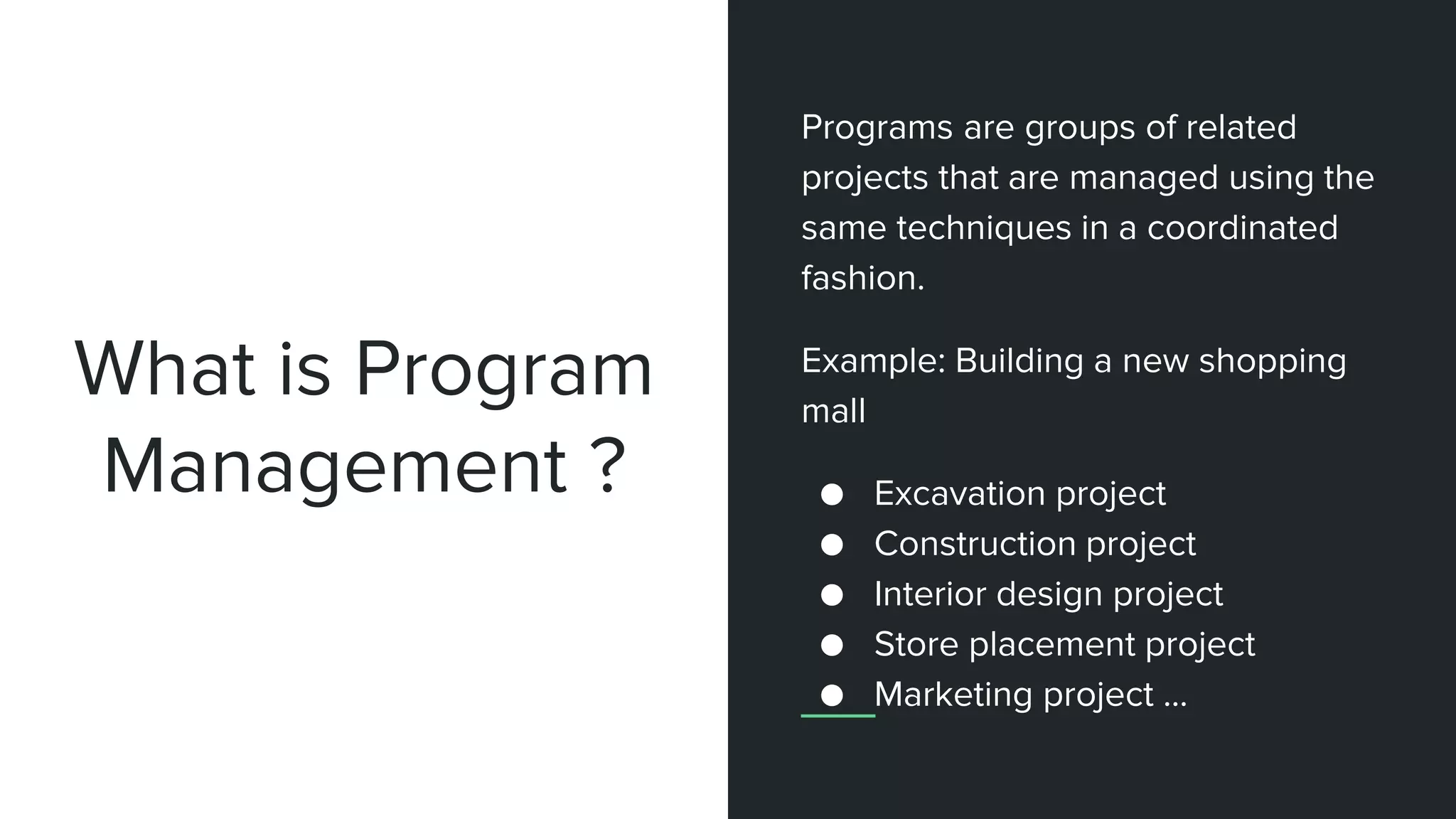
Programs are groups of related
projects that are managed using the
same techniques in a coordinated
fashion.
Example: Building a new shopping
mall
● Excavation project
● Construction project
● Interior design project
● Store placement project
● Marketing project ...
What is PortFolio
Management ?
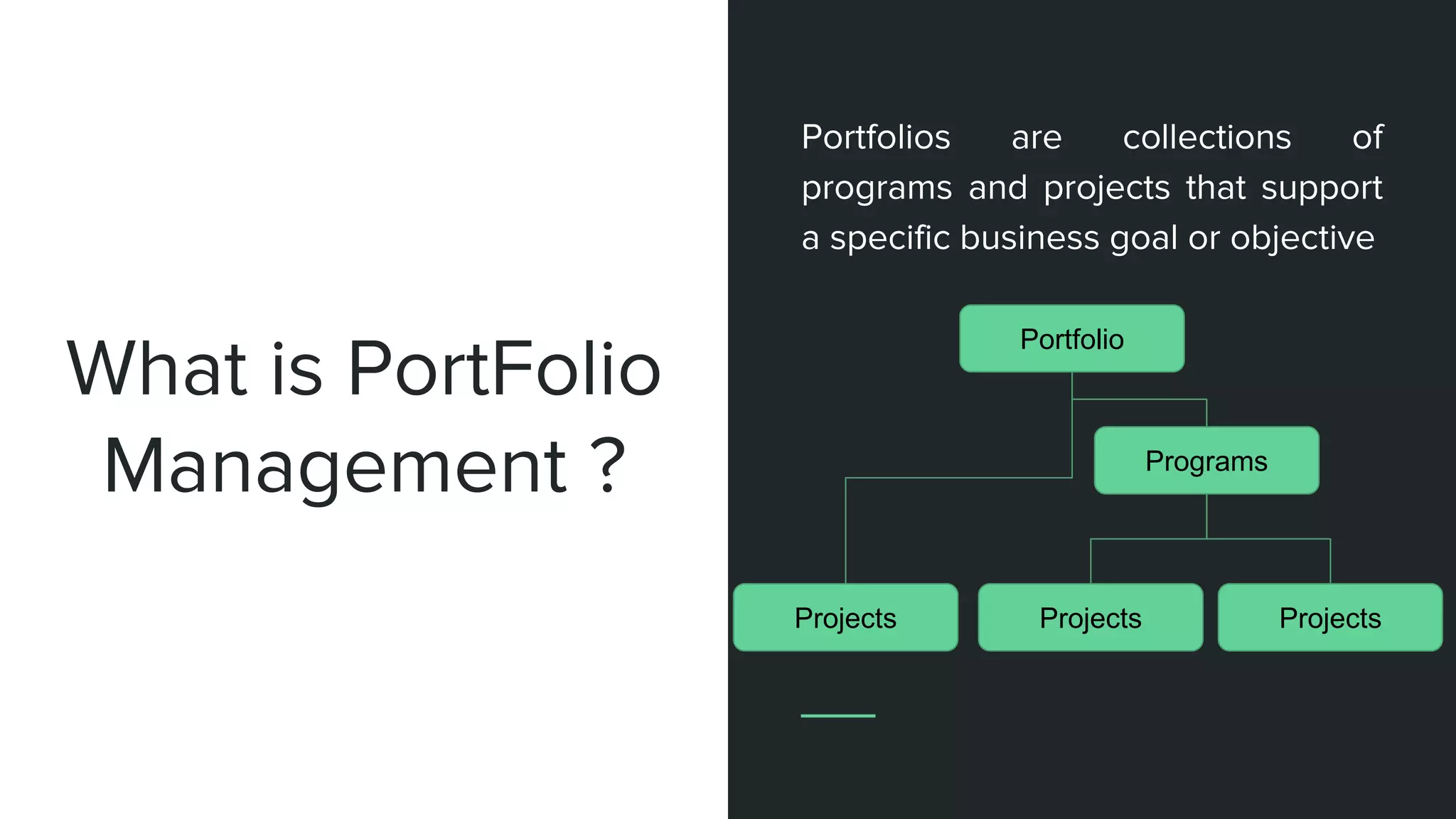
Portfolios are collections of
programs and projects that support
a specific business goal or objective
Portfolio
Projects
Programs
Projects Projects
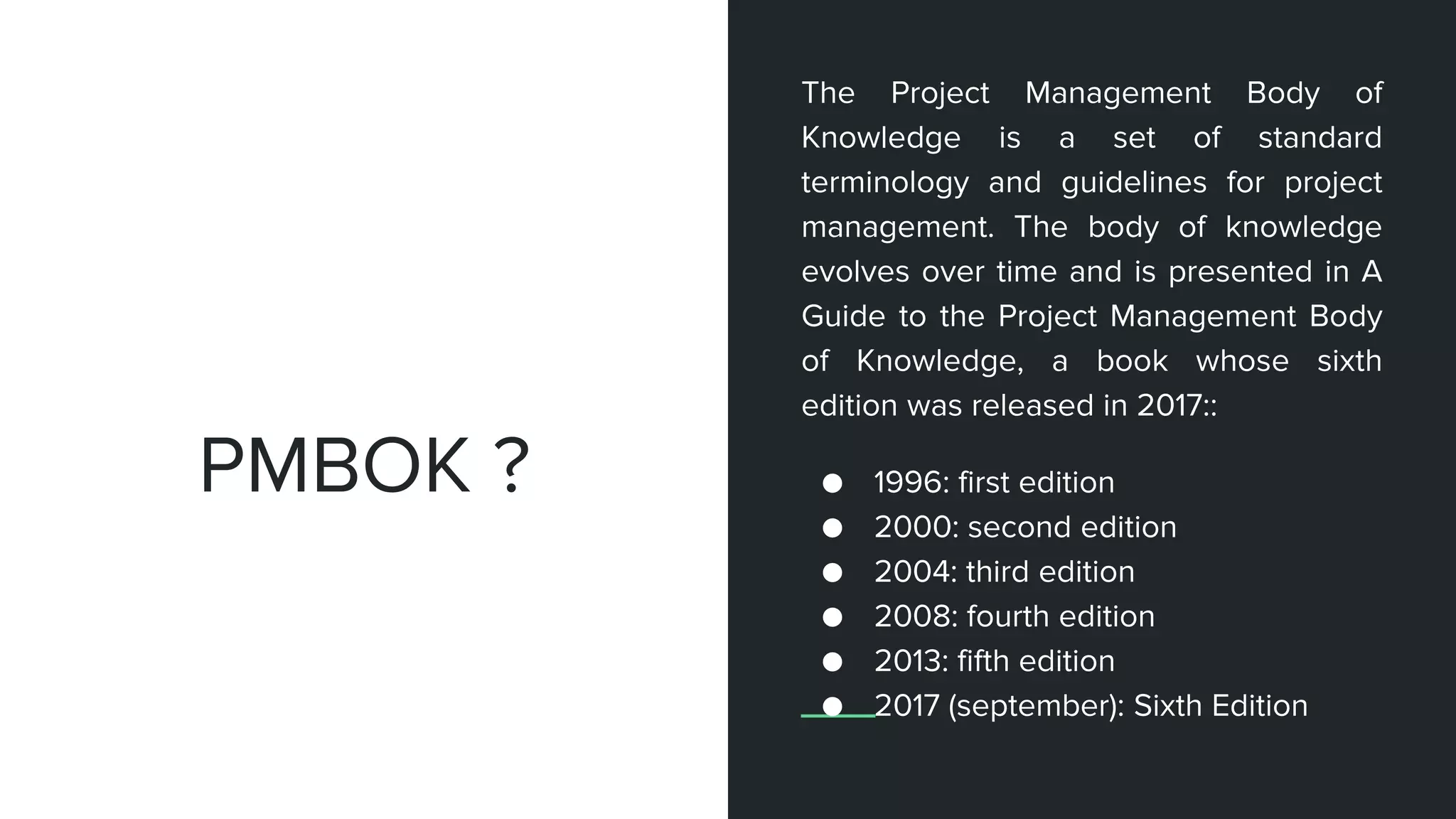
The Project Management Body of
Knowledge is a set of standard
terminology and guidelines for project
management. The body of knowledge
evolves over time and is presented in A
Guide to the Project Management Body
of Knowledge, a book whose sixth
edition was released in 2017::
● 1996: first edition
● 2000: second edition
● 2004: third edition
● 2008: fourth edition
● 2013: fifth edition
● 2017 (september): Sixth Edition
PMBOK ?
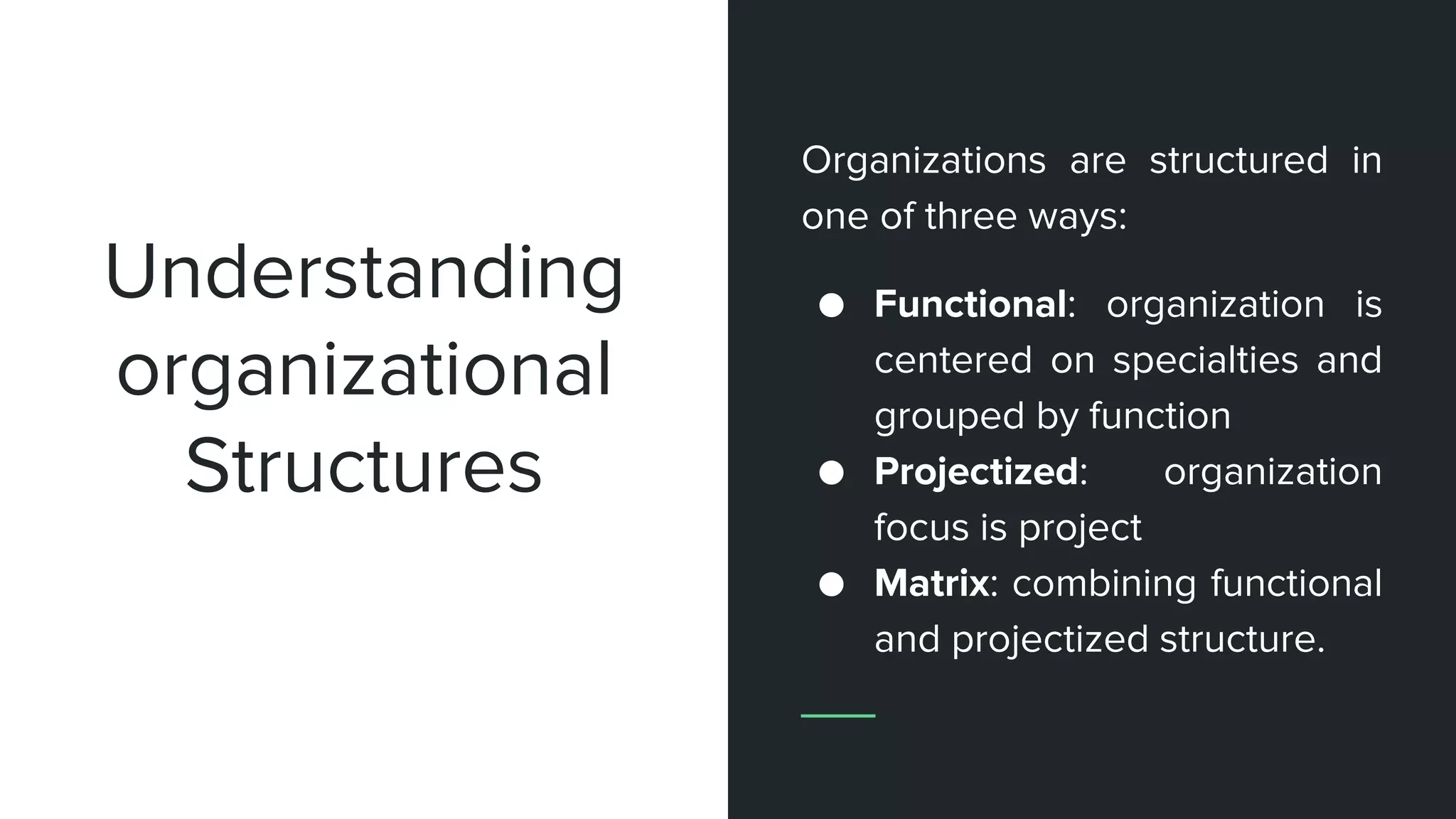
Organizations are structured in
one of three ways:
● Functional: organization is
centered on specialties and
grouped by function
● Projectized: organization
focus is project
● Matrix: combining functional
and projectized structure.
Understanding
organizational
Structures
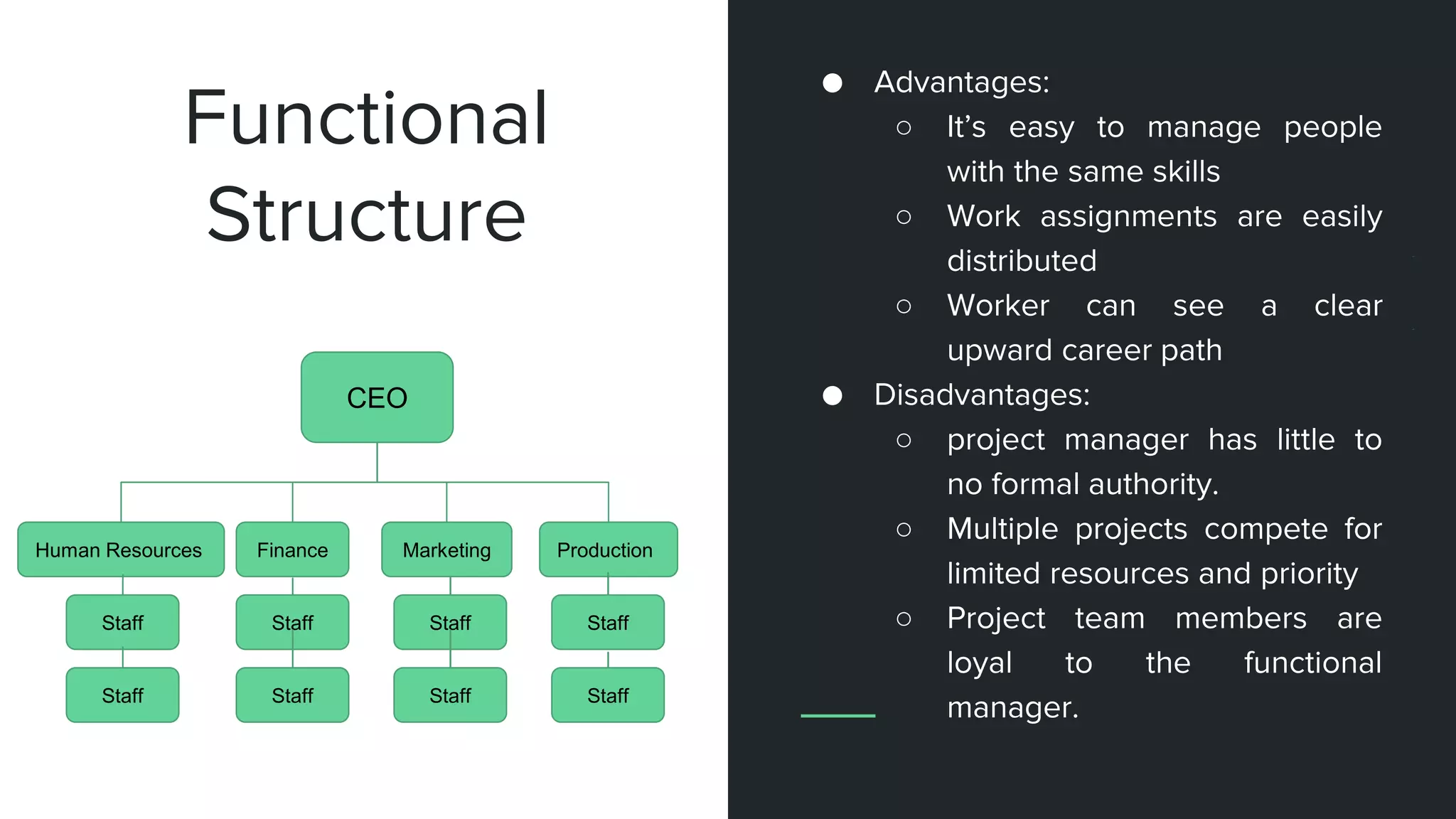
● Advantages:
○ It’s easy to manage people
with the same skills
○ Work assignments are easily
distributed
○ Worker can see a clear
upward career path
● Disadvantages:
○ project manager has little to
no formal authority.
○ Multiple projects compete for
limited resources and priority
○ Project team members are
loyal to the functional
manager.
Functional
Structure
CEO
Human Resources Finance Marketing Production
Staff
Staff
Staff
Staff
Staff
Staff
Staff
Staff
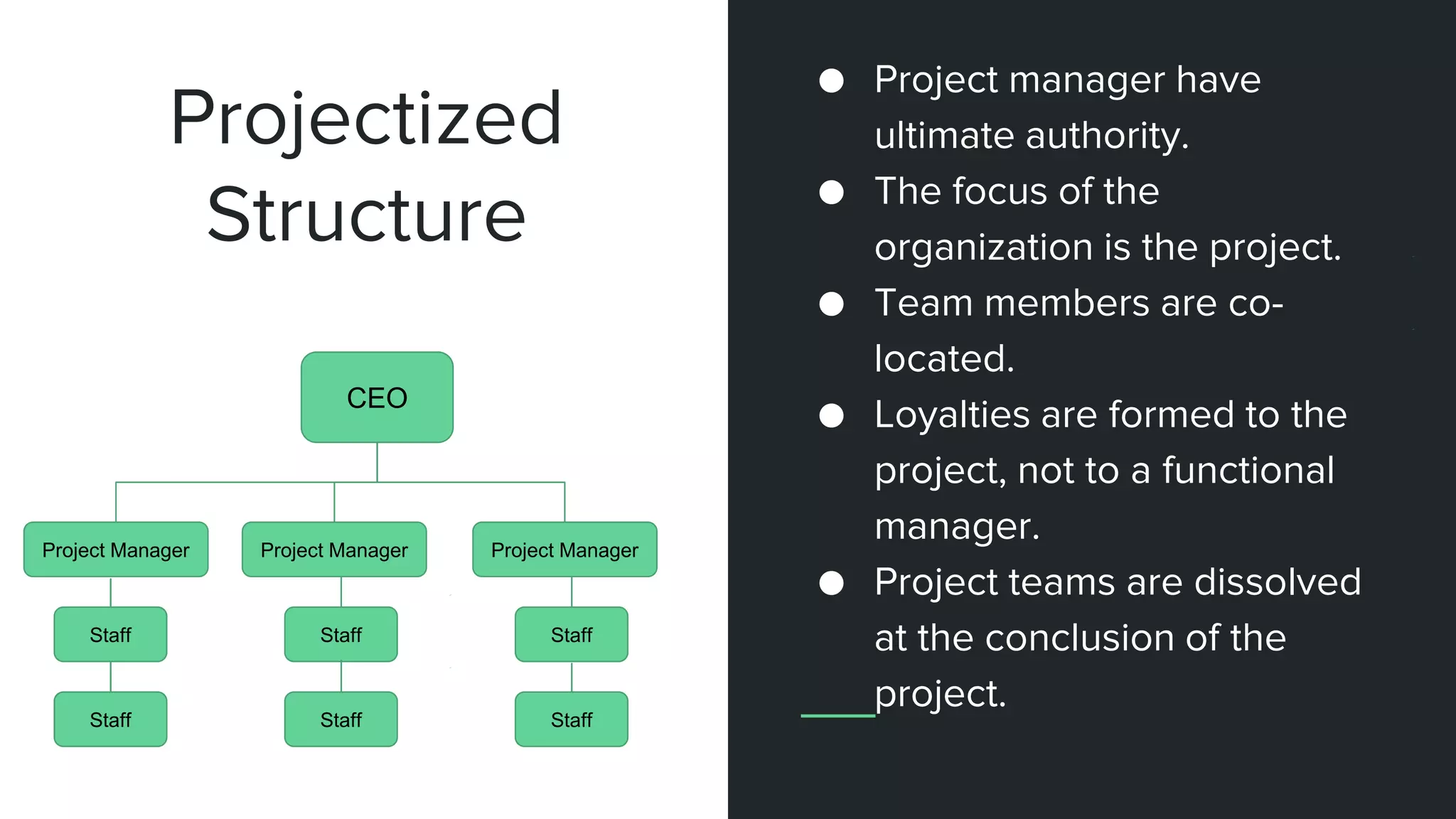
● Project manager have
ultimate authority.
● The focus of the
organization is the project.
● Team members are co-
located.
● Loyalties are formed to the
project, not to a functional
manager.
● Project teams are dissolved
at the conclusion of the
project.
Projectized
Structure
CEO
Project Manager
Staff
Staff
Project Manager Project Manager
Staff
Staff
Staff
Staff
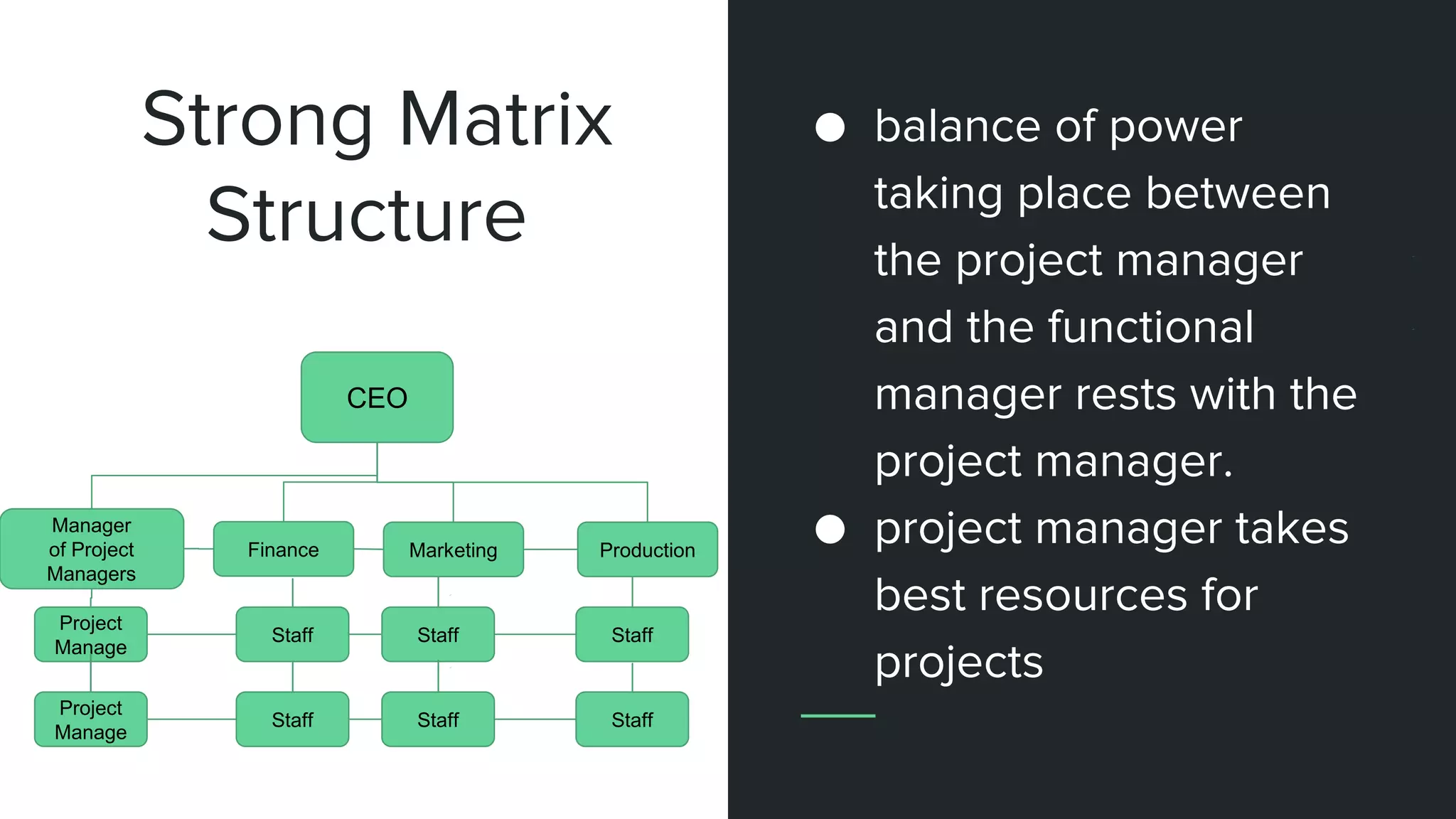
● balance of power
taking place between
the project manager
and the functional
manager rests with the
project manager.
● project manager takes
best resources for
projects
Strong Matrix
Structure
CEO
Finance
Staff
Staff
Marketing Production
Staff
Staff
Staff
Staff
Manager
of Project
Managers
Project
Manage
Project
Manage
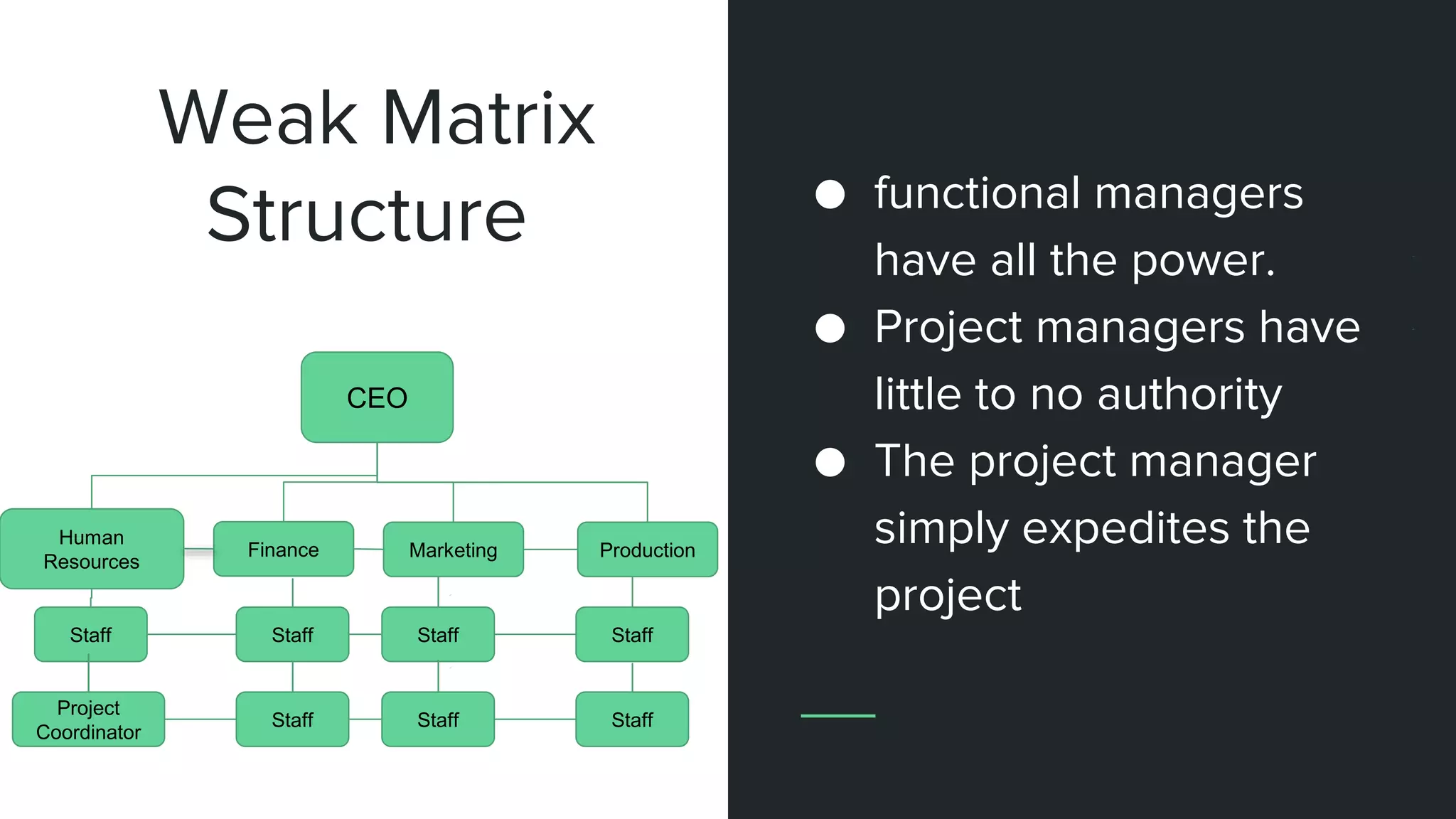
● functional managers
have all the power.
● Project managers have
little to no authority
● The project manager
simply expedites the
project
Weak Matrix
Structure
CEO
Finance
Staff
Staff
Marketing Production
Staff
Staff
Staff
Staff
Human
Resources
Staff
Project
Coordinator
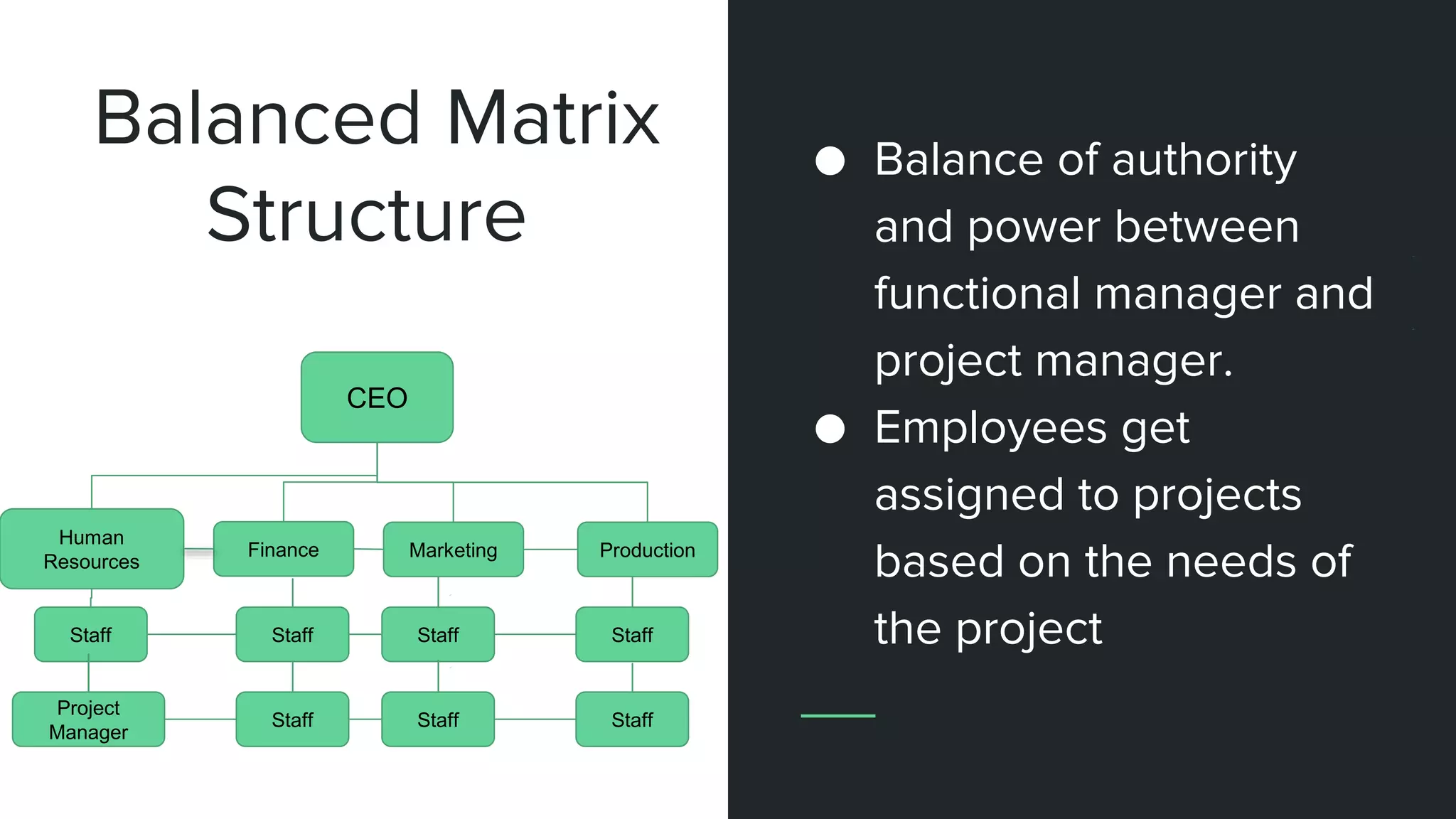
● Balance of authority
and power between
functional manager and
project manager.
● Employees get
assigned to projects
based on the needs of
the project
Balanced Matrix
Structure
CEO
Finance
Staff
Staff
Marketing Production
Staff
Staff
Staff
Staff
Human
Resources
Staff
Project
Manager
Project Life
Cycles
Project life cycle addresses the
question, “What to do to get the
work done?” It varies industry wise.
IT project :
● Requirement analysis phase
● Design phase
● Coding phase
● Testing phase
● Installation phase
● Operations and support phase
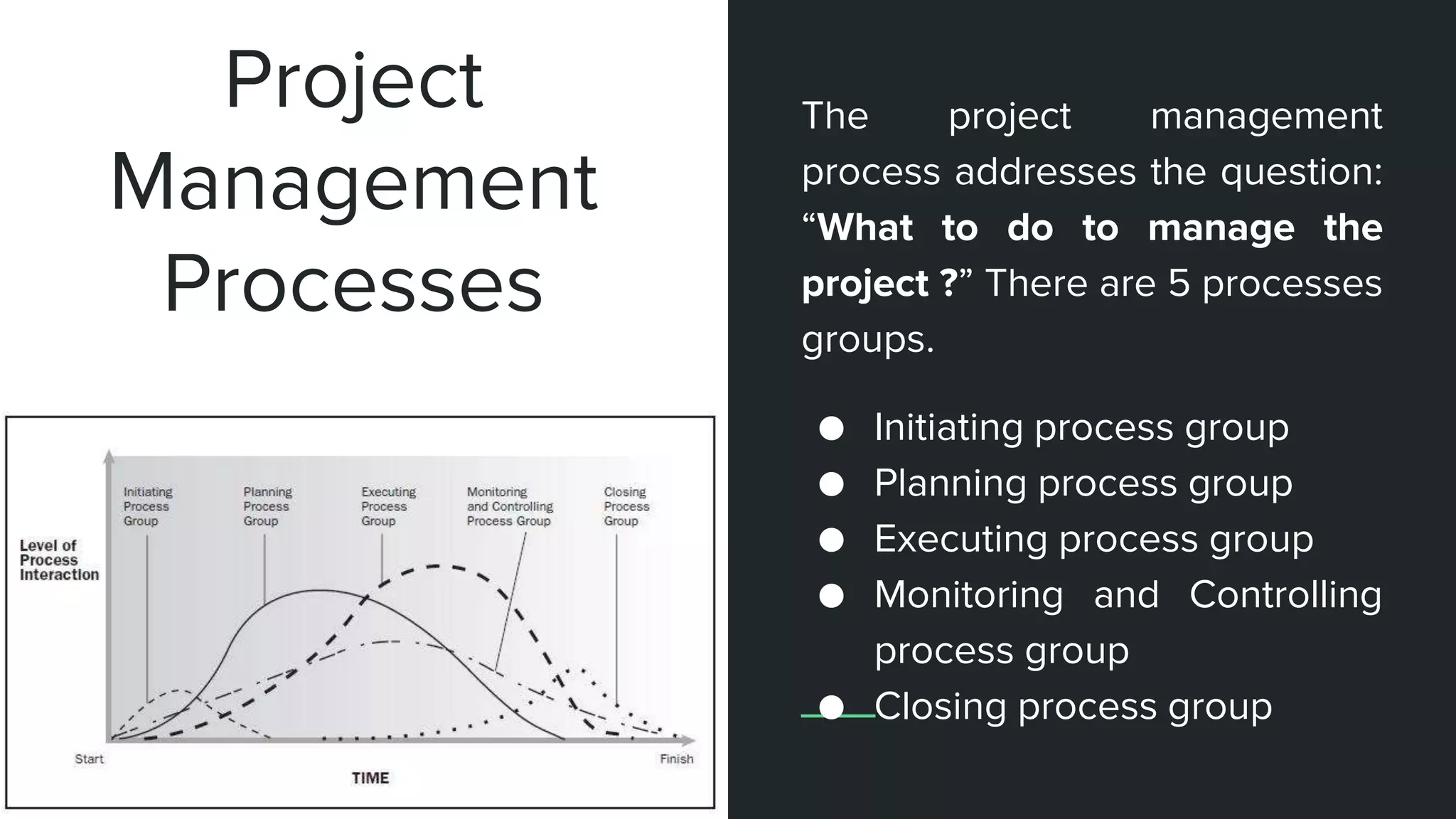
Project
Management
Processes
The project management
process addresses the question:
“What to do to manage the
project ?” There are 5 processes
groups.
● Initiating process group
● Planning process group
● Executing process group
● Monitoring and Controlling
process group
● Closing process group
Resources
● Understanding the Project Management Plan
● PMBOK 5th edition

Introduction to project management

  • 1.
    Introduction to Project Management ByBadre Edine Mokhlisse Senior Software Engineer At Digimind mokhlisse_badre@yahoo.fr
  • 2.
    Table of contents ●PMP ● Project Management ● Program management ● PortFolio management ● PMBOK ● PMI ● Organizational Structures ● Project Life Cycles ● Project Management Processes
  • 3.
    PMP ? The ProjectManagement Professional (PMP)® is the most important industry- recognized certification for project managers. Why become PMP certified ? ● It demonstrates proof of professional achievement ● It increases your marketability ● It provides greater opportunity for advancement in your field ● It raises customer confidence in you and in your company’s services
  • 4.
    PMP Exam? ● Thecertification exam has 200 multiple-choice questions, and you have four hours to complete it. ● Certification is valid for 3 years. ● To maintain your PMP, you must earn 60 professional development units (PDUs) every three years.
  • 5.
    Project ? A temporaryendeavor to create a unique product, service or result. Temporary means having a definite beginning and end. The end is reached when the project's objectives have been achieved, or if the project is terminated for any reason.
  • 6.
    Operations vs. Projects ? ● Operationalwork is ongoing work to support business and systems of the organisation ● When project is finished, the product is handed off to operations.
  • 7.
    What is Project Management? The application of (all appropriate) knowledge, skills, tools & techniques and whatsoever to manage project activities with a view to meet the project requirements and achieve customer satisfactions
  • 8.
    What is Program Management? Programs are groups of related projects that are managed using the same techniques in a coordinated fashion. Example: Building a new shopping mall ● Excavation project ● Construction project ● Interior design project ● Store placement project ● Marketing project ...
  • 9.
    What is PortFolio Management? Portfolios are collections of programs and projects that support a specific business goal or objective Portfolio Projects Programs Projects Projects
  • 10.
    The Project ManagementBody of Knowledge is a set of standard terminology and guidelines for project management. The body of knowledge evolves over time and is presented in A Guide to the Project Management Body of Knowledge, a book whose sixth edition was released in 2017:: ● 1996: first edition ● 2000: second edition ● 2004: third edition ● 2008: fourth edition ● 2013: fifth edition ● 2017 (september): Sixth Edition PMBOK ?
  • 11.
    Organizations are structuredin one of three ways: ● Functional: organization is centered on specialties and grouped by function ● Projectized: organization focus is project ● Matrix: combining functional and projectized structure. Understanding organizational Structures
  • 12.
    ● Advantages: ○ It’seasy to manage people with the same skills ○ Work assignments are easily distributed ○ Worker can see a clear upward career path ● Disadvantages: ○ project manager has little to no formal authority. ○ Multiple projects compete for limited resources and priority ○ Project team members are loyal to the functional manager. Functional Structure CEO Human Resources Finance Marketing Production Staff Staff Staff Staff Staff Staff Staff Staff
  • 13.
    ● Project managerhave ultimate authority. ● The focus of the organization is the project. ● Team members are co- located. ● Loyalties are formed to the project, not to a functional manager. ● Project teams are dissolved at the conclusion of the project. Projectized Structure CEO Project Manager Staff Staff Project Manager Project Manager Staff Staff Staff Staff
  • 14.
    ● balance ofpower taking place between the project manager and the functional manager rests with the project manager. ● project manager takes best resources for projects Strong Matrix Structure CEO Finance Staff Staff Marketing Production Staff Staff Staff Staff Manager of Project Managers Project Manage Project Manage
  • 15.
    ● functional managers haveall the power. ● Project managers have little to no authority ● The project manager simply expedites the project Weak Matrix Structure CEO Finance Staff Staff Marketing Production Staff Staff Staff Staff Human Resources Staff Project Coordinator
  • 16.
    ● Balance ofauthority and power between functional manager and project manager. ● Employees get assigned to projects based on the needs of the project Balanced Matrix Structure CEO Finance Staff Staff Marketing Production Staff Staff Staff Staff Human Resources Staff Project Manager
  • 17.
    Project Life Cycles Project lifecycle addresses the question, “What to do to get the work done?” It varies industry wise. IT project : ● Requirement analysis phase ● Design phase ● Coding phase ● Testing phase ● Installation phase ● Operations and support phase
  • 18.
    Project Management Processes The project management processaddresses the question: “What to do to manage the project ?” There are 5 processes groups. ● Initiating process group ● Planning process group ● Executing process group ● Monitoring and Controlling process group ● Closing process group
  • 19.
    Resources ● Understanding theProject Management Plan ● PMBOK 5th edition