By:
ATIFAAQUEEL
(Guest Teacher)
Electronics Engg. Section
University Women’s Polytechnic
Zakir Hussain College of Engg. and Tech.
Aligarh Muslim University
Welcome to the 21st Century
EDUCATION
Where Learning Process is
Redefined
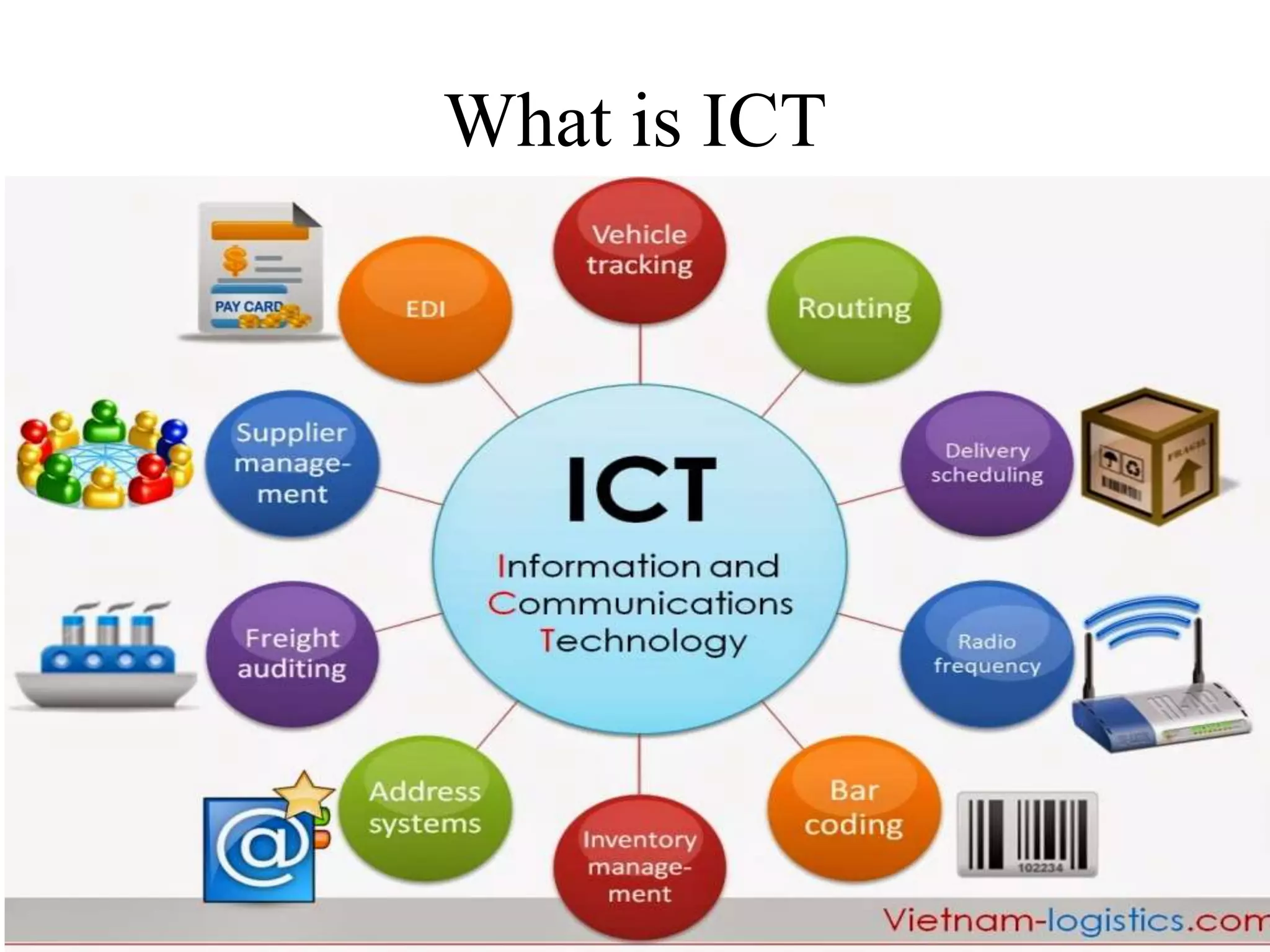
What is ICT
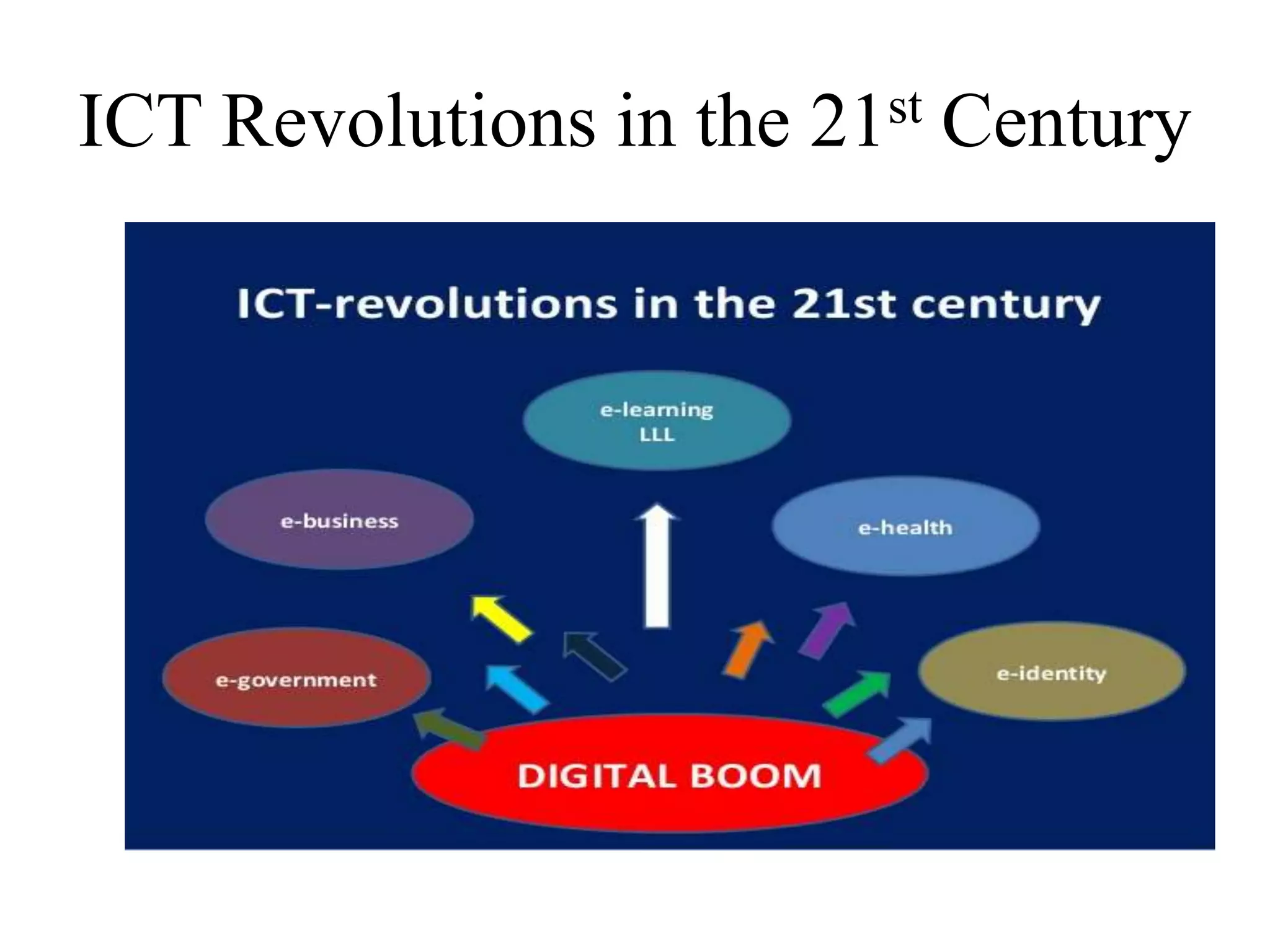
ICT Revolutions in the 21st Century
The Reality
There is no going
back.
We live in a
connected wired
world
Students need to be taught
how to engage those
connections, collaborate &
communicate globally in a
fluent and skillful way
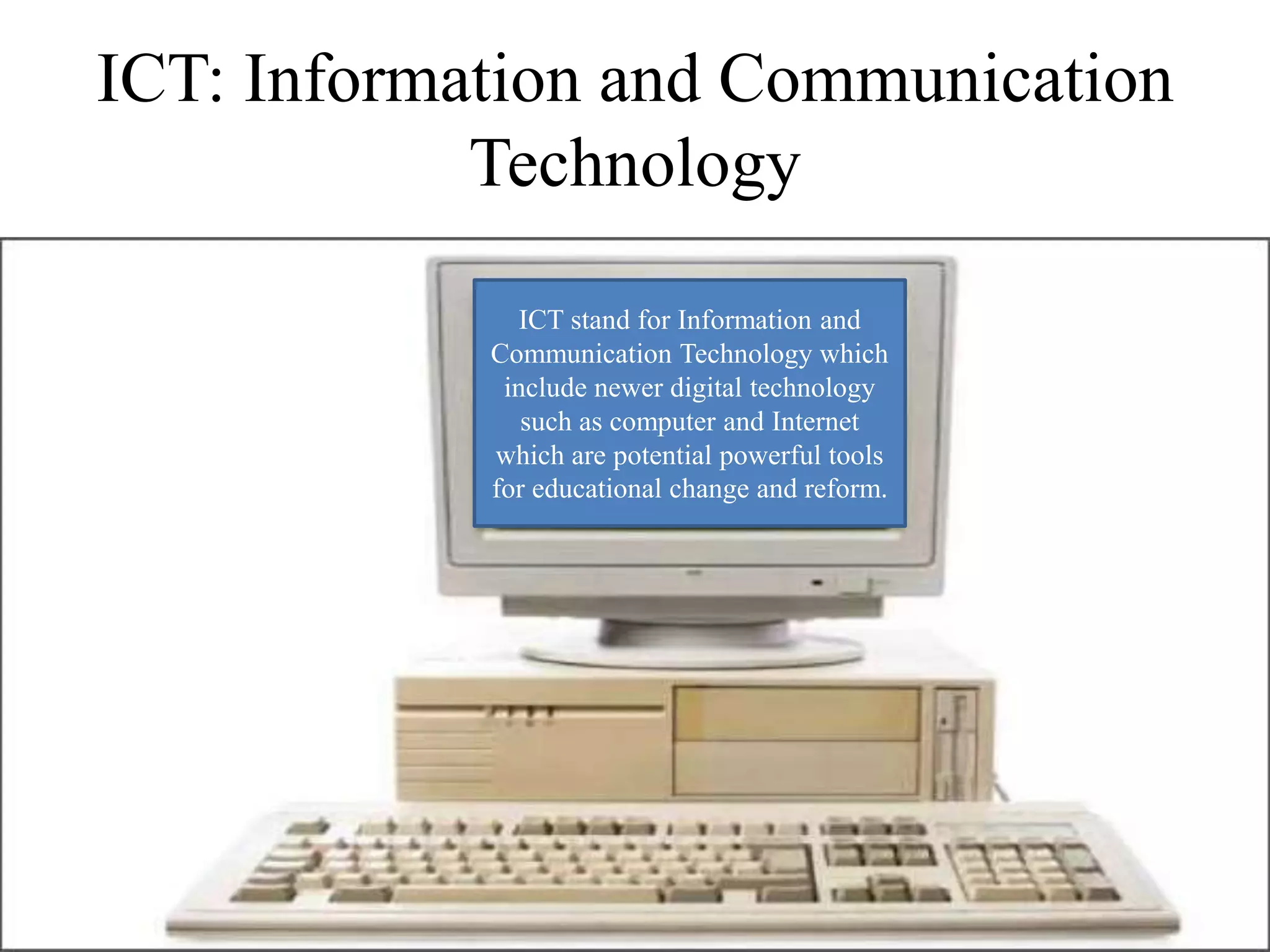
ICT: Information and Communication
Technology
ICT stand for Information and
Communication Technology which
include newer digital technology
such as computer and Internet
which are potential powerful tools
for educational change and reform.
Viewpoints
• According to Mr Kofi Annan, Ex Secretary-General of the
United Nations, Information and Communication Technology
has transformed education.
• ICTs provide an array of powerful tools that may help in
transforming the present isolated teacher-centered and text -
bound classrooms into rich, student – focused, interactive
knowledge environment.
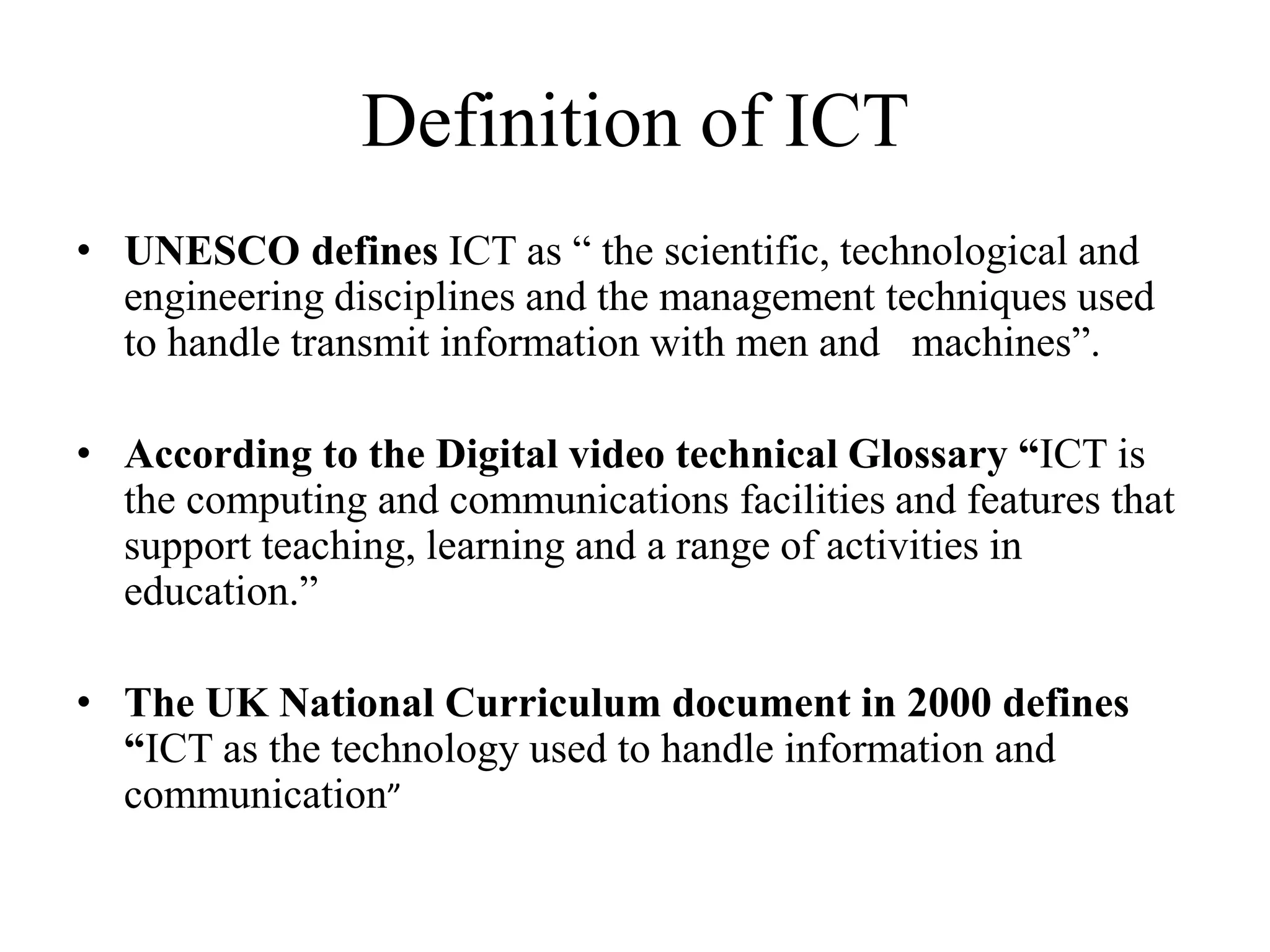
Definition of ICT
• UNESCO defines ICT as “ the scientific, technological and
engineering disciplines and the management techniques used
to handle transmit information with men and machines”.
• According to the Digital video technical Glossary “ICT is
the computing and communications facilities and features that
support teaching, learning and a range of activities in
education.”
• The UK National Curriculum document in 2000 defines
“ICT as the technology used to handle information and
communication”
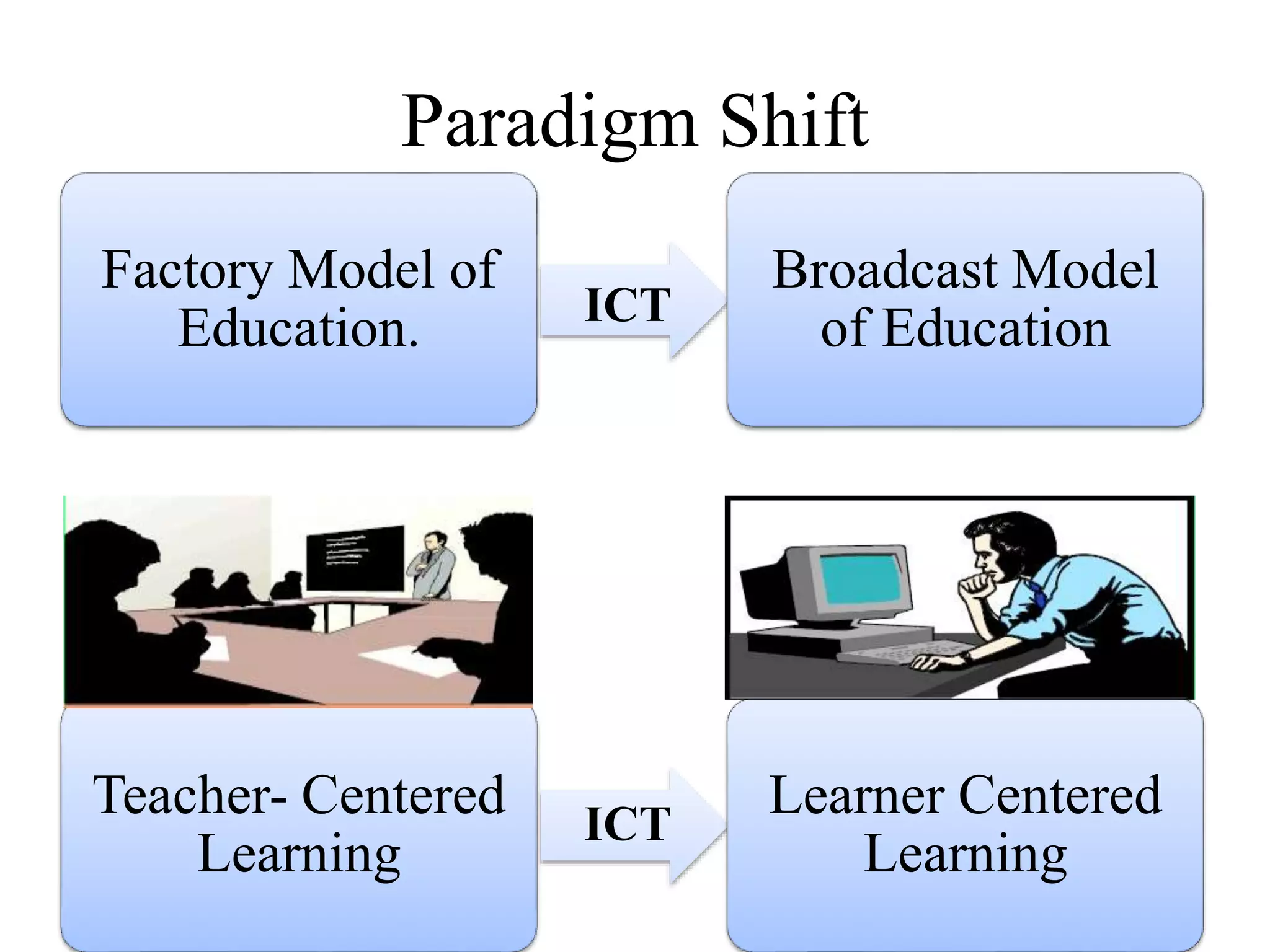
Paradigm Shift
Factory Model of
Education.
Broadcast Model
of EducationICT
Teacher- Centered
Learning
Learner Centered
Learning
ICT
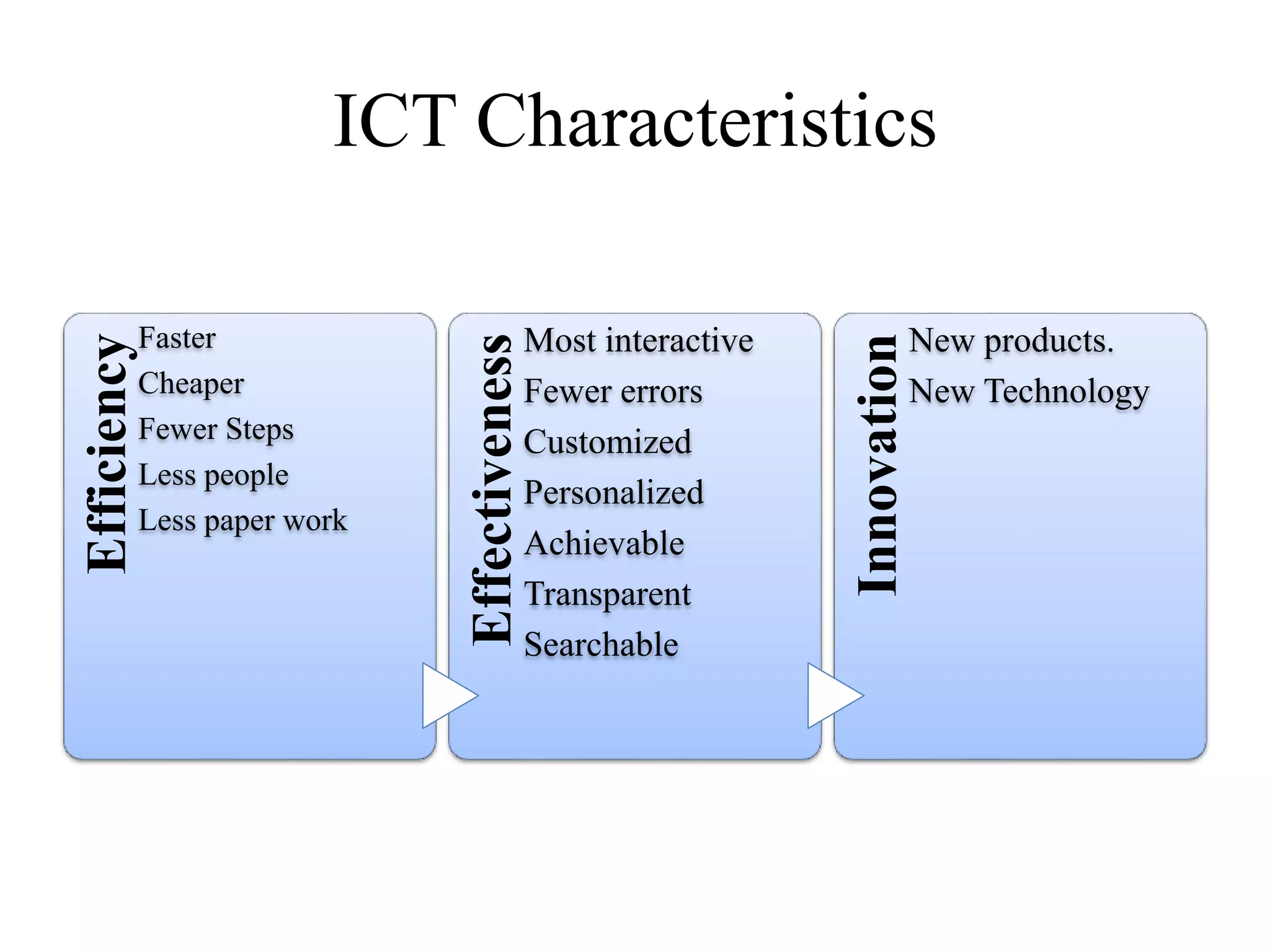
ICT CharacteristicsEfficiency
Faster
Cheaper
Fewer Steps
Less people
Less paper work
Effectiveness
Most interactive
Fewer errors
Customized
Personalized
Achievable
Transparent
Searchable
Innovation
New products.
New Technology
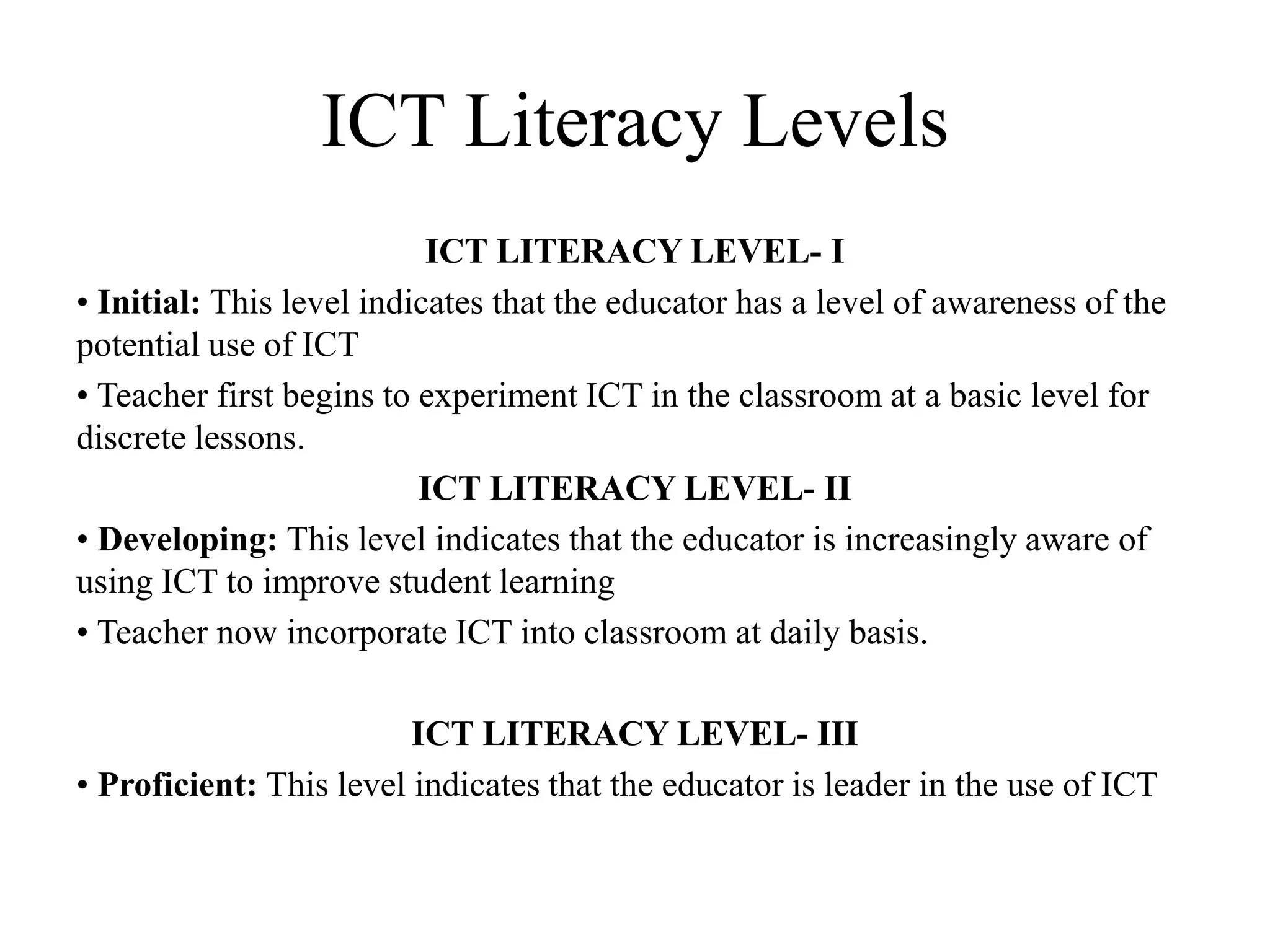
ICT Literacy Levels
ICT LITERACY LEVEL- I
• Initial: This level indicates that the educator has a level of awareness of the
potential use of ICT
• Teacher first begins to experiment ICT in the classroom at a basic level for
discrete lessons.
ICT LITERACY LEVEL- II
• Developing: This level indicates that the educator is increasingly aware of
using ICT to improve student learning
• Teacher now incorporate ICT into classroom at daily basis.
ICT LITERACY LEVEL- III
• Proficient: This level indicates that the educator is leader in the use of ICT
Types f ICTs
• Radio
• Television
• Telephony (Landlines/Mobiles)
• Computers
• Internet
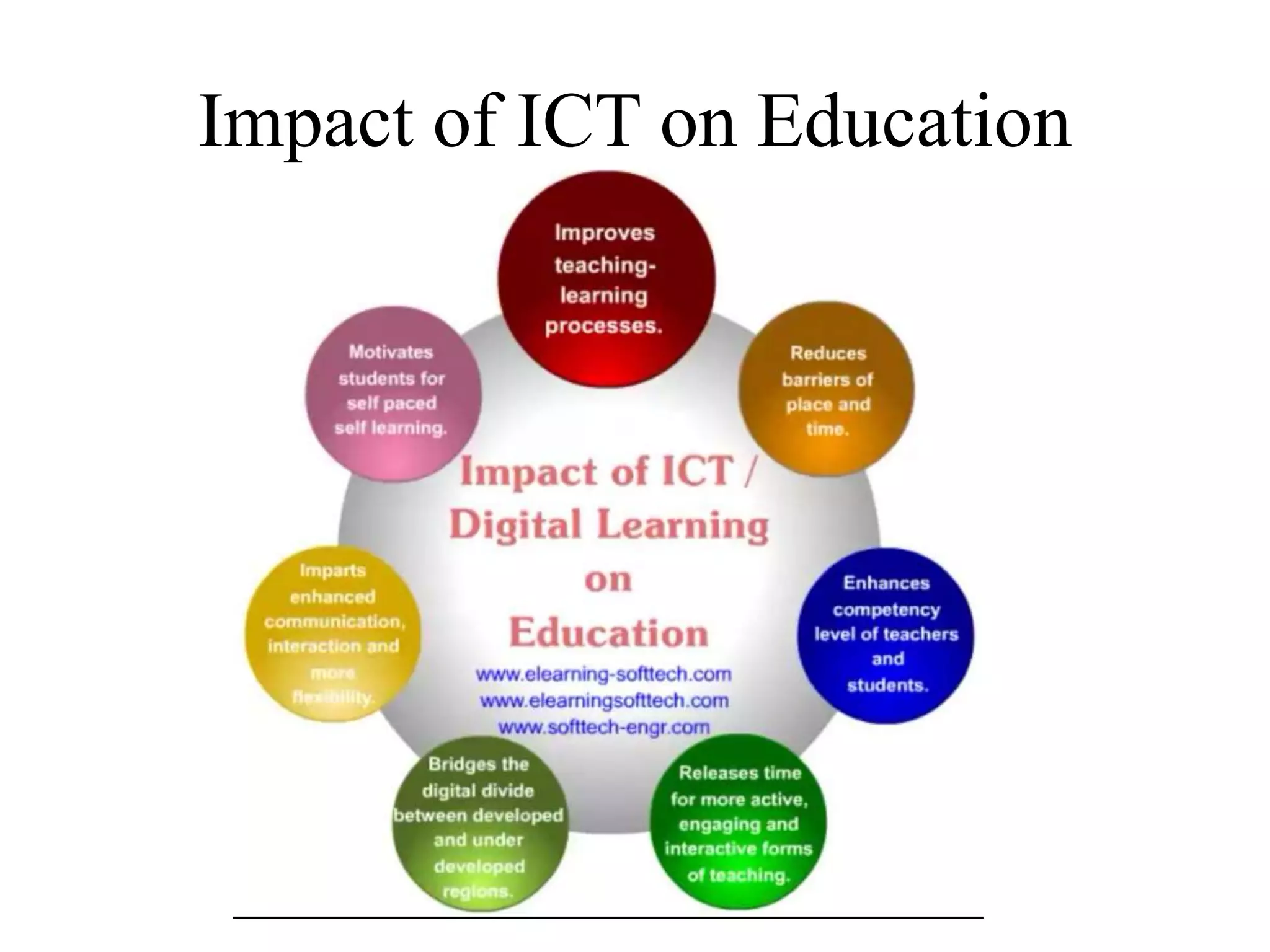
Impact of ICT on Education
Why do we need ICT in Education
https://www.youtube.com/watch?v=K8tTJZw59Fc
Modern Philosophy of Education
• ICT in education is a much needed vehicle of achieving the modern
philosophy of education whereby a student can decide on:
 WHAT he learns.
 WHEN he learns.
 WHERE he learns, and
 HOW he learns.
“Technology will not have a significant impact on students learning
until teachers change the way they teach.”
Larry Cuban, 1986
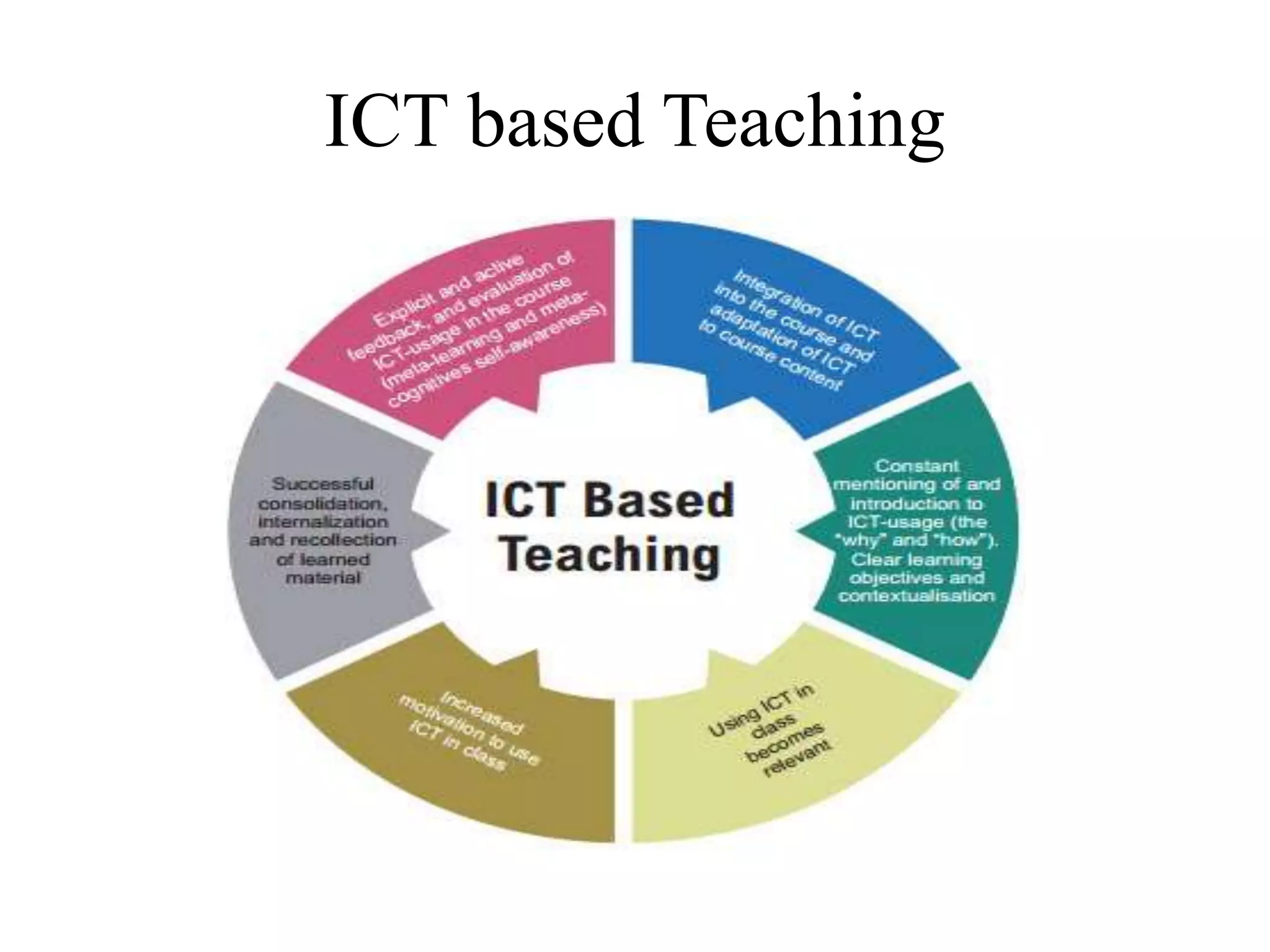
ICT based Teaching
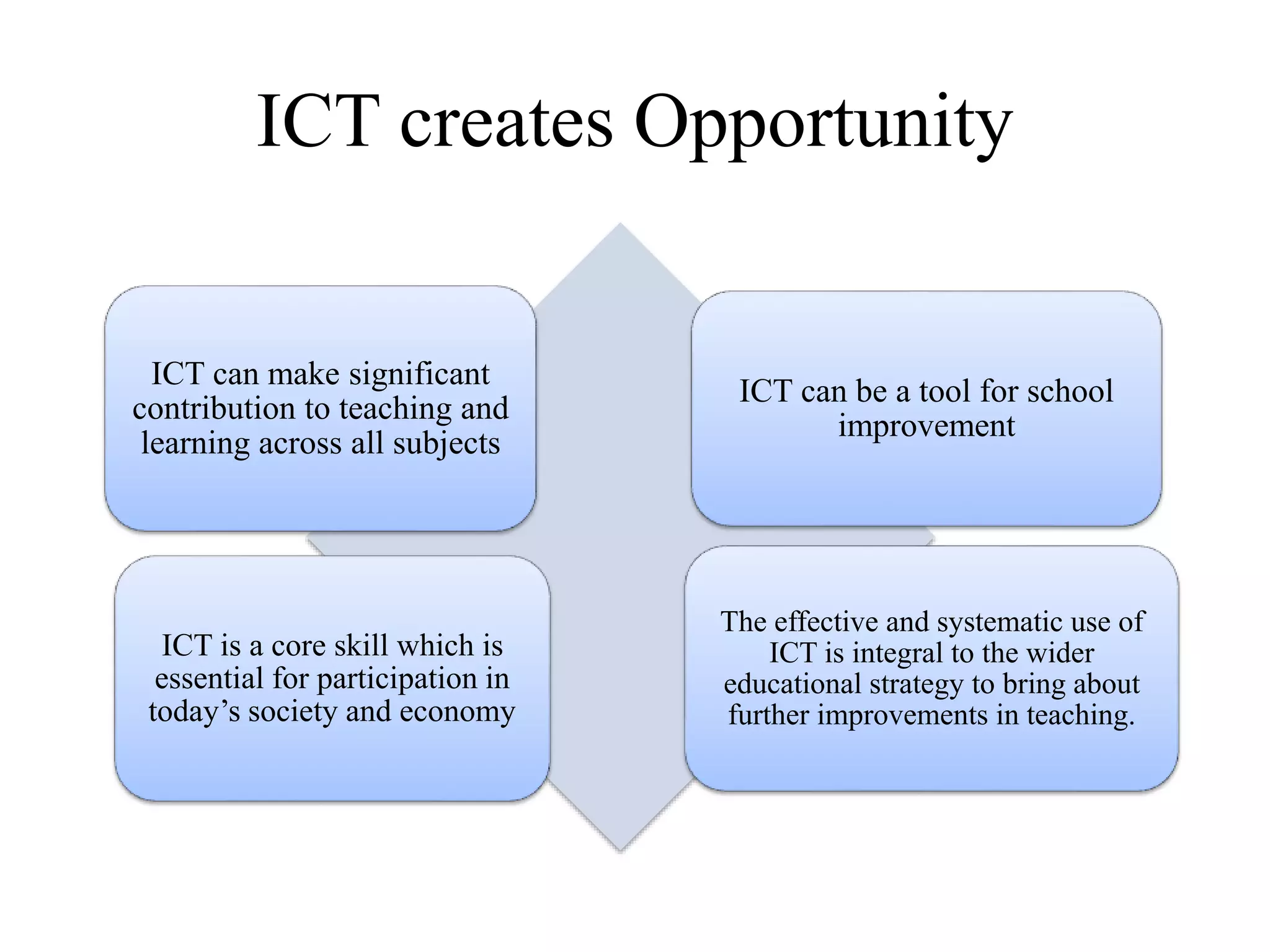
ICT creates Opportunity
ICT can make significant
contribution to teaching and
learning across all subjects
ICT can be a tool for school
improvement
ICT is a core skill which is
essential for participation in
today’s society and economy
The effective and systematic use of
ICT is integral to the wider
educational strategy to bring about
further improvements in teaching.
Observation
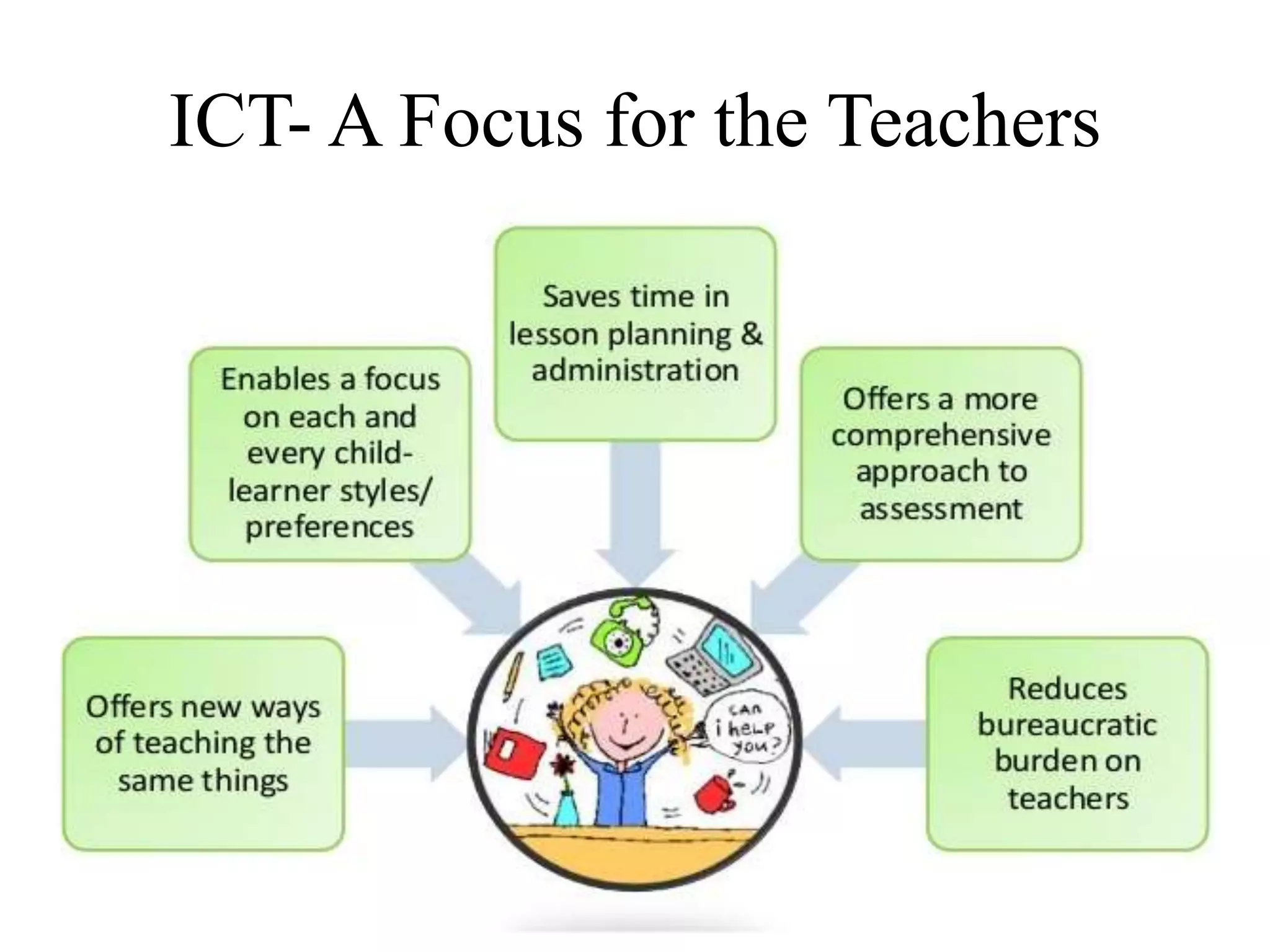
ICT- A Focus for the Teachers
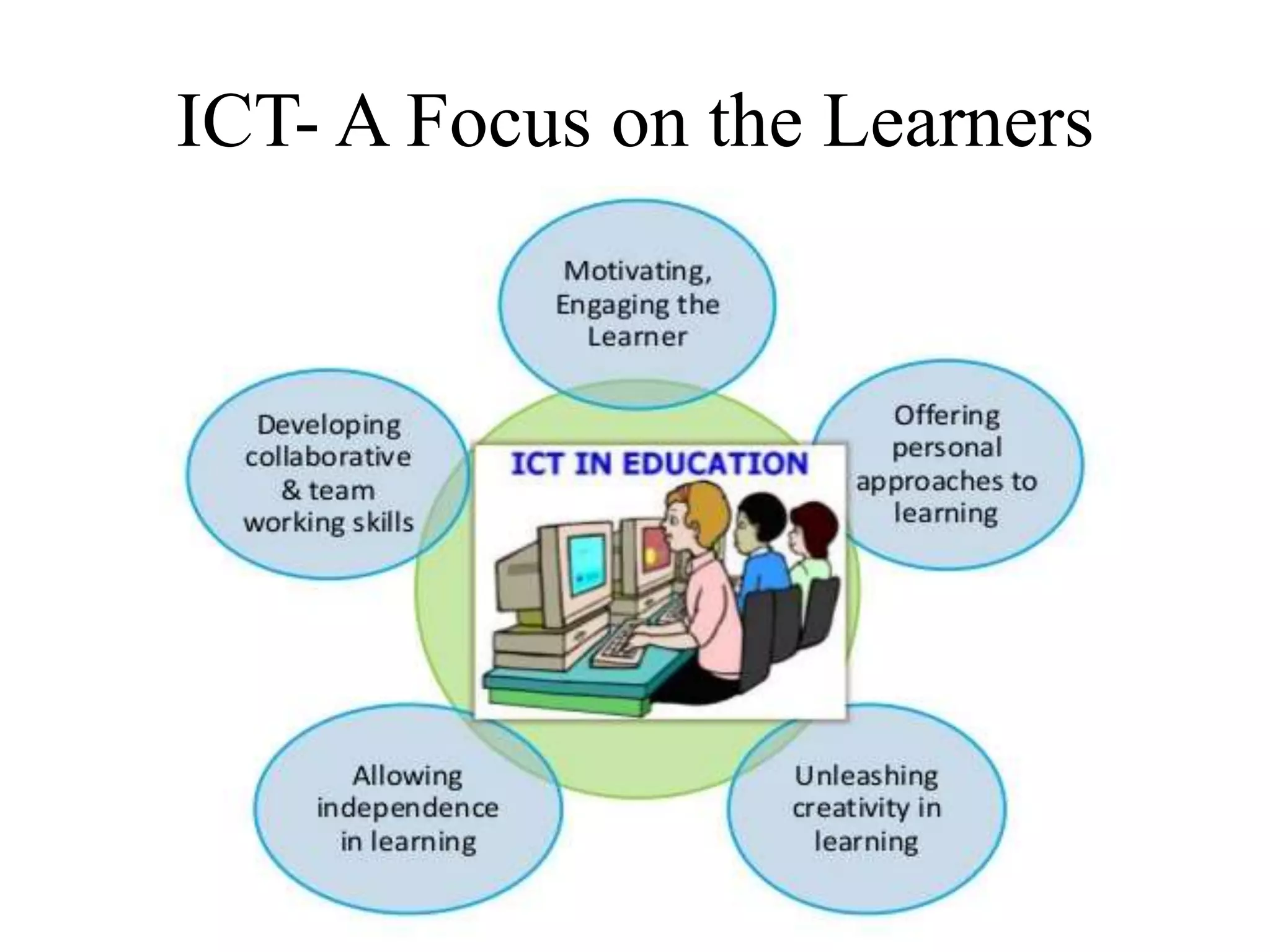
ICT- A Focus on the Learners
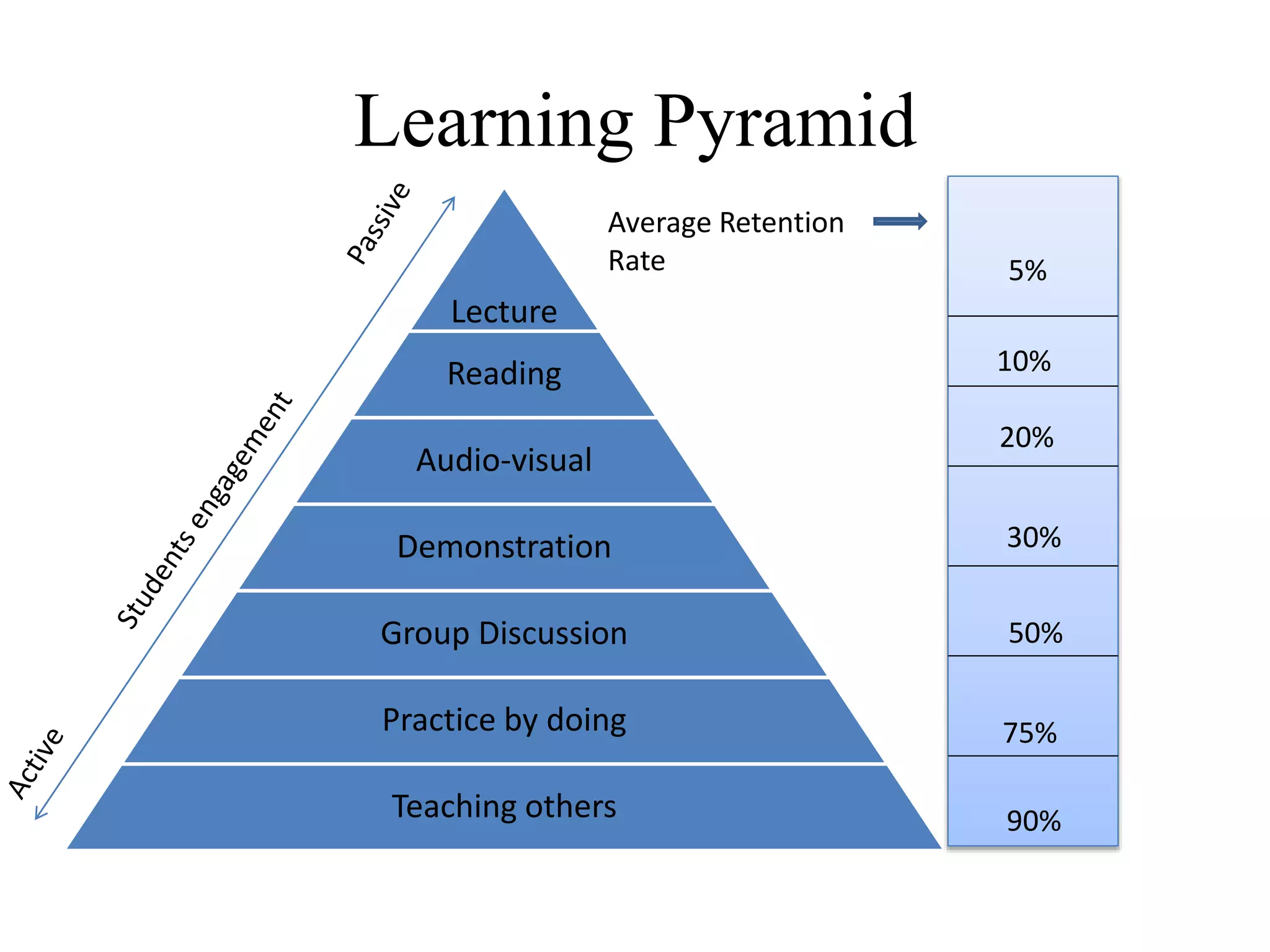
Learning Pyramid
Lecture
Reading
Audio-visual
Demonstration
Group Discussion
Practice by doing
Teaching others
Average Retention
Rate 5%
10%
20%
30%
50%
75%
90%
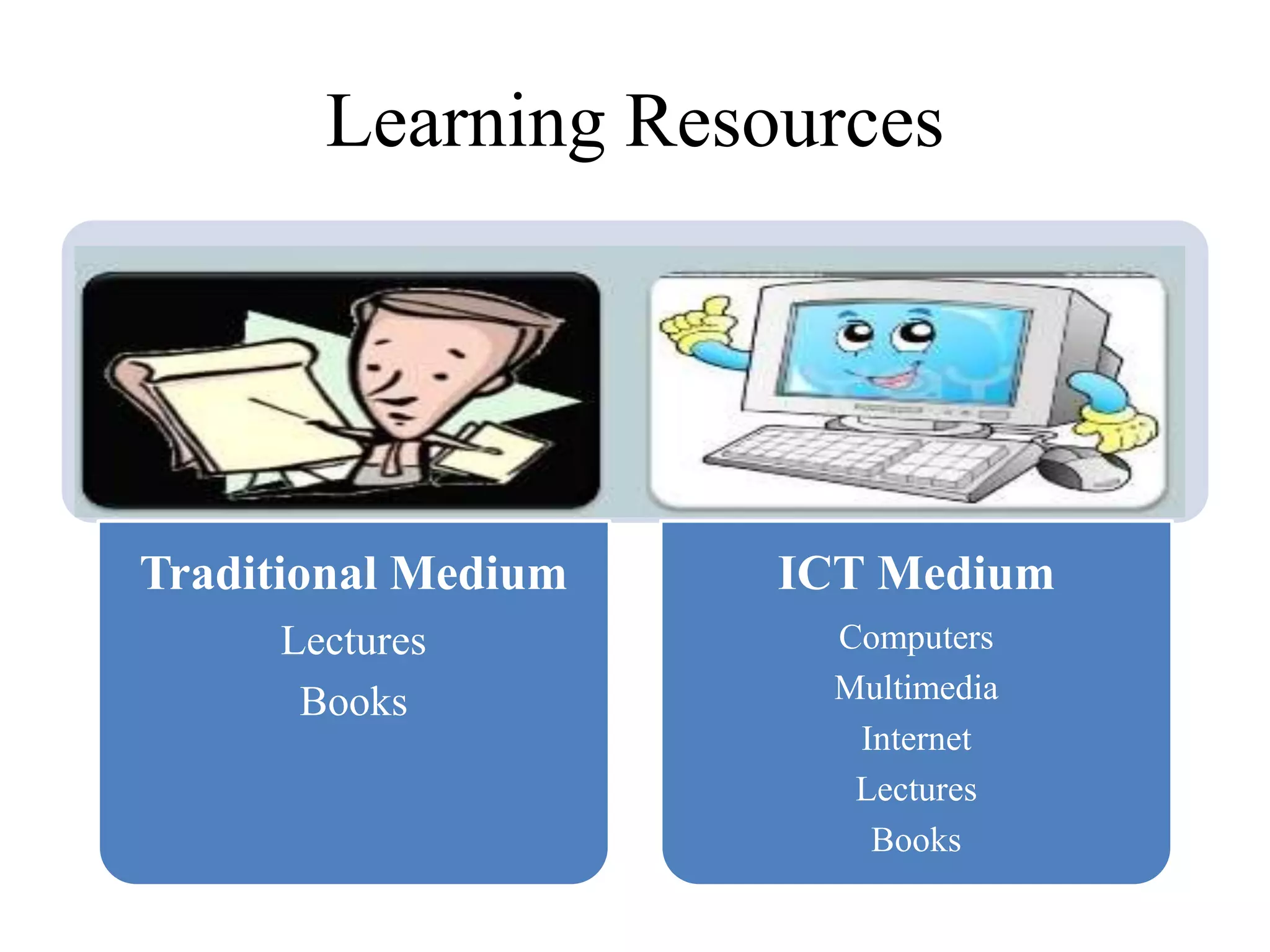
Learning Resources
Traditional Medium
Lectures
Books
ICT Medium
Computers
Multimedia
Internet
Lectures
Books
20th century vs. 21st century
Classrooms
20th century Classrooms 21st century Classrooms
Teacher Centered Student Centered
Passive Learning Active Learning
Textbook driven Research driven
Focus is on memorization of facts Focus is on what students know and can
do
Learners work in isolation Learners work in collaboration
Literacy in 3R’s – reading ,writing and
mathematics.
Literacy in 3 C’s– critical thinking,
creativity and communication skills
Print is the primary vehicle of learning and
assessment
Multiple forms of media and projects are
used for learning and assessments
Lesson is focused on lower level of
Bloom’s Taxonomy- knowledge,
comprehension and application.
Lesson is focused on higher level of
Bloom’s Taxonomy- analysis , synthesis
and evaluation.
Little or no freedom to the student Great deal of freedom to the student
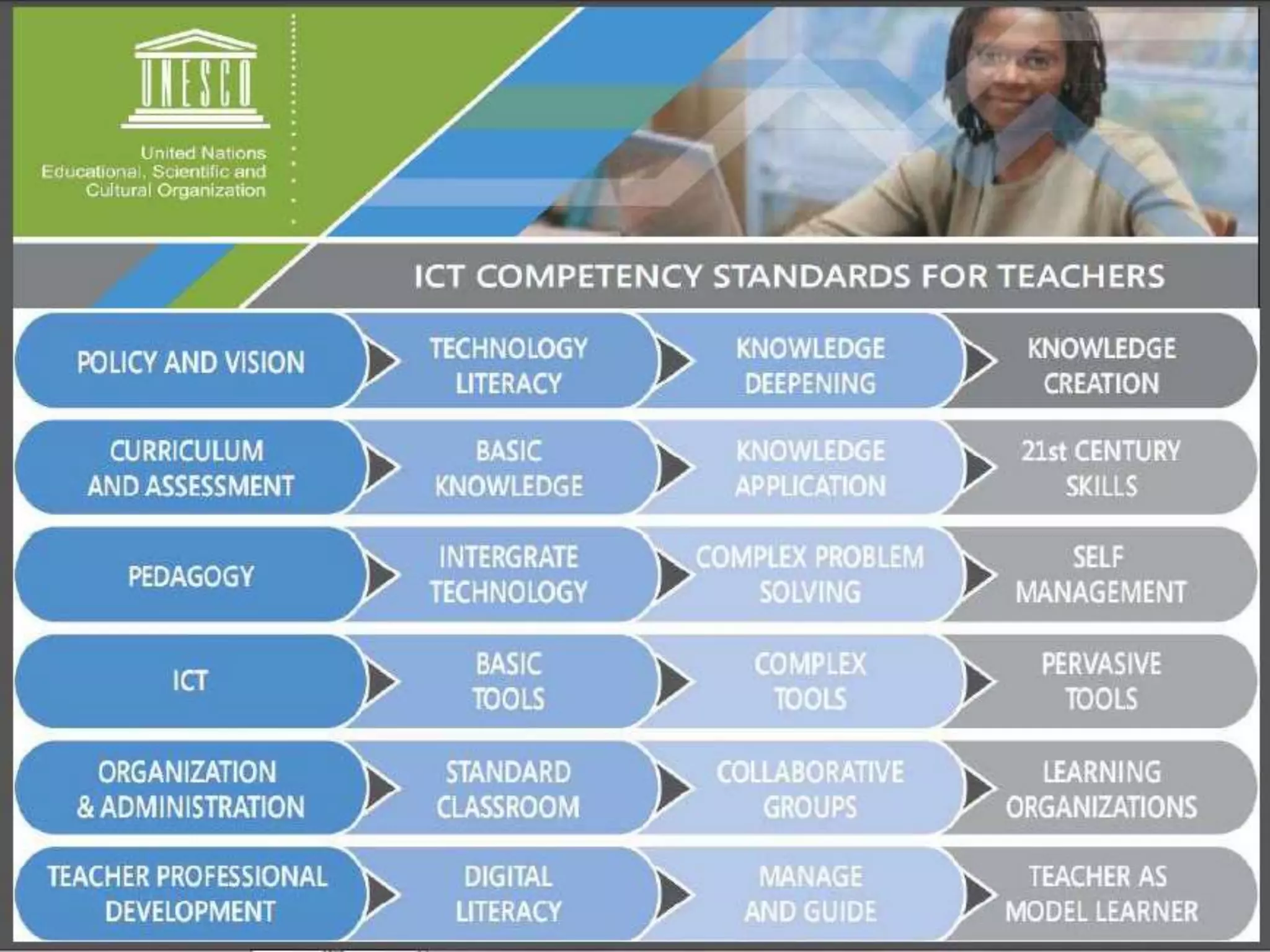
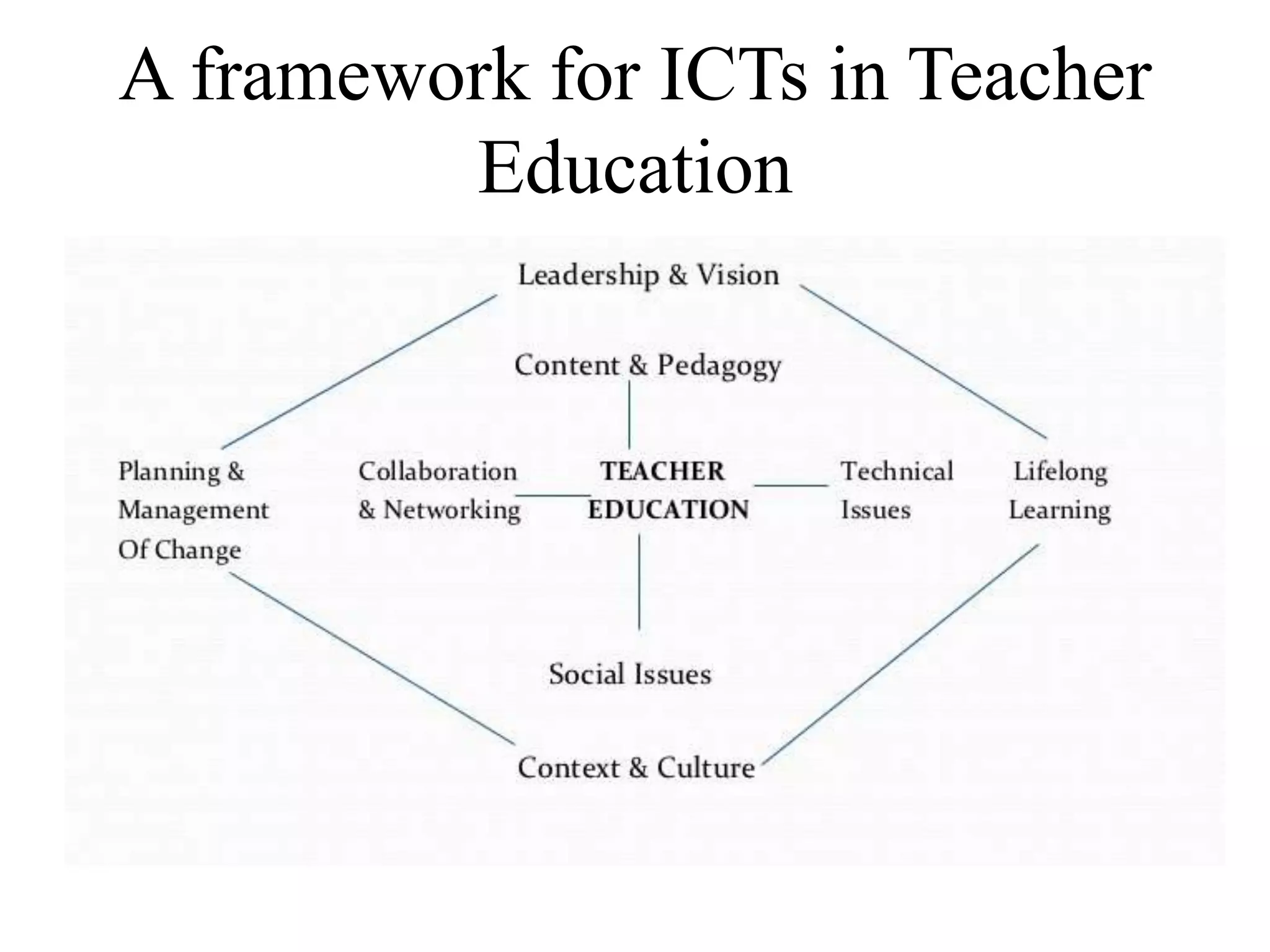
A framework for ICTs in Teacher
Education
Contd.…
• This curriculum framework comprises four clusters of competencies
and four supportive themes.
• Four Competencies.
1. Padagogy :
• Teachers instructional practices and knowledge of the curriculum.
• Effective use of ICTs to support and extend teaching and learning.
2. Collaborations and Networking:
• Communicative potential of ICTs to extend learning beyond the
classroom walls.
• Development of new knowledge and skills.
3. Social Issues:
• Right and responsibilities.
• Access to technological resources.
• Care for individual health.
Contd…
4. Technical issues:
• Update skills related to software and hardware.
• Four themes
1. Context and Culture
• Use of technology in culturally appropriate way.
2. Leadership and Vision
• It is essential for successful planning and implementation of
technology into teachers education.
3. Lifelong Learning
• It is continuous process.
4. Planning and Management of change
• Careful management and planning is essential which is accelerated by
the technology itself.
Attributes of Computer Based
Technology
1. Multi-sensory delivery: Text, graphics, animation, sound and
audio
2. Active learning: Enhanced learner interest
3. Co-operative learning: Positive group/social interaction
4. Communication skills: One-to-one, One-to-many, Many-to-
many
5. Multicultural education: Linking students outside
6. Motivation: Greater learner engagement
ICT Tools
• Representation tools (MS-office package)
• Presentation tools (Power-point, Blogs)
• Search tools (Search engines, Web pages)
• Communication tools (E-mail, Social networks, Lectures, Video
conferencing)
• Educational sources (Digital Library, E-books and electronic
publications)
Good comes with the bad
Merits of ICT
• Ensures Lifelong learning
• Enables Distance learning
• Ability to perform impossible
experiments by using
simulations
• Video Conferencing- we can
consult many experts by video
conferencing.
• Online examination can
eradicate manpower issues
De-merits of
ICT
• Large costs involved
• A child’s imagination power
decreases or ability to imagine
vanishes.
ICT Challenges
• Teacher has to learn how to use a variety of ICT application
• Teacher has to use, adapt and design ICT enhanced curricula
• Teacher has to expand the content area of knowledge
• Teacher has to take new roles
• Teacher has to respond to individual students
To ‘’Tech” or not to “Tech” education is not the
question…
The real question is how to harvest the power of
technology to meet the challenges of 21st
century and make education relevent,
responsive and effective for everyone,
anywhere, anytime
Conclusion
• ICT doesn’t automatically add quality to teaching and learning
• ICT application can accelerate and improve learning (basic
skills, problem solving, information management, concept
development)
• ICT provides means of gathering, connecting and analysing
data about teaching and learning
THANK YOU

ICT in Teaching

  • 1.
    By: ATIFAAQUEEL (Guest Teacher) Electronics Engg.Section University Women’s Polytechnic Zakir Hussain College of Engg. and Tech. Aligarh Muslim University
  • 2.
    Welcome to the21st Century EDUCATION Where Learning Process is Redefined
  • 3.
  • 4.
    ICT Revolutions inthe 21st Century
  • 5.
    The Reality There isno going back. We live in a connected wired world Students need to be taught how to engage those connections, collaborate & communicate globally in a fluent and skillful way
  • 6.
    ICT: Information andCommunication Technology ICT stand for Information and Communication Technology which include newer digital technology such as computer and Internet which are potential powerful tools for educational change and reform.
  • 7.
    Viewpoints • According toMr Kofi Annan, Ex Secretary-General of the United Nations, Information and Communication Technology has transformed education. • ICTs provide an array of powerful tools that may help in transforming the present isolated teacher-centered and text - bound classrooms into rich, student – focused, interactive knowledge environment.
  • 8.
    Definition of ICT •UNESCO defines ICT as “ the scientific, technological and engineering disciplines and the management techniques used to handle transmit information with men and machines”. • According to the Digital video technical Glossary “ICT is the computing and communications facilities and features that support teaching, learning and a range of activities in education.” • The UK National Curriculum document in 2000 defines “ICT as the technology used to handle information and communication”
  • 9.
    Paradigm Shift Factory Modelof Education. Broadcast Model of EducationICT Teacher- Centered Learning Learner Centered Learning ICT
  • 10.
    ICT CharacteristicsEfficiency Faster Cheaper Fewer Steps Lesspeople Less paper work Effectiveness Most interactive Fewer errors Customized Personalized Achievable Transparent Searchable Innovation New products. New Technology
  • 11.
    ICT Literacy Levels ICTLITERACY LEVEL- I • Initial: This level indicates that the educator has a level of awareness of the potential use of ICT • Teacher first begins to experiment ICT in the classroom at a basic level for discrete lessons. ICT LITERACY LEVEL- II • Developing: This level indicates that the educator is increasingly aware of using ICT to improve student learning • Teacher now incorporate ICT into classroom at daily basis. ICT LITERACY LEVEL- III • Proficient: This level indicates that the educator is leader in the use of ICT
  • 12.
    Types f ICTs •Radio • Television • Telephony (Landlines/Mobiles) • Computers • Internet
  • 13.
    Impact of ICTon Education
  • 14.
    Why do weneed ICT in Education https://www.youtube.com/watch?v=K8tTJZw59Fc
  • 15.
    Modern Philosophy ofEducation • ICT in education is a much needed vehicle of achieving the modern philosophy of education whereby a student can decide on:  WHAT he learns.  WHEN he learns.  WHERE he learns, and  HOW he learns. “Technology will not have a significant impact on students learning until teachers change the way they teach.” Larry Cuban, 1986
  • 16.
  • 19.
    ICT creates Opportunity ICTcan make significant contribution to teaching and learning across all subjects ICT can be a tool for school improvement ICT is a core skill which is essential for participation in today’s society and economy The effective and systematic use of ICT is integral to the wider educational strategy to bring about further improvements in teaching.
  • 20.
  • 21.
    ICT- A Focusfor the Teachers
  • 22.
    ICT- A Focuson the Learners
  • 23.
    Learning Pyramid Lecture Reading Audio-visual Demonstration Group Discussion Practiceby doing Teaching others Average Retention Rate 5% 10% 20% 30% 50% 75% 90%
  • 24.
    Learning Resources Traditional Medium Lectures Books ICTMedium Computers Multimedia Internet Lectures Books
  • 25.
    20th century vs.21st century Classrooms 20th century Classrooms 21st century Classrooms Teacher Centered Student Centered Passive Learning Active Learning Textbook driven Research driven Focus is on memorization of facts Focus is on what students know and can do Learners work in isolation Learners work in collaboration Literacy in 3R’s – reading ,writing and mathematics. Literacy in 3 C’s– critical thinking, creativity and communication skills Print is the primary vehicle of learning and assessment Multiple forms of media and projects are used for learning and assessments Lesson is focused on lower level of Bloom’s Taxonomy- knowledge, comprehension and application. Lesson is focused on higher level of Bloom’s Taxonomy- analysis , synthesis and evaluation. Little or no freedom to the student Great deal of freedom to the student
  • 26.
    A framework forICTs in Teacher Education
  • 27.
    Contd.… • This curriculumframework comprises four clusters of competencies and four supportive themes. • Four Competencies. 1. Padagogy : • Teachers instructional practices and knowledge of the curriculum. • Effective use of ICTs to support and extend teaching and learning. 2. Collaborations and Networking: • Communicative potential of ICTs to extend learning beyond the classroom walls. • Development of new knowledge and skills. 3. Social Issues: • Right and responsibilities. • Access to technological resources. • Care for individual health.
  • 28.
    Contd… 4. Technical issues: •Update skills related to software and hardware. • Four themes 1. Context and Culture • Use of technology in culturally appropriate way. 2. Leadership and Vision • It is essential for successful planning and implementation of technology into teachers education. 3. Lifelong Learning • It is continuous process. 4. Planning and Management of change • Careful management and planning is essential which is accelerated by the technology itself.
  • 29.
    Attributes of ComputerBased Technology 1. Multi-sensory delivery: Text, graphics, animation, sound and audio 2. Active learning: Enhanced learner interest 3. Co-operative learning: Positive group/social interaction 4. Communication skills: One-to-one, One-to-many, Many-to- many 5. Multicultural education: Linking students outside 6. Motivation: Greater learner engagement
  • 30.
    ICT Tools • Representationtools (MS-office package) • Presentation tools (Power-point, Blogs) • Search tools (Search engines, Web pages) • Communication tools (E-mail, Social networks, Lectures, Video conferencing) • Educational sources (Digital Library, E-books and electronic publications)
  • 31.
    Good comes withthe bad Merits of ICT • Ensures Lifelong learning • Enables Distance learning • Ability to perform impossible experiments by using simulations • Video Conferencing- we can consult many experts by video conferencing. • Online examination can eradicate manpower issues De-merits of ICT • Large costs involved • A child’s imagination power decreases or ability to imagine vanishes.
  • 32.
    ICT Challenges • Teacherhas to learn how to use a variety of ICT application • Teacher has to use, adapt and design ICT enhanced curricula • Teacher has to expand the content area of knowledge • Teacher has to take new roles • Teacher has to respond to individual students
  • 33.
    To ‘’Tech” ornot to “Tech” education is not the question… The real question is how to harvest the power of technology to meet the challenges of 21st century and make education relevent, responsive and effective for everyone, anywhere, anytime
  • 34.
    Conclusion • ICT doesn’tautomatically add quality to teaching and learning • ICT application can accelerate and improve learning (basic skills, problem solving, information management, concept development) • ICT provides means of gathering, connecting and analysing data about teaching and learning
  • 35.