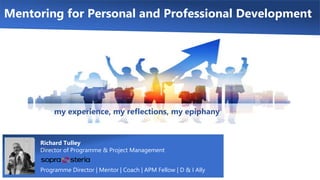




Mentoring for Personal and Professional Development
Richard Tulley
Director of Programme & Project Management
Programme Director | Mentor | Coach | APM Fellow | D & I Ally
my experience, my reflections, my epiphany
food for thought
6th July 2021
Wimbledon
Exits in 4th Round with breathing difficulties
11th September 2021
U.S. Open Champion
First qualifier ever to do so
Wins the match after an injury enforced time out
??
What made the biggest difference
??
Tim Henman’s match point is
sign of his key role as Emma
Raducanu’s mentor
Neil Johnston
Monday September 13 2021, 12.01am
The Times
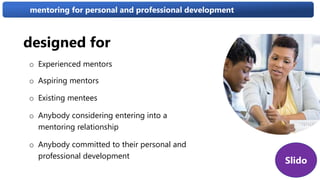
designed for
o Experienced mentors
o Aspiring mentors
o Existing mentees
o Anybody considering entering into a
mentoring relationship
o Anybody committed to their personal and
professional development
mentoring for personal and professional development
Slido
roadmap
oGetting Started
oCoaching & Mentoring
oAn Introduction to
Mentoring
oHow the Mentee Benefits
oHow the Mentor Benefits
oCritical Success Factors
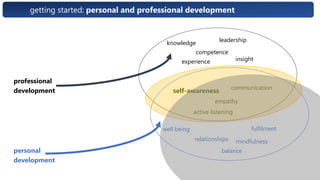
getting started: personal and professional development
relationships
balance
mindfulness
fulfilment
self-awareness communication
empathy
knowledge
experience
competence
leadership
insight
well being
active listening
professional
development
personal
development
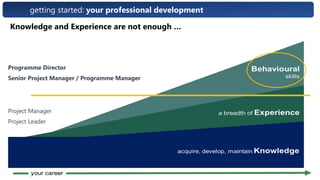
Project Manager
Project Leader
Programme Director
Senior Project Manager / Programme Manager
getting started: your professional development
Knowledge and Experience are not enough …
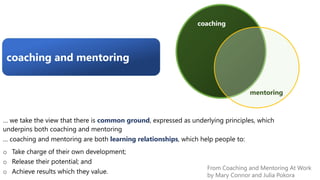
coaching and mentoring
coaching
mentoring
From Coaching and Mentoring At Work
by Mary Connor and Julia Pokora
… we take the view that there is common ground, expressed as underlying principles, which
underpins both coaching and mentoring
… coaching and mentoring are both learning relationships, which help people to:
o Take charge of their own development;
o Release their potential; and
o Achieve results which they value.
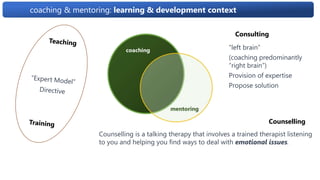
coaching & mentoring: learning & development context
Counselling
Counselling is a talking therapy that involves a trained therapist listening
to you and helping you find ways to deal with emotional issues.
Consulting
“left brain”
(coaching predominantly
“right brain”)
Provision of expertise
Propose solution
coaching & mentoring: coaching
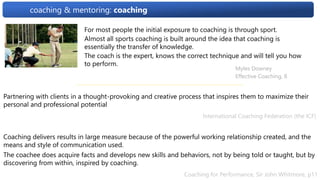
For most people the initial exposure to coaching is through sport.
Almost all sports coaching is built around the idea that coaching is
essentially the transfer of knowledge.
The coach is the expert, knows the correct technique and will tell you how
to perform.
Myles Downey
Effective Coaching, 8
Partnering with clients in a thought-provoking and creative process that inspires them to maximize their
personal and professional potential
International Coaching Federation (the ICF)
Coaching delivers results in large measure because of the powerful working relationship created, and the
means and style of communication used.
The coachee does acquire facts and develops new skills and behaviors, not by being told or taught, but by
discovering from within, inspired by coaching.
Coaching for Performance, Sir John Whitmore, p11
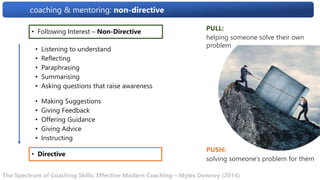
coaching & mentoring: non-directive
PULL:
helping someone solve their own
problem
PUSH:
solving someone’s problem for them
• Following Interest – Non-Directive
• Directive
• Listening to understand
• Reflecting
• Paraphrasing
• Summarising
• Asking questions that raise awareness
• Making Suggestions
• Giving Feedback
• Offering Guidance
• Giving Advice
• Instructing
The Spectrum of Coaching Skills, Effective Modern Coaching – Myles Downey (2014)
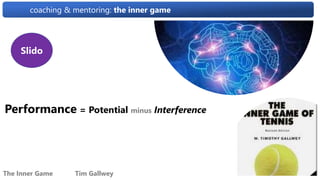
coaching & mentoring: the inner game
The Inner Game Tim Gallwey
Performance = Potential minus Interference
Slido
an introduction to mentoring
Off-line help, by one person to another, in making significant transitions in
knowledge, work or thinking.
Megginson and Clutterbuck (1998)
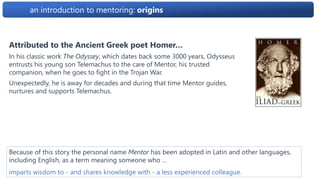
an introduction to mentoring: origins
Because of this story the personal name Mentor has been adopted in Latin and other languages,
including English, as a term meaning someone who …
imparts wisdom to - and shares knowledge with - a less experienced colleague.
Attributed to the Ancient Greek poet Homer…
In his classic work The Odyssey, which dates back some 3000 years, Odysseus
entrusts his young son Telemachus to the care of Mentor, his trusted
companion, when he goes to fight in the Trojan War.
Unexpectedly, he is away for decades and during that time Mentor guides,
nurtures and supports Telemachus.
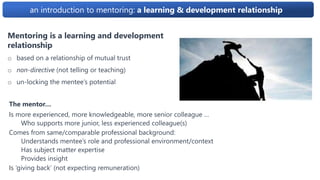
an introduction to mentoring: a learning & development relationship
The mentor…
Is more experienced, more knowledgeable, more senior colleague …
Who supports more junior, less experienced colleague(s)
Comes from same/comparable professional background:
Understands mentee’s role and professional environment/context
Has subject matter expertise
Provides insight
Is ‘giving back’ (not expecting remuneration)
Mentoring is a learning and development
relationship
o based on a relationship of mutual trust
o non-directive (not telling or teaching)
o un-locking the mentee’s potential
an introduction to mentoring: a good mentor
A good mentor stays on the mentee’s agenda
o Listens to develop awareness
o Asks ‘good’, open questions
o Confirms understanding, plays back
o Encourages reflection
o Understands and applies coaching models and techniques
o Encourages the mentee to find their own answers
o Through creating awareness
o Through identifying their potential
o Takes on certain roles:
Trusted adviser, critical friend …
Sometimes coach, sometimes advocate/sponsor
o Opens their network, enables connections
an introduction to mentoring: mentoring relationships
A successful mentoring relationship …
o Non-directive
o Mentee takes responsibility
o Voluntary
o A conscious decision made by the mentee
o An opportunity accepted by the mentor
o Purpose
o Professional context
o Built on mutual trust
o Mutually beneficial
o Temporary by nature (doesn’t mean short duration)
o Develops over time
o Shared values
o Commitment
an introduction to mentoring: evolution of mentoring relationships
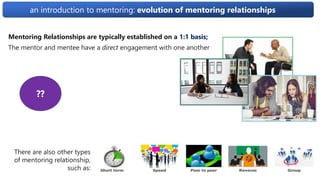
Mentoring Relationships are typically established on a 1:1 basis;
The mentor and mentee have a direct engagement with one another
There are also other types
of mentoring relationship,
such as:
??
how the mentee benefits
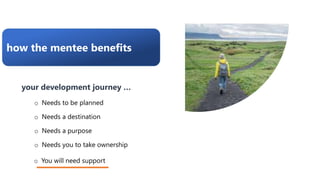
your development journey …
o Needs to be planned
o Needs a destination
o Needs a purpose
o Needs you to take ownership
o You will need support
how the mentee benefits: why people want to be mentored
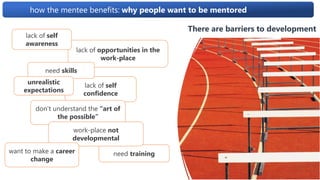
There are barriers to development
lack of self
confidence
lack of opportunities in the
work-place
lack of self
awareness
don’t understand the “art of
the possible”
need training
need skills
unrealistic
expectations
work-place not
developmental
want to make a career
change
how the mentee benefits: why people want to be mentored
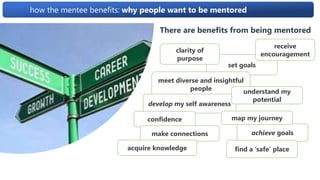
There are benefits from being mentored
set goals
clarity of
purpose
achieve goals
meet diverse and insightful
people
develop my self awareness
understand my
potential
receive
encouragement
confidence map my journey
make connections
acquire knowledge find a ‘safe’ place
how the mentee benefits: how we learn and develop
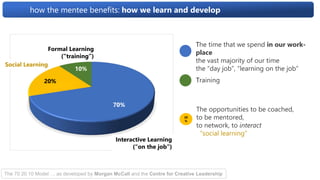
Formal Learning
(“training”)
Social Learning
Interactive Learning
(“on the job”)
70%
10%
20%
The 70 20 10 Model … as developed by Morgan McCall and the Centre for Creative Leadership
The time that we spend in our work-
place
the vast majority of our time
the “day job”, “learning on the job”
Training
20
%
The opportunities to be coached,
to be mentored,
to network, to interact
“social learning”
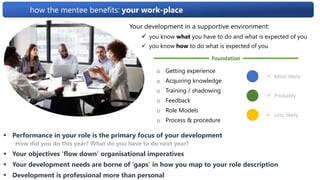
how the mentee benefits: your work-place
Your development in a supportive environment:
 you know what you have to do and what is expected of you
 you know how to do what is expected of you
o Getting experience
o Acquiring knowledge
o Training / shadowing
o Feedback
o Role Models
o Process & procedure
??
Who’s Agenda
??
 Performance in your role is the primary focus of your development
How did you do this year? What do you have to do next year?
 Your objectives ‘flow down’ organisational imperatives
 Your development needs are borne of ‘gaps’ in how you map to your role description
 Development is professional more than personal
Foundation
 Most likely
 Probably
× Less likely
how the mentee benefits: your future possibilities
your current reality
your future possibilities
somebody to help take you here??
your mentor
 Focus on your agenda
 Take 100% of your opportunities to learn
 Apply focus to your professional development and your
personal development
 Explore potential, more than measure performance
 Map out your future, not just next year
 Benefit from a fresh perspective
 Find a ‘safe place’
20
%
how the mentor benefits
The greatest good you can do for another is not just
to share your riches but to reveal to him his own
--- Benjamin Disraeli ---
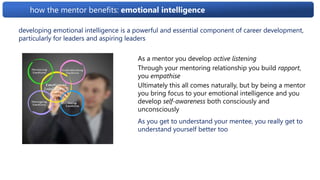
how the mentor benefits: emotional intelligence
developing emotional intelligence is a powerful and essential component of career development,
particularly for leaders and aspiring leaders
As a mentor you develop active listening
Through your mentoring relationship you build rapport,
you empathise
Ultimately this all comes naturally, but by being a mentor
you bring focus to your emotional intelligence and you
develop self-awareness both consciously and
unconsciously
As you get to understand your mentee, you really get to
understand yourself better too
how the mentor benefits: leadership
becoming an effective mentor also takes you on the journey towards becoming an effective leader
the qualities of an effective leader reflect many of the skills that a mentor needs to develop and
refine
Mentoring helps you develop your ability to motivate and
encourage others…
Grow as a manager who builds high performing teams, an
employee who engages and team member who leads by
example
Leaders inspire, they take people on the journey …
As a mentor you encourage your mentee to evaluate their
situation, to explore possibilities, to unlock their potential
Guiding others to evaluate options and make the right
decision for them is one of the qualities of a leader
As is authenticity
how the mentor benefits: effective communication
not telling, teaching or training …
as a mentor you are talking about ideas, concepts and possibilities
you have to communicate effectively for your mentee to understand and contextualise the
guidance that you provide
Different background, environment or demographic …
Different perspective
Mentors and mentees may not "speak the same language" or
use the same lexicon
Mentors learn to adapt their communications style to most
effectively engage their mentee …
based on how they learn, how they are best engaged
Naturally flows in to professional and personal interactions
too
how the mentor benefits: effective communication (yes, again)
the art of effective communication has many facets…
in light of the pandemic and less f2f engagement our ability to effectively engage and
communicate is being put to the test, and has become more important than ever
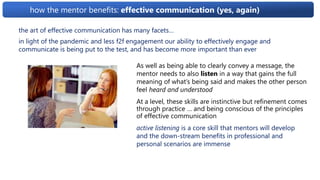
As well as being able to clearly convey a message, the
mentor needs to also listen in a way that gains the full
meaning of what’s being said and makes the other person
feel heard and understood
At a level, these skills are instinctive but refinement comes
through practice … and being conscious of the principles
of effective communication
active listening is a core skill that mentors will develop
and the down-stream benefits in professional and
personal scenarios are immense
how the mentor benefits: reflection
as a mentor you are often drawn to self-reflection – looking at your experiences, the challenges
that you over came and your achievements
Positivity will come to a mentor – and to their mentee –
from recognising successes
This motivational factor is really important as people
develop and grow – it provides the fuel for their
development journey
Self reflection is also a powerful way of ‘checking’ yourself
and maybe identifying some new, previously
undiscovered development opportunities for you, as the
mentor
You can draw lessons learnt from previous experience and
identify positive ways in which you can develop in your
professional environment
how the mentee and mentor benefit … insight
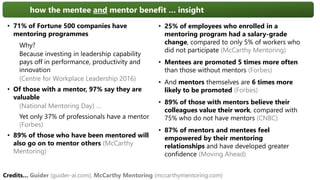
• 71% of Fortune 500 companies have
mentoring programmes
Why?
Because investing in leadership capability
pays off in performance, productivity and
innovation
(Centre for Workplace Leadership 2016)
• Of those with a mentor, 97% say they are
valuable
(National Mentoring Day) …
Yet only 37% of professionals have a mentor
(Forbes)
• 89% of those who have been mentored will
also go on to mentor others (McCarthy
Mentoring)
Credits… Guider (guider-ai.com); McCarthy Mentoring (mccarthymentoring.com)
• 25% of employees who enrolled in a
mentoring program had a salary-grade
change, compared to only 5% of workers who
did not participate (McCarthy Mentoring)
• Mentees are promoted 5 times more often
than those without mentors (Forbes)
• And mentors themselves are 6 times more
likely to be promoted (Forbes)
• 89% of those with mentors believe their
colleagues value their work, compared with
75% who do not have mentors (CNBC)
• 87% of mentors and mentees feel
empowered by their mentoring
relationships and have developed greater
confidence (Moving Ahead)
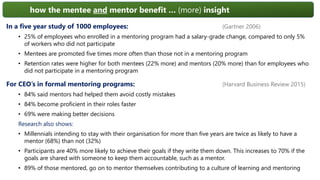
In a five year study of 1000 employees: (Gartner 2006)
• 25% of employees who enrolled in a mentoring program had a salary-grade change, compared to only 5%
of workers who did not participate
• Mentees are promoted five times more often than those not in a mentoring program
• Retention rates were higher for both mentees (22% more) and mentors (20% more) than for employees who
did not participate in a mentoring program
how the mentee and mentor benefit … (more) insight
For CEO’s in formal mentoring programs: (Harvard Business Review 2015)
• 84% said mentors had helped them avoid costly mistakes
• 84% become proficient in their roles faster
• 69% were making better decisions
Research also shows:
• Millennials intending to stay with their organisation for more than five years are twice as likely to have a
mentor (68%) than not (32%)
• Participants are 40% more likely to achieve their goals if they write them down. This increases to 70% if the
goals are shared with someone to keep them accountable, such as a mentor.
• 89% of those mentored, go on to mentor themselves contributing to a culture of learning and mentoring
roadmap
oGetting Started
oCoaching & Mentoring
oAn Introduction to
Mentoring
oHow the Mentee Benefits
oHow the Mentor Benefits
oCritical Success Factors Critical Success Factors
Slido
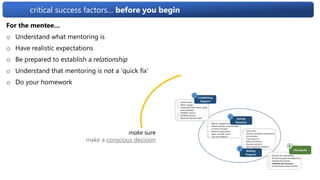
critical success factors… before you begin
For the mentee…
o Understand what mentoring is
o Have realistic expectations
o Be prepared to establish a relationship
o Understand that mentoring is not a ‘quick fix’
o Do your homework
make sure
make a conscious decision
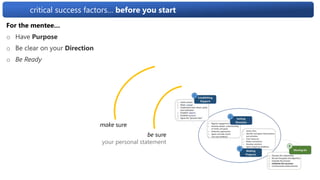
critical success factors… before you start
For the mentee…
o Have Purpose
o Be clear on your Direction
o Be Ready
make sure
be sure
your personal statement
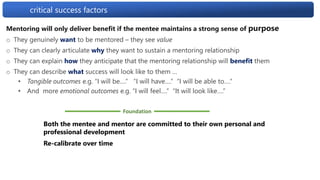
critical success factors
Mentoring will only deliver benefit if the mentee maintains a strong sense of purpose
o They genuinely want to be mentored – they see value
o They can clearly articulate why they want to sustain a mentoring relationship
o They can explain how they anticipate that the mentoring relationship will benefit them
o They can describe what success will look like to them …
• Tangible outcomes e.g. “I will be….” “I will have….” “I will be able to….”
• And more emotional outcomes e.g. “I will feel….” “It will look like….”
Both the mentee and mentor are committed to their own personal and
professional development
Re-calibrate over time
Foundation
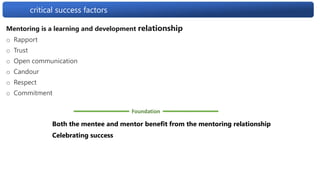
critical success factors
Mentoring is a learning and development relationship
o Rapport
o Trust
o Open communication
o Candour
o Respect
o Commitment
Both the mentee and mentor benefit from the mentoring relationship
Celebrating success
Foundation
Richard Tulley
Director of Programme & Project Management
Programme Director | Mentor | Coach | APM Fellow | D & I Ally
Mentoring for Personal and Professional Development
Web: The Project Mentor Space
https://www.projectmentor.space
Linked In:
https://linkedin.com/in/richard-tulley-1b02ba1/
Thank you for engaging …

Mentoring for Personal and Professional Development webinar

  • 1.
    Mentoring for Personaland Professional Development Richard Tulley Director of Programme & Project Management Programme Director | Mentor | Coach | APM Fellow | D & I Ally my experience, my reflections, my epiphany
  • 2.
    food for thought 6thJuly 2021 Wimbledon Exits in 4th Round with breathing difficulties 11th September 2021 U.S. Open Champion First qualifier ever to do so Wins the match after an injury enforced time out ?? What made the biggest difference ?? Tim Henman’s match point is sign of his key role as Emma Raducanu’s mentor Neil Johnston Monday September 13 2021, 12.01am The Times
  • 3.
    designed for o Experiencedmentors o Aspiring mentors o Existing mentees o Anybody considering entering into a mentoring relationship o Anybody committed to their personal and professional development mentoring for personal and professional development Slido
  • 4.
    roadmap oGetting Started oCoaching &Mentoring oAn Introduction to Mentoring oHow the Mentee Benefits oHow the Mentor Benefits oCritical Success Factors
  • 5.
    getting started: personaland professional development relationships balance mindfulness fulfilment self-awareness communication empathy knowledge experience competence leadership insight well being active listening professional development personal development
  • 6.
    Project Manager Project Leader ProgrammeDirector Senior Project Manager / Programme Manager getting started: your professional development Knowledge and Experience are not enough …
  • 7.
    coaching and mentoring coaching mentoring FromCoaching and Mentoring At Work by Mary Connor and Julia Pokora … we take the view that there is common ground, expressed as underlying principles, which underpins both coaching and mentoring … coaching and mentoring are both learning relationships, which help people to: o Take charge of their own development; o Release their potential; and o Achieve results which they value.
  • 8.
    coaching & mentoring:learning & development context Counselling Counselling is a talking therapy that involves a trained therapist listening to you and helping you find ways to deal with emotional issues. Consulting “left brain” (coaching predominantly “right brain”) Provision of expertise Propose solution
  • 9.
    coaching & mentoring:coaching For most people the initial exposure to coaching is through sport. Almost all sports coaching is built around the idea that coaching is essentially the transfer of knowledge. The coach is the expert, knows the correct technique and will tell you how to perform. Myles Downey Effective Coaching, 8 Partnering with clients in a thought-provoking and creative process that inspires them to maximize their personal and professional potential International Coaching Federation (the ICF) Coaching delivers results in large measure because of the powerful working relationship created, and the means and style of communication used. The coachee does acquire facts and develops new skills and behaviors, not by being told or taught, but by discovering from within, inspired by coaching. Coaching for Performance, Sir John Whitmore, p11
  • 10.
    coaching & mentoring:non-directive PULL: helping someone solve their own problem PUSH: solving someone’s problem for them • Following Interest – Non-Directive • Directive • Listening to understand • Reflecting • Paraphrasing • Summarising • Asking questions that raise awareness • Making Suggestions • Giving Feedback • Offering Guidance • Giving Advice • Instructing The Spectrum of Coaching Skills, Effective Modern Coaching – Myles Downey (2014)
  • 11.
    coaching & mentoring:the inner game The Inner Game Tim Gallwey Performance = Potential minus Interference Slido
  • 12.
    an introduction tomentoring Off-line help, by one person to another, in making significant transitions in knowledge, work or thinking. Megginson and Clutterbuck (1998)
  • 13.
    an introduction tomentoring: origins Because of this story the personal name Mentor has been adopted in Latin and other languages, including English, as a term meaning someone who … imparts wisdom to - and shares knowledge with - a less experienced colleague. Attributed to the Ancient Greek poet Homer… In his classic work The Odyssey, which dates back some 3000 years, Odysseus entrusts his young son Telemachus to the care of Mentor, his trusted companion, when he goes to fight in the Trojan War. Unexpectedly, he is away for decades and during that time Mentor guides, nurtures and supports Telemachus.
  • 14.
    an introduction tomentoring: a learning & development relationship The mentor… Is more experienced, more knowledgeable, more senior colleague … Who supports more junior, less experienced colleague(s) Comes from same/comparable professional background: Understands mentee’s role and professional environment/context Has subject matter expertise Provides insight Is ‘giving back’ (not expecting remuneration) Mentoring is a learning and development relationship o based on a relationship of mutual trust o non-directive (not telling or teaching) o un-locking the mentee’s potential
  • 15.
    an introduction tomentoring: a good mentor A good mentor stays on the mentee’s agenda o Listens to develop awareness o Asks ‘good’, open questions o Confirms understanding, plays back o Encourages reflection o Understands and applies coaching models and techniques o Encourages the mentee to find their own answers o Through creating awareness o Through identifying their potential o Takes on certain roles: Trusted adviser, critical friend … Sometimes coach, sometimes advocate/sponsor o Opens their network, enables connections
  • 16.
    an introduction tomentoring: mentoring relationships A successful mentoring relationship … o Non-directive o Mentee takes responsibility o Voluntary o A conscious decision made by the mentee o An opportunity accepted by the mentor o Purpose o Professional context o Built on mutual trust o Mutually beneficial o Temporary by nature (doesn’t mean short duration) o Develops over time o Shared values o Commitment
  • 17.
    an introduction tomentoring: evolution of mentoring relationships Mentoring Relationships are typically established on a 1:1 basis; The mentor and mentee have a direct engagement with one another There are also other types of mentoring relationship, such as: ??
  • 18.
    how the menteebenefits your development journey … o Needs to be planned o Needs a destination o Needs a purpose o Needs you to take ownership o You will need support
  • 19.
    how the menteebenefits: why people want to be mentored There are barriers to development lack of self confidence lack of opportunities in the work-place lack of self awareness don’t understand the “art of the possible” need training need skills unrealistic expectations work-place not developmental want to make a career change
  • 20.
    how the menteebenefits: why people want to be mentored There are benefits from being mentored set goals clarity of purpose achieve goals meet diverse and insightful people develop my self awareness understand my potential receive encouragement confidence map my journey make connections acquire knowledge find a ‘safe’ place
  • 21.
    how the menteebenefits: how we learn and develop Formal Learning (“training”) Social Learning Interactive Learning (“on the job”) 70% 10% 20% The 70 20 10 Model … as developed by Morgan McCall and the Centre for Creative Leadership The time that we spend in our work- place the vast majority of our time the “day job”, “learning on the job” Training 20 % The opportunities to be coached, to be mentored, to network, to interact “social learning”
  • 22.
    how the menteebenefits: your work-place Your development in a supportive environment:  you know what you have to do and what is expected of you  you know how to do what is expected of you o Getting experience o Acquiring knowledge o Training / shadowing o Feedback o Role Models o Process & procedure ?? Who’s Agenda ??  Performance in your role is the primary focus of your development How did you do this year? What do you have to do next year?  Your objectives ‘flow down’ organisational imperatives  Your development needs are borne of ‘gaps’ in how you map to your role description  Development is professional more than personal Foundation  Most likely  Probably × Less likely
  • 23.
    how the menteebenefits: your future possibilities your current reality your future possibilities somebody to help take you here?? your mentor  Focus on your agenda  Take 100% of your opportunities to learn  Apply focus to your professional development and your personal development  Explore potential, more than measure performance  Map out your future, not just next year  Benefit from a fresh perspective  Find a ‘safe place’ 20 %
  • 24.
    how the mentorbenefits The greatest good you can do for another is not just to share your riches but to reveal to him his own --- Benjamin Disraeli ---
  • 25.
    how the mentorbenefits: emotional intelligence developing emotional intelligence is a powerful and essential component of career development, particularly for leaders and aspiring leaders As a mentor you develop active listening Through your mentoring relationship you build rapport, you empathise Ultimately this all comes naturally, but by being a mentor you bring focus to your emotional intelligence and you develop self-awareness both consciously and unconsciously As you get to understand your mentee, you really get to understand yourself better too
  • 26.
    how the mentorbenefits: leadership becoming an effective mentor also takes you on the journey towards becoming an effective leader the qualities of an effective leader reflect many of the skills that a mentor needs to develop and refine Mentoring helps you develop your ability to motivate and encourage others… Grow as a manager who builds high performing teams, an employee who engages and team member who leads by example Leaders inspire, they take people on the journey … As a mentor you encourage your mentee to evaluate their situation, to explore possibilities, to unlock their potential Guiding others to evaluate options and make the right decision for them is one of the qualities of a leader As is authenticity
  • 27.
    how the mentorbenefits: effective communication not telling, teaching or training … as a mentor you are talking about ideas, concepts and possibilities you have to communicate effectively for your mentee to understand and contextualise the guidance that you provide Different background, environment or demographic … Different perspective Mentors and mentees may not "speak the same language" or use the same lexicon Mentors learn to adapt their communications style to most effectively engage their mentee … based on how they learn, how they are best engaged Naturally flows in to professional and personal interactions too
  • 28.
    how the mentorbenefits: effective communication (yes, again) the art of effective communication has many facets… in light of the pandemic and less f2f engagement our ability to effectively engage and communicate is being put to the test, and has become more important than ever As well as being able to clearly convey a message, the mentor needs to also listen in a way that gains the full meaning of what’s being said and makes the other person feel heard and understood At a level, these skills are instinctive but refinement comes through practice … and being conscious of the principles of effective communication active listening is a core skill that mentors will develop and the down-stream benefits in professional and personal scenarios are immense
  • 29.
    how the mentorbenefits: reflection as a mentor you are often drawn to self-reflection – looking at your experiences, the challenges that you over came and your achievements Positivity will come to a mentor – and to their mentee – from recognising successes This motivational factor is really important as people develop and grow – it provides the fuel for their development journey Self reflection is also a powerful way of ‘checking’ yourself and maybe identifying some new, previously undiscovered development opportunities for you, as the mentor You can draw lessons learnt from previous experience and identify positive ways in which you can develop in your professional environment
  • 30.
    how the menteeand mentor benefit … insight • 71% of Fortune 500 companies have mentoring programmes Why? Because investing in leadership capability pays off in performance, productivity and innovation (Centre for Workplace Leadership 2016) • Of those with a mentor, 97% say they are valuable (National Mentoring Day) … Yet only 37% of professionals have a mentor (Forbes) • 89% of those who have been mentored will also go on to mentor others (McCarthy Mentoring) Credits… Guider (guider-ai.com); McCarthy Mentoring (mccarthymentoring.com) • 25% of employees who enrolled in a mentoring program had a salary-grade change, compared to only 5% of workers who did not participate (McCarthy Mentoring) • Mentees are promoted 5 times more often than those without mentors (Forbes) • And mentors themselves are 6 times more likely to be promoted (Forbes) • 89% of those with mentors believe their colleagues value their work, compared with 75% who do not have mentors (CNBC) • 87% of mentors and mentees feel empowered by their mentoring relationships and have developed greater confidence (Moving Ahead)
  • 31.
    In a fiveyear study of 1000 employees: (Gartner 2006) • 25% of employees who enrolled in a mentoring program had a salary-grade change, compared to only 5% of workers who did not participate • Mentees are promoted five times more often than those not in a mentoring program • Retention rates were higher for both mentees (22% more) and mentors (20% more) than for employees who did not participate in a mentoring program how the mentee and mentor benefit … (more) insight For CEO’s in formal mentoring programs: (Harvard Business Review 2015) • 84% said mentors had helped them avoid costly mistakes • 84% become proficient in their roles faster • 69% were making better decisions Research also shows: • Millennials intending to stay with their organisation for more than five years are twice as likely to have a mentor (68%) than not (32%) • Participants are 40% more likely to achieve their goals if they write them down. This increases to 70% if the goals are shared with someone to keep them accountable, such as a mentor. • 89% of those mentored, go on to mentor themselves contributing to a culture of learning and mentoring
  • 32.
    roadmap oGetting Started oCoaching &Mentoring oAn Introduction to Mentoring oHow the Mentee Benefits oHow the Mentor Benefits oCritical Success Factors Critical Success Factors Slido
  • 33.
    critical success factors…before you begin For the mentee… o Understand what mentoring is o Have realistic expectations o Be prepared to establish a relationship o Understand that mentoring is not a ‘quick fix’ o Do your homework make sure make a conscious decision
  • 34.
    critical success factors…before you start For the mentee… o Have Purpose o Be clear on your Direction o Be Ready make sure be sure your personal statement
  • 35.
    critical success factors Mentoringwill only deliver benefit if the mentee maintains a strong sense of purpose o They genuinely want to be mentored – they see value o They can clearly articulate why they want to sustain a mentoring relationship o They can explain how they anticipate that the mentoring relationship will benefit them o They can describe what success will look like to them … • Tangible outcomes e.g. “I will be….” “I will have….” “I will be able to….” • And more emotional outcomes e.g. “I will feel….” “It will look like….” Both the mentee and mentor are committed to their own personal and professional development Re-calibrate over time Foundation
  • 36.
    critical success factors Mentoringis a learning and development relationship o Rapport o Trust o Open communication o Candour o Respect o Commitment Both the mentee and mentor benefit from the mentoring relationship Celebrating success Foundation
  • 37.
    Richard Tulley Director ofProgramme & Project Management Programme Director | Mentor | Coach | APM Fellow | D & I Ally Mentoring for Personal and Professional Development Web: The Project Mentor Space https://www.projectmentor.space Linked In: https://linkedin.com/in/richard-tulley-1b02ba1/ Thank you for engaging …