
OpenKilda
Stream Processing Meets OpenFlow
Jeff Young
Product Architecture, Global Platforms
Agenda
• What is the Telstra Programmable Network?
• Why Build on Openflow?
• Why Create (yet another) Openflow Controller?
• Our Solution
• Current State of the Project
• What’s Next?
• Get Involved!
3
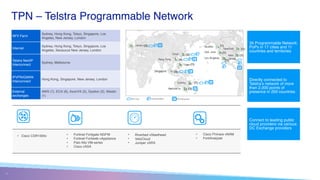
TPN – Telstra Programmable Network
(7)
(3)
(1)
(5)
(4)
(2)
(3)
(1)
(1)
(1)
(1)
(1)
NFV Farm Internet Breakout VPN Interconnect
NFV Farm
Sydney, Hong Kong, Tokyo, Singapore, Los
Angeles, New Jersey, London
Internet
Sydney, Hong Kong, Tokyo, Singapore, Los
Angeles, Secaucus New Jersey, London
Telstra NextIP
Interconnect
Sydney, Melbourne
IPVPN/GWAN
Interconnect
Hong Kong, Singapore, New Jersey, London
External
exchanges
AWS (7), ECX (6), AxonVX (2), Epsilon (2), Westin
(1)
• Fortinet Fortigate NGFW
• Fortinet Fortiweb vAppliance
• Palo Alto VM-series
• Cisco vASA
• Cisco CSR1000v • Riverbed vSteelhead
• VeloCloud
• Juniper vSRX
• Cisco Primare vNAM
• FortiAnalyzer
35 Programmable Network
PoPs in 17 cities and 11
countries and territories
Directly connected to
Telstra’s network of more
than 2,000 points of
presence in 200 countries
Connect to leading public
cloud providers via various
DC Exchange providers
4
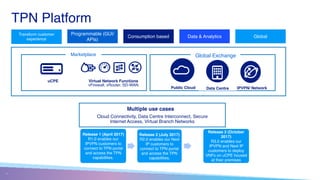
TPN Platform
Transform customer
experience
Programmable (GUI/
APIs)
Consumption based Data & Analytics Global
Marketplace Global Exchange
Data CentrePublic Cloud
Virtual Network Functions
vFirewall, vRouter, SD-WAN
uCPE
Cloud Connectivity, Data Centre Interconnect, Secure
Internet Access, Virtual Branch Networks
Multiple use cases
IPVPN/ Network
Release 1 (April 2017)
R1.0 enables our
IPVPN customers to
connect to TPN portal
and access the TPN
capabilities.
Release 2 (July 2017)
R2.0 enables our Next
IP customers to
connect to TPN portal
and access the TPN
capabilities.
Release 3 (October
2017)
R3.0 enables our
IPVPN and Next IP
customers to deploy
VNFs on uCPE housed
at their premises
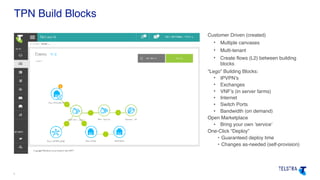
TPN Build Blocks
5
Customer Driven (created)
• Multiple canvases
• Multi-tenant
• Create flows (L2) between building
blocks
“Lego” Building Blocks:
• IPVPN’s
• Exchanges
• VNF’s (in server farms)
• Internet
• Switch Ports
• Bandwidth (on demand)
Open Marketplace
• Bring your own ’service’
One-Click “Deploy”
• Guaranteed deploy time
• Changes as-needed (self-provision)
Why Build Yet Another OpenFlow Controller?

A few of the existing controllers available today:
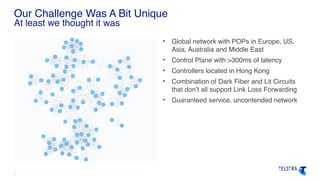
Our Challenge Was A Bit Unique

At least we thought it was
7
• Global network with POPs in Europe, US,
Asia, Australia and Middle East
• Control Plane with >300ms of latency
• Controllers located in Hong Kong
• Combination of Dark Fiber and Lit Circuits
that don’t all support Link Loss Forwarding
• Guaranteed service, uncontended network
What We Found
8
• Constant topology changes
• Network changes increased
with network complexity
• Correlation of multiple
events
Convergence
• 100K’s messages into/out
of the controller
• Managing >1M Flows
Events
• LAN based controllers
• High latency in Control
Plane
WAN
Features We Wanted
9
Operations:
•Sub-Second Failover
•Auto-re-route based on real-time latency/packet loss/jitter measurements
•Self Healing/Optimizing Network
•Zero Touch Controller Deployment/Upgrade
Architecture:
•Horizontal scale
•Number of switches
•Number of flows
•Negative Affinity In Path Selection
•Path Selection Based on Latency
•Multiple data points for comprehensive end-to-end network state
•Product:
•Complex match/actions using experimenters
•Stats collections at 1 second intervals
•Active Latency Measurement on ISL
•End-to-End Latency Measurements on every flow
Our Solution

10
Floodlight
Regionalized OpenFlow Speakers
Our Solution

11
Floodlight Apache Kafka
Message Queue as ESP Bus
Our Solution

12
Floodlight Apache Kafka Apache Storm
Real-time Stream Processing via Apache Storm
Our Solution

13
Floodlight Apache Kafka Apache Storm
Neo4J
GraphDB - based on Neo4j
Our Solution

14
Floodlight Apache Kafka Apache Storm OpenTSDB
Neo4J
Reporting via OpenTSDB and HBase
Our Solution

15
HDFS
HBASEKAFKA
ZOOKEEPER
STORM OpenTSDB
TOPOLOGY ENGINE
NORTHBOUNDAPI
OPENFLOWSWITCH
NEO4J
Architecture
Sequence Diagram
16
Current State
17
Northbound Interface
• Restful
• Create/Modify/Delete Flow
• Push/Pop/Modify VLANs
• List Flows/Switches
Telemetry
• Flow stats
• Port stats
• Switch status
Operational
• Auto-discover network
• Active monitor of ISL with Latency
• Re-Flow when topology change occurs
API
How’d We Do?

Based On The Original Objectives
18
Sub-Second Failover – NOT YET
Negative Affinity In Path Selection
Active Latency Measurement on ISL
End-to-End Latency Measurement on Flow
Path Selection Based on Latency
Auto-re-route based on real-time latency/packet loss/jitter measurements
Multiple data points for comprehensive end-to-end network state – HALF DONE
Horizontal scale (achieved in testing)
Number of switches - 10K Switches
Number of flows – 16M Flows
Complex match/actions using experimenters – NOT YET
Stats collections at 1 second intervals
Self Healing/Optimizing Network
Zero Touch Controller Deployment/Upgrade
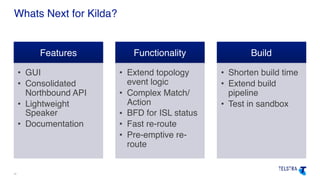
Whats Next for Kilda?
19
Features
• GUI
• Consolidated
Northbound API
• Lightweight
Speaker
• Documentation
Functionality
• Extend topology
event logic
• Complex Match/
Action
• BFD for ISL status
• Fast re-route
• Pre-emptive re-
route
Build
• Shorten build time
• Extend build
pipeline
• Test in sandbox
20
What’s next for TPN?
New Capability
uCPE hardware device
• Customer can deploy VNFs
from marketplace on a uCPE
in their branch 

(Juniper NFX 250)
New virtual network functions
• Juniper vSRX
• VeloCloud SD-WAN
• Riverbed vSteeklhead
Portal enhancements
• Online on-boarding for existing
Telstra customers
• Automated retrieval of
customer’s Telstra VPN and
Internet service for information
display
Exchange &
Marketplace
Programmable
Network
Internet
Secure connection
to the internet
Direct and scalable
connection to public
clouds
Equinix Cloud Exchange
Internet
Next IP/IPVPN
Universal CPE
Firewall
SD-WAN
Router
VNFs
WAN-Opt
Release 3 (October 2017)
R3.0 enables our IPVPN and Next IP
customers to deploy VNFs on uCPE
housed at their premises
Release 2 (July 2017)
R2.0 enables our Next IP customers to
connect to TPN portal and access the TPN
capabilities.
Release 1 (April 2017)
R1.0 enables our IPVPN customers to
connect to TPN portal and access the TPN
capabilities.
Via Cloud Exchange
Firewall
Router
VNF Farms
WAN-Opt
SD-WAN
~32 TPN PoP Data Centres
Globally
Get Involved!

21
Homepage - https://github.com/telstra/open-kilda
(git clone https://github.com/telstra/open-kilda.git)
Native Development
Environment
# clone your GitHub fork
> make build-latest
> docker-compose up
Linux Based Environment
> vagrant up
> vagrant ssh
> ssh-keygen -t rsa –C your_email@example.com
# update your GitHub fork with ssh key
# clone your GitHub fork
> make build-latest
> docker-compose up
Thank you
22

OpenKilda: Stream Processing Meets Openflow

  • 1.
    OpenKilda Stream Processing MeetsOpenFlow Jeff Young Product Architecture, Global Platforms
  • 2.
    Agenda • What isthe Telstra Programmable Network? • Why Build on Openflow? • Why Create (yet another) Openflow Controller? • Our Solution • Current State of the Project • What’s Next? • Get Involved!
  • 3.
    3 TPN – TelstraProgrammable Network (7) (3) (1) (5) (4) (2) (3) (1) (1) (1) (1) (1) NFV Farm Internet Breakout VPN Interconnect NFV Farm Sydney, Hong Kong, Tokyo, Singapore, Los Angeles, New Jersey, London Internet Sydney, Hong Kong, Tokyo, Singapore, Los Angeles, Secaucus New Jersey, London Telstra NextIP Interconnect Sydney, Melbourne IPVPN/GWAN Interconnect Hong Kong, Singapore, New Jersey, London External exchanges AWS (7), ECX (6), AxonVX (2), Epsilon (2), Westin (1) • Fortinet Fortigate NGFW • Fortinet Fortiweb vAppliance • Palo Alto VM-series • Cisco vASA • Cisco CSR1000v • Riverbed vSteelhead • VeloCloud • Juniper vSRX • Cisco Primare vNAM • FortiAnalyzer 35 Programmable Network PoPs in 17 cities and 11 countries and territories Directly connected to Telstra’s network of more than 2,000 points of presence in 200 countries Connect to leading public cloud providers via various DC Exchange providers
  • 4.
    4 TPN Platform Transform customer experience Programmable(GUI/ APIs) Consumption based Data & Analytics Global Marketplace Global Exchange Data CentrePublic Cloud Virtual Network Functions vFirewall, vRouter, SD-WAN uCPE Cloud Connectivity, Data Centre Interconnect, Secure Internet Access, Virtual Branch Networks Multiple use cases IPVPN/ Network Release 1 (April 2017) R1.0 enables our IPVPN customers to connect to TPN portal and access the TPN capabilities. Release 2 (July 2017) R2.0 enables our Next IP customers to connect to TPN portal and access the TPN capabilities. Release 3 (October 2017) R3.0 enables our IPVPN and Next IP customers to deploy VNFs on uCPE housed at their premises
  • 5.
    TPN Build Blocks 5 CustomerDriven (created) • Multiple canvases • Multi-tenant • Create flows (L2) between building blocks “Lego” Building Blocks: • IPVPN’s • Exchanges • VNF’s (in server farms) • Internet • Switch Ports • Bandwidth (on demand) Open Marketplace • Bring your own ’service’ One-Click “Deploy” • Guaranteed deploy time • Changes as-needed (self-provision)
  • 6.
    Why Build YetAnother OpenFlow Controller?
 A few of the existing controllers available today:
  • 7.
    Our Challenge WasA Bit Unique
 At least we thought it was 7 • Global network with POPs in Europe, US, Asia, Australia and Middle East • Control Plane with >300ms of latency • Controllers located in Hong Kong • Combination of Dark Fiber and Lit Circuits that don’t all support Link Loss Forwarding • Guaranteed service, uncontended network
  • 8.
    What We Found 8 •Constant topology changes • Network changes increased with network complexity • Correlation of multiple events Convergence • 100K’s messages into/out of the controller • Managing >1M Flows Events • LAN based controllers • High latency in Control Plane WAN
  • 9.
    Features We Wanted 9 Operations: •Sub-SecondFailover •Auto-re-route based on real-time latency/packet loss/jitter measurements •Self Healing/Optimizing Network •Zero Touch Controller Deployment/Upgrade Architecture: •Horizontal scale •Number of switches •Number of flows •Negative Affinity In Path Selection •Path Selection Based on Latency •Multiple data points for comprehensive end-to-end network state •Product: •Complex match/actions using experimenters •Stats collections at 1 second intervals •Active Latency Measurement on ISL •End-to-End Latency Measurements on every flow
  • 10.
  • 11.
    Our Solution
 11 Floodlight ApacheKafka Message Queue as ESP Bus
  • 12.
    Our Solution
 12 Floodlight ApacheKafka Apache Storm Real-time Stream Processing via Apache Storm
  • 13.
    Our Solution
 13 Floodlight ApacheKafka Apache Storm Neo4J GraphDB - based on Neo4j
  • 14.
    Our Solution
 14 Floodlight ApacheKafka Apache Storm OpenTSDB Neo4J Reporting via OpenTSDB and HBase
  • 15.
    Our Solution
 15 HDFS HBASEKAFKA ZOOKEEPER STORM OpenTSDB TOPOLOGYENGINE NORTHBOUNDAPI OPENFLOWSWITCH NEO4J Architecture
  • 16.
  • 17.
    Current State 17 Northbound Interface •Restful • Create/Modify/Delete Flow • Push/Pop/Modify VLANs • List Flows/Switches Telemetry • Flow stats • Port stats • Switch status Operational • Auto-discover network • Active monitor of ISL with Latency • Re-Flow when topology change occurs API
  • 18.
    How’d We Do?
 BasedOn The Original Objectives 18 Sub-Second Failover – NOT YET Negative Affinity In Path Selection Active Latency Measurement on ISL End-to-End Latency Measurement on Flow Path Selection Based on Latency Auto-re-route based on real-time latency/packet loss/jitter measurements Multiple data points for comprehensive end-to-end network state – HALF DONE Horizontal scale (achieved in testing) Number of switches - 10K Switches Number of flows – 16M Flows Complex match/actions using experimenters – NOT YET Stats collections at 1 second intervals Self Healing/Optimizing Network Zero Touch Controller Deployment/Upgrade
  • 19.
    Whats Next forKilda? 19 Features • GUI • Consolidated Northbound API • Lightweight Speaker • Documentation Functionality • Extend topology event logic • Complex Match/ Action • BFD for ISL status • Fast re-route • Pre-emptive re- route Build • Shorten build time • Extend build pipeline • Test in sandbox
  • 20.
    20 What’s next forTPN? New Capability uCPE hardware device • Customer can deploy VNFs from marketplace on a uCPE in their branch 
 (Juniper NFX 250) New virtual network functions • Juniper vSRX • VeloCloud SD-WAN • Riverbed vSteeklhead Portal enhancements • Online on-boarding for existing Telstra customers • Automated retrieval of customer’s Telstra VPN and Internet service for information display Exchange & Marketplace Programmable Network Internet Secure connection to the internet Direct and scalable connection to public clouds Equinix Cloud Exchange Internet Next IP/IPVPN Universal CPE Firewall SD-WAN Router VNFs WAN-Opt Release 3 (October 2017) R3.0 enables our IPVPN and Next IP customers to deploy VNFs on uCPE housed at their premises Release 2 (July 2017) R2.0 enables our Next IP customers to connect to TPN portal and access the TPN capabilities. Release 1 (April 2017) R1.0 enables our IPVPN customers to connect to TPN portal and access the TPN capabilities. Via Cloud Exchange Firewall Router VNF Farms WAN-Opt SD-WAN ~32 TPN PoP Data Centres Globally
  • 21.
    Get Involved!
 21 Homepage -https://github.com/telstra/open-kilda (git clone https://github.com/telstra/open-kilda.git) Native Development Environment # clone your GitHub fork > make build-latest > docker-compose up Linux Based Environment > vagrant up > vagrant ssh > ssh-keygen -t rsa –C your_email@example.com # update your GitHub fork with ssh key # clone your GitHub fork > make build-latest > docker-compose up
  • 22.