ITEM ANALYSIS
Ann Meredith Garcia, MD
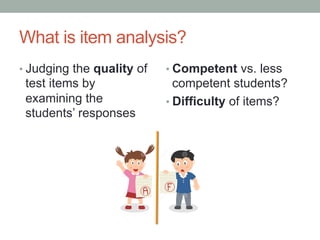
What is item analysis?
• Judging the quality of
test items by
examining the
students’ responses
• Competent vs. less
competent students?
• Difficulty of items?
How is item analysis done?
Administer the
test
Check the
students’
responses to
separate items
Check the total
scores
Tasks of item analysis
1st task: Item discrimination
•  Sort the students who
know the topic well from
those who do not
•  Correlate performance on
a single test item with
total test performance
•  (+) Correlation à better
discrimination
2nd task: Item difficulty
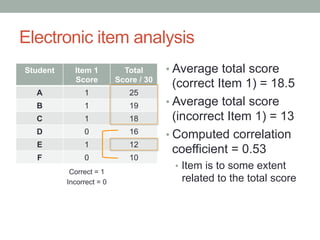
Electronic item analysis
Student Item 1
Score
Total
Score / 30
A 1 25
B 1 19
C 1 18
D 0 16
E 1 12
F 0 10
• Average total score
(correct Item 1) = 18.5
• Average total score
(incorrect Item 1) = 13
• Computed correlation
coefficient = 0.53
•  Item is to some extent
related to the total score
Correct = 1
Incorrect = 0
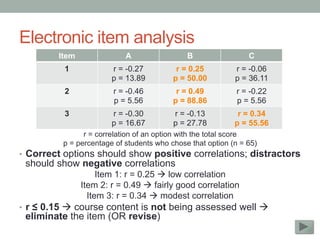
Electronic item analysis
r = correlation of an option with the total score
p = percentage of students who chose that option (n = 65)
•  Correct options should show positive correlations; distractors
should show negative correlations
Item 1: r = 0.25 à low correlation
Item 2: r = 0.49 à fairly good correlation
Item 3: r = 0.34 à modest correlation
•  r ≤ 0.15 à course content is not being assessed well à
eliminate the item (OR revise)
Item A B C
1 r = -0.27
p = 13.89
r = 0.25
p = 50.00
r = -0.06
p = 36.11
2 r = -0.46
p = 5.56
r = 0.49
p = 88.86
r = -0.22
p = 5.56
3 r = -0.30
p = 16.67
r = -0.13
p = 27.78
r = 0.34
p = 55.56
Electronic item analysis
r = correlation of an option with the total score
p = percentage of students who chose that option (n = 65)
•  Standard error (SE) = 1 / √ (number of students – 1)
= 0.12
•  Any r > 2(SE) will be accepted as other than a chance
relationship between the item and the total score
Item 1: r = 0.25 > 0.24 [2(SE)] à very marginal but acceptable
Item A B C
1 r = -0.27
p = 13.89
r = 0.25
p = 50.00
r = -0.06
p = 36.11
2 r = -0.46
p = 5.56
r = 0.49
p = 88.86
r = -0.22
p = 5.56
3 r = -0.30
p = 16.67
r = -0.13
p = 27.78
r = 0.34
p = 55.56
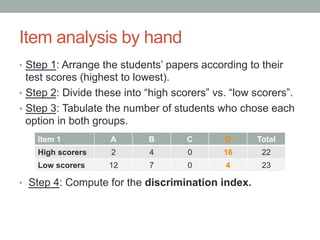
Item analysis by hand
•  Step 1: Arrange the students’ papers according to their
test scores (highest to lowest).
•  Step 2: Divide these into “high scorers” vs. “low scorers”.
•  Step 3: Tabulate the number of students who chose each
option in both groups.
•  Step 4: Compute for the discrimination index.
Item 1 A B C D Total
High scorers 2 4 0 16 22
Low scorers 12 7 0 4 23
Item analysis by hand
•  Step 4: Compute for the discrimination index (DI).
DI = (NumHigh – NumLow) x
Number of students in larger group
= (16 – 4) / 23 = 0.52
* Ranges from 0 – 1.00
* Can also be negative (for distractors)
Item 1 A B C D Total
High scorers 2 4 0 16 22
Low scorers 12 7 0 4 23
Item analysis by hand
Alternative: Straight difference method
•  Steps 1 – 3: Same
•  Step 4: Compute for NumHigh – NumLow.
•  If ≥ 0.10(n) à adequate (used across all items)
16 – 4 = 12
0.10(45) = 4.5
Item 1 A B C D Total
High scorers 2 4 0 16 22
Low scorers 12 7 0 4 23
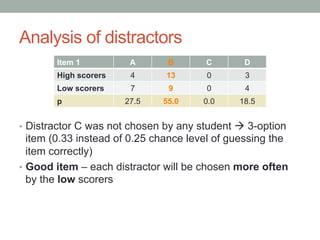
Analysis of distractors
•  Distractor C was not chosen by any student à 3-option
item (0.33 instead of 0.25 chance level of guessing the
item correctly)
•  Good item – each distractor will be chosen more often
by the low scorers
Item 1 A B C D
High scorers 4 13 0 3
Low scorers 7 9 0 4
p 27.5 55.0 0.0 18.5
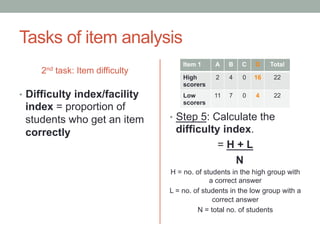
Tasks of item analysis
2nd task: Item difficulty
•  Difficulty index/facility
index = proportion of
students who get an item
correctly
•  Step 1: Award a score to
each student.
•  Step 2: Arrange the scored
tests from highest to lowest.
•  Step 3: Identify the upper
and lower 27%.
•  Step 4: Count the response
counts in each group.
Item 1 A B C D Total
High
scorers
2 4 0 16 22
Low
scorers
11 7 0 4 22
Tasks of item analysis
2nd task: Item difficulty
•  Difficulty index/facility
index = proportion of
students who get an item
correctly
•  Step 5: Calculate the
difficulty index.
= H + L
N
H = no. of students in the high group with
a correct answer
L = no. of students in the low group with a
correct answer
N = total no. of students
Item 1 A B C D Total
High
scorers
2 4 0 16 22
Low
scorers
11 7 0 4 22
Tasks of item analysis
2nd task: Item difficulty
•  Difficulty index/facility
index = proportion of
students who get an item
correctly
•  Ranges from 0 – 1.00
•  Best ≈ 0.50 (0.30 – 0.70)
•  Larger index à easier
item; smaller index à
more difficult item
DI = (16 + 4) / 80
= 0.25
•  Criteria:
•  ≥0.35 = excellent question
•  0.25 – 0.34 = good question
•  0.15 – 0.24 = marginal
question à revise
•  <0.15 = poor question à
discard
Item 1 A B C D Total
High
scorers
2 4 0 16 22
Low
scorers
11 7 0 4 22
Item analysis for essay tests
•  Step 1: Identify the upper and lower 25% of the students.
•  Step 2: Compute for the following:
Disc. = (Sum of scores for highs – sum of score for lows)
N x (max. possible score on item)
Diff. = (Sum of scores for highs + sum of score for lows)
2N x (max. possible score on item)
N = 25% of the number tested
Item Score
High Group Low Group
No. of Students No. of Students
x Score
No. of Students No. of Students
x Score
10 9 90 1 10
8 6 48 0 0
6 2 12 4 24
4 3 12 7 28
2 0 0 8 16
Total 20 162 20 78
Item analysis for essay tests
•  Step 2: Compute for the following:
Disc. = (Sum of scores for highs – sum of score for lows)
N x (max. possible score on item)
= (162 – 78) / [(0.25 x 80) x 10] = 0.42
Satisfactory discrimination
Item Score
High Group Low Group
No. of Students No. of Students
x Score
No. of Students No. of Students
x Score
10 9 90 1 10
8 6 48 0 0
6 2 12 4 24
4 3 12 7 28
2 0 0 8 16
Total 20 162 20 78
Item analysis for essay tests
•  Step 2: Compute for the following:
Diff. = (Sum of scores for highs + sum of score for lows)
2N x (max. possible score on item)
= (162 + 78) / [(2 x 0.25 x 80) x 10] = 0.60
Satisfactory difficulty
Item Score
High Group Low Group
No. of Students No. of Students
x Score
No. of Students No. of Students
x Score
10 9 90 1 10
8 6 48 0 0
6 2 12 4 24
4 3 12 7 28
2 0 0 8 16
Total 20 162 20 78
Item response theory and item analysis
•  Calculates the odds of getting an item right à converts
this number to a natural logarithm
•  Allows faculty to equate the item difficulty scale on one
test to the scale of another test and across different
student groups
•  Useful system for building item banks
Thank you! J

Item Analysis

  • 1.
  • 2.
    What is itemanalysis? • Judging the quality of test items by examining the students’ responses • Competent vs. less competent students? • Difficulty of items?
  • 3.
    How is itemanalysis done? Administer the test Check the students’ responses to separate items Check the total scores
  • 4.
    Tasks of itemanalysis 1st task: Item discrimination •  Sort the students who know the topic well from those who do not •  Correlate performance on a single test item with total test performance •  (+) Correlation à better discrimination 2nd task: Item difficulty
  • 5.
    Electronic item analysis StudentItem 1 Score Total Score / 30 A 1 25 B 1 19 C 1 18 D 0 16 E 1 12 F 0 10 • Average total score (correct Item 1) = 18.5 • Average total score (incorrect Item 1) = 13 • Computed correlation coefficient = 0.53 •  Item is to some extent related to the total score Correct = 1 Incorrect = 0
  • 6.
    Electronic item analysis r= correlation of an option with the total score p = percentage of students who chose that option (n = 65) •  Correct options should show positive correlations; distractors should show negative correlations Item 1: r = 0.25 à low correlation Item 2: r = 0.49 à fairly good correlation Item 3: r = 0.34 à modest correlation •  r ≤ 0.15 à course content is not being assessed well à eliminate the item (OR revise) Item A B C 1 r = -0.27 p = 13.89 r = 0.25 p = 50.00 r = -0.06 p = 36.11 2 r = -0.46 p = 5.56 r = 0.49 p = 88.86 r = -0.22 p = 5.56 3 r = -0.30 p = 16.67 r = -0.13 p = 27.78 r = 0.34 p = 55.56
  • 7.
    Electronic item analysis r= correlation of an option with the total score p = percentage of students who chose that option (n = 65) •  Standard error (SE) = 1 / √ (number of students – 1) = 0.12 •  Any r > 2(SE) will be accepted as other than a chance relationship between the item and the total score Item 1: r = 0.25 > 0.24 [2(SE)] à very marginal but acceptable Item A B C 1 r = -0.27 p = 13.89 r = 0.25 p = 50.00 r = -0.06 p = 36.11 2 r = -0.46 p = 5.56 r = 0.49 p = 88.86 r = -0.22 p = 5.56 3 r = -0.30 p = 16.67 r = -0.13 p = 27.78 r = 0.34 p = 55.56
  • 8.
    Item analysis byhand •  Step 1: Arrange the students’ papers according to their test scores (highest to lowest). •  Step 2: Divide these into “high scorers” vs. “low scorers”. •  Step 3: Tabulate the number of students who chose each option in both groups. •  Step 4: Compute for the discrimination index. Item 1 A B C D Total High scorers 2 4 0 16 22 Low scorers 12 7 0 4 23
  • 9.
    Item analysis byhand •  Step 4: Compute for the discrimination index (DI). DI = (NumHigh – NumLow) x Number of students in larger group = (16 – 4) / 23 = 0.52 * Ranges from 0 – 1.00 * Can also be negative (for distractors) Item 1 A B C D Total High scorers 2 4 0 16 22 Low scorers 12 7 0 4 23
  • 10.
    Item analysis byhand Alternative: Straight difference method •  Steps 1 – 3: Same •  Step 4: Compute for NumHigh – NumLow. •  If ≥ 0.10(n) à adequate (used across all items) 16 – 4 = 12 0.10(45) = 4.5 Item 1 A B C D Total High scorers 2 4 0 16 22 Low scorers 12 7 0 4 23
  • 11.
    Analysis of distractors • Distractor C was not chosen by any student à 3-option item (0.33 instead of 0.25 chance level of guessing the item correctly) •  Good item – each distractor will be chosen more often by the low scorers Item 1 A B C D High scorers 4 13 0 3 Low scorers 7 9 0 4 p 27.5 55.0 0.0 18.5
  • 12.
    Tasks of itemanalysis 2nd task: Item difficulty •  Difficulty index/facility index = proportion of students who get an item correctly •  Step 1: Award a score to each student. •  Step 2: Arrange the scored tests from highest to lowest. •  Step 3: Identify the upper and lower 27%. •  Step 4: Count the response counts in each group. Item 1 A B C D Total High scorers 2 4 0 16 22 Low scorers 11 7 0 4 22
  • 13.
    Tasks of itemanalysis 2nd task: Item difficulty •  Difficulty index/facility index = proportion of students who get an item correctly •  Step 5: Calculate the difficulty index. = H + L N H = no. of students in the high group with a correct answer L = no. of students in the low group with a correct answer N = total no. of students Item 1 A B C D Total High scorers 2 4 0 16 22 Low scorers 11 7 0 4 22
  • 14.
    Tasks of itemanalysis 2nd task: Item difficulty •  Difficulty index/facility index = proportion of students who get an item correctly •  Ranges from 0 – 1.00 •  Best ≈ 0.50 (0.30 – 0.70) •  Larger index à easier item; smaller index à more difficult item DI = (16 + 4) / 80 = 0.25 •  Criteria: •  ≥0.35 = excellent question •  0.25 – 0.34 = good question •  0.15 – 0.24 = marginal question à revise •  <0.15 = poor question à discard Item 1 A B C D Total High scorers 2 4 0 16 22 Low scorers 11 7 0 4 22
  • 15.
    Item analysis foressay tests •  Step 1: Identify the upper and lower 25% of the students. •  Step 2: Compute for the following: Disc. = (Sum of scores for highs – sum of score for lows) N x (max. possible score on item) Diff. = (Sum of scores for highs + sum of score for lows) 2N x (max. possible score on item) N = 25% of the number tested Item Score High Group Low Group No. of Students No. of Students x Score No. of Students No. of Students x Score 10 9 90 1 10 8 6 48 0 0 6 2 12 4 24 4 3 12 7 28 2 0 0 8 16 Total 20 162 20 78
  • 16.
    Item analysis foressay tests •  Step 2: Compute for the following: Disc. = (Sum of scores for highs – sum of score for lows) N x (max. possible score on item) = (162 – 78) / [(0.25 x 80) x 10] = 0.42 Satisfactory discrimination Item Score High Group Low Group No. of Students No. of Students x Score No. of Students No. of Students x Score 10 9 90 1 10 8 6 48 0 0 6 2 12 4 24 4 3 12 7 28 2 0 0 8 16 Total 20 162 20 78
  • 17.
    Item analysis foressay tests •  Step 2: Compute for the following: Diff. = (Sum of scores for highs + sum of score for lows) 2N x (max. possible score on item) = (162 + 78) / [(2 x 0.25 x 80) x 10] = 0.60 Satisfactory difficulty Item Score High Group Low Group No. of Students No. of Students x Score No. of Students No. of Students x Score 10 9 90 1 10 8 6 48 0 0 6 2 12 4 24 4 3 12 7 28 2 0 0 8 16 Total 20 162 20 78
  • 18.
    Item response theoryand item analysis •  Calculates the odds of getting an item right à converts this number to a natural logarithm •  Allows faculty to equate the item difficulty scale on one test to the scale of another test and across different student groups •  Useful system for building item banks
  • 19.