OPEN SHORTEST PATH
FIRST (OSPF)
ROUTING PROTOCOL
A routing protocol specifies
how routers communicate with each other.
 Routing algorithms determine the specific
choice of route.
Suffered from problems of Distance Vector
Protocol
• Count to Infinity Problem
• Slow Convergence
• Large update packets
• Slow response to topological changes
Need for a Link State Protocol.
OSPF
• OSPF Open Shortest Path First (std protocol)
• Intra domain routing protocol based on
link-state routing protocol
• It uses SPF or dijkistra algorithm
• Unlimited hop count
• It’s a classless routing protocol
• Only equal cost load balancing
• Provides authentication of routing
messages
AREAS
AREAS
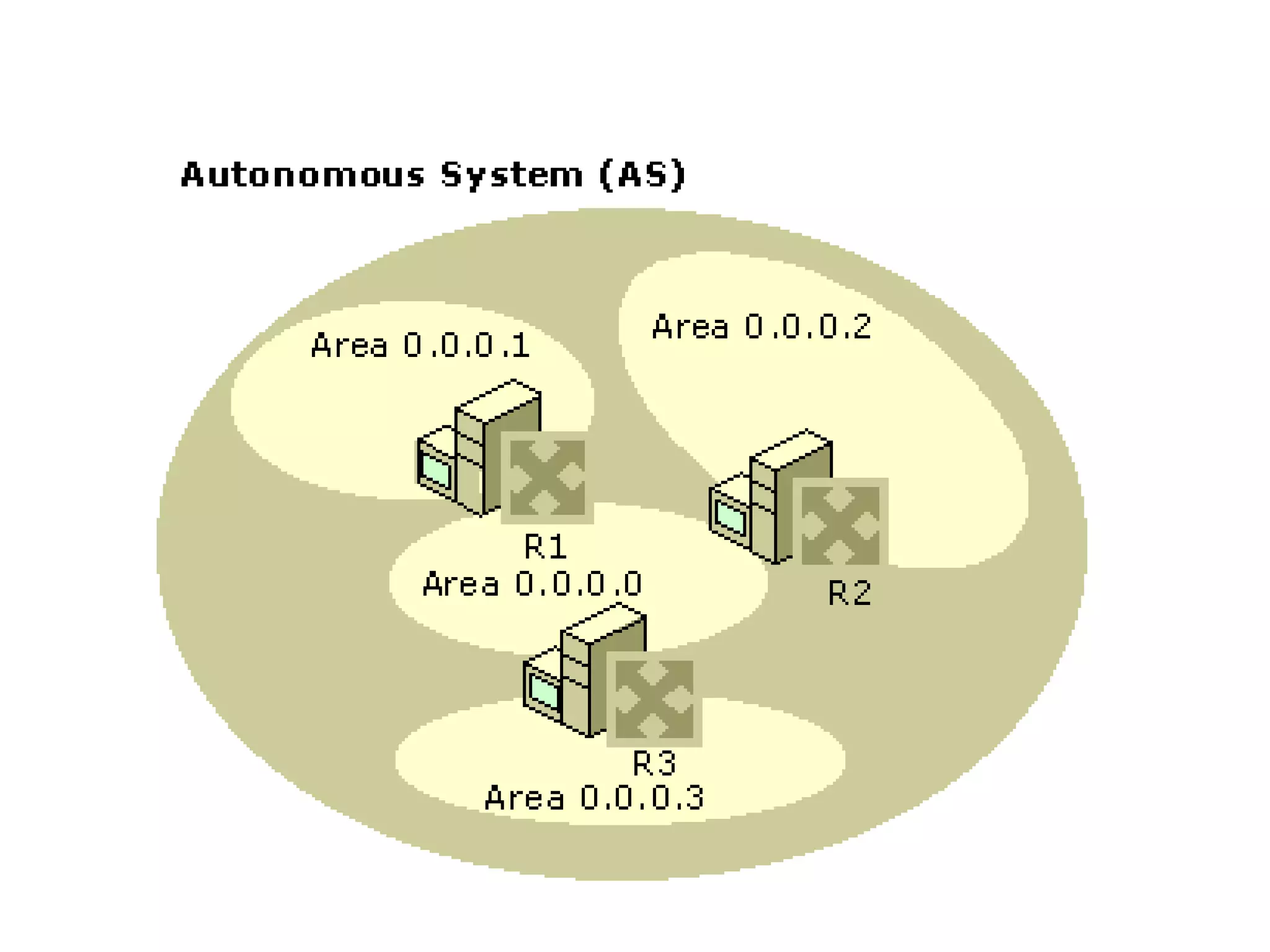
An OSPF network can be divided into sub-
domains called areas.
 An area is a logical collection of OSPF networks,
routers, and links that have the same area
identification.
Areas limit the scope of route information
distribution.
 Benefit of creating areas is to reduce the number
of routes to propagate—by the filtering and the
summarization of routes.
 Areas are identified by an area ID.
 All network inside an area must be
connected.
 At the border of an area, special router called
area border routers.
 It summarize the information and send to
other areas
BACKBONE AREA
 A backbone area—which combines a set of independent
areas into a single domain.
 The backbone has the reserved area ID of 0.0.0.0. The OSPF
backbone area is also known as area 0.
 The backbone acts as a hub for inter-area transit traffic and
the distribution of routing information between areas
 Each non-backbone area must be directly connected to the
backbone area.
 The backbone area must not be partitioned—divided into
smaller pieces—under any failure conditions
 The backbone serves as primary area and the other areas as
secondary areas.
 The router inside backbone area is known as backbone
routers.
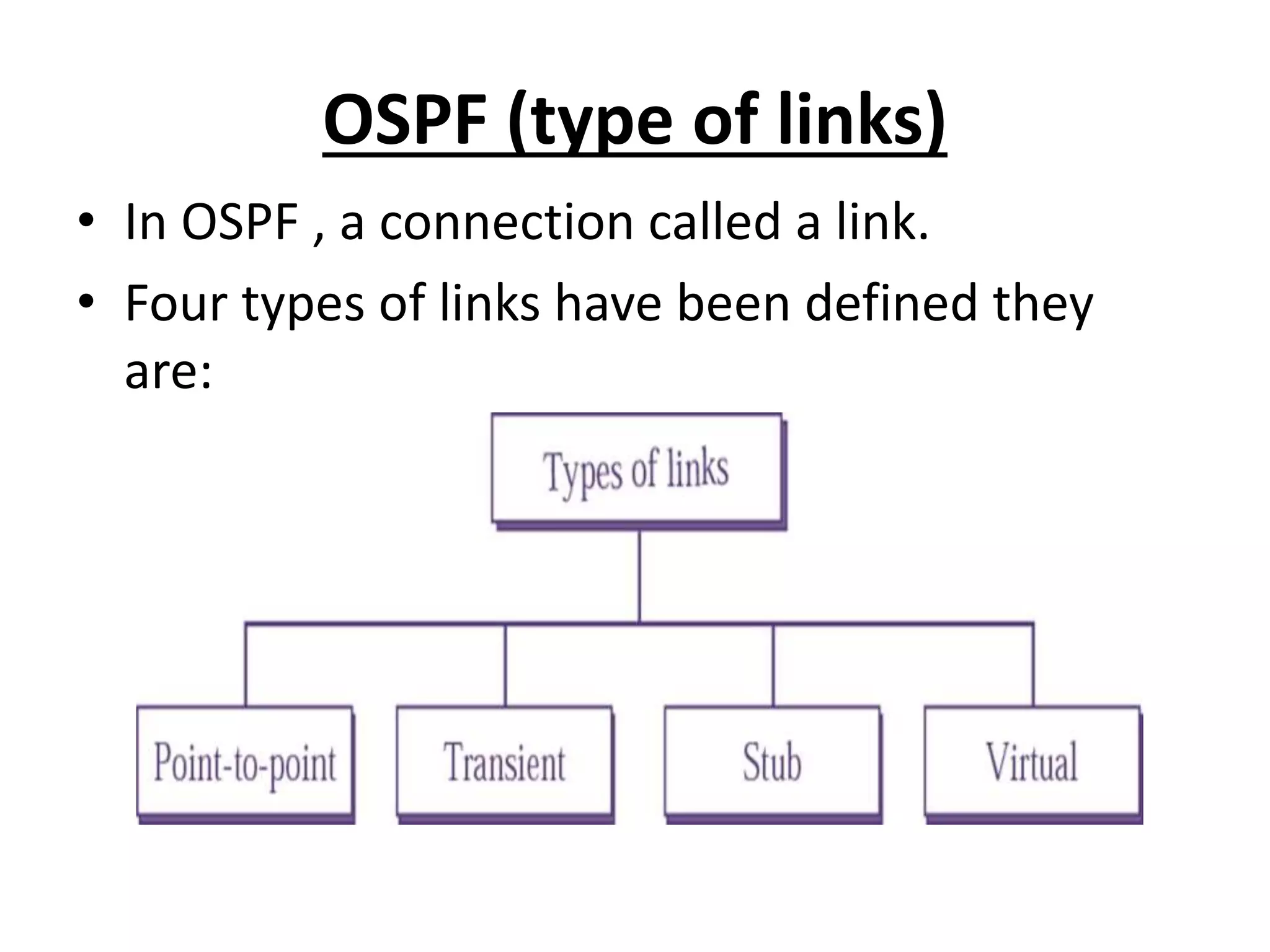
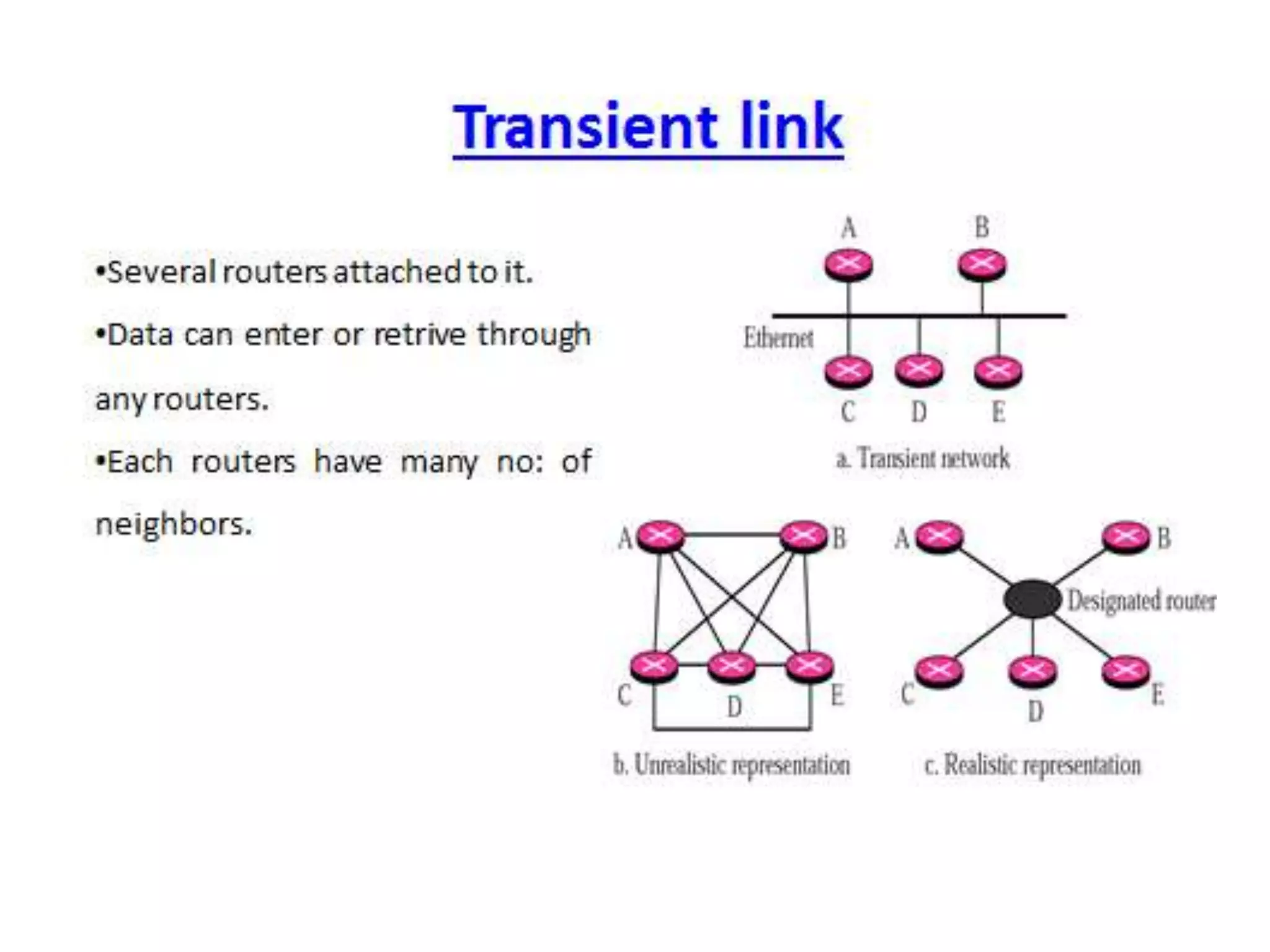
OSPF (type of links)
• In OSPF , a connection called a link.
• Four types of links have been defined they
are:
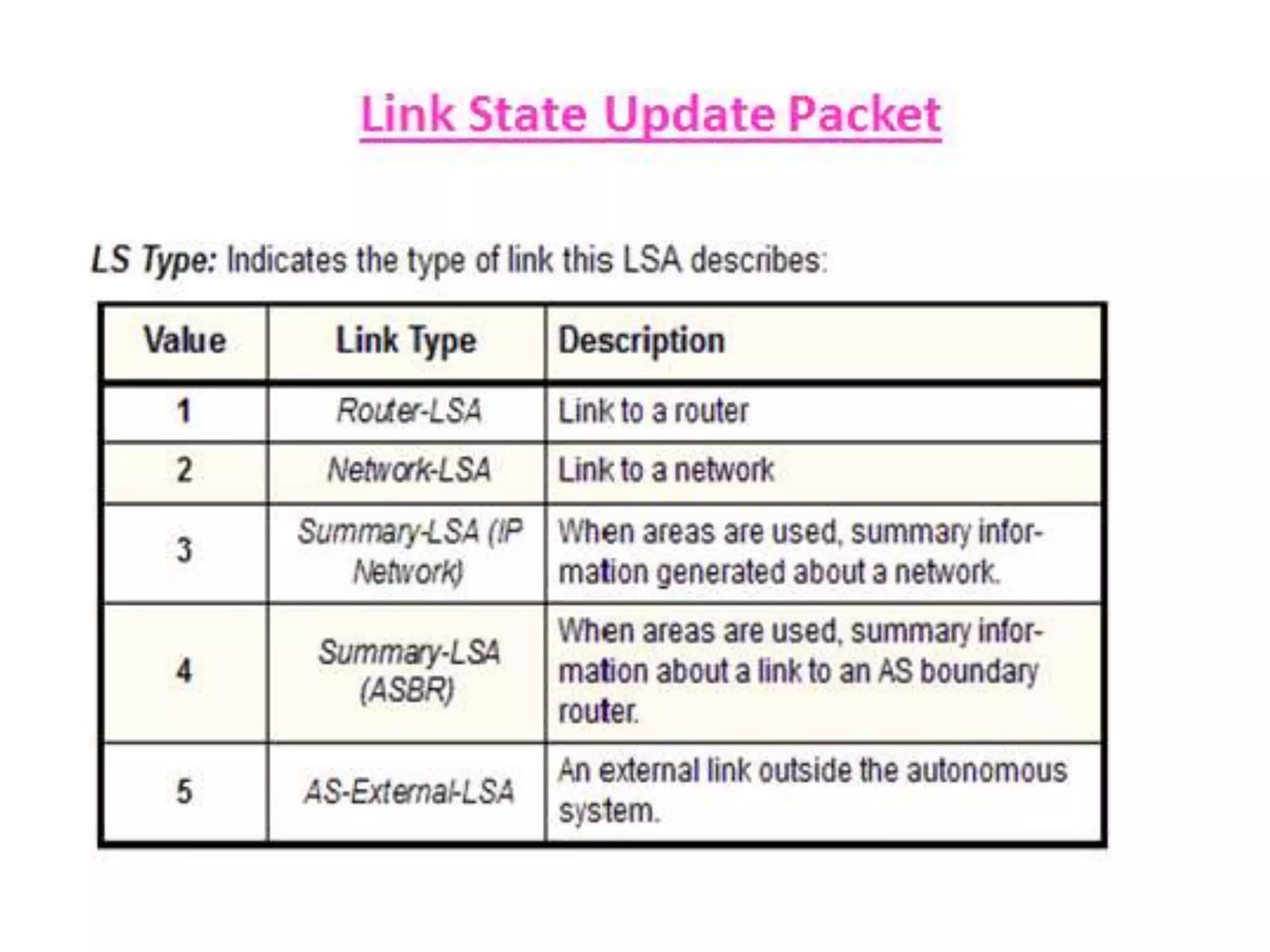
COMMON HEADER
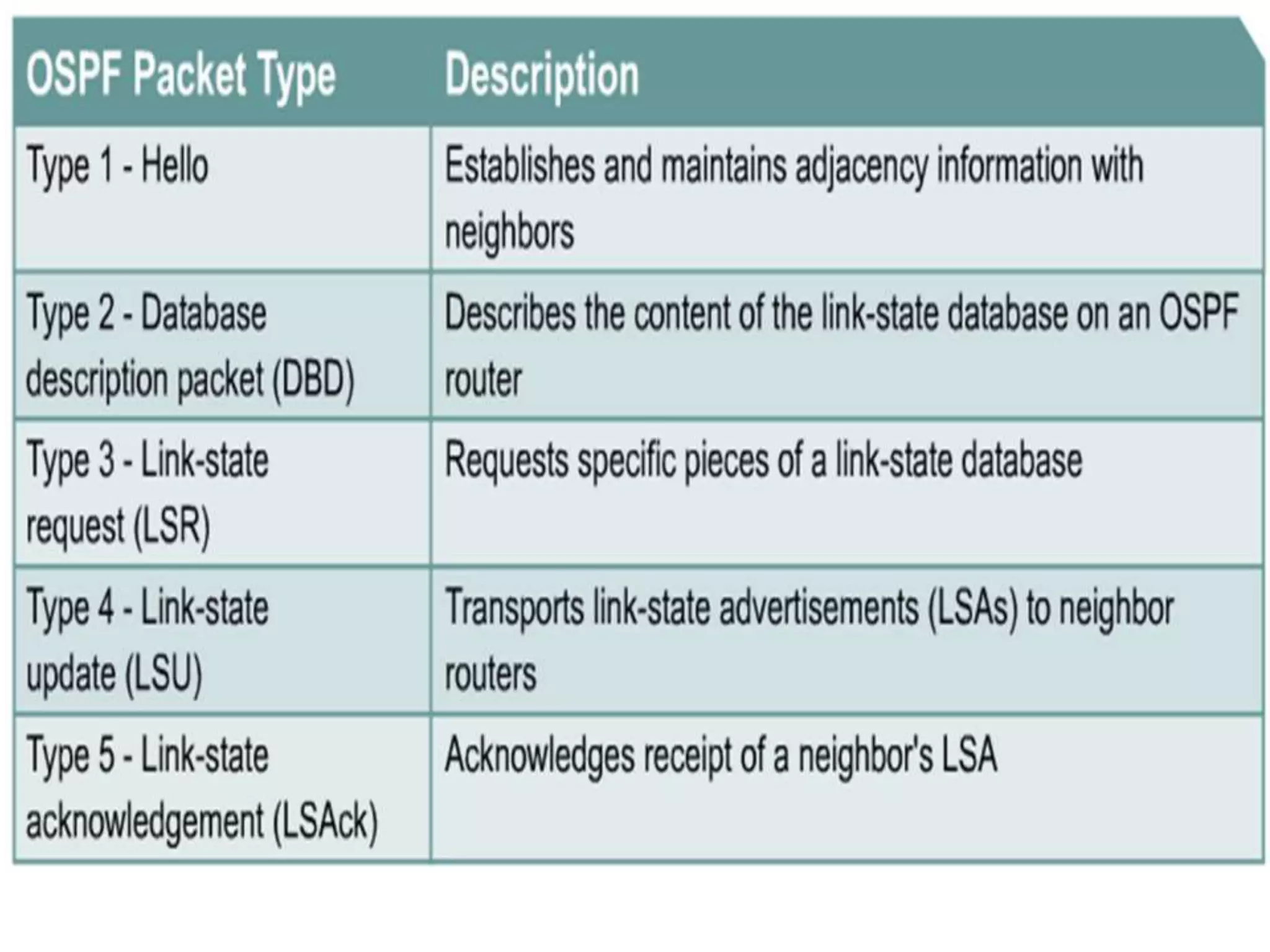
OSPF Packet Types
Hello subprotocol is intended to perform the following tasks
within OSPF:
Dynamic neighbor discovery
Detect unreachable neighbors
Ensure two-way communications between neighbors
Ensure correctness of basic interface parameters between
neighbors
Provide necessary information for the election of the Designated
and Backup Designated routers on a LAN segment (coming)
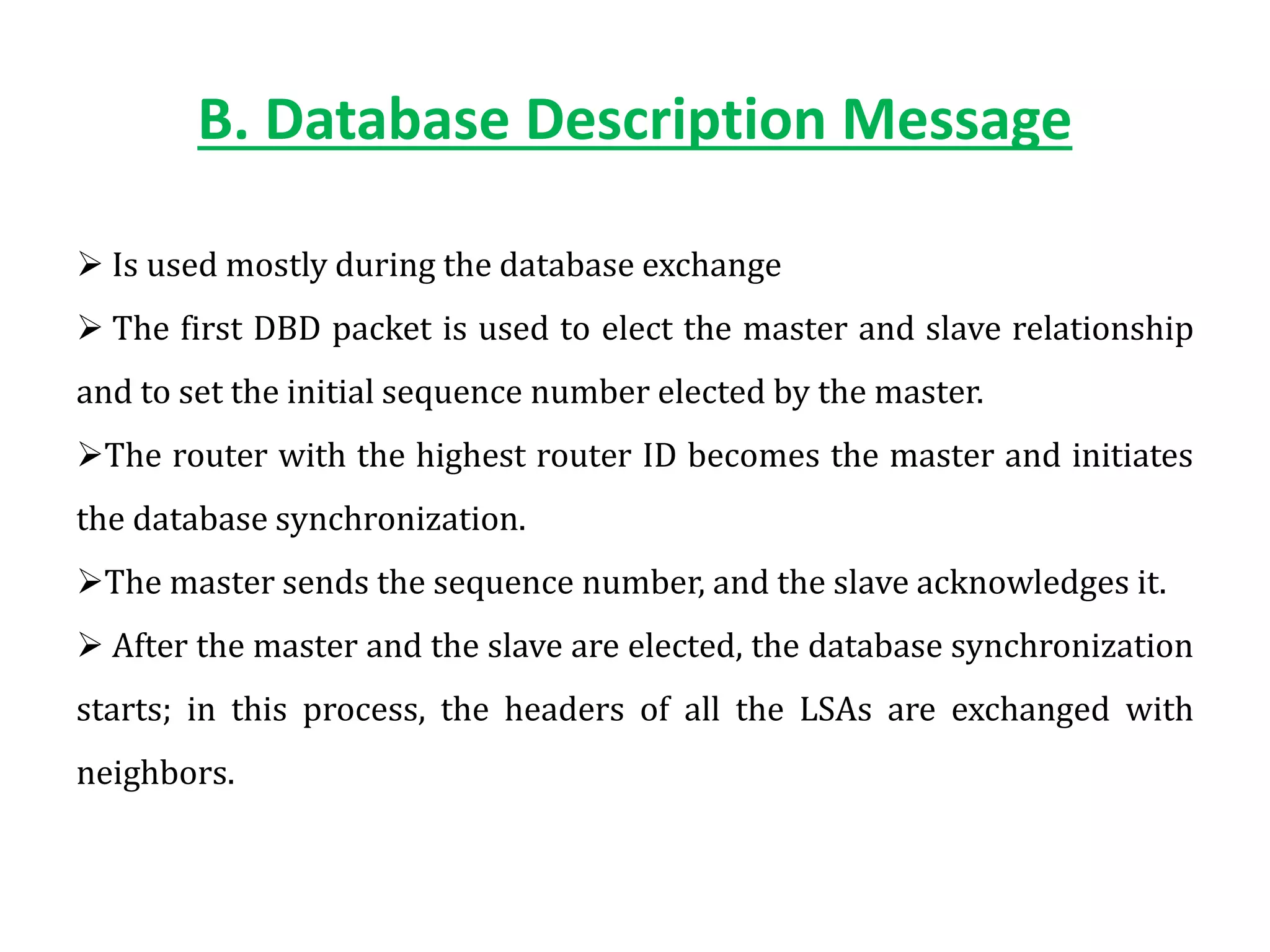
B. Database Description Message
 Is used mostly during the database exchange
 The first DBD packet is used to elect the master and slave relationship
and to set the initial sequence number elected by the master.
The router with the highest router ID becomes the master and initiates
the database synchronization.
The master sends the sequence number, and the slave acknowledges it.
 After the master and the slave are elected, the database synchronization
starts; in this process, the headers of all the LSAs are exchanged with
neighbors.
I Bit— When set to 1, this means that this is the first packet in DBD exchange.
M Bit— When set to 1, this means that more packets will follow.
MS Bit— Use this for master and slave. When this bit is set, it means that the
router is a master in the DBD exchange process. If this bit is set to 0, it means
that the router is the slave.
DBD Sequence Number— This field contains a unique value set by the
master. This sequence number is used during database exchange. Only a
master can increment the sequence number.
LSA Header— This field consists of a list of the link-state database headers.
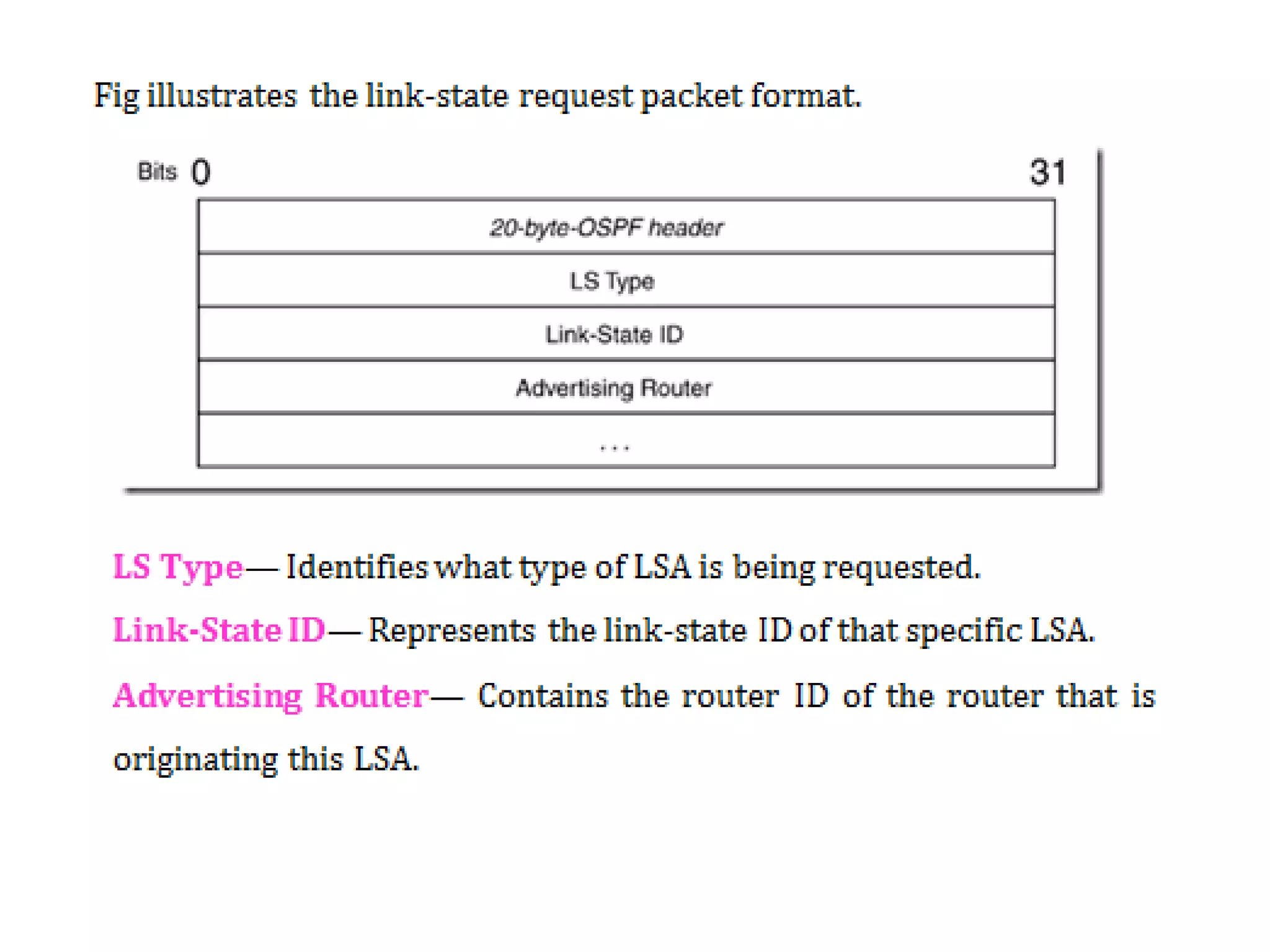
C. Link-State Request Packets
 A link-state request packet, is sent if part of the database is
missing or out-of-date.
 The link-state request packet is used to retrieve that precise
piece of database information that is missing.
 Link-state packets are also used after the DBD exchange is
finished to request the LSAs that have been seen during the DBD
exchange.
D. Link-State Acknowledgment Packet
The link-state acknowledgment packet, is used to acknowledge each
LSA.
This packet is sent in response to link-state update packets.
 Multiple LSAs can be acknowledged in a single link-state
acknowledgment packet.
This packet is responsible for the reliable delivery of link-state update
packets.
Figure illustrates the link-state acknowledgment packet format.
ADVANTAGES OF OSPF
• Unlimited hop count
• Open standard
• Loop free
• Fast convergence
DISADVANTAGES OF OSPF
• Complex design
• Supports only equal cost balancing
• Consumes a lot of CPU resources
OPEN SHORTEST PATH FIRST (OSPF)

OPEN SHORTEST PATH FIRST (OSPF)

  • 1.
  • 2.
    ROUTING PROTOCOL A routingprotocol specifies how routers communicate with each other.  Routing algorithms determine the specific choice of route.
  • 3.
    Suffered from problemsof Distance Vector Protocol • Count to Infinity Problem • Slow Convergence • Large update packets • Slow response to topological changes Need for a Link State Protocol.
  • 4.
    OSPF • OSPF OpenShortest Path First (std protocol) • Intra domain routing protocol based on link-state routing protocol • It uses SPF or dijkistra algorithm • Unlimited hop count • It’s a classless routing protocol • Only equal cost load balancing • Provides authentication of routing messages
  • 5.
  • 6.
    AREAS An OSPF networkcan be divided into sub- domains called areas.  An area is a logical collection of OSPF networks, routers, and links that have the same area identification. Areas limit the scope of route information distribution.  Benefit of creating areas is to reduce the number of routes to propagate—by the filtering and the summarization of routes.
  • 7.
     Areas areidentified by an area ID.  All network inside an area must be connected.  At the border of an area, special router called area border routers.  It summarize the information and send to other areas
  • 8.
    BACKBONE AREA  Abackbone area—which combines a set of independent areas into a single domain.  The backbone has the reserved area ID of 0.0.0.0. The OSPF backbone area is also known as area 0.  The backbone acts as a hub for inter-area transit traffic and the distribution of routing information between areas  Each non-backbone area must be directly connected to the backbone area.
  • 9.
     The backbonearea must not be partitioned—divided into smaller pieces—under any failure conditions  The backbone serves as primary area and the other areas as secondary areas.  The router inside backbone area is known as backbone routers.
  • 11.
    OSPF (type oflinks) • In OSPF , a connection called a link. • Four types of links have been defined they are:
  • 17.
  • 19.
  • 25.
    Hello subprotocol isintended to perform the following tasks within OSPF: Dynamic neighbor discovery Detect unreachable neighbors Ensure two-way communications between neighbors Ensure correctness of basic interface parameters between neighbors Provide necessary information for the election of the Designated and Backup Designated routers on a LAN segment (coming)
  • 26.
    B. Database DescriptionMessage  Is used mostly during the database exchange  The first DBD packet is used to elect the master and slave relationship and to set the initial sequence number elected by the master. The router with the highest router ID becomes the master and initiates the database synchronization. The master sends the sequence number, and the slave acknowledges it.  After the master and the slave are elected, the database synchronization starts; in this process, the headers of all the LSAs are exchanged with neighbors.
  • 28.
    I Bit— Whenset to 1, this means that this is the first packet in DBD exchange. M Bit— When set to 1, this means that more packets will follow. MS Bit— Use this for master and slave. When this bit is set, it means that the router is a master in the DBD exchange process. If this bit is set to 0, it means that the router is the slave. DBD Sequence Number— This field contains a unique value set by the master. This sequence number is used during database exchange. Only a master can increment the sequence number. LSA Header— This field consists of a list of the link-state database headers.
  • 29.
    C. Link-State RequestPackets  A link-state request packet, is sent if part of the database is missing or out-of-date.  The link-state request packet is used to retrieve that precise piece of database information that is missing.  Link-state packets are also used after the DBD exchange is finished to request the LSAs that have been seen during the DBD exchange.
  • 31.
    D. Link-State AcknowledgmentPacket The link-state acknowledgment packet, is used to acknowledge each LSA. This packet is sent in response to link-state update packets.  Multiple LSAs can be acknowledged in a single link-state acknowledgment packet. This packet is responsible for the reliable delivery of link-state update packets. Figure illustrates the link-state acknowledgment packet format.
  • 33.
    ADVANTAGES OF OSPF •Unlimited hop count • Open standard • Loop free • Fast convergence DISADVANTAGES OF OSPF • Complex design • Supports only equal cost balancing • Consumes a lot of CPU resources