NASP Mentor Training Webinar
Celeste Malone, Co-Chair
Chase McCullum, Member
Leadership Development Committee
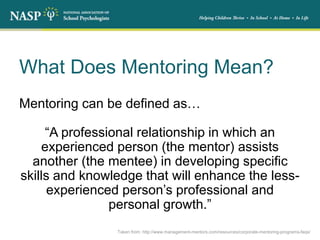
What Does Mentoring Mean?
Mentoring can be defined as…
“A professional relationship in which an
experienced person (the mentor) assists
another (the mentee) in developing specific
skills and knowledge that will enhance the less-
experienced person’s professional and
personal growth.”
Taken from: http://www.management-mentors.com/resources/corporate-mentoring-programs-faqs/
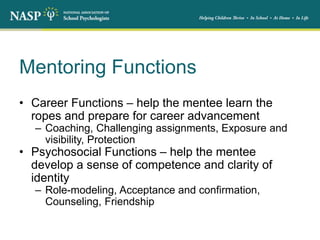
Mentoring Functions
• Career Functions – help the mentee learn the
ropes and prepare for career advancement
– Coaching, Challenging assignments, Exposure and
visibility, Protection
• Psychosocial Functions – help the mentee
develop a sense of competence and clarity of
identity
– Role-modeling, Acceptance and confirmation,
Counseling, Friendship
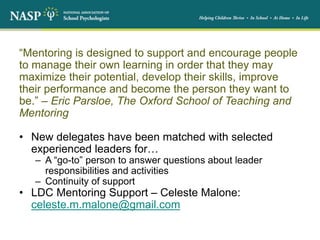
“Mentoring is designed to support and encourage people
to manage their own learning in order that they may
maximize their potential, develop their skills, improve
their performance and become the person they want to
be.” – Eric Parsloe, The Oxford School of Teaching and
Mentoring
• New delegates have been matched with selected
experienced leaders for…
– A “go-to” person to answer questions about leader
responsibilities and activities
– Continuity of support
• LDC Mentoring Support – Celeste Malone:
celeste.m.malone@gmail.com
Mentoring Expectations
• Minimum of quarterly check ups through phone,
email, or video chat (e.g., Skype, Zoom)
• Mentors will be available to respond to e-mails
from their mentees in a timely manner
• Mentees participate in mid-year and end-of-year
progress checks
• Leadership Development Co-Chair will provide
structured support and follow-up initially
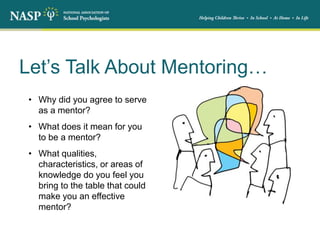
Let’s Talk About Mentoring…
• Why did you agree to serve
as a mentor?
• What does it mean for you
to be a mentor?
• What qualities,
characteristics, or areas of
knowledge do you feel you
bring to the table that could
make you an effective
mentor?
Stages of Mentoring
• Initiation Stage
• Cultivation Stage
– Primary stage of learning and development
– Emphasis on mentoring functions: career
development and psychosocial
• Separation Stage
• Redefinition Stage
Mentee Needs
• Guidance in a general or specific professional area
• Opportunity to dialogue about questions or issues that
arise
• Broad guidance for leadership development
• Ethical and professional conduct guidance
• Assistance in navigating professional settings,
institutions, structures, and politics
• Professional identity guidance development
Leadership Mentoring
• Helps mentees become more comfortable in their
roles as leaders
• Fosters teamwork and motivation and helps to
increase the competence levels of the mentee
• Benefits to mentors
– Extrinsic  networking, enhanced professional
recognition when their mentees perform well
– Intrinsic  career satisfaction, rejuvenation of
creativity from collaboration with mentees
Roles and Characteristics of
Mentors
• Acts as an experienced role model
• Provides acceptance, encouragement, and moral
support
• Provides wisdom, advice, counsel, and coaching
• Acts as a sponsor in professional organization and
supports networking efforts
• Assists with the navigation of professional
settings, institutions, structures, and politics
Roles and Characteristics of
Mentors
• Facilitates professional development
• Challenges and encourages appropriately to
facilitate growth
• Enjoys the opportunity to pass on wisdom
and knowledge and to collaborate with early
career professionals
• Assists in connecting mentees to association
resources
Clarifying Mentor/Mentee
Expectations
• What do you both hope to gain from this
relationship?
• Communication norms and styles
– Use of multiple communication platforms
– Frequency of communication
• Setting mentoring goals
– SMART goals
Suggested Mentoring Activities
• No expectation of “formal” mentor
activities, but, instead, focus on
relationship building
– New leader mentor interview
– NASP leader self-check
– Regular, ongoing communication
Advice to Mentors
• Recognize that your mentee may not be
comfortable asking for help
– Break the ice by sharing some of your own
experiences and mis-steps
• Stay in your zone of expertise/experience
• Extend your mentee’s developmental network
by suggesting additional mentors to address
unique needs
Questions, Comments, Concerns?

NASP Mentor Training Webinar.pptx

  • 1.
    NASP Mentor TrainingWebinar Celeste Malone, Co-Chair Chase McCullum, Member Leadership Development Committee
  • 2.
    What Does MentoringMean? Mentoring can be defined as… “A professional relationship in which an experienced person (the mentor) assists another (the mentee) in developing specific skills and knowledge that will enhance the less- experienced person’s professional and personal growth.” Taken from: http://www.management-mentors.com/resources/corporate-mentoring-programs-faqs/
  • 3.
    Mentoring Functions • CareerFunctions – help the mentee learn the ropes and prepare for career advancement – Coaching, Challenging assignments, Exposure and visibility, Protection • Psychosocial Functions – help the mentee develop a sense of competence and clarity of identity – Role-modeling, Acceptance and confirmation, Counseling, Friendship
  • 4.
    “Mentoring is designedto support and encourage people to manage their own learning in order that they may maximize their potential, develop their skills, improve their performance and become the person they want to be.” – Eric Parsloe, The Oxford School of Teaching and Mentoring • New delegates have been matched with selected experienced leaders for… – A “go-to” person to answer questions about leader responsibilities and activities – Continuity of support • LDC Mentoring Support – Celeste Malone: celeste.m.malone@gmail.com
  • 5.
    Mentoring Expectations • Minimumof quarterly check ups through phone, email, or video chat (e.g., Skype, Zoom) • Mentors will be available to respond to e-mails from their mentees in a timely manner • Mentees participate in mid-year and end-of-year progress checks • Leadership Development Co-Chair will provide structured support and follow-up initially
  • 6.
    Let’s Talk AboutMentoring… • Why did you agree to serve as a mentor? • What does it mean for you to be a mentor? • What qualities, characteristics, or areas of knowledge do you feel you bring to the table that could make you an effective mentor?
  • 7.
    Stages of Mentoring •Initiation Stage • Cultivation Stage – Primary stage of learning and development – Emphasis on mentoring functions: career development and psychosocial • Separation Stage • Redefinition Stage
  • 8.
    Mentee Needs • Guidancein a general or specific professional area • Opportunity to dialogue about questions or issues that arise • Broad guidance for leadership development • Ethical and professional conduct guidance • Assistance in navigating professional settings, institutions, structures, and politics • Professional identity guidance development
  • 9.
    Leadership Mentoring • Helpsmentees become more comfortable in their roles as leaders • Fosters teamwork and motivation and helps to increase the competence levels of the mentee • Benefits to mentors – Extrinsic  networking, enhanced professional recognition when their mentees perform well – Intrinsic  career satisfaction, rejuvenation of creativity from collaboration with mentees
  • 10.
    Roles and Characteristicsof Mentors • Acts as an experienced role model • Provides acceptance, encouragement, and moral support • Provides wisdom, advice, counsel, and coaching • Acts as a sponsor in professional organization and supports networking efforts • Assists with the navigation of professional settings, institutions, structures, and politics
  • 11.
    Roles and Characteristicsof Mentors • Facilitates professional development • Challenges and encourages appropriately to facilitate growth • Enjoys the opportunity to pass on wisdom and knowledge and to collaborate with early career professionals • Assists in connecting mentees to association resources
  • 12.
    Clarifying Mentor/Mentee Expectations • Whatdo you both hope to gain from this relationship? • Communication norms and styles – Use of multiple communication platforms – Frequency of communication • Setting mentoring goals – SMART goals
  • 13.
    Suggested Mentoring Activities •No expectation of “formal” mentor activities, but, instead, focus on relationship building – New leader mentor interview – NASP leader self-check – Regular, ongoing communication
  • 14.
    Advice to Mentors •Recognize that your mentee may not be comfortable asking for help – Break the ice by sharing some of your own experiences and mis-steps • Stay in your zone of expertise/experience • Extend your mentee’s developmental network by suggesting additional mentors to address unique needs
  • 15.