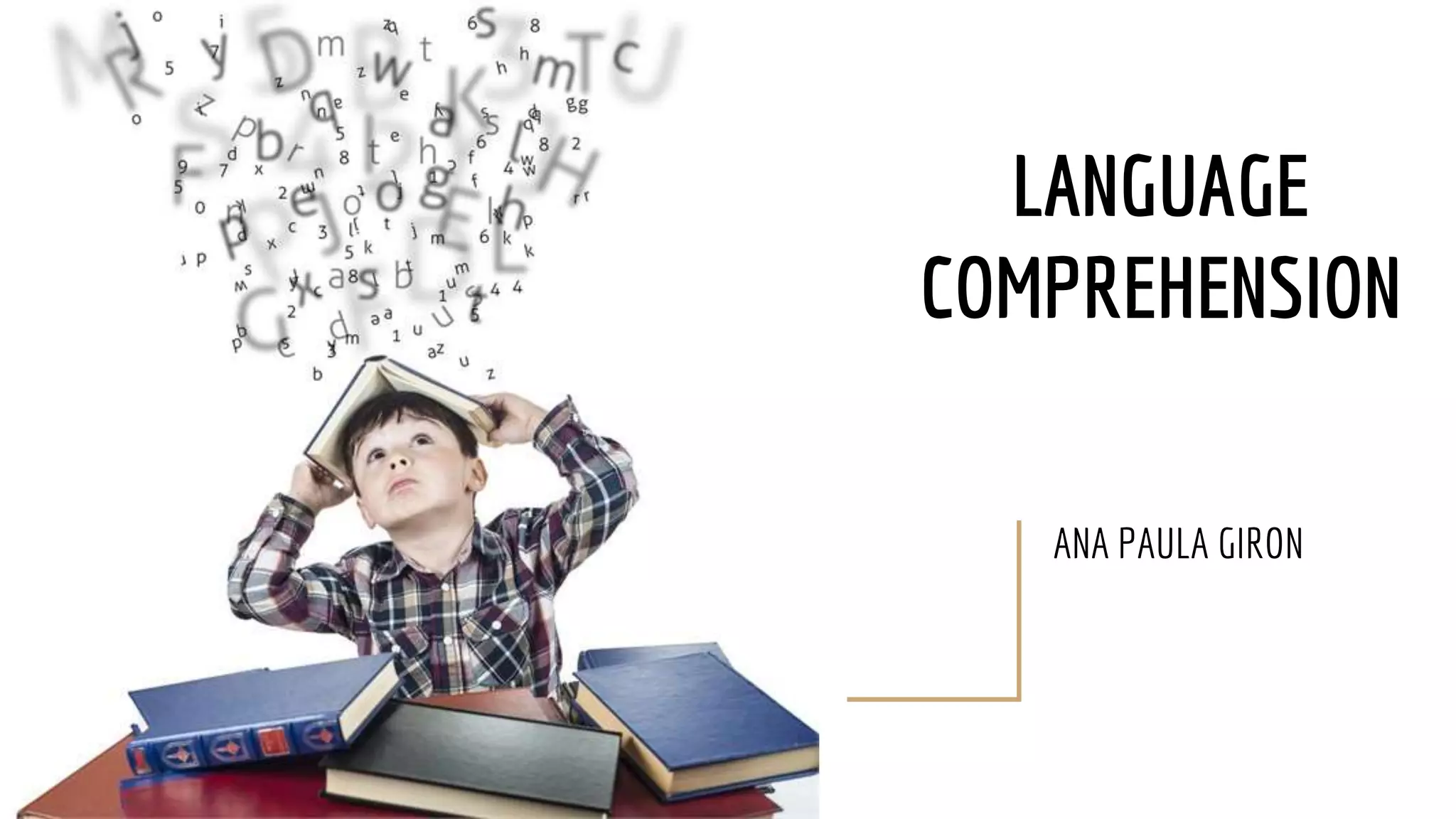
LANGUAGE
COMPREHENSION
ANA PAULA GIRON
Understanding what other people
say and write is more complicated
than it might at first appear.
Comprehending language
involves a variety of capacities,
skills, processes, knowledge and
dispositions that are used to derive
meanings from spoken, written and
signed languages.
Language comprehension
is a complex process that
occurs easily and
effortlessly by humans.
It develops along with the
“brain” and is able to be
enhanced with the use of
gestures.
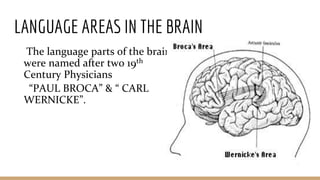
LANGUAGE AREAS IN THE BRAIN
The language parts of the brain
were named after two 19th
Century Physicians
“PAUL BROCA” & “ CARL
WERNICKE”.
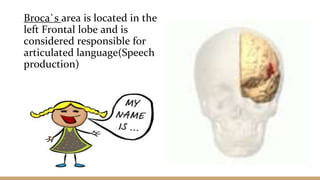
Broca`s area is located in the
left Frontal lobe and is
considered responsible for
articulated language(Speech
production)
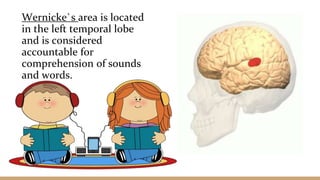
Wernicke`s area is located
in the left temporal lobe
and is considered
accountable for
comprehension of sounds
and words.
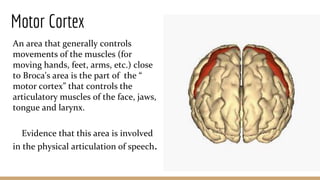
Motor Cortex
An area that generally controls
movements of the muscles (for
moving hands, feet, arms, etc.) close
to Broca's area is the part of the “
motor cortex” that controls the
articulatory muscles of the face, jaws,
tongue and larynx.
Evidence that this area is involved
in the physical articulation of speech.
Gunning(1996) identifies three main theories:
●SCHEMA THEORY
●MENTAL MODEL THEORY
●PROPOSITION THEORY
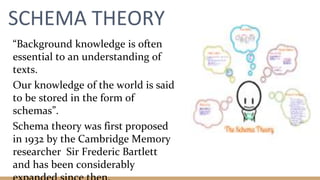
SCHEMA THEORY
“Background knowledge is often
essential to an understanding of
texts.
Our knowledge of the world is said
to be stored in the form of
schemas”.
Schema theory was first proposed
in 1932 by the Cambridge Memory
researcher Sir Frederic Bartlett
and has been considerably
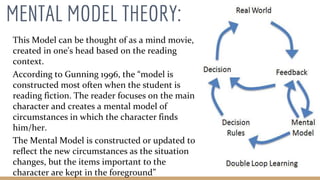
MENTAL MODEL THEORY:
This Model can be thought of as a mind movie,
created in one's head based on the reading
context.
According to Gunning 1996, the “model is
constructed most often when the student is
reading fiction. The reader focuses on the main
character and creates a mental model of
circumstances in which the character finds
him/her.
The Mental Model is constructed or updated to
reflect the new circumstances as the situation
changes, but the items important to the
character are kept in the foreground”
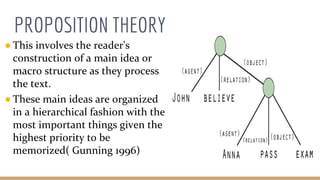
PROPOSITION THEORY
● This involves the reader's
construction of a main idea or
macro structure as they process
the text.
● These main ideas are organized
in a hierarchical fashion with the
most important things given the
highest priority to be
memorized( Gunning 1996)
Language comprehension

Language comprehension

  • 1.
  • 2.
    Understanding what otherpeople say and write is more complicated than it might at first appear. Comprehending language involves a variety of capacities, skills, processes, knowledge and dispositions that are used to derive meanings from spoken, written and signed languages.
  • 3.
    Language comprehension is acomplex process that occurs easily and effortlessly by humans. It develops along with the “brain” and is able to be enhanced with the use of gestures.
  • 4.
    LANGUAGE AREAS INTHE BRAIN The language parts of the brain were named after two 19th Century Physicians “PAUL BROCA” & “ CARL WERNICKE”.
  • 5.
    Broca`s area islocated in the left Frontal lobe and is considered responsible for articulated language(Speech production)
  • 6.
    Wernicke`s area islocated in the left temporal lobe and is considered accountable for comprehension of sounds and words.
  • 7.
    Motor Cortex An areathat generally controls movements of the muscles (for moving hands, feet, arms, etc.) close to Broca's area is the part of the “ motor cortex” that controls the articulatory muscles of the face, jaws, tongue and larynx. Evidence that this area is involved in the physical articulation of speech.
  • 8.
    Gunning(1996) identifies threemain theories: ●SCHEMA THEORY ●MENTAL MODEL THEORY ●PROPOSITION THEORY
  • 9.
    SCHEMA THEORY “Background knowledgeis often essential to an understanding of texts. Our knowledge of the world is said to be stored in the form of schemas”. Schema theory was first proposed in 1932 by the Cambridge Memory researcher Sir Frederic Bartlett and has been considerably
  • 10.
    MENTAL MODEL THEORY: ThisModel can be thought of as a mind movie, created in one's head based on the reading context. According to Gunning 1996, the “model is constructed most often when the student is reading fiction. The reader focuses on the main character and creates a mental model of circumstances in which the character finds him/her. The Mental Model is constructed or updated to reflect the new circumstances as the situation changes, but the items important to the character are kept in the foreground”
  • 11.
    PROPOSITION THEORY ● Thisinvolves the reader's construction of a main idea or macro structure as they process the text. ● These main ideas are organized in a hierarchical fashion with the most important things given the highest priority to be memorized( Gunning 1996)