
Visual Methodologies
By : Maria Aleem
Visual research is a qualitative research
methodology that relies on the use of artistic
mediums to "produce and represent knowledge."
These artistic mediums include, but are not limited
to : film, photography, drawings, paintings,
and sculptures. The artistic mediums provide a rich
source of information that has the ability of
capturing reality. They also reveal information
about what the medium captures, but the artist or
the creator behind the medium. Using photography
as an example, the photographs taken illustrate
reality and give information about the
photographer through the angle, focus of the
image, and the moment in which the photograph
was taken.
These images are never transparent windows on to the world.
They interpret the world; they display it in very particular
ways. Thus a distinction is sometimes made between vision
and visuality. Vision is what the human eye is physiologically
capable of seeing. Visuality, on the other hand, refers to way
in which vision is constructed in various ways: `how we see,
how we are able, allowed, or made to see, and how we see
this seeing and the unseeing therein' For some writers, the
visual is the most fundamental of all senses. According to
researchers `depiction, picturing and seeing are ubiquitous
features of the process by which most human beings come to
know the world as it really is for them', and John Berger
(1972: 7) suggests that this is because `seeing comes before
words. The child looks and recognizes before it can speak'
it is important not to forget that knowledge is conveyed through all
sorts of different media, including senses other than the visual, and
that visual images very often work in conjunction with other kinds of
representations. It is very unusual, for example, to encounter a visual
image unaccompanied by any text at all, whether spoken or written.
Even the most abstract painting in a gallery will have a written label on
the wall giving certain information about its making, and in certain
sorts of galleries there'll be a sheet of paper giving a price too, and
these make a difference to how spectators will see that painting. So
it’s certainly correct that visual modes of conveying meanings are not
the same as written modes. However, visual images are always
embedded into a range of other texts, some of which will be visual and
some of which will be written and all of which intersect with each
other. But visual images can be powerful and seductive in their own
right.
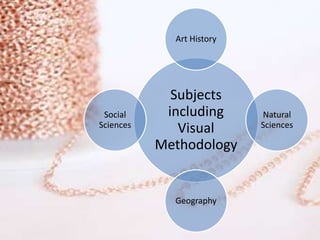
Subjects
including
Visual
Methodology
Art History
Natural
Sciences
Geography
Social
Sciences
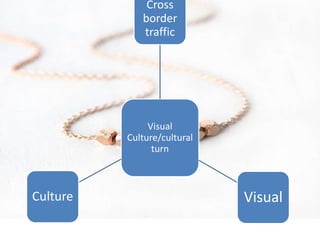
Visual
Culture/cultural
turn
Cross
border
traffic
VisualCulture
Culture is a complex concept, culture
but, in very broad terms, the result of
its deployment has been that social
scientists are now very often interested
in the ways in which social life is
constructed through the ideas that
people have about it, and the practices
that flow from those ideas.
Butmorerecently,manywritersaddressingtheseissuesarguedthatthevisualiscentraltothecultural
constructionofsociallifeincontemporaryWesternsocieties.Weare,ofcourse,surroundedbydifferent
sortsofvisualtechnologies-photography,film,video,digitalgraphics,television,acrylics,forexample-
andtheimagestheyshowus-TVprogrammes,advertisements,snapshots,publicsculpture,movies,
surveillancevideofootage,newspaperpictures,paintings.Allthesedifferentsortsoftechnologiesand
imagesofferviewsoftheworld;theyrendertheworldinvisualterms.
`visual culture' is its concern for the way in which
images visualize (or render invisible) social difference.
As Fyfe and Law (1988: 1) say, `a depiction is never
just an illustration . . . it is the site for the construction
and depiction of social difference'. One of the central
aims of `the cultural turn' in the social sciences is to
argue that social categories are not natural but
instead are constructed. These constructions can take
visual form. This point has been made most forcefully
by feminist and postcolonial writers who have studied
the ways femininity and blackness have been
visualized.
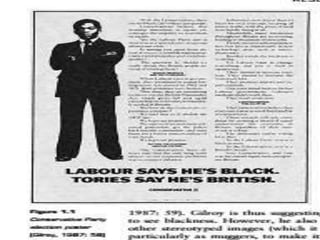
The poster shows a young black man in a suit, with `LABOUR SAYS HE'S
BLACK. TORIES SAY HE'S BRITISH' as its headline text. Gilroy's discussion
is detailed but his main point is that the poster offers a choice between
being black and being. British, not only in its text but also in its image.
The fact that the black man is pictured wearing a suit suggests to Gilroy
that `blacks are being invited to forsake all that marks them out as
culturally distinct before real Britishness can be guaranteed' (Gilroy,
1987: 59). Gilroy is thus suggesting that this poster asks its viewers not
to see blackness. However, he also points out that the poster depends
on other stereotyped images (which it does not show) of young black
men, particularly as muggers, to make its point about the acceptability
of this be suited man. This poster thus plays in complex ways with both
visible and invisible signs of racial difference. Hence Fyfe and Law's
general prescription for a critical approach to the ways images can
picture social power relations.
`we never look just at one thing; we are
always looking at the relation between
things and ourselves' (Berger, 1972: 9). His
best known example is that of the genre
of female nude painting in Western art.
He reproduces many examples of that
genre (see Figure 1.2), pointing out as he
does so the particular ways they represent
women: as unclothed, as vain, as passive,
as sexually alluring, as a spectacle to be
assessed.
In the average European oil painting of
the nude, the principal protagonist is
never painted. He is the spectator in
front of the painting and he is presumed
to be a man. Everything is addressed to
him. Everything must appear to be the
result of his being there. Thus for Berger,
understanding this particular genre of
painting means understanding not only
its representation of femininity, but its
construction of masculinity too. And
these representations are in their turn
understood as part of a wider cultural
construction of gendered difference.
To quote Berger again:
One might simplify this by saying:men act and
women appear. Men look
at women. Women watch themselves being
looked at. This determines
not only most relations between women and
men but also the relation of
women to themselves. The surveyor of
woman in herself is male: the
surveyed female. Thus she turns herself into
an object ± and most
particularly an object of vision: a sight.
(Berger, 1972: 47)
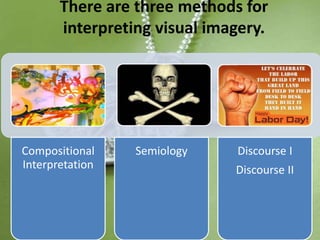
Compositional
Interpretation
Semiology Discourse I
Discourse II
There are three methods for
interpreting visual imagery.
Compositional interpretation is
a method that offers a way of
looking very carefully at the
content and form of images.
Composition refers to the
structure of an image: how all
its elements combine together
(which might or might not make
a whole)
Procedure
Thereisthecontent of an image. Whatexactlyisit showing?
Thentherearethecoloursofanimage. The colourscanbedescribed intermsoftheirhue,
saturationand value.Howthesecoloursworktogether? Aretheyharmoniousornot? Whatis
highlighted bytheuseofwhat colours? Are connectionsmadebetweencertainpartsofan
imagebytherepeateduseofonecolour? Do certain coloursmean something? And so on…
Internal organization
Above mewntioned qsmergeintoanotherset ofquestions
Doesithavebackground? Whatmovementorrhythmisthereintheimagebetween its
volumes? Isthereadepth indicatedbysomekindofperspectiveorflatness?
Thisinternalorganization offersaparticularviewingpositionto itsspectater.
Limitations
Thisisveryusefulasafirst stageof gettingto gripswith an imagebutithasvarious
shortcomings. Itsgreatest limitation isitresolutedescriptiveness. Itfocuses almostentirelyon
Semiology
Semiologymeansthestudyofsigns.Semiologyhasanelaborateanalytical
vocabularyfordescribinghowsignsmakesense.Signisthebasicunitoflanguage.
Itconsistsoftwoparts.
Signified:Anideaorobject
Signifier:theword,thesoundimage
Averyyounghumanunabletowalkortalk.(signified)
Baby.(signifier)
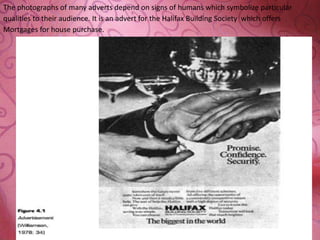
The photographs of many adverts depend on signs of humans which symbolize particular
qualities to their audience. It is an advert for the Halifax Building Society which offers
Mortgages for house purchase.
The ring . . . stand[s] for marriage, and in [the] picture the
strong male hand stands for `Promise, Confidence, and
Security'. The pictures are cliché Âd illustrations of three
words. But the point of the ad is to undermine the
`Confidence and Security' offered by the man...The cliché Â of
masculine security and promise is exposed, to show the need
for the Halifax. Yet simultaneously, the image of the ad, the
hand and the ring, etc., undermined in its literal sense of
marriage-as-security, is used in all its cliche Âdness to
represent the promise, security and confidence offered in
reparation by the Halifax ...Ino ther words, Security,signified
by the hand, becomes a signifier, in its possible absence, of
the need for Halifax; it is then returned to its original status of
signified through the conduit of the product.
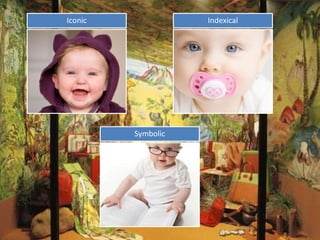
Iconic: in iconic signs the signifier
represents the signified by apparently
having a likeness to it. Thus a
photograph of a baby is an iconic sign
of that baby.
Indexical: They have an inherent
relationship between the signified and
signifier. It is often culturally specific e.g
a baby soother is often used to denote
a room in public places where there are
baby changing facilities.
Symbolic: they have a conventialised
but clearly arbitrary relation between
signifier and signified. Thus pictures of
babies are often used to represent
notions of ‘the future’
Iconic Indexical
Symbolic
Discourse
Discourse has a quite specific meaning. It refers to
groups of statements which structure the way a thing
is thought, and the way we act on the basis of that
thinking. In other words, discourse is a particular
knowledge about the world which shapes how the
world is understood and how things are done in it. It
is “A particular form of language with its own rules
and conventions and the institutions within which the
discourse is produced and circulated” as medical
discourse which refers to the specific vocabulary of
medicine. Same as Art that can also be understood as
a discourse as a specialized form of knowledge.
Discourse Analysis I
The first type of discourse analysis is centrally concerned with language.
It can also be used to explore how images construct specific views of the
social world. This type of discourse analysis therefore pays special
attention to images themselves. Since discourse s are seen as socially
produced rather than created by individuals, this type of discourse
analysis is specially concerned with how specific views or accounts are
constructed as real or truthful.
Intertextuality: to collect a wide range of texts that are relevant in some
way to the research question in hand. Theses texts are then read
carefully, repeatedly to find out the truth.
A statement coming from a source endowed with an authority is likely to
be more productive than one coming from a marginalized social position.
Discourse Analysis II
Thisformofdiscourseanalysistendstopaymoreattentiontothepracticesofinstitutionsthanitdoestothevisual
imagesandverbaltexts.Itsmethodologyisusuallyleftimplicit.Ittendstobemoreexplicitlyconcernedwithissuesof
power,regimesoftruth,institutionsandtechnologies.
Thank You

Visual Methodology

  • 1.
  • 2.
    Visual research isa qualitative research methodology that relies on the use of artistic mediums to "produce and represent knowledge." These artistic mediums include, but are not limited to : film, photography, drawings, paintings, and sculptures. The artistic mediums provide a rich source of information that has the ability of capturing reality. They also reveal information about what the medium captures, but the artist or the creator behind the medium. Using photography as an example, the photographs taken illustrate reality and give information about the photographer through the angle, focus of the image, and the moment in which the photograph was taken.
  • 3.
    These images arenever transparent windows on to the world. They interpret the world; they display it in very particular ways. Thus a distinction is sometimes made between vision and visuality. Vision is what the human eye is physiologically capable of seeing. Visuality, on the other hand, refers to way in which vision is constructed in various ways: `how we see, how we are able, allowed, or made to see, and how we see this seeing and the unseeing therein' For some writers, the visual is the most fundamental of all senses. According to researchers `depiction, picturing and seeing are ubiquitous features of the process by which most human beings come to know the world as it really is for them', and John Berger (1972: 7) suggests that this is because `seeing comes before words. The child looks and recognizes before it can speak'
  • 4.
    it is importantnot to forget that knowledge is conveyed through all sorts of different media, including senses other than the visual, and that visual images very often work in conjunction with other kinds of representations. It is very unusual, for example, to encounter a visual image unaccompanied by any text at all, whether spoken or written. Even the most abstract painting in a gallery will have a written label on the wall giving certain information about its making, and in certain sorts of galleries there'll be a sheet of paper giving a price too, and these make a difference to how spectators will see that painting. So it’s certainly correct that visual modes of conveying meanings are not the same as written modes. However, visual images are always embedded into a range of other texts, some of which will be visual and some of which will be written and all of which intersect with each other. But visual images can be powerful and seductive in their own right.
  • 5.
  • 6.
  • 7.
    Culture is acomplex concept, culture but, in very broad terms, the result of its deployment has been that social scientists are now very often interested in the ways in which social life is constructed through the ideas that people have about it, and the practices that flow from those ideas.
  • 8.
  • 9.
    `visual culture' isits concern for the way in which images visualize (or render invisible) social difference. As Fyfe and Law (1988: 1) say, `a depiction is never just an illustration . . . it is the site for the construction and depiction of social difference'. One of the central aims of `the cultural turn' in the social sciences is to argue that social categories are not natural but instead are constructed. These constructions can take visual form. This point has been made most forcefully by feminist and postcolonial writers who have studied the ways femininity and blackness have been visualized.
  • 11.
    The poster showsa young black man in a suit, with `LABOUR SAYS HE'S BLACK. TORIES SAY HE'S BRITISH' as its headline text. Gilroy's discussion is detailed but his main point is that the poster offers a choice between being black and being. British, not only in its text but also in its image. The fact that the black man is pictured wearing a suit suggests to Gilroy that `blacks are being invited to forsake all that marks them out as culturally distinct before real Britishness can be guaranteed' (Gilroy, 1987: 59). Gilroy is thus suggesting that this poster asks its viewers not to see blackness. However, he also points out that the poster depends on other stereotyped images (which it does not show) of young black men, particularly as muggers, to make its point about the acceptability of this be suited man. This poster thus plays in complex ways with both visible and invisible signs of racial difference. Hence Fyfe and Law's general prescription for a critical approach to the ways images can picture social power relations.
  • 12.
    `we never lookjust at one thing; we are always looking at the relation between things and ourselves' (Berger, 1972: 9). His best known example is that of the genre of female nude painting in Western art. He reproduces many examples of that genre (see Figure 1.2), pointing out as he does so the particular ways they represent women: as unclothed, as vain, as passive, as sexually alluring, as a spectacle to be assessed.
  • 13.
    In the averageEuropean oil painting of the nude, the principal protagonist is never painted. He is the spectator in front of the painting and he is presumed to be a man. Everything is addressed to him. Everything must appear to be the result of his being there. Thus for Berger, understanding this particular genre of painting means understanding not only its representation of femininity, but its construction of masculinity too. And these representations are in their turn understood as part of a wider cultural construction of gendered difference.
  • 14.
    To quote Bergeragain: One might simplify this by saying:men act and women appear. Men look at women. Women watch themselves being looked at. This determines not only most relations between women and men but also the relation of women to themselves. The surveyor of woman in herself is male: the surveyed female. Thus she turns herself into an object ± and most particularly an object of vision: a sight. (Berger, 1972: 47)
  • 15.
    Compositional Interpretation Semiology Discourse I DiscourseII There are three methods for interpreting visual imagery.
  • 16.
    Compositional interpretation is amethod that offers a way of looking very carefully at the content and form of images. Composition refers to the structure of an image: how all its elements combine together (which might or might not make a whole)
  • 17.
    Procedure Thereisthecontent of animage. Whatexactlyisit showing? Thentherearethecoloursofanimage. The colourscanbedescribed intermsoftheirhue, saturationand value.Howthesecoloursworktogether? Aretheyharmoniousornot? Whatis highlighted bytheuseofwhat colours? Are connectionsmadebetweencertainpartsofan imagebytherepeateduseofonecolour? Do certain coloursmean something? And so on… Internal organization Above mewntioned qsmergeintoanotherset ofquestions Doesithavebackground? Whatmovementorrhythmisthereintheimagebetween its volumes? Isthereadepth indicatedbysomekindofperspectiveorflatness? Thisinternalorganization offersaparticularviewingpositionto itsspectater. Limitations Thisisveryusefulasafirst stageof gettingto gripswith an imagebutithasvarious shortcomings. Itsgreatest limitation isitresolutedescriptiveness. Itfocuses almostentirelyon
  • 18.
  • 19.
    The photographs ofmany adverts depend on signs of humans which symbolize particular qualities to their audience. It is an advert for the Halifax Building Society which offers Mortgages for house purchase.
  • 20.
    The ring .. . stand[s] for marriage, and in [the] picture the strong male hand stands for `Promise, Confidence, and Security'. The pictures are cliché Âd illustrations of three words. But the point of the ad is to undermine the `Confidence and Security' offered by the man...The cliché Â of masculine security and promise is exposed, to show the need for the Halifax. Yet simultaneously, the image of the ad, the hand and the ring, etc., undermined in its literal sense of marriage-as-security, is used in all its cliche Âdness to represent the promise, security and confidence offered in reparation by the Halifax ...Ino ther words, Security,signified by the hand, becomes a signifier, in its possible absence, of the need for Halifax; it is then returned to its original status of signified through the conduit of the product.
  • 21.
    Iconic: in iconicsigns the signifier represents the signified by apparently having a likeness to it. Thus a photograph of a baby is an iconic sign of that baby. Indexical: They have an inherent relationship between the signified and signifier. It is often culturally specific e.g a baby soother is often used to denote a room in public places where there are baby changing facilities. Symbolic: they have a conventialised but clearly arbitrary relation between signifier and signified. Thus pictures of babies are often used to represent notions of ‘the future’
  • 22.
  • 23.
    Discourse Discourse has aquite specific meaning. It refers to groups of statements which structure the way a thing is thought, and the way we act on the basis of that thinking. In other words, discourse is a particular knowledge about the world which shapes how the world is understood and how things are done in it. It is “A particular form of language with its own rules and conventions and the institutions within which the discourse is produced and circulated” as medical discourse which refers to the specific vocabulary of medicine. Same as Art that can also be understood as a discourse as a specialized form of knowledge.
  • 24.
    Discourse Analysis I Thefirst type of discourse analysis is centrally concerned with language. It can also be used to explore how images construct specific views of the social world. This type of discourse analysis therefore pays special attention to images themselves. Since discourse s are seen as socially produced rather than created by individuals, this type of discourse analysis is specially concerned with how specific views or accounts are constructed as real or truthful. Intertextuality: to collect a wide range of texts that are relevant in some way to the research question in hand. Theses texts are then read carefully, repeatedly to find out the truth. A statement coming from a source endowed with an authority is likely to be more productive than one coming from a marginalized social position.
  • 25.
  • 26.