images, power, &
    politics
     02/09/2011
to do
overview of images, power, and politics
semiotics
semiology
representation
discourse
practices of looking
•   looking entails implicit relationships of power

•   consciously and unconsciously

•   these practices affect how we comprehend objects, people, or events and
    subsequently how we interpret them

•   images then can be understood from a number of levels and a number of
    different ways

•   these practices intersect and form the ways in which we look and
    understand, the economy of looking

•   within the world in which we live we are bombarded by a number of
    different images which convey a wide range of emotions - these images can
    mean a number of different things to a no of different people

•   examples...
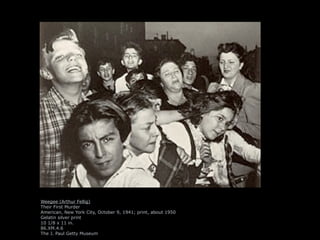
Weegee (Arthur Fellig)
Their First Murder
American, New York City, October 9, 1941; print, about 1950
Gelatin silver print
10 1/8 x 11 in.
86.XM.4.6
The J. Paul Getty Museum
•   "A woman relative cried...but neighborhood dead-end kids
    enjoyed the show when a small-time racketeer was shot and
    killed," wrote Weegee in the caption accompanying this
    startling photograph in his 1945 publication Naked City. On
    the facing page Weegee showed the bloody body lying in the
    street.

    Alternately laughing, staring in disbelief, or looking into the
    camera to grasp their own momentary chance to be recorded,
    the children who had witnessed this grisly scene form an
    unsettling amalgam of human emotion and self-absorption.
    Two women are among the group: one, whom Weegee
    mentioned above, stands at the center, her face contorted with
    anguished tears, her personal loss turned into public
    spectacle.
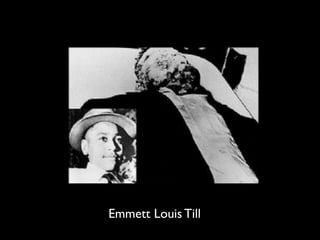
Emmett Louis Till
representation
•   ...to the use of language and images to create meaning
    about the world around us
•   we use words to understand, describe, and define the world
    as we see it
•   this happens through systems, i.e. oral and written language,
    visual language, sign systems, etc
•   languages’ follow a series of rules and conventions
•   same can be said for visual objects, film, narratives there are
    a number of rules which they follow
•   2 methods that are helpful here are semiotics and linguistics
Representation is the production of the meaning of the concepts in our
minds through language. It is the link between concepts and language
which enables us to refer to either the real world of objects, people or
events, or indeed to imaginary worlds of fictional objects, people and
events.
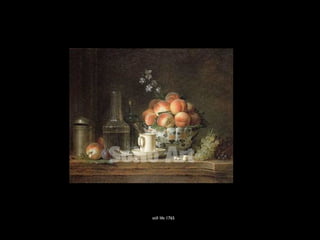
still life 1765
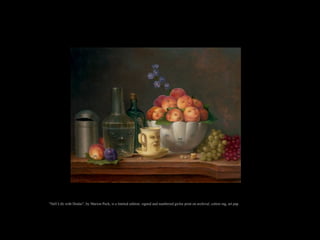
"Still Life with Dralas", by Marion Peck, is a limited edition, signed and numbered giclee print on archival, cotton rag, art pap
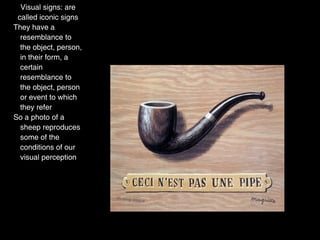
What one must paint is the image of resemblance—if thought is to
become visible in the world.
                                                            —Rene Magritte
Visual signs: are
 called iconic signs
They have a
  resemblance to
  the object, person,
  in their form, a
  certain
  resemblance to
  the object, person
  or event to which
  they refer
So a photo of a
  sheep reproduces
  some of the
  conditions of our
  visual perception
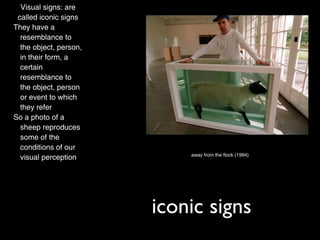
Visual signs: are
 called iconic signs
They have a
  resemblance to
  the object, person,
  in their form, a
  certain
  resemblance to
  the object, person
  or event to which
  they refer
So a photo of a
  sheep reproduces
  some of the
  conditions of our
                            away from the flock (1994)
  visual perception


                        iconic signs
S.H.E.E.P.
Written or spoken signs are indexical signs
They have no obvious relationship to the things in which they refer –
this makes their relationship arbitrary
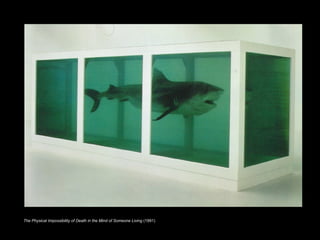
The Physical Impossibility of Death in the Mind of Someone Living (1991)
-
•
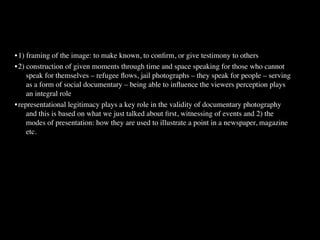
1) framing of the image: to make known, to confirm, or give testimony to others
•
2) construction of given moments through time and space speaking for those who cannot
     speak for themselves – refugee flows, jail photographs – they speak for people – serving
     as a form of social documentary – being able to influence the viewers perception plays
     an integral role
•
representational legitimacy plays a key role in the validity of documentary photography
     and this is based on what we just talked about first, witnessing of events and 2) the
     modes of presentation: how they are used to illustrate a point in a newspaper, magazine
     etc.
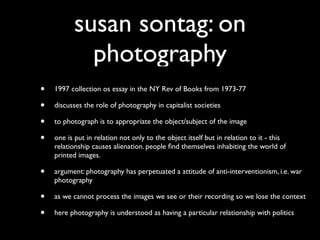
susan sontag: on
            photography
•   1997 collection os essay in the NY Rev of Books from 1973-77

•   discusses the role of photography in capitalist societies

•   to photograph is to appropriate the object/subject of the image

•   one is put in relation not only to the object itself but in relation to it - this
    relationship causes alienation. people find themselves inhabiting the world of
    printed images.

•   argument: photography has perpetuated a attitude of anti-interventionism, i.e. war
    photography

•   as we cannot process the images we see or their recording so we lose the context

•   here photography is understood as having a particular relationship with politics
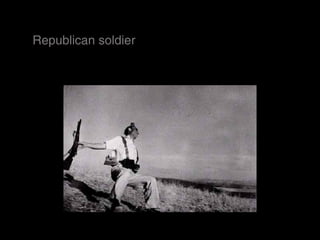
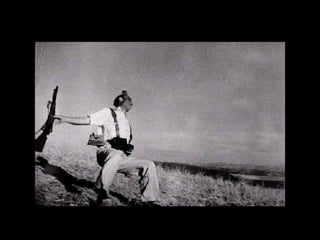
Republican soldier
Class 2 media
Class 2 media
Class 2 media
Class 2 media

Class 2 media

  • 1.
    images, power, & politics 02/09/2011
  • 2.
    to do overview ofimages, power, and politics semiotics semiology representation discourse
  • 3.
    practices of looking • looking entails implicit relationships of power • consciously and unconsciously • these practices affect how we comprehend objects, people, or events and subsequently how we interpret them • images then can be understood from a number of levels and a number of different ways • these practices intersect and form the ways in which we look and understand, the economy of looking • within the world in which we live we are bombarded by a number of different images which convey a wide range of emotions - these images can mean a number of different things to a no of different people • examples...
  • 4.
    Weegee (Arthur Fellig) TheirFirst Murder American, New York City, October 9, 1941; print, about 1950 Gelatin silver print 10 1/8 x 11 in. 86.XM.4.6 The J. Paul Getty Museum
  • 5.
    "A woman relative cried...but neighborhood dead-end kids enjoyed the show when a small-time racketeer was shot and killed," wrote Weegee in the caption accompanying this startling photograph in his 1945 publication Naked City. On the facing page Weegee showed the bloody body lying in the street. Alternately laughing, staring in disbelief, or looking into the camera to grasp their own momentary chance to be recorded, the children who had witnessed this grisly scene form an unsettling amalgam of human emotion and self-absorption. Two women are among the group: one, whom Weegee mentioned above, stands at the center, her face contorted with anguished tears, her personal loss turned into public spectacle.
  • 6.
  • 7.
    representation • ...to the use of language and images to create meaning about the world around us • we use words to understand, describe, and define the world as we see it • this happens through systems, i.e. oral and written language, visual language, sign systems, etc • languages’ follow a series of rules and conventions • same can be said for visual objects, film, narratives there are a number of rules which they follow • 2 methods that are helpful here are semiotics and linguistics
  • 8.
    Representation is theproduction of the meaning of the concepts in our minds through language. It is the link between concepts and language which enables us to refer to either the real world of objects, people or events, or indeed to imaginary worlds of fictional objects, people and events.
  • 9.
  • 10.
    "Still Life withDralas", by Marion Peck, is a limited edition, signed and numbered giclee print on archival, cotton rag, art pap
  • 11.
    What one mustpaint is the image of resemblance—if thought is to become visible in the world. —Rene Magritte
  • 12.
    Visual signs: are called iconic signs They have a resemblance to the object, person, in their form, a certain resemblance to the object, person or event to which they refer So a photo of a sheep reproduces some of the conditions of our visual perception
  • 13.
    Visual signs: are called iconic signs They have a resemblance to the object, person, in their form, a certain resemblance to the object, person or event to which they refer So a photo of a sheep reproduces some of the conditions of our away from the flock (1994) visual perception iconic signs
  • 14.
    S.H.E.E.P. Written or spokensigns are indexical signs They have no obvious relationship to the things in which they refer – this makes their relationship arbitrary
  • 15.
    The Physical Impossibilityof Death in the Mind of Someone Living (1991)
  • 16.
    - • 1) framing ofthe image: to make known, to confirm, or give testimony to others • 2) construction of given moments through time and space speaking for those who cannot speak for themselves – refugee flows, jail photographs – they speak for people – serving as a form of social documentary – being able to influence the viewers perception plays an integral role • representational legitimacy plays a key role in the validity of documentary photography and this is based on what we just talked about first, witnessing of events and 2) the modes of presentation: how they are used to illustrate a point in a newspaper, magazine etc.
  • 25.
    susan sontag: on photography • 1997 collection os essay in the NY Rev of Books from 1973-77 • discusses the role of photography in capitalist societies • to photograph is to appropriate the object/subject of the image • one is put in relation not only to the object itself but in relation to it - this relationship causes alienation. people find themselves inhabiting the world of printed images. • argument: photography has perpetuated a attitude of anti-interventionism, i.e. war photography • as we cannot process the images we see or their recording so we lose the context • here photography is understood as having a particular relationship with politics
  • 28.