HOW TO POST TO WORDPRESS
HINT: Write your post in Word or another word processing software and cut and
paste
LOOKING + THE
SPECTATOR/VIEWER
Spectatorial Reception
How spectators/viewers
receive and interpret visual
forms (images, moving
images, objects)
KANTIAN DISINTERESTED VIEWER +
FORMALISM
• Immanuel Kant’s (1724-1804) ideal of 'disinterested' aesthetic judgment
• For Kant, aesthetic judgments are disinterested, meaning that we take pleasure in
something because we judge it beautiful, rather than judging it beautiful because
we find it pleasurable.
• Kant accordingly claims that the aesthetic judgment must concern itself only with
form (shape, arrangement, rhythm, etc.) in the object presented, not content that
affects the senses (color, tone, etc.), since the latter has a deep connection to the
agreeable, and thus to interest.
• Disinterested judgement is objective, not subjective
• Museum structures support disinterest – theory in practice
• Adopted by post-1950s US Modernist art critics like Clement Greenberg and
Michael Fried as form of aesthetic judgement
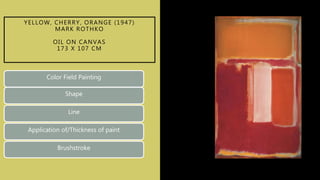
YELLOW, CHERRY, ORANGE (1947)
MARK ROTHKO
OIL ON CANVAS
173 X 107 CM
Color Field Painting
Shape
Line
Application of/Thickness of paint
Brushstroke
CINEMA OF
ATTRACTION
CINEMA OF ATTRACTION (1890-1908)
Cinema of Attractions = “an aesthetic of astonishment”
Thomas Gunning (1986)
CINEMA OF
ATTRACTION
Cinema before 1908
Single-shot without camera tricks
(usually) and early narrative/animation
Emphasis on image, not story
CINEMA OF
ATTRACTION:
FOREGROUNDS
THE ROLE THE
SPECTATOR
• Film audiences don’t know how to view moving
images
• Film audience don’t know how to look
• Filmmakers create work that invites the audience
to look
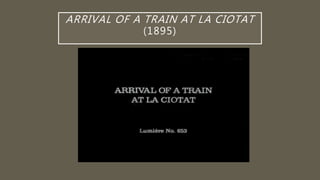
ARRIVAL OF A TRAIN AT LA CIOTAT
(1895)
HOW SPECTATORS ARE INVITED TO
LOOK
Exhibitionist in nature
Designed for affect (emotion) – not neutral
Creates surprise/shock
Uses Violence/Aggression/Danger/Humor/Cuteness
Focuses on Taboo Subjects/Voyeurism
Relationship to Carnival/Side-Show
THE KISS (1896)
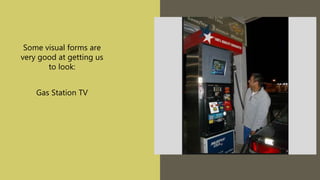
Some visual forms are
very good at getting us
to look:
Gas Station TV
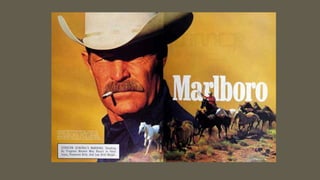
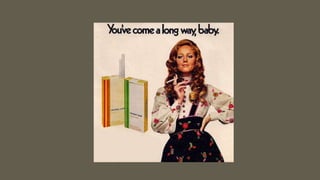
LOOKING
Marita Sturken, “Images, Power and Politics”
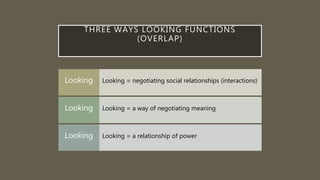
THREE WAYS LOOKING FUNCTIONS
(OVERLAP)
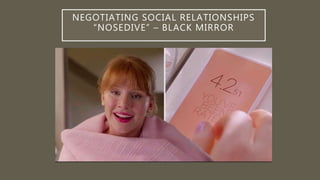
Looking = negotiating social relationships (interactions)
Looking
Looking = a way of negotiating meaning
Looking
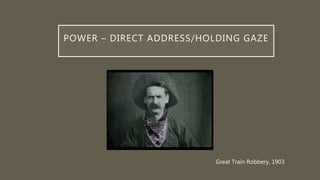
Looking = a relationship of power
Looking
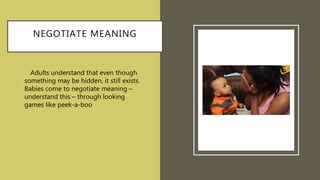
NEGOTIATE MEANING
• Adults understand that even though
something may be hidden, it still exists.
Babies come to negotiate meaning –
understand this – through looking
games like peek-a-boo.
NEGOTIATING SOCIAL RELATIONSHIPS
“NOSEDIVE” – BLACK MIRROR
POWER – DIRECT ADDRESS/HOLDING GAZE
Great Train Robbery, 1903
THE VALUE OF DISTURBING
IMAGES
Key question for the time we live In
In 1973, the critic Susan Sontag wrote about viewing, for the first time,
photographs of World War II concentration camps:
“One’s first encounter with the photographic inventory of ultimate horror is
a kind of revelation, perhaps the only revelation people are granted now, a
negative epiphany. For me, it was photographs of Bergen-Belsen and
Dachau which I came across by chance in a bookstore in Santa Monica in
July 1945. Nothing I have seen—in photographs or in real life—ever cut me
as sharply, deeply, instantaneously. Ever since then, it has seemed plausible
to me to think of my life as being divided into two parts: before I saw those
photographs (I was twelve) and after. My life was changed by them, though
not until several years later did I understand what they were about.”
“The role of images providing views of violence, voyeurism and fascination with
violence is countered by a history of using images to expose the devastating aspects
of violence” Sturken (p. 11)
• What is the value of engaging with or making material that depicts or represents
challenging or disturbing content?
• What is the risk of engaging with or making material that depicts or represents
challenging or disturbing content?
• How do we balance the risks and benefits of engaging or making with this
material?
DEPICTIONS OF VIOLENCE
DISTURBING IMAGES
CASE STUDY:
PHOTO OF EMMETT TILL
(1955)
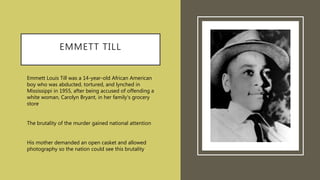
EMMETT TILL
Emmett Louis Till was a 14-year-old African American
boy who was abducted, tortured, and lynched in
Mississippi in 1955, after being accused of offending a
white woman, Carolyn Bryant, in her family's grocery
store.
The brutality of the murder gained national attention
His mother demanded an open casket and allowed
photography so the nation could see this brutality
DISTURBING IMAGES, ARTISTIC
INTENTION AND SPECTATORIAL
RECEPTION
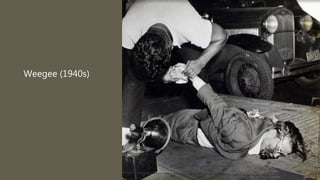
Weegee (1940s)
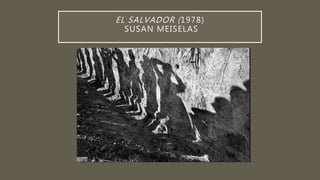
EL SALVADOR (1978)
SUSAN MEISELAS
CASE STUDY:
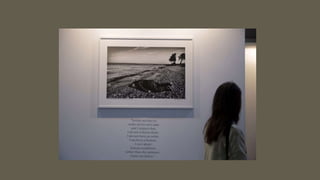
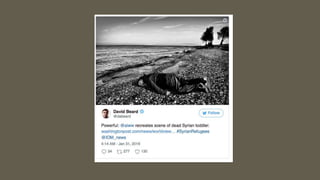
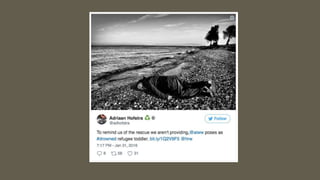
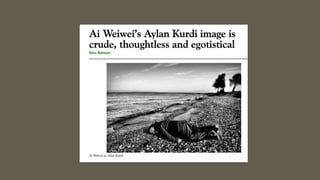
AI WEI WEI AS ALAN KURDI +
SPECTATORIAL RECEPTION
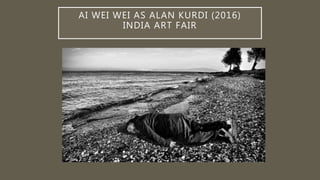
AI WEI WEI AS ALAN KURDI (2016)
INDIA ART FAIR
AI WEI WEI: INTENTION
"You see so many children come off these boats. They are like angels --
they are the most vulnerable. You can see the world has put them in
extreme, hopeless conditions. There are two worlds -- a world of adults
and a world of babies, and they are not connected”
"I was standing there and I could feel my body shaking with the wind --
you feel death in the wind. You are taken by some kind of emotions that
you can only have when you are there. So for me to be in the same
position [as Kurdi], is to suggest our condition can be so far from human
concerns in today's politics."
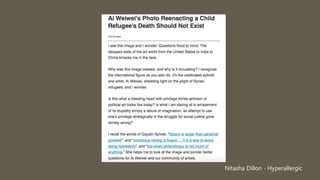
Nitasha Dillon - Hyperallergic
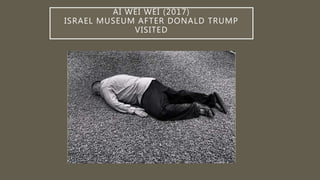
AI WEI WEI (2017)
ISRAEL MUSEUM AFTER DONALD TRUMP
VISITED
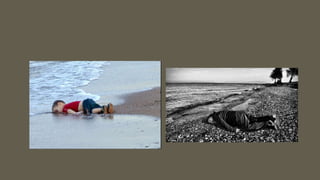
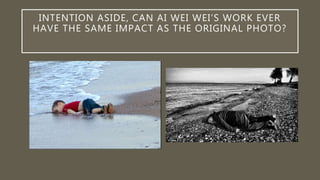
INTENTION ASIDE, CAN AI WEI WEI’S WORK EVER
HAVE THE SAME IMPACT AS THE ORIGINAL PHOTO?
SYMBOL VS. SIGN (SEMIOTICS)
• Stands for something else
• Open for interpretation
• We can miss seeing symbols
• Has a meaning of its own
• Culturally-bound definitions
• We unconsciously read signs, but can learn to
read them critically
INTERPRETATION OF AN IMAGE
“is dependent on social, historical and cultural context. It is also dependent on the
context in which the image is presented (in a museum gallery of a magazine, for
instance) and on the viewers who interpret it” (p. 29)
1 . S O C I O - H I S T O R I C A L C O N T E X T ( D I F F E R E N T M E A N I N G A T
D I F F E R E N T H I S T O R I C A L T I M E / C H A N G I N G S O C I A L N O R M S ) :
“we may consider when and where an image was made and displayed or the social
context in which it is presented” (p. 27)
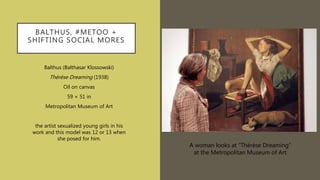
BALTHUS, #METOO +
SHIFTING SOCIAL MORES
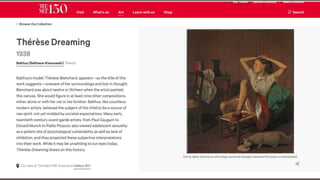
Balthus (Balthasar Klossowski)
Thérèse Dreaming (1938)
Oil on canvas
59 × 51 in
Metropolitan Museum of Art
the artist sexualized young girls in his
work and this model was 12 or 13 when
she posed for him.
A woman looks at “Thérèse Dreaming”
at the Metropolitan Museum of Art
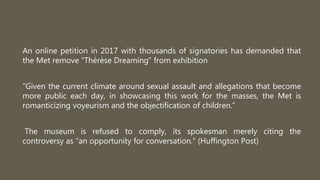
An online petition in 2017 with thousands of signatories has demanded that
the Met remove “Thérèse Dreaming” from exhibition
“Given the current climate around sexual assault and allegations that become
more public each day, in showcasing this work for the masses, the Met is
romanticizing voyeurism and the objectification of children.”
The museum is refused to comply, its spokesman merely citing the
controversy as “an opportunity for conversation.” (Huffington Post)
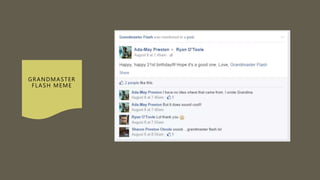
CULTURAL KNOWLEDGE/CULTURAL REFERENCE (MEANING LINKED
TO KNOWING WHAT IS BEING REFERENCED):
“the conventions the images use
or play off of, the other images
they refer to, and the familiar
figures and symbols they
include” (p. 28)
(Being in the know)
GRANDMASTER
FLASH MEME
3. THE CONTEXT IN WHICH THE IMAGE
IS PRESENTED
i.e., “ museum gallery vs. a magazine” (p. 27) or a meme, on social media, etc.
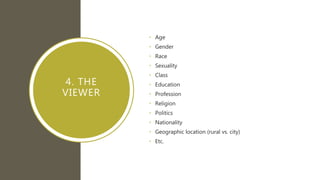
4. THE
VIEWER
• Age
• Gender
• Race
• Sexuality
• Class
• Education
• Profession
• Religion
• Politics
• Nationality
• Geographic location (rural vs. city)
• Etc.
“IN DEFENSE OF THE POOR IMAGE”
(2009)
Hito Steyerl
(pre-social media explosion)
THE POOR IMAGE DEFINED
Poor image = bad resolution, lack of quality
but is accessible, that was re-downloaded and
re-edited and remixed many times:
“It is a ghost of an image, a preview, a
thumbnail, an errant idea, an itinerant image
distributed for free, squeezed through slow
digital connections, compressed, reproduced,
ripped, remixed, as well as copied and pasted
into other channels of distribution.”
IS IT EVEN STILL AN IMAGE?
“Not only is it often degraded to the point of being just a hurried blur, one even
doubts whether it could be called an image at all. Only digital technology could
produce such a dilapidated image in the first place.”
POOR IMAGE, RICH IMAGE,
DEMOCRATIZATION
• Non-commercial images were hidden through the advent of Internet/streaming
• “Twenty or even thirty years ago, the neoliberal restructuring of media production
(i.e., mergers/acquisitions) began slowly obscuring non-commercial imagery, to the
point where experimental and essayistic cinema became almost invisible.”
• VHS copies of cult movies passed around
• “With the possibility to stream video online, this condition started to dramatically
change. An increasing number of rare materials reappeared on publicly accessible
platforms, some of them carefully curated (Ubuweb) and some just a pile of stuff
(YouTube).”
UBUWEB
• https://ubu.com/film/index.html
• https://ubu.com/film/pfeiffer_count_rumble.html
• The Long Count (Rumble In The Jungle)(2001) -
Muhammad Ali vs George Foreman
POOR IMAGES
REVEAL THE
CONDITIONS OF
THEIR
MARGINALIZATION
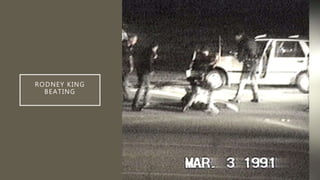
“Poor images are poor because they are not
assigned any value within the class society of
images—their status as illicit or degraded grants
them exemption from its criteria. Their lack of
resolution attests to their appropriation and
displacement.”
https://whyevolutionistrue.com/2019/11/13/a-
defiant-song-of-protest-in-santiago/
RODNEY KING
BEATING
THE
ECONOMY
OF POOR
IMAGES
“the economy of poor images, with its immediate
possibility of worldwide distribution and its ethics
of remix and appropriation, enables the
participation of a much larger group of producers
than ever before. But this does not mean that
these opportunities are only used for progressive
ends. Hate speech, spam, and other rubbish make
their way through digital connections as well.”
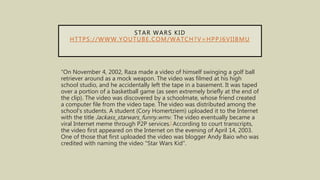
STAR WARS KID
HTTPS://WWW.YOUTUBE.COM/WATCH?V=HPPJ6VIIBMU
“On November 4, 2002, Raza made a video of himself swinging a golf ball
retriever around as a mock weapon. The video was filmed at his high
school studio, and he accidentally left the tape in a basement. It was taped
over a portion of a basketball game (as seen extremely briefly at the end of
the clip). The video was discovered by a schoolmate, whose friend created
a computer file from the video tape. The video was distributed among the
school's students. A student (Cory Homertziem) uploaded it to the Internet
with the title Jackass_starwars_funny.wmv. The video eventually became a
viral Internet meme through P2P services.[ According to court transcripts,
the video first appeared on the Internet on the evening of April 14, 2003.
One of those that first uploaded the video was blogger Andy Baio who was
credited with naming the video "Star Wars Kid".
SHARED HISTORIES
• “The poor image thus constructs anonymous global networks just as it creates a
shared history. It builds alliances as it travels, provokes translation or
mistranslation, and creates new publics and debates.”
• “there is also the circulation and production of poor images based on cell phone
cameras, home computers, and unconventional forms of distribution. Its optical
connections—collective editing, file sharing, or grassroots distribution circuits—
reveal erratic and coincidental links between producers everywhere, which
simultaneously constitute dispersed audiences.”
CASE STUDIES
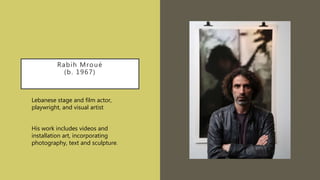
Rabih Mroué
(b. 1967)
Lebanese stage and film actor,
playwright, and visual artist
His work includes videos and
installation art, incorporating
photography, text and sculpture.
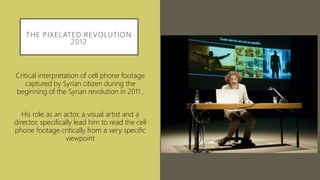
THE PIXELATED REVOLUTION
2012
Critical interpretation of cell phone footage
captured by Syrian citizen during the
beginning of the Syrian revolution in 2011 ,
His role as an actor, a visual artist and a
director, specifically lead him to read the cell
phone footage critically from a very specific
viewpoint
Questions
Mroué asks
How should we understand the mobile phone
images uploaded to the internet during the
ongoing Syrian Revolution?
Are the broken-up and incomplete images taken
by Syrians an extension of their physical
experiences?
Are mobile phones extensions of photographers'
brains, of their bodies, of their beings?”
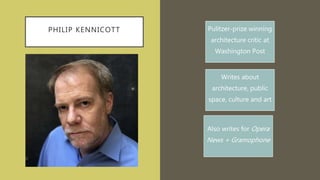
PHILIP KENNICOTT Pulitzer-prize winning
architecture critic at
Washington Post
Writes about
architecture, public
space, culture and art
Also writes for Opera
News + Gramophone
“THROUGH THE
LENS OF A CNN
CAMERA ON
THE GROUND,
A VIEW OF
AMERICAN
DISINTEGRATIO
N”
On-camera arrest of CNN team covering Black
Lives Matter protests in Minnesota
Analyzes what it means when the CNN camera is
laid on the ground and changes perspective
How does the eye of the camera produce the
image?
How do we see the image when the camera
changes position?
https://www.cnn.com/us/live-news/george-floyd-protest-updates-
05-28-
20/h_4ed08403663fa4ed3518221d0f2a1552?utm_medium=social
&utm_source=twCNN&utm_content=2020-05-29T10:24:57

Looking.pptx

  • 1.
    HOW TO POSTTO WORDPRESS HINT: Write your post in Word or another word processing software and cut and paste
  • 2.
  • 3.
    Spectatorial Reception How spectators/viewers receiveand interpret visual forms (images, moving images, objects)
  • 4.
    KANTIAN DISINTERESTED VIEWER+ FORMALISM • Immanuel Kant’s (1724-1804) ideal of 'disinterested' aesthetic judgment • For Kant, aesthetic judgments are disinterested, meaning that we take pleasure in something because we judge it beautiful, rather than judging it beautiful because we find it pleasurable. • Kant accordingly claims that the aesthetic judgment must concern itself only with form (shape, arrangement, rhythm, etc.) in the object presented, not content that affects the senses (color, tone, etc.), since the latter has a deep connection to the agreeable, and thus to interest. • Disinterested judgement is objective, not subjective • Museum structures support disinterest – theory in practice • Adopted by post-1950s US Modernist art critics like Clement Greenberg and Michael Fried as form of aesthetic judgement
  • 5.
    YELLOW, CHERRY, ORANGE(1947) MARK ROTHKO OIL ON CANVAS 173 X 107 CM Color Field Painting Shape Line Application of/Thickness of paint Brushstroke
  • 6.
  • 7.
    CINEMA OF ATTRACTION(1890-1908) Cinema of Attractions = “an aesthetic of astonishment” Thomas Gunning (1986)
  • 8.
    CINEMA OF ATTRACTION Cinema before1908 Single-shot without camera tricks (usually) and early narrative/animation Emphasis on image, not story
  • 9.
    CINEMA OF ATTRACTION: FOREGROUNDS THE ROLETHE SPECTATOR • Film audiences don’t know how to view moving images • Film audience don’t know how to look • Filmmakers create work that invites the audience to look
  • 10.
    ARRIVAL OF ATRAIN AT LA CIOTAT (1895)
  • 11.
    HOW SPECTATORS AREINVITED TO LOOK Exhibitionist in nature Designed for affect (emotion) – not neutral Creates surprise/shock Uses Violence/Aggression/Danger/Humor/Cuteness Focuses on Taboo Subjects/Voyeurism Relationship to Carnival/Side-Show
  • 12.
  • 13.
    Some visual formsare very good at getting us to look: Gas Station TV
  • 16.
  • 17.
    THREE WAYS LOOKINGFUNCTIONS (OVERLAP) Looking = negotiating social relationships (interactions) Looking Looking = a way of negotiating meaning Looking Looking = a relationship of power Looking
  • 18.
    NEGOTIATE MEANING • Adultsunderstand that even though something may be hidden, it still exists. Babies come to negotiate meaning – understand this – through looking games like peek-a-boo.
  • 19.
  • 20.
    POWER – DIRECTADDRESS/HOLDING GAZE Great Train Robbery, 1903
  • 21.
    THE VALUE OFDISTURBING IMAGES Key question for the time we live In
  • 22.
    In 1973, thecritic Susan Sontag wrote about viewing, for the first time, photographs of World War II concentration camps: “One’s first encounter with the photographic inventory of ultimate horror is a kind of revelation, perhaps the only revelation people are granted now, a negative epiphany. For me, it was photographs of Bergen-Belsen and Dachau which I came across by chance in a bookstore in Santa Monica in July 1945. Nothing I have seen—in photographs or in real life—ever cut me as sharply, deeply, instantaneously. Ever since then, it has seemed plausible to me to think of my life as being divided into two parts: before I saw those photographs (I was twelve) and after. My life was changed by them, though not until several years later did I understand what they were about.”
  • 23.
    “The role ofimages providing views of violence, voyeurism and fascination with violence is countered by a history of using images to expose the devastating aspects of violence” Sturken (p. 11)
  • 24.
    • What isthe value of engaging with or making material that depicts or represents challenging or disturbing content? • What is the risk of engaging with or making material that depicts or represents challenging or disturbing content? • How do we balance the risks and benefits of engaging or making with this material?
  • 25.
  • 26.
    CASE STUDY: PHOTO OFEMMETT TILL (1955)
  • 27.
    EMMETT TILL Emmett LouisTill was a 14-year-old African American boy who was abducted, tortured, and lynched in Mississippi in 1955, after being accused of offending a white woman, Carolyn Bryant, in her family's grocery store. The brutality of the murder gained national attention His mother demanded an open casket and allowed photography so the nation could see this brutality
  • 28.
    DISTURBING IMAGES, ARTISTIC INTENTIONAND SPECTATORIAL RECEPTION
  • 29.
  • 30.
  • 31.
    CASE STUDY: AI WEIWEI AS ALAN KURDI + SPECTATORIAL RECEPTION
  • 32.
    AI WEI WEIAS ALAN KURDI (2016) INDIA ART FAIR
  • 34.
    AI WEI WEI:INTENTION "You see so many children come off these boats. They are like angels -- they are the most vulnerable. You can see the world has put them in extreme, hopeless conditions. There are two worlds -- a world of adults and a world of babies, and they are not connected” "I was standing there and I could feel my body shaking with the wind -- you feel death in the wind. You are taken by some kind of emotions that you can only have when you are there. So for me to be in the same position [as Kurdi], is to suggest our condition can be so far from human concerns in today's politics."
  • 39.
    Nitasha Dillon -Hyperallergic
  • 40.
    AI WEI WEI(2017) ISRAEL MUSEUM AFTER DONALD TRUMP VISITED
  • 41.
    INTENTION ASIDE, CANAI WEI WEI’S WORK EVER HAVE THE SAME IMPACT AS THE ORIGINAL PHOTO?
  • 42.
    SYMBOL VS. SIGN(SEMIOTICS)
  • 43.
    • Stands forsomething else • Open for interpretation • We can miss seeing symbols • Has a meaning of its own • Culturally-bound definitions • We unconsciously read signs, but can learn to read them critically
  • 45.
    INTERPRETATION OF ANIMAGE “is dependent on social, historical and cultural context. It is also dependent on the context in which the image is presented (in a museum gallery of a magazine, for instance) and on the viewers who interpret it” (p. 29)
  • 46.
    1 . SO C I O - H I S T O R I C A L C O N T E X T ( D I F F E R E N T M E A N I N G A T D I F F E R E N T H I S T O R I C A L T I M E / C H A N G I N G S O C I A L N O R M S ) : “we may consider when and where an image was made and displayed or the social context in which it is presented” (p. 27)
  • 47.
    BALTHUS, #METOO + SHIFTINGSOCIAL MORES Balthus (Balthasar Klossowski) Thérèse Dreaming (1938) Oil on canvas 59 × 51 in Metropolitan Museum of Art the artist sexualized young girls in his work and this model was 12 or 13 when she posed for him. A woman looks at “Thérèse Dreaming” at the Metropolitan Museum of Art
  • 48.
    An online petitionin 2017 with thousands of signatories has demanded that the Met remove “Thérèse Dreaming” from exhibition “Given the current climate around sexual assault and allegations that become more public each day, in showcasing this work for the masses, the Met is romanticizing voyeurism and the objectification of children.” The museum is refused to comply, its spokesman merely citing the controversy as “an opportunity for conversation.” (Huffington Post)
  • 50.
    CULTURAL KNOWLEDGE/CULTURAL REFERENCE(MEANING LINKED TO KNOWING WHAT IS BEING REFERENCED): “the conventions the images use or play off of, the other images they refer to, and the familiar figures and symbols they include” (p. 28) (Being in the know)
  • 51.
  • 52.
    3. THE CONTEXTIN WHICH THE IMAGE IS PRESENTED i.e., “ museum gallery vs. a magazine” (p. 27) or a meme, on social media, etc.
  • 53.
    4. THE VIEWER • Age •Gender • Race • Sexuality • Class • Education • Profession • Religion • Politics • Nationality • Geographic location (rural vs. city) • Etc.
  • 54.
    “IN DEFENSE OFTHE POOR IMAGE” (2009) Hito Steyerl (pre-social media explosion)
  • 55.
    THE POOR IMAGEDEFINED Poor image = bad resolution, lack of quality but is accessible, that was re-downloaded and re-edited and remixed many times: “It is a ghost of an image, a preview, a thumbnail, an errant idea, an itinerant image distributed for free, squeezed through slow digital connections, compressed, reproduced, ripped, remixed, as well as copied and pasted into other channels of distribution.”
  • 56.
    IS IT EVENSTILL AN IMAGE? “Not only is it often degraded to the point of being just a hurried blur, one even doubts whether it could be called an image at all. Only digital technology could produce such a dilapidated image in the first place.”
  • 57.
    POOR IMAGE, RICHIMAGE, DEMOCRATIZATION • Non-commercial images were hidden through the advent of Internet/streaming • “Twenty or even thirty years ago, the neoliberal restructuring of media production (i.e., mergers/acquisitions) began slowly obscuring non-commercial imagery, to the point where experimental and essayistic cinema became almost invisible.” • VHS copies of cult movies passed around • “With the possibility to stream video online, this condition started to dramatically change. An increasing number of rare materials reappeared on publicly accessible platforms, some of them carefully curated (Ubuweb) and some just a pile of stuff (YouTube).”
  • 58.
    UBUWEB • https://ubu.com/film/index.html • https://ubu.com/film/pfeiffer_count_rumble.html •The Long Count (Rumble In The Jungle)(2001) - Muhammad Ali vs George Foreman
  • 59.
    POOR IMAGES REVEAL THE CONDITIONSOF THEIR MARGINALIZATION “Poor images are poor because they are not assigned any value within the class society of images—their status as illicit or degraded grants them exemption from its criteria. Their lack of resolution attests to their appropriation and displacement.” https://whyevolutionistrue.com/2019/11/13/a- defiant-song-of-protest-in-santiago/
  • 60.
  • 61.
    THE ECONOMY OF POOR IMAGES “the economyof poor images, with its immediate possibility of worldwide distribution and its ethics of remix and appropriation, enables the participation of a much larger group of producers than ever before. But this does not mean that these opportunities are only used for progressive ends. Hate speech, spam, and other rubbish make their way through digital connections as well.”
  • 62.
    STAR WARS KID HTTPS://WWW.YOUTUBE.COM/WATCH?V=HPPJ6VIIBMU “OnNovember 4, 2002, Raza made a video of himself swinging a golf ball retriever around as a mock weapon. The video was filmed at his high school studio, and he accidentally left the tape in a basement. It was taped over a portion of a basketball game (as seen extremely briefly at the end of the clip). The video was discovered by a schoolmate, whose friend created a computer file from the video tape. The video was distributed among the school's students. A student (Cory Homertziem) uploaded it to the Internet with the title Jackass_starwars_funny.wmv. The video eventually became a viral Internet meme through P2P services.[ According to court transcripts, the video first appeared on the Internet on the evening of April 14, 2003. One of those that first uploaded the video was blogger Andy Baio who was credited with naming the video "Star Wars Kid".
  • 63.
    SHARED HISTORIES • “Thepoor image thus constructs anonymous global networks just as it creates a shared history. It builds alliances as it travels, provokes translation or mistranslation, and creates new publics and debates.” • “there is also the circulation and production of poor images based on cell phone cameras, home computers, and unconventional forms of distribution. Its optical connections—collective editing, file sharing, or grassroots distribution circuits— reveal erratic and coincidental links between producers everywhere, which simultaneously constitute dispersed audiences.”
  • 65.
  • 66.
    Rabih Mroué (b. 1967) Lebanesestage and film actor, playwright, and visual artist His work includes videos and installation art, incorporating photography, text and sculpture.
  • 67.
    THE PIXELATED REVOLUTION 2012 Criticalinterpretation of cell phone footage captured by Syrian citizen during the beginning of the Syrian revolution in 2011 , His role as an actor, a visual artist and a director, specifically lead him to read the cell phone footage critically from a very specific viewpoint
  • 68.
    Questions Mroué asks How shouldwe understand the mobile phone images uploaded to the internet during the ongoing Syrian Revolution? Are the broken-up and incomplete images taken by Syrians an extension of their physical experiences? Are mobile phones extensions of photographers' brains, of their bodies, of their beings?”
  • 69.
    PHILIP KENNICOTT Pulitzer-prizewinning architecture critic at Washington Post Writes about architecture, public space, culture and art Also writes for Opera News + Gramophone
  • 70.
    “THROUGH THE LENS OFA CNN CAMERA ON THE GROUND, A VIEW OF AMERICAN DISINTEGRATIO N” On-camera arrest of CNN team covering Black Lives Matter protests in Minnesota Analyzes what it means when the CNN camera is laid on the ground and changes perspective How does the eye of the camera produce the image? How do we see the image when the camera changes position? https://www.cnn.com/us/live-news/george-floyd-protest-updates- 05-28- 20/h_4ed08403663fa4ed3518221d0f2a1552?utm_medium=social &utm_source=twCNN&utm_content=2020-05-29T10:24:57