THE CITY AS A SYSTEM - Rogers Models (R.Rogers, Cities for a Small Planet, 1997)

     Food                    UNSUSTAINABLE/LINEAR SYSTEM                        Waste (organic, inorganic)
     Goods                                                                      (landfill, dumped in rivers/sea)


                                                         OUTPUTS
    Non


                                    INPUTS
                                                 MEGA                                             Air pollution, noise
 renewable                                       CITY                                             (Carbon, nitrogen and
   energy                                                                                         sulfur dioxides, ozone)


    People                                                                      Goods, Services
                                                                                Wealth, Sprawl
                               SUSTAINABLE/CIRCULAR SYSTEM
       Food                  Recycling of organic waste (water, compost)
       Goods


                                                                                Reduced outputs
Conservation                                                                                       Examples of “green cities”:

                                                         OUTPUTS
                                        INPUTS


                                                                                                   Loja (Ecuador)
  + use of                                        ECO                                              Curitiba (Brazil)
 renewable                                        CITY                                             Freiburg (Germany)
                                                                                                   Melbourne (Australia)
   energy

     People                         Recycling of inorganic waste
                                        (paper, Antoine Delaitre
                                          © 2011 plastic, etc)                                                          1
SUSTAINABLE CITY MANAGEMENT
holistic management strategies that seeks to improve the quality of life for current
             without compromising quality of life of future residents
                     concept of “ecocities” (Richard Register)
 Management
                                                      Strategies
    areas

                                  provide adequate housing, social services, security,
                         social equity, access to leisure/culture, reduce traffic/commute time
   Social
 management         Kibera (Nairobi,Kenya): www.youtube.com/watch?v=QZWe33fToPo&feature=fvsr
                        Singapore: www.youtube.com/watch?v=6HofttbuWhA&feature=related


                                 balance development, optimize energy performance,
  Economic                             create jobs, control urban growth/sprawl
 management
                                Denmark: www.youtube.com/watch?v=E22eKYCZ2dQ


                      reduce waste and pollution, heal biosphere (air, water, soil), restore/re-use
Environmental                                      degraded land
 management
                                Mexico City: www.youtube.com/watch?v=oiJSibk1ok0

                                  © 2011 Antoine Delaitre                                             2
Slum upgrading project                   Offshore windmills          Free bicycle sharing   Electronic Road Pricing (ERP)
      In Kibera, Nairobi (Kenya)                    (Denmark)                      (Paris)                  (Singapore)


                                   EXAMPLES OF SUSTAINABLE STRATEGIES


Alternate circulation Program        City Hall rooftop garden          Urban organic farm            Stone/cactus garden
        (Mexico City)                       (Chicago)                    (San Francisco)                (Palm Springs)


                                                      © 2011 Antoine Delaitre                                                3
EXAMPLES OF SUSTAINABLE STRATEGIES
  SUSTAINABLE
                        CITY                                       EXAMPLE
   STRATEGIES
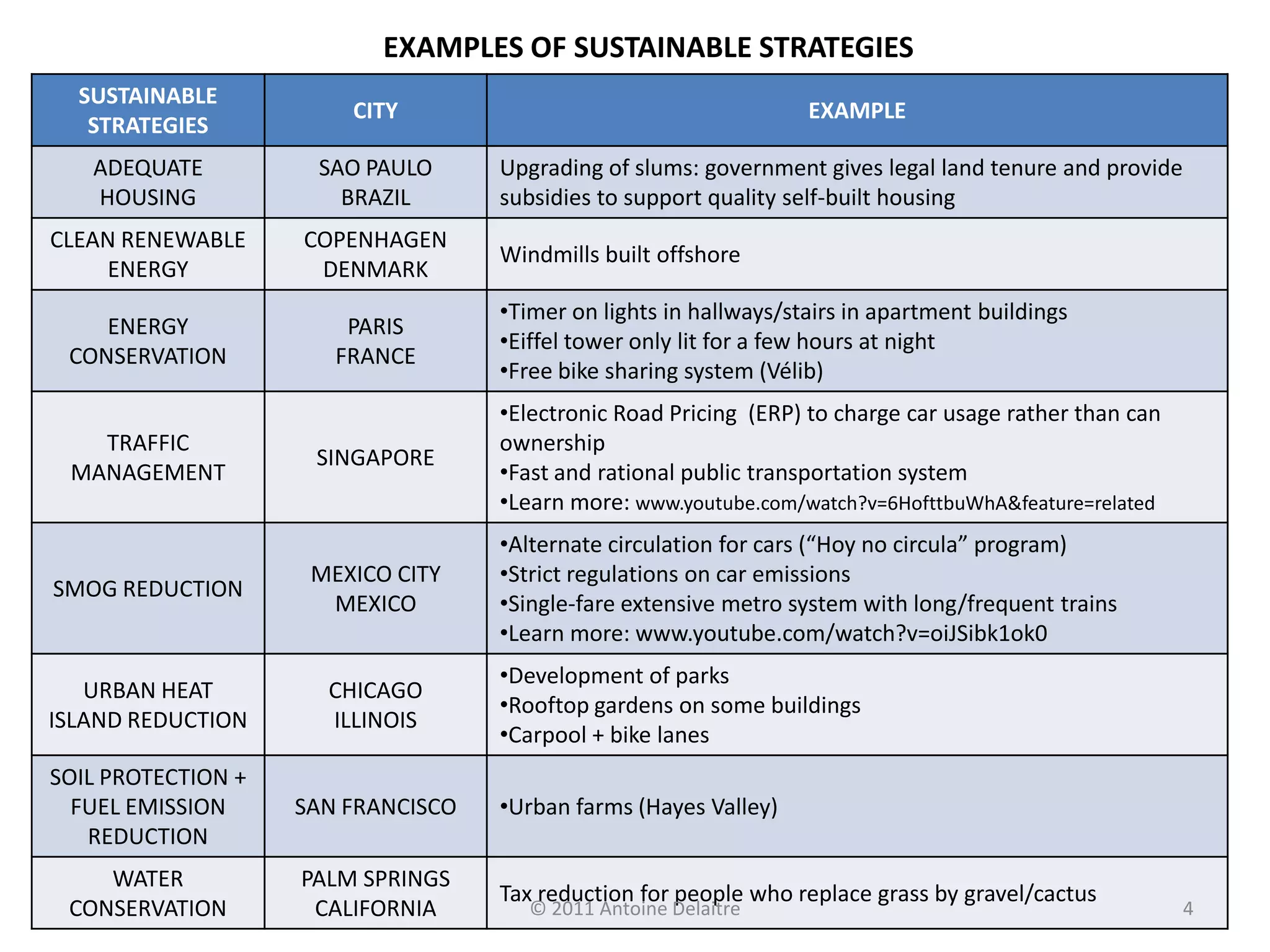
   ADEQUATE          SAO PAULO      Upgrading of slums: government gives legal land tenure and provide
   HOUSING             BRAZIL       subsidies to support quality self-built housing
CLEAN RENEWABLE     COPENHAGEN
                                    Windmills built offshore
    ENERGY           DENMARK
                                    •Timer on lights in hallways/stairs in apartment buildings
    ENERGY              PARIS
                                    •Eiffel tower only lit for a few hours at night
 CONSERVATION          FRANCE
                                    •Free bike sharing system (Vélib)
                                    •Electronic Road Pricing (ERP) to charge car usage rather than can
   TRAFFIC                          ownership
                     SINGAPORE
 MANAGEMENT                         •Fast and rational public transportation system
                                    •Learn more: www.youtube.com/watch?v=6HofttbuWhA&feature=related
                                    •Alternate circulation for cars (“Hoy no circula” program)
                     MEXICO CITY    •Strict regulations on car emissions
SMOG REDUCTION
                      MEXICO        •Single-fare extensive metro system with long/frequent trains
                                    •Learn more: www.youtube.com/watch?v=oiJSibk1ok0
                                    •Development of parks
   URBAN HEAT         CHICAGO
                                    •Rooftop gardens on some buildings
ISLAND REDUCTION      ILLINOIS
                                    •Carpool + bike lanes
SOIL PROTECTION +
  FUEL EMISSION     SAN FRANCISCO   •Urban farms (Hayes Valley)
   REDUCTION
    WATER           PALM SPRINGS
                                    Tax reduction for people who replace grass by gravel/cactus
 CONSERVATION        CALIFORNIA        © 2011 Antoine Delaitre                                           4
SUSTAINABLE CITY MANAGEMENT: CURITIBA (BRAZIL)
Pop x 6 in 60 years 2M in 2010 but has avoided problems typically associated with rapid growth due to innovative planning by Mayor Jaime Lerner
starting in 1971: public transportation preferred to private cars, environment used rather than changed, cheap low-tech solutions preferred to hi-
tech ones, bottom-up development involving local communities rather than top-down centralized planning. Look for the video “Curitiba, City of
Dreams” on Youtube www.youtube.com/watch?v=hRD3l3rlMpo
                      Describe the sustainable strategies used to achieve in Curitiba the following goals:
Reduce air and noise pollution:
(Learn more about Curitiba’s public transportation system at http://www.youtube.com/watch?v=eeAZsmpt7a8)


Increase land value and control natural hazards (flooding):


Recycling :
(Learn more about the “Green Exchange” Program at http://www.youtube.com/watch?v=T1bRUZ--9Ws)


Clean and rehabilitate slums:


                                                            © 2011 Antoine Delaitre                                                        5
SUSTAINABLE CITY MANAGEMENT: CURITIBA (BRAZIL)
 Look for the video “Curitiba, City of Dreams” on Youtube (http://www.youtube.com/watch?v=hRD3l3rlMpo)
               Describe the sustainable strategies used to achieve in Curitiba the following goals:
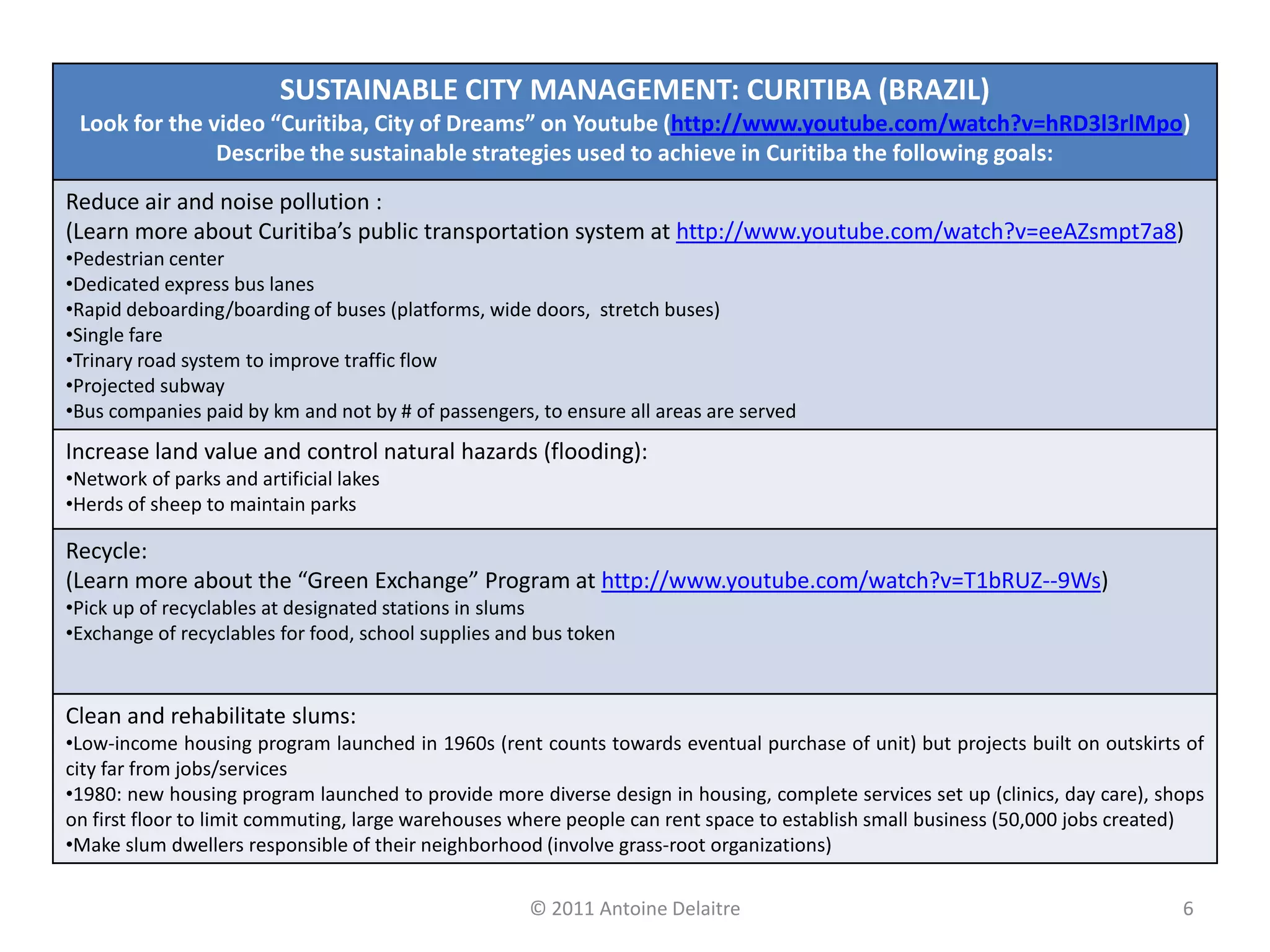
Reduce air and noise pollution :
(Learn more about Curitiba’s public transportation system at http://www.youtube.com/watch?v=eeAZsmpt7a8)
•Pedestrian center
•Dedicated express bus lanes
•Rapid deboarding/boarding of buses (platforms, wide doors, stretch buses)
•Single fare
•Trinary road system to improve traffic flow
•Projected subway
•Bus companies paid by km and not by # of passengers, to ensure all areas are served
Increase land value and control natural hazards (flooding):
•Network of parks and artificial lakes
•Herds of sheep to maintain parks

Recycle:
(Learn more about the “Green Exchange” Program at http://www.youtube.com/watch?v=T1bRUZ--9Ws)
•Pick up of recyclables at designated stations in slums
•Exchange of recyclables for food, school supplies and bus token


Clean and rehabilitate slums:
•Low-income housing program launched in 1960s (rent counts towards eventual purchase of unit) but projects built on outskirts of
city far from jobs/services
•1980: new housing program launched to provide more diverse design in housing, complete services set up (clinics, day care), shops
on first floor to limit commuting, large warehouses where people can rent space to establish small business (50,000 jobs created)
•Make slum dwellers responsible of their neighborhood (involve grass-root organizations)


                                                     © 2011 Antoine Delaitre                                                   6
SUSTAINABLE CITY MANAGEMENT: CURITIBA (BRAZIL)
                                                       Take a closer look at Curitiba on Google Earth
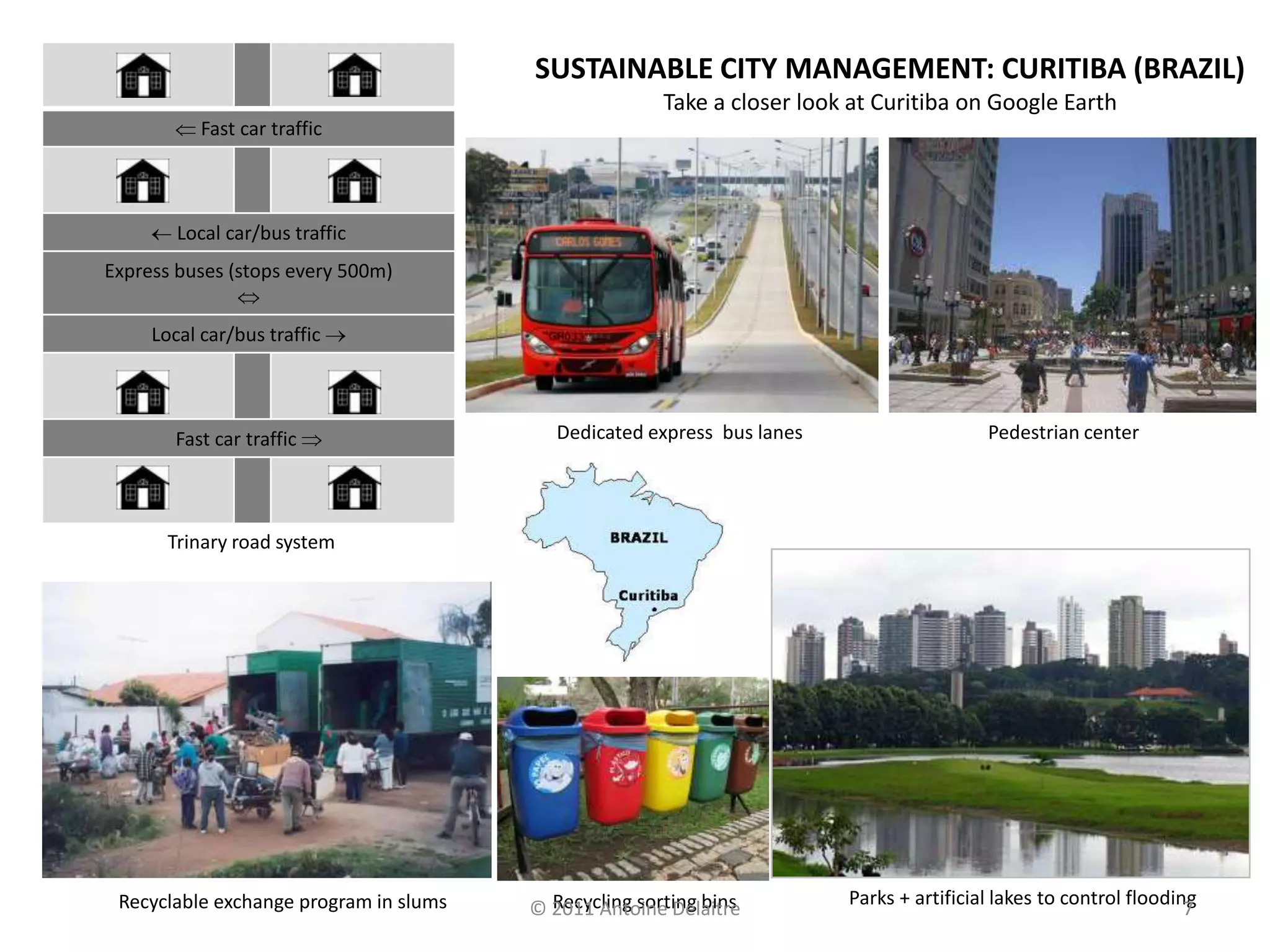
           Fast car traffic


        Local car/bus traffic
Express buses (stops every 500m)


     Local car/bus traffic


       Fast car traffic                    Dedicated express bus lanes                    Pedestrian center


       Trinary road system


 Recyclable exchange program in slums     Recycling sorting bins         Parks + artificial lakes to control flooding
                                        © 2011 Antoine Delaitre                                                     7
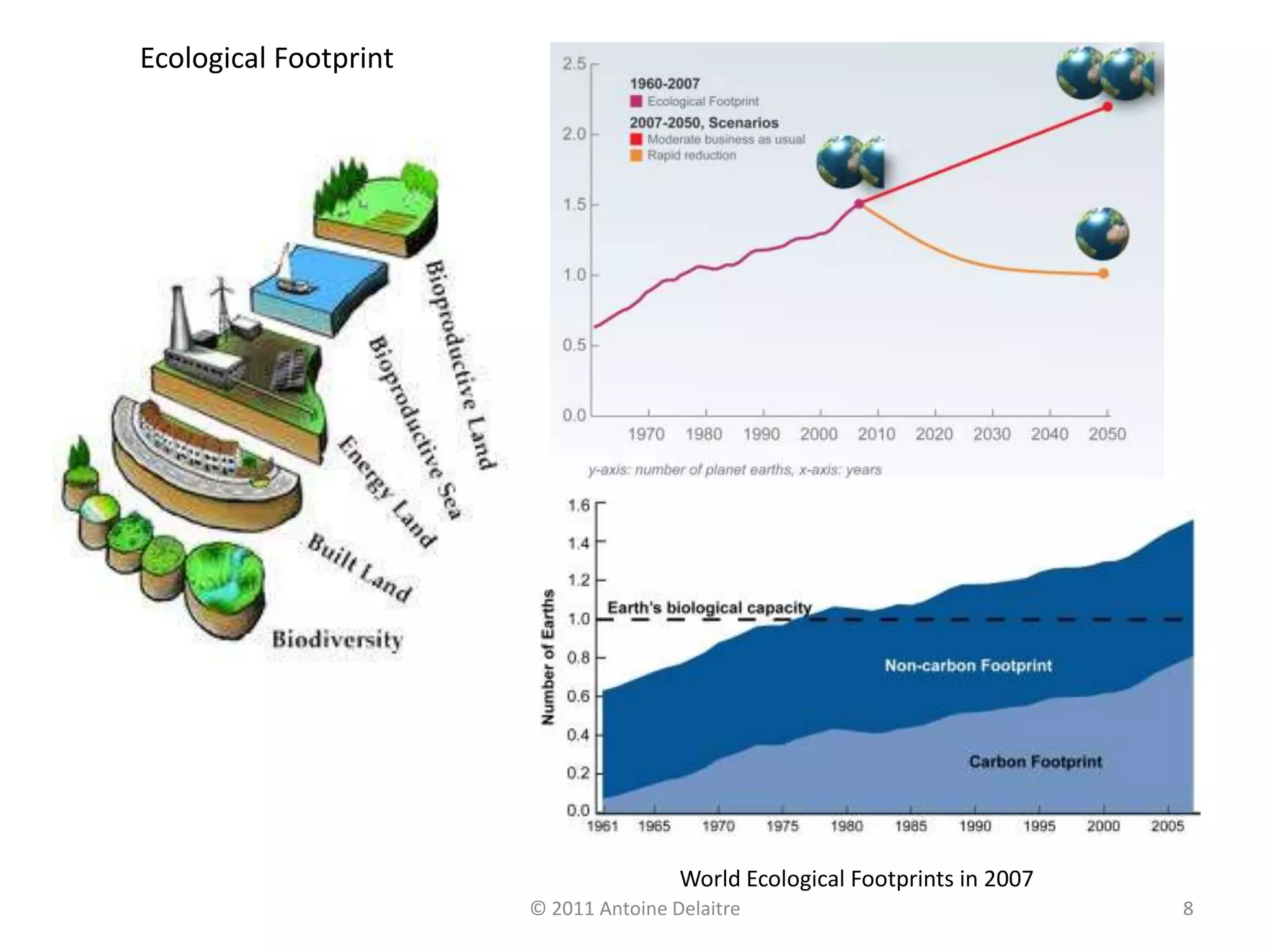
Ecological Footprint


                                       World Ecological Footprints in 2007
                       © 2011 Antoine Delaitre                               8
Ecological footprint by countries (2007)


   © 2011 Antoine Delaitre                 9
Ecological footprint and Biocapacity


                    Ecological Footprint < Biocapacity   Sustainability

                    Ecological Footprint > Biocapacity   Unsustainability


          © 2011 Antoine Delaitre                                   10
URBAN ECOLOGICAL FOOTPRINT IN CALGARY (CANADA)
               Go to www.footprintnetwork.org/en/index.php/GFN/page/case_stories/#calgary
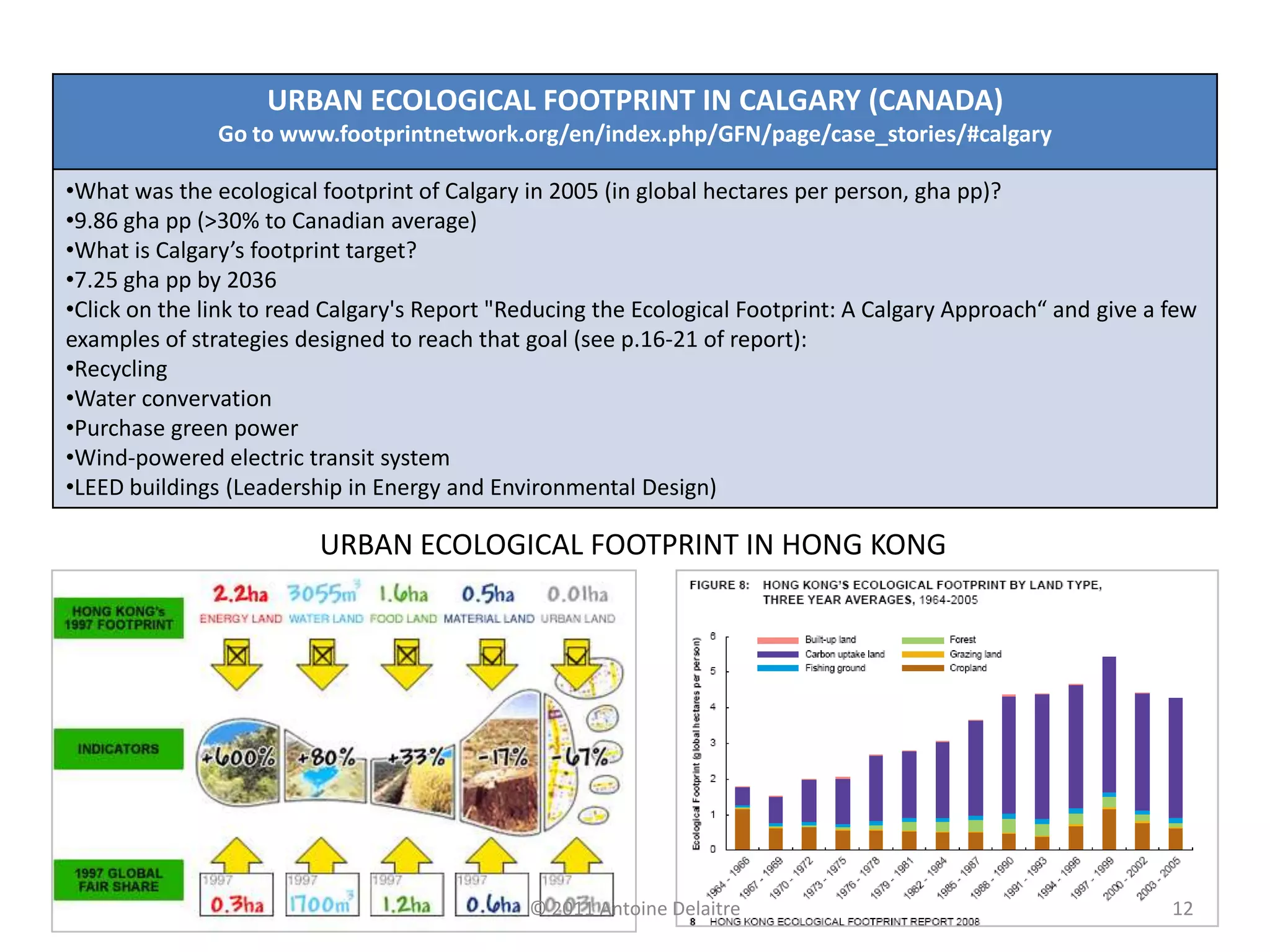
•What was the ecological footprint of Calgary in 2005 (in global hectares per person, gha pp)?
•What is Calgary’s footprint target?
•Click on the link to read Calgary's Report "Reducing the Ecological Footprint: A Calgary Approach“ and give a few
examples of strategies designed to reach that goal (see p.16-21 of report):


                         URBAN ECOLOGICAL FOOTPRINT IN HONG KONG


                                              © 2011 Antoine Delaitre                                          11
URBAN ECOLOGICAL FOOTPRINT IN CALGARY (CANADA)
               Go to www.footprintnetwork.org/en/index.php/GFN/page/case_stories/#calgary

•What was the ecological footprint of Calgary in 2005 (in global hectares per person, gha pp)?
•9.86 gha pp (>30% to Canadian average)
•What is Calgary’s footprint target?
•7.25 gha pp by 2036
•Click on the link to read Calgary's Report "Reducing the Ecological Footprint: A Calgary Approach“ and give a few
examples of strategies designed to reach that goal (see p.16-21 of report):
•Recycling
•Water convervation
•Purchase green power
•Wind-powered electric transit system
•LEED buildings (Leadership in Energy and Environmental Design)

                         URBAN ECOLOGICAL FOOTPRINT IN HONG KONG


                                              © 2011 Antoine Delaitre                                          12
Estimate your ecological footprint with this calculator:
www.footprintnetwork.org/en/index.php/GFN/page/personal_footprint/


                          © 2011 Antoine Delaitre                    13
10 tips to reduce your                                            Effect
    ecological footprint                    See some tips at www.youtube.com/watch?v=2JhhkU_A3r8
  Use zero-emission public transport,
                                                                             Reduce carbon emissions
          walking or bicycle
   Buy locally-produced organic food             Reduce use of fertilizers and energy needed for processing, transport and storage
   Local holidays by train instead of                                        Reduce carbon emissions
    long-distance trips in airplanes        (a Eurostar passenger creates ten times less CO2 than on when taking a flight Paris-London)
Use hybrid cars, for short distances only                                    Reduce carbon emissions
      Buy second-hand or borrow             10% of footprint comes from things we buy (which we only wear them a few times a year)
Improve home insulation, built rooftop
                                                          Reduce gas and electricity consumption and carbon emissions
   garden, turn thermostat down
    Use clean (wind, solar) energy,
                                                          Reduce gas and electricity consumption and carbon emissions
          Install solar panels
                                                1 kg of beef = farming to feed animal + fertilizers + processing (=15 liters of water)
    Eat less meat (particularly beef)
                                                                           1 kg of rice = 3 liters of water
       Avoid overpackaged items
                                                                 Reduce processing and packaging (plastic, paper)
    recycle, donate unwanted items
  Read newspapers/magazines online                                         Reduce consumption of paper


                                                       © 2011 Antoine Delaitre                                                       14
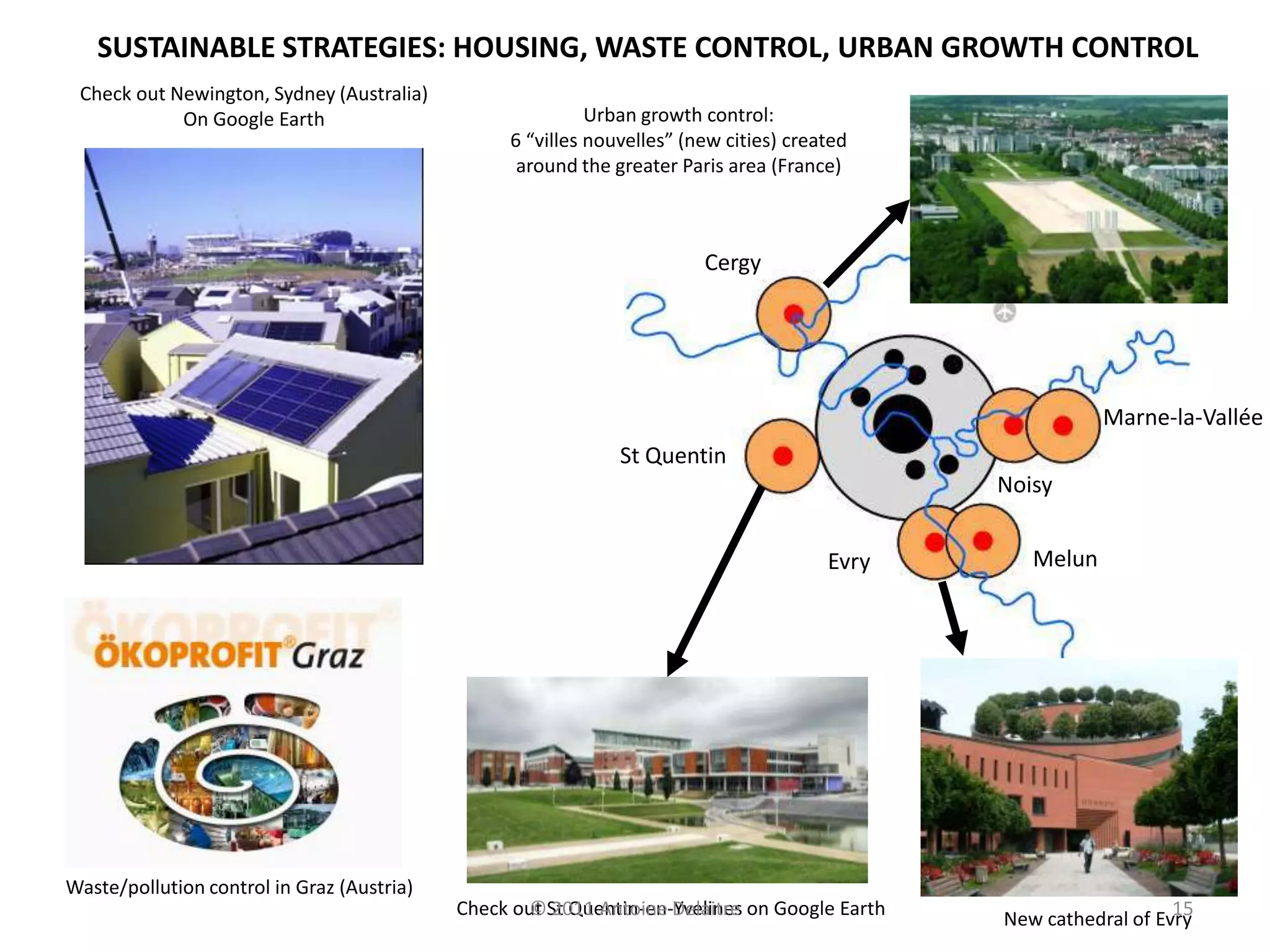
SUSTAINABLE STRATEGIES: HOUSING, WASTE CONTROL, URBAN GROWTH CONTROL
 Check out Newington, Sydney (Australia)
            On Google Earth                                 Urban growth control:
                                                  6 “villes nouvelles” (new cities) created
                                                   around the greater Paris area (France)


                                                                         Cergy


                                                                                                          Marne-la-Vallée
                                                               St Quentin
                                                                                               Noisy


                                                                                        Evry      Melun


Waste/pollution control in Graz (Austria)
                                            Check out St Quentin-en-Yvelines on Google Earth
                                                   © 2011 Antoine Delaitre                                        15
                                                                                               New cathedral of Evry
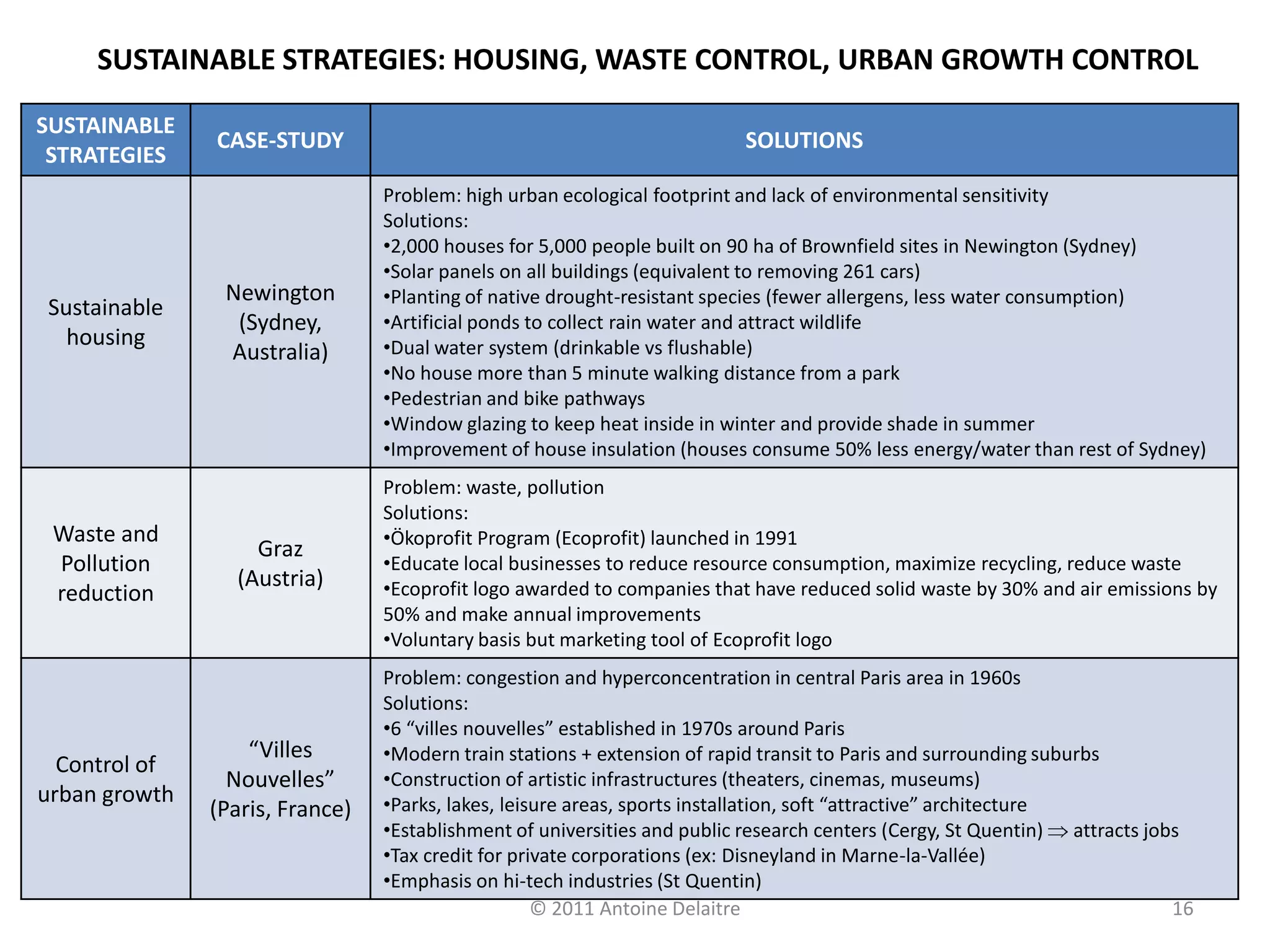
SUSTAINABLE STRATEGIES: HOUSING, WASTE CONTROL, URBAN GROWTH CONTROL

SUSTAINABLE
               CASE-STUDY                                                 SOLUTIONS
 STRATEGIES
                                 Problem: high urban ecological footprint and lack of environmental sensitivity
                                 Solutions:
                                 •2,000 houses for 5,000 people built on 90 ha of Brownfield sites in Newington (Sydney)
                                 •Solar panels on all buildings (equivalent to removing 261 cars)
                Newington        •Planting of native drought-resistant species (fewer allergens, less water consumption)
Sustainable
                 (Sydney,        •Artificial ponds to collect rain water and attract wildlife
  housing                        •Dual water system (drinkable vs flushable)
                Australia)
                                 •No house more than 5 minute walking distance from a park
                                 •Pedestrian and bike pathways
                                 •Window glazing to keep heat inside in winter and provide shade in summer
                                 •Improvement of house insulation (houses consume 50% less energy/water than rest of Sydney)
                                 Problem: waste, pollution
                                 Solutions:
 Waste and                       •Ökoprofit Program (Ecoprofit) launched in 1991
                   Graz
 Pollution                       •Educate local businesses to reduce resource consumption, maximize recycling, reduce waste
                 (Austria)       •Ecoprofit logo awarded to companies that have reduced solid waste by 30% and air emissions by
 reduction
                                 50% and make annual improvements
                                 •Voluntary basis but marketing tool of Ecoprofit logo
                                 Problem: congestion and hyperconcentration in central Paris area in 1960s
                                 Solutions:
                                 •6 “villes nouvelles” established in 1970s around Paris
                   “Villes       •Modern train stations + extension of rapid transit to Paris and surrounding suburbs
  Control of
                 Nouvelles”      •Construction of artistic infrastructures (theaters, cinemas, museums)
urban growth                     •Parks, lakes, leisure areas, sports installation, soft “attractive” architecture
               (Paris, France)
                                 •Establishment of universities and public research centers (Cergy, St Quentin) attracts jobs
                                 •Tax credit for private corporations (ex: Disneyland in Marne-la-Vallée)
                                 •Emphasis on hi-tech industries (St Quentin)
                                                    © 2011 Antoine Delaitre                                                 16
ECOCITY PROJECTS
                ww.good.is/post/the-death-and-life-of-model-%E2%80%9Ceco-cities%E2%80%9D


Masdar City (United Arab Emirates) : 80% likelihood                     Babcock Ranch (Florida): 70% likelihood


Tianjin Ecocity (China): 50% likelihood     © 2011 Antoine Delaitre   Greensburg (Kansas): 90% likelihood         17

IV. The sustainable city

  • 1.
    THE CITY ASA SYSTEM - Rogers Models (R.Rogers, Cities for a Small Planet, 1997) Food UNSUSTAINABLE/LINEAR SYSTEM Waste (organic, inorganic) Goods (landfill, dumped in rivers/sea) OUTPUTS Non INPUTS MEGA Air pollution, noise renewable CITY (Carbon, nitrogen and energy sulfur dioxides, ozone) People Goods, Services Wealth, Sprawl SUSTAINABLE/CIRCULAR SYSTEM Food Recycling of organic waste (water, compost) Goods Reduced outputs Conservation Examples of “green cities”: OUTPUTS INPUTS Loja (Ecuador) + use of ECO Curitiba (Brazil) renewable CITY Freiburg (Germany) Melbourne (Australia) energy People Recycling of inorganic waste (paper, Antoine Delaitre © 2011 plastic, etc) 1
  • 2.
    SUSTAINABLE CITY MANAGEMENT holisticmanagement strategies that seeks to improve the quality of life for current without compromising quality of life of future residents concept of “ecocities” (Richard Register) Management Strategies areas provide adequate housing, social services, security, social equity, access to leisure/culture, reduce traffic/commute time Social management Kibera (Nairobi,Kenya): www.youtube.com/watch?v=QZWe33fToPo&feature=fvsr Singapore: www.youtube.com/watch?v=6HofttbuWhA&feature=related balance development, optimize energy performance, Economic create jobs, control urban growth/sprawl management Denmark: www.youtube.com/watch?v=E22eKYCZ2dQ reduce waste and pollution, heal biosphere (air, water, soil), restore/re-use Environmental degraded land management Mexico City: www.youtube.com/watch?v=oiJSibk1ok0 © 2011 Antoine Delaitre 2
  • 3.
    Slum upgrading project Offshore windmills Free bicycle sharing Electronic Road Pricing (ERP) In Kibera, Nairobi (Kenya) (Denmark) (Paris) (Singapore) EXAMPLES OF SUSTAINABLE STRATEGIES Alternate circulation Program City Hall rooftop garden Urban organic farm Stone/cactus garden (Mexico City) (Chicago) (San Francisco) (Palm Springs) © 2011 Antoine Delaitre 3
  • 4.
    EXAMPLES OF SUSTAINABLESTRATEGIES SUSTAINABLE CITY EXAMPLE STRATEGIES ADEQUATE SAO PAULO Upgrading of slums: government gives legal land tenure and provide HOUSING BRAZIL subsidies to support quality self-built housing CLEAN RENEWABLE COPENHAGEN Windmills built offshore ENERGY DENMARK •Timer on lights in hallways/stairs in apartment buildings ENERGY PARIS •Eiffel tower only lit for a few hours at night CONSERVATION FRANCE •Free bike sharing system (Vélib) •Electronic Road Pricing (ERP) to charge car usage rather than can TRAFFIC ownership SINGAPORE MANAGEMENT •Fast and rational public transportation system •Learn more: www.youtube.com/watch?v=6HofttbuWhA&feature=related •Alternate circulation for cars (“Hoy no circula” program) MEXICO CITY •Strict regulations on car emissions SMOG REDUCTION MEXICO •Single-fare extensive metro system with long/frequent trains •Learn more: www.youtube.com/watch?v=oiJSibk1ok0 •Development of parks URBAN HEAT CHICAGO •Rooftop gardens on some buildings ISLAND REDUCTION ILLINOIS •Carpool + bike lanes SOIL PROTECTION + FUEL EMISSION SAN FRANCISCO •Urban farms (Hayes Valley) REDUCTION WATER PALM SPRINGS Tax reduction for people who replace grass by gravel/cactus CONSERVATION CALIFORNIA © 2011 Antoine Delaitre 4
  • 5.
    SUSTAINABLE CITY MANAGEMENT:CURITIBA (BRAZIL) Pop x 6 in 60 years 2M in 2010 but has avoided problems typically associated with rapid growth due to innovative planning by Mayor Jaime Lerner starting in 1971: public transportation preferred to private cars, environment used rather than changed, cheap low-tech solutions preferred to hi- tech ones, bottom-up development involving local communities rather than top-down centralized planning. Look for the video “Curitiba, City of Dreams” on Youtube www.youtube.com/watch?v=hRD3l3rlMpo Describe the sustainable strategies used to achieve in Curitiba the following goals: Reduce air and noise pollution: (Learn more about Curitiba’s public transportation system at http://www.youtube.com/watch?v=eeAZsmpt7a8) Increase land value and control natural hazards (flooding): Recycling : (Learn more about the “Green Exchange” Program at http://www.youtube.com/watch?v=T1bRUZ--9Ws) Clean and rehabilitate slums: © 2011 Antoine Delaitre 5
  • 6.
    SUSTAINABLE CITY MANAGEMENT:CURITIBA (BRAZIL) Look for the video “Curitiba, City of Dreams” on Youtube (http://www.youtube.com/watch?v=hRD3l3rlMpo) Describe the sustainable strategies used to achieve in Curitiba the following goals: Reduce air and noise pollution : (Learn more about Curitiba’s public transportation system at http://www.youtube.com/watch?v=eeAZsmpt7a8) •Pedestrian center •Dedicated express bus lanes •Rapid deboarding/boarding of buses (platforms, wide doors, stretch buses) •Single fare •Trinary road system to improve traffic flow •Projected subway •Bus companies paid by km and not by # of passengers, to ensure all areas are served Increase land value and control natural hazards (flooding): •Network of parks and artificial lakes •Herds of sheep to maintain parks Recycle: (Learn more about the “Green Exchange” Program at http://www.youtube.com/watch?v=T1bRUZ--9Ws) •Pick up of recyclables at designated stations in slums •Exchange of recyclables for food, school supplies and bus token Clean and rehabilitate slums: •Low-income housing program launched in 1960s (rent counts towards eventual purchase of unit) but projects built on outskirts of city far from jobs/services •1980: new housing program launched to provide more diverse design in housing, complete services set up (clinics, day care), shops on first floor to limit commuting, large warehouses where people can rent space to establish small business (50,000 jobs created) •Make slum dwellers responsible of their neighborhood (involve grass-root organizations) © 2011 Antoine Delaitre 6
  • 7.
    SUSTAINABLE CITY MANAGEMENT:CURITIBA (BRAZIL) Take a closer look at Curitiba on Google Earth Fast car traffic Local car/bus traffic Express buses (stops every 500m) Local car/bus traffic Fast car traffic Dedicated express bus lanes Pedestrian center Trinary road system Recyclable exchange program in slums Recycling sorting bins Parks + artificial lakes to control flooding © 2011 Antoine Delaitre 7
  • 8.
    Ecological Footprint World Ecological Footprints in 2007 © 2011 Antoine Delaitre 8
  • 9.
    Ecological footprint bycountries (2007) © 2011 Antoine Delaitre 9
  • 10.
    Ecological footprint andBiocapacity Ecological Footprint < Biocapacity Sustainability Ecological Footprint > Biocapacity Unsustainability © 2011 Antoine Delaitre 10
  • 11.
    URBAN ECOLOGICAL FOOTPRINTIN CALGARY (CANADA) Go to www.footprintnetwork.org/en/index.php/GFN/page/case_stories/#calgary •What was the ecological footprint of Calgary in 2005 (in global hectares per person, gha pp)? •What is Calgary’s footprint target? •Click on the link to read Calgary's Report "Reducing the Ecological Footprint: A Calgary Approach“ and give a few examples of strategies designed to reach that goal (see p.16-21 of report): URBAN ECOLOGICAL FOOTPRINT IN HONG KONG © 2011 Antoine Delaitre 11
  • 12.
    URBAN ECOLOGICAL FOOTPRINTIN CALGARY (CANADA) Go to www.footprintnetwork.org/en/index.php/GFN/page/case_stories/#calgary •What was the ecological footprint of Calgary in 2005 (in global hectares per person, gha pp)? •9.86 gha pp (>30% to Canadian average) •What is Calgary’s footprint target? •7.25 gha pp by 2036 •Click on the link to read Calgary's Report "Reducing the Ecological Footprint: A Calgary Approach“ and give a few examples of strategies designed to reach that goal (see p.16-21 of report): •Recycling •Water convervation •Purchase green power •Wind-powered electric transit system •LEED buildings (Leadership in Energy and Environmental Design) URBAN ECOLOGICAL FOOTPRINT IN HONG KONG © 2011 Antoine Delaitre 12
  • 13.
    Estimate your ecologicalfootprint with this calculator: www.footprintnetwork.org/en/index.php/GFN/page/personal_footprint/ © 2011 Antoine Delaitre 13
  • 14.
    10 tips toreduce your Effect ecological footprint See some tips at www.youtube.com/watch?v=2JhhkU_A3r8 Use zero-emission public transport, Reduce carbon emissions walking or bicycle Buy locally-produced organic food Reduce use of fertilizers and energy needed for processing, transport and storage Local holidays by train instead of Reduce carbon emissions long-distance trips in airplanes (a Eurostar passenger creates ten times less CO2 than on when taking a flight Paris-London) Use hybrid cars, for short distances only Reduce carbon emissions Buy second-hand or borrow 10% of footprint comes from things we buy (which we only wear them a few times a year) Improve home insulation, built rooftop Reduce gas and electricity consumption and carbon emissions garden, turn thermostat down Use clean (wind, solar) energy, Reduce gas and electricity consumption and carbon emissions Install solar panels 1 kg of beef = farming to feed animal + fertilizers + processing (=15 liters of water) Eat less meat (particularly beef) 1 kg of rice = 3 liters of water Avoid overpackaged items Reduce processing and packaging (plastic, paper) recycle, donate unwanted items Read newspapers/magazines online Reduce consumption of paper © 2011 Antoine Delaitre 14
  • 15.
    SUSTAINABLE STRATEGIES: HOUSING,WASTE CONTROL, URBAN GROWTH CONTROL Check out Newington, Sydney (Australia) On Google Earth Urban growth control: 6 “villes nouvelles” (new cities) created around the greater Paris area (France) Cergy Marne-la-Vallée St Quentin Noisy Evry Melun Waste/pollution control in Graz (Austria) Check out St Quentin-en-Yvelines on Google Earth © 2011 Antoine Delaitre 15 New cathedral of Evry
  • 16.
    SUSTAINABLE STRATEGIES: HOUSING,WASTE CONTROL, URBAN GROWTH CONTROL SUSTAINABLE CASE-STUDY SOLUTIONS STRATEGIES Problem: high urban ecological footprint and lack of environmental sensitivity Solutions: •2,000 houses for 5,000 people built on 90 ha of Brownfield sites in Newington (Sydney) •Solar panels on all buildings (equivalent to removing 261 cars) Newington •Planting of native drought-resistant species (fewer allergens, less water consumption) Sustainable (Sydney, •Artificial ponds to collect rain water and attract wildlife housing •Dual water system (drinkable vs flushable) Australia) •No house more than 5 minute walking distance from a park •Pedestrian and bike pathways •Window glazing to keep heat inside in winter and provide shade in summer •Improvement of house insulation (houses consume 50% less energy/water than rest of Sydney) Problem: waste, pollution Solutions: Waste and •Ökoprofit Program (Ecoprofit) launched in 1991 Graz Pollution •Educate local businesses to reduce resource consumption, maximize recycling, reduce waste (Austria) •Ecoprofit logo awarded to companies that have reduced solid waste by 30% and air emissions by reduction 50% and make annual improvements •Voluntary basis but marketing tool of Ecoprofit logo Problem: congestion and hyperconcentration in central Paris area in 1960s Solutions: •6 “villes nouvelles” established in 1970s around Paris “Villes •Modern train stations + extension of rapid transit to Paris and surrounding suburbs Control of Nouvelles” •Construction of artistic infrastructures (theaters, cinemas, museums) urban growth •Parks, lakes, leisure areas, sports installation, soft “attractive” architecture (Paris, France) •Establishment of universities and public research centers (Cergy, St Quentin) attracts jobs •Tax credit for private corporations (ex: Disneyland in Marne-la-Vallée) •Emphasis on hi-tech industries (St Quentin) © 2011 Antoine Delaitre 16
  • 17.
    ECOCITY PROJECTS ww.good.is/post/the-death-and-life-of-model-%E2%80%9Ceco-cities%E2%80%9D Masdar City (United Arab Emirates) : 80% likelihood Babcock Ranch (Florida): 70% likelihood Tianjin Ecocity (China): 50% likelihood © 2011 Antoine Delaitre Greensburg (Kansas): 90% likelihood 17