R
Carbon
R
Extraction of Essential Oils from
Spices using Steam Distillation
Carbon
R
Carbon
Contents
	 Objectives										 1
	Introduction									 1
	 Extraction of trans-anethole from star anise		 		 2
	 Extraction of trans-cinnamaldehyde from cinnamon			 5
Manuscript prepared by Dr. Almas I. Zayya, Dr. A. Jonathan Singh and Dr. Hemi Cumming.
School of Chemical and Physical Sciences, Victoria University of Wellington, New Zealand.
Carbon
R
Carbon
Introduction
Extraction of the aroma and flavour components
from dried plant materials is one of the oldest
chemical operations developed by humankind.
The preparation of a cup of tea or coffee is an
everyday example of extracting the flavour and
aroma components, including the stimulant
caffeine, with hot water. In the following
experiments, steam distillation is used to extract
the essential oils from two common spices: star
anise and cinnamon bark (Figure 1). The main
essential oils responsible for the aroma and flavour
of these spices are trans-anethole
[1-methoxy-4-(1-propenyl)benzene] from star anise
and trans-cinnamaldehyde
[(2E)-3-phenylprop-2-enal] from cinnamon bark.
Steam distillation is a technique used to distill
immiscible liquids, for which steam provides
one of the immiscible phases.1 The two
substances mix in the gas phase and co-distill,
but when cooled the desired component
separates from water as it is immiscible.
Steam distillation is commonly used to extract
perfume and flavour oils from natural sources.
Figure 1. Essential oils to be extracted from spices: trans-anethole from star
	 aniseand trans-cinnamaldehyde from cinnamon.
Objectives
The principal aims of these experiments are to
provide experience in the extraction of essential
oils from spices using the steam distillation
technique. Students will isolate and purify the key
chemical compounds that contribute to the aroma
and flavour of the spices. The compounds will then
be characterised by NMR spectroscopy using the
benchtop Spinsolve NMR spectrometer.
1
R
Carbon
Extraction of trans-anethole from
star anise
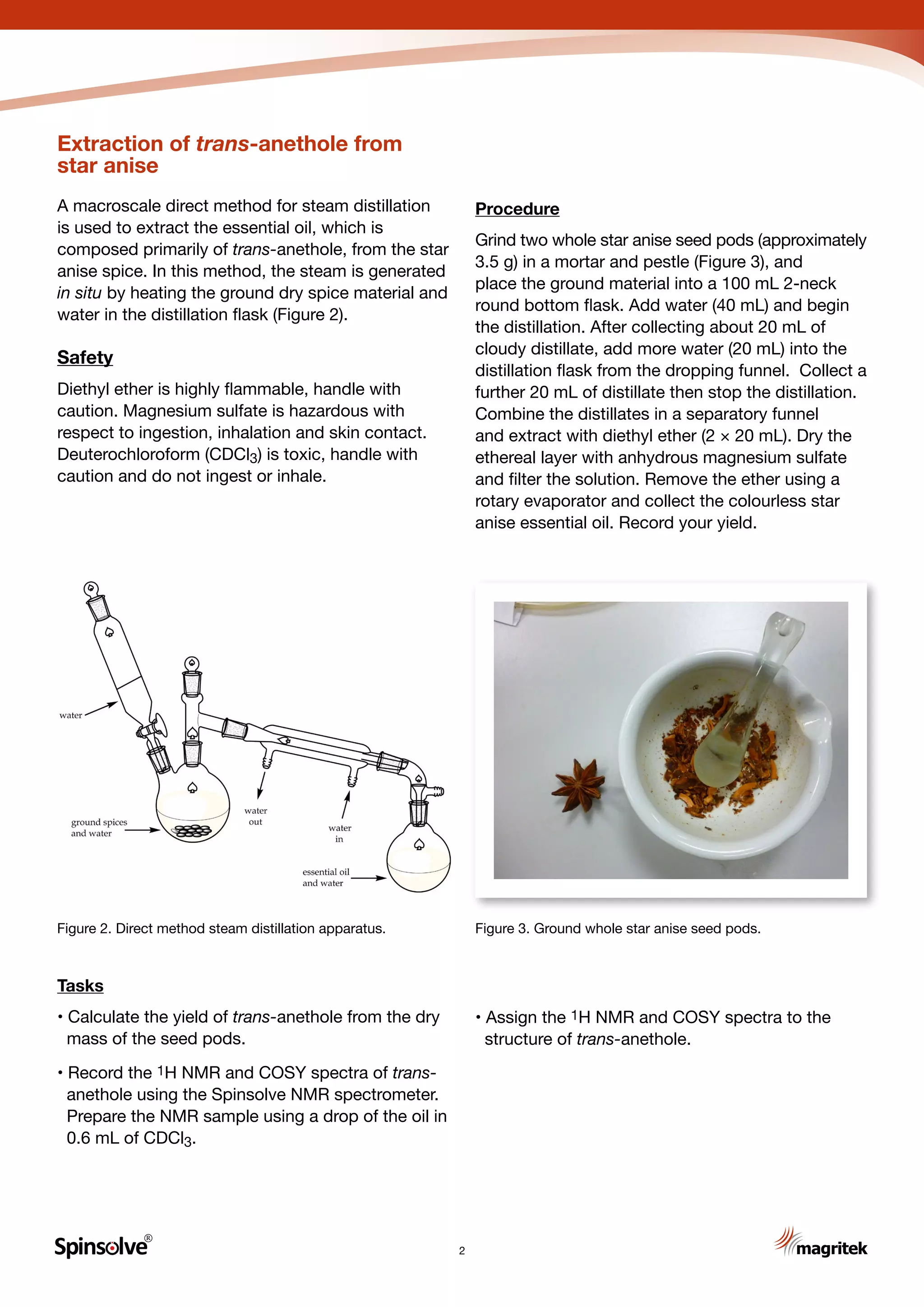
A macroscale direct method for steam distillation
is used to extract the essential oil, which is
composed primarily of trans-anethole, from the star
anise spice. In this method, the steam is generated
in situ by heating the ground dry spice material and
water in the distillation flask (Figure 2).
Safety
Diethyl ether is highly flammable, handle with
caution. Magnesium sulfate is hazardous with
respect to ingestion, inhalation and skin contact.
Deuterochloroform (CDCl3) is toxic, handle with
caution and do not ingest or inhale.
Figure 3. Ground whole star anise seed pods.Figure 2. Direct method steam distillation apparatus.
2
Tasks
• Calculate the yield of trans-anethole from the dry
mass of the seed pods.
• Record the 1H NMR and COSY spectra of trans-
anethole using the Spinsolve NMR spectrometer.
Prepare the NMR sample using a drop of the oil in
0.6 mL of CDCl3.
• Assign the 1H NMR and COSY spectra to the
structure of trans-anethole.
Procedure
Grind two whole star anise seed pods (approximately
3.5 g) in a mortar and pestle (Figure 3), and
place the ground material into a 100 mL 2-neck
round bottom flask. Add water (40 mL) and begin
the distillation. After collecting about 20 mL of
cloudy distillate, add more water (20 mL) into the
distillation flask from the dropping funnel. Collect a
further 20 mL of distillate then stop the distillation.
Combine the distillates in a separatory funnel
and extract with diethyl ether (2 × 20 mL). Dry the
ethereal layer with anhydrous magnesium sulfate
and filter the solution. Remove the ether using a
rotary evaporator and collect the colourless star
anise essential oil. Record your yield.
R
Carbon
The 1H NMR spectrum of trans-anethole (Figure 4)
shows a singlet (3H) at 3.78 ppm, corresponding
to the methoxy (OCH3) group. A doublet (3H) is
observed at 1.85 ppm for the methyl group at
position 7. The two CH protons at positions 5
and 6 appear between 6.11-6.25 ppm as a broad
multiplet. The four aromatic protons at positions 2
and 3 resonate as a second-order AA’BB’ system
with two multiplets centred at 6.80 and 7.27 ppm.
NMR Spectra
Figure 4. 1H NMR spectrum of trans-anethole, CDCl3.
3
R
Carbon
Figure 5. COSY spectrum of trans-anethole, CDCl3.
4
The COSY spectrum of trans-anethole (Figure 5)
clearly shows the correlations between the two
alkene CH protons at positions 5 and 6 and the
methyl group at position 7. COSY correlations are
also observed between the four aromatic protons
at positions 2 and 3.
R
Carbon 5
Extraction of trans-cinnamaldehyde
from cinnamon
A macroscale direct method for steam distillation
is also used to extract the essential oil, which is
composed primarily of trans-cinnamaldehyde, from
the cinnamon spice. In this method, the steam is
generated in situ by heating the ground dry spice
material and water in the distillation flask (Figure 2).
Safety
Diethyl ether is highly flammable, handle with
caution. Magnesium sulfate is hazardous with
respect to ingestion, inhalation and skin contact.
Deuterochloroform (CDCl3) is toxic, handle with
caution and do not ingest or inhale.
Procedure
Grind two whole sticks of cinnamon (approximately
5.5 g) in a mortar and pestle (Figure 6), and
place the ground material into a 100 mL 2-neck
round bottom flask. Add water (40 mL) and begin
the distillation. After collecting about 20 mL of
cloudy distillate, add more water (20 mL) into the
distillation flask from the dropping funnel. Collect a
further 20 mL of distillate then stop the distillation.
Combine the distillates in a separatory funnel
and extract with diethyl ether (2 × 20 mL). Dry the
ether layer with anhydrous magnesium sulfate and
filter the solution. Remove the ether using a rotary
evaporator and collect the colourless cinnamon
essential oil. Record your yield.
Figure 6. Ground sticks of cinnamon.
Tasks
• Calculate the yield of trans-cinnamaldehyde from
the dry mass of cinnamon sticks.
• Record the 1H NMR and COSY spectra of trans-
cinnamaldehyde using the Spinsolve NMR
spectrometer. Prepare the NMR sample using a
drop of the oil in 0.6 mL of CDCl3.
• Assign the 1H NMR and COSY spectra to the
structure of trans-cinnamaldehyde.
R
Carbon
Figure 7. 1H NMR spectrum of trans-cinnamaldehyde, CDCl3.
The 1H NMR spectrum of trans-cinnamaldehyde
(Figure 7) shows a doublet (7.3 Hz) at 9.73 ppm
for the aldehyde proton (CHO). The CH proton at
position 2 is observed as a doublet of doublets
(16.0 Hz, 7.3 Hz) at 6.69 ppm, as it is coupling
to both the aldehyde proton (7.3 Hz) and the
other alkene CH proton at position 3. The 16.0
Hz coupling constant between positions 2 and
3 is indicative of (E)- geometry about the double
bond. The five aromatic protons at positions
5, 6 and 7 appear as a broad multiplet centred
at approximately 7.49 ppm. The CH proton at
position 3 should resonate as a doublet as it
is coupling to the CH proton at position 3, but
its signal is overlapping with the signal for the
aromatic protons.
6
NMR Spectra
R
Carbon 7
Figure 8. COSY spectrum of trans-cinnamaldehyde, CDCl3.
The COSY spectrum of trans-cinnamaldehyde
(Figure 8) clearly shows the correlations between
the aldehyde proton (CHO) at 9.73 ppm and the
alkene CH proton at position 2. The CH protons at
positions 2 and 3 are also coupling to each other.
COSY correlations are also observed between the
aromatic protons at positions 5, 6 and 7.
R
Carbon
R
References
1) Pavia, D., L.; Lampman, G., M.; Kriz, G., S.; Engel, R., G. Introduction to Organic
Laboratory Techniques: A Small Scale Approach; Thomson Brooks/Coles, 2005.
CONTACT INFORMATION
For further information, please contact: sales@magritek.com
UNITED STATES 			 GERMANY				 NEW ZEALAND									
6440 Lusk Blvd (D108) 			 Philipsstraße 8				 32 Salamanca Road
San Diego, CA 92121, USA 		 52068 Aachen, Germany		 Wellington 6012, NZ
Tel: (855) 667-6835 			 Tel: +49 (241) 70525-6000		 Tel: +64 (4) 920-7671
(855) NMR-MTEK 			 Fax: +49 (241) 9278-6939		 Fax: +64 (4) 471-4665
Or visit our website www.magritek.com

Spinsolve lab manual_essential oils

  • 1.
    R Carbon R Extraction of EssentialOils from Spices using Steam Distillation Carbon
  • 2.
    R Carbon Contents Objectives 1 Introduction 1 Extraction of trans-anethole from star anise 2 Extraction of trans-cinnamaldehyde from cinnamon 5 Manuscript prepared by Dr. Almas I. Zayya, Dr. A. Jonathan Singh and Dr. Hemi Cumming. School of Chemical and Physical Sciences, Victoria University of Wellington, New Zealand. Carbon
  • 3.
    R Carbon Introduction Extraction of thearoma and flavour components from dried plant materials is one of the oldest chemical operations developed by humankind. The preparation of a cup of tea or coffee is an everyday example of extracting the flavour and aroma components, including the stimulant caffeine, with hot water. In the following experiments, steam distillation is used to extract the essential oils from two common spices: star anise and cinnamon bark (Figure 1). The main essential oils responsible for the aroma and flavour of these spices are trans-anethole [1-methoxy-4-(1-propenyl)benzene] from star anise and trans-cinnamaldehyde [(2E)-3-phenylprop-2-enal] from cinnamon bark. Steam distillation is a technique used to distill immiscible liquids, for which steam provides one of the immiscible phases.1 The two substances mix in the gas phase and co-distill, but when cooled the desired component separates from water as it is immiscible. Steam distillation is commonly used to extract perfume and flavour oils from natural sources. Figure 1. Essential oils to be extracted from spices: trans-anethole from star aniseand trans-cinnamaldehyde from cinnamon. Objectives The principal aims of these experiments are to provide experience in the extraction of essential oils from spices using the steam distillation technique. Students will isolate and purify the key chemical compounds that contribute to the aroma and flavour of the spices. The compounds will then be characterised by NMR spectroscopy using the benchtop Spinsolve NMR spectrometer. 1
  • 4.
    R Carbon Extraction of trans-anetholefrom star anise A macroscale direct method for steam distillation is used to extract the essential oil, which is composed primarily of trans-anethole, from the star anise spice. In this method, the steam is generated in situ by heating the ground dry spice material and water in the distillation flask (Figure 2). Safety Diethyl ether is highly flammable, handle with caution. Magnesium sulfate is hazardous with respect to ingestion, inhalation and skin contact. Deuterochloroform (CDCl3) is toxic, handle with caution and do not ingest or inhale. Figure 3. Ground whole star anise seed pods.Figure 2. Direct method steam distillation apparatus. 2 Tasks • Calculate the yield of trans-anethole from the dry mass of the seed pods. • Record the 1H NMR and COSY spectra of trans- anethole using the Spinsolve NMR spectrometer. Prepare the NMR sample using a drop of the oil in 0.6 mL of CDCl3. • Assign the 1H NMR and COSY spectra to the structure of trans-anethole. Procedure Grind two whole star anise seed pods (approximately 3.5 g) in a mortar and pestle (Figure 3), and place the ground material into a 100 mL 2-neck round bottom flask. Add water (40 mL) and begin the distillation. After collecting about 20 mL of cloudy distillate, add more water (20 mL) into the distillation flask from the dropping funnel. Collect a further 20 mL of distillate then stop the distillation. Combine the distillates in a separatory funnel and extract with diethyl ether (2 × 20 mL). Dry the ethereal layer with anhydrous magnesium sulfate and filter the solution. Remove the ether using a rotary evaporator and collect the colourless star anise essential oil. Record your yield.
  • 5.
    R Carbon The 1H NMRspectrum of trans-anethole (Figure 4) shows a singlet (3H) at 3.78 ppm, corresponding to the methoxy (OCH3) group. A doublet (3H) is observed at 1.85 ppm for the methyl group at position 7. The two CH protons at positions 5 and 6 appear between 6.11-6.25 ppm as a broad multiplet. The four aromatic protons at positions 2 and 3 resonate as a second-order AA’BB’ system with two multiplets centred at 6.80 and 7.27 ppm. NMR Spectra Figure 4. 1H NMR spectrum of trans-anethole, CDCl3. 3
  • 6.
    R Carbon Figure 5. COSYspectrum of trans-anethole, CDCl3. 4 The COSY spectrum of trans-anethole (Figure 5) clearly shows the correlations between the two alkene CH protons at positions 5 and 6 and the methyl group at position 7. COSY correlations are also observed between the four aromatic protons at positions 2 and 3.
  • 7.
    R Carbon 5 Extraction oftrans-cinnamaldehyde from cinnamon A macroscale direct method for steam distillation is also used to extract the essential oil, which is composed primarily of trans-cinnamaldehyde, from the cinnamon spice. In this method, the steam is generated in situ by heating the ground dry spice material and water in the distillation flask (Figure 2). Safety Diethyl ether is highly flammable, handle with caution. Magnesium sulfate is hazardous with respect to ingestion, inhalation and skin contact. Deuterochloroform (CDCl3) is toxic, handle with caution and do not ingest or inhale. Procedure Grind two whole sticks of cinnamon (approximately 5.5 g) in a mortar and pestle (Figure 6), and place the ground material into a 100 mL 2-neck round bottom flask. Add water (40 mL) and begin the distillation. After collecting about 20 mL of cloudy distillate, add more water (20 mL) into the distillation flask from the dropping funnel. Collect a further 20 mL of distillate then stop the distillation. Combine the distillates in a separatory funnel and extract with diethyl ether (2 × 20 mL). Dry the ether layer with anhydrous magnesium sulfate and filter the solution. Remove the ether using a rotary evaporator and collect the colourless cinnamon essential oil. Record your yield. Figure 6. Ground sticks of cinnamon. Tasks • Calculate the yield of trans-cinnamaldehyde from the dry mass of cinnamon sticks. • Record the 1H NMR and COSY spectra of trans- cinnamaldehyde using the Spinsolve NMR spectrometer. Prepare the NMR sample using a drop of the oil in 0.6 mL of CDCl3. • Assign the 1H NMR and COSY spectra to the structure of trans-cinnamaldehyde.
  • 8.
    R Carbon Figure 7. 1HNMR spectrum of trans-cinnamaldehyde, CDCl3. The 1H NMR spectrum of trans-cinnamaldehyde (Figure 7) shows a doublet (7.3 Hz) at 9.73 ppm for the aldehyde proton (CHO). The CH proton at position 2 is observed as a doublet of doublets (16.0 Hz, 7.3 Hz) at 6.69 ppm, as it is coupling to both the aldehyde proton (7.3 Hz) and the other alkene CH proton at position 3. The 16.0 Hz coupling constant between positions 2 and 3 is indicative of (E)- geometry about the double bond. The five aromatic protons at positions 5, 6 and 7 appear as a broad multiplet centred at approximately 7.49 ppm. The CH proton at position 3 should resonate as a doublet as it is coupling to the CH proton at position 3, but its signal is overlapping with the signal for the aromatic protons. 6 NMR Spectra
  • 9.
    R Carbon 7 Figure 8.COSY spectrum of trans-cinnamaldehyde, CDCl3. The COSY spectrum of trans-cinnamaldehyde (Figure 8) clearly shows the correlations between the aldehyde proton (CHO) at 9.73 ppm and the alkene CH proton at position 2. The CH protons at positions 2 and 3 are also coupling to each other. COSY correlations are also observed between the aromatic protons at positions 5, 6 and 7.
  • 10.
    R Carbon R References 1) Pavia, D.,L.; Lampman, G., M.; Kriz, G., S.; Engel, R., G. Introduction to Organic Laboratory Techniques: A Small Scale Approach; Thomson Brooks/Coles, 2005. CONTACT INFORMATION For further information, please contact: sales@magritek.com UNITED STATES GERMANY NEW ZEALAND 6440 Lusk Blvd (D108) Philipsstraße 8 32 Salamanca Road San Diego, CA 92121, USA 52068 Aachen, Germany Wellington 6012, NZ Tel: (855) 667-6835 Tel: +49 (241) 70525-6000 Tel: +64 (4) 920-7671 (855) NMR-MTEK Fax: +49 (241) 9278-6939 Fax: +64 (4) 471-4665 Or visit our website www.magritek.com