Language processing (HUL455)
MORPHOLOGICAL
ANALYSIS
-JINIA RAO & ASHISH KASHYAP
CONTENTS
• Morphology & its types.
• Approaches to Morphology
• Morpheme based morphology
• Morphological Analysis and its need.
• Morphological Generation and Analysis using
Paradigms
• Problems in Morphological Analysis.
• Bibliography.
MORPHOLOGY
• The study of word formation – how words are
built up from smaller pieces.
• Identification, analysis, and description of the
structure of a given language's MORPHEMES
and other linguistic units, such as root
words, affixes, parts of
speech, intonations and stresses, or
implied context.
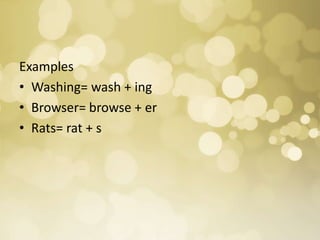
Examples
• Washing= wash + ing
• Browser= browse + er
• Rats= rat + s
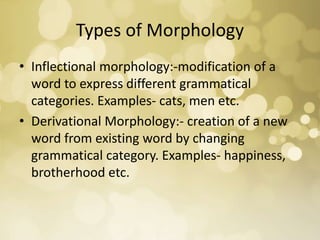
Types of Morphology
• Inflectional morphology:-modification of a
word to express different grammatical
categories. Examples- cats, men etc.
• Derivational Morphology:- creation of a new
word from existing word by changing
grammatical category. Examples- happiness,
brotherhood etc.
APPROACHES TO MORPHOLOGY
There are three principal approaches to
morphology
• Morpheme based morphology
• Lexeme based morphology
• Word based morphology
Morpheme-based morphology
• Word forms are analyzed as arrangements
of morphemes.
• Morphemes- smallest linguistic unit with a
grammatical function.
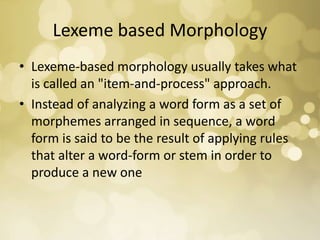
Lexeme based Morphology
• Lexeme-based morphology usually takes what
is called an "item-and-process" approach.
• Instead of analyzing a word form as a set of
morphemes arranged in sequence, a word
form is said to be the result of applying rules
that alter a word-form or stem in order to
produce a new one
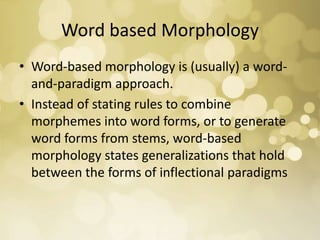
Word based Morphology
• Word-based morphology is (usually) a word-
and-paradigm approach.
• Instead of stating rules to combine
morphemes into word forms, or to generate
word forms from stems, word-based
morphology states generalizations that hold
between the forms of inflectional paradigms
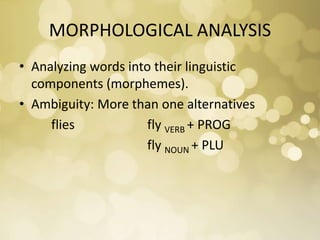
MORPHOLOGICAL ANALYSIS
• Analyzing words into their linguistic
components (morphemes).
• Ambiguity: More than one alternatives
flies fly VERB + PROG
fly NOUN + PLU
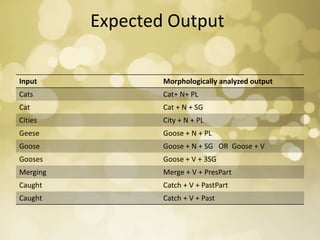
Expected Output
Input Morphologically analyzed output
Cats Cat+ N+ PL
Cat Cat + N + SG
Cities City + N + PL
Geese Goose + N + PL
Goose Goose + N + SG OR Goose + V
Gooses Goose + V + 3SG
Merging Merge + V + PresPart
Caught Catch + V + PastPart
Caught Catch + V + Past
NEED FOR MORPHOLOGICAL ANALYSIS
• Wastage of memory in exhaustive lexicon.
• Failure to depict linguistic generalization-
necessary to understand an unknown word.
• Morphologically rich and productive
languages might be problematic.
MORPHOLOGICAL ANALYSIS
USING PARADIGMS
• Most NLP systems use simple linguistic
theories for morphological analysis.
• Most NLP systems widely use this approach.
• Words are related to each other by analogical
rules.
• Words can be categorized based on the
pattern they fit into.
• Applicable both to existing words and to new
ones.
• Application of a pattern different from the
one that has been used - give rise to a new
word
• Examples:-older replacing elder .
Procedure and Algorithm
• A language expert provides different tables of
word forms covering the words in the entire
language.
• The roots follow the pattern( or paradigm )
implicit in the table for generating their word
forms.
• Examples
Continued..
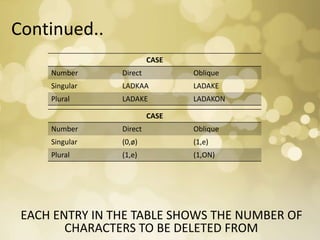
EACH ENTRY IN THE TABLE SHOWS THE NUMBER OF
CHARACTERS TO BE DELETED FROM
CASE
Number Direct Oblique
Singular LADKAA LADAKE
Plural LADAKE LADAKON
CASE
Number Direct Oblique
Singular (0,ø) (1,e)
Plural (1,e) (1,ON)
Continued…
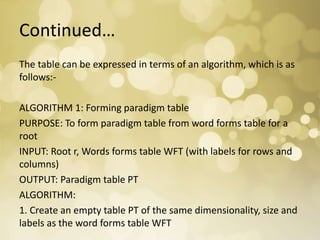
The table can be expressed in terms of an algorithm, which is as
follows:-
ALGORITHM 1: Forming paradigm table
PURPOSE: To form paradigm table from word forms table for a
root
INPUT: Root r, Words forms table WFT (with labels for rows and
columns)
OUTPUT: Paradigm table PT
ALGORITHM:
1. Create an empty table PT of the same dimensionality, size and
labels as the word forms table WFT
Continued…
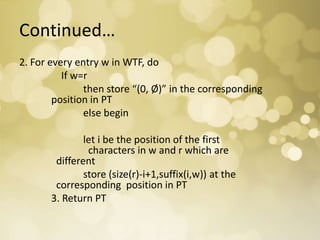
2. For every entry w in WTF, do
If w=r
then store “(0, Ø)” in the corresponding
position in PT
else begin
let i be the position of the first
characters in w and r which are
different
store (size(r)-i+1,suffix(i,w)) at the
corresponding position in PT
3. Return PT
Generation of a Word Form
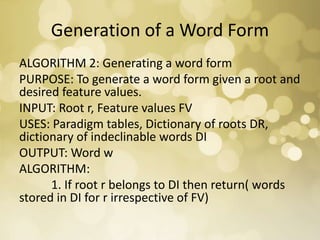
ALGORITHM 2: Generating a word form
PURPOSE: To generate a word form given a root and
desired feature values.
INPUT: Root r, Feature values FV
USES: Paradigm tables, Dictionary of roots DR,
dictionary of indeclinable words DI
OUTPUT: Word w
ALGORITHM:
1. If root r belongs to DI then return( words
stored in DI for r irrespective of FV)
Continued…
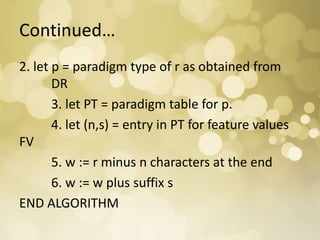
2. let p = paradigm type of r as obtained from
DR
3. let PT = paradigm table for p.
4. let (n,s) = entry in PT for feature values
FV
5. w := r minus n characters at the end
6. w := w plus suffix s
END ALGORITHM
PROBLEMS IN MORPHOLOGICAL
ANALYSIS
• False Analysis
• Productivity
• Bound base morphemes
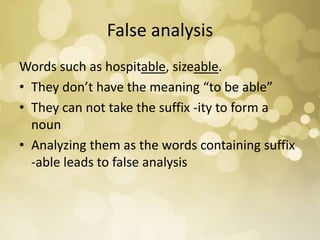
False analysis
Words such as hospitable, sizeable.
• They don’t have the meaning “to be able”
• They can not take the suffix -ity to form a
noun
• Analyzing them as the words containing suffix
-able leads to false analysis
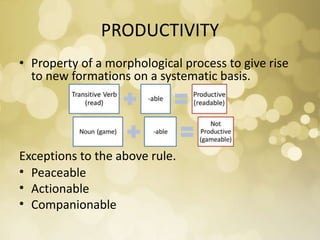
PRODUCTIVITY
• Property of a morphological process to give rise
to new formations on a systematic basis.
Exceptions to the above rule.
• Peaceable
• Actionable
• Companionable
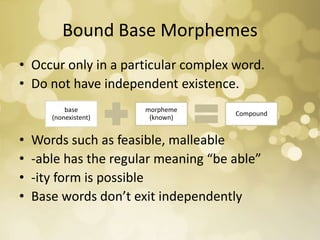
Bound Base Morphemes
• Occur only in a particular complex word.
• Do not have independent existence.
• Words such as feasible, malleable
• -able has the regular meaning “be able”
• -ity form is possible
• Base words don’t exit independently
base
(nonexistent)
morpheme
(known)
Compound
REFERENCES
• “Linguistics, An Introduction to Language and
Communication” by Adrian Akmajian, Richard A.
Demers, Ann K. Farmer and Robert M. Harnish (5th
Edition)
• SPEECH and LANGUAGE PROCESSING, An Introduction
to Natural Language Processing,
Computational Linguistics, and Speech Recognition by
Daniel Jurafsky and James H. Martin (Second Edition)
• “Natural Language Processing- a Paninian perspective”
by Akshar Bharati, Vineet Chaitanya, Rajeev Sangal.
THANKYOU!!!

Morphological Analysis

  • 1.
  • 2.
    CONTENTS • Morphology &its types. • Approaches to Morphology • Morpheme based morphology • Morphological Analysis and its need. • Morphological Generation and Analysis using Paradigms • Problems in Morphological Analysis. • Bibliography.
  • 3.
    MORPHOLOGY • The studyof word formation – how words are built up from smaller pieces. • Identification, analysis, and description of the structure of a given language's MORPHEMES and other linguistic units, such as root words, affixes, parts of speech, intonations and stresses, or implied context.
  • 4.
    Examples • Washing= wash+ ing • Browser= browse + er • Rats= rat + s
  • 5.
    Types of Morphology •Inflectional morphology:-modification of a word to express different grammatical categories. Examples- cats, men etc. • Derivational Morphology:- creation of a new word from existing word by changing grammatical category. Examples- happiness, brotherhood etc.
  • 6.
    APPROACHES TO MORPHOLOGY Thereare three principal approaches to morphology • Morpheme based morphology • Lexeme based morphology • Word based morphology
  • 7.
    Morpheme-based morphology • Wordforms are analyzed as arrangements of morphemes. • Morphemes- smallest linguistic unit with a grammatical function.
  • 8.
    Lexeme based Morphology •Lexeme-based morphology usually takes what is called an "item-and-process" approach. • Instead of analyzing a word form as a set of morphemes arranged in sequence, a word form is said to be the result of applying rules that alter a word-form or stem in order to produce a new one
  • 9.
    Word based Morphology •Word-based morphology is (usually) a word- and-paradigm approach. • Instead of stating rules to combine morphemes into word forms, or to generate word forms from stems, word-based morphology states generalizations that hold between the forms of inflectional paradigms
  • 10.
    MORPHOLOGICAL ANALYSIS • Analyzingwords into their linguistic components (morphemes). • Ambiguity: More than one alternatives flies fly VERB + PROG fly NOUN + PLU
  • 11.
    Expected Output Input Morphologicallyanalyzed output Cats Cat+ N+ PL Cat Cat + N + SG Cities City + N + PL Geese Goose + N + PL Goose Goose + N + SG OR Goose + V Gooses Goose + V + 3SG Merging Merge + V + PresPart Caught Catch + V + PastPart Caught Catch + V + Past
  • 12.
    NEED FOR MORPHOLOGICALANALYSIS • Wastage of memory in exhaustive lexicon. • Failure to depict linguistic generalization- necessary to understand an unknown word. • Morphologically rich and productive languages might be problematic.
  • 13.
    MORPHOLOGICAL ANALYSIS USING PARADIGMS •Most NLP systems use simple linguistic theories for morphological analysis. • Most NLP systems widely use this approach.
  • 14.
    • Words arerelated to each other by analogical rules. • Words can be categorized based on the pattern they fit into. • Applicable both to existing words and to new ones. • Application of a pattern different from the one that has been used - give rise to a new word • Examples:-older replacing elder .
  • 15.
    Procedure and Algorithm •A language expert provides different tables of word forms covering the words in the entire language. • The roots follow the pattern( or paradigm ) implicit in the table for generating their word forms. • Examples
  • 16.
    Continued.. EACH ENTRY INTHE TABLE SHOWS THE NUMBER OF CHARACTERS TO BE DELETED FROM CASE Number Direct Oblique Singular LADKAA LADAKE Plural LADAKE LADAKON CASE Number Direct Oblique Singular (0,ø) (1,e) Plural (1,e) (1,ON)
  • 17.
    Continued… The table canbe expressed in terms of an algorithm, which is as follows:- ALGORITHM 1: Forming paradigm table PURPOSE: To form paradigm table from word forms table for a root INPUT: Root r, Words forms table WFT (with labels for rows and columns) OUTPUT: Paradigm table PT ALGORITHM: 1. Create an empty table PT of the same dimensionality, size and labels as the word forms table WFT
  • 18.
    Continued… 2. For everyentry w in WTF, do If w=r then store “(0, Ø)” in the corresponding position in PT else begin let i be the position of the first characters in w and r which are different store (size(r)-i+1,suffix(i,w)) at the corresponding position in PT 3. Return PT
  • 19.
    Generation of aWord Form ALGORITHM 2: Generating a word form PURPOSE: To generate a word form given a root and desired feature values. INPUT: Root r, Feature values FV USES: Paradigm tables, Dictionary of roots DR, dictionary of indeclinable words DI OUTPUT: Word w ALGORITHM: 1. If root r belongs to DI then return( words stored in DI for r irrespective of FV)
  • 20.
    Continued… 2. let p= paradigm type of r as obtained from DR 3. let PT = paradigm table for p. 4. let (n,s) = entry in PT for feature values FV 5. w := r minus n characters at the end 6. w := w plus suffix s END ALGORITHM
  • 21.
    PROBLEMS IN MORPHOLOGICAL ANALYSIS •False Analysis • Productivity • Bound base morphemes
  • 22.
    False analysis Words suchas hospitable, sizeable. • They don’t have the meaning “to be able” • They can not take the suffix -ity to form a noun • Analyzing them as the words containing suffix -able leads to false analysis
  • 23.
    PRODUCTIVITY • Property ofa morphological process to give rise to new formations on a systematic basis. Exceptions to the above rule. • Peaceable • Actionable • Companionable
  • 24.
    Bound Base Morphemes •Occur only in a particular complex word. • Do not have independent existence. • Words such as feasible, malleable • -able has the regular meaning “be able” • -ity form is possible • Base words don’t exit independently base (nonexistent) morpheme (known) Compound
  • 25.
    REFERENCES • “Linguistics, AnIntroduction to Language and Communication” by Adrian Akmajian, Richard A. Demers, Ann K. Farmer and Robert M. Harnish (5th Edition) • SPEECH and LANGUAGE PROCESSING, An Introduction to Natural Language Processing, Computational Linguistics, and Speech Recognition by Daniel Jurafsky and James H. Martin (Second Edition) • “Natural Language Processing- a Paninian perspective” by Akshar Bharati, Vineet Chaitanya, Rajeev Sangal.
  • 26.