PIPE APPARATUS
PRESENTED BY:
AKHIL KM
AKSHAY P
ANIL AM
ROHIT KUMAR
GUIDED BY:
Prof G.C Bellad
CONTENTS
SELECTION OF PIPES
PIPES USED IN WATER SUPPLY SYSTEM
FUNCTION OF PIPES
VALVES
DIFFERENT TYPES OF VALVES USED IN WATER SUPPLY
SYSTEM
CONCLUSION
REFERENCES
PARAMETERS CONSIDERD FOR
SELECTION OF PIPES.
• Carrying capacity.
• Durability.
• Maintenance cost.
Different types of Pipes used in water supply system are given
below.
• Cast Iron (CI) Pipes.
• Steel Pipes.
• Concrete Pipes.
• Plastic or Polythene or PVC pipes.
• Galvanized Iron (GI) Pipes.
• Asbestos Cement (AC) Pipes.
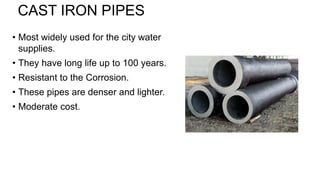
CAST IRON PIPES
• Most widely used for the city water
supplies.
• They have long life up to 100 years.
• Resistant to the Corrosion.
• These pipes are denser and lighter.
• Moderate cost.
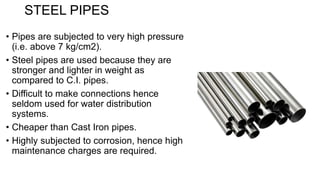
STEEL PIPES
• Pipes are subjected to very high pressure
(i.e. above 7 kg/cm2).
• Steel pipes are used because they are
stronger and lighter in weight as
compared to C.I. pipes.
• Difficult to make connections hence
seldom used for water distribution
systems.
• Cheaper than Cast Iron pipes.
• Highly subjected to corrosion, hence high
maintenance charges are required.
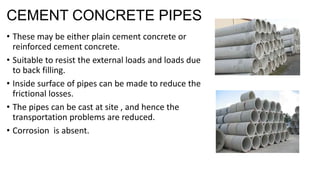
CEMENT CONCRETE PIPES
• These may be either plain cement concrete or
reinforced cement concrete.
• Suitable to resist the external loads and loads due
to back filling.
• Inside surface of pipes can be made to reduce the
frictional losses.
• The pipes can be cast at site , and hence the
transportation problems are reduced.
• Corrosion is absent.
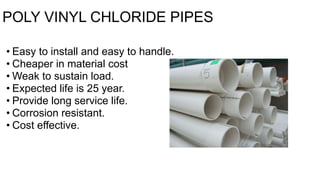
POLY VINYL CHLORIDE PIPES
• Easy to install and easy to handle.
• Cheaper in material cost
• Weak to sustain load.
• Expected life is 25 year.
• Provide long service life.
• Corrosion resistant.
• Cost effective.
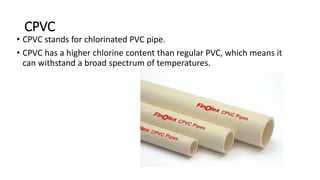
CPVC
• CPVC stands for chlorinated PVC pipe.
• CPVC has a higher chlorine content than regular PVC, which means it
can withstand a broad spectrum of temperatures.
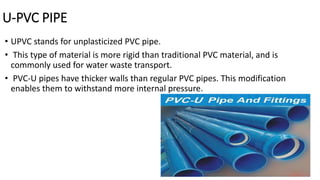
U-PVC PIPE
• UPVC stands for unplasticized PVC pipe.
• This type of material is more rigid than traditional PVC material, and is
commonly used for water waste transport.
• PVC-U pipes have thicker walls than regular PVC pipes. This modification
enables them to withstand more internal pressure.
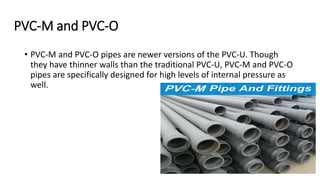
PVC-M and PVC-O
• PVC-M and PVC-O pipes are newer versions of the PVC-U. Though
they have thinner walls than the traditional PVC-U, PVC-M and PVC-O
pipes are specifically designed for high levels of internal pressure as
well.
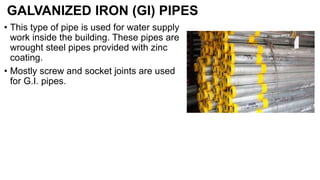
GALVANIZED IRON (GI) PIPES
• This type of pipe is used for water supply
work inside the building. These pipes are
wrought steel pipes provided with zinc
coating.
• Mostly screw and socket joints are used
for G.I. pipes.
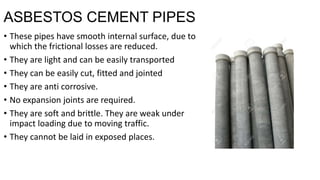
ASBESTOS CEMENT PIPES
• These pipes have smooth internal surface, due to
which the frictional losses are reduced.
• They are light and can be easily transported
• They can be easily cut, fitted and jointed
• They are anti corrosive.
• No expansion joints are required.
• They are soft and brittle. They are weak under
impact loading due to moving traffic.
• They cannot be laid in exposed places.
VALVES
• In water works , to control the flow of water , to regulate the
pressure, to release or to admit air , prevent flow of water in
opposite direction valves required.
• Depending upon the different situation and requirements
different types of valves are used in the distribution system.
DIFFERENT TYPES OF VALVES
• SLUICE VALVE OR STOP VALVE
• CHECK VALVE OR REFLUX VALVE
• AIR RELIFE VALVE OR FLOAT VALVE
• DRAIN VALVE OR BLOW-OFFS
• SCOUR VALVE
• CUT OFF VALVE
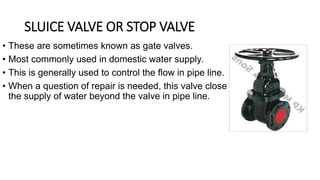
• These are sometimes known as gate valves.
• Most commonly used in domestic water supply.
• This is generally used to control the flow in pipe line.
• When a question of repair is needed, this valve close
the supply of water beyond the valve in pipe line.
SLUICE VALVE OR STOP VALVE
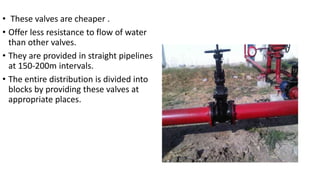
• These valves are cheaper .
• Offer less resistance to flow of water
than other valves.
• They are provided in straight pipelines
at 150-200m intervals.
• The entire distribution is divided into
blocks by providing these valves at
appropriate places.
CHECK VALVES OR REFLUX VALVES
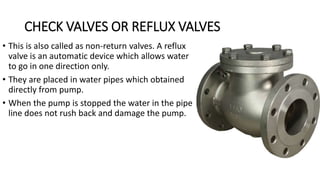
• This is also called as non-return valves. A reflux
valve is an automatic device which allows water
to go in one direction only.
• They are placed in water pipes which obtained
directly from pump.
• When the pump is stopped the water in the pipe
line does not rush back and damage the pump.
AIR RELIEF VALVE OR FLOAT VALVE
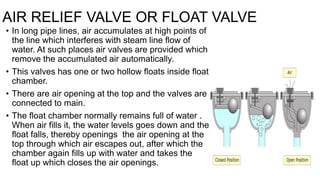
• In long pipe lines, air accumulates at high points of
the line which interferes with steam line flow of
water. At such places air valves are provided which
remove the accumulated air automatically.
• This valves has one or two hollow floats inside float
chamber.
• There are air opening at the top and the valves are
connected to main.
• The float chamber normally remains full of water .
When air fills it, the water levels goes down and the
float falls, thereby openings the air opening at the
top through which air escapes out, after which the
chamber again fills up with water and takes the
float up which closes the air openings.
DRAIN VALVE OR BLOW-OFFS
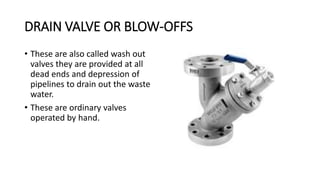
• These are also called wash out
valves they are provided at all
dead ends and depression of
pipelines to drain out the waste
water.
• These are ordinary valves
operated by hand.
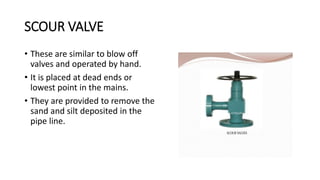
SCOUR VALVE
• These are similar to blow off
valves and operated by hand.
• It is placed at dead ends or
lowest point in the mains.
• They are provided to remove the
sand and silt deposited in the
pipe line.
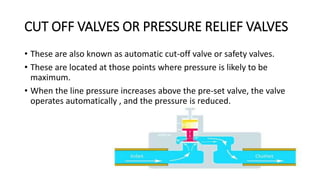
CUT OFF VALVES OR PRESSURE RELIEF VALVES
• These are also known as automatic cut-off valve or safety valves.
• These are located at those points where pressure is likely to be
maximum.
• When the line pressure increases above the pre-set valve, the valve
operates automatically , and the pressure is reduced.
CONCLUSION
• Pipe apparatus are necessary for control and proper distribution
water supply.
• Water losses can be minimized.
REFERENCES
• http://www.ehow.com/about_5092663_types-pvc-pipes.html
• https://en.wikipedia.org/wiki/Safety_shutoff_valve
• https://www.sswm.info/content/water-distribution-pipes.
• B.C Punmia , Ashok Jain, Arun Jain, “Water supply engineering”,
2nd-edn.Laxmi Publications, New Delhi.

Pipe water distribution system2

  • 1.
    PIPE APPARATUS PRESENTED BY: AKHILKM AKSHAY P ANIL AM ROHIT KUMAR GUIDED BY: Prof G.C Bellad
  • 2.
    CONTENTS SELECTION OF PIPES PIPESUSED IN WATER SUPPLY SYSTEM FUNCTION OF PIPES VALVES DIFFERENT TYPES OF VALVES USED IN WATER SUPPLY SYSTEM CONCLUSION REFERENCES
  • 3.
    PARAMETERS CONSIDERD FOR SELECTIONOF PIPES. • Carrying capacity. • Durability. • Maintenance cost.
  • 4.
    Different types ofPipes used in water supply system are given below. • Cast Iron (CI) Pipes. • Steel Pipes. • Concrete Pipes. • Plastic or Polythene or PVC pipes. • Galvanized Iron (GI) Pipes. • Asbestos Cement (AC) Pipes.
  • 5.
    CAST IRON PIPES •Most widely used for the city water supplies. • They have long life up to 100 years. • Resistant to the Corrosion. • These pipes are denser and lighter. • Moderate cost.
  • 6.
    STEEL PIPES • Pipesare subjected to very high pressure (i.e. above 7 kg/cm2). • Steel pipes are used because they are stronger and lighter in weight as compared to C.I. pipes. • Difficult to make connections hence seldom used for water distribution systems. • Cheaper than Cast Iron pipes. • Highly subjected to corrosion, hence high maintenance charges are required.
  • 7.
    CEMENT CONCRETE PIPES •These may be either plain cement concrete or reinforced cement concrete. • Suitable to resist the external loads and loads due to back filling. • Inside surface of pipes can be made to reduce the frictional losses. • The pipes can be cast at site , and hence the transportation problems are reduced. • Corrosion is absent.
  • 8.
    POLY VINYL CHLORIDEPIPES • Easy to install and easy to handle. • Cheaper in material cost • Weak to sustain load. • Expected life is 25 year. • Provide long service life. • Corrosion resistant. • Cost effective.
  • 9.
    CPVC • CPVC standsfor chlorinated PVC pipe. • CPVC has a higher chlorine content than regular PVC, which means it can withstand a broad spectrum of temperatures.
  • 10.
    U-PVC PIPE • UPVCstands for unplasticized PVC pipe. • This type of material is more rigid than traditional PVC material, and is commonly used for water waste transport. • PVC-U pipes have thicker walls than regular PVC pipes. This modification enables them to withstand more internal pressure.
  • 11.
    PVC-M and PVC-O •PVC-M and PVC-O pipes are newer versions of the PVC-U. Though they have thinner walls than the traditional PVC-U, PVC-M and PVC-O pipes are specifically designed for high levels of internal pressure as well.
  • 12.
    GALVANIZED IRON (GI)PIPES • This type of pipe is used for water supply work inside the building. These pipes are wrought steel pipes provided with zinc coating. • Mostly screw and socket joints are used for G.I. pipes.
  • 13.
    ASBESTOS CEMENT PIPES •These pipes have smooth internal surface, due to which the frictional losses are reduced. • They are light and can be easily transported • They can be easily cut, fitted and jointed • They are anti corrosive. • No expansion joints are required. • They are soft and brittle. They are weak under impact loading due to moving traffic. • They cannot be laid in exposed places.
  • 14.
    VALVES • In waterworks , to control the flow of water , to regulate the pressure, to release or to admit air , prevent flow of water in opposite direction valves required. • Depending upon the different situation and requirements different types of valves are used in the distribution system.
  • 15.
    DIFFERENT TYPES OFVALVES • SLUICE VALVE OR STOP VALVE • CHECK VALVE OR REFLUX VALVE • AIR RELIFE VALVE OR FLOAT VALVE • DRAIN VALVE OR BLOW-OFFS • SCOUR VALVE • CUT OFF VALVE
  • 16.
    • These aresometimes known as gate valves. • Most commonly used in domestic water supply. • This is generally used to control the flow in pipe line. • When a question of repair is needed, this valve close the supply of water beyond the valve in pipe line. SLUICE VALVE OR STOP VALVE
  • 17.
    • These valvesare cheaper . • Offer less resistance to flow of water than other valves. • They are provided in straight pipelines at 150-200m intervals. • The entire distribution is divided into blocks by providing these valves at appropriate places.
  • 18.
    CHECK VALVES ORREFLUX VALVES • This is also called as non-return valves. A reflux valve is an automatic device which allows water to go in one direction only. • They are placed in water pipes which obtained directly from pump. • When the pump is stopped the water in the pipe line does not rush back and damage the pump.
  • 19.
    AIR RELIEF VALVEOR FLOAT VALVE • In long pipe lines, air accumulates at high points of the line which interferes with steam line flow of water. At such places air valves are provided which remove the accumulated air automatically. • This valves has one or two hollow floats inside float chamber. • There are air opening at the top and the valves are connected to main. • The float chamber normally remains full of water . When air fills it, the water levels goes down and the float falls, thereby openings the air opening at the top through which air escapes out, after which the chamber again fills up with water and takes the float up which closes the air openings.
  • 20.
    DRAIN VALVE ORBLOW-OFFS • These are also called wash out valves they are provided at all dead ends and depression of pipelines to drain out the waste water. • These are ordinary valves operated by hand.
  • 21.
    SCOUR VALVE • Theseare similar to blow off valves and operated by hand. • It is placed at dead ends or lowest point in the mains. • They are provided to remove the sand and silt deposited in the pipe line.
  • 22.
    CUT OFF VALVESOR PRESSURE RELIEF VALVES • These are also known as automatic cut-off valve or safety valves. • These are located at those points where pressure is likely to be maximum. • When the line pressure increases above the pre-set valve, the valve operates automatically , and the pressure is reduced.
  • 23.
    CONCLUSION • Pipe apparatusare necessary for control and proper distribution water supply. • Water losses can be minimized.
  • 24.
    REFERENCES • http://www.ehow.com/about_5092663_types-pvc-pipes.html • https://en.wikipedia.org/wiki/Safety_shutoff_valve •https://www.sswm.info/content/water-distribution-pipes. • B.C Punmia , Ashok Jain, Arun Jain, “Water supply engineering”, 2nd-edn.Laxmi Publications, New Delhi.