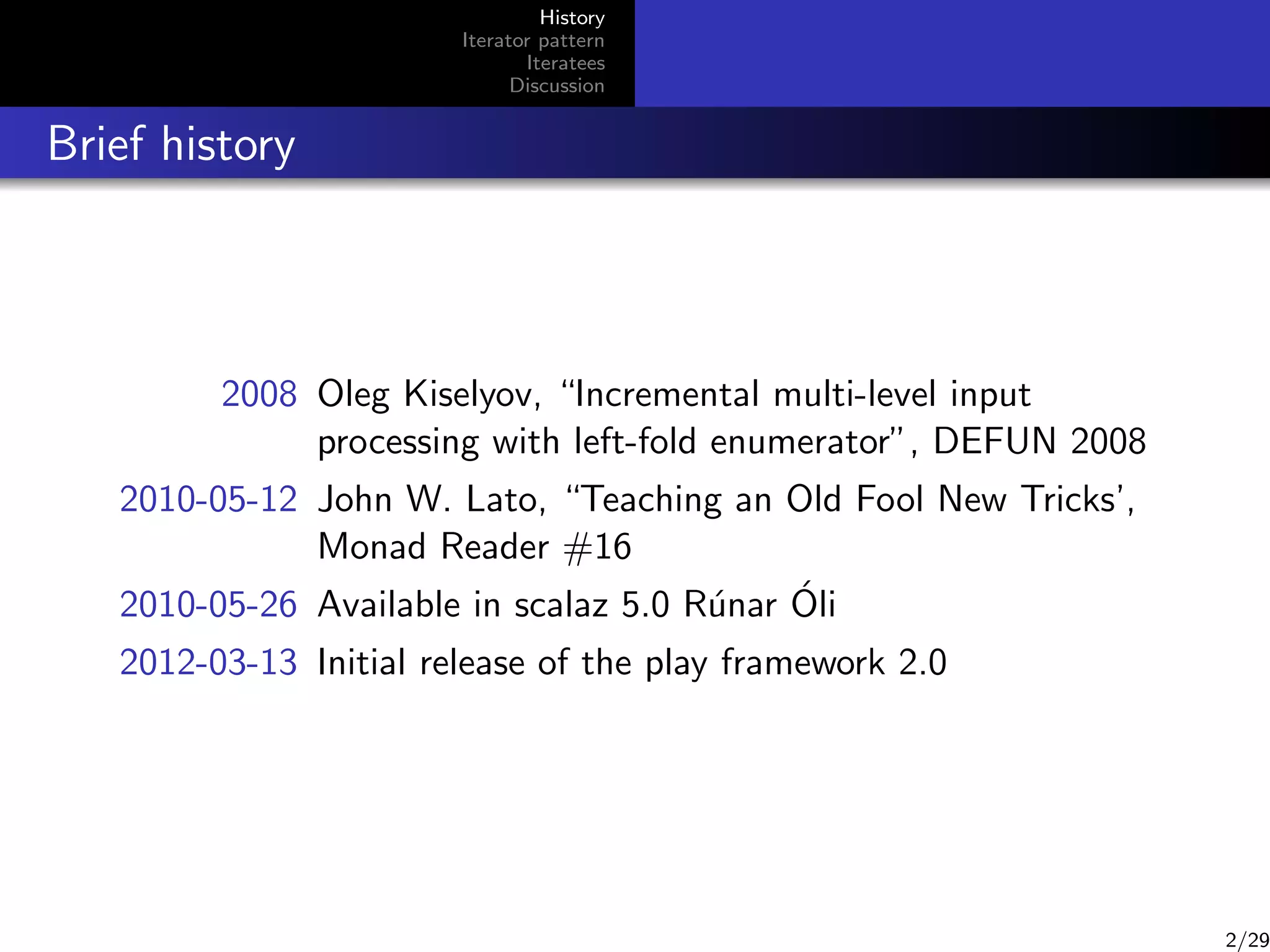
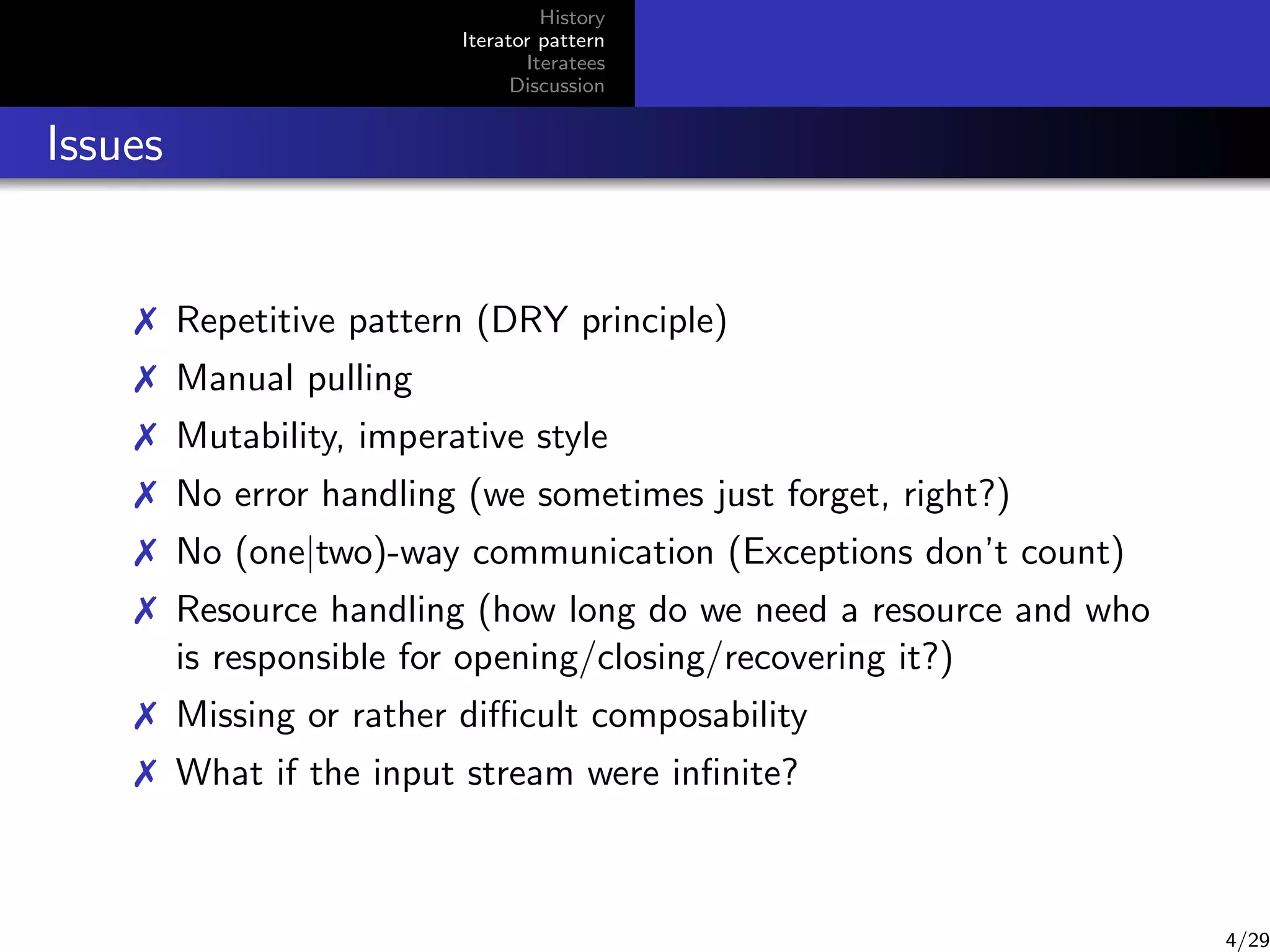
The document discusses the history and implementation of the iterator pattern and iteratees, emphasizing the need for more functional programming techniques to manage input processing. It outlines various issues with traditional iterators, such as mutability and lack of error handling, and presents an alternative approach using iteratees that are both composable and capable of handling asynchronous data. The overview concludes with a recommendation to explore the Play framework and the Scalaz library for practical implementations of iteratees.
![History
Iterator pattern
Iteratees
Discussion
We’ve often seen something along the lines of
import io.Source.fromFile
val it: Iterator[String] = fromFile("foo.txt").getLines
var result = 0
while (it.hasNext) {
val line = it.next
result += line.toInt
}
// Do something with the result
3/29](https://image.slidesharecdn.com/iteratees-intro-131230005031-phpapp02/75/Introduction-to-Iteratees-Scala-3-2048.jpg)
![History
Iterator pattern
Iteratees
Discussion
Try to be more “functional” and invert control...
val it: Iterator[String] = fromFile(foo.txt).getLines
var result = 0
it foreach { line =
result += line.toInt
}
5/29](https://image.slidesharecdn.com/iteratees-intro-131230005031-phpapp02/75/Introduction-to-Iteratees-Scala-5-2048.jpg)
![History
Iterator pattern
Iteratees
Discussion
define ourselves a re-usable utility function...
def enum(it: Iterator[String]): Int = {
var result = 0
it foreach { line = result += line.toInt }
result
}
val foo = enum(fromFile(foo.txt).getLines)
6/29](https://image.slidesharecdn.com/iteratees-intro-131230005031-phpapp02/75/Introduction-to-Iteratees-Scala-6-2048.jpg)
![History
Iterator pattern
Iteratees
Discussion
being more versatile for the greater good...
def enum(it: Iterator[String])(init: Int)
(f: (Int, String) = Int): Int = {
var result = init
it foreach { line = result = f(result, line) }
result
}
val it: Iterator[String] = fromFile(foo.txt).getLines
val foo: Int = enum(it)(0)(_ + _.toInt)
7/29](https://image.slidesharecdn.com/iteratees-intro-131230005031-phpapp02/75/Introduction-to-Iteratees-Scala-7-2048.jpg)
(init: Out)
(f: (Out, In) = Out): Out = {
var result = init
it foreach { x = result = f(result, x) }
result
}
val it: Iterator[String] = fromFile(foo.txt).getLines
val foo: Int = enum(it)(0)(_ + _.toInt)
8/29](https://image.slidesharecdn.com/iteratees-intro-131230005031-phpapp02/75/Introduction-to-Iteratees-Scala-8-2048.jpg)
(init: Out)
(f: (Out, In) = Out): Out = {
var result = init
try {
it foreach { x = result = f(result, x) }
} catch {
case t: Throwable = /* TODO (fingers crossed) */
}
result
}
val it: Iterator[String] = fromFile(foo.txt).getLines
val foo: Int = enum(it)(0)(_ + _.toInt)
9/29](https://image.slidesharecdn.com/iteratees-intro-131230005031-phpapp02/75/Introduction-to-Iteratees-Scala-9-2048.jpg)
(init: Out)
(f: (Out, In) = Out): Option[Out] = {
try {
var result = init
it foreach { x = result = f(result, x) }
Some(result)
} catch {
case t: Throwable = None
}
}
val it: Iterator[String] = fromFile(foo.txt).getLines
val foo: Option[Int] = enum(it)(0)(_ + _.toInt)
10/29](https://image.slidesharecdn.com/iteratees-intro-131230005031-phpapp02/75/Introduction-to-Iteratees-Scala-10-2048.jpg)
![History
Iterator pattern
Iteratees
Discussion
only to realize we’ve already had it all!?
val it: Iterator[String] = fromFile(foo.txt).getLines
val foo: Try[Int] = it.foldLeft(Try(0)) {
// f: (Out, In) = Out
case (acc, line) =
acc map { x = x + line.toInt }
}
11/29](https://image.slidesharecdn.com/iteratees-intro-131230005031-phpapp02/75/Introduction-to-Iteratees-Scala-11-2048.jpg)
![History
Iterator pattern
Iteratees
Discussion
only to realize we’ve already had it all!?
val it: Iterator[String] = fromFile(foo.txt).getLines
val foo: Try[Int] = it.foldLeft(Try(0)) {
// f: (Out, In) = Out
case (acc, line) =
acc map { x = x + line.toInt }
}
Really? What about
producer and consumer talking back and forth
cannot cope with infinite streams
resource handling (stick this into another function?)
asynchronism (could have used Futures)
data which are not available all at once
11/29](https://image.slidesharecdn.com/iteratees-intro-131230005031-phpapp02/75/Introduction-to-Iteratees-Scala-12-2048.jpg)
![History
Iterator pattern
Iteratees
Discussion
only to realize we’ve already had it all!?
val it: Iterator[String] = fromFile(foo.txt).getLines
val foo: Try[Int] = it.foldLeft(Try(0)) {
// f: (Out, In) = Out
case (acc, line) =
acc map { x = x + line.toInt }
}
Think ofWhat about
Really?
producer and consumer talking back and forth
cannot cope with infinite streams
foldLeft as Enumerator
resource handling (stickIteratee another function?)
acc together with f as this into
asynchronism (could have used Futures)
data which are not available all at once
11/29](https://image.slidesharecdn.com/iteratees-intro-131230005031-phpapp02/75/Introduction-to-Iteratees-Scala-13-2048.jpg)
![History
Iterator pattern
Iteratees
Discussion
Enumerators
Basics
Composition
Enumeratees
Enumerators . . .
are stream producers
push subsequent chunks of data to an Iteratee, hence folding
the Iteratee over the input stream
sealed trait Enumerator[F] {
def apply[T](iter: Iteratee[F,T]): Iteratee[F,T]
def run[T](iter: Iteratee[F,T]): T
}
act synchronously or asynchronously (think Futures)
come with batteries included
object Enumerator {
def apply[T](xs: T*): Enumerator[T]
def fromTextFile(fileName: String): Enumerator[String]
def fromStream(s: InputStream, chunkSize: Int = 8192)
: Enumerator[Array[Byte]]
}
12/29](https://image.slidesharecdn.com/iteratees-intro-131230005031-phpapp02/75/Introduction-to-Iteratees-Scala-14-2048.jpg)
![History
Iterator pattern
Iteratees
Discussion
Enumerators
Basics
Composition
Enumeratees
Enumerators communicate state to the Iteratee:
sealed trait Input[+T]
case class Element[T](x: T) extends Input[T]
case object Empty
extends Input[Nothing]
case object EOF
extends Input[Nothing]
13/29](https://image.slidesharecdn.com/iteratees-intro-131230005031-phpapp02/75/Introduction-to-Iteratees-Scala-15-2048.jpg)
![History
Iterator pattern
Iteratees
Discussion
Enumerators
Basics
Composition
Enumeratees
Enumerators communicate state to the Iteratee:
sealed trait Input[+T]
case class Element[T](x: T) extends Input[T]
case object Empty
extends Input[Nothing]
case object EOF
extends Input[Nothing]
For now, assume enumerators like this:
def enum[F,T](xs: List[F])(it: Iteratee[F,T]): Iteratee[F,T]
13/29](https://image.slidesharecdn.com/iteratees-intro-131230005031-phpapp02/75/Introduction-to-Iteratees-Scala-16-2048.jpg)
![History
Iterator pattern
Iteratees
Discussion
Enumerators
Basics
Composition
Enumeratees
Iteratees . . .
stream consumers
consume chunks of input (as a whole)
are immutable, re-usable computations
state is encoded through type
sealed trait Iteratee[F,T] { def run: T }
case class Done[F,T] (result: T, remainingInput: Input[F])
case class Cont[F,T] (k: Input[F] = Iteratee[F,T])
case class Error[F,T](t: Throwable)
// All of Done, Cont and Error extend Iteratee[F,T]
14/29](https://image.slidesharecdn.com/iteratees-intro-131230005031-phpapp02/75/Introduction-to-Iteratees-Scala-17-2048.jpg)
![History
Iterator pattern
Iteratees
Discussion
Enumerators
Basics
Composition
Enumeratees
So far:
Enumerators fold iteratees over a stream
Enumerators communicate state through Input[T]
Iteratees encapsulate result, error or computation
15/29](https://image.slidesharecdn.com/iteratees-intro-131230005031-phpapp02/75/Introduction-to-Iteratees-Scala-18-2048.jpg)
![History
Iterator pattern
Iteratees
Discussion
Enumerators
Basics
Composition
Enumeratees
So far:
Enumerators fold iteratees over a stream
Enumerators communicate state through Input[T]
Iteratees encapsulate result, error or computation
Let’s revisit our “enumerator”:
def enum[F,T](xs: List[F])(it: Iteratee[F,T]): Iteratee[F,T] =
(xs, it) match {
case (h::t, Cont(k)) = enum(t)( k(Element(h)) )
case _
= it
}
// k: Input[In] = Iteratee[F,T]
This is all we need to have some working examples.
15/29](https://image.slidesharecdn.com/iteratees-intro-131230005031-phpapp02/75/Introduction-to-Iteratees-Scala-19-2048.jpg)
![History
Iterator pattern
Iteratees
Discussion
Enumerators
Basics
Composition
Enumeratees
def head[T]: Iteratee[T,T] = {
def step: Input[T] = Iteratee[T,T] = {
case Element(x) = Done(x, Empty)
case Empty
= Cont(step)
case EOF
= Error(new NoSuchElementException)
}
Cont(step)
}
Example:
scala enum(Hello world!.toList)(head)
res1: Iteratee[Char,Char] = Done(H,Empty)
scala res1.run
res2: Char = H
16/29](https://image.slidesharecdn.com/iteratees-intro-131230005031-phpapp02/75/Introduction-to-Iteratees-Scala-20-2048.jpg)
![History
Iterator pattern
Iteratees
Discussion
Enumerators
Basics
Composition
Enumeratees
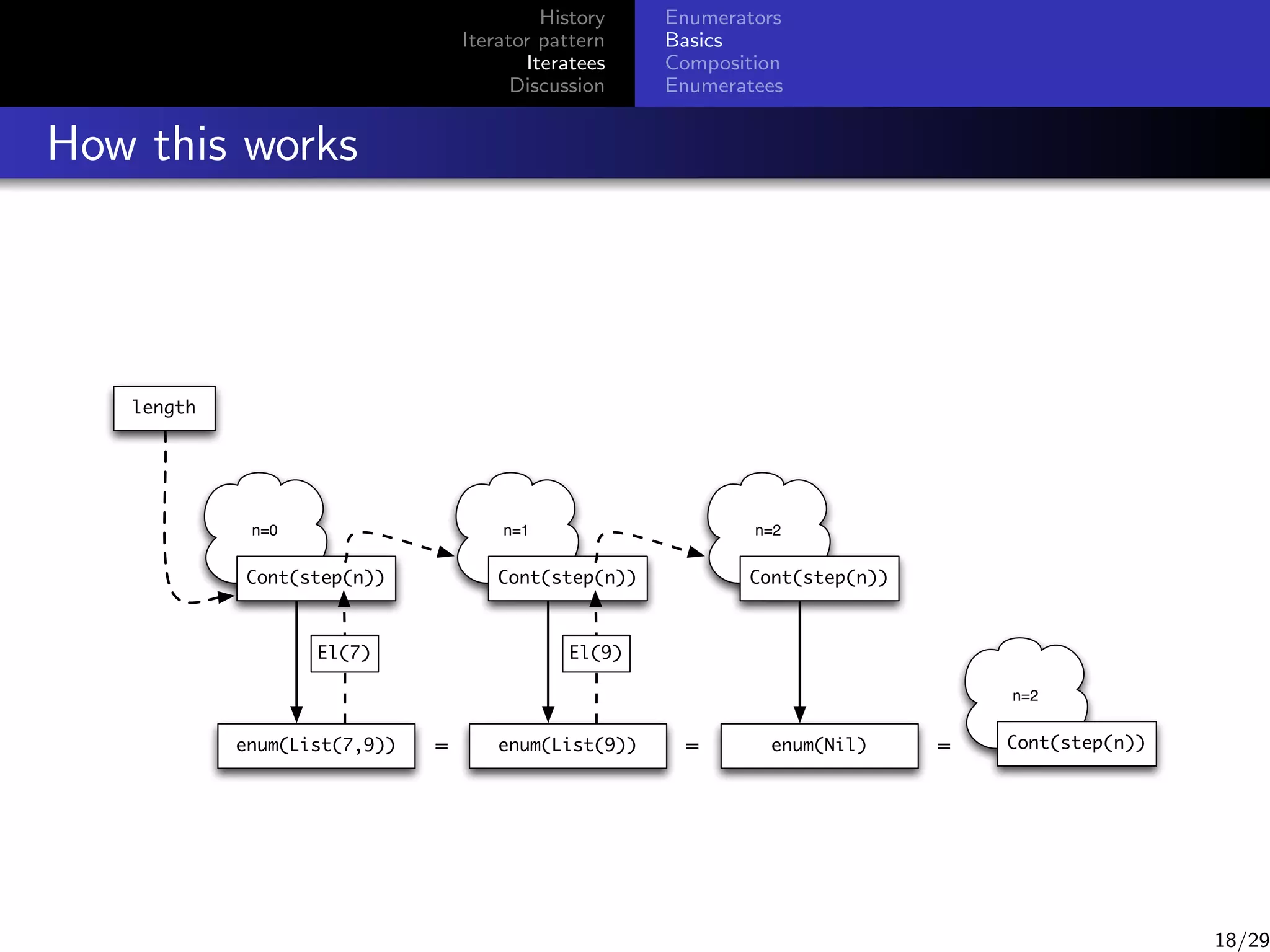
def length[T]: Iteratee[T, Int] = {
def step(n: Int): Input[T] = Iteratee[T, Int] = {
case EOF
= Done(n, EOF)
case Empty
= Cont(step(n))
case Element(_) = Cont(step(n+1))
}
Cont(step(0))
}
Example:
scala enum(Hello world!.toList)(length)
res3: Iteratee[Char,Int] = Cont(function1)
scala res3.run
res4: Int = 12
17/29](https://image.slidesharecdn.com/iteratees-intro-131230005031-phpapp02/75/Introduction-to-Iteratees-Scala-21-2048.jpg)
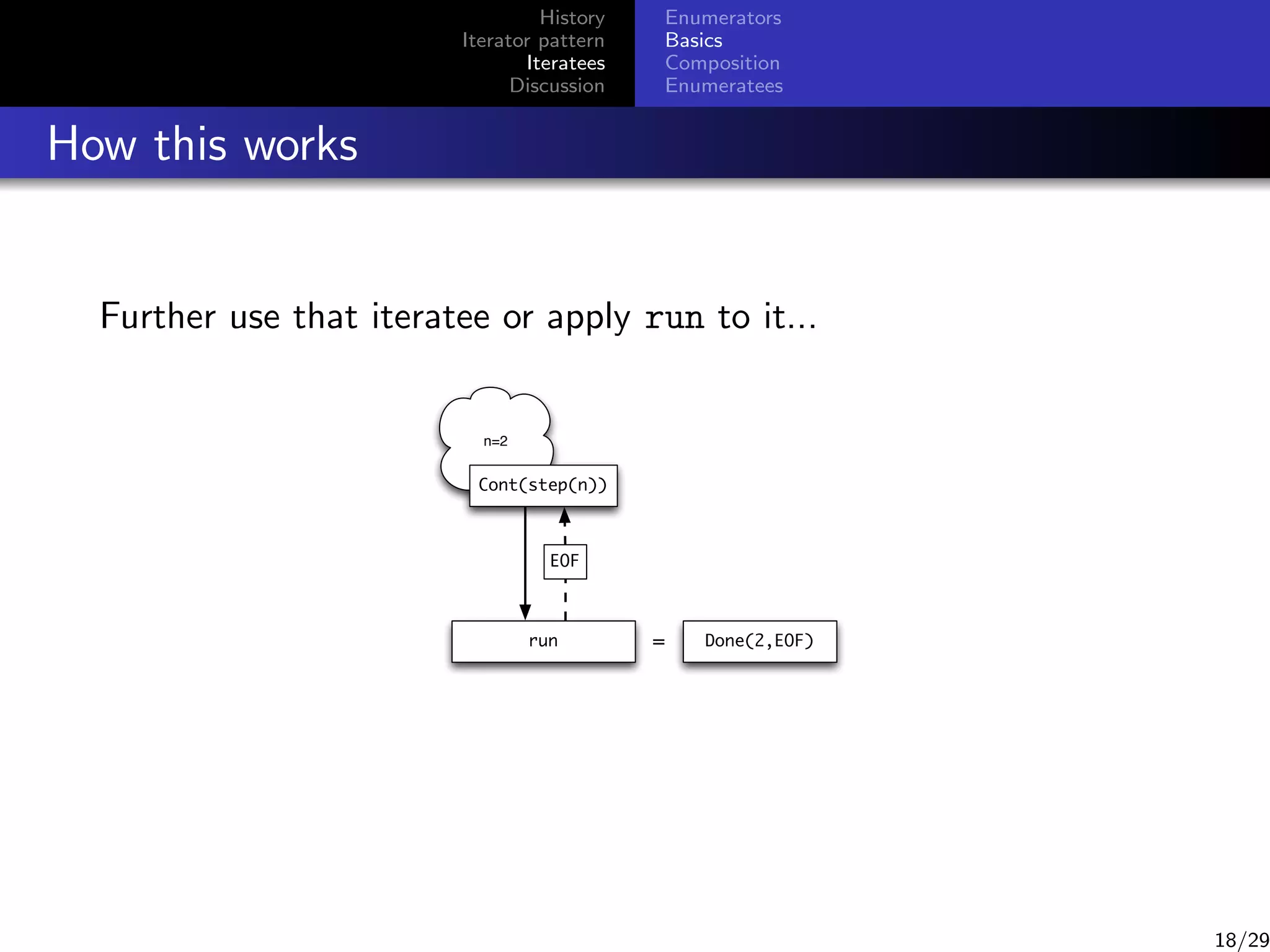
: Iteratee[F,T]
def fold[F,T](z: T)(f: (T,F) = T): Iteratee[F,T]
}
Because that’s what we need most of the time.
19/29](https://image.slidesharecdn.com/iteratees-intro-131230005031-phpapp02/75/Introduction-to-Iteratees-Scala-24-2048.jpg)
![History
Iterator pattern
Iteratees
Discussion
Enumerators
Basics
Composition
Enumeratees
Wouldn’t it be awesome if Iteratees were composable?
def drop1Keep1[T] = for {
_ - drop[T](1)
h - head
} yield h
def pair[T] = for {
h1 - head[T]
h2 - head
} yield (h1, h2)
They are indeed! Iteratees compose sequentially (and so do
Enumerators).
scala enum(Hello World!.toList)(drop1Keep1).run
res1: Char = e
scala enum(Hello World!.toList)(pair).run
res2: (Char, Char) = (H,e)
20/29](https://image.slidesharecdn.com/iteratees-intro-131230005031-phpapp02/75/Introduction-to-Iteratees-Scala-25-2048.jpg)
![History
Iterator pattern
Iteratees
Discussion
Enumerators
Basics
Composition
Enumeratees
As we know, for translates to map and flatMap:
trait Iteratee[F,T] {
def map[U](f: T = U): Iteratee[F,U]
def flatMap[U](f: T = Iteratee[F,U]): Iteratee[F,U]
}
21/29](https://image.slidesharecdn.com/iteratees-intro-131230005031-phpapp02/75/Introduction-to-Iteratees-Scala-26-2048.jpg)
![History
Iterator pattern
Iteratees
Discussion
Enumerators
Basics
Composition
Enumeratees
As we know, for translates to map and flatMap:
trait Iteratee[F,T] {
def map[U](f: T = U): Iteratee[F,U]
def flatMap[U](f: T = Iteratee[F,U]): Iteratee[F,U]
}
Adding this to Cont is straight-forward.
def map[U](f: T = U): Iteratee[F,U] =
Cont(elt = k(elt) map f)
def flatMap[U](f: T = Iteratee[F,U]): Iteratee[F,U] =
Cont(elt = k(elt) flatMap f)
// k: Input[F] = Iteratee[F,T]
22/29](https://image.slidesharecdn.com/iteratees-intro-131230005031-phpapp02/75/Introduction-to-Iteratees-Scala-27-2048.jpg)
: Iteratee[F,U] =
Done(f(x), remainingInput)
def flatMap[U](f: T = Iteratee[F,U]): Iteratee[F,U] =
f(x) match {
case Done(xPrime, _) = Done(xPrime, remainingInput)
case Cont(k)
= k(remainingInput)
case err @ Error(_) = err
}
23/29](https://image.slidesharecdn.com/iteratees-intro-131230005031-phpapp02/75/Introduction-to-Iteratees-Scala-28-2048.jpg)
![History
Iterator pattern
Iteratees
Discussion
Enumerators
Basics
Composition
Enumeratees
Now why is that so great?
Easily compose simple (or complex) iteratees
def pair[T] = for {
def drop1Keep1[T] = for {
h1 - head[T]
_ - drop[T](1)
h - head
h2 - head
} yield h
} yield (h1, h2)
No repetitive pattern-matching hell
Benefit from utility functions, e.g. sequence or repeat
Example:
scala def fivePairs[T] = sequence(List.fill(5)(pair[T]))
...
scala enum((1 to 10).toList)(fivePairs).run
res1: List[(Int, Int)] = List((1,2), (3,4), (5,6), (7,8), (9,10)
24/29](https://image.slidesharecdn.com/iteratees-intro-131230005031-phpapp02/75/Introduction-to-Iteratees-Scala-29-2048.jpg)
![History
Iterator pattern
Iteratees
Discussion
Enumerators
Basics
Composition
Enumeratees
Now why is that so great?
Easily compose simple (or complex) iteratees
def pair[T] = for {
def drop1Keep1[T] = for {
h1 - head[T]
_ - drop[T](1)
h - head
h2 - head
} yield h
} yield (h1, h2)
No repetitive pattern-matching hell
Benefit from utility functions, e.g. sequence or repeat
Example:
scala def alternates[T] = repeat(drop1Keep1[T])
...
scala enum((1 to 10).toList)(alternates).run
res2: Stream[Int] = Stream(2, ?)
// res2.toList == List(2, 4, 6, 8, 10)
24/29](https://image.slidesharecdn.com/iteratees-intro-131230005031-phpapp02/75/Introduction-to-Iteratees-Scala-30-2048.jpg)
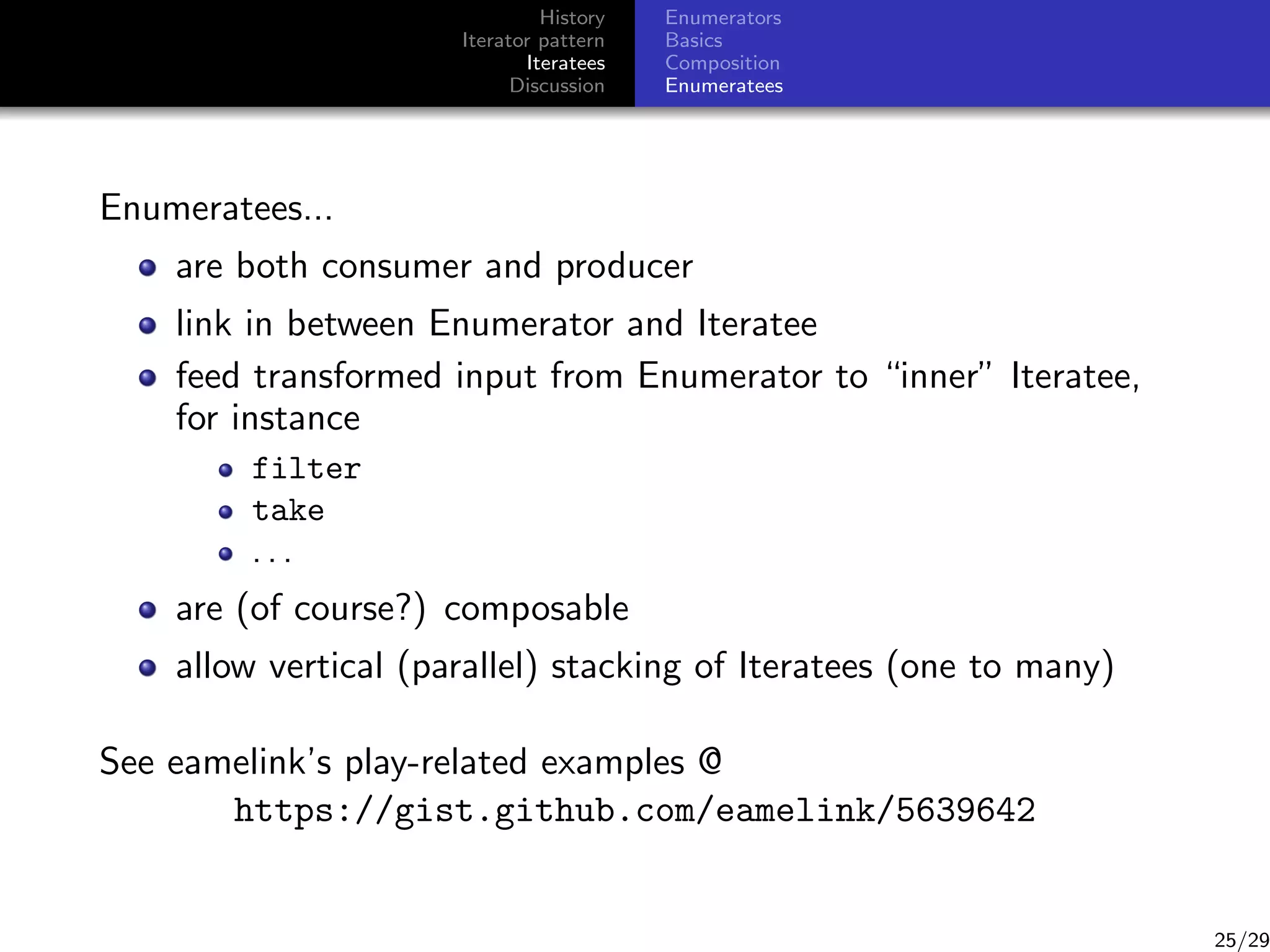
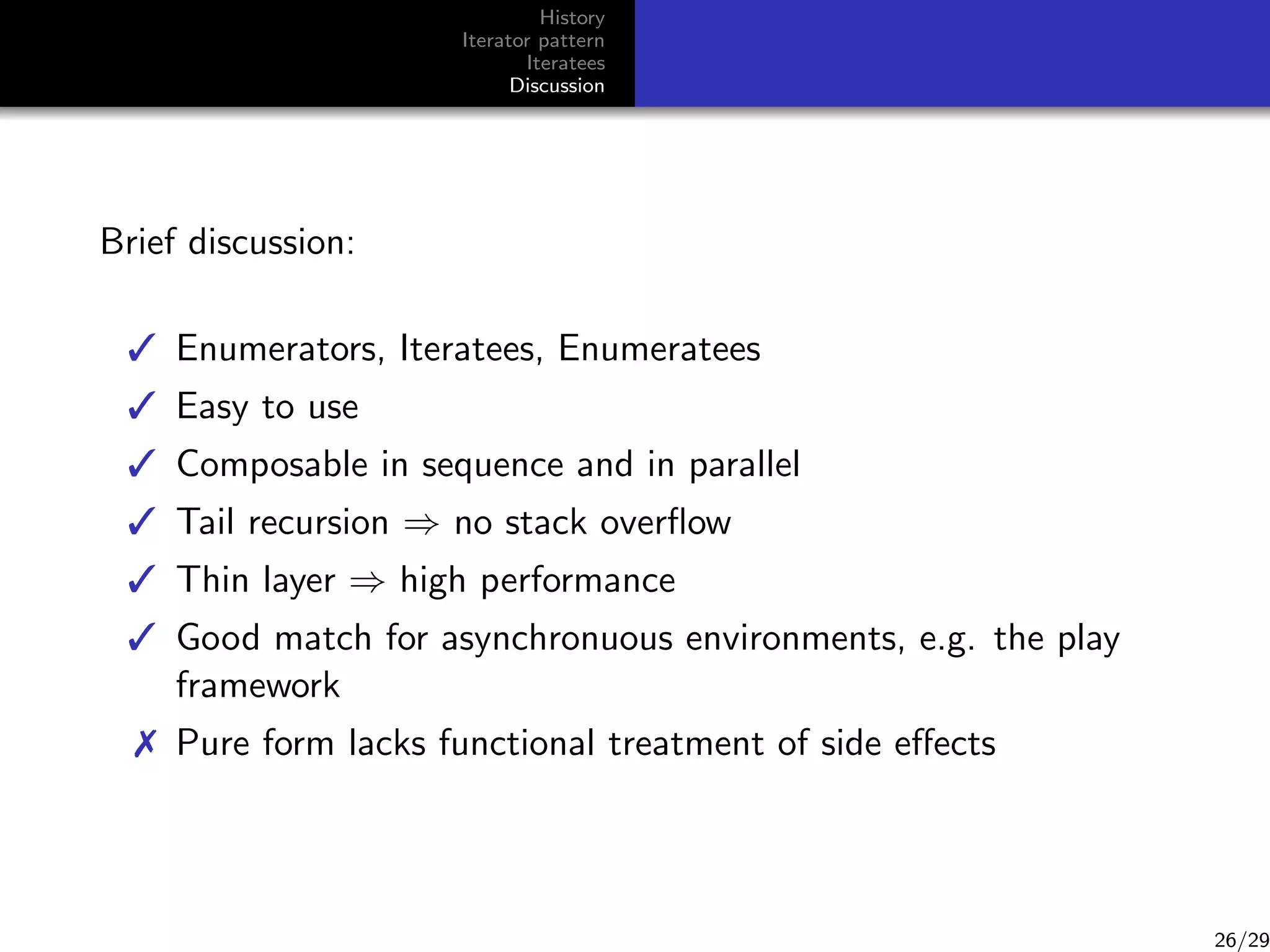
![History
Iterator pattern
Iteratees
Discussion
Where to go from here
Read blogs tutorials, start out with [1] to [6]
Use or rather implement iteratees
Check out the play framework
Asynchronous iteratees
Numerous factory methods, e.g. easily bridge
between Rx’s Observables and Enumerators [3]
All the other goodies from play
Check out scalaz 7
Implementation in terms of monad transformers
⇒ your choice of IO, Future, Option, . . .
All what’s missing in the standard library
See examples and explanations at [1] and [2]
27/29](https://image.slidesharecdn.com/iteratees-intro-131230005031-phpapp02/75/Introduction-to-Iteratees-Scala-33-2048.jpg)
![History
Iterator pattern
Iteratees
Discussion
Thank you for your attention
Anyone trying to understand monads will inevitably run
into the [...] monad, and the results are almost always
the same: bewilderment, confusion, anger, and ultimately
Perl.
Daniel Spiewak, Dec. 2010
28/29](https://image.slidesharecdn.com/iteratees-intro-131230005031-phpapp02/75/Introduction-to-Iteratees-Scala-34-2048.jpg)
![History
Iterator pattern
Iteratees
Discussion
References:
[1] “Enumeration-based I/O With Iteratees” @
http://blog.higher-order.com/blog/2010/10/14/scalaz-tutorial-enumeration-based-io-with-iteratees/
[2] “learning Scalaz: Enumeration-Based I/O with Iteratees” @
http://eed3si9n.com/learning-scalaz/Iteratees.html
[3] “RxPlay: Diving into iteratees and observables and making
them place nice” @
http://bryangilbert.com/code/2013/10/22/rxPlay-making-iteratees-and-observables-play-nice/
[4] “Understanding Play2 Iteratees for Normal Humans” @
http://mandubian.com/2012/08/27/understanding-play2-iteratees-for-normal-humans/
[5] “Incremental multi-level input processing and collection
enumeration” @ http://okmij.org/ftp/Streams.html
[6] “Teaching an Old Fool New Tricks” @
http://themonadreader.wordpress.com/2010/05/12/issue-16/
29/29](https://image.slidesharecdn.com/iteratees-intro-131230005031-phpapp02/75/Introduction-to-Iteratees-Scala-35-2048.jpg)
![Running Iteratees
Example
run makes great effort to yield the final result:
def run: T = this match {
case Done(rslt, _) = rslt
case Error(t)
= throw t
// k: Input[F] = Iteratee[F,T]
case Cont(k)
= k(EOF).run
// may loop forever
}
31/29](https://image.slidesharecdn.com/iteratees-intro-131230005031-phpapp02/75/Introduction-to-Iteratees-Scala-37-2048.jpg)
![Running Iteratees
Example
run makes great effort to yield the final result:
def run: T = this match {
case Done(rslt, _)
= rslt
case Error(t)
= throw t
// k: Input[F] = Iteratee[F,T]
case Cont(k)
= k(EOF) match {
case Done(rslt, _) = rslt
case Cont(_)
= sys.error(Diverging iteratee!)
case Error(t)
= throw t
}
}
31/29](https://image.slidesharecdn.com/iteratees-intro-131230005031-phpapp02/75/Introduction-to-Iteratees-Scala-38-2048.jpg)
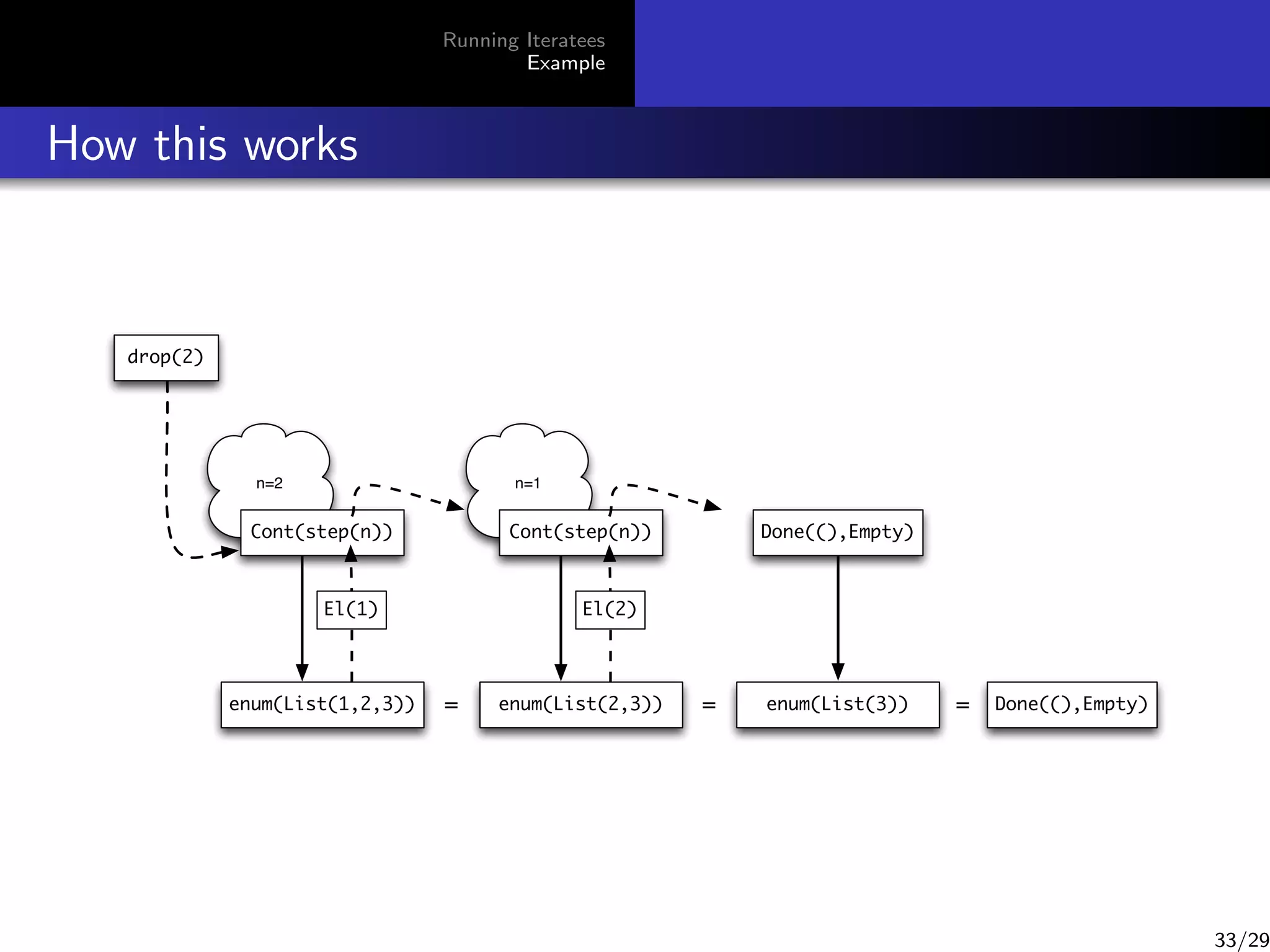
: Iteratee[T, Unit] = {
def step: Input[T] = Iteratee[T, Unit] = {
case EOF
= Done((), EOF)
case Empty
= Cont(step)
case Element(_) = drop(n-1)
}
if (n = 0) Done((), Empty) else Cont(step)
}
Example:
scala enum(Hello World!.toList)(drop(3))
res5: Iteratee[Char,Unit] = Done((),Empty)
scala res5.run
// blank
32/29](https://image.slidesharecdn.com/iteratees-intro-131230005031-phpapp02/75/Introduction-to-Iteratees-Scala-39-2048.jpg)


![Data Structures - Lecture 6 [queues]](https://cdn.slidesharecdn.com/ss_thumbnails/lecture-6queues-150114114904-conversion-gate01-thumbnail.jpg?width=640&height=640&fit=bounds)


![Vibe Coding vs. Spec-Driven Development [Free Meetup]](https://cdn.slidesharecdn.com/ss_thumbnails/vibecodingvsspecdrivendevelopment-251209105622-43f455e7-thumbnail.jpg?width=640&height=640&fit=bounds)


![Coded Agents – with UiPath SDK + LangGraph [Virtual Hands-on Workshop]](https://cdn.slidesharecdn.com/ss_thumbnails/codedagentsdeck-251215155422-5497c599-thumbnail.jpg?width=640&height=640&fit=bounds)


